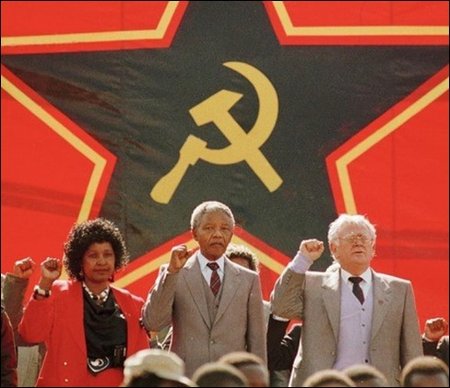
Nelson Mandela was very much in favour of his Xhosa tribe’s annual initiation rite during which circumcision for teenage boys takes place in remote rural areas, usually with blunt instruments that are not sterilised.
The current “initiation season” is upon us in South Africa and so far the body count is 13. Of course, no-one in the outside world would ever report about this as it would be considered “racist” or at least politically incorrect to question African cultural practices, endorsed by the Great Xhosa himself.
According to provincial health department, “thirteen initiates have died in the Eastern Cape since the beginning of the winter initiation season”.
Spokesperson Sizwe Kupelo said hospitals were overcrowded with severely ill initiates seeking medical assistance.
“The worst affected area is Mthatha in the OR Tambo region where health centres are clogged. Boys are brought in with their penises practically falling off,” Kupelo said.
The already constrained health system in the province was suffering a setback because of the initiation season.
“The day to day work by health workers is severely affected, the department is spending R1 000 on each initiate brought in for treatment,” said Kupelo.
The department had set aside R20m to intervene and help the initiates.
Private healthcare services and an additional 37 SUV vehicles have been hired to get health workers to initiates in the mountains.
Nelson Mandela’s long-serving personal assistant has described the “chaos” around his funeral and bickering over his legacy in a hard-hitting memoir.
Zelda la Grange, who was Mandela’s assistant for almost 20 years, paints a picture of ANC politicians and his family clamouring to use Mandela for their own ends as he lay dying and during his funeral.
“I had never experienced such chaos,” she wrote of Mandela’s memorial service, laying in state and funeral, saying that plans were changed every few minutes.
“No one really knew who was in charge. One could not help but wonder whether it was just eight years of bad planning, wasting money on foreign travel to consult with other countries about events of this magnitude, or whether it was a deliberate attempt to exclude from Mandela’s funeral people who were not allied with the right people.”
La Grange also describes suspicions that her phone and that of others close to Mandela were tapped by South Africa security agencies, which may have also placed two agents on Mandela’s medical team.
Mandela’s daughter Zindzi as well as Mandela’s eldest grandson support La Grange.
Mandla Mandela said “I think, my grandfather is definitely at this hour …looking down with a big smile.”
Among the guests at the book launch were Mandela’s former anti-apartheid struggle comrades — the frail and ageing George Bizos and jail-mate Ahmed Kathrada.
Nobel laureate and retired archbishop Desmond Tutu said La Grange’s “utter devotion to Madiba was so, so obvious to anyone who beheld it. It was a very heartwarming thing.”
Twenty years ago, on 28 March 1994, the ANC’s militia massacred a crowd of protesting Zulus in downtown Johannesburg, using automatic weapons against men armed only with symbolic “cultural weapons”, such as spears and cowhide shields. Mandela himself gave the order “to kill, if necessary”.
The official death toll ranges from 9 to 53, but anecdotal evidence suggests it may have been much larger. Pamela Wallace, a commenter on the Daily Maverick article on the massacre, claims that there was so much blood on the floors of the Johannesburg General Hospital on 28 March that staff had to wear gumboots:
My late husband was working at the Johannesburg General at the time. They wore gum boots as they waded in blood and that hospital alone declared more than a hundred and fifty dead when the official figure at the time was about ten. I wonder what that figure is today?
And here lies the rub: no-one has ever been charged with any wrongdoing! Mandela, who gave the order to mow down the Inkatha men, afterwards delivered a speech in parliament exonerating himself and placing the blame squarely on the Zulu nationalist movement. Even more curiously, the De Klerk government – who were still in charge at the time – did nothing to ensure justice for the many people who were killed on 28 March.
FW de Klerk was just a puppet leader at the time; his response to the Shell House massacre constitutes one more proof of his spineless expediency.
If ever I find the time, I want to write a proper history of South Africa from after World War II to the present, showing the rapid rise and decline of the Afrikaner nation. Thanks to the patriotic fervour of our people, our previously fine education system with its emphasis on literature, mathematics and science, we were able to build an industrial society on the African continent within a few decades. The whole of the subcontinent benefited from this feat and even today South Africa is considered an exception, surrounded by countries such as Zimbabwe and Mozambique that have held or are still holding the dubious position of “poorest country in the world”. The growing squalor, corruption and decay of present-day South Africa stands in stark contrast to the order, progress and optimism of the immediate postwar period. Ultimately Afrikaners were not conquered militarily, but they were utterly defeated through propaganda, terrorism and calumny.
In the grand scheme of the relentless propaganda war against Afrikaners, the armed police response to the black rioters at Sharpeville on 21 March 1960 became a cause célèbre and to this day is constantly referred to in the media worldwide, while Shell House and the ANC’s war crimes in the form of terrorist attacks on unarmed civilians go almost unmentioned. It is therefore curious that a liberal website such The Daily Maverick should even recall the events of Shell House as they did today, including some gruesome photographs of the bloodshed.
Incidents such as Shell House, together with the ANC and Communist Party’s terror campaign during the 1980s demonstrate the doctrine of “people’s war”, an apparently North-Vietnamese strategy whereby one gains “democratic support through terror and violence”. The seasoned political and historical researcher, Dr. Anthea Jeffery, wrote a lengthy book on the ANC’s strategy of People’s War: New Light on the Struggle for South Africa (Jonathan Ball Publishers, 2009), which explains why we were destined to become a one-party state.
Video warning the public against ANC terrorist bombings in the 1980s:
Communist Party leader Joe Slovo had a master plan to conquer South Africa through a combination of propaganda, people’s war and urban terror, in which he largely succeeded.
And still the carnage continues; just look at the murder of Afrikaner farmers today which have as object the destruction of the rural economy and agriculture. When there is famine, he who controls the food supply, controls the population, as Mengistu and his British “humanitarian” collaborators so amply demonstrated in Ethiopia.
South Africa remains in the grip of the ruthlessly radical people who summarily shot practically unarmed Zulu nationalist demonstrators in the streets of Johannesburg twenty years ago. That the whole of the so-called West, in the form of the USA and EU, still bend over backwards in rolling out the red carpet to them at every occasion, speaks volumes about the moral confusion that exists out there.
Few outsiders understand the ethnic dynamics of South Africa. Foreign journalists come here and imagine that we are some kind of remake of the USA, transposing American ethnic categories (and Hollywood movies) onto us. Of course, many people in Johannesburg and Cape Town imagine that they are living in America too, especially the mediocre crowd who have taken over our universities, describing the world in terms of “racism”, “whiteness”, “white privilege” and so on.
Race is undeniably a driving force in South African history, but not in the way that most people think. More fundamentally, one cannot understand our past and present upheavals without appreciating what Boerehaat, or “hatred of the Boers” is.
A week ago, an associate director of the South African Jewish Board of Deputies, David Saks, casually mentioned on the News24 website in a comment that there had been an underlying current of Boerehaat in the ranks of the anti-apartheid movement. When I was at university, many people in Johannesburg and at the University of the Witwatersrand were proud of their Boerehaat and of hating Afrikaners. It could even be seen as a sign of distinction.
In the early 1970s a cartoonist for the Wits campus newspaper, Franco Frescura, went out of his way to portray Afrikaners as oafish, unintelligent and ugly. He later became a lecturer in architecture. Although Frescura was of Italian origin, he has publicly denounced his “racist parents” and he was apparently strongly influenced by his English-speaking Johannesburg peers. Call this the “uitlander culture” of Johannesburg which goes right back to the discovery of gold in 1886 when hordes of British and Eastern European thugs had descended upon Johannesburg. The uitlanders’ visceral hatred of Kruger and the Transvaal Boers soon led to the outbreak of the Second Anglo-Boer War of 1899-1902.
Franco Frescura actually has a website of his own where he describes his upbringing thus:
In Johannesburg Franco attended Houghton Primary and King Edward VII High School (KES) where, unbeknown to him, a number of the families with whom he came into contact had deep-seated links with the Communist and Liberal Parties.
He also proudly states in the same website biography:
Although Franco has gone down in student folk lore as the author of a well-known lampoon published on the cover of Wits Student in 1972 which featured a child looking into a lavatory asking the question “Excuse me, are you the prime minister?”, this is incorrect for the real author was a fellow student and co-activist who has since preferred to remain anonymous.
The South African prime minister at the time was B.J. Vorster, possibly the most popular white South African politician ever as he had managed to garner 65% of the vote and 80% of the seats during the 1977 elections. A golfer and reputedly a heavy drinker, with such tastes Vorster could almost have been described as an Englishman except that he spoke the language with a pronounced Afrikaans accent. However he did pander to English public opinion and famously discouraged Afrikaans language activists from pushing for more language equality by saying “it might upset our English-speaking voters”.
Why would Franco Frescura and so many others have held Vorster in such contempt, given his popularity with most English-speakers? The answer, of course, is to be found in David Saks’s statement: the anti-apartheid movement, as well as the South African Communist Party and ultra-liberals such as Mrs. Helen Suzman who represented the ultra-rich suburb of Houghton, were saturated with Boerehaat.
I would go much further than David Saks and state that South African communists were hardly ever motivated by love for blacks or black human rights. Instead, the driving force of the whole movement was ethnic hatred of gigantic proportions, directed against the Afrikaner people of South Africa. The current near-genocidal levels of violence as encountered in sadistic farm murders, suburban attacks, as wel as the country’s rape epidemic (more than a million women are raped every year, or about three thousand every day) have their roots in the Boerehaat movement. What unites both the gangs of anomic black killers torturing farmers to death and the more genteel haters sniffing out “Afrikaner racism” in mainstream media columns? Boerehaat pure and simple.
Except Boerehaat is not simple. Sure, most Afrikaners in this country have been exposed to English invective such as “rockspider”, “dumb Dutchman”, “bonehead”, “crunchie”, ‘white trash” and the like. But underlying it is a whole worldview, a psychosis well worth a Ph.D. thesis. Or several.
Jews are very touchy about anti-Semitism and most criticism of Jews is usually deflected as anti-Semtism. Even aspects of US foreign policy that could be construed as being detrimental to Israel are described as “anti-Semitic΅. For example, American senator Ron Paul has recently been accused of anti-Semitism by Ben Stein for criticising US bellicosity in the Middle East and the American occupation of Afghanistan.
Any cartoon or verbal caricature of Jews as being rich, greedy, devious people with hooked noses would immediately be denounced as anti-Semitic and in South Africa charges would no doubt be laid with the so-called Human Rights Commission. The Dieudonné affair in France is another case in point where the French government clamped down on the comedian and banned some of his shows for their anti-Semitic jokes.
Buy Dan Roodt’s book through Amazon.com
Caricaturing, stereotyping and even inciting hatred or genocide against Afrikaners do not carry the same weight, however. Communist Party members Nelson Mandela and Ronnie Kasrils sang their version of the “Kill the Boer” song which is all over YouTube, and it hardly dented the exemplary reputation that these two men, as well as their “comrade” Joe Slovo, enjoy in England, France, the USA and other Western countries.
Apart from Franco Frescura and his fellow cartoonist Zapiro, the list of proud Boerehaters in South Africa would be very long indeed. It would include author Nadine Gordimer, former editor of the Rand Daily Mail, Allister Sparks, as well as the newsrooms of many newspapers and radio stations, not to mention academic departments at universities where political correctness, Marxist ideology and Boerehaat are Siamese triplets. Probably the website The Daily Maverick is currently the flagbearer of Boerehaat ideas and attracts a particularly shrill kind of ultraliberal or left-wing inquisitor out to drive the final few nails in the Afrikaner coffin, sometimes literally when sadistic murders against Afrikaners are defended or minimised.
The German concentration camps of the Second World War are usually held up to be the prime example of genocide. We forget that the British – in order to further uitlander political and economic objectives – had introduced the concentration camp into South Africa where 30 000 Boer women and children died. But to understand contemporary Boerehaat and the excesses it might lead to, we have to look at the more left-wing instances of genocide that occurred during the twentieth century. There is the example of the Russian revolution during which Trotsky, Stalin and Beria killed millions of people or worked them to death in the gulags.
More recently, there is the case of the fanatical Khmer Rouge movement in Cambodia during the late seventies which blended ethnic hatred and communism to produce a particularly lethal cocktail. Just like in South Africa, there was a left-wing revolution in Cambodia with the ideal of constructing a millennarian society free of classes and races in a great “transformation”. Up to four million people were killed, many of whom were ethnic Chinese and Vietnamese.
When I lived in Paris, I had a Cambodian-Chinese neighbour whose mother was shot outside their house by the Khmer Rouge. That contributed to my increasingly critical sense when it came to left-wing revolutionary ideology. However, very much later I realised that he was telling me that his family had been victimised because they had been Chinese and not Khmer! When the race enemy and the class enemy coincide, that is when you get a particularly powerful incentive to genocide. In Cambodia the entire population was driven out of the cities, in order to effect the revolution and build “a new society”.
In an article entitled “Racial Communism: Cambodia under the Khmer Rouge”, Eric D. Weitz writes:
“Someth May was a young Cambodian… [who] recalls… when a party cadre addressed a crowd [amidst deportation]: “As you all know, during the Lon Nol regime the Chinese were parasites on our nation. They cheated the government. They made money out of Cambodian farmers…. Now the High Revolutionary Committee wants to separate Chinese infiltrators from Cambodians, to watch the kind of tricks they get up to. The population of each village will be divided into a Chinese, a Vietnamese and a Cambodian section. So, if you are not Cambodian, stand up and leave the group. Remember that Chinese and Vietnamese look completely different from Cambodians.”…. Under the new regime, the Khmer Rouge declared, “there are to be no Chams or Chinese or Vietnamese. Everybody is to join the same, single, Khmer nationality…. [There is] only one religion – Khmer religion. Similarly, a survivor recalls a cadre saying: “Now we are making revolution. Everyone becomes a Khmer.””
Does that not sound familiar to us today, here in South Africa?
“Now we are making revolution. Everyone becomes a Khmer.”
Since 1994 we have seen equally fanatical attempts at so-called “nation-building” in South Africa whereby people have to adopt a new identity and “dissolve ethnically” into “the majority nation”. Those who refuse, or prove to be unassimilable or simply “different”, are then targeted, vilified and even killed.
I have previously remarked that in South Africa, “apartheid” is a simple metonym for “Afrikaner”. The racial, ethnic, linguistic, geographical and historical complexities of this society could hardly be subsumed under the globalised myth of “apartheid” as an evil neo-Nazi system of oppression. In that sense “apartheid” is meaningless, semantically empty. But to be anti-apartheid far more concretely means hating Afrikaners. Like Helen Suzman, the MP for Houghton, once said:
“I hate the Afrikaner. I hate his ways, his language and of course his politics.”
The fires of Boerehaat have not been extinguished by the Afrikaner leadership’s abject abdication from South African politics in 1994. On the contrary, Afrikaner powerlessness and seemingly masochistic obsequiousness in suffering vituperation on a daily basis have just added fuel to the fire. It has also led to pathological manifestations and internecine conflicts within the ranks of Afrikaners themselves. The phenomenon of the “self-hating Jew” has been replicated in South Africa with the self-hating Afrikaner, ever ready to heap opprobium on his own and to serve the cause of Afrikanerdom’s enemies. Many homosexual and lesbian Afrikaners, filled with rancour against the majority heterosexual members of their own tribe, have rallied to the cause of the anti-Afrikaner propaganda war that is raging to this day.
Up to 40% of journalists writing in Afrikaans today are apparently “gay”. Whatever their private lives, their opinions are far to the left of what ordinary people are thinking, so they are fast destroying what is left of Afrikaans journalism and newspapers by alienating their readers. In fact, the entire Naspers media group seems to have lurched into a “self-hating” orgy of white guilt and a kind of cultural death or ethnocide perpetrated against the very nation that had nurtured them financially for so long. Naspers represents nothing but a gigantic “psyops” operation aimed at the ultimate destruction of the Afrikaner people, their sense of identity, belonging and togetherness. Distributing Boerehaat invective, together with exalting nihilism, rancour and guilt feelings, all in Afrikaans, may be deemed more effective than simply overwhelming Afrikaners with propaganda in English.
According to the Boerehaat stereotype, Afrikaners are:
Of low intelligence
Ugly as sin
Rough, coarse and lacking in manners
Racist and anti-black
Women are fat and men have beer bellies
Ignorant and uncultivated
Given to incest and “in-breeding”
Afrikaans sounds ugly and “guttural”
In some respects, the Boerehaat caricature of Afrikaners corresponds to the Appalachian stereotypes in the USA. Combing through the production of South African English novels and films for such caricatures would be an easy, if tedious, task. Often in such publications, incest is presented as a metaphor for racial exclusivity, as in the supreme Boerehaat novel of the 1990s, Triomf, first written in Afrikaans by an Afrikaner lesbian, Marlene van Niekerk. Often Afrikaners who spend a lot of time on neo-Marxist, English campuses in South Africa would either have an identity crisis and commit suicide or they would actually become Boerehaters themselves, despising their own family, language and traditions to varying degrees. Although Van Niekerk apparently still writes poetry in Afrikaans, she has publicly called for violence against Afrikaners and abjured any sense of an Afrikaner identity.
The main character in her book is mentally retarded, the quintessential “dumb Dutchman”; both he and his brother sleep with their mother. In one scene he voyeuristically gazes thtough the hedge at the lesbian neighbours having sex and from the narrator’s point of view it represents a kind of higher world that he may only watch from a distance, being mired in mental retardation and ethnic exclusivity, which one supposes to be mutually linked in some way.
Although horribly vulgar, tedious and badly written, Triomf was immediately hailed as a masterpiece and translated into English. It was also made into a movie which was a complete box office flop but was again feted as a work of genius by the liberal press of Johannesburg, being “a true depiction of the Afrikaner psyche”.
During the Oscar Pistorius murder trial, the global media had a feeding frenzy, extolling on the natural propensity of Afrikaner men to abuse women and possibly even kill them. One of the ANC ministers, Lulu Xingwana, immediately diagnosed the Pistorius murder as a natural outcome of Afrikaner male chauvinism, saying to the Australian Broadcasting Corporation:
“Young Afrikaner men are brought up in the Calvinist religion believing that they own a woman, they own a child, they own everything and therefore they can take that life because they own it,” she said during the interview aired on Monday.”
Pistorius, despite his surname, was not even an Afrikaner and had been educated in English schools. But it was Boerehaat on a global scale in which the local uitlander journalists, or journalists infused with the Afrikaner-hating uitlander spirit, gleefully participated. To such an extent that even a self-hating Afrikaner “useful idiot” such as Max du Preez, to my great surprise, identified it correctly in his blog entry, Fifty Shades of Boerehaat:
“I can write a book about the downside of Afrikaner Calvinism, but hating or disrespecting women and children would not feature. The women in my family were and are strong, independent human beings whom all the men in the family love and respect deeply.” (See the whole blog comment underneath.)
Many Afrikaners have often wondered: Why do the people in Johannesburg and Cape Town, especially in the media, hate us so much that we are consistently misrepresented? In this cartoon by Zapiro, Afrikaans singer Steve Hofmeyr and author Annelie Botes are represented as dinosaurs from a bygone age (which, by definition, should already be dead or extinct). Note also the emphasis on their “small brains” or low intelligence.
Cartoon by Zapiro, alias Jonathan Shapiro
I hope the reader has by now formed an image in his mind as to what Boerehaat is. In most parts of the world, there are to be found what Freud called the “narcissicism of small differences”: Belgian jokes in Holland or in France, and so on. When such minor ethnic chauvinism degenerates into a social and political ideology, and is married to Marxist-revolutionary doctrine, we may well see the genesis of a Khmer Rouge movement or the potential for genocide.
Afrikaners are already the scapegoats for everything that goes wrong in South Africa. The lack of performance of other groups, even their corruption and profligacy in government, is routinely blamed on the Afrikaner.
Could Boerehaat discourse and societal breakdown as a result of social anarchy, crime and corruption lead to a bloodbath in South Africa, with Afrikaners being held responsible for every kind of failure, even while completely out of power?
And what causes Boerehaat? Why is it so persistent? These are questions I want to address in a second part of this column.
To be continued.
Max du Preez writes: Fifty Shades of Boerehaat?
The killing of Reeva Steenkamp by Oscar Pistorius has brought out the worst in people, from journalists to politicians to ordinary people. We read on the weekend (Mail & Guardian) that the problem with violence against women has a relationship to the macho rugby culture among white men; that Pistorius got treated differently because he was white and rich – what an insult to Magistrate Nair, one of the best in the country.
Now we have cabinet minister Lulu Xingwana saying to (of all places) Australian radio that the problem starts with Afrikaner men and their Calvinist upbringing who think all things, including women and children, belong to them to treat as they want.
I am a product of a Calvinist Christian-National Afrikaner upbringing of the extreme Free State platteland kind and not only am I a rugby fanatic, I played the game (not very well, though) from the age of six to well into my twenties.
I can write a book about the downside of Afrikaner Calvinism, but hating or disrespecting women and children would not feature. The women in my family were and are strong, independent human beings whom all the men in the family love and respect deeply. Whenever my father or uncles acted as if they were “the head of the family”, we all chuckled behind our hinds and said Ag shame.
Minister Xingwana should read the story (in my books Of Tricksters, Tyrants and Turncoats and Oor Krygers, Korrelkoppe en Konkelaars) of the wife of General Koos de la Rey, one of the most prominent patriarchs and Calvinist fundamentalists in Afrikaner history. Her name was Nonnie. She was not only the head of the rather big De la Rey family in every sense, her husband made very few decisions without her, even when he was a general in the Anglo Boer War. More than that: she stood up to the British generals who not only respected her, but actually feared her as much as they feared her husband’s military prowess. They knew: don’t mess with a stoere Boervrou.
(By the way, I wonder if Lulu realises that one of her own struggle icons, dominee Beyers Naude, was also a staunch Afrikaner Calvinist right to the end?)
It simply boggles the mind having to witness people still prostrating themselves in the dust whenever the name Mandela is spoken. Elevated to a modern-day god, Mandela is believed to be three, a `Holy Trinity`… yet he is only one – the one ultimately responsible for having turned South Africa into a failed-state-in-the-making.
Mandela No 1 is the latest poster boy of the secularization process which dictated the morality of the West after WWII. It is, basically, the moral world in which the 10 Commandments were replaced by Human Rights. A world in which the biblical “love God and love thy neighbor like thyself” has been replaced by “love thy neighbor like thyself because /she is thyself, (both) God”.
This is the moral universe of George Soros’ Open Society Foundation – which turned the Afrikaners Beyers Naude, Van Zyl Slabbert, Max du Preez, etc. into Walter Lippman`s useful-idiots of Mandela No 2`s world. And it is the world that grounded Pax Americana…
“We hold these truths to be self-evident, that all men are created, that they are endowed by their Creator with certain unalienable Rights, that among these are Life, Liberty and the pursuit of Happiness.”
Funny; if this “Creator” is no more – i.e. the moral rationale driving secular-humanism – how can we still state with such hubristic certainty that we are still “endowed” with them? Rather silly, but then; no wonder it has become the Inquisition.
Mandela No 2 is the world of End Game. A world which saw the dumbest Afrikaner philosopher ever, Willie Esterhuyse, formally hand South Africa’s future over to the cold Queen of England… at the behest of Her Holocaust card-playing Randlords. The world which saw Mandela and his inner-circle “struggle” buddies become some of the richest men in Africa… simply because Mandela No 3 did everything KGB colonel Joe Slovo taught him.
Mandela No 3, the real Mandela, is the great “democrat” who wrote; “If force will advance [the struggle], then it must be used whether or not the majority agrees with us.” And that is precisely what he, and his murderous “necklacing” wife, Winnie Mandela, did… killing 15 000 fellow blacks in the process!
This is the true world painstakingly depicted in the fantastic book The People’s War, by Dr Anthea Jeffery of the SAIRR…
“the ANC had little compunction about attacking black civilians, including its own supporters, for the formula for people’s war draws no distinction between combatants and others and regards all civilians (irrespective of their political affiliation) as expendable in conflict;
the ANC had a motive to unleash violence, for it wanted to create enough mayhem and unrest either to spark an insurrection or to weaken its opponents to the point where it could triumph in negotiations;
the ANC had the means to unleash violence, for the peace process allowed it to bring back into South Africa some 13 000 armed and trained combatants whom it then refused to disarm or disband; and
the ANC was the only organisation to draw benefit from the 15 000 political killings that took place in the early 1990s (after all major apartheid laws had been repealed), for it used these to;
stigmatise De Klerk and the IFP,
stampede negotiators into giving it what Joe Slovo called ‘a famous victory’ in negotiations, and
put great pressure on the first all-race election, while making it unthinkable for anyone to demand a re-run of the deeply flawed April 1994 poll in which it was accorded (no accurate count being possible) some 63% of the vote” (source).
Well, there you have it. Mandela is not three. He is only one, No 3 – although No 1 and No 2 gave him – and his murderous, greedy and woefully incompetent ANC thugs – the Noble Prize for Peace… for having turned South Africa into a failed-state-in-the-making.
Margaret Thatcher made no mention of Nelson Mandela during the only formal talks she held with South Africa’s leader PW Botha, documents released recently reveal.
The papers blow apart recent Tory boasts that she helped end apartheid – and her own claim that she had pressed for his release at the summit.
Instead Thatcher relegated the issue to a short, private chat with Botha before the June 1984 talks officially got under way. No notes were taken so there is no evidence of what was discussed.
The then PM had been urged by the British Foreign Office to raise Mandela’s imprisonment officially during the four-hour minuted formal discussions.
But Thatcher, who objected to sanctions against Botha’s regime and had branded Mandela a terrorist, failed to do so.
Thatcher’s own account says Mandela’s incarceration was “noted” during a private audience on “sensitive issues”.
But her adviser John Coles stated: “No note-takers were present. Mr Botha said he could not interfere with the South African judicial process.” – extract from The Mirror
Ever since Britain started getting seriously interested in South Africa after the discovery of diamonds at Kimberley in 1866, there have been at least two conflicting views of the country. Throughout the twentieth century too, South Africa has borne the brunt of the Western ideological revolutions, all the way from colonialism and so-called “white supremacy” to contemporary political correctness. In fact, in the aftermath of the Mandela funeral, one could almost speak of the West’s religious devotion to black Africans who are being endowed with all the capricious amoral innocence of Greek gods.
More precisely, South Africa has been the theatre of an “epistemic war” if I could be excused such a French-sounding term. Apart from the very palpable shifts in demographic, political, economic and military power towards South African blacks, locals are also acutely aware of how the Western world view is no longer the dominant one in South Africa.
A few years ago I spoke to a liberal, anglophone, Jewish woman who lived in Johannesburg but who had some connection to the huge Baragwanath hospital in Soweto, one of the proud achievements of the former Afrikaner-led government. Within the Afrikaner mind, blacks had wanted not real political power but hospitals, schools, universities and jobs which is why they put so much effort into constructing such public institutions. Those institutions are currently being derided as having been entirely useless and a sop, or an insult to blacks, especically to the divine black leaders such as Mandela.
The point is, however, that since the black takeover in the country “they have changed the frame of reference” as my liberal Jewish friend put it. But she wasn’t really speaking in general terms, referring to the broad sweep of history and politics. First and foremost, she was speaking in medical terms. What she was saying, was that with the new order had come a new way of looking at healthcare, at patients and the function of a hospital. In short, the age-old belief systems of Africans have been reasserting themselves and “success” is no longer measured in white or European terms. That is why, when whites decry the deterioration of the state hospital system, as well as standards of professionalism and hygiene there, blacks are quick to retort with the ubiquitous cry of “racism”. After all, blacks are now in charge and they make the rules and set the standards against which a hospital, a school, a university or even a government will be measured.
It is really hard to understand the hullabaloo over President Zuma’s expenditure on what amounts to a private Zulu homestead or kraal at Nkandla. Compared to the billions being frittered away in corruption and unauthorised expenditure, the R240 million (about $20 million) involved seems almost paltry.
It is a truism of historians and philosophers alike, that one’s assessment of a situation – any situation – depends on one’s perspective. Not so long ago I read a paragraph by French political philosopher Alain de Benoist wherein he said:
… I am not fighting for the white race. I am not fighting for France. I am fighting for a world view. I am a philosopher, a theoretician, and I fight to explain my world view. And in this world view, Europe, race, culture, and identity all have roles. They are not excluded. But mainly I am working in defense of a world view. Of course, I am very interested in the future and destiny of my own nation, race, and culture, but I am also interested in the future of every other group.
That all sounds very interesting, but somewhat abstract. To the Afrikaner farmer who is being attacked in his or her home by a group of blacks who had imbibed some form of “medicine” or muti to make them invincible, the quesion is one, not of philosophy but of survival.
At a more mundane or political level, the clash is one of perspectives, even a traditional fight between the left and the right. In South Africa, any statement expressing concern over the future of whites or their well-being is almost always characterised as “right-wing”. Blacks are simply too good-natured and inherently moral ever to commit evil on a significant scale against whites.
This is also the foreign perspective. A Marxist theologian in Germany or a pro-white militant in America would concur that whites “have no place in South Africa, at the southern tip of a black continent”. On the other hand, the Afrikaner perspective is quite the opposite. They feel deeply rooted in South Africa and reject the “black supremacism” of both the foreign whites and the anglicised, superficially Westernised blacks who see them as being “not indigenous” to the country or the continent.
For most of the twentieth century, there has been a perspectival war around the notion of whether Afrikaners or whites really “belong” in South Africa or not. Once, I was shocked to see the former leader of the opposition, Tony Leon, being bluntly told by a BBC announcer on the programme Hard Talk that he was a “white politician” and that South Africa had always been “their country” – meaning that of the blacks – even in former centuries when their numbers were limited to about a million, nomadically drifting through parts of a mostly unpopulated territory twice the size of France.
Buy Dan Roodt’s book through Amazon.com
History, as the ruling ANC politicians usually put it in their quasi-communist way, is “a terrain of ideological struggle”. Needless to say, whites have lost that ideological struggle – or the perspectival war over the past – hands down. It is now better to kiss the feet of Mandela’s bronze colosssus than to voice your own opinions or interpretation of history.
Faulkner, that strange author from the American South who uses the “N word” in his novels but depicts his own Southern whites with relentless cynicism, once wrote: “The past is never dead. It’s not even past.” So there will always be a feud over history, everyone’s history.
But looking at the future of South Africa, or even our present safety in a physical sense, it also depends on one’s perspective. To foreigners and overseas correspondents in South Africa, this is Mandelatopia, a liberal democracy with same-sex marriages and universal suffrage – although cannabis is not yet quite legal. According to this view, which is based on a very superficial “multicultural” reading, “South Africa belongs to all who live in it, united in our diversity”, as it is stated in our incongruous constitution, replete with rancour and affirmative-action clauses.
Many whites, especially women, have a sense of impending doom. The crime, corruption and general sense of lawlessness portend worse to come. Usually, they are not arguing against the dominant ideology with its illusions of democratic bliss. Rather, they intuit some kind of typically African implosion or civil war during which whites will be punished for all the evil they have wrought in their zeal to “uplift” and “civlise” blacks, admittedly ridiculous notions within the present context.
To the pessimist or the more intuitive analyst, South Africa’s future represents the “chronicle of a death foretold”, or many deaths, if you will pardon my paraphrasing the fetching title of Gabriel Márquez’s little novel. It will be Zimbabwe on a much vaster scale, and much bloodier. It is already much bloodier, and ultimately the country will be ethnically cleansed of its Caucasian undesirables, probably to universal acclaim.
Depending on one’s point of view, South Africa is either a “problem that has been happily solved” or a disaster in the making. Looking at the past, especially the nineteenth century when indigenous whites were as weak as they are now and were regularly massacred by blacks, as well as the history of postcolonial Africa, I am not macho enough to cast all caution to the winds and believe in the foreign male fantasy of a South Africa that is some kind of Switzerland or Singapore, clean, tolerant and law-abiding.
There being no common ground in this war of perspectives, no rational debate will take place either. I am inclined to trust those “womanly” truths that are as unspeakable as they are likely to come to pass.
Maybe the empire thought that we would not honor our word when, during days of uncertainty in the past century, we affirmed that even if the USSR were to disappear Cuba would continue struggling.
World War II broke out on September 1, 1939 when Nazi-fascist troops invaded Poland and struck like a lightning over the heroic people of the USSR, who contributed 27 million lives to preserve mankind from that brutal massacre that ended the lives of 50 million persons.
War, on the other hand, is the only venture that the human race throughout history has failed to avoid, leading Einstein to say that he did not know how World War III would be like but most certainly the fourth would be fought with sticks and stones.
Added up, the means available to the two most powerful powers –United States and Russia— amount to 20,000 (twenty thousand) nuclear warheads. Mankind should know that three days before John F. Kennedy assumed the presidency of his country on January 20, 1961, a US B-52 bomber, in a routine flight, carrying two atomic bombs with a destructive capacity 260 times that of the bomb dropped in Hiroshima, had an accident and the aircraft crashed. For such cases sophisticated automatic equipment are in place to prevent the bombs from exploding. The first bomb landed without risks. In the case of the second, three of the four mechanisms failed, and the fourth, in very critical conditions could barely function. The bomb did not explode by mere chance.
There is no present or past event I remember or have heard of that has impacted world public opinion so much as the death of Nelson Mandela, and not because of his wealth, but for his human quality and the loftiness of his ideas and feelings.
Throughout history and barely one and a half century ago — before robots and machines took over our modest tasks with a minimum energy cost– none of the phenomena that today shake mankind and inexorably rule each and every person –men and women, children and elders, young and adult, farmers and factory workers, manual workers or intellectuals– existed. The prevailing trend is to move to the cities, where the creation of jobs, transportation, and basic living conditions demand huge investments to the detriment of food production and other more rational ways of life.
Three powers have landed in our planet’s Moon. The same day Nelson Mandela, covered with his country’s flag, was buried in the backyard of the humble house where he was born 95 years ago, a sophisticated module from the Peoples Republic of China descended upon a bright spot in our Moon. The coincidence of both events was purely by chance.
Millions of scientists are studying earth and outer-space matters and radiations. Through them we now know that Titan, one of Saturn’s rings, accumulated 40 times more oil than the existing amount in our planet when oil extraction began 125 years ago and which will last barely one more century at current consumption rates.
The fraternal feelings of profound brotherhood between the Cuban people and Nelson Mandela’s homeland were born out of an event that has never been mentioned and about which we have never said a word during all these long years; Mandela, because he was an apostle of peace and did not want to hurt anyone; Cuba, because we have never done anything for the sake of glory and prestige.
Since the very triumph of the Revolution in Cuba we extended our solidarity to the Portuguese colonies in Africa. Liberation movements in that continent had colonialism and imperialism on the rack after World War II and the liberation of the Peoples Republic of China –the most highly populated country in the world— following the glorious triumph of the Russian Socialist Revolution.
Social revolutions were shaking the pillars of the old world order. In 1960 the inhabitants of the planet amounted to three million. Along with this, the power of big transnational companies –almost all Americans– was growing and the American currency, underpinned by US gold monopoly and its intact industry so far removed from the battle fields, took control of the world economy. Richard Nixon unilaterally abolished the backing of US currency in gold and his country’s companies took control over the main resources and raw materials in the planet which they bought with paper bills.
Nothing I have said till now is new.
But why do they try to hide the fact that the Apartheid regime –that brought so much suffering onto Africa and arouse so much indignation in most nations throughout the world– was the fruit of European colonial powers and was turned into a nuclear power by the United States and Israel, something Cuba, who supported Portuguese colonies in Africa fighting for their independence openly condemned?
Our people, handed over to the United States by Spain after 30 years of heroic struggle, never reconciled with the slavery regime imposed during almost 500 years.
In 1975, racist troops supported by light tanks equipped with 90-millimeter guns set off from Namibia –then occupied by South Africa— and penetrated more than one thousand kilometers into Angolan territory up to the vicinity of Luanda, where an airborne battalion of Cuban Special Troops and several Cuban crews for Soviet tanks with no crews, succeeded in delaying their advance. This happened in November 1975, 13 years before the Cuito Cuanavale Battle.
I’ve already said that we have done nothing for the sake of prestige or seeking benefit of any kind. It is a fact that Mandela was an upright man, a profound revolutionary and a radical socialist who endured with great stoicism 27 years of solitary confinement. I could not but admire his honesty, modesty and enormous merit.
Cuba was strictly fulfilling its internationalist duties by defending key positions and training thousands of Angolans in the use of weapons every year. The USSR was providing the weapons. At the time, however, we disagreed with the idea of the main advisor of the suppliers of military equipment. Thousands of young and healthy Angolans were constantly joining the units of their then incipient army. Their main adviser, however, was not a Zhúkov, Rokossovski, Malinowvsky or any of the many men that brought so much glory to Soviet military strategy. His obsessive idea was to send Angolan brigades carrying the best weapons to the territory where the tribal government of Savimbi – a mercenary serving the United States and South Africa– was supposedly located, which was tantamount to sending the troops fighting in Stalingrad to the border with the Falangist Spain that had sent over hundred thousand troops to fight against the USSR. That year a similar operation was going on.
The enemy was advancing behind several Angolan brigades severely hitting them near the place they had been sent to, approximately 1,500 kilometers away from Luanda. They were returning from there, pursued by South African troops en route to Cuito Cuanavale, a former NATO military base, located some 100 kilometers away from where a Cuban Tank Brigade was stationed.
At such a critical point, the President of Angola requested the support of Cuban troops. The commander of our troops in the South, General Leopoldo Cintra Frías, sent us the request as usual. Our firm reply was that we would provide such support provided that all Angolan troops and equipment would be under the Cuban command in South Angola. Everybody understood that our request was a requirement to turn the former base into the ideal battle field to hit the racist South African forces.
There was a positive response from Angola in less than 24 hours.
It was decided that a Cuban Tank Brigade would be immediately sent there. Several other were in the same line towards the West. The main obstacle was the mud and humidity due to the rainy season and the fact that every stretch of land had to be checked for anti-personnel mines. The military personnel to operate the tanks and guns without crew were also sent to Cuito.
To the East, the base was separated from the territory by the large and fast- flowing Cuito River over which there was a solid bridge under the frantic attack of the racist army. A radio-controlled airplane full of explosives was hit, brought down on the bridge and put out of action. The retreating Angolan tanks still moving were crossed more to the North. Those that were not in good conditions were buried with their weapons facing East; a thick strip of anti-personnel and anti-tank mines turned the line into a mortal trap on the other side of the river. When the racist troops renewed their advance and ran into that defensive wall, the artillery and tanks of the revolutionary brigades came down on them shooting from their positions in the Cuito area.
The Mig-23 fighters had a special role to play. Flying at a speed of almost 1,000 kilometers per hour and 100 (one hundred) meters altitude they were able to distinguish if the artillery personnel was black or white and began firing relentlessly against them.
When the battered and immobilized enemy began to withdraw, the revolutionary forces began to get ready for the final combats.
Numerous Angolan and Cuban brigades began moving quickly and keeping proper distance to the West towards the only wide routes from which South Africans always began their military actions against Angola. The airport, however, was approximately 300 (three hundred) kilometers from the border with Namibia, which was totally occupied by the Apartheid army.
While troops reorganized and rearmed the urgent decision to build a runway for the Mig-23 was made. Our pilots were using the aircraft equipment provided by the USSR to Angola, whose pilots had lacked the time for a proper training. Several aircrafts were inoperative sometimes due to the action of our own artillerymen or anti-aircraft weapon operators. South Africans still occupied part of the main road going from the border of the Angolan plateau to Namibia. They began shooting from the bridges over the wide Cunene River –located between Southern Angola and Northern Namibia– with their 140-millimeter guns giving their projectiles a range of about 40 kilometers. The main problem was that the racist South Africans had, according to our estimates, 10 to 12 nuclear weapons. They had even tested them in the frozen areas or seas to the South. President Ronald Reagan had authorized such tests and the device for blasting the nuclear charge was among the equipment delivered by Israel. Our response was to organize the troops in combat groups of no more than 1,000 men, who would have to advance equipped with anti-aircraft tanks throughout an extensive territory at night.
According to reliable sources, South African nuclear weapons could not be transported by Mirage planes; heavy Canberra type bombers were required instead. In any case, our forces’ air defense had many different types of missiles that could hit and destroy air targets located dozens of kilometers away from our troops. In addition, a dam with 80 million cubic meters of water located in Angolan territory had been occupied and mined by Cuban and Angolan fighters. The explosion of that dam would have been tantamount to the explosion of several nuclear weapons.
Nonetheless, a hydroelectric plant using the strong current of the Cunene River, before reaching the Namibian border, was being used by a South African army detachment.
When the racists began shooting with their 140-millimeter guns in this new theater of operations, the detachment of white soldiers was strongly hit by the Mig-23 and the survivors fled the place leaving some posters criticizing their high command. That was the situation when Cuban and Angolan troops marched over the enemy lines.
I learned that Katiuska Blanco, the author of some historical accounts, together with other reporters and press photographers were there. It was a tense situation but everybody kept cool.
It was then that we got the news that the enemy was willing to negotiate. We had succeeded in stopping the imperialist and racist adventure in a continent where, in 30 years time, the population will exceed that of China and India together.
The role of the Cuban delegation on the occasion of the demise of our brother and friend Nelson Mandela will be unforgettable.
I congratulate comrade Raul for his brilliant performance and particularly for his strength of character and dignity when in a kind but firm gesture greeted the United States Head of Government and told him in English: “Mr. President, I’m Castro”.
When my health imposed limits to my physical capacity, I did not hesitate in expressing my criteria on who, in my view, could assume the responsibility. A life is a minute in the history of the peoples and I believe that whoever holds today that responsibility must have the experience and authority required to choose among an increasing -almost infinite— number of alternatives.
Imperialism will always have several cards up its sleeve to subdue our island even if it has to depopulate it, depriving it from young men and women to whom they offer the scraps of the goods and natural resources it ransacks from the world.
Let the spokesmen of the empire now talk about how and why Apartheid came to life.
Various newspaper reports suggest that Mandela’s heirs are fighting tooth and nail over the world-famous terrorist’s estate. One family friend even described the environment as “toxic”.
Apparently the Mandelas aim to kick Mandela’s widow, Graça Machel, out of the mansion in Houghton she had been sharing with her late husband. She was flatly told to leave the house once the famous Mandela had died.
Mandela’s eldest daughter, Makaziwe, who is married to a Ghanian, is often not on speaking terms with Machel. According to reports, Makaziwe has also “verbally abused staff and repeatedly insisted she alone will determine how to divide the spoils of Mandela’s estate”.
Using her father’s name, Makaziwe Mandela has climbed the social ladder in South Africa’s black power politics. According to Wikipedia, her biography reads as follows:
Pumla Makaziwe “Maki” Mandela-Amuah (born 1954) is the daughter of Nelson Mandela and his first wife Evelyn Mase. She was named after her older sister, born in 1947, who died aged just nine months. Of the four children born to Nelson and Evelyn Mandela, Makaziwe is the only one still living. She is married to Dr. Isaac Amuah, who is of Ghanaian origin.
She received her secondary education at Waterford Kamhlaba UWC of Southern Africa before going to the University of Fort Hare in South Africa. In 1993, she earned a Ph.D. in Anthropology at the University of Massachusetts, in Amherst, Massachusetts, USA.
She has held senior posts at the University of the Witwatersrand and the Development Bank of Southern Africa, and now heads the Industrial Development Group (IDG), with interests in mining and petroleum.
As if the hostility of Makaziwe was not enough, Graça Machel is said to have suffered verbal abuse from Mandela’s grandson Ndaba Mandela who “he even tried to attack her physically but was restrained from doing so after the intervention of household staff”.
Machel is supposed to leave the luxurious Houghton home for a lesser abode in the Johannesburg suburb of Bryanston. Mandela family members suspect her of “having spent all Mandela’s money” although they have no proof.
Mandela’s will has not been read yet, but legal battles over the spoils are expected to ensue. The first salvo was fired by his daughters Zenani and Makaziwe even prior to his death when they tried to have the directors of two companies owned by the Mandela Trust removed. George Bizos, Tokyo Sexwale, Bally Chuene and Eastern Cape Judge President Themba Sangoni were sued in a failed attempt to remove them.
The Mandela daughters eventually gave up on their case and agreed to pay the costs of the proceedings, prompting the law firm Norton Rose Fulbright to issue the following statement on behalf of the directors:
“This ill-considered and misguided application had the effect of causing reputational harm not only to the respondents as directors and trustees but also to the trust and the image of the founder, Mr Nelson Mandela, himself.”
Chief Justice Dikgang Moseneke, George Bizos and Vice-Chancellor Adam Habib
At a ceremony held at the University of the Witwatersrand yesterday, the audience heard that “Madiba was a radical and revolutionary” who met his fellow revolutionaries such as communist leader Joe Slovo, Ismail Meer, JN Singh, Ruth First, George Bizos and Bram Fischer at the same university. Together they went on to triumph and subjugate their Afrikaner opponents.
Wits University will honour and preserve the legacy of Nelson Rolihlahla Mandela by erecting a wall of remembrance in his name and in the names of those who fought in the struggle with him.
This was announced by the Vice-Chancellor and Principal of Wits, Professor Adam Habib, last night during a memorial service in honour of the great icon and Wits alumnus.
“Madiba was Wits’ most renowned student, our greatest asset. It was at Wits where he met Ismail Meer, JN Singh, Joe Slovo, Ruth First, George Bizos and Bram Fischer. At Wits, he met the very people who stood by his side and defended him during the Rivonia trial,” said Habib.
The Vice-Chancellor said he would table a resolution to the Wits Council in the new year to erect a wall of remembrance for Madiba and his comrades, as a visible sign of Wits’ pledge and commitment to making education the most powerful tool in transforming the campus, the country and the world.
The memorial service was graced by renowned struggle veterans and longstanding friends of Mandela, Dr Ahmed Kathrada and Advocate George Bizos, in conversation with Deputy Chief Justice Dikgang Moseneke. The three men regaled the audience with stories about how they met Mandela, as well as their time together during the Rivonia trial and their subsequent jail sentence.
Bizos and his fellow legal counsel represented Mandela, Kathrada, Walter Sisulu, Denis Goldberg, Govan Mbeki, Rusty Bernstein, Raymond Mhlaba, James Kantor, Elias Motsoaledi and Andrew Mlangeni in the trial, which took place in 1964 and lasted for eight months.
Personal tales and anecdotes abounded, and Kathrada and Bizos had the audience hanging on their every word as they spoke about what a great man Mandela had been, not just as a fellow freedom fighter, but also as a friend and comrade.
“The world has united in his illness and upon his death. He was a great man, but he always emphasised that he was part of a collective. He always said he did not make policy, but that the collective made policy. I will be very disappointed to see the policies that he helped to form, be changed,” said Kathrada.
Bizos spoke with great emotion about the man he called one of his best friends, and said Mandela had saved South Africa from war when he was released after 27 years of incarceration.
“Mandela saved South Africa from a bloody civil war because he believed that fanatics were responsible for civil wars. He was not a fanatic, he was a conciliator. For him, South Africa was not a one-man state,” said Bizos.
The memorial service was attended by more than a thousand mourners who came to pay tribute to Madiba. Other speakers included Johannesburg Mayor Parks Tau; President of the Wits Convocation, Professor Mamokgethi Phakeng; and President of the Wits Student Representative Council, Shafee Verachia, who received a standing ovation after his moving tribute.
Award-winning South African songstress Lira performed “Something So Strong Inside”, one of Madiba’s favourite songs, while the Wits School of Music and the Wits Choir, in their usual colourful and poignant fashion, also entertained the guests. – Wits Communication Service
The body of Nelson Mandela, globally feted as a revolutionary, is lying in state at the Union Buildings, Pretoria, built by the hated Anglo-Boer government of 1910 and designed in a eurocentric, neo-classical style by British architect Sir Herbert Baker.
According to the South African government, Mandela’s remains will lie in state for three days under a glass cover where members of the public will be able to pay their last respects.
“Ordinary South Africans and guests will be given an opportunity to pay their last respects to former president Nelson Mandela,” the Government Communication and Information System said in a statement.
“The City of Tshwane has activated park-and-ride facilities for the public… Mourners are advised that cameras, including cellphones, will not be allowed at the Union Buildings.”
The GCIS said the Mandela family and heads of state will view the body before the public on Wednesday. The public will have the opportunity to view it from midday until 5pm.
On Thursday and Friday, the public will be able to view the body from 8am to 5pm. – praag.org and government press releases
Pickens County Sheriff Rick Clark says the lowering of the American flag to half-staff should be reserved for Americans. / KEN OSBURN/Staff / Greenville News
The American flag that flies over the Pickens County Sheriff’s Office will be raised high tonight despite an order by President Barack Obama that flags across the country be lowered to half-staff to honor the death of iconic South African leader Nelson Mandela.
Sheriff Rick Clark told The Greenville News that he has ordered the flag be raised at the end of today because he said the honor of lowering flags to half-staff should be reserved for Americans.
“The flag at half-staff is for Americans’ ultimate sacrifice for our country,” Clark said. “We should never stray away from that.”
The flag has flown at half-staff and will continue to during daylight hours today in honor of a Lowcountry law enforcement officer who was killed and in honor of Pearl Harbor Day, Clark said.
However, come tonight, the flag will be raised, he said.
On Thursday, Obama ordered that flags be flown at half-staff on public grounds until sunset Monday.
The federal flag code “does not prescribe any penalties for non-compliance nor does it include enforcement provisions” and “functions simply as a guide to be voluntarily followed by civilians and civilian groups,” according to a U.S. congressional report commissioned by the U.S. Senate.
In a proclamation issued Thursday ordering flags at half-staff, Obama said that Mandela “achieved more than could be expected of any man.”
“While we mourn his loss, we will forever honor Nelson Mandela’s memory,” the president said. “He left behind a South Africa that is free and at peace with itself — a close friend and partner of the United States. And his memory will be kept in the hearts of billions who have been lifted up by the power of his example.”
Mandela is regarded the world over for his leadership in bringing South Africa out of the racial discrimination known as apartheid. Mandela was imprisoned in 1964 for his revolutionary activities and wasn’t released until 27 years later.
In 1994, Mandela was elected president of South Africa and lived a philanthropic life until his death Thursday at the age of 95. – excerpted from greenvilleonline.com
Winnie and Nelson Mandela, as well as Joe Slovo of the SACP, singing “Kill the whites”
In a statement a few days ago, the South African Communist Party confirmed Nelson Mandela’s membership, calling him “one of the greatest revolutionaries of the 20th century”. The party proudly announed that Mandela was very much a communist during the time of his arrest for sabotage and treason.
Said national spokesman for the South African Communist Party, Alex Mashilo:
“At his arrest in August 1962, Nelson Mandela was not only a member of the then underground South African Communist Party, but was also a member of our Party’s Central Committee. To us as South African communists, Cde Mandela shall forever symbolise the monumental contribution of the SACP in our liberation struggle. The contribution of communists in the struggle to achieve the South African freedom has very few parallels in the history of our country. After his release from prison in 1990, Cde Madiba became a great and close friend of the communists till his last days.”
The party is of the opinion that the passing away of “Comrade Mandela” marks an end to the life of one of the greatest revolutionaries of the 20th century, who fought for freedom and against all forms of oppression in both their countries and globally.
Mashilo caled for greater euality in South Africa and continued:
“As part of the masses that make history, Cde Mandela’s contribution in the struggle for freedom was located and steeled in the collective membership and leadership of our revolutionary national liberation movement as led by the ANC – for he was not an island. In Cde Mandela we had a brave and courageous soldier, patriot and internationalist who, to borrow from Che Guevara, was a true revolutionary guided by great feelings of love for his people, an outstanding feature of all genuine people’s revolutionaries.”
Most of Nelson Mandela’s handwriting is neat, but it harbors a few mysteries. Archivists sometimes struggle to decipher words in the vast body of documents that Mandela penned, and he often jotted an acronym that nobody, not even the former South African president in later years, has been able to explain.
Now, some of the words that Mandela wrote, which help define the man who led the fight against white rule and became president after apartheid, are on display at the Nelson Mandela Foundation, which on Monday unveiled a public facility.
Mandela, now 95 and critically ill, wrote prolifically during his storied career.
In jail, Mandela’s associates wrote some things in tiny script, reducing the amount of paper used so that it could be smuggled out of prison more easily. In his autobiography, “Long Walk to Freedom,” Mandela notes his copy of the book manuscript was confiscated by authorities, but applauds fellow prisoners with “unique calligraphic skills” who helped get the original manuscript out of prison.
Mandela was a lawyer early in his career, and some letters to family from prison balance sadness with hope and optimism, with carefully chosen words.
“He doesn’t shoot from the hip,” said Razia Saleh, a senior archivist at the foundation.
Mandela, also known by his clan name Madiba, was released in 1990 after 27 years in apartheid prisons, and many of the notes he wrote since then include the initials KLM. Nobody at the foundation can figure out its meaning.
“Madiba hasn’t been able to tell us what it means,” Saleh said. “So that’s a mystery. Maybe somebody can solve it at some point.”
The former president’s orderly handwriting stems from his education in Christian mission schools, though it’s sometimes hard for archivists to make out letters such as “s” and “h” in Mandela missives.
“We’ve transcribed his desk calendars, and sometimes we battle to make out words,” Saleh said.
The display at the non-profit Nelson Mandela Foundation is open by appointment and includes a small piece of stone from the hut where Mandela was born in the rural village of Mvezo in Eastern Cape province. The hut was demolished a few years ago to make way for new construction.
“There isn’t much that survived from his early childhood. There’s no photograph. We don’t have a birth certificate,” said Saleh. The stone, she added, is “one of the few things that’s tangible, that links us to Madiba’s early life.”
The opening of the public facility coincides with the 20th anniversary of the approval of an interim constitution and an electoral bill that set the stage for South Africa’s first all-race elections in 1994.
Mandela now stays in a big house in a Johannesburg neighborhood near the center named after him, attended by doctors. President Jacob Zuma visited him on Monday, and the president’s office said Mandela remains in stable but critical condition.
The Sunday Independent, a South African newspaper, quoted Mandela’s former wife, Winnie Madikizela-Mandela, as saying he is unable to speak because of tubes that keep his lungs clear of fluid. Mandela has been in intensive medical care at his home since Sept. 1, when he was discharged after nearly three months in a hospital for a recurring lung infection. – AP
This website uses cookies to improve your experience. We'll assume you're ok with this, but you can opt-out if you wish. Cookie settingsACCEPT
Privacy & Cookies Policy
Privacy Overview
This website uses cookies to improve your experience while you navigate through the website. Out of these cookies, the cookies that are categorized as necessary are stored on your browser as they are essential for the working of basic functionalities of the website. We also use third-party cookies that help us analyze and understand how you use this website. These cookies will be stored in your browser only with your consent. You also have the option to opt-out of these cookies. But opting out of some of these cookies may have an effect on your browsing experience.
Necessary cookies are absolutely essential for the website to function properly. This category only includes cookies that ensures basic functionalities and security features of the website. These cookies do not store any personal information.
Any cookies that may not be particularly necessary for the website to function and is used specifically to collect user personal data via analytics, ads, other embedded contents are termed as non-necessary cookies. It is mandatory to procure user consent prior to running these cookies on your website.