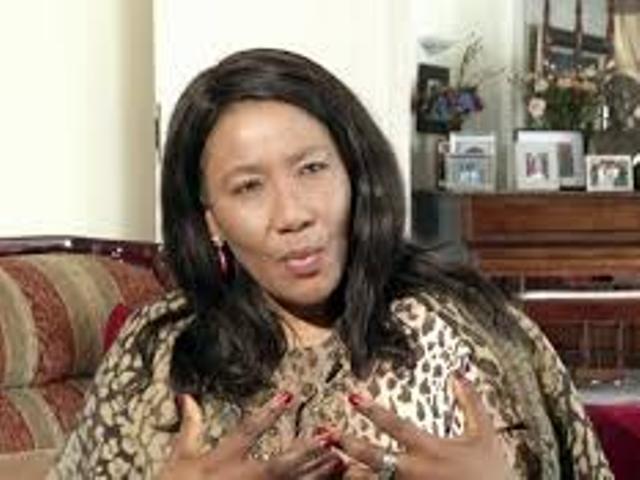
Mandela family feud over his money

Makaziwe Mandela
Makaziwe Mandela

Various newspaper reports suggest that Mandela’s heirs are fighting tooth and nail over the world-famous terrorist’s estate. One family friend even described the environment as “toxic”. 

Apparently the Mandelas aim to kick Mandela’s widow, Graça Machel, out of the mansion in Houghton she had been sharing with her late husband. She was flatly told to leave the house once the famous Mandela had died.

Mandela’s  eldest daughter, Makaziwe, who is married to a Ghanian, is often not on speaking terms with Machel. According to reports, Makaziwe has also “verbally abused staff and repeatedly insisted she alone will determine how to divide the spoils of Mandela’s estate”.

Using her father’s name, Makaziwe Mandela has climbed the social ladder in South Africa’s black power politics. According to Wikipedia, her biography reads as follows:

Pumla Makaziwe “Maki” Mandela-Amuah (born 1954) is the daughter of Nelson Mandela and his first wife Evelyn Mase. She was named after her older sister, born in 1947, who died aged just nine months. Of the four children born to Nelson and Evelyn Mandela, Makaziwe is the only one still living. She is married to Dr. Isaac Amuah, who is of Ghanaian origin.

She received her secondary education at Waterford Kamhlaba UWC of Southern Africa before going to the University of Fort Hare in South Africa. In 1993, she earned a Ph.D. in Anthropology at the University of Massachusetts, in Amherst, Massachusetts, USA.

She has held senior posts at the University of the Witwatersrand and the Development Bank of Southern Africa, and now heads the Industrial Development Group (IDG), with interests in mining and petroleum.

As if the hostility of Makaziwe was not enough, Graça Machel is said to have suffered verbal abuse from Mandela’s grandson Ndaba Mandela who  “he even tried to attack her physically but was restrained from doing so after the intervention of household staff”.

Machel is supposed to leave the luxurious Houghton home for a lesser abode in the Johannesburg suburb of Bryanston. Mandela family members suspect her of “having spent all Mandela’s money” although they have no proof.

Mandela’s will has not been read yet, but legal battles over the spoils are expected to ensue. The first salvo was fired by his daughters Zenani and Makaziwe even prior to his death when they tried to have the directors of two companies owned by the Mandela Trust removed. George Bizos, Tokyo Sexwale, Bally Chuene and Eastern Cape Judge President Themba Sangoni were sued in a failed attempt to remove them.

The Mandela daughters eventually gave up on their case and agreed to pay the costs of the proceedings, prompting the law firm Norton Rose Fulbright to issue the following statement on behalf of the directors:

“This ill-considered and misguided application had the effect of causing reputational harm not only to the respondents as directors and trustees but also to the trust and the image of the founder, Mr Nelson Mandela, himself.”

Mandela’s money: Case struck off the roll

The Mandelas are going to have to wait for the loot

A court application for the removal of trustees by former president Nelson Mandela‘s children has been struck off the roll, the law firm Norton Rose Fulbright said on Monday.

The ongoing battle revolves around the removal of George Bizos, Tokyo Sexwale, and Bally Chuene as directors of Harmonieux Investment Holdings and Magnifique Investment Holdings.

The application to remove them, brought by Makaziwe Mandela and Zenani Mandela-Dlamini, was removed from the roll for hearing this week by notice of removal, said Norton Rose Fulbright spokeswoman Candice Collins.

The firm, which represents Bizos, Sexwale, and Chuene, said that after Ismail Ayob withdrew as the attorney for the Mandela children, the court directed them to provide a new address for service by Friday and to file further affidavits by 30 August.

Also on Monday, Mandela’s grandson Nkosi Zwelivelile Mandela condemned the women’s action as a blatant attempt to disregard and undermine decisions Mandela made while he was “strong”.

“I consider the action by my relatives as a blatant abuse of the elderly.

“Why wait until the sponsor of a trust is not well to question decisions that he made [a] long time ago?” he asked.

He considered the court action nothing more than an attempt to “loot Nkosi Dalibhunga’s [Mandela] money that he has so carefully set out how it must benefit the family, and who must guide decisions relating to that”.

He believed all the people appointed by his grandfather were men of integrity, who had always had his grandfather’s confidence and support.

“All of us are mere beneficiaries and should be grateful that Nkosi Dalibhunga was kind enough to consider our needs through this trust and we should, therefore, avoid this type of actions that clearly infringe on his dignity,” he said. – Sapa

Mandelas want money

Makaziwe Mandela
Makaziwe Mandela

The Mandela family is heading back to court today.

This time it’s over access to money that has accrued in trusts the elder statesman set up for the upkeep of his family.

Lawyers representing Madiba’s daughters and grandchildren will square up against his appointed trustees and confidants.

Among the latter are Mandela’s long-time friend and lawyer, George Bizos, and politician and former Robben Island prisoner Tokyo Sexwale. At issue is money.

The Mandela-appointed trustees are having none of it. They say their overriding duty is to carry out Madiba’s wishes.

Mandela-appointed trustee Tokyo Sexwale said: “We’ll stick with it. It is at this time that those he asked to do certain things must stand firm. If we don’t, that would be behaving like traitors.”

The two sides have spent the past few weeks trying to reach a settlement but failed.

To make matters worse, the lawyer representing Mandela’s family, Ismail Ayob, has quit.

The family has since found a new lawyer. They say nothing and no one is going to deter them from fighting on.

Former president Nelson Mandela has begun his 52nd day in hospital. – SABC

Why is Rhodes University really funding the ‘indigent’ Mandelas?

Indigent Mandelas
Indigent Mandelas and a security guard

The Sunday Times revealed recently that the Rhodes University law clinic provided funding to Makaziwe Mandela and 15 other members of the Mandela clan to engage in a public spat about their inheritance.

The funding helped an order forcing Mandla Mandela to move the remains of three of Nelson Mandela’s children from Mvezo Great Place to Qunu which the Eastern Cape High Court in Mthatha issued.

The university is standing by its law clinic’s decision to fund 16 members of the Mandela family, who apparently qualified for aid as indigents.

Part of the reason for the clinic’s decision, the university said on Tuesday, was because Mandla Mandela appeared to be silencing the voices of women in the Mandela family.

This meant that the case fell within the clinic’s mandate to pursue cases that “impact on the human rights and socio-economic conditions of disadvantaged communities”. The university says Hayes was acting in accordance with this “strategic objective”.

Their instructing attorney in that court application was Wesley Hayes, who is also a the deputy director of the law clinic. Hayes was previously known to the Mandela family.

Also on Sunday, Mandla Mandela visited his grandfather in hospital in Pretoria, declaring afterwards that Nelson Mandela’s health was improving. Makaziwe’s laywer earlier described Mandela’s state as “vegetative”.

He said he had asked his lawyers to write to the Rhodes vice-chancellor Saleem Badat to discuss the reasons why the law clinic saw fit to provide the funding.

An objective of the Rhodes University Law Clinic is to provide free legal advice and services to people who are deemed to be indigent.

Critics say there is no logic in the university’s stance that “a number” of the Mandela applicants were indigent.

“This is the Mandela family we are talking about. How does a Mandela family member become indigent?” said Mandla’s laywer Pilusa.

He said Mandla Mandela suspected the university had an alternative agenda in funding his aunt and others’ court application “that would force them [the clinic] to depart from the normal procedure, which looks at real indigent families”.

“Even the reasons given, that one or two of the Mandelas are indigent, doesn’t make any sense. It’s really a very odd situation,” said Pilusa. – M&G

Mandela family ‘cannot afford legal fees’

The American educated Makaziwe Mandela

The Mandela family members, who took Mandla Mandela to court over the relocation of the graves of former president Nelson Mandela’s children, were too poor to afford their own lawyers, the Sunday Times reported.

The Rhodes University Law clinic told the newspaper it had established some of the Mandela family members were “indigent” but would not reveal the criteria used to determine their eligibility for funding the case.

“A call was made to the management of the law clinic requesting permission to take on the matter,” director of special projects at the university Susan Smailes was quoted as saying.

“Permission was granted as the management was satisfied that there was compliance with the means test.”

When Sunday Times asked Ndaba Mandela whether his family members had requested legal aid and which of his relatives he considered to be indigent, he said: “Be careful of your sources.”

Makaziwe Mandela did not respond to requests for comment from the newspaper.

The clinic states on its website that it provided free legal services to the “indigent people from Grahamstown and the surrounding area, who cannot afford to pay a private practitioner” as one of its primary objectives.

“We find their claim that some members of the Mandela family are indigent absurd,” said Mandla Mandela’s spokesman Freddy Pilusa.

The court case referred to the graves of Mandela’s eldest son Madiba Thembekile, who died in a car accident in 1969; Mandla Mandela’s father Makgatho Mandela, who died in 2005; and Mandela’s first daughter Makaziwe Mandela, who died as an infant in 1948.

On July 3, the court ordered Mandla Mandela to return the remains of his grandfather’s three children to Qunu from Mvezo, where he had moved them two years ago. It then dismissed his application to rescind its decision as frivolous.

The ailing anti-apartheid icon was admitted into a Pretoria hospital on June 8 with a recurring lung infection. – Sapa

‘Mandela is not in a vegetative state’

The American educated Makaziwe Mandela
The American educated Makaziwe Mandela says her grandfather is in a vegetative state

Doctors treating former president Nelson Mandela have denied that he is in a vegetative state, the Presidency said on Thursday.

“We confirm our earlier statement released this afternoon after President Jacob Zuma visited Madiba in hospital that Madiba remains in a critical, but stable condition,” spokesman Mac Maharaj said in a statement.

He said Mandela was under the care of a “multi-disciplinary” panel of medical experts drawn from the South African Military Health Services, the public and private sector, and universities.

“Under this panel, a team of doctors, nurses, paramedics and other health professionals attend to Madiba on a 24-hour basis.”

The statement from the Presidency came after court documents surfaced stating that Mandela was in a “permanent vegetative state” and that his family had been advised to turn off his life-support machine.

The certificate of urgency dated June 27 and submitted to the Eastern Cape High Court was widely reported by local and international media. A copy was obtained by Sapa.

In it, an advocate for the American educated Makaziwe Mandela said he had been advised by his instructing attorney that Mandela’s condition had “taken a turn for the worst (sic)” and that the “Mandela family” – ie Makaziwe and her supporters – have “been advised by the medical practitioners that his life-support machines should be switched off”.

“Rather than prolonging his suffering, the Mandela family is exploring this option as a very real probability.”

The document was attributed to David Smith, an advocate representing 15 members of the “Mandela family” in a court case against Mandela’s grandson, Mandla Mandela.

In the document, Smith described Mandela’s health as perilous, and said he was in a permanent vegetative state and was being assisted in breathing by a life-support machine.

“Affidavits will be provided, at the hearing of this application, from his treating physicians that he is in a permanent vegetative state and is assisted in breathing by a life-support machine,” he said.

“The anticipation of his impending death is based on real and substantial grounds.”

A later version of the document filed in the court omitted the paragraphs referring to Mandela’s “vegetative state” and the advice by physicians to take Mandela off life support.

A lawyer for the Mandela family later said the original certificate of urgency was “merely a submission outside of court”.

“To the extent there is speculation, a certificate of urgency was filed in terms of the practice of our court,” said Wesley Hayes, who represented the family in the dispute with Mandla Mandela about the graves of his father and his grandfather’s other two children.

“The certificate is not evidence, but merely submissions on why a matter should be heard outside ordinary court sittings.”

Hayes said the ruling on the urgency of the matter had been made “in camera” and that this “would extend to the contents of the certificate of urgency”.

“Further than that we have no comment,” he said.

On Wednesday, the Eastern Cape High Court ordered Mandla Mandela to return the remains of his grandfather’s three children to Qunu from Mvezo, where he moved them two years ago.

The remains were those of Mandela’s eldest son Madiba Thembekile, who died in a car accident in 1969; Mandla Mandela’s father Makgatho Mandela, who died in 2005; and Mandela’s first daughter Makaziwe Mandela, who died as an infant in 1948.

The bones were re-buried at a ceremony at a gravesite at Nelson Mandela’s home in Qunu on Thursday afternoon. – Sapa

Mandela’s legacy: Fighting about money

makimandlaSince Nelson Mandela’s hospitalisation, his daughter Makaziwe and grandson Mandla have emerged as the two bulls in the kraal. And it’s about money.

Since the hospitalisation of former state president Nelson Mandela last month, his eldest daughter, Makaziwe Mandela (60) and eldest grandson, chief Mandla Mandela (38) have engaged in a public spat about ownership of the icon’s legacy, or rather income.

This week, Mandla, officially head of the Mandela clan, denied that there was tension between him and his aunt. A few days later, Makaziwe and 16 other family members filed an interdict with the Eastern Cape High Court, ordering Mandla to return the remains of three family members he controversially exhumed two years ago and re-buried in Mvezo.

The matter was first raised at a family meeting held in Qunu last week. Mandla allegedly walked out and refused to answer why he had taken such a huge decision without consulting the family.

When he moved the graves, Mandla said that Mvezo was the birthplace and traditional home of the Mandelas and therefore held historic and heritage significance.

Mandla, who is based in the family homestead in the Transkei, became the chief of Mvezo after the death of his father Makgatho Mandela in 2005. He was chosen as a successor at the age of 32. He graduated with a degree in politics from Rhodes University and is a Member of Parliament for the ANC.

In recent years he has become increasingly vocal politically as a member of the ANC and a traditional leader. In an interview this week with Cii, an Islamic radio station, he spoke of how people needed to embrace their traditions and culture, especially when it came to the treatment of the elderly. “Ubuntu needs to be our guide to everything we do towards senior citizens. There is a lot of disrespect and abuse suffered by the vulnerable,” he said, adding that the topic was close to his heart because of his grandfather’s advanced age and health.

Mandela’s daughter Makaziwe is no stranger to bad publicity either. She and her sister Zenani made news last month by announcing their intent to sue their father’s trust. They went to court in an attempt to remove their father’s choices of directors and trustees of the Mandela Trust, namely attorney George Bizos SC, Human Settlements Minister Tokyo Sexwale and lawyer Bally Chuene.

In his replying affidavit, Chuene reportedly said he, Bizos and Sexwale had, in 2011, refused to release the trust’s money to the daughters without a legal justification. Critics slammed the daughters’ move as desperate and an act of greed. The case was clouded by the recent ill-health of the elder statesman.

Recently, Makaziwe has set her sights further, extending her intervention in the family’s public image and administration. She has added her voice to the ongoing Mandela family graves debacle, moving to make sure that the exhumed remains are returned to and reburied in Qunu.

Makaziwe is also taking a firmer hand with family matters, going as far as addressing not only Mandla, but the media as well. In a recent interview with the SABC she spoke on behalf of the family, accusing the international media of being “racist vultures”.

Her recent unapologetic stance has led to speculation that she is vying to be the new head of the clan.

Makaziwe, affectionately known as Maki, is the daughter of Mandela and his first wife Evelyn. She was named after her older sister who was born in 1947 but who died before her first birthday. She is the only remaining child from Mandela’s first marriage.

Like her father, she attended the University of Fort Hare in the Eastern Cape. She later earned a PhD in anthropology from the University of Massachusetts. She has been in positions of power at the University of the Witwatersrand, the Development Bank of Southern Africa, and now heads the Industrial Development Group, with interests in mining and petroleum.

Last year, Mandla was taken to court by a community member who claimed he dug up private graves (separate to the family graves) in order to build a hotel and a stadium on the land. The case is still in court.

Mandla, however, emphasised the developmental aspect of project, as the stadium is needed for activities such as the Mvezo Komkhulu Youth Tournament, an annual soccer and netball tournament that has been running for six years.

“The tournament is aimed at exposing the talent of rural boys and girls and fighting alcohol and substance abuse. We want the youth to live in clean, healthy environments. Through sport we can have a healthy nation and disciplined future leaders,” he said at the time to local media. However, thanks to flouting correct procedure, the project landed him in court and has further deepened his unpopularity.

Ultimately, one of the two has to start behaving like a leader, or run the risk of the Mandela name being increasingly mired in scandal. – Mail&Guardian