Budapest has been shaken by several days of mass street demonstration against plans by Viktor Orban’s government to introduce a tax on the internet. According to the media, 100,000 Hungarians came out onto the streets of Hungary’s capital to tell the prime minister “no”.
In and of itself, the internet tax is a weak excuse for the organisation of 100,000-strong demonstrations. And, of course, demands to abolish the tax turned into demands for the resignation of Hungary’s ‘dictatorial’ and ‘corrupt’ government. Attacks were also launched on government buildings: as one, internet users pelted them with stones, notebooks and mobile phones.
Other signs of a ‘Hungarian Maidan’ were also evident: demonstrators defiantly jumped around chanting “He who does not jump pays the tax” (the Ukrainian version of this standard spectacle is “He who does not jump is a Moskal”). Local human rights defenders declared that introducing a tax on the internet is an assassination attempt on freedom of speech unacceptable for a democracy.
Among the demonstrators was the U.S. charge d’affaires in Hungary, Andre Goodfriend, who previously reported that the US authorities had banned six Hungarian nationals close to the Hungarian prime minister from entering the country.
It appears that Washington was protesting against the corrupt practices of these Hungarian nationals and expressed its displeasure to Viktor Orban in Brussels. On her Twitter page, the European Commissioner for Competition, Neelie Kroes, backed the street demonstrations and called for those who still had not done so to join them.
Western media write that Orban is under the influence of Putin. Orban himself has had to state more than once that he is not a pro-Russian but a pro-Hungarian politician, but he continues to be accused of yielding to pressure from Moscow. And no wonder: he has introduced restrictions on the work of foreign companies in the country, has too much power concentrated in his hands, and has approved Hungary’s neoliberal Constitution.
Orban is guilty before European democracy in a number of ways. As the father of five children, he resolutely opposes attempts to register the cohabitation of same-sex couples as ‘marriage’. He was also opposed to economic sanctions against Russia, calling them nonsensical, and saying they would do more harm to EU countries than to Russia. In addition, he is calling for compensation from Brussels for the losses incurred by Hungarian manufacturers as a result of curtailed cooperation with their Russian partners.
The head of the Hungarian government is not able to withstand all pressure, however. It was not long before Orban had to declare that Hungary stood with Germany in its assessment of events in Ukraine, and that the introduction of sanctions was a justified move.
It is easy to conclude that the change in the Hungarian prime minister’s initial position was a consequence of pressure from Berlin.
Thus, representatives of Deutsche Telekom’s subsidiary Magyar Telekom, Hungary’s largest internet company, have expressed their outrage at Orban’s plans to introduce a tax on the internet. Berlin is also putting pressure on Orban in other ways. Following German Minister of State for Europe Michael Roth’s visit to Budapest during the street demonstrations, the Hungarian prime minister declared that the government had listened to the people and the tax would not be introduced.
Yet the battle formations of a Maidan-style protest movement in Hungary remain ready to go. The leader of the protests, liberal Balazs Nemes, has reported that the protesters are in touch with each other and are ready to go back out onto the streets the instant that the authorities decide to launch an offensive on their civil rights. Balazs Nemes has referred to Viktor Orban’s leadership style as “the most appalling tyranny”.
The Hungarian prime minister’s independence, including with regard to Russia, has long irritated both Brussels and Washington.
Viktor Orban’s statements regarding his intention of finding allies in Europe capable of opposing the introduction of new sanctions against Russia together have not gone unnoticed.
Western capitals have been particularly outraged by the fact that on 4 November 2014, the Hungarian parliament passed a law allowing the construction of the South Stream pipeline to take place in Hungary, despite the position of the European Commission. Thanks to this law, Hungary now has a legal basis for refusing to comply with the requirements of the EU’s Third Energy Package.
Protests in Budapest against “the most appalling tyranny” are a warning to Viktor Orban, and a reminder of the fate of another Viktor – Viktor Yanukovych.
The street protests organised in the Hungarian capital should also be regarded as a warning to eastern European ‘Russophiles’ like Slovak Prime Minister Robert Fico or Czech President Miloš Zeman, since their attitude towards anti-Russian sanctions and events in Ukraine is much like that of Orban.
The US government loves to “promote democracy” overseas, often at the barrel of a gun. Strangely enough, however, it often “deplores” actual elections being held in such places. Take Ukraine, for example. An election held last week by a group that forcibly seized power from a legitimately-elected government was hailed by the US administration as a great democratic achievement.
Said John Kerry about last week’s parliamentary election held by the post-coup government in Kiev:
We applaud Ukraine’s commitment to an inclusive and transparent political process that strengthens national unity. … The people of Ukraine have spoken, and they have again chosen to chart the course of democracy, reform, and European integration.
In this US-approved vote, the parties disapproved by the US were harassed and even essentially banned. But that’s OK.
However in eastern Ukraine, which refused to recognize February’s US-backed coup in the western part of the country, parliamentary and presidential elections scheduled for tomorrow are scorned and even “deplored” by the US administration.
The White House condemned tomorrow’s elections in eastern Ukraine in no uncertain terms:
We deplore the intent of separatists in parts of eastern Ukraine to hold illegitimate so-called local ‘elections’ on Sunday, November 2. If held, these ‘elections’ would contravene Ukraine’s constitution and laws and the September 5 Minsk Protocol.
So much does the US administration hate the idea of unapproved people voting, that it even refused to call them elections, placing the very term in “scare quotes.”
Shortly after the February coup in Kiev, referenda were held in Crimea and in parts of eastern Ukraine to determine whether to remain tied to Kiev or declare independence from the new regime. Those elections were also condemned by the US.
“We reject the ‘referendum’ that took place today in the Crimean region of Ukraine. This referendum is contrary to Ukraine’s constitution,” said the White House immediately after the March vote in that region. The February coup was also contrary to Ukraine’s constitution but that did apparently not bother Washington.
Similarly, when referenda were held in eastern Ukraine this spring to determine that region’s future course, the White House spokesman condemned them as “illegal under Ukrainian law and a transparent attempt to create further division and disorder.”
When the wrong people hold votes, it seems, “division and disorder” are the result.
Those who overthrow democracy by force are legitimized – you might even say laundered – by an election they had no legal right to hold in the first place, while those who stood by previously-elected leaders and scheduled elections as a way out of the crisis caused by US interference are condemned, ignored, and not even recognized by the US government.
So here is the real message from the US government: elections overseas are only legitimate if we have pre-approved the parties allowed to stand and if we have pre-approved the outcome. The election must result in exactly the kind of “pro-West” government that we desire or we will begin destabilization and regime change, if completely ignoring the results does not do the trick.
Obama’s new wars in Iraq and Syria are totally immoral as well as illegal under US and international law, RPI Chairman Ron Paul told RT’s Abby Martin in September. The idea that US force will solve the problem is also mistaken, he said. “US action will increase the violence,” rather than reduce it, he added.
In a lengthy interview, broadcast on RT’s popular “Breaking the Set” program, Dr. Paul wonders why the countries in the region, feeling the pressure from ISIS, do not get together to solve the problem.
Said Dr. Paul about US involvement in the fight:
Why should someone 6,000 miles away, that has been stirring this pot for so long, be the group that is going to bring everyone together and organize the fight?
The fearmongers who have terrified many Americans into supporting another war in the Middle East are “not concerned with the defense of America,” said Ron Paul. But the weapons manufacturers are making out very well, with the US bombing its own weapons that have fallen into the hands of ISIS. – Daniel McAdams
Secessionists across the world were inspired by Scotland’s energetic attempt at independence from the United Kingdom earlier this month. Ron Paul, as it turns out, joined them.
In an essay on his eponymous institution’s website Sunday, the former U.S. congressman from Texas wrote that any supporters of freedom should cheer secessionism because it allows for smaller government—a constant mantra for the libertarian and perennial presidential candidate, who didn’t previously realize there were more than a handful of secessionist groups in the United States.
“I was real pleased with that, and a bit surprised,” Paul told National Journal. “But then, on second thought, you think, ‘Why not? Why not more?’ ”
Fringe groups calling for states and regions to secede from the U.S., such as the Second Vermont Republic and the Alaskan Independence Party, gained more publicity in the weeks leading up to the Scottish referendum. As the outsized federal government continues to encroach on individual rights, Paul said, he thinks there will be a groundswell of these movements.
“It’s something that I think is going to grow, because the failure of the federal government is going to get much worse,” he said. “When the bankruptcy evolves, and maybe some of these pension funds are confiscated, and the wars never end, and bankruptcy comes forth, people [will say], ‘Hey, we’re getting a bad deal from this. Why don’t we leave?’ ”
He added: “I think it’s inevitable people wanting to leave will be there, and the numbers will grow.”
Realistically, though, Paul said he doesn’t think any of these groups could actually succeed. Despite the founders’ own deep belief in secession—they gained America’s independence from Europe, after all—he said the Civil War set the precedent that secession would carry “very, very bad” results.
“By our history, the heavy hand of the federal government would come down,” Paul told National Journal. “They’d probably shoot ’em.”
In typical fashion, Paul argued that the principle of secession was more important than what could actually happen in reality. It’s the threat, he said, that’s important to keep the federal government in check.
“I think what is most important is we have a concrete right to secede,” Paul said. “Even if we never had any secession, or any state declare independence, we would be so much better off, because there would always be this threat. Once the threat of a state leaving was removed, it was just open-door policy for the federal government to expand itself and run roughshod out over the states because the states couldn’t do much.”
Given that his son, Sen. Rand Paul, R-Ky., will likely run for president in 2016 with a much better chance of winning than his father ever had, the elder Paul’s willingness to share his reasonably radical views seem imprudent, if not unexpected. In an election cycle that has often equated the politics of Ron and Rand, this latest remark is sure to annoy the potential 2016-er’s supporters.
For Rand’s sake, it’s fortunate that Ron didn’t express his support for the Texas Nationalist Movement or any other secessionist groups in the U.S. Before he’d back Texan independence, he joked, “I better check out and see who’s running Austin before we decide about that.”
Former Congressman Ron Paul said the US knows ‘more than it is telling’ about the Malaysian aircraft that crashed in eastern Ukraine last month, killing 298 people on board and seriously damaging US-Russian relations in the process.
In an effort to inject some balance of opinion, not to mention pure sanity, into the ongoing debate over what happened to Malaysian Flight MH17, Ron Paul is convinced the US government is withholding information on the catastrophe.
“The US government has grown strangely quiet on the accusation that it was Russia or her allies that brought down the Malaysian airliner with a Buk anti-aircraft missile,” Paul said on his news website on Thursday.
Ron Paul to Obama: Let’s just leave Ukraine alone!
Paul’s comments are in sharp contrast to the echo chamber of one-sided opinion inside Western mainstream media, which has almost unanimously blamed anti-Kiev militia for bringing down the commercial airline. Incredibly, in many cases Washington had nothing to show as evidence to incriminate pro-Russian rebels aside from tenuous references to social media.
“We’ve seen that there were heavy weapons moved from Russia to Ukraine, that they have moved into the hands of separatist leaders,” said White House spokesman Josh Earnest. “And according to social media reports, those weapons include the SA-11 [Buk missile] system.”
In another instance, State Department spokeswoman Marie Harf told reporters “the Russians intend to deliver heavier and more powerful rocket launchers to the separatist forces in Ukraine, and have evidence that Russia is firing artillery from within Russia to attack Ukrainian military positions.” When veteran AP reporter Matthew Lee asked for proof, he was to be disappointed.
“I can’t get into the sources and methods behind it,” Harf responded. “I can’t tell you what the information is based on.” Lee said the allegations made by the State Department on Ukraine have fallen far short of “definitive proof.”
Just days after US intelligence officials admitted they had no conclusive evidence to prove Russia was behind the downing of the airliner, Kiev published satellite images as ‘proof’ it didn’t deploy anti-aircraft batteries around the MH17 crash site. However, these images have altered time-stamps and are from the days after the MH17 tragedy, the Russian Defense Ministry revealed, fully discrediting the Ukrainian claims.
In yet another inexplicable occurrence, Russian military detected a Ukrainian SU-25 fighter jet approaching the MH17 Boeing on the day of the catastrophe. No acceptable explanation has ever been given by Kiev as to why this fighter aircraft was so close to the doomed passenger jet moments before it was brought down.
“[We] would like to get an explanation as to why the military jet was flying along a civil aviation corridor at almost the same time and at the same level as a passenger plane,” Russian Lieutenant-General Andrey Kartopolov demanded days after the crash.
Paul has slammed the Obama administration, despite its arsenal of surveillance technologies at its disposal, for its failure to provide a single grain of evidence to solve the mystery of the Malaysian airliner.
“It’s hard to believe that the US, with all of its spy satellites available for monitoring everything in Ukraine, that precise proof of who did what and when is not available,” the two-time presidential candidate said.
“Too bad we can’t count on our government to just tell us the truth and show us the evidence,” Paul added. “I’m convinced that it knows a lot more than it’s telling us.”
Questions remain regarding the downed Malaysia Airlines plane. Too bad our gov’t won’t paint the full picture: http://t.co/oxM2eeCjRA
Although no sufficient evidence has been presented to prove that the anti-Kiev militia was responsible for the downing of the international flight, such an inconvenient oversight has not stopped the United States and Europe from slapping economic sanctions and travel bans against Russia.
Moscow hit back, saying it would place a ban on agricultural imports from the United States and the European Union. Russia’s tit-for-tat ban will certainly be felt, as food and agricultural imports from the US amounted to $1.3 billion last year, according to the US Department of Agriculture. In 2013, meanwhile, the EU’s agricultural exports to Russia totaled 11.8 billion euros ($15.8 billion).
After the crash, Ron Paul was one of a few voices calling for calm as US officials were pointing fingers without a shred of evidence to support their claims. Paul has not been afraid to say the painfully obvious things the US media, for any number of reasons, cannot find the courage to articulate.
“They will not report that the crisis in Ukraine started late last year, when EU and US-supported protesters plotted the overthrow of the elected Ukrainian president, Viktor Yanukovych,” Paul said. “Without US-sponsored ‘regime change,’ it is unlikely that hundreds would have been killed in the unrest that followed. Nor would the Malaysian Airlines crash have happened.”
Paul also found it outrageous that Western media, parroting the government line, has reported that the Malaysian flight must have been downed by “Russian-backed separatists,” because the BUK missile that reportedly brought down the aircraft was Russian made.
“They will not report that the Ukrainian government also uses the exact same Russian-made weapons,” he emphasized. – RT.COM
Few outsiders understand the ethnic dynamics of South Africa. Foreign journalists come here and imagine that we are some kind of remake of the USA, transposing American ethnic categories (and Hollywood movies) onto us. Of course, many people in Johannesburg and Cape Town imagine that they are living in America too, especially the mediocre crowd who have taken over our universities, describing the world in terms of “racism”, “whiteness”, “white privilege” and so on.
Race is undeniably a driving force in South African history, but not in the way that most people think. More fundamentally, one cannot understand our past and present upheavals without appreciating what Boerehaat, or “hatred of the Boers” is.
A week ago, an associate director of the South African Jewish Board of Deputies, David Saks, casually mentioned on the News24 website in a comment that there had been an underlying current of Boerehaat in the ranks of the anti-apartheid movement. When I was at university, many people in Johannesburg and at the University of the Witwatersrand were proud of their Boerehaat and of hating Afrikaners. It could even be seen as a sign of distinction.
In the early 1970s a cartoonist for the Wits campus newspaper, Franco Frescura, went out of his way to portray Afrikaners as oafish, unintelligent and ugly. He later became a lecturer in architecture. Although Frescura was of Italian origin, he has publicly denounced his “racist parents” and he was apparently strongly influenced by his English-speaking Johannesburg peers. Call this the “uitlander culture” of Johannesburg which goes right back to the discovery of gold in 1886 when hordes of British and Eastern European thugs had descended upon Johannesburg. The uitlanders’ visceral hatred of Kruger and the Transvaal Boers soon led to the outbreak of the Second Anglo-Boer War of 1899-1902.
Franco Frescura actually has a website of his own where he describes his upbringing thus:
In Johannesburg Franco attended Houghton Primary and King Edward VII High School (KES) where, unbeknown to him, a number of the families with whom he came into contact had deep-seated links with the Communist and Liberal Parties.
He also proudly states in the same website biography:
Although Franco has gone down in student folk lore as the author of a well-known lampoon published on the cover of Wits Student in 1972 which featured a child looking into a lavatory asking the question “Excuse me, are you the prime minister?”, this is incorrect for the real author was a fellow student and co-activist who has since preferred to remain anonymous.
The South African prime minister at the time was B.J. Vorster, possibly the most popular white South African politician ever as he had managed to garner 65% of the vote and 80% of the seats during the 1977 elections. A golfer and reputedly a heavy drinker, with such tastes Vorster could almost have been described as an Englishman except that he spoke the language with a pronounced Afrikaans accent. However he did pander to English public opinion and famously discouraged Afrikaans language activists from pushing for more language equality by saying “it might upset our English-speaking voters”.
Why would Franco Frescura and so many others have held Vorster in such contempt, given his popularity with most English-speakers? The answer, of course, is to be found in David Saks’s statement: the anti-apartheid movement, as well as the South African Communist Party and ultra-liberals such as Mrs. Helen Suzman who represented the ultra-rich suburb of Houghton, were saturated with Boerehaat.
I would go much further than David Saks and state that South African communists were hardly ever motivated by love for blacks or black human rights. Instead, the driving force of the whole movement was ethnic hatred of gigantic proportions, directed against the Afrikaner people of South Africa. The current near-genocidal levels of violence as encountered in sadistic farm murders, suburban attacks, as wel as the country’s rape epidemic (more than a million women are raped every year, or about three thousand every day) have their roots in the Boerehaat movement. What unites both the gangs of anomic black killers torturing farmers to death and the more genteel haters sniffing out “Afrikaner racism” in mainstream media columns? Boerehaat pure and simple.
Except Boerehaat is not simple. Sure, most Afrikaners in this country have been exposed to English invective such as “rockspider”, “dumb Dutchman”, “bonehead”, “crunchie”, ‘white trash” and the like. But underlying it is a whole worldview, a psychosis well worth a Ph.D. thesis. Or several.
Jews are very touchy about anti-Semitism and most criticism of Jews is usually deflected as anti-Semtism. Even aspects of US foreign policy that could be construed as being detrimental to Israel are described as “anti-Semitic΅. For example, American senator Ron Paul has recently been accused of anti-Semitism by Ben Stein for criticising US bellicosity in the Middle East and the American occupation of Afghanistan.
Any cartoon or verbal caricature of Jews as being rich, greedy, devious people with hooked noses would immediately be denounced as anti-Semitic and in South Africa charges would no doubt be laid with the so-called Human Rights Commission. The Dieudonné affair in France is another case in point where the French government clamped down on the comedian and banned some of his shows for their anti-Semitic jokes.
Buy Dan Roodt’s book through Amazon.com
Caricaturing, stereotyping and even inciting hatred or genocide against Afrikaners do not carry the same weight, however. Communist Party members Nelson Mandela and Ronnie Kasrils sang their version of the “Kill the Boer” song which is all over YouTube, and it hardly dented the exemplary reputation that these two men, as well as their “comrade” Joe Slovo, enjoy in England, France, the USA and other Western countries.
Apart from Franco Frescura and his fellow cartoonist Zapiro, the list of proud Boerehaters in South Africa would be very long indeed. It would include author Nadine Gordimer, former editor of the Rand Daily Mail, Allister Sparks, as well as the newsrooms of many newspapers and radio stations, not to mention academic departments at universities where political correctness, Marxist ideology and Boerehaat are Siamese triplets. Probably the website The Daily Maverick is currently the flagbearer of Boerehaat ideas and attracts a particularly shrill kind of ultraliberal or left-wing inquisitor out to drive the final few nails in the Afrikaner coffin, sometimes literally when sadistic murders against Afrikaners are defended or minimised.
The German concentration camps of the Second World War are usually held up to be the prime example of genocide. We forget that the British – in order to further uitlander political and economic objectives – had introduced the concentration camp into South Africa where 30 000 Boer women and children died. But to understand contemporary Boerehaat and the excesses it might lead to, we have to look at the more left-wing instances of genocide that occurred during the twentieth century. There is the example of the Russian revolution during which Trotsky, Stalin and Beria killed millions of people or worked them to death in the gulags.
More recently, there is the case of the fanatical Khmer Rouge movement in Cambodia during the late seventies which blended ethnic hatred and communism to produce a particularly lethal cocktail. Just like in South Africa, there was a left-wing revolution in Cambodia with the ideal of constructing a millennarian society free of classes and races in a great “transformation”. Up to four million people were killed, many of whom were ethnic Chinese and Vietnamese.
When I lived in Paris, I had a Cambodian-Chinese neighbour whose mother was shot outside their house by the Khmer Rouge. That contributed to my increasingly critical sense when it came to left-wing revolutionary ideology. However, very much later I realised that he was telling me that his family had been victimised because they had been Chinese and not Khmer! When the race enemy and the class enemy coincide, that is when you get a particularly powerful incentive to genocide. In Cambodia the entire population was driven out of the cities, in order to effect the revolution and build “a new society”.
In an article entitled “Racial Communism: Cambodia under the Khmer Rouge”, Eric D. Weitz writes:
“Someth May was a young Cambodian… [who] recalls… when a party cadre addressed a crowd [amidst deportation]: “As you all know, during the Lon Nol regime the Chinese were parasites on our nation. They cheated the government. They made money out of Cambodian farmers…. Now the High Revolutionary Committee wants to separate Chinese infiltrators from Cambodians, to watch the kind of tricks they get up to. The population of each village will be divided into a Chinese, a Vietnamese and a Cambodian section. So, if you are not Cambodian, stand up and leave the group. Remember that Chinese and Vietnamese look completely different from Cambodians.”…. Under the new regime, the Khmer Rouge declared, “there are to be no Chams or Chinese or Vietnamese. Everybody is to join the same, single, Khmer nationality…. [There is] only one religion – Khmer religion. Similarly, a survivor recalls a cadre saying: “Now we are making revolution. Everyone becomes a Khmer.””
Does that not sound familiar to us today, here in South Africa?
“Now we are making revolution. Everyone becomes a Khmer.”
Since 1994 we have seen equally fanatical attempts at so-called “nation-building” in South Africa whereby people have to adopt a new identity and “dissolve ethnically” into “the majority nation”. Those who refuse, or prove to be unassimilable or simply “different”, are then targeted, vilified and even killed.
I have previously remarked that in South Africa, “apartheid” is a simple metonym for “Afrikaner”. The racial, ethnic, linguistic, geographical and historical complexities of this society could hardly be subsumed under the globalised myth of “apartheid” as an evil neo-Nazi system of oppression. In that sense “apartheid” is meaningless, semantically empty. But to be anti-apartheid far more concretely means hating Afrikaners. Like Helen Suzman, the MP for Houghton, once said:
“I hate the Afrikaner. I hate his ways, his language and of course his politics.”
The fires of Boerehaat have not been extinguished by the Afrikaner leadership’s abject abdication from South African politics in 1994. On the contrary, Afrikaner powerlessness and seemingly masochistic obsequiousness in suffering vituperation on a daily basis have just added fuel to the fire. It has also led to pathological manifestations and internecine conflicts within the ranks of Afrikaners themselves. The phenomenon of the “self-hating Jew” has been replicated in South Africa with the self-hating Afrikaner, ever ready to heap opprobium on his own and to serve the cause of Afrikanerdom’s enemies. Many homosexual and lesbian Afrikaners, filled with rancour against the majority heterosexual members of their own tribe, have rallied to the cause of the anti-Afrikaner propaganda war that is raging to this day.
Up to 40% of journalists writing in Afrikaans today are apparently “gay”. Whatever their private lives, their opinions are far to the left of what ordinary people are thinking, so they are fast destroying what is left of Afrikaans journalism and newspapers by alienating their readers. In fact, the entire Naspers media group seems to have lurched into a “self-hating” orgy of white guilt and a kind of cultural death or ethnocide perpetrated against the very nation that had nurtured them financially for so long. Naspers represents nothing but a gigantic “psyops” operation aimed at the ultimate destruction of the Afrikaner people, their sense of identity, belonging and togetherness. Distributing Boerehaat invective, together with exalting nihilism, rancour and guilt feelings, all in Afrikaans, may be deemed more effective than simply overwhelming Afrikaners with propaganda in English.
According to the Boerehaat stereotype, Afrikaners are:
Of low intelligence
Ugly as sin
Rough, coarse and lacking in manners
Racist and anti-black
Women are fat and men have beer bellies
Ignorant and uncultivated
Given to incest and “in-breeding”
Afrikaans sounds ugly and “guttural”
In some respects, the Boerehaat caricature of Afrikaners corresponds to the Appalachian stereotypes in the USA. Combing through the production of South African English novels and films for such caricatures would be an easy, if tedious, task. Often in such publications, incest is presented as a metaphor for racial exclusivity, as in the supreme Boerehaat novel of the 1990s, Triomf, first written in Afrikaans by an Afrikaner lesbian, Marlene van Niekerk. Often Afrikaners who spend a lot of time on neo-Marxist, English campuses in South Africa would either have an identity crisis and commit suicide or they would actually become Boerehaters themselves, despising their own family, language and traditions to varying degrees. Although Van Niekerk apparently still writes poetry in Afrikaans, she has publicly called for violence against Afrikaners and abjured any sense of an Afrikaner identity.
The main character in her book is mentally retarded, the quintessential “dumb Dutchman”; both he and his brother sleep with their mother. In one scene he voyeuristically gazes thtough the hedge at the lesbian neighbours having sex and from the narrator’s point of view it represents a kind of higher world that he may only watch from a distance, being mired in mental retardation and ethnic exclusivity, which one supposes to be mutually linked in some way.
Although horribly vulgar, tedious and badly written, Triomf was immediately hailed as a masterpiece and translated into English. It was also made into a movie which was a complete box office flop but was again feted as a work of genius by the liberal press of Johannesburg, being “a true depiction of the Afrikaner psyche”.
During the Oscar Pistorius murder trial, the global media had a feeding frenzy, extolling on the natural propensity of Afrikaner men to abuse women and possibly even kill them. One of the ANC ministers, Lulu Xingwana, immediately diagnosed the Pistorius murder as a natural outcome of Afrikaner male chauvinism, saying to the Australian Broadcasting Corporation:
“Young Afrikaner men are brought up in the Calvinist religion believing that they own a woman, they own a child, they own everything and therefore they can take that life because they own it,” she said during the interview aired on Monday.”
Pistorius, despite his surname, was not even an Afrikaner and had been educated in English schools. But it was Boerehaat on a global scale in which the local uitlander journalists, or journalists infused with the Afrikaner-hating uitlander spirit, gleefully participated. To such an extent that even a self-hating Afrikaner “useful idiot” such as Max du Preez, to my great surprise, identified it correctly in his blog entry, Fifty Shades of Boerehaat:
“I can write a book about the downside of Afrikaner Calvinism, but hating or disrespecting women and children would not feature. The women in my family were and are strong, independent human beings whom all the men in the family love and respect deeply.” (See the whole blog comment underneath.)
Many Afrikaners have often wondered: Why do the people in Johannesburg and Cape Town, especially in the media, hate us so much that we are consistently misrepresented? In this cartoon by Zapiro, Afrikaans singer Steve Hofmeyr and author Annelie Botes are represented as dinosaurs from a bygone age (which, by definition, should already be dead or extinct). Note also the emphasis on their “small brains” or low intelligence.
Cartoon by Zapiro, alias Jonathan Shapiro
I hope the reader has by now formed an image in his mind as to what Boerehaat is. In most parts of the world, there are to be found what Freud called the “narcissicism of small differences”: Belgian jokes in Holland or in France, and so on. When such minor ethnic chauvinism degenerates into a social and political ideology, and is married to Marxist-revolutionary doctrine, we may well see the genesis of a Khmer Rouge movement or the potential for genocide.
Afrikaners are already the scapegoats for everything that goes wrong in South Africa. The lack of performance of other groups, even their corruption and profligacy in government, is routinely blamed on the Afrikaner.
Could Boerehaat discourse and societal breakdown as a result of social anarchy, crime and corruption lead to a bloodbath in South Africa, with Afrikaners being held responsible for every kind of failure, even while completely out of power?
And what causes Boerehaat? Why is it so persistent? These are questions I want to address in a second part of this column.
To be continued.
Max du Preez writes: Fifty Shades of Boerehaat?
The killing of Reeva Steenkamp by Oscar Pistorius has brought out the worst in people, from journalists to politicians to ordinary people. We read on the weekend (Mail & Guardian) that the problem with violence against women has a relationship to the macho rugby culture among white men; that Pistorius got treated differently because he was white and rich – what an insult to Magistrate Nair, one of the best in the country.
Now we have cabinet minister Lulu Xingwana saying to (of all places) Australian radio that the problem starts with Afrikaner men and their Calvinist upbringing who think all things, including women and children, belong to them to treat as they want.
I am a product of a Calvinist Christian-National Afrikaner upbringing of the extreme Free State platteland kind and not only am I a rugby fanatic, I played the game (not very well, though) from the age of six to well into my twenties.
I can write a book about the downside of Afrikaner Calvinism, but hating or disrespecting women and children would not feature. The women in my family were and are strong, independent human beings whom all the men in the family love and respect deeply. Whenever my father or uncles acted as if they were “the head of the family”, we all chuckled behind our hinds and said Ag shame.
Minister Xingwana should read the story (in my books Of Tricksters, Tyrants and Turncoats and Oor Krygers, Korrelkoppe en Konkelaars) of the wife of General Koos de la Rey, one of the most prominent patriarchs and Calvinist fundamentalists in Afrikaner history. Her name was Nonnie. She was not only the head of the rather big De la Rey family in every sense, her husband made very few decisions without her, even when he was a general in the Anglo Boer War. More than that: she stood up to the British generals who not only respected her, but actually feared her as much as they feared her husband’s military prowess. They knew: don’t mess with a stoere Boervrou.
(By the way, I wonder if Lulu realises that one of her own struggle icons, dominee Beyers Naude, was also a staunch Afrikaner Calvinist right to the end?)
US Senator Ron Paul says US foreign policy doesn’t pass the laugh test.
A military coup in Egypt yesterday resulted in the removal and imprisonment of the elected president, Mohamed Morsi, a closure of media outlets sympathetic to him, the house arrest of his advisors, and the suspension of the constitution. The military that overthrew Morsi is the main recipient of the $1.3 billion yearly US aid package to Egypt. You could say that the US “owns” the Egyptian military that just overthrew its democratically-elected leader.
The hypocrisy of the US administration on these events in Egypt is stunning. As the New York Times reported today:
President Obama urged the military to move quickly to return Egypt to a democratically elected government, saying, ‘We are deeply concerned by the decision of the Egyptian Armed Forces to remove President Morsi and suspend the Egyptian Constitution.’ The president notably did not refer to the military’s takeover as a coup — a phrase that would have implications for the $1.3 billion a year in American military aid to Egypt.
Well, Egypt had a democratically-elected government, but it was overthrown by the US-funded Egyptian military!
Let’s review US policy toward Egypt to see the foolish hypocrisy of the government’s interventionism: First the US props up the unelected Hosni Mubarak for decades, spending tens of billions of dollars to keep him in power. Then the US provides assistance to those who in 2011 successfully overthrew Mubarak. Then the US demands an election. The Egyptians held an election that was deemed free and fair and shortly afterward the US-funded military overthrows the elected president. Then the US government warns the military that it needs to restore democracy – the very democracy that was destroyed by military coup! All the while the US government will not allow itself to utter the word “coup” when discussing what happened in Egypt yesterday because it would mean they might have to stop sending all those billions of dollars to Egypt.
All this they do with a straight face. We are not supposed to notice the insanity of their foreign policy. – prisonplanet.com
During an interview with FOX Business, former Rep. Ron Paul explained that he was concerned about the well-being of National Security Agency whistle-blower Edward Snowden.
“I’m worried about somebody in our government might kill him with a cruise missile or a drone missile,” Paul explained. “I mean we live in a bad time where American citizens don’t even have rights and that they can be killed, but the gentlemen is trying to tell the truth about what’s going on.”
Paul added that there were no signs of Snowden defecting to a foreign country, which meant that he was not really a threat.
“It’s a shame that we are in an age where people who tell the truth about what the government is doing gets into trouble,” he concluded.
Dozens of delegates for White House also-ran Ron Paul walked out of the Republican National convention for a second straight day Wednesday, angered by rule changes they say squelch grass roots political rights.
It was a rowdy end to Texas congressman Paul’s presidential bid, which fell short against rival Mitt Romney, the former Massachusetts governor who accepts the party’s nomination on Thursday.
Paul was not given a speaking slot at the convention in Tampa, Florida, but organizers aired a video tribute to the longtime lawmaker, and his son, Senator Rand Paul, did get to address the delegates Wednesday, praising the American system which led an immigrant’s son like Ron Paul to run for president.
Several loud supporters headed into the halls of the Tampa Bay Times Forum where they marched around the building chanting “As goes Maine, so goes the nation.”
The reference was to last-minute efforts by the Republican Party to award half of Maine’s delegates to Romney, and preventing the ousted Paul delegates from being seated at the convention.
“This walkout was specifically in support of the Maine delegation and how it was treated,” Ann Barnet of Nevada said.
GOP officials “have violated a lot of their own rules. It’s not a clean process,” she added.
Ron Paul won 154 delegates in this year’s state-by-state primary race, coming in third behind Romney and ex-senator Rick Santorum.
But Paul’s backers, through savvy and persistent maneuvering, managed to control additional delegates in the process, and they were pressing –unsuccessfully, in the end — to have Paul’s name entered into nomination before the roll call vote on Tuesday.
“We feel that this process has become a sham. How can these people stand up there and talk about the constitution if they don’t follow their own rules?” said Adam Bates, a Ron Paul supporter from Oklahoma who heard the chants and joined the group.
“The GOP can’t even run a convention, and want us to believe they can run the country.”
Paul lit a fuse under the party’s libertarian wing, uniting legions of young supporters behind his anti-tax, anti-war message.
The surge in popularity for the movement has coincided with US weariness at expensive overseas wars and seething anger at the 2008 financial crisis that made fiscal discipline more appealing to voters.
Paul, 77, retires in January, leaving the causes of personal liberty and small government without their Washington champion just as they appear to be gaining traction.
Son Rand, elected in 2010 as part of the Tea Party surge, is a constitutional conservative and libertarian, and he is the most logical person to take up the baton from his father.
But his endorsement of Romney alienated many in the movement who say the nominee, and former multimillionaire businessman, shares none of their beliefs. – AFP
WASHINGTON (AP) — Mitt Romney scored a hard-won, home state triumph in Michigan and powered to victory in Arizona Tuesday night, gaining a two-state primary sweep over Rick Santorum and precious momentum in the most turbulent Republican presidential race in a generation.
“We didn’t win by a lot, but we won by enough,” Romney told cheering supporters in Michigan. He also tweeted his delight – and his determination: “I take great pride in my Michigan roots, and am humbled to have received so much support here these past few weeks. On to the March contests.”
Santorum was already campaigning in Ohio, one of the Super Tuesday states, when the verdict came in from Michigan.
“A month ago they didn’t know who we are, but they do now,” he told his own supporters, vowing to stay the conservative course he has set.
The two other candidates, Newt Gingrich and Ron Paul, made little effort in either state, pointing instead to next week’s 10-state collection of Super Tuesday primaries and caucuses.
Romney’s Arizona triumph came in a race that was scarcely contested, and he pocketed all of the 29 Republican National Convention delegates at stake in the winner-take-all state.
Michigan was as different as could be – a hard-fought and expensive battle in Romney’s home state that he could ill afford to lose and Santorum made every effort to win.
Returns from 82 percent of Michigan’s precincts showed Romney at 41 percent and Santorum at 38 percent. Paul was winning 12 percent of the vote to 7 percent for Gingrich. In Arizona, with votes counted from 52 percent of the precincts, Romney had 48 percent, Santorum 26, Gingrich 16 percent and Paul 8 percent.
In Michigan, 30 delegates were apportioned according to the popular vote. Two were set aside for the winner of each of the state’s 14 congressional districts. The remaining two delegates were likely to be divided between the top finishers in the statewide vote.
With his victory in Arizona, Romney had 152 delegates, according to The AP’s count,, compared to 72 for Santorum, 32 for Gingrich and 19 for Paul. It takes 1,144 to win the nomination at the Republican National Convention in Tampa next summer.
In interviews as they left their polling places, Michigan voters expressed a notable lack of enthusiasm about their choices. Just 45 percent said they strongly favored the candidate they voted for, while 38 percent expressed reservations and 15 percent said they made the choice they did because they disliked the alternatives.
The lengthening GOP nomination struggle has coincided with a rise in Democratic President Barack Obama’s prospects for a new term. A survey released during the day showed consumer confidence at the highest level in a year, and other polls show an increase in Americans saying they believe the country is on the right track.
Along with the improving economy, the long and increasingly harsh campaign, in which Gingrich and Santorum have challenged Romney as insufficiently conservative, has prompted some officials to express concern about the party’s chances of defeating Obama in the fall.
Exit polling showed a plurality of Republican voters in both Michigan and Arizona saying the most important factor to them in the primaries was that a candidate be able to beat Obama in November. Romney won that group in Michigan, where it mattered most, and also prevailed among voters in the state who said experience was the quality that mattered most.
Santorum ran particularly well among voters who cited a desire for strong conservatism or strong moral character.
The polls surveyed both primary day and absentee or early voters. Interviews were conducted at 30 polling places in each state. Early results from Arizona’s poll included interviews with 1,617 voters, including 601 absentee or early voters interviewed by phone. In Michigan it was 2,133 interviews including 412 absentee or early voters interviewed by telephone. The margin of sampling error for both polls was plus or minus 4 percentage points.
Not even the opening of polls on Tuesday brought an end to the squabbling between the two leading Republicans.
Romney accused Santorum of trying to hijack a victory in Michigan by courting Democratic votes through automated telephone calls and suggested his rival was appealing to conservatives by making the kind of “incendiary” statements he would not.
“I’m not willing to light my hair on fire to try and get support,” Romney said. “I am what I am.”
Santorum brushed aside the allegations of hijacking, saying Romney had appealed for support from independents in earlier states.
“We’re going to get voters that we need to be able to win this election. And we’re going to do that here in Michigan today,” Santorum said, referring to blue collar voters with a history of swinging between the parties.
The exit poll said about 10 percent of the day’s Michigan primary voters were Democrats.
If nothing else, the unexpected clash on Romney’s home field dramatized that two months into the campaign season – after nearly a dozen primaries and caucuses – the GOP race to pick an opponent for President Barack Obama remains unpredictable.
Unopposed for renomination, Obama timed a campaign-style appearance before United Auto Workers Union members in Washington for the same day as the Michigan primary. Attacking Republicans, he said assertions that union members profited from a taxpayer-paid rescue of the auto industry in 2008 are a “load of you know what.”
All of the Republicans running for the White House opposed the bailout, but even in the party’s Michigan primary a survey of voters leaving polling places showed about four in ten supported it.
Michigan loomed as a key test for Romney as he struggled to reclaim his early standing as front-runner in the race. The first of the industrial battleground states to vote in the nominating campaign, it is also the place where the former Massachusetts governor was born and where he won a primary when he first ran for the party nomination four years ago.
But Santorum, a former Pennsylvania senator, rolled into the state on the strength of surprising victories on Feb. 7 in caucuses in Minnesota and Colorado plus a non-binding primary in Missouri. He quickly sought to stitch together the same coalition of conservatives and tea party activists that carried him to a narrow victory in the Iowa caucuses that opened the campaign nearly two months ago.
The Michigan primary was open to Republicans or any voter who declared they were Republican for the purpose of voting, and there was precedent for an influx of outsiders influencing the outcome.
A dozen years ago, John McCain defeated the heavily favored George W. Bush, relying on the support of Michigan independents and Democrats. Exit polls then showed that Bush won 66 percent of Republican votes, while McCain won 82 percent of self-described Democrats and 67 percent of independents. Together, the non-Republican voters accounted for more than half the electorate.
In a measure this year of the state’s importance to the battle for the nomination, the two leading candidates and the super PACs that support them spent about $6 million on television advertisements, and Romney and Santorum spent much of the past 10 days crisscrossing the state in search of support.
Arizona was Romney’s to lose, judging by the behavior of his rivals, who spent little time campaigning in the state and no money advertising on its television airwaves.
In all, there were 59 delegates at stake in the two states.
Arizona awarded all 29 of its delegates to the winner of the statewide vote.
In Michigan, by contrast, 30 delegates were apportioned according to the popular vote. Two were set aside for the winner of each of the state’s 14 congressional districts. The remaining two delegates were likely to be divided between the top finishers in the statewide vote.
Romney entered the night the delegate leader in The Associated Press count.
He had 123, compared to 72 for Santorum, 32 for Gingrich and 19 for Paul. It takes 1,144 to win the nomination at the Republican National Convention in Tampa next summer.
There are 40 delegates at stake in Washington caucuses on Saturday, followed by 419 on Super Tuesday, including big state primaries in Ohio and Georgia.
Already, the television advertising wars were under way. Romney and restore Our Future, the super PAC that supports him, have spent more than $3 million combined on ads in Ohio.
In Michigan, Santorum campaigned heavily for the support of tea party activists and other non-establishment Republicans, appearing in churches at times and often dwelling on social issues, as is his custom. In a string of attention-gathering remarks in the race’s final days, he said Obama was a snob who wanted everyone to attend college, said he nearly threw up over a speech that candidate John F. Kennedy gave in 1960 about the separation of church and state, and said Romney was uniquely unqualified to defeat Obama because the two men shared so much in common on issues like health care.
The former Massachusetts governor made a play for tea party support, too, at a pair of appearances, but for the most part campaigned on his pledge to use his background as a successful businessman to help create jobs and fix the economy. Last week, he issued a call for 20 percent across-the-board cuts in personal income tax rates.
But he was hampered by off-the-cuff comments that reinforced his difficulty in reaching out to struggling voters in a state with 9.3 percent unemployment. He said at one point that his wife drives a couple of Cadillacs, and at another that he was friends with some of the owners of NASCAR teams.
At a rare news conference after the polls opened on Tuesday, he conceded that his own mistakes had hurt his campaign.
The primaries in Michigan and Arizona were the first contests since Romney squeaked out a victory over Paul in the Maine caucuses on Feb. 11, a lull of two and a half weeks.
Except for a debate in Arizona last Wednesday and a brief burst of campaigning in the hours before and after, Romney and Santorum have focused their time and campaign money on Michigan.
Polls showed Santorum racing to a large advantage after his victories on Feb. 7, before the weight of attack ads by a Romney-aligned super PAC and the candidate himself began to narrow and finally erase the gap in many surveys.
In the end, the combination of Romney and the outside group accounted for about $3.8 million in TV ads, compared to about $2.2 million for Santorum and a super PAC supporting him.
While that gave Romney an advantage, it wasn’t nearly as lopsided as in some of the earlier states.
EAST MACHIAS, Maine (AP) — Ron Paul has gained 83 votes on Mitt Romney following a Republican presidential caucus in eastern Maine, where voting last week had been postponed due to bad weather. Romney still holds a 156-vote lead over Paul in statewide totals.
Paul received 163 votes in Saturday’s Washington County caucus, where Republicans from more than two dozen towns gathered to cast their votes. Romney received 80 votes. Rick Santorum got 57 votes and Newt Gingrich received four votes.
The Maine Republican Party last week declared Romney the winner of the state’s GOP caucuses, but Washington County Republicans were angered their votes weren’t counted after their caucus was postponed last Saturday because of a snowstorm.
County Chairman Chris Gardner says the state party should include the caucus tally in the final results.
The Republican State Committee will consider the request next month.
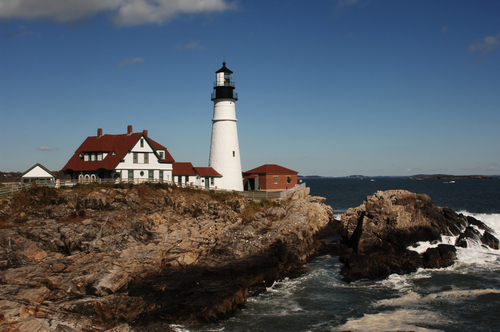
A lighthouse in MaineA profile of Maine, site of the Republican caucus on Feb. 11:
NUMBERS
Population: 1,328,361
AGE
Median age: 42.7
Percentage of population 65 and over: 15.9 percent
RACE AND ETHNICITY
95.2 percent white, 1.3 percent Hispanic or Latino origin, 1.2 percent black, 1 percent Asian
LANGUAGE
Language other than English spoken at home: 7.1 percent
EDUCATION
High school graduate or higher: 89.8 percent
Bachelor’s degree or higher: 26.5 percent
MONEY
Median household income: $46,933
People below poverty level: 12.6 percent
Home ownership rate: 73.1 percent
2008 PRESIDENTIAL RESULTS:
Barack Obama, 57.6 percent; John McCain, 40.4 percent; Ralph Nader, 1.4 percent.
REGISTERED VOTERS (as of 11/2/11):
Republican: 275,978
Democratic: 324,435
Undeclared: 355,037
Green Independent: 34,435.
MAINE QUICK FACTS:
— Maine is the nation’s most heavily forested state.
— Maine has 3,500 miles of coastline and 6,000 lakes and ponds.
— Maine fishermen harvested more than 100 million pounds of lobster in 2011.
— Hannibal Hamlin of Paris, Maine, served as vice president under Abraham Lincoln.
— Writer Stephen King was raised in Maine and lives in Bangor.
— Maine is nearly as large as the other five New England states combined.
— Maine is home to Mount Katahdin, the northern end of the Appalachian Trail and the state’s highest mountain at 5,268 feet
— Maine has the nation’s oldest median age.
___
Sources: 2010 U.S. Census data; Maine Office of the Secretary of State; State of Maine website. – Associated Press
This website uses cookies to improve your experience. We'll assume you're ok with this, but you can opt-out if you wish. Cookie settingsACCEPT
Privacy & Cookies Policy
Privacy Overview
This website uses cookies to improve your experience while you navigate through the website. Out of these cookies, the cookies that are categorized as necessary are stored on your browser as they are essential for the working of basic functionalities of the website. We also use third-party cookies that help us analyze and understand how you use this website. These cookies will be stored in your browser only with your consent. You also have the option to opt-out of these cookies. But opting out of some of these cookies may have an effect on your browsing experience.
Necessary cookies are absolutely essential for the website to function properly. This category only includes cookies that ensures basic functionalities and security features of the website. These cookies do not store any personal information.
Any cookies that may not be particularly necessary for the website to function and is used specifically to collect user personal data via analytics, ads, other embedded contents are termed as non-necessary cookies. It is mandatory to procure user consent prior to running these cookies on your website.