Zuma reiterates that Eskom’s problems are the fault of whites and ‘apartheid’

President Jacob Zuma used the ANC’s January 8 birthday rally to absolve his government from responsibility of the energy crises gripping the country, according to reports from the ANC shindig in Cape Town.

Zuma told over 50 000 of ANC supporters gathered at the Green Point Stadium on Saturday that “the ANC government should not feel guilty for the lack of power in the country”.

“The energy problem is not our problem today. It is a problem of apartheid which we are resolving,” he said.

Zuma reaffirmed comments he made in the past that apartheid was responsible for the rolling blackouts affecting the country.

“The reality is that we are dealing with the legacy of apartheid, which was skewed to deal with the minority and not the majority,” the president said.

Once upon a time, under National Party rule, South Africa had the cheapest power in the world, with excess production exported or sold at risible rates to aluminium smelters. Yet yesterday the country had to contend with a new round of “load shedding” as the state utility Eskom ran out of electricity again. The power utility said it was due to “high electricity demand and the unavailability” of some generating units. Stage one allows for up to 1 000MW of the national load to be shed, stage two for up to 2 000MW and stage three for up to 4 000MW.

Eskom has been fanatical about affirmative action and has laid off scores of white engineers, leaving the company without engineering and financial expertise but with high-salaried affirmative-action freeloaders.

“When commentators comment on energy they forget this (that apartheid was responsible for the lack of energy). They want to put the blame on the democratic government,” said Zuma.

The Mail & Guardian reported on Friday that Eskom would run out of money by the end of January.

However, Zuma refuses to shoulder any blame for the electricity mess in South Africa.

“The ANC government is accelerating the pace to bring the Medupi and Kusile power stations onto the grid and we are licensing independent power producers,” he said.

“We continue to evaluate options to maximise our energy mix including coal, gas, nuclear, solar and renewables,” he added.

A nuclear plan has also been announced by Zuma.

“The ANC is therefore putting energy as one of our apex priorities,” he said.

‘Monopoly capital’
Zuma’s speech focussed on the Freedom Charter, a Marxist document drawn up by Rusty Bernstein and others in 1955 and has since served as a central party manifesto to both the Communist Party and the ANC. He warned against monopoly capital:

“We must break the stranglehold of monopoly capital on our economic development. It is imperative that the Competitions Commission continues to address monopolistic, collusive and anti-competitive behaviour and become even bolder in their preventative and punitive measures.”

Zuma’s statements on the economy were warmly received by the Communist Party and its main trade union, Cosatu.

Cosatu President Sdumo Dlamini said he was “satisfied that the president raised the debate of racial transformation in the financial sector”.

“But it will remain a speech if there is no implementation,” he added.

Zuma wants banking to become more affordable too.

“Banking has become much more accessible to the majority of South Africans, but the excessive bank charges and fees mean that many people still cannot afford bank services,” he said.

The ANC is also preparing to implement a Zimbabwe-style “land reform” in South Africa, pushing white farmers off the land.

“We commit that the land will be returned to our people and the ANC calls on its government to act with the necessary speed to put the legislation in place, this year, to ensure that this happens.”

Czech artist gives Communists and Leftists the Finger

thefingerThe Czech artist David Cerny’s sculpture floats in the Vltava River and is aimed at the presidential residence, Prague Castle, in the background.

Mr. Cerny is not known for understatement or diplomacy after displaying a caricature of a former Czech president inside an enormous fiberglass rear end.

But on Monday, Mr. Cerny, 45, took his political satire to new heights when, on the eve of Czech general elections this weekend, he installed on the Vltava River a 10m plastic purple hand with a raised middle finger. It is a symbol, he said, that points directly at the Prague Castle, the seat of the current Czech president, Milos Zeman.

Mr. Cerny said the monumental hand with its outstretched middle finger, placed on a float facing the castle, was a “scream of alarm” against the state of politics in the Czech Republic, endemic corruption and Mr. Zeman, a former leftist prime minister, whom he accused of becoming intoxicated with power.

He said the sculpture, which he gave an unprintable title, was also aimed at the country’s Communist Party, which could gain a share of power in the coming elections for the first time since the revolution that overthrew communism more than two decades ago.

“This finger is aimed straight at the castle politics,” Mr. Cerny said by phone from Prague, the Czech capital. “After 23 years, I am horrified at the prospect of the Communists returning to power and of Mr. Zeman helping them to do so.”

Mr. Zeman, who was visiting Ukraine on Monday, declined to comment through a spokeswoman, who told the Czech news media that he had not yet seen the sculpture.

The sculpture is part of a Czech tradition of cultural rebellion dating to Communist times, when artists, writers and musicians like the Plastic People of the Universe used subversive lyrics or gestures to revolt against authority.

Black mob threatens school over its Afrikaans language medium

Heidelberg_ANCA mob chanting that they will burn the headmaster of an old and prestigious high school east of Johannesburg yesterday marched on the school, led by local politicians from the South African Communist Party and the ANC.

One of the ANC-Communist apparatchiks who participated in yesterday’s march in Heidelberg, Recato Eberwein, had previously written on a blog:

I personally hope genocide happens. Then we get rid of amabhunu’s that life (sic) in cuckoo land. Kill a Boer, Kill a Farmer. Until Jesus comes we the ANC will rule

The ANC-Communist Party provincial government in Gauteng is currently on an offensive to stamp out Afrikaans in schools under its radical MEC, Ms. Barbara Creecy, a self-confessed Marxist revolutionary.

After an incident during which a black pupil at Volkskool Heidelberg had tried to kill a white classmate, the school suspended the pupil concerned, pending a disciplinary hearing. Due to the race of the suspended pupil, it was immediately denounced as racism by local ANC-Communist Party officials.

After a previous protest had been prohibited by court order, a march was held yesterday to protest against the suspension of the murderous pupil, as well as 10 others who had been investigated for drug possession and abuse. This too, was denounced as “racism”.

Mr. Johan Bester, the school governing body’s representative for safety and security, said the suspended pupils were suspected of taking drugs.

“We have a drug monitoring system and we regularly test pupils for drugs,” said Bester.

“If they test positive they are suspended and we put them on a programme to help them.”

Anglo-black genocide pact

A retired historian in Nigel, a nearby town, told praag.org: “What we are seeing are old rancours coming to the fore. During the Anglo-Boer War the British military in these parts had encouraged armed Bantu men to kill and rape the Boer women. Boer civilians were also put into concentration camps where they were starved to death or left without water.

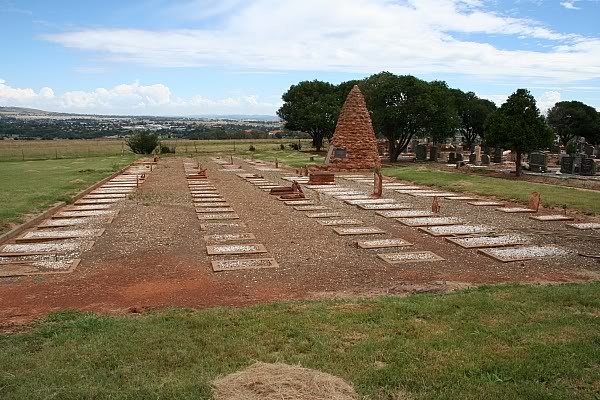
Children's graves at the British concentration camp site in Heidelberg
Children’s graves at the British concentration camp site in Heidelberg Photo: Boerevryheid

“This particular high school was founded just after the war, in a desperate attempt to save the Afrikaans language from being extirpated by the British administration. The fact that the school is today highly successful, displined and one of the top-performing schools in the province, is just too much to bear for Mrs. Creecy and pro-British genocidaires who are still nursing the Afrikaner hatred from hundred years ago.”

The mob was demanding that the century-old patriotic name of the school be changed to that of a local communist, Robert Nkosi. Another member of the South African Communist Party, Archie Mokonane of the South African Communist Party (SACP) told the crowd that the school was racist because it taught in Afrikaans.

“English is the language of proletarian internationalism, therefore all other languages are racist. Those people in Europe who teach in Dutch or German or French are racists too!”

Sipho Nhlengethwa, a local ANC councillor, said they would campaign for the school to be named after Obed Nkosi, a terrorist from Ratanda, the black township in the area. “This is our public school now, we have conquered the Boers,” said Nhlengethwa.

Regional leaders from the ANC, SA Communist Party, Cosatu and the Young Communist League handed over a memorandum of demands.

They want the school’s civilian governing body to be dissolved and replaced with a revolutionary communist council of “education workers”.

‘We will necklace them, we will burn them’

Young Red Guards chanting “we will necklace them, we will burn them”, referring to the Afrikaner pupils at Heidelberg Volkskool, disrupted and brought to a halt all education in the black township of Ratanda. School children were forced to participate in the protest, with both primary and high schools being deserted for the rest of the day. Bystanders put the number of marchers at 8 000. Teachers had told children that there would be no classes on Monday as “everybody had to march against the Afrikaner cockroaches”.

Volkskool was also accused of being racist because there were white players in the rugby team, with some members of the mob claiming that governmental race quotas for rugby only allowed one or two white players per team. “We want no whites in the team, it hurts our eyes to see whites,” said one.

A spokesman for the school blamed the inflamed racial tensions in the town on the provincial government’s failure to build an extra English-language high school, as promised in 1998. Cornelius Human, a member of the school’s governing body responsible for its legal affairs, said:

“What we found ourselves in was just a situation with wild allegations, with no substance – and we’re expected to act on them. It’s exactly the same situation that we have now.”

In hundred years, not much has changed in Heidelberg. The British concentration camp has gone, leaving a children’s graveyard like so many others in South Africa, but the hatred of Afrikaner children has stayed.

Controversies around Greece’s Golden Dawn party: a timeline

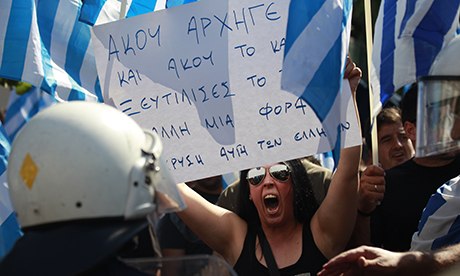
A protestor outside police headquarters in Athens holds a placard stating: 'Listen chief, listen again, you have ridiculed the system one more time - Golden Dawn of the Greeks'
A protestor outside police headquarters in Athens holds a placard stating: ‘Listen chief, listen again, you have ridiculed the system one more time – Golden Dawn of the Greeks’

Golden Dawn, the aggressive Greek right-wing party making headlines in the crisis-hit country after the murder of an anti-fascist musician, has gone from provocation to provocation in its short career in Greece’s parliament.

The party’s 18 lawmakers have been accused of using their parliamentary immunity to intimidate police and evade arrest, meaning that there are only a few cases of solid prosecution against them.

Until the murder of hip hop artist Pavlos Fyssas on Wednesday, police had failed to pursue most other cases of brazen aggression by suspected Golden Dawn members against migrants or political rivals.

– June 7, 2012: Golden Dawn party spokesman Ilias Kasidiaris, a former commando, strikes female Communist MP Liana Kanelli during a heated talk show debate. He escapes arrest by temporarily going into hiding. Parliament later lifts his immunity so Kasidiaris can face trial.

– June 12, 2012: Four Egyptian fishermen are attacked in their sleep in the working-class district of Perama by a gang of black-clad attackers. One victim is hospitalised with serious head injuries.

Six people arrested at the time denied involvement and were released. According to media reports, at least one of the assailants would take part in another beating of Communist party members in Perama a year later.

– September 7, 2012: Golden Dawn lawmakers George Germenis and Panagiotis Iliopoulos lead a black-clad detachment of party members to an open-air fair near Athens, where they proceed to smash the stalls of unlicensed migrant peddlers.

Another GD team headed by lawmaker Costas Barbaroussis carries out a similar operation in the western town of Messolonghi the following day.

Parliament has agreed to lift the immunity of all three MPs so they can be prosecuted.

– January 17, 2013: A Pakistani migrant is fatally stabbed in central Athens by two Greeks, one of them a fireman. Police later find Golden Dawn tracts at the one of the attackers’ homes.

– May 2, 2013: Athens Mayor George Kaminis bans a Golden Dawn food handout exclusively catering to Greeks as racist. Hours later, GD lawmaker George Germenis is detained after apparently trying to punch the mayor, and hitting a 12-year-old girl instead. Germenis’ immunity has again been lifted over the assault and he will be tried.

– September 12, 2013: Communists putting up posters in the working-class district of Perama are attacked by a large group of alleged Golden Dawn members bearing nail-studded clubs. Eight Communists are hospitalised but the attackers escape.

– September 18, 2013: Anti-fascist singer Pavlos Fyssas is fatally stabbed after an apparent ambush by suspected Golden Dawn members. The killer, George Roupakias, is immediately arrested and later confesses to police his Golden Dawn affiliation.

Golden Dawn continues to deny involvement and accuses its critics of slander, but pictures soon appear in the press, showing Roupakias participating in party events, wearing GD insignia. – AFP