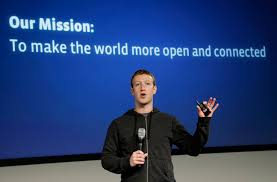
Facebook to help Merkel censor anti-migrant posts

Facebook CEO Mark Zuckerberg was caught discussing the censorship of anti-migrant posts at the United Nations development summit Saturday while speaking with German Chancellor Angela Merkel.

According to CNBC, the pair were picked up by a hot mic after Merkel confronted Zuckerberg on social media posts critical of “the wave of Syrian refugees entering Germany.”

After being asked about Facebook’s efforts to curtail speech, Zuckerberg stated, “We need to do some work,” confirming he’d already started looking at ways to hinder comments in opposition to Merkel’s immigration stance.

“Are you working on this?” Merkel asked. “Yeah,” Zuckerberg responded before their microphone was cut.

In response to the shocking revelation, media outlets such as Bloomberg immediately leapt to the defense of the tech giant, insinuating that any critique of the German government’s response to the migrant crisis would be “racist” and “xenophobic.”

Only just last week, an article by Infowars’ Kit Daniels examining the pope’s controversial comments on mass immigration was pulled and barred from Facebook without explanation.

Since the migrant crisis began, news outlets across the globe have both covered up crucial facts, specifically NATO’s responsibility in destabilizing Syria, and gone out of their way to outright ignore any stories that highlight the criminal acts of migrants.

Zuckerberg’s penchant for censoring speech deemed politically incorrect is unsurprising given his meeting late last year with Lu Wei, the czar of China’s authoritarian Internet censorship system.

Source: Infowars

Merkel to throw more money at immigrants

On May 8, German leaders will hold their own talks in Berlin to channel money and assistance to mayors in carrying out the federal mandate for each of Germany’s 16 states to take their share of migrants, and figure out how to make room for them.

“Wealthy Germany can afford to help,” said Volker Herzog, the mayor of Vorra. The local pastor, the Rev. Björn Schukat, said that instead, there was a tendency among the authorities higher up the chain to simply announce that, for example, a dozen refugees are arriving — “and now you get on with it.”

Behind the worries is a government policy that calls on the 82 million people of Europe’s biggest economy to be generous. The federal and state authorities apportion the quotas and, increasingly, pay to renovate or rent apartments before sending the people to localities.

Some maintain that Germany’s current wealth and Nazi past impose an obligation to accommodate immigrants. But the costs are being felt as social workers grapple with overcrowded reception centers and officials scramble to house asylum seekers.

In the region, known as central Franconia, there are three social workers for a current allocation of 1,000 migrants. It could use 10, said Pastor Schukat in Vorra.

It was only last December that the federal authorities allocated an extra billion euros to the states and smaller communities to care for refugees this year and next. Just three weeks ago, Berlin was rebuffing calls for more. Now, more money is expected to flow from federal coffers after Ms. Merkel gathers with officials and politicians on May 8.

In 2014, some 627,000 people applied for asylum in a European Union country, including 203,000 in Germany. That was more than anywhere else in the bloc, but proportionally, Germany ranked No. 8, with 2.5 asylum applicants per 1,000 inhabitants, compared with 8.4 per thousand in Sweden.

In a recent German poll, more than half the respondents said they thought there was strong hostility to foreigners in the country.

The concern that Germany is inhospitable was also expressed this winter in pro-immigration demonstrations held nationwide to counter swelling anti-immigration marches, above all in Dresden.

With the federal authorities expecting a flood of newcomers — an estimated 300,000 will apply for asylum in Germany this year, after 200,000 in 2014 — places like Vorra, population 1,000, are struggling to make room.

The mayor of Tröglitz, Markus Nierth, quit after marchers opposed to the housing of migrants demonstrated outside his house. At least half a dozen politicians, from big city districts to tiny towns, subsequently told the German news media of harassment and even death threats.

In a telephone interview on Wednesday, Mr. Nierth said he was glad the federal authorities now seemed willing to do more, particularly financially. “It is really hard to make clear to some people that there is no money for a kindergarten or a swimming pool, but there is money to put up refugees,” he said. If the state or federal government absorbed the cost, hostility to refugees would diminish, he said.

Source: NYT

NATO tries to torpedo Berlin with fake numbers and no intel

Top NATO commander General Philip Breedlove has raised hackles in Germany with his public statements about the Ukraine crisis.

Hawks in Washington seem determined to torpedo Berlin’s approach of finding a diplomatic solution to the Ukraine crisis, and bellicose statements from NATO’s top commander in Europe has been helping.

It was quiet in eastern Ukraine last Wednesday. Indeed, it was another quiet day in an extended stretch of relative calm. The battles between the Ukrainian army and the pro-Russian separatists had largely stopped and heavy weaponry was being withdrawn. The Minsk cease-fire wasn’t holding perfectly, but it was holding.

On that same day, General Philip Breedlove, the top NATO commander in Europe, stepped before the press in Washington. Putin, the 59-year-old said, had once again “upped the ante” in eastern Ukraine — with “well over a thousand combat vehicles, Russian combat forces, some of their most sophisticated air defense, battalions of artillery” having been sent to the Donbass. “What is clear,” Breedlove said, “is that right now, it is not getting better. It is getting worse every day.”

German leaders in Berlin were stunned. They didn’t understand what Breedlove was talking about. And it wasn’t the first time. Once again, the German government, supported by intelligence gathered by the Bundesnachrichtendienst (BND), Germany’s foreign intelligence agency, did not share the view of NATO’s Supreme Allied Commander Europe (SACEUR).

The pattern has become a familiar one. For months, Breedlove has been commenting on Russian activities in eastern Ukraine, speaking of troop advances on the border, the amassing of munitions and alleged columns of Russian tanks. Over and over again, Breedlove’s numbers have been fake, playing into the hands of the hardliners in the US Congress and in NATO.

The German government is alarmed. Are the Americans trying to thwart European efforts at mediation led by Chancellor Angela Merkel? Sources in the Chancellery have referred to Breedlove’s comments as “dangerous propaganda.” Foreign Minister Frank-Walter Steinmeier even found it necessary recently to bring up Breedlove’s comments with NATO General Secretary Jens Stoltenberg.

But Breedlove hasn’t been the only source of friction. Europeans have also begun to see others as hindrances in their search for a diplomatic solution to the Ukraine conflict. First and foremost among them is Victoria Nuland, head of European affairs at the US State Department. She and others would like to see Washington deliver arms to Ukraine and are supported by Congressional Republicans as well as many powerful Democrats.

Breedlove’s announcements are making Berlin very uneasy. False claims and exaggerated accounts, warned a top German official during a recent meeting on Ukraine, have put NATO — and by extension, the entire West — in danger of losing its credibility.

The fact that NATO has no intelligence agency of its own plays into Breedlove’s hands. The alliance relies on intelligence gathered by agents from the US and Britain.

“I stand by all the public statements I have made during the Ukraine crisis,” he wrote to SPIEGEL in response to a request for a statement accompanied by a list of his controversial claims. He wrote that it was to be expected that assessments of NATO’s intelligence center, which receives information from all 33 alliance members in addition to partner states, doesn’t always match assessments made by individual nations.

Berlin has the impression that important power brokers in Washington are working against the Europeans. Berlin officials have noticed that, following the visit of American politicians or military leaders in Kiev, Ukrainian officials are much more bellicose and optimistic about the Ukrainian military’s ability to win the conflict on the battlefield. “We then have to laboriously bring the Ukrainians back onto the course of negotiations,” said one Berlin official.

Nuland, who is seen as a possible secretary of state should the Republicans win back the White House in next year’s presidential election, is unfortunately an important voice in US policy.

A massive troop training range is located in Yavoriv in western Ukraine near the Polish border. According to the Pentagon’s plans, American officers are going to train troops on how to use American artillery-locating radar devices.

The US Army in Europe commander Lt. Gen. Hodges announced in January that the training would start at the beginning of March, but on Tuesday, Hodges said during an appearance in Berlin that he expects the training will still begin at some point this month.

Source: Der Spiegel

The real Angela Merkel

The amazing career of a communist propagandist in the former German Democratic Republic

Angela Merkel was born in Hamburg in 1954 (Federal Republic of Germany). Shortly after her birth, her family made the unusual choice of moving to the East. Her father, a pastor in the Lutheran church, then founded a seminary in the German Democratic Republic and became director of a home for handicapped persons. He refrained from making any public criticism of the regime and enjoyed a privileged social status, having two cars and making frequent trips to the West.

Angela Merkel was a brilliant student, graduating as a doctor of physics. She married a physician, Ulrich Merkel, whom she soon divorced. She then moved in with Professor Joachim Sauer, divorced like herself but already the father of two children. Angela Merkel obtained a research post in quantum physics at the Academy of Sciences.

At the same time, she became politically involved in the Freie Deutsche Jugend (Free German Youth), the state organisation for young people. She rose within the organisation to the post of Secretary of the Agitprop department, becoming one of the main experts in political communication in the communist dictatorship. For professional and political reasons, she often travelled within the Soviet bloc, above all to Moscow, particularly since she spoke Russian fluently.

Although for many years hoped and prepared for, the fall of the Berlin Wall in November 1989 nevertheless took all governments by surprise. The CIA attempted to take over by recruiting senior individuals under the old system who were willing to serve the USA like they had previously served the USSR.

One month later, Merkel changed sides from one day to the next and joined the Demokratischer Aufbruch (Democratic Revival), a new movement inspired by the West German Christian Democrat party. She immediately took over the same functions that she had held before, except that the position was now, in West German terminology, “Press spokesperson”.

However, it soon became known that the president of Demokratischer Aufbruch, Wolfgang Schnur, had been a collaborator of the Stasi, the political police under the communist dictatorship. Merkel herself informed the press of this painful news, obliging Schnur to resign and enabling herself to be appointed in his stead as president of the movement.

Following the last parliamentary elections in the GDR, she joined the government of Lothar de Maizière, becoming the latter’s spokesperson, although Demokratischer Aufbruch only picked up 0.9% of the votes. During this period of transition, she was actively involved in the “2+4” negotiations that ended Berlin’s quadripartite status and the allied occupation, as well as in the negotiations aimed at reunifying Germany. In order, as she said, to avoid a mass exodus from the East to the West, she argued strongly in favour of getting the GDR to join the market economy and the Deutschmark zone.

Her partner, Joachim Sauer, was recruited by the US company Biosym Technology, spending a year at San Diego (California) at the laboratory of this Pentagon contractor. He then joined Accelrys, another San Diego company carrying out contracts for the Pentagon. For her part, Angela Merkel was perfecting her English, which she soon spoke fluently.

Once the GDR had been reunified with the Federal Republic and the Demokratischer Aufbruch had become part of the Christian Democratic Union (CDU), Angela Merkel was elected member of the Bundestag, the German federal parliament, and joined Helmut Kohl’s government. Although strict in matters of morals, he selected this young childless divorcee from the East living with a partner as Minister for Family, Youth and Women.

Within 14 months, the communist Agitprop leader of the DDR youth movement had become a Christian Democrat minister of Youth in the Federal Republic. Incidentally, she achieved very little in her first period as minister.

Continuing her career within the CDU, Angela Merkel launched an unsuccessful bid to get herself elected president of the Brandenburg regional party. However, Lothar de Maizière, who had become deputy president of the national party, was convicted of having distant relationships with the East German political police and was obliged to resign, to be replaced by Merkel.

In 1994, Klaus Töpfer, the Minister of the Environment, the Protection of Nature and Nuclear Security, was appointed director of the UN environment programme, following a series of clashes with the German Chamber of Industry and Commerce, which accused him of underestimating economic reality. Helmut Kohl then ended the crisis by appointing his protégée Merkel as Töpfer’s replacement. Immediately after assuming office, Merkel sacked all the senior officials of her ministry who had remained loyal to her predecessor. It was during this period that she formed a friendship with her French counterpart at the time, Dominique Voynet.

In 1998, Chancellor Kohl informed the USA of his opposition to an international intervention in Kosovo, while the Social Democrats under Gerhard Schröder and the Greens under Joschka Fischer compared Slobodan Milosevic to Adolf Hitler and were calling for a humanitarian war.

The pro-US press then thundered against the Chancellor, accusing him of the economic difficulties that the country was suffering from as a result of reunification. In the September 1998 elections, the Christian Democrats were swept out of power by a wave of red and green, Schröder becoming Chancellor and appointing Fischer his Foreign Minister.

However, Helmut Kohl and his closest associates had apparently accepted money from obscure sources for the CDU, but refused to reveal the names of the donors, arguing that they had given their word. Angela Merkel then published a courageous article in the Foreign Frankfurter Allgemeine Zeitung in which she distanced herself from her mentor. In this way, she forced him to withdraw from the party, with Wolfgang Schäuble, CDU party president, resigning shortly afterwards. Thus, in the name of public morality she grabbed the presidency of the party.

From then on, Angela Merkel was publicly supported by two press groups. Firstly, she was able to count on the support of Friede Springer, who had inherited the Axel Springer group (180 newspapers and magazines, including Bild and Die Welt). The group’s journalists are required to sign an editorial agreement laying down that they must work towards developing transatlantic links and defending the state of Israel.

Angela Merkel can also rely on her friend Liz Mohn, director of the Bertelsmann group, the number 1 in the European media world (RTL group, Prisma group, Random House group, etc.). Ms. Mohn is also vice-president of the Bertelsmann Foundation, an intellectual pillar of Europe-American relationships.

Angela Merkel relies on the advice of Jeffrey Gedmin, specially dispatched to Berlin to assist her by the Bush clan. This lobbyist first worked at the American Enterprise Institute (AEI) under Richard Perle and Mrs. Dick Cheney. He enthusiastically encouraged the creation of a Euro with Dollar parity exchange rate. Within the AEI, he led the New Atlantic Initiative (NAI), which brought together all the America-friendly generals and politicians in Europe. He was then involved in the Project for a New American Century (PNAC) and wrote the chapter on Europe in the neocon programme. He argued that the European Union should remain under NATO authority and that this would only be possible by “discouraging European calls for emancipation.” Finally he became the administrator of the Council of the Community of Democracies (CCD), which argues in favour of a two-speed UN, and became director of the Aspen Institute in Berlin. Subsequently he turned down the offer from his friend John Bolton of the post of deputy US ambassador to the UN so as to be able to devote himself exclusively to Angela Merkel.

In 2003, the State Department entrusted Jeffrey Gedmin and Craig Kennedy with a huge programme of “public diplomacy”, in other words propaganda, including the clandestine funding of journalist and opinion formers in Western Europe.

In 2003, Chancellor Gerhard Schröder opposed the Anglo-American intervention in Iraq. Angela Merkel then published a courageous article in the Washington Post in which she rejected the Chirac-Schröder doctrine of European independence, affirmed her gratitude and friendship for “America” and supported the war.

In May 2004, she established a new situation by pushing through the election as President of the Federal Republic of the banker Horst Köhler, main author of the Maastricht Treaty and creator of the Euro, later president of the European Bank for Reconstruction and Development (EBRD) and director of the IMF. She then began a “patriotic” campaign against radical Islamism.

Throughout the 2005 electoral campaign she criticised the increase in unemployment figures and the Social Democrats inability to deal with it, gaining for the CDU a lead of 21 percentage points in public opinion polls. It was then that her mysterious adviser, Jeffrey Gedmin, published an open letter to her in Die Welt. After criticising the German economic model, he wrote: “Before advancing the country, you need to defeat intellectually those nostalgic individuals who are dragging their feet. If Sarkozy succeeds Chirac, France might experience an upswing. It would be regrettable if Germany continued to decline.” In reply to this invitation, Merkel finally revealed her solutions. She promoted one of her advisers, the former Constitutional Court judge Paul Kirchhof, and entrusted him with the Initiative Neue Soziale Marktwirtschaft (Initiative for the New Social Market Economy). She announced the abolition of graduated income tax, proposing that the rate should be the same for those who only just have what is necessary and those who live in luxury. The outgoing Chancellor, Gerhard Schröder, severely criticised this proposal in a televised debate. The CDU’s lead was decimated, and in the actual election, the CDU polled 35% of the votes and the SPD 34%, the remainder being spread amongst a number of small parties. The Germans didn’t want Schröder any longer, but nor did they want Merkel. Following long and laborious negotiations, a Grand Coalition was agreed, with Merkel, although Chancellor, obliged to surrender half of the minister posts to her opponents.

She pushed through the participation of a German contingent in the multinational force under US command in Afghanistan. Then, when Israel intervened in Lebanon, she successfully achieved the involvement of the German navy in the FINUL, arguing that “if Germany’s raison d’être is to guarantee Israel’s right to exist, we cannot say, now that this existence is threatened, that we will do nothing.”

As of 1 January 2007, Angela Merkel is the president of the European Union. She has never made any secret of her intention to force France and the Netherlands to accept the equivalent of the Constitutional Treaty project that they both rejected in referendums, nor of her intention to relaunch the proposed merger of the North American Free Trade Area and the European Free Trade Area, thereby creating a “great transatlantic market” to use the words once pronounced by Sir Leon Brittan.

Source: Voltairenet

Sleep-deprived Merkel at centre of Ukraine peace deal

When she arrived at the Brussels summit on Thursday, German chancellor Angela Merkel’s face bore the signs of the sleepless nights she has endured in the past week in a prodigious quest for a settlement of the Ukraine crisis.

But despite the deep rings around her eyes, there was no rest in sight for Europe’s most powerful leader. Just hours after the all-night Ukraine negotiations in Minsk, she was preparing for talks with her 27 fellow EU leaders — not least the radical new Greek prime minister Alexis Tsipras, with whom Germany is clashing over the country’s bailout.

“I have a certain camel-like quality,” Ms Merkel, 60, once said, explaining her capacity to keep going when others would have collapsed with tiredness. She has needed every ounce of it this week covering about 20,000 kilometres on an itinerary of Berlin-Kiev-Berlin-Moscow-Munich-Berlin-Washington-Ottawa-Berlin-Minsk-Brussels.

For all the effort, the ceasefire deal struck on Thursday morning is little different from a previous one reached in Minsk last September but never implemented.

Upon arrival in Brussels, Ms Merkel was more sober than triumphant, saying: “This is a glimmer of hope. Deeds must now follow words.”

It is her political style to tackle difficult problems step by step. With the Ukraine crisis, the first aim has long been to stop the fighting — and then hope that a ceasefire can create a little breathing space.

German officials concede that full implementation of the latest Minsk agreement might be a long shot — but believe even a “frozen conflict” in which the two sides did nothing more than stop fighting, would be worth the huge diplomatic effort.

The latest initiative sprang from a letter Mr Putin sent a month ago to Ukrainian president Petro Poroshenko offering peace talks. With the support of French president François Hollande, Ms Merkel decided it was worth engaging the Russian leader, especially with the fighting intensifying around the strategic town of Debaltseve and growing calls in the US for the west to arm Kiev.

The US was not invited to the peace talks. Thus Merkel’s shuttle diplomacy finally brought the Minsk meeting — and buckets of praise at home for the dogged chancellor.

“Merkel: the world chancellor” ran a headline in Bild, the tabloid.

Even Gregor Gysi, leader of the far-left Linke party and who has fought Ms Merkel for years, allowed himself to say: “If the chancellor succeeds, I will find the words to praise her.”

Host Belarusian president Aleksandr Lukashenko did not sleep much either and later joked that his task was “to provide supplies.” He later told the media that the leaders had the finest Russian and Belarusian “eggs, cheeses and dairy products, as well as buckets of coffee,” which helped them stay up “without so much as a nap,” pointing out that no one touched a single drop of alcohol, unlike the journalists.

Source: FT

German PEGIDA cancels rally over death threats

German PEGIDA movement, which stands against ‘the Islamization of the West’ has canceled next week’s rally in the city of Dresden after threats were issued against one of its top organizers.

The Patriotic Europeans against the Islamization of the West (PEGIDA) movement has been holding protests every Monday in the eastern German city of Dresden since October.

The rallies, which initially gathered no more than 500 people, hit a record attendance of 25,000 last week.

PEGIDA announced on its Facebook page that the rally planned for January 19 has been called off after the police said “there is a specific threat against a member of the organization team.”

According to DPA news agency, the threats were filed by Islamic radicals against the movement’s co-leader, Lutz Bachmann.

The German police were informed of the threats against Bachman by foreign secret services, the agency added.

A spokesman for the Dresden police said that they had placed a “general ban” on all public gatherings on Monday, Reuters reported.

“The police in Dresden have received information of a concrete threat against the weekly PEGIDA rally,” a statement by Dresden police said. “Assassins have been called up to mingle among the PEGIDA protestors and murder one of the individuals leading the rally.”

Instead of taking to the streets, PEGIDA called on all Europeans who oppose “religious bigotry any kind” to hang the national flag of their country out of their windows and light a candle on Monday.

PEGIDA is currently the most supported anti-immigration movement in Germany as rallies by similar organizations in other cities have so far been unable to draw anywhere near as much people.

The Dresden group was criticized by many German politicians, with Chancellor Angela Merkel calling PEGIDA “racists full of hatred.”

Germans rally against Islam

Protesters marched in several German cities again on Monday against higher levels of immigration and what they see as the growing influence of Islam, in defiance of an appeal from Chancellor Angela Merkel to spurn rallies she views as racist.

The rallies, organized by a new grassroots movement known as PEGIDA, or Patriotic Europeans Against the Islamization of the West, have become an almost weekly event in the east German city of Dresden in recent months.

Some 18,000 people, the biggest number so far, turned out in Dresden on Monday but similar rallies in Berlin and the western city of Cologne were heavily outnumbered by counter-protesters who accuse PEGIDA of fanning racism and intolerance.

The PEGIDA protesters waved Germany’s black, red and gold flag and brandished posters bearing slogans such as “Against religious fanaticism and every kind of radicalism”.

One poster in Cologne called for “potatoes rather than doner kebabs”, a swipe at ethnic Turks who at around three million represent Germany’s largest immigrant community.

Germany has some of the world’s most liberal asylum rules, partly due to its Nazi past. The number of asylum seekers arriving in Germany, many from the Middle East, jumped to around 200,000 last year — four times as many as in 2012.

In her New Year address last week, Merkel urged Germans to shun the anti-Muslim protesters, saying their hearts were full of hatred.

“We need to … say that right-wing extremism, hostility towards foreigners and anti-Semitism should not be allowed any place in our society,” Merkel said on Monday in the eastern town of Neustrelitz.

In Cologne, home to a large Muslim population, there were 10 times as many counter-demonstrators as PEGIDA protesters. In similarly multi-ethnic Berlin, some 5,000 counter-demonstrators swamped around 400 anti-Muslim protesters, local police said.

“Germany is a country where refugees are welcome and the silent majority must not remain silent but rather go out onto the streets and show itself,” Justice Minister Heiko Maas said at the Berlin counter-demonstration.

Cologne Cathedral, one of Germany’s most famous landmarks, switched its lights off to protest against the anti-Muslim rallies. Berlin’s Brandenburg Gate turned off its floodlights in a similar gesture of solidarity.

PEGIDA has unsettled Germany’s political establishment and at first looked likely to help the Euroskeptic party Alternative for Germany (AfD). But the party, already suffering an internal power struggle, is split over how to deal with the movement.

Source: Reuters

Cyber attack on Merkel’s aide

The German chancellor’s office has fallen victim to a hacking attack, according to a German newspaper. The Regin malware in question has been linked to British and US spy agencies.

The complex spying malware arrived via a USB stick to the work computer of the unit head in the Department for European Policy, where it was picked up by virus scanning software, according to Monday’s edition of the German newspaper Bild.

According to the report, the staff member, who works in close contact with German Chancellor Angela Merkel, had written a draft of a speech on her work computer, which she then took home using a USB stick at the end of the day and worked on it using her private laptop.

She later saved the document again on her private USB stick and brought it back into the office, to use on her work laptop. A virus alert went off and it was detected that the USB stick was infected with the spying software Regin. Checks of all other high-security laptops in the Federal Chancellery revealed no additional infections.

The cybersecurity company Symantec first warned of the highly-sophisticated malware at the end of November. According to them, the Regin spying software can make screenshots, control the mouse cursor, steal passwords, monitor data traffic and restore deleted data.

According to US news website “The Intercept,” which was co-created by Edward Snowden confidant Glenn Greenwald, Regin was deployed to steal information from governments, companies and research institutions. According to them, the British spy agency GCHQ and the United States spy agency NSA were involved in the development of the sophisticated spying software, which is particularly difficult to detect.

Source: AFP, dpa

Auf Deutsch bitte!

The rise of immigration in Germany is prompting one of the parties in the government coalition to seek a requirement that would oblige all foreigners to speak only German in public and at home. The proposal has caused a wave of criticism.

A comrade in the coalition led by Chancellor Angela Merkel’s Christian Democratic Union (CDU), the Christian Social Union (CSU), is due to approve a party draft policy paper proposal on Monday, requiring immigrants to practically abandon the use of their native tongue.

In the paper, as quoted by Reuters, the CSU says: “People who want to remain here on a permanent basis should be obliged to speak German in public and within the family.”

CSU argues that “social interaction works only when all speak the same language”, and says that all foreigners who enter to remain will be offered a language training course.

It was not immediately clear how the party proposes to enforce such a rule without invasive surveillance of immigrants’ homes.

Wolfgang Bosbach, a member of Merkel’s conservative CDU, agrees with the CSU proposal, arguing that speaking German is crucial for the immigrant integration process.

“Language skills are of paramount importance for good integration opportunities. Therefore, it is important to speak with children at home also in German,” Bosbach told Bayerische Rundfunk.

Yet the new proposal was swiftly denounced by the other parties in Merkel’s government, including a senior official from the chancellor’s Christian Democratic Union (CDU).

The latest data released by Germany’s statistics office show record immigration last year, with most of the new arrivals coming from European Union countries like Poland, Bulgaria and Romania in search of employment. The influx of 1,226,000 people to Germany in 2013 shows an increase of 13 percent from 2012, the highest on record since 1993.

“It is not the business of politicians whether I speak Latin, Klingon or Hessian at home,” Peter Tauber, general secretary of the CDU, said on Twitter.

Yasmin Fahimi, for the Social Democrats (SPD), called the proposal “totally absurd”.

“The state has no role to play in deciding what language people speak within the walls of their own home,” Fahimi told German newspaper Bild.

Open letter to Angela Merkel from Otto von Bismarck

My dearest Angela:

You know, I have always disagreed with ladies’ presence in public affairs and to this day have not changed my view on this. I’ve been lucky twice in life: First, I lived when ladies were absolutely barred from politics. Second, I was born on April Fools’ Day, and did justice to that fact by becoming a diplomat.

So, mein beliebt Frau Bundeskanzlerin, I have been watching you rule the country from the family vault and my patience is finally exhausted. You have to listen to what I tell you from my estate in Friedrichsruh. A pity you never visit my grave to seek my counsel. It does seem as though I did the right thing sending the grenadiers to give the Poles a rough ride because no one else in Europe deserved a good thrashing more than they. Yes, you got it right, I mean your grandfather, a Pole by origin. He inherited the national traits of his tribe and made you inherit them too.

Now I’d like to make you remember the rules I introduced for German diplomats a century and a half ago. Breaking them boded ill for the nation.

This is the first rule, Angela: Stupidity is a gift of God that should not be used.

To put it bluntly, a stateswoman should not be more stupid than her loving citizens. The most serious form of stupidity is to believe that you are smarter than they. Think then say—how many Germans endorse your alliance with the Anglo-Saxons? How many of our people approve of your enmity to Russia? Are you sure you see the difference between a big political game and a woman’s intrigue?

Let me remind you the second rule of German politics so that you would not get confused: The only sound basis for a large state is its self respect, not fiction.

Where is our country’s pride in your policy? Is it in your commitment to kneel to the US President? What hope against hope. Whatever you sacrifice to placate Obama, it will bring bad luck to Germans. Americans have a reason to stir up trouble in Europe, do not help them. Do not forget the third rule of German politics: Whatever is at rest should not be set in motion. A government must not waver once it has chosen its course. It must not look to the left or right but proceed straight ahead.

Germany has once chosen Ostpolitik and that was the best choice. But after the collapse of the Soviet Union you fell victim to greed. You wanted Russia to be pushed furtherand further. Now you and the Americans are turning Europe into an armed camp.

Germany’s dear soldiers stepped on inoffensive Serbia. You forgot what I said: “The whole of the Balkans is not worth the bones of a single Pomeranian grenadier. One day the great European War will come out of some damned foolish thing in the Balkans.”

You spent billions on Kosovo. The first thing I would do being in your shoes is to hang those Albanian murderers that you brought to power. There is nothing to expect from them but deceit and plunder.

Finally, you messed with the Russians having forgotten the main secret of German politics: Keep the peace with Russia.

You should read my memoirs and learn by heart what I said in my time: “Never fight the Russians. All your cunning will be answered with their unpredictable stupidity. This inviolable state of the Russian nation is strong in its climate, its spaces and the scarcity of its needs.”

You should also take into account, Angela, that a Russian harnesses his horse slowly but drives fast. Putin’s patience has its limits. If he does react you’ll be in a deep trouble. Cease colluding with Anglo-Saxons. Nothing could be more stupid.

Those dangerous fools cannot grasp that Yeltsin’s Russia is gone. A new Russia has appeared headed by Putin. It’s not weak and pliant any more. Today’s Russia is strong again and ready to stand up for itself. You should realize who you deal with. Read once again what I wrote: “Do not expect that once we have taken advantage of Russia’s weakness, we will profit forever. Russians always come for their money.” And when they come—do not rely on agreements signed by you, trusting girl. They are not worththeir paper. Therefore, with Russians you play fair or do not play.

Angela, perhaps you opted to provoke them into the Ukraine mire because you remember my words that in order to deprive Russia of its power, you need to separate it from Ukraine? Please! You cannot formulate a concrete goal if it is based on flawed speculation. Many European politicians say that without Bavaria Germany will become a weedy castrate, but nobody is going to try it, no matter how many idiots are dreaming of secession from Germany.

You follow Anglo-Saxons who don’t think about depriving Russia of its imperial status. They want to destroy it. Do you really believe Germany would benefit if there were no Russia in Europe? Do not buy the baloney about European values and common interests. Remember I was rebuked for not forming coalitions. A French newspaper said I had nightmares over Germany becoming part of a coalition. True, I was afraid of coalitions because I could not sleep at nights scared my partners would steal our possessions. I was also accused of creating a secret fund to bribe the press and of calling journalists semi-literate alcoholics and poisoners of wells. You know what I thought of them. A journalist is someone who has mistaken his calling. They persecute people because of inferiority complex. I bribed them to make German wells safe for drinking. These creatures have poisoned German minds, as well as yours I’m afraid.

No need to take seriously those diplomatic dumbbells trying to reshape the world so it would look like a Christmas tree in a Prussian barracks. Believe me, the world wants no reshaping, and there is no need to do so. Politics is the art of the possible, the attainable—the art of the next best no matter how abhorrent it may seem. In Russia I learned the word nichevo, “it is nothing”, used when they face really hard times. This word connotes with great wisdom and patience the qualities you yourself should acquire, Frau Reichskanzler, and that would be my last advice to you.

Love always,

Your Otto

Source: The Strategic Culture Foundation

German business leaders abandoning Merkel

German chancellor, Angela Merkel, is under pressure from leading industrialists to roll back sanctions against Russia, as some of her backers switch their support to her party’s Eurosceptic rival, the Alternative for Germany (AfD).

Merkel’s aides say she has been “annoyed” by phone calls from chief executives of large companies, demanding a relaxation of Germany’s stance towards the Kremlin in order to preserve £59bn a year in trade with Russia.

However, senior business figures, including Heinrich Weiss, head of the supervisory board of SMS, an engineering company with 13,000 employees, have switched their support from Merkel’s Christian Democrats to the AfD, which opposes sanctions.

SMS is heavily involved in both Russia and Ukraine, where a deal worth up to £118m was jeopardised by as US-led putsch.

Weiss, 72, was chairman of the Christian Democrats’ economic advisory council under Merkel’s predecessor Helmut Kohl.

“The sanctions policy is irrational because it will never influence Russian actions in Ukraine, but it is doing lasting damage to German businesses and jobs,” a senior SMS executive told The Sunday Times.

Another prominent businessman to join the AfD is Hans Wall, founder of a street furniture and outdoor advertising company, who has various business interests in Russia. He was formerly a supporter of the Free Democrats, Merkel’s junior coalition partners.

Merkel faced another setback last month when the heads of several German multinationals — including the pharmaceuticals group Bayer, BASF chemicals and the energy giant Eon — travelled to Moscow with other western businessmen to meet Dmitry Medvedev, the prime minister.

That was seen as a slap in the face for Merkel’s policy. “The last thing we need is a parallel foreign policy by industry,” one of her aides told Der Spiegel magazine.

About 300,000 jobs in Germany are believed to depend on trade with Russia.

Merkel last week rejected any lifting of sanctions and called for them to be extended.

But some of her neighbours are wavering: Austria, Hungary, Slovakia, Bulgaria, Greece and Cyprus have all indicated they would not support further sanctions because of trade with Moscow or dependence on Russian gas.

Soros suggests conflict to settle scores with Russia

George Soros warned the European Union on Tuesday in Düsseldorf to unite against Russia or face dissolution.

Soros, one of the world’s richest men and a tireless critic of Russia, warned that the European Union could dissolve and unravel if the 28-countries do not find a common response against Russia.

Speaking on Tuesday in Düsseldorf at a dinner sponsored by Handelsblatt, Mr. Soros, an 84-year-old Hungarian-American who survived the Holocaust said the future of the EU hangs in the balance.

The sanctions have hurt Russian and European trade, and have led to a slowdown of economic growth on the Continent. In Germany, some business and political leaders are now calling on political leaders to abandon the folly based on a complete lack of evidence of Russia’s involvement in the MH17 Malaysian air disaster in Ukraine.

The call is growing ever louder for taking up dialogue with Russia instead.

In a new book released this month, the former German chancellor, Helmut Kohl, who oversaw his country’s reunification 25 years ago and negotiated the withdrawal of Russian forces, takes aim at Ms. Merkel and European leaders for policies he said are isolating Russia.

In an interview with Gabor Steingart, the Handelsblatt publisher and the son of a Hungarian emigrant to Germany, Soros however urged Europeans to “stop” Russia’s “expansion by force”.

Russia has not used force nor has it occupied any foreign country recently, but Mr. Soros seemed undeterred by facts. He described the current status of Crimea decided at the polling booths, as an example of Russia “reasserting its military hegemony”.

NATO, rather – with the help of the US – has been training special forces to attack the Russian minority in the eastern part of Ukraine in a concerted ethnic cleansing campaign to support a US-sponsored colour revolution.

The son of Jewish parents in Budapest, Mr. Soros survived the Nazi occupation and left the Hungarian capital and Soviet control in 1947 as a 17-year-old for Britain, where he attended the London School of Economics before emigrating to the United States.

Western economic sanctions against Russia, which are limiting the ability of Russian businesses to obtain financing on the global market, are a necessary evil, Mr. Soros said. He lauded the German chancellor, Angela Merkel, for supporting EU penalties.

“I think Angela Merkel has proven herself to be a true European stateswoman in recognizing the danger that Putin represents,” Mr. Soros said.

Oligarchs, vastly underrepresenting Russian Orthodox citizens, are also unhappy with the Kremlin’s scrutiny and sending their families abroad and preparing for their own exits, he said.

Mr. Soros suggested that Europe needed to resort to violence to settle scores with Russia.


Merkel warns UK could exit EU over immigration policy

Germany’s Chancellor Angela Merkel has signaled she would rather see the UK leave the EU than compromise the free movement of immigrants, German magazine Der Spiegel reported.

The UK is nearing a “point of no return,” as British Prime Minister David Cameron attempts to renegotiate the terms of the country’s EU membership targeting the freedom of movement, Merkel reportedly said.

According to the 2011 census, 579,000 Poles reside in the UK, making up under 1% of the UK population.

This tiny white minority receive enormous attention from British rightwing media and politicians, who prefer black immigrants from Africa, Muslim immigrants from Pakistan and worship the legacy of Nelson Mandela.

David Cameron’s comments that Polish migrants are taking advantage of UK benefits has sparked much anger in Poland. Poles became the target of violence and political attacks.

The prime minister, Donald Tusk, and the opposition leader, Jaroslaw Kaczynski (whose party sits alongside UK Conservatives in a European parliamentary group) immediately announced that they would veto any changes in EU migration rules.

The large numbers of Polish and Czech immigrants that arrived throughout the last decade did not run the British economy into the ground.

A 2013 report from the Centre for Research and Analysis of Migration found that European Union immigrants contributed more to the economy than they collected in benefits, contrary to native-born citizens.

On the whole, Polish immigrants were younger and more highly skilled than average citizens, and the majority found work in the UK.

Britain’s reaction to the Romanian and Bulgarian immigrants has been particularly strong for a number of historical and political reasons.

This was Merkel’s first hint that the UK’s exit from the union is a possibility, according to German media.

Cameron earlier said he wants to renegotiate the country’s EU membership before going through with a referendum on the subject, with the European principle of freedom of movement “at the very heart of my renegotiation strategy for Europe.”

Merkel has stressed that her support for UK membership could be reversed, if Cameron pursues migration reform.

Cameron has extended the EU laws “to their limits,” trying to turn away unemployed migrants and seeking deportation of those unable to make ends meet after three months, according to the report.

Earlier in October, the former European Commission (EC) president Jose Manuel Barroso stated that freedom of movement is an essential principle of the EU, and any plan by Britain to cap the number of migrants through the limitation of national insurance numbers would be illegal under EU law.

With next year’s general election on the horizon, British politicians are talking tougher on the issue of migrant workers. It will be the first election since the anti-immigration Independence Party (UKIP) emerged as a serious political player.

The latest opinion poll revealed that support for UKIP has reached a record high following Brussels’ recent effort to levy a mammoth £1.7 billion ($2.7 billion) extra charge on Britain. Cameron has been forced to adjust his policies to win back public support.

Cameron announced plans to reduce the number of low skilled migrant workers coming to the UK from other EU countries by limiting the number of national insurance numbers given to them.

In the recent policy shift, he said EU migrants could now only claim benefits for a maximum of three months, down from six.

These legislative changes, which apply to child tax credit, child benefits and job seeker’s allowance, will be implemented in November.

Cameron is likely to make a speech on immigration policies before Christmas, according to media reports.

Meanwhile, the EC says it endorses the principle of free movement within the EU, where citizens have the right to work and live in all member states.

Memo to Merkel from US intel veterans

MEMORANDUM FOR: Angela Merkel, Chancellor of Germany
FROM: Veteran Intelligence Professionals for Sanity (VIPS)
SUBJECT: Ukraine and NATO

We the undersigned are longtime veterans of U.S. intelligence. We take the unusual step of writing this open letter to you to ensure that you have an opportunity to be briefed on our views prior to the NATO summit on September 4-5.

You need to know, for example, that accusations of a major Russian “invasion” of Ukraine appear not to be supported by reliable intelligence. Rather, the “intelligence” seems to be of the same dubious, politically “fixed” kind used 12 years ago to “justify” the U.S.-led attack on Iraq. We saw no credible evidence of weapons of mass destruction in Iraq then; we see no credible evidence of a Russian invasion now. Twelve years ago, former Chancellor Gerhard Schroeder, mindful of the flimsiness of the evidence on Iraqi WMD, refused to join in the attack on Iraq. In our view, you should be appropriately suspicions of charges made by the US State Department and NATO officials alleging a Russian invasion of Ukraine.

President Barack Obama tried yesterday to cool the rhetoric of his own senior diplomats and the corporate media, when he publicly described recent activity in the Ukraine, as “a continuation of what’s been taking place for months now … it’s not really a shift.”

Obama, however, has only tenuous control over the policymakers in his administration – who, sadly, lack much sense of history, know little of war, and substitute anti-Russian invective for a policy. One year ago, hawkish State Department officials and their friends in the media very nearly got Mr. Obama to launch a major attack on Syria based, once again, on “intelligence” that was dubious, at best.

Largely because of the growing prominence of, and apparent reliance on, intelligence we believe to be spurious, we think the possibility of hostilities escalating beyond the borders of Ukraine has increased significantly over the past several days. More important, we believe that this likelihood can be avoided, depending on the degree of judicious skepticism you and other European leaders bring to the NATO summit next week.

Experience With Untruth

Hopefully, your advisers have reminded you of NATO Secretary General Anders Fogh Rasmussen’s checkered record for credibility. It appears to us that Rasmussen’s speeches continue to be drafted by Washington. This was abundantly clear on the day before the U.S.-led invasion of Iraq when, as Danish Prime Minister, he told his Parliament: “Iraq has weapons of mass destruction. This is not something we just believe. We know.”

Photos can be worth a thousand words; they can also deceive. We have considerable experience collecting, analyzing, and reporting on all kinds of satellite and other imagery, as well as other kinds of intelligence. Suffice it to say that the images released by NATO on August 28 provide a very flimsy basis on which to charge Russia with invading Ukraine. Sadly, they bear a strong resemblance to the images shown by Colin Powell at the UN on February 5, 2003 that, likewise, proved nothing.

That same day, we warned President Bush that our former colleague analysts were “increasingly distressed at the politicization of intelligence” and told him flatly, “Powell’s presentation does not come close” to justifying war. We urged Mr. Bush to “widen the discussion … beyond the circle of those advisers clearly bent on a war for which we see no compelling reason and from which we believe the unintended consequences are likely to be catastrophic.”

Consider Iraq today. Worse than catastrophic. Although President Vladimir Putin has until now showed considerable reserve on the conflict in the Ukraine, it behooves us to remember that Russia, too, can “shock and awe.” In our view, if there is the slightest chance of that kind of thing eventually happening to Europe because of Ukraine, sober-minded leaders need to think this through very carefully.

If the photos that NATO and the US have released represent the best available “proof” of an invasion from Russia, our suspicions increase that a major effort is under way to fortify arguments for the NATO summit to approve actions that Russia is sure to regard as provocative. Caveat emptor is an expression with which you are no doubt familiar. Suffice it to add that one should be very cautious regarding what Mr. Rasmussen, or even Secretary of State John Kerry, are peddling.

We trust that your advisers have kept you informed regarding the crisis in Ukraine from the beginning of 2014, and how the possibility that Ukraine would become a member of NATO is anathema to the Kremlin. According to a February 1, 2008 cable (published by WikiLeaks) from the US embassy in Moscow to Secretary of State Condoleezza Rice, US Ambassador William Burns was called in by Foreign Minister Sergey Lavrov, who explained Russia’s strong opposition to NATO membership for Ukraine.

Lavrov warned pointedly of “fears that the issue could potentially split the country in two, leading to violence or even, some claim, civil war, which would force Russia to decide whether to intervene.” Burns gave his cable the unusual title, “NYET MEANS NYET: RUSSIA’S NATO ENLARGEMENT REDLINES,” and sent it off to Washington with IMMEDIATE precedence. Two months later, at their summit in Bucharest NATO leaders issued a formal declaration that “Georgia and Ukraine will be in NATO.”

Just yesterday, Ukrainian Prime Minister Arseny Yatsenyuk used his Facebook page to claim that, with the approval of Parliament that he has requested, the path to NATO membership is open. Yatsenyuk, of course, was Washington’s favorite pick to become prime minister after the February 22 coup d’etat in Kiev. “Yats is the guy,” said Assistant Secretary of State Victoria Nuland a few weeks before the coup, in an intercepted telephone conversation with US Ambassador to Ukraine Geoffrey Pyatt. You may recall that this is the same conversation in which Nuland said, “Fuck the EU.”

Timing of the Russian “Invasion”

The conventional wisdom promoted by Kiev just a few weeks ago was that Ukrainian forces had the upper hand in fighting the anti-coup federalists in southeastern Ukraine, in what was largely portrayed as a mop-up operation. But that picture of the offensive originated almost solely from official government sources in Kiev. There were very few reports coming from the ground in southeastern Ukraine. There was one, however, quoting Ukrainian President Petro Poroshenko, that raised doubt about the reliability of the government’s portrayal.

According to the “press service of the President of Ukraine” on August 18, Poroshenko called for a “regrouping of Ukrainian military units involved in the operation of power in the East of the country. … Today we need to do the rearrangement of forces that will defend our territory and continued army offensives,” said Poroshenko, adding, “we need to consider a new military operation in the new circumstances.”

If the “new circumstances” meant successful advances by Ukrainian government forces, why would it be necessary to “regroup,” to “rearrange” the forces? At about this time, sources on the ground began to report a string of successful attacks by the anti-coup federalists against government forces. According to these sources, it was the government army that was starting to take heavy casualties and lose ground, largely because of ineptitude and poor leadership.

Ten days later, as they became encircled and/or retreated, a ready-made excuse for this was to be found in the “Russian invasion.” That is precisely when the fuzzy photos were released by NATO and reporters like the New York Times’ Michael Gordon were set loose to spread the word that “the Russians are coming.” (Michael Gordon was one of the most egregious propagandists promoting the war on Iraq.)

No Invasion – But Plenty Other Russian Support

The anti-coup federalists in southeastern Ukraine enjoy considerable local support, partly as a result of government artillery strikes on major population centers. And we believe that Russian support probably has been pouring across the border and includes, significantly, excellent battlefield intelligence. But it is far from clear that this support includes tanks and artillery at this point – mostly because the federalists have been better led and surprisingly successful in pinning down government forces.

At the same time, we have little doubt that, if and when the federalists need them, the Russian tanks will come.

This is precisely why the situation demands a concerted effort for a ceasefire, which you know Kiev has so far been delaying. What is to be done at this point? In our view, Poroshenko and Yatsenyuk need to be told flat-out that membership in NATO is not in the cards – and that NATO has no intention of waging a proxy war with Russia – and especially not in support of the ragtag army of Ukraine. Other members of NATO need to be told the same thing.

For the Steering Group, Veteran Intelligence Professionals for Sanity

William Binney, former Technical Director, World Geopolitical & Military Analysis, NSA; co-founder, SIGINT Automation Research Center (ret.)
David MacMichael, National Intelligence Council (ret.)
Ray McGovern, former US Army infantry/intelligence officer & CIA analyst (ret.)
Elizabeth Murray, Deputy National Intelligence Officer for Middle East (ret.)
Todd E. Pierce, MAJ, US Army Judge Advocate (Ret.)
Coleen Rowley, Division Counsel & Special Agent, FBI (ret.)
Ann Wright, Col., US Army (ret.); Foreign Service Officer (resigned)