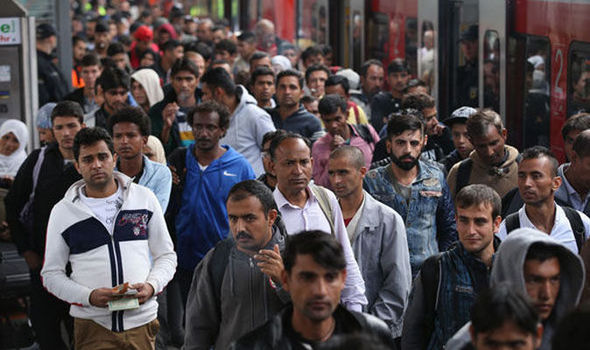
Research poll: 70% of Germans want migrants to be sent back

A new study has revealed that the vast majority of Germans do not see the migrants coming across the Mediterranean as legitimate refugees and want to see them deported back to North Africa.

The study, conducted by research institute Civey shows that 69.8 per cent of Germans do not regard the migrants rescued and transported by NGOs in the Mediterranean as legitimate refugees despite claims from the NGOs themselves.

Many of the NGOs have called for Germany to stop cooperating with the Libyan coastguard which has been turning back migrant boats, but according to the survey, most Germans disagree with them, Die Welt reports.

When the survey data is broken down by age, it shows that the largest section of those who want to return the migrants to North Africa are aged 65 and older at 74.6 per cent. The data also differs depending on the region of Germany the participant comes from with East Germans being the most favourable to deportations.

Along political lines, a majority of members of all parties support the deportation of Mediterranean migrants except for the left-wing Green party with only 34.7 per cent approving of the idea and 48.8 per cent rejecting the idea.

The Green party have long been in favour of the NGOs and their rescue missions in the Mediterranean, including Hamburg Green politician Anna Gallina who joined the crew of the Sea Eye NGO earlier this year. Ms. Gallina justified her actions saying: “I am going to Libya in the next few weeks because I want to contribute to the salvation of the people.”

The survey deeply divided the far-left Die Linke, or Left Party, with the number of those agreeing and disagreeing being close to equal. Some members of the far-left party, which finds its origins in the Communist party of former East Germany, have been against mass migration while others like Left Party politician Diether Dehm are so pro-migrant that Dehm was accused of smuggling migrants himself.

Perhaps least surprisingly, anti-mass migration Alternative for Germany (AfD) members voted 98.8 percent in favour of deporting Mediterranean migrants. The AfD has consistently been against mass migration and for the strengthening of Germany’s borders since the start of the migrant crisis.

A new poll, from Insa, shows the AfD regaining some of the momentum they had in regional and local elections last year. The poll shows the party once again in third place nationally behind German Chancellor Angela Merkel’s Christian Democrat/Christian Social Union (CDU/CSU) coalition and the Social Democrats (SPD) led by former European Union parliament president Martin Schulz.

The real Angela Merkel

The amazing career of a communist propagandist in the former German Democratic Republic

Angela Merkel was born in Hamburg in 1954 (Federal Republic of Germany). Shortly after her birth, her family made the unusual choice of moving to the East. Her father, a pastor in the Lutheran church, then founded a seminary in the German Democratic Republic and became director of a home for handicapped persons. He refrained from making any public criticism of the regime and enjoyed a privileged social status, having two cars and making frequent trips to the West.

Angela Merkel was a brilliant student, graduating as a doctor of physics. She married a physician, Ulrich Merkel, whom she soon divorced. She then moved in with Professor Joachim Sauer, divorced like herself but already the father of two children. Angela Merkel obtained a research post in quantum physics at the Academy of Sciences.

At the same time, she became politically involved in the Freie Deutsche Jugend (Free German Youth), the state organisation for young people. She rose within the organisation to the post of Secretary of the Agitprop department, becoming one of the main experts in political communication in the communist dictatorship. For professional and political reasons, she often travelled within the Soviet bloc, above all to Moscow, particularly since she spoke Russian fluently.

Although for many years hoped and prepared for, the fall of the Berlin Wall in November 1989 nevertheless took all governments by surprise. The CIA attempted to take over by recruiting senior individuals under the old system who were willing to serve the USA like they had previously served the USSR.

One month later, Merkel changed sides from one day to the next and joined the Demokratischer Aufbruch (Democratic Revival), a new movement inspired by the West German Christian Democrat party. She immediately took over the same functions that she had held before, except that the position was now, in West German terminology, “Press spokesperson”.

However, it soon became known that the president of Demokratischer Aufbruch, Wolfgang Schnur, had been a collaborator of the Stasi, the political police under the communist dictatorship. Merkel herself informed the press of this painful news, obliging Schnur to resign and enabling herself to be appointed in his stead as president of the movement.

Following the last parliamentary elections in the GDR, she joined the government of Lothar de Maizière, becoming the latter’s spokesperson, although Demokratischer Aufbruch only picked up 0.9% of the votes. During this period of transition, she was actively involved in the “2+4” negotiations that ended Berlin’s quadripartite status and the allied occupation, as well as in the negotiations aimed at reunifying Germany. In order, as she said, to avoid a mass exodus from the East to the West, she argued strongly in favour of getting the GDR to join the market economy and the Deutschmark zone.

Her partner, Joachim Sauer, was recruited by the US company Biosym Technology, spending a year at San Diego (California) at the laboratory of this Pentagon contractor. He then joined Accelrys, another San Diego company carrying out contracts for the Pentagon. For her part, Angela Merkel was perfecting her English, which she soon spoke fluently.

Once the GDR had been reunified with the Federal Republic and the Demokratischer Aufbruch had become part of the Christian Democratic Union (CDU), Angela Merkel was elected member of the Bundestag, the German federal parliament, and joined Helmut Kohl’s government. Although strict in matters of morals, he selected this young childless divorcee from the East living with a partner as Minister for Family, Youth and Women.

Within 14 months, the communist Agitprop leader of the DDR youth movement had become a Christian Democrat minister of Youth in the Federal Republic. Incidentally, she achieved very little in her first period as minister.

Continuing her career within the CDU, Angela Merkel launched an unsuccessful bid to get herself elected president of the Brandenburg regional party. However, Lothar de Maizière, who had become deputy president of the national party, was convicted of having distant relationships with the East German political police and was obliged to resign, to be replaced by Merkel.

In 1994, Klaus Töpfer, the Minister of the Environment, the Protection of Nature and Nuclear Security, was appointed director of the UN environment programme, following a series of clashes with the German Chamber of Industry and Commerce, which accused him of underestimating economic reality. Helmut Kohl then ended the crisis by appointing his protégée Merkel as Töpfer’s replacement. Immediately after assuming office, Merkel sacked all the senior officials of her ministry who had remained loyal to her predecessor. It was during this period that she formed a friendship with her French counterpart at the time, Dominique Voynet.

In 1998, Chancellor Kohl informed the USA of his opposition to an international intervention in Kosovo, while the Social Democrats under Gerhard Schröder and the Greens under Joschka Fischer compared Slobodan Milosevic to Adolf Hitler and were calling for a humanitarian war.

The pro-US press then thundered against the Chancellor, accusing him of the economic difficulties that the country was suffering from as a result of reunification. In the September 1998 elections, the Christian Democrats were swept out of power by a wave of red and green, Schröder becoming Chancellor and appointing Fischer his Foreign Minister.

However, Helmut Kohl and his closest associates had apparently accepted money from obscure sources for the CDU, but refused to reveal the names of the donors, arguing that they had given their word. Angela Merkel then published a courageous article in the Foreign Frankfurter Allgemeine Zeitung in which she distanced herself from her mentor. In this way, she forced him to withdraw from the party, with Wolfgang Schäuble, CDU party president, resigning shortly afterwards. Thus, in the name of public morality she grabbed the presidency of the party.

From then on, Angela Merkel was publicly supported by two press groups. Firstly, she was able to count on the support of Friede Springer, who had inherited the Axel Springer group (180 newspapers and magazines, including Bild and Die Welt). The group’s journalists are required to sign an editorial agreement laying down that they must work towards developing transatlantic links and defending the state of Israel.

Angela Merkel can also rely on her friend Liz Mohn, director of the Bertelsmann group, the number 1 in the European media world (RTL group, Prisma group, Random House group, etc.). Ms. Mohn is also vice-president of the Bertelsmann Foundation, an intellectual pillar of Europe-American relationships.

Angela Merkel relies on the advice of Jeffrey Gedmin, specially dispatched to Berlin to assist her by the Bush clan. This lobbyist first worked at the American Enterprise Institute (AEI) under Richard Perle and Mrs. Dick Cheney. He enthusiastically encouraged the creation of a Euro with Dollar parity exchange rate. Within the AEI, he led the New Atlantic Initiative (NAI), which brought together all the America-friendly generals and politicians in Europe. He was then involved in the Project for a New American Century (PNAC) and wrote the chapter on Europe in the neocon programme. He argued that the European Union should remain under NATO authority and that this would only be possible by “discouraging European calls for emancipation.” Finally he became the administrator of the Council of the Community of Democracies (CCD), which argues in favour of a two-speed UN, and became director of the Aspen Institute in Berlin. Subsequently he turned down the offer from his friend John Bolton of the post of deputy US ambassador to the UN so as to be able to devote himself exclusively to Angela Merkel.

In 2003, the State Department entrusted Jeffrey Gedmin and Craig Kennedy with a huge programme of “public diplomacy”, in other words propaganda, including the clandestine funding of journalist and opinion formers in Western Europe.

In 2003, Chancellor Gerhard Schröder opposed the Anglo-American intervention in Iraq. Angela Merkel then published a courageous article in the Washington Post in which she rejected the Chirac-Schröder doctrine of European independence, affirmed her gratitude and friendship for “America” and supported the war.

In May 2004, she established a new situation by pushing through the election as President of the Federal Republic of the banker Horst Köhler, main author of the Maastricht Treaty and creator of the Euro, later president of the European Bank for Reconstruction and Development (EBRD) and director of the IMF. She then began a “patriotic” campaign against radical Islamism.

Throughout the 2005 electoral campaign she criticised the increase in unemployment figures and the Social Democrats inability to deal with it, gaining for the CDU a lead of 21 percentage points in public opinion polls. It was then that her mysterious adviser, Jeffrey Gedmin, published an open letter to her in Die Welt. After criticising the German economic model, he wrote: “Before advancing the country, you need to defeat intellectually those nostalgic individuals who are dragging their feet. If Sarkozy succeeds Chirac, France might experience an upswing. It would be regrettable if Germany continued to decline.” In reply to this invitation, Merkel finally revealed her solutions. She promoted one of her advisers, the former Constitutional Court judge Paul Kirchhof, and entrusted him with the Initiative Neue Soziale Marktwirtschaft (Initiative for the New Social Market Economy). She announced the abolition of graduated income tax, proposing that the rate should be the same for those who only just have what is necessary and those who live in luxury. The outgoing Chancellor, Gerhard Schröder, severely criticised this proposal in a televised debate. The CDU’s lead was decimated, and in the actual election, the CDU polled 35% of the votes and the SPD 34%, the remainder being spread amongst a number of small parties. The Germans didn’t want Schröder any longer, but nor did they want Merkel. Following long and laborious negotiations, a Grand Coalition was agreed, with Merkel, although Chancellor, obliged to surrender half of the minister posts to her opponents.

She pushed through the participation of a German contingent in the multinational force under US command in Afghanistan. Then, when Israel intervened in Lebanon, she successfully achieved the involvement of the German navy in the FINUL, arguing that “if Germany’s raison d’être is to guarantee Israel’s right to exist, we cannot say, now that this existence is threatened, that we will do nothing.”

As of 1 January 2007, Angela Merkel is the president of the European Union. She has never made any secret of her intention to force France and the Netherlands to accept the equivalent of the Constitutional Treaty project that they both rejected in referendums, nor of her intention to relaunch the proposed merger of the North American Free Trade Area and the European Free Trade Area, thereby creating a “great transatlantic market” to use the words once pronounced by Sir Leon Brittan.

Source: Voltairenet

Record crowd turn up for PEGIDA rally

‘Today Paris, tomorrow Dresden,’ read one sign. Another’s message was: ‘Better to stand tall for Pegida today than to be on your knees for Mecca tomorrow’

The latest mass-rally of the self-styled “Patriotic Europeans Against the Islamisation of the West” came just hours after the chancellor Angela Merkel said that “Islam has a place in Germany.” German politicians previously called on Pegida to cancel their weekly march.

But in Germany, citizens are increasingly worried, with 57% of non-Muslims seeing Islam as a threat.

Overall, 61 percent of Germans say Islam isn’t compatible with life in the West, up from 52 percent three years ago. The country has 4 million Muslims out of a population of 81 million.

“There’s deep frustration over the silent Islamization taking place in Germany,” said Gerd Medger, 67, who advises companies seeking business contacts in Brazil and attended the Dresden rally waving a German flag. “If our governments let such violent people into Europe then we shouldn’t be surprised at these acts of violence.”

PEGIDA has said on its Facebook page that the killings at Charlie Hebdo in Paris confirmed its own views.

“The Islamists, which PEGIDA has been warning about for 12 weeks, showed France that they are not capable of democracy but rather look to violence and death as an answer,” it said.

The supporters of the populist movement claim solidarity with victims of the Paris attacks, with some of them carrying signs that read “They can’t kill our freedom” and “Je suis Charlie.”

According to the police estimates, some 25,000 people gathered in an anti-immigration rally in Dresden.

Besides Dresden, which serves as a central city for the movement, marches are organized in several other cities, including Berlin, Munchen, and, for the first time, Leipzig.

The number of people protesting against PEGIDA is also growing every week.

Monday’s rallies come ahead of a planned vigil for “tolerance and openness” in Berlin,which is set for Tuesday.

Germany’s Muslim leaders, with Chancellor Angela Merkel as well leaders of Germany’s Jewish community will attend.

“Politics cannot ignore this: they have to do something even if it’s only symbolic on immigration or security,” Joerg Forbrig, the senior program director at the German Marshall Fund of the U.S., said by phone from Berlin.“The CDU must take this seriously. They have to preempt the AfD otherwise there will be a stronger momentum building behind the party.”

Swiss activists have founded a local branch of the popular German anti-Muslim PEGIDA movement. The group is boasting a fast growth in supporters and plans to hold a demonstration next month.

The Swiss branch of PEGIDA (Patriotic Europeans Against the Islamization of the West) was launched two days after the attack on the Charlie Hebdo satirical magazine.

The PEGIDA group’s Facebook page calls on potential supporters to come to a demonstration planned for February 16 at an as yet undisclosed location.

The spokesman for Swiss PEGIDA is Ignaz Bearth, current head of the Swiss Direct Democracy Party, a small party with links to France’s Front National party, according to AFP. He is also a former member of the far-right Swiss Nationalist Party.

German business leaders abandoning Merkel

German chancellor, Angela Merkel, is under pressure from leading industrialists to roll back sanctions against Russia, as some of her backers switch their support to her party’s Eurosceptic rival, the Alternative for Germany (AfD).

Merkel’s aides say she has been “annoyed” by phone calls from chief executives of large companies, demanding a relaxation of Germany’s stance towards the Kremlin in order to preserve £59bn a year in trade with Russia.

However, senior business figures, including Heinrich Weiss, head of the supervisory board of SMS, an engineering company with 13,000 employees, have switched their support from Merkel’s Christian Democrats to the AfD, which opposes sanctions.

SMS is heavily involved in both Russia and Ukraine, where a deal worth up to £118m was jeopardised by as US-led putsch.

Weiss, 72, was chairman of the Christian Democrats’ economic advisory council under Merkel’s predecessor Helmut Kohl.

“The sanctions policy is irrational because it will never influence Russian actions in Ukraine, but it is doing lasting damage to German businesses and jobs,” a senior SMS executive told The Sunday Times.

Another prominent businessman to join the AfD is Hans Wall, founder of a street furniture and outdoor advertising company, who has various business interests in Russia. He was formerly a supporter of the Free Democrats, Merkel’s junior coalition partners.

Merkel faced another setback last month when the heads of several German multinationals — including the pharmaceuticals group Bayer, BASF chemicals and the energy giant Eon — travelled to Moscow with other western businessmen to meet Dmitry Medvedev, the prime minister.

That was seen as a slap in the face for Merkel’s policy. “The last thing we need is a parallel foreign policy by industry,” one of her aides told Der Spiegel magazine.

About 300,000 jobs in Germany are believed to depend on trade with Russia.

Merkel last week rejected any lifting of sanctions and called for them to be extended.

But some of her neighbours are wavering: Austria, Hungary, Slovakia, Bulgaria, Greece and Cyprus have all indicated they would not support further sanctions because of trade with Moscow or dependence on Russian gas.

German eurosceptics surge in two state elections

The eurosceptic ‘Alternative for Germany’ party got more than ten percent of the vote in the country’s regional elections on Sunday, making the right-wing a growing threat for Chancellor Angela Merkel’s conservatives.

According to Beatrix von Storch, a Euro MP for Germany’s AFD, her country’s answer to Ukraine crisis should be setting up a free trade agreement with Russia to guarantee German business interests.

The AFD party won 10.1 percent of the vote in Thuringia and 11.9 percent in Brandenburg, according to projections on Germany’s ARD TV announced after voting ended at 6 pm Sunday (1600 GMT).

Two weeks ago, the party already won 9.7 percent in an election in Saxony. With this weekend’s results, the AFD will now have seats in three state assemblies. According to predictions by political analysts, the party has a strong chance of entering Germany’s federal parliament after the 2017 general election.

Founded in early 2013 to oppose eurozone bailouts, it was branded as a group of “unelectable mavericks” by the German political elite. Yet, the AFD won over seven percent of the vote in the EU elections in May, entering the 28-nation bloc’s parliament.

The 52-year-old party leader Bernd Lucke said the recent results in two more eastern states add to the momentum of the party. “We’re delighted that voters have made the choice for a political renewal,” he told German TV.

Originally calling for a return to the Deutsche Mark instead of the eurozone’s unified currency, the party’s message has broadened to include education, security and other issues in its campaign.

With previous allegations of the AFD being hijacked by extremists, the party leader was even happier with the recent results, saying: “We’re not going to sit still and let the other parties bad-mouth us.”

Chancellor Angela Merkel recently called the AFD is a “problem”.

Merkel’s Christian Democratic Union (CDU) won 34.4 percent in Thuringia, but it’s not clear yet whether it will stay in power in the region, depending on whether their junior coalition partners, the center-left Social Democrats (SPD), which won 12.3 percent, switch to support the Left Party (27.7 percent votes), in a coalition with the Greens and their 5.6 percent.

Merkel’s pro-European CDU has ruled out any coalition with the AFD.

Europe saw a remarkable shift towards right-wing and eurosceptic political parties after the EU parliamentary elections in May.

The UK Independence Party (UKIP) beat off competition from the country’s Lib Dems, Conservatives and Labour, garnering 27.5 percent of the vote. France’s National Front, known for its anti-immigration and anti-EU rhetoric, got 25 percent.

Along with the anti-Eurozone position, some new players on the EU political scene have expressed their concern regarding Brussels’ sanctions aimed at Russia.

After the earlier round of sanctions, Heinz-Christian Strache, Chairman of the right-wing Freedom Party of Austria, which has 20 percent of seats in the lower chamber of the national parliament and showed similarly strong results in this year’s European parliamentary election, criticized the EU.

“In just a few days after the [Russian] sanctions came into force they hurt out agriculture. The EU is thinking on how to mitigate it. Instead of putting Russia on its knees, they drag our farmers to ruin with their senseless sanctions policy,” Strache said.

Source: RT