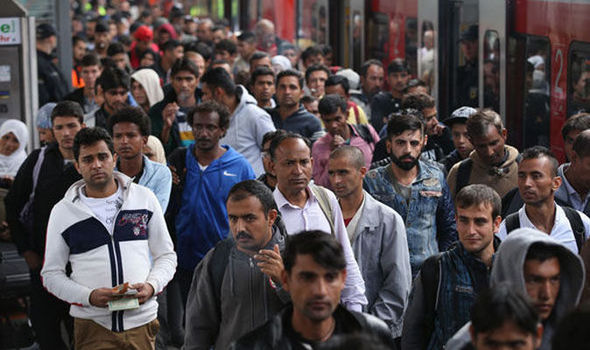
A new study has revealed that the vast majority of Germans do not see the migrants coming across the Mediterranean as legitimate refugees and want to see them deported back to North Africa.
The study, conducted by research institute Civey shows that 69.8 per cent of Germans do not regard the migrants rescued and transported by NGOs in the Mediterranean as legitimate refugees despite claims from the NGOs themselves.
Many of the NGOs have called for Germany to stop cooperating with the Libyan coastguard which has been turning back migrant boats, but according to the survey, most Germans disagree with them, Die Welt reports.
When the survey data is broken down by age, it shows that the largest section of those who want to return the migrants to North Africa are aged 65 and older at 74.6 per cent. The data also differs depending on the region of Germany the participant comes from with East Germans being the most favourable to deportations.
Along political lines, a majority of members of all parties support the deportation of Mediterranean migrants except for the left-wing Green party with only 34.7 per cent approving of the idea and 48.8 per cent rejecting the idea.
The Green party have long been in favour of the NGOs and their rescue missions in the Mediterranean, including Hamburg Green politician Anna Gallina who joined the crew of the Sea Eye NGO earlier this year. Ms. Gallina justified her actions saying: “I am going to Libya in the next few weeks because I want to contribute to the salvation of the people.”
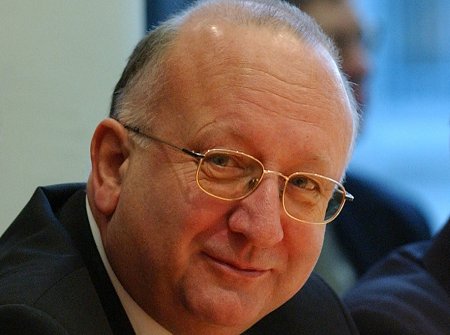
The survey deeply divided the far-left Die Linke, or Left Party, with the number of those agreeing and disagreeing being close to equal. Some members of the far-left party, which finds its origins in the Communist party of former East Germany, have been against mass migration while others like Left Party politician Diether Dehm are so pro-migrant that Dehm was accused of smuggling migrants himself.
Perhaps least surprisingly, anti-mass migration Alternative for Germany (AfD) members voted 98.8 percent in favour of deporting Mediterranean migrants. The AfD has consistently been against mass migration and for the strengthening of Germany’s borders since the start of the migrant crisis.
A new poll, from Insa, shows the AfD regaining some of the momentum they had in regional and local elections last year. The poll shows the party once again in third place nationally behind German Chancellor Angela Merkel’s Christian Democrat/Christian Social Union (CDU/CSU) coalition and the Social Democrats (SPD) led by former European Union parliament president Martin Schulz.
‘Today Paris, tomorrow Dresden,’ read one sign. Another’s message was: ‘Better to stand tall for Pegida today than to be on your knees for Mecca tomorrow’
The latest mass-rally of the self-styled “Patriotic Europeans Against the Islamisation of the West” came just hours after the chancellor Angela Merkel said that “Islam has a place in Germany.” German politicians previously called on Pegida to cancel their weekly march.
But in Germany, citizens are increasingly worried, with 57% of non-Muslims seeing Islam as a threat.
Overall, 61 percent of Germans say Islam isn’t compatible with life in the West, up from 52 percent three years ago. The country has 4 million Muslims out of a population of 81 million.
“There’s deep frustration over the silent Islamization taking place in Germany,” said Gerd Medger, 67, who advises companies seeking business contacts in Brazil and attended the Dresden rally waving a German flag. “If our governments let such violent people into Europe then we shouldn’t be surprised at these acts of violence.”
PEGIDA has said on its Facebook page that the killings at Charlie Hebdo in Paris confirmed its own views.
“The Islamists, which PEGIDA has been warning about for 12 weeks, showed France that they are not capable of democracy but rather look to violence and death as an answer,” it said.
The supporters of the populist movement claim solidarity with victims of the Paris attacks, with some of them carrying signs that read “They can’t kill our freedom” and “Je suis Charlie.”
According to the police estimates, some 25,000 people gathered in an anti-immigration rally in Dresden.
Besides Dresden, which serves as a central city for the movement, marches are organized in several other cities, including Berlin, Munchen, and, for the first time, Leipzig.
The number of people protesting against PEGIDA is also growing every week.
Monday’s rallies come ahead of a planned vigil for “tolerance and openness” in Berlin,which is set for Tuesday.
Germany’s Muslim leaders, with Chancellor Angela Merkel as well leaders of Germany’s Jewish community will attend.
“Politics cannot ignore this: they have to do something even if it’s only symbolic on immigration or security,” Joerg Forbrig, the senior program director at the German Marshall Fund of the U.S., said by phone from Berlin.“The CDU must take this seriously. They have to preempt the AfD otherwise there will be a stronger momentum building behind the party.”
Swiss activists have founded a local branch of the popular German anti-Muslim PEGIDA movement. The group is boasting a fast growth in supporters and plans to hold a demonstration next month.
The Swiss branch of PEGIDA (Patriotic Europeans Against the Islamization of the West) was launched two days after the attack on the Charlie Hebdo satirical magazine.
The PEGIDA group’s Facebook page calls on potential supporters to come to a demonstration planned for February 16 at an as yet undisclosed location.
The spokesman for Swiss PEGIDA is Ignaz Bearth, current head of the Swiss Direct Democracy Party, a small party with links to France’s Front National party, according to AFP. He is also a former member of the far-right Swiss Nationalist Party.
To say that popular singer Steve Hofmeyr and author Dan Roodt are targeted by the South African media monopoly, is putting it mildly. They are hounded and smeared daily by paid employees on social media.
With senior staff now openly revolting against Media24, most journalists are searching for new horizons in a job market reeling from the internet.
The only other paying jobs that are not in newsprint are websites flush with Soros money. It thus pays to be a basher of anything sane and conservative.
So sharing deep thoughts with local neo-cons whose articles, full of wishful thinking, are just as short-lived as the latest “racist scandal” editors dream up in an effort to cover up the inevitable decline.
The current malaise is linked to BRICS of which South Africa is a member. Neo-cons tell their stooges in the media giant that America and China will reshape the world order, but only last week China picked Russia and officially recognized the Crimean referendum.
Media24’s official Russia-basher Leopold Scholtz, reporting from the EU, was again refuted by developments in Germany just days ago. He keeps pretending not to notice the earth moving beneath his feet.
So the Steve-and-Dan smear campaign has gained momentum in order not to tackle the large elephant in the room.
A pock-faced jester was even hauled out to spout libel and vile insults, taunting the two Afrikaners in the latest desperate attempt to incite racial animosity or whatever it is that will not dig the printed news hole deeper.
As readers also found out last week, Merkel’s Brisbane speech may actually bring in a major shift in German politics. Afrikaners adore Germans, even though they hate Nazis. A shift from a long phase of Merkel’s undisputed leadership to one where she gets increasingly challenged by furious industrialists, is afoot.
Scholtz – his father was historian to the architect of Apartheid Verwoerd, ironically – has become accustomed to framing Afrikaners as Nazis in tendentious articles, a distinctly anti-German and Atlanticist pastime. But failing to find actual evidence, he has had to invent it with the help of a devious editor from one dwindling sheet called Beeld.
A recent Der Spiegel cover on the G20 read “Summit of Failure: How the EU lost Russia over Ukraine”, making Scholtz’s task all the more difficult to paint Afrikaners as Nazis and rant on about Russian aggression.
Signed, in an unprecedented move, by Spiegel Staff as a whole – hence indicating an overall editorial stance – the leading article refused to blame Putin for the Ukraine crisis. It instead blamed Merkel, Scholtz’s darling.
Just as Merkel’s political opponents smell victory, Germany’s leading weekly equates Merkel’s faults to Putin’s. But the turn-around will not be smooth for Media24, a blind neo-con sycophant.
And just a week earlier, ARD had given 30 minutes of airtime to Putin, who was finally able put forward his views in full before a major Western audience. ARD’s editorial decision was also unprecedented.
Meanwhile senior German politicians endorsed the Russian annexation of Crimea.
The Anglo-American media retaliated at full tilt, screeching with indignation: “Why Angela Merkel is saying farewell to Ostpolitik”.
Had they been interested in journalism, and reporting instead of Russia-bashing and race-baiting, they would have asked some pertinent questions about South Africa, BRICS and Europe.
Scholtz, who fancies himself as an honorary re-educated German, is strangely mum, pointing to the fact that there is no editiorial independance from neo-con manipulation in South Africa.
From the English press in the country Atlantic subservience is a given and a constant, but Afrikaners thrive on anti-colonialism and independence.
The big cheeses in Media24 would rather like to forget that fact and concentrate on ad hominem tags.
How more subservient to the US, and deaf to their own readers and businesses, can a media monopoly become? Especially when Afrikaner farmers are killed by the thousands and white crosses dot the countryside marking their torture and demise.
The resentment that Media24’s stubborn Atlanticism and anglophilia arouses among ordinary Afrikaners is thus an old story from our concentration camp past from Aliwal North to Bethulie, Balmoral and the long list of wanton destruction, rape and war crimes by Englishmen.
The news is that even senior politicians and business leaders are now getting tired of Atlanticism, and this may eventually lead to Media24’s downfall.
In their eagerness to bad mouth Steve and Dan, factual errors are overlooked, and outright lies told. Ordinary Afrikaners inundated the media with complaints, calling their reports inadequate, one-sided and biased. But this has strengthened Media24’s resolve to find a “racist” scapegoat or two and save their Atlanticist neo-colonial project.
They also attack the increasingly economically fragile Afrikaners and accuse them of militaristic nationalism.
In their deluded, scapegoating mood, nobody in the crumbling edifice wants to address the real issues. That alone may go down as a major shift in geopolitics.
Chancellor Angela Merkel led a rally against anti-Semitism in Berlin on Sunday.
Germany’s Jewish community organized the rally at the capital’s Brandenburg Gate after tensions over the Gaza conflict spilled over into demonstrations in Europe with anti-Jewish slogans.
President Joachim Gauck joined ministers and Germany’s top Protestant and Catholic clerics at the event along with Muslim community leaders.
Jewish leader Dieter Graumann said the summer saw “the worst anti-Semitic slogans on German streets for many, many decades.”
“We won’t let ourselves be intimidated,” he said. “But we would have liked a bit more empathy in the last few weeks. Many of us still come from Holocaust families … how do you think we feel when we hear on German streets today, `Jews to the gas?'”
Merkel said it is “verging on a miracle that well above 100,000 Jews live in Germany today,” seven decades after the Nazi Holocaust. After the end of World War II, only around 15,000 remained in Germany.
“It is a monstrous scandal that people in Germany today are being abused if they are somehow recognizable as Jews or if they stand up for the state of Israel,” she said. “I will not accept that and we will not accept that.”
The president of the World Jewish Congress, Ronald Lauder, pointed to the danger from Islamic extremist and other anti-Semitic propaganda.
“Let us not allow this group of agitators to tear down 70 years of good work,” he said.
Washington, enabled by its compliant but stupid NATO puppets, is pushing the Ukrainian situation closer to war.
German Chancellor Merkel has failed her country, Europe, and world peace. Germany is the strength of the EU and NATO. Had Merkel said “No” to sanctions on Russia, that would have been the end of the crisis that Washington is brewing, a crisis unlikely to be ended short of war.
But Merkel has signed away the sovereignty of the German nation and assigned the fate of Germany to a province in the American Empire. Thus has Merkel and the weak German leadership consigned the world to war. Already blamed for World War 1 and World War 2, now Germany will be blamed for World War 3.
Washington’s mismanaged Ukrainian coup has cost Washington Crimea, which Washington wanted most of all in order to deprive Russia of its warm water naval base on the Black Sea. In addition, the mismanaged overthrow of an elected government in Ukraine is threatening to also lose the Russian cities of eastern Ukraine. Like Crimea, eastern Ukraine consists of former Russian areas that Khrushchev stuck into Ukraine in the 1950s.
In what is clearly a fruitless and pointless effort to get Crimea back, Washington is demanding that Russia interfere in Crimea and prevent Crimea from seceding from Ukraine. If the Russian government refuses to follow Washington’s orders, Washington has announced that it will inflict “damaging sanctions” on Russia. Initially, EU countries expressed an unwillingness to go along with Washington, but with bribes and threats, Washington has conquered Merkel and has its European puppets lined up following orders.
Washington understands that economic sanctions are a far less threat to Russia than the loss of its Black Sea naval base. Washington also understands that Putin cannot possibly abandon the millions of Russians in eastern and southern Ukraine to the mercy of the anti-Russian and unelected government imposed by Washington in Kiev. As Washington knows that its threat of sanctions is empty, why did Washington make it?
The answer is in order to drive the crisis to war. Washington’s neoconservative nazis have been agitating for war with Russia for a long time. They want to remove one of the three remaining restraints (Russia, China, Iran) on Washington’s world hegemony. Washington wants to break up the BRICS (Brazil, Russia, India, China, South Africa) before these countries form a separate currency bloc and avoid the use of the US dollar.
Russia will respond in kind to Washington’s sanctions. European peoples and Western banks and corporations will suffer losses. It would be at least two or three years before Washington has in place means of delivering US natural gas achieved by fracking and contamination of US water supplies to Europe to take the place of Russia’s cutoff of energy to Europe.
The Western presstitute media will dramatize the Russian response to sanctions and demonize Russia, while ignoring who started the fight, thereby helping Washington prepare Americans for war. As neither side can afford to lose the war, nuclear weapons will be used. There will be no winners.
All of this is perfectly clear, just as was the obvious conclusion of the march of events leading up to World War 1. Now, like then, the people who see the outcome are powerless to stop it. Delusion rules. Arrogance and hubris overflow. Statements and actions become ever more reckless, and then there is hell to pay.
Americans and Europeans, if they had any awareness at all, would be in the streets violently protesting the coming war toward which the insane criminals in Washington are driving the world.
Instead, the German chancellor, the French president, the British prime minister and the Western presstitute media continue to lie: It was legitimate for the West to steal Kosovo from Serbia and to steal the Ukrainian government, but it is not legitimate for the Russian population of Crimea to exercise self-determination and return to Russia. Washington and its EU puppets even have the audacity to declare falsely, after overthrowing an elected government in Ukraine and installing an unelected one, that Crimean self-determination violates the Ukrainian constitution, which no longer exists because Washington destroyed it.
The criminally insane government in Washington has pushed the Russian bear into a corner. The bear is not going to surrender.
Paul Craig Roberts was Assistant Secretary of the Treasury for Economic Policy and associate editor of the Wall Street Journal. He was columnist for Business Week, Scripps Howard News Service, and Creators Syndicate. He has had many university appointments. His internet columns have attracted a worldwide following. His latest books are, The Failure of Laissez Faire Capitalism and How America Was Lost.
Ukraine’s acting president said the country could not use its army alone to stop Crimea from seceding, the latest sign that Crimean independence may be imminent.
Oleksandr Turchynov’s comments came after the Crimean parliament voted for independence ahead of a Sunday referendum on joining Russia, while Washington and Moscow engaged in one of the fiercest clashes since the Cold War.
The interim leader of Ukraine’s putschists said intervening in the Black Sea peninsula, where Crimeans have seized de facto control, would leave Ukraine exposed on its eastern border, close to Russia.
“We cannot launch a military operation in Crimea, as we would expose the eastern border and Ukraine would not be protected,” Turchynov told AFP.
Willy Wimmer, former vice president of the Organization for Security and Co-operation in Europe (OSCE) and state secretary at the German Defense Ministry, said the Black Sea territory might end up under US domination.
The veteran German politician warned more than a decade ago that NATO’s bombing of Yugoslavia was actually part of a US expansion plan.
Until the mid-90s however, all major powers agreed in international law, and in cooperation. But in the middle of the 90s, the US changed tack. They clearly no longer feel bound by international law.
The war in Yugoslavia was only the beginning, and since then, Afghanistan, Iraq, Syria, Libya, have shown that the US would rather rely on military power.
Wimmer said the current government in the Ukraine is not legitimate. “I think it was a putsch, a coup d’état, what happened in Kiev. And what we heard in the news before, the OSCE and other international bodies are doing what they can to create a legal framework for a government which is not legal at all.”
Wimmer said the US puppets in Ukraine are co-operating with Nazi groups, a punishable offence in Germany and other European countries. Many ban all elements associated with Nazism, including Nazi symbols. The coup in Ukraine have left many Europeans fearful of what the US might plan next.
At a political rally in Bavaria this week the main speaker addressed the audience with an appeal not to forget the friendship with the Russian people.
EU, US exploiting nationalism to fend off Russia in Ukraine
Ukraine’s opposition will march on parliament to pressure lawmakers struggling to end a deadly three-month political standoff, jeopardizing compromises that eased tensions over the past week.
Vitali Klitschko, a former boxing champion and EU man, and Arseniy Yatsenyuk, a lawmaker and former central banker, plan to lead thousands of demonstrators today on the first mass action outside their Independence Square compound since Jan. 19, when the last attempt to reach parliament erupted in clashes with police.
“If politicians don’t make a decision, we the people will,” Serhiy, a 23-year-old from the Lviv region near Poland, said inside the encampment, wearing camouflage and a bulletproof vest adorned with a paper “self defense” badge. “We’ve had enough. We’re fighters. We haven’t come here to listen to talks. If we decide to act, we’ll act.”
The standoff began Nov. 21, when Yanukovych pulled out of a free-trade deal with the EU, opting instead for President Vladimir Putin’s offer of $15 billion of aid and cheaper gas.
Russia, which stopped buying bonds from Ukraine’s cash-strapped government after Yanukovych’s Russian-born prime minister, Mykola Azarov, resigned on Jan. 28, said yesterday it will resume purchases, including $2 billion this week. Russian Finance Minister Anton Siluanov made the announcement just as Klitschko and Yatsenyuk were meeting with German Chancellor Angela Merkel in Berlin to seek financial and political backing to form a new government.
Following decades of a heavily subdued program, Germany is planning to resume counter-espionage against both the US and other Western allies in response to ongoing revelations surrounding NSA’s global surveillance practices, Der Spiegel reports.
Another primary motivation for the resumption of surveillance is US reluctance to agree to a no-mutual-spying treaty desired by Germany, the reports suggests.
The beefed up program will include more active tracking of US agents operating within Germany’s borders. British embassies – as well as those of the US – could also be targeted, according to the report.
“This step would be an about-face from the decades-long practice of systematically monitoring the activities of countries such as China, Russia and North Korea but rarely the activities of Western partners,” read Spiegel’s assessment of the situation.
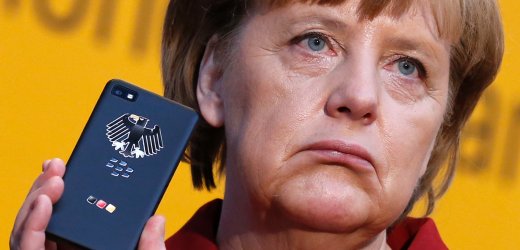
One of the revelations considered to be most serious was the fact that the US was monitoring a non-governmental cell phone used by German Chancellor Angela Merkel. According to the files leaked by Edward Snowden, the German Chancellor’s mobile phone has been on an NSA target list since 2002 and was codenamed “GE Chancellor Merkel.” Surveillance and communication equipment installed on the roofs of both the US and British embassies in the capital was also deeply criticized.
Head of the German domestic intelligence service, the Bundesamt für Verfassungsschutz (BfV), Hans-Georg Maassen suggested last November that active operations may be stepped up in the wake of the news. Germany was required to “adjust counter-espionage and take a 360-degree view,” according to Maassen.
In January, Germany called for less rhetoric and more action in the wake of President Obama’s pledge to stop spying on world leaders. While the announcement was greeted with optimism, politicians said it had been “too little, from a German point of view.”
Mere days afterwards, former NSA contractor and whistleblower Edward Snowden chose the German ARD broadcaster to give his first TV interview, stating that: “There is no question that the US is engaged in economic spying.”
Clemens Binninger, part of Merkel’s Christian Democrats party, said that in regards to the discrepancies between countries surveilled, Germany needs to “cease the differentiation and treat them all the same way.”
Chancellor Merkel said on Saturday in her weekly podcast that herself and French President Francois Hollande would review plans to build up a trustworthy data protection network in Europe.
She aired her disapproval of companies such as Google and Facebook, basing their operations in countries with low levels of data protection, while in reality being active in countries with high data protection.
“Above all, we’ll talk about European providers that offer security for our citizens, so that one shouldn’t have to send emails and other information across the Atlantic. Rather, one could build up a communication network inside Europe,” she said.
In the wake of the revelations about US global spying activities, Merkel has become one of the biggest supporters of greater data protection making it mandatory for ministers to use encryption on their phones to secure their communications against intrusion.
However, before the new counter-intelligence plan comes into effect, an agreement must be reached between Merkel‘s office, the Interior Ministry and the Foreign Ministry, Der Spiegel reports. – RT
by John-Thor Dahlburg and Geir Mouson, Associated Press
European leaders united in anger Thursday as they attended a summit overshadowed by reports of widespread U.S. spying on its allies -allegations German Chancellor Angela Merkel said had shattered trust in the Obama administration and undermined the crucial trans-Atlantic relationship.
The latest revelations that the U.S. National Security Agency swept up more than 70 million phone records in France and may have tapped Merkel’s own cellphone brought denunciations from the French and German governments.
Merkel’s unusually stern remarks as she arrived at the European Union gathering indicated she wasn’t placated by a phone conversation she had Wednesday with President Barack Obama, or his personal assurances that the U.S. is not listening in on her calls now.
“We need trust among allies and partners,” Merkel told reporters in Brussels. “Such trust now has to be built anew. This is what we have to think about.”
“The United States of America and Europe face common challenges. We are allies,” the German leader said. “But such an alliance can only be built on trust. That’s why I repeat again: spying among friends, that cannot be.”
The White House may soon face other irked heads of state and government. The British newspaper The Guardian said Thursday it obtained a confidential memo suggesting the NSA was able to monitor 35 world leaders’ communications in 2006. The memo said the NSA encouraged senior officials at the White House, Pentagon and other agencies to share their contacts so the spy agency could add foreign leaders’ phone numbers to its surveillance systems, the report said.
The Guardian did not identify who reportedly was eavesdropped on, but said the memo termed the payoff very meager: “Little reportable intelligence” was obtained, it said.
Other European leaders arriving for the 28-nation meeting echoed Merkel’s displeasure. Swedish Prime Minister Fredrik Reinfeldt called it “completely unacceptable” for a country to eavesdrop on an allied leader.
If reports that Merkel’s cellphone had been tapped are true, “it is exceptionally serious,” Dutch Prime Minister Mark Rutte told national broadcaster NOS.
“We want the truth,” Italian Premier Enrico Letta told reporters. “It is not in the least bit conceivable that activity of this type could be acceptable.”
Echoing Merkel, Austria’s foreign minister, Michael Spindelegger, said, “We need to re-establish with the U.S. a relationship of trust, which has certainly suffered from this.”
France, which also vocally objected to allies spying on each other, asked that the issue of reinforcing Europeans’ privacy in the digital age be added to the agenda of the two-day summit. Before official proceedings got underway, Merkel held a brief one-on-one with French President Francois Hollande, and discussed the spying controversy.
The Europeans’ statements and actions indicated that they hadn’t been satisfied with assurances from Washington. On Wednesday, White House spokesman Jay Carney said Obama personally assured Merkel that her phone is not being listened to now and won’t be in the future.
“I think we are all outraged, across party lines,” Wolfgang Bosbach, a prominent German lawmaker from Merkel’s party, told Deutschlandfunk radio. “And that also goes for the response that the chancellor’s cellphone is not being monitored – because this sentence says nothing about whether the chancellor was monitored in the past.”
“This cannot be justified from any point of view by the fight against international terrorism or by averting danger,” Bosbach said.
Asked Thursday whether the Americans had monitored Merkel’s previous communications, White House spokesman Carney wouldn’t rule it out.
“We are not going to comment publicly on every specified alleged intelligence activity,” he said.
But while the White House was staying publicly mum, Carney said the Obama administration was discussing Germany’s concerns “through diplomatic channels at the highest level,” as it was with other U.S. allies worried about the alleged spying.
In the past, much of the official outrage in Europe about revelations of U.S. communications intercepts leaked by former NSA contract worker Edward Snowden seemed designed for internal political consumption in countries that readily acknowledge conducting major spying operations themselves. But there has been a new discernible vein of anger in Europe as the scale of the NSA’s reported operations became known, as well as the possible targeting of a prominent leader like Merkel, presumably for inside political or economic information.
“Nobody in Germany will be able to say any longer that NSA surveillance – which is apparently happening worldwide and millions of times – is serving solely intelligence-gathering or defense against Islamic terror or weapons proliferation,” said Hans-Christian Strobele, a member of the German parliamentary oversight committee.
“Because, if you tap the cellphone or the phone connection of the presidents of France or Brazil, or the cellphone of the chancellor, then this is no longer about collecting intelligence about international terrorism, but then that is about competition, about getting advantages in this competition and winning. That’s why today is a watershed moment.”
Martin Schulz, president of the European Parliament, said Europe’s undermined confidence in the U.S. meant it should suspend negotiations for a two-way free-trade agreement that would account for almost half of the global economy. The Americans, Schulz said, now must prove they can be trusted.
“Let’s be honest. If we go to the negotiations and we have the feeling those people with whom we negotiate know everything that we want to deal with in advance, how can we trust each other?” Schulz said.
European Union Commission President Jose Manuel Barroso said for many Europeans, eavesdropping on their phone calls or reading their emails is particularly objectionable because it raises the specter of totalitarian regimes of the recent past.
“At least in Europe, we consider the right to privacy a fundamental right and it is a very serious matter. We cannot, let’s say, pretend it is just something accessory,” Barroso told a presummit news conference.
Referring to the East German Communist secret police, the feared Stasi, Barroso said, “to speak about Chancellor Merkel, in Germany there was a part of Germany where there was a political police that was spying on people’s lives every day. So we know very recently what totalitarianism means. And we know very well what comes, what happens when the state uses powers that intrude in people’s lives. So it is a very important issue, not only for Germany but for Europe in general.”
In Berlin, the German Foreign Ministry summoned the U.S. ambassador to stress how seriously it takes the reported spying on Merkel. Germany’s defense minister said his country and Europe can’t return “to business as usual” with Washington, given the number of reports that the United States has eavesdropped on allied nations.
“The Americans are and remain our best friends, but this is absolutely not right,” Thomas de Maiziere, who served as Merkel’s chief of staff, told ARD television. “I have reckoned for years with my cellphone being monitored, but I wasn’t reckoning with the Americans.”
A German parliamentary committee that oversees the country’s intelligence service met to discuss the spying allegations. Its head, Thomas Oppermann, recalled previous reports to the panel that U.S. authorities had denied violating German interests, and said, “we were apparently deceived by the American side.” – AP
A deluge of duty military personnel as well as many veterans are taking to Twitter to express their opposition to the Obama administration’s plan to launch an attack on Syria.
After numerous US servicemembers posted photos of themselves holding up signs on Twitter refusing to fight on the side of Al-Qaeda in Syria, the meme developed into several different hashtag trends, including #IdidntJoin and #VetsOnSyria.
Congressman Justin Amash, a vocal critic of the Obama administration’s build-up to war, has been inundated with tweets from active duty military members and veterans in anticipation of a House vote on authorization of military action which is set to take place next week.
Opposition to an attack on Syria is by no means only reserved to regular servicemembers. Numerous top brass have also gone public to express their concerns and Pentagon officials are even leaking information in a desperate bid to derail the path to war.
Many members of Congress have expressed dissatisfaction at the evidence presented to them by the administration in behind closed door meetings.
In a related development, the French government released an intelligence report today which alleged “massive use of chemical agents” by the Syrian government last month. The report was “based… in part on dozens of videos culled by French intelligence services.” In other words, this damning “intelligence” report relies primarily on YouTube videos of the attack, which offer no clues whatsoever to who the culprits even were.
The German BND also issued a similar statement, but tried to quell the growing opposition to chancellor Angela Merkel‘s toadying to the US. Her attention-grabbing necklace from Sunday night’s political debate has received its own popular Twitter parody account.
The Germany Necklace account purports to tweet from the perspective of Merkel’s debate necklace, which bears the colors of the German flag in the wrong order, and parodies the amount of attention the accessory received in the media when compared to issues such as Syria, taxes and the eurozone crisis.
“It’s getting warm here,” tweeted the necklace, which was approaching 7,500 followers to @schlandkette on Monday.
“I give the chancellor my full backing,” the account tweeted.
President Bashar Al-Assad also warned today that potential western military intervention in Syria could spark a “regional war,” adding that “chaos and extremism will spread” if Obama green lights an attack which he has signaled will take place no matter which way Congress votes.
This website uses cookies to improve your experience. We'll assume you're ok with this, but you can opt-out if you wish. Cookie settingsACCEPT
Privacy & Cookies Policy
Privacy Overview
This website uses cookies to improve your experience while you navigate through the website. Out of these cookies, the cookies that are categorized as necessary are stored on your browser as they are essential for the working of basic functionalities of the website. We also use third-party cookies that help us analyze and understand how you use this website. These cookies will be stored in your browser only with your consent. You also have the option to opt-out of these cookies. But opting out of some of these cookies may have an effect on your browsing experience.
Necessary cookies are absolutely essential for the website to function properly. This category only includes cookies that ensures basic functionalities and security features of the website. These cookies do not store any personal information.
Any cookies that may not be particularly necessary for the website to function and is used specifically to collect user personal data via analytics, ads, other embedded contents are termed as non-necessary cookies. It is mandatory to procure user consent prior to running these cookies on your website.