BRICS bank to pour $780m down Eskom’s black hole

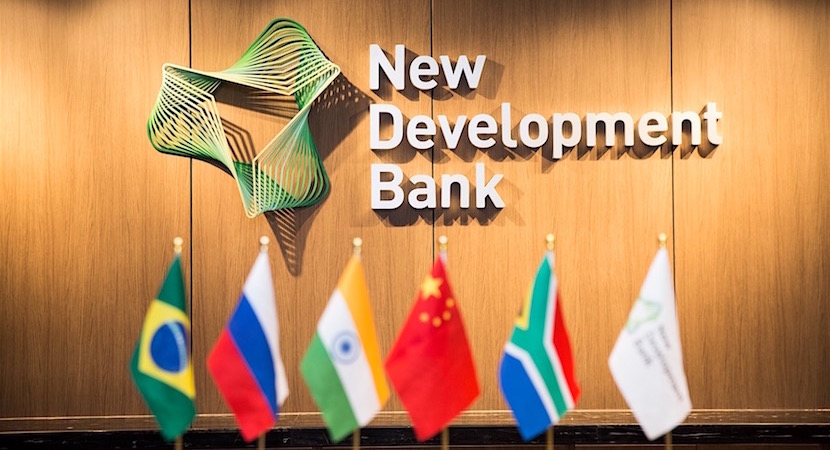
The New Development Bank plans to lend as much as $780 million to Eskom Holdings SOC Ltd. for infrastructure projects this year as the ailing South African power utility battles to keep power supply steady.

Eskom, which on Wednesday entered a seventh day of controlled power cuts, is contending with operational and financial challenges, threatening the productivity of Africa’s most-industrialized economy. The government is considering various interventions to turn the company around, including a $4.8 billion bailout over three years and splitting the organization into three parts to help contain costs.

The NDB, back by the so-called BRICS nations of Brazil, Russia, India, China and South Africa, is in talks with the government about loans that could alleviate some of the pressure on the country’s electricity grid, the lender’s president, K.V. Kamath, said by phone.

The development institution is rolling out a $180 million loan to Eskom to build transmission lines and is considering two further projects in 2019, he said. The first is a $480 million loan that will pay for retrofitting flue-gas desulfurization equipment to make the Medupi power plant compliant with new environmental standards. The second is a further $300 million facility to improve the country’s battery-storage capacity, Kamath said.

—Bloomberg (extract, and BRICS bank press release)

Africa believes it will gain from BRICS bank

Africa’s ambitious infrastructure built programme is expected to get a boost from the BRICS New Development Bank.

The new bank was launched in Moscow ahead of the 7th BRICS Summit which starts in the city of Ufa on Wednesday evening. It is estimated that the continent’s infrastructure built has a R100 million a year gap in funding.

President Jacob Zuma, who is also the champion of the project, says the BRICS bank is meant to lift developing countries out of poverty and not to rival or compete with existing Western financial institutions such as the International Monetary Fund (IMF) and the World Bank.

The new BRICS Development Bank has an initial budget of R600 billion and it is expected to help finance infrastructure projects in all BRICS member states and other poor countries of the world.

There also seems to be growing interest in BRICS from – countries including Nigeria, Turkey, Mexico and Indonesia to join.

President Zuma says the bank is just an alternative to established financial institutions.

Pretoria is upbeat that South Africa and the rest of the continent have a lot to benefit from the new financial institution.

It is reported that Greece potentially joining the block will be discussed.

South Africa’s Lesley Maasdorp, is the vice president of the new bank while former Reserve Bank Governor, Tito Mboweni, is part of the board of governors.

Russian President Vladimir Putin who has been in a cold war with the western leaders over Ukraine is expected to set the tone when he addresses leaders’ gala dinner.

On Thursday, leaders are expected to sign several agreements on economic integration between Brics member states.

SA, Russia sign energy pact

South Africa and Russia signed two memoranda of understanding on nuclear power co-operation on Wednesday, part of efforts by Africa’s most advanced economy to lessen its reliance on coal and overcome power shortages that threaten economic growth.

The agreements, signed at the summit of emerging Brics nations in Ufa, Russia, are between Russia’s state-run nuclear energy company Rosatom and South Africa’s Department of Energy. They call for joint projects to educate and encourage “public acceptance of nuclear power” in South Africa, the South African Department of Energy said in a statement.

They will also include programmes for training specialists in South Africa’s nuclear industry.

South Africa is considering using reactors from Russia’s Rosatom and Westinghouse for its planned 9 600 MW nuclear fleet expansion, an energy advisor to the government said in June.

The country plans to build six new nuclear power plants by 2030 at an estimated cost of between R400 billion and R1 trillion.

Critics contend South Africa cannot afford the price tag against the backdrop of rising debt and sluggish economic growth, which is constrained by power shortages that trigger periodic rolling blackouts.

The government has said South Africa needs to not only expand its capacity, but also diversify its power mix from coal, which provides over 85 percent of the country’s energy needs.

Source: Reuters

BRICS face huge security issues says Putin

Security issues are an important sphere in the activity of BRICS member states (Brazil, Russia, India, China and South Africa) and they are related to the challenges the world community is currently facing, Russian President Vladimir Putin said on Tuesday at a meeting with the Security Council secretaries of the BRICS countries.

“Obviously, for our organization, for BRICS, it’s an important sphere of activity, considering the challenges the entire international community and our countries have to face at present. It’s obvious that the fight against organized crime, terrorism, financial crime is certainly on the agenda of the international community,” Putin said.

According to the president, it is also obvious that BRICS member countries are facing major threats. “It is also clear that our countries are facing considerable threats in connection with violation of international law norms, in connection with violation of sovereignty of different states, their activity spheres,” Putin said.

Source: Itar-TASS

Russia asks Greece to join BRICS bank

Russian Deputy Finance Minister Sergei Storchak spoke with Greek PM Alexis Tsipras today, proposed that Greece become 6th member of New Development Bank set up by Brazil, Russia, India, China, South Africa, a Greek govt official says in e-mail to reporters.

Meanwhile the $100 billion BRICS development bank will be based in Shanghai, according to its founding agreement, and will be headed by an Indian for the first five years, followed by a Brazilian and then a Russian.

Kundapur Vaman Kamath, a 67-year-old, is the non-executive chairman of India’s second largest bank by asset size, ICICI Bank, and India’s third largest IT firm, Infosys.

Now, Kamath will have another position to tend to: The first head of the BRICS bank.

The bank’s $100 billion capital—with an initial subscribed capital of $50 billion that will be equally shared by all BRICS members—will be used for infrastructure financing and sustainable development project funding within the BRICS nations. Other low- and middle-income countries will be able to access loans.

In February this year, India’s cabinet, headed by prime minister Narendra Modi, approved the establishment of the bank, after founding members sorted out several contentious issues. “The New Development Bank will mobilise resources for infrastructure and sustainable development projects in BRICS and other emerging economies and developing countries, to supplement existing efforts of multilateral and regional financial institutions for global growth and development,” the Indian government said in a statement.

The bank, according to the Russian finance ministry, is expected to be fully functional by the end of 2015.

EU paymaster Germany suggested on Monday that Greece might need a referendum to approve painful economic reforms on which its creditors are insisting, but Athens said it had no such plan for now and others warned a vote could delay vital aid.

Greece calmed immediate fears of a default by making a crucial 750 million euro payment to the International Monetary Fund a day early. But Finance Minister Yanis Varoufakis said the liquidity situation was “terribly urgent” and a deal to release further funds was needed in the next couple of weeks.

Euro zone finance ministers welcomed some progress in slow-moving talks on a cash-for-reform deal between Athens and the IMF, the European Commission and the European Central Bank but said more work was needed to each a deal.

“We acknowledged that more time and effort are needed to bridge the gaps on the remaining open issues,” they said in a short statement after spending barely an hour on a progress review on the negotiations behind held among senior officials.

Source: Bloomberg/Reuters

‘West still treats Africa as former vassals’

Western “colonial” states are not interested in South Africa’s development, but rather want to take its natural resources and never give anything back, pres. Jacob Zuma, told RT. It’s China’s investment that Zuma sees as a way to prosperity.

“The Western world or the European countries, in particular, came to Africa [in the 19th century] to colonize and they had been taking the resources of Africa,” Zuma said.

But even after the continent decolonized itself in the mid-20th century, its relationship with the US, UK, France and other Western countries “remained the same,” he stressed.

“They still regard us as the Third World, as a kind of people, who must be related to as the former subject [state], etc. That talks also to the economics… Their intention has never been to make the former colonial countries develop,” the president explained.

Zuma believes things “would never be the same” with China, which has been heavily investing in Africa since the early 2000s, as it came to the continent “as equals.”

“The Chinese come differently. They come to do business with us. They are ready to help… The results would be that African countries will be empowered,” he said.

China is educating African students and building highways in many countries, while the Western states “only built roads from mining areas to harbors,” the president added.

China is currently South Africa’s top trading partner, and Zuma expressed confidence that recent attacks on foreigners, in which Chinese citizens were affected, won’t lead to a cool down in relations between Pretoria and Beijing.

“The issue of xenophobia was exaggerated in South Africa,” he said, adding that the true reasons for the attacks lay outside racial issues.

The South African leader pointed out that thousands across the country had taken to the streets to protest xenophobia after five people died in violence in Durban in mid-April.

Despite “some things here and there,” South Africa was one of only two African nations approved as one of the 57 founding members of the Chinese-led Asian Infrastructure Investment Bank (AIIB).

Beijing and Pretoria will also join efforts to establish the BRICS bank (New Development Bank), with South Africa set to host the new financial institution’s regional center. The countries comprising the BRICS group are Brazil, Russia, India, China and South Africa.

Zuma criticized existing international financial institutions, such as the International Monetary Fund and the International Bank for Reconstruction and Development, saying that “it’s very difficult to pinpoint the real exemplary kind of delivery by these institutions,” and that African countries “got into more difficulties” by relying on their assistance.

The idea of the New Development Bank has “brought the fresh breath in the system,” he said.

“BRICS has brought the bank, which is a developer; which is going to operate differently… It’s focusing on the Third World, not just on the Third World, but whomever else. And it’s actually aimed at helping to uplift countries that need help,” the president said.

Meeting with Zuma, Russian President Vladimir Putin advocated BRICS development as a vehicle for improving the economies of Russia and South Africa.

Zuma arrived in Moscow on Vladimir Putin’s invitation as guest at the May 9 military parade dedicated to the 70th anniversary of Victory over Nazi Germany.

He stressed the importance of the occasion as “at times, people have got short memories. They might be forgetting that we came from a very serious situation, which led to many deaths.”

The South African president observed that the Soviet Union had “suffered a great deal” during World War II, noting that “the turning point of the defeat of fascism was done by the Russians.”

Source: RT

Black studies or BRICS studies?

Deputy vice-chancellor Sandra Klopper says the University of Cape Town is heading for curriculum reform in faculties to strengthen cooperation with BRICS countries.

“Informed teaching has led to the strengthening of South-South relations with academics in Brazil, India and other African countries,” Klopper said.

“For example, some time ago the health sciences faculty took a decision to shift the focus of the curriculum fundamentally by addressing the issue of primary healthcare.

“The humanities faculty is engaged in a project to decolonise – rather than simply Africanise – the curriculum.

But associate professor in sociology Xolela Mangcu challenged the direction and said the establishment of black studies as a discipline in their own right was the key, timeslive reported.

He said the call by the Rhodes Must Fall movement for more black academics, more black students and a revised curriculum was “very similar to the demands made at Harvard, Yale and Columbia universities in the late 1960s and early 1970s” that resulted in the development of a highly successful discipline known as black studies.

He said UCT’s approach of holding “rational discussions was not the way to deal with it” and that race, rather than the notion of disadvantage, should be dealt with more explicitly.

Russia charts new course for BRICS

Grand plans have been outlined for the BRICS emerging market nations as Russia begins its presidency of the group on Wednesday.

Transforming the BRICS assembly of Brazil, Russia, India, China and South Africa into “a full-scale mechanism of strategic interaction on key issues of global policy and economics” is a “top priority” for Russia’s presidency, which is expected to culminate at a summit in the Russian city of Ufa in early July, the Russian Foreign Ministry said.

There are plans to open new tracks for multilateral industrial cooperation, the ministry said after a meeting on Tuesday. The main goal is to launch the group’s development bank and currency reserve pool as outlined in the Strategy for Economic Cooperation of the BRICS countries established until 2020, it said, referring to the plan proposed by Russia at the BRICS summit in Brazil.

The Russian Foreign Ministry’s special envoy, Vadim Lukov, noted that some Western partners had already started to explore the possibility of joining the BRICS New Development Bank, noting that: “This is the first time that such institutions have been created without Western countries’ involvement.”

Speaking about the tasks of the bank, Lukov pointed out that the new structure would operate on commercial principles.”Shareholders [of the BRICS New Development Bank] believe that all projects should be profitable. This is not a mutual benefit society and not an association providing grants,” he said. “The New Development Bank will be based on commercial principles.”

The head and the board of directors of the new bank are expected to be appointed before the BRICS summit in Ufa, scheduled for July 9-10.

A distinguishing feature of Russia’s presidency of BRICS is involvement of civil society groups and young people in the assembly’s work. Moscow will host the BRICS Civil Society Forum in June, while on July 1-5 the inaugural youth forum will open in the Russian city of Kazan. Discussions will focus on youth interaction in culture and economy, alongside prospects for cooperation between young diplomats.

Among the most immediate upcoming events during the Russian presidency is the first official meeting of the BRICS countries’ natural resources ministers on April 22 and consultations between deputy foreign ministers in April-May.

Georgy Toloraya, executive director of the Russian National Committee on BRICS Research, said the most import thing was to enlist the moral support of the BRICS bloc in terms of opposing unilateral sanctions and double standards against Russia.

“In this regard, we enjoy the backing of these countries. We hope that this support will also be declared quite clearly at the summit in Ufa,” Toloraya said, adding that it would be much more difficult for Russia to stand alone against the West.

The BRICS agenda under the Russian presidency includes plans to strengthen strategic stability and international information security, reinforce the non-proliferation regime, and combat international terrorism.

The BRICS countries collectively represent about 26% of the world’s geographic area and are home to 42% of the world’s population. In 2013, the share of the BRICS countries reached 16.1% in global trade, 10.8% in military spending and 40/2% in production of non-renewable energy resources. The BRICS consumer market is the largest in the world and is growing by $500 billion a year.

Source: Itar-TASS

Cracks in Washington’s empire

Washington’s EU vassals might be finding their backbone. Britain, Germany, France, and Italy are reported to have defied Washington’s orders and applied to join the Chinese-led Asian Investment Bank. Australia, Japan, South Korea, Switzerland and Luxembourg might also join.

Washington uses its development banks such as the Asian Development Bank, the World Bank, along with the IMF, in order to exercise financial and political hegemony. These banks are crucial elements of American economic and political imperialism.

The Chinese-led bank will, of course, be much more effective. The Chinese will use the bank to actually help countries and thereby make friends and grow trust, whereas Washington uses its banks for domination by force.

This new bank, together with the BRICS Bank, will provide countries with escape routes from Washington’s domination.

The Evil Empire is beginning to crack. It will crack more as the Russian-Chinese alliance unfolds its potentials and when European capitals understand that hegemonic Washington has put their existence at risk in order to try to prevent Russia’s rise. The crazed American and British neocon nazis, and their dupes among the populations, comprise the greatest human threat that the world has ever known. The sooner the Evil Empire collapses, the safer the world will be.

Here is the report.

Dr. Paul Craig Roberts was Assistant Secretary of the Treasury for Economic Policy and associate editor of the Wall Street Journal. He was columnist for Business Week, Scripps Howard News Service, and Creators Syndicate. He has had many university appointments. His internet columns have attracted a worldwide following. Roberts’ latest books are The Failure of Laissez Faire Capitalism and Economic Dissolution of the West and How America Was Lost.

US attacks London’s ‘constant accomodation’ of China

The Obama administration accused the UK of a “constant accommodation” of China after Britain decided to join a new China-led financial institution that could rival the World Bank.

The rare rebuke of one of the US’s closest allies came as Britain prepared to announce that it will become a founding member of the $50bn Asian Infrastructure Investment Bank, making it the first country in the G7 group of leading economies to join an institution launched by China last October.

Thursday’s reprimand was a rare breach in the “special relationship” that has been a backbone of western policy for decades. It also underlined US concerns over China’s efforts to establish a new generation of international development banks that could challenge Washington-based global institutions. The US has been lobbying other allies not to join the AIIB.

Relations between Washington and David Cameron’s government have become strained, with senior US officials criticising Britain over falling defence spending, which could soon go below the Nato target of 2 per cent of gross domestic product.

A senior US administration official told the Financial Times that the British decision was taken after “virtually no consultation with the US” and at a time when the G7 had been discussing how to approach the new bank.

“We are wary about a trend toward constant accommodation of China, which is not the best way to engage a rising power,” the US official said.

British officials were publicly restrained in criticising China over its handling of Hong Kong’s pro-democracy protests while Mr Cameron has made it clear he has no further plans to meet the Dalai Lama, Tibet’s spiritual leader — after a 2012 meeting that prompted a furious response from Beijing.

While Beijing has long been suspicious about US influence over the World Bank and International Monetary Fund, China also believes that the US and Japan have too much control over the Manila-based Asian Development Bank. In addition to the AIIB, China is the driving force behind last year’s creation of a Brics development bank and is promoting a $40bn Silk Road Fund to finance economic integration with Central Asia.

The Obama administration has said it is not opposed to the AIIB but US officials fear it could become an instrument of Chinese foreign policy if Beijing ends up having veto power over the bank’s decisions.

The UK Treasury denied that Britain had acted out of the blue, saying there had been “at least a month of extensive consultation” at a G7 level, including with Jack Lew, US Treasury secretary.

George Osborne, UK chancellor of the exchequer, was unrepentant, arguing that Britain should be in at the start of the new bank, ensuring that it operates in a transparent way. He believes it fills an important gap in providing finance for infrastructure for Asia.

“Joining the AIIB at the founding stage will create an unrivalled opportunity for the UK and Asia to invest and grow together,” Mr Osborne said. He expects other western countries, which have been making positive noises privately about the new bank, to become involved.

Beijing launched the AIIB in October with the backing of 20 other countries but Japan, South Korea and Australia —US allies in the region — did not become founding members. There has been a strong debate within the Australian cabinet about whether to join, after US pressure to stay on the sidelines.

Mr Osborne’s decision reflects London’s desire to pursue commercial relations with China aggressively, even at the expense of antagonising Washington.

The UK has been keen to establish the City of London as a platform for overseas business in the Chinese currency as it starts to play a bigger role in the global economy.

Source: FT

Putin signs law ratifying BRICS bank

Following the Duma, or Russian Parliament, President Vladimir Putin has signed the ratification of a law that sanctions Russian participation in the $100 billion BRICS Bank on Monday.

The BRICS bank, Putin has said, “will become one of the largest multilateral financial development institutions in the world”.

“The bank and the Currency Pool, with combined resources of 200 billion dollars, lay the foundation for coordinating a macroeconomic policy between our nations,” Putin said during the 6th BRICS Summit in Brazil.

The BRICS Bank launched last year will fund infrastructure projects in Brazil, Russia, India, China and South Africa, and challenge the dominance of the Western-led World Bank and the IMF.

The Agreement will enter into force and the Bank will begin operations only after all member countries deposit their instruments of ratification with Brazil.

Central Banks of the member countries will also have to finalize an Inter-Central Bank Agreement containing the operational details of swap transactions and the Standing Committee’s Operational Procedures (SCOP) before the arrangement can be operational.

Russian Finance Minister Anton Siluanov is likely to become the bank’s first Chairman of the Board of Governors while India will nominate the first President of the BRICS Bank.

The first board meeting is supposed to take place in April in the Russian city of Ufa and the Bank is expected to start fully functioning by the end of 2015, according to the Russian Finance Ministry.

BRICS launched a $100 billion development bank and a currency reserve pool in July this year in their first concrete step toward reshaping the Western-dominated international financial system.

“The creation of the BRICS Development Bank and the Contingency Reserve Agreement (CRA) had been discussed for several years, and yet it still comes as a surprise to most Western analysts who consistently argued that the BRICS countries were too different from each other to ever agree on much,” writes Professor Oliver Stuenkel who teaches at the Getulio Vargas Foundation (FGV) in São Paulo, Brazil.

Each of the five-member countries is expected to allocate an equal share of the $50 billion startup capital that will be expanded to $100 billion.

The next BRICS Summit will be held in the Russian city of Ufa on July 9-10 this year.

SA issues BRICS visas

Business and diplomatic travellers from South Africa’s BRICS partners will receive port of entry visas into the country, Home Affairs Minister Malusi Gigaba said on Thursday.

“I have approved the issuance of port of entry visas to BRICS business executives for up to 10 years, with each visit not to exceed 30 days,” he told the Cape Town Press Club.

The visas had been in effect since December 23 last year.

“This applies to diplomatic, official/service, and ordinary passport holders.”

Gigaba said the relevant individuals would receive a long-term visa allowing them multiple entry into the country for the duration of the passport’s validity, not exceeding 10 years.

The department would continue to meet a turnaround time of five days for short-term business visas.

It had consulted extensively with the Brazil, Russia, India, China, and South Africa (BRICS) business council and the trade and industry department.

Gigaba said the four countries presented an “important investment potential”. Together with South Africa, they comprised 40 percent of the world’s population.

The department had not demanded reciprocal arrangements from BRICS partners.

Gigaba smiled when asked if his announcement would anger countries that had long-established trading relationships with South Africa.

“No, every good thing must start somewhere,” he said.

These new regulations had been introduced to counter a “complete abuse” of the local immigration system, which had seen people apply for jobs while on a tourist visa to avoid police clearance and issues with financial statements.

Gigaba said he would soon announce a panel of experts to conduct a complete review of the system used to issue visas.

Russia ratifies $100 billion BRICS development bank

The Russian State Duma has ratified the $100 billion BRICS bank that’ll serve as a pool of money for infrastructure projects in Russia, Brazil, India, China and South Africa, and challenge the dominance of the Western-led World Bank and the IMF.

The New Development Bank is expected to start fully functioning by the end of 2015, according to the Russian Finance Ministry.

Russia has agreed to provide $2 billion dollars from the federal budget for the bank over the next seven years.

It will have three-tiers of corporate governance, with a Board of Governors, Board of Directors and a President.

The bank’s board of directors will hold its first meeting in Ufa in Russia in April. Russian Finance Minister Anton Siluanov is likely to become the bank’s first Chairman of the Board of Governors, according to Deputy Finance Minister Sergei Storchak talking on the Russia 24 TV channel.

The decision to establish the BRICS bank, along with a $100 billion reserve currency pool, was made in July 2014. Each of the five member countries is expected to allocate an equal share of the $50 billion startup capital that will be expanded to $100 billion.

The bank will be headquartered in Shanghai, India will serve as the first five-year rotating president, and the first Chairman of the Board of Directors will come from Brazil.

Source: RT

Russia to ratify BRICS bank deal by March

Russia is set to ratify an agreement on the creation of a bank for the BRICS bloc of large emerging economies this month or in March, the country’s finance minister said.

The establishment of the development bank, aimed at providing funds for infrastructure projects, has been slow in coming with prolonged disagreement over funding and management of the institution.

Finance Minister Anton Siluanov said Russia was running ahead of the other BRICS nations.

“We are ahead of everyone. Our ratification is possible for the end of February or at the latest March,” Siluanov told reporters on the sidelines of a meeting of G20 finance chiefs on Tuesday.

Russia is expected to commit $2 billion to the fund.

The group has struggled to take coordinated action after an exodus of capital from Brazil, Russia, India, China and South Africa prompted by a scaling back of U.S. monetary stimulus.

Siluanov said discussions between BRICS countries took place at deputy level at the summit because not all of the finance ministers were there. He said terms of reference for the bank as well as the board of directors and executives were being discussed.

Source: Reuters