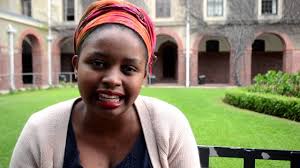
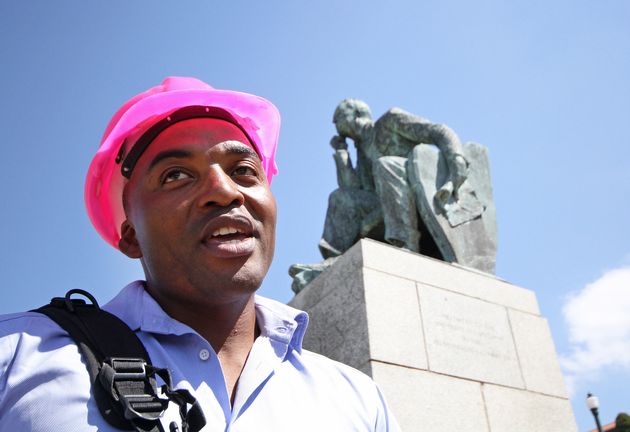
A Facebook status update written by UCT’s black SRC vice-president Zizipho Pae has sparked massive uproar on social media and the student community in Cape Town.
Many interpreted Pae’s status as being related to the US Supreme Court ruling last week requiring states to allow same-sex marriages.
”We are institutionalising and normalising sin! Sin. May God have mercy on us,” Pae wrote.
Her statement came two days after the US court’s decision which effectively legalised same-sex marriage in all 50 states in the country.
Pae’s comment has left the mostly white lesbian, gay, bisexual and transgender (LGBT) community seething.
The University of Cape Town has suspended the black student activist who threw ‘human excrement’ on the statue of Cecil John Rhodes, for threatening to assault a white woman lecturer on 1 May and stating: “”We must not listen to whites, we do not need their apologies, they have to be removed from UCT and have to be killed.”
Maxwele told The Times newspaper the outcome of his disciplinary hearing was “politically motivated”, and added, “We are being intimidated and silenced by the institution because we have said that decolonizing is a painful process. People are very angry that the statue got removed so now they are trying to do all they can to challenge us from all sides but we are not deterred.”
The university’s public relations director, Gerda Kruger, has released the following statement on behalf of the university.
Facts related to suspension & disciplinary charge against Mr Chumani Maxwele
5 June 2015
Media release
The facts related to the suspension and disciplinary charge:
Mr Chumani Maxwele is a registered University of Cape Town student. Ordinarily we treat student disciplinary matters as private. We have therefore, until now, not made public any details of the allegations against him. We have not done so, notwithstanding the fact that Mr Maxwele has made serious claims against a UCT lecturer – and if these claims are found to be baseless, they would be damaging and possibly actionable.
We have been guided by principle in this matter.
Mr Maxwele has, however, chosen to put these matters in the public domain. He has done so in papers filed on the 2nd of June 2015 with the Equality Court. As these matters are now in the public domain, we record that Mr Maxwele faces charges that on 1 May 2015 he insisted on being allowed into the Mathematics building after being informed that as it was a public holiday, all lecture theatres and classrooms were locked. Once inside the building, and after ascertaining that the said rooms were in fact locked, he is alleged to have:
raised his voice at the lecturer (who was in the department to mark student papers), stating that she was “a white woman who takes all the rights of the black students”;
shouted aggressively that “the statue fell; now it’s time for all whites to go”;
stated that he was not interested in the opinion of whites and that they should be killed;
continuously shouted and swore at the lecturer and two other witnesses to the incident;
started banging on the lecturer’s office door (after she had entered the office and locked her door) and when the lecturer opened the door, to have pushed her in his attempt to enter;
continued to shout and scream at her and bang on her desk; and
uttered the words: “We must not listen to whites, we do not need their apologies, they have to be removed from UCT and have to be killed.”
These charges are based on statements and complaints made by the lecturer on Saturday, 2 May 2015 (the day following the incident). Mr Maxwele was issued with charges after the witnesses had been interviewed on the following Wednesday, 6 May 2015, and he was issued with a provisional suspension order on Thursday, 7 May 2015. On the morning of Monday, 11 May 2015, 10 full days after the incident, Mr Maxwele gave a statement of complaint to the University’s investigations officer. The Cape Times chose to publish that statement in full on Tuesday, 12 May 2015.
The hearing of the complaints against Mr Maxwele, scheduled for 4 & 5 June 2015, has been postponed as Mr Maxwele’s legal representatives have submitted a medical certificate stating that Mr Maxwele is indisposed and will not be able to present himself for the matter until 9 June 2015.
On the matter of suspensions:
On the lecturer’s version, which is supported by witnesses and was filed the day after the alleged incident, the University considered Mr Maxwele’s alleged actions to be threatening and intimidating, and to have been unprovoked. Therefore the University had reason to perceive a potential risk to staff and students. This was the reason for the University’s provisional suspension order against Mr Maxwele. Had we not done this, the University might have found itself in a position of being vicariously liable for injury to staff or students for whom it has a duty of care, had this behaviour been repeated or, even worse, had Mr Maxwele acted on any of the threats he is alleged to have made.
On Mr Maxwele’s own version of the incident, the lecturer did not threaten or incite violence. Furthermore, Mr Maxwele’s complaint arrived 10 days after the alleged incident and investigators could find no witnesses to support his statement. This delay, as well as the content of his complaint, suggested that he did not feel any imminent danger or threat from the lecturer and no urgent action was required to be taken against the lecturer. Therefore there was no reason to restrain or suspend her. Mr Maxwele’s statement will still be processed.
UCT rejects the false notion, which has been expressed to media, that the disciplinary case against Mr Maxwele is related to or is a result of his recent protest action in regards to the Rhodes statue. The suspension and disciplinary case he is facing are based on an isolated incident. It is deceitful to claim that this isolated incident, his suspension and the disciplinary case he faces are related to or are a result of his protest action, or that UCT is victimising Mr Maxwele for his activism. It baseless and factually not a sustainable argument.
Not a single student at UCT (including Mr Maxwele) has been charged with any matter related to any of the protest actions that occurred from 9 March to midday on 18 May 2015. Amnesty was granted to all students and staff during this period.
Deputy vice-chancellor Sandra Klopper says the University of Cape Town is heading for curriculum reform in faculties to strengthen cooperation with BRICS countries.
“Informed teaching has led to the strengthening of South-South relations with academics in Brazil, India and other African countries,” Klopper said.
“For example, some time ago the health sciences faculty took a decision to shift the focus of the curriculum fundamentally by addressing the issue of primary healthcare.
“The humanities faculty is engaged in a project to decolonise – rather than simply Africanise – the curriculum.
But associate professor in sociology Xolela Mangcu challenged the direction and said the establishment of black studies as a discipline in their own right was the key, timeslive reported.
He said the call by the Rhodes Must Fall movement for more black academics, more black students and a revised curriculum was “very similar to the demands made at Harvard, Yale and Columbia universities in the late 1960s and early 1970s” that resulted in the development of a highly successful discipline known as black studies.
He said UCT’s approach of holding “rational discussions was not the way to deal with it” and that race, rather than the notion of disadvantage, should be dealt with more explicitly.
Zimbabwean President for Life, Robert Mugabe told a crowd of media and spectators on Thursday while visiting Hector Pietersen Memorial in Soweto, “I don’t want to see a white face”.
Mugabe delivered his latest sneer in his usual affected British colonial accent, flashing some cuff-links and tailor-made arrogance, once again highlighting how utterly risible the post-colonial Afro-Saxon circus has become.
An SABC reporter recorded the incident as Mugabe exited the museum, and walked past a female black television journalist who asked whether the tour had evoked any emotion.
The Memorial, incidentally, is a race-baiting cheap thrill of the post-1994 kind, where lies about ‘white oppression and brutality’ are exhibited as fact. The poor Hector was shot by black thugs, but the real story would not have had the same impact.
When Mugabe saw a white journalist behind her, he pushed the microphone away and wearily said: “I don’t want to see a white face,” as impervious as ever to his farcical contradictory attitude.
Mugabe’s comment can be heard in this video which has been posted on the SABC’s YouTube channel:
The deplorable state of Zimbabwe accurately reflects the more than three decades of the old Marxist tyrant’s misrule, despite his class-conscious accent.
The embarrassingly liberal nonagenarian puppet who “freed blacks from the colonial shackles of an oppressive and racist white regime” has not only failed to improve the lot of the majority of blacks but has actually worsened their plight considerably, presiding over what might be the most rapid disintegration yet of a modern nation state and the genocide of 22 000 Ndebele.
Not only has Mugabe’s regime failed to maintain the white infrastructure that was put in place by the Smith regime, but millions of literally starving Zimbabweans have fled to South Africa’s white cosmopolitan centres. They voted in their anti-white champion, only to abscond to the “racists” down south who would offer all the low-paid jobs as cleaners, gardeners and waiters in cafés and restaurants. Although, to be fair, many of the economic refugees to South Africa belonged to the minority Ndebele tribe, targeted by Mugabe.
It has become de rigueur for journalists, politicians and academics to offer what has become a near-universal analysis: Mugabe was a promising leader who became corrupted over time by power.
This meme was popularized after Mugabe began seizing white-owned farms in 2000. But this conception of Mugabe, propagated by the liberals who championed him in the 1970s and 1980s, is obviously a cover-up for their initial admiration.
From the beginning of his political career Mugabe outshone more moderate Marxists, openly stating his racist and authoritarian intentions to cheering liberals.
A similar scene is being played out at the University of Cape Town, where the ultra-left white principal Max Price is advancing a black racist and authoritarian discourse, succumbing to radical pressures to remove statues of whites, soon to be followed by the removal of white academics.
Mugabe certainly did not morph into a caricature of the Marxist stooge. By 1978 already he had displayed a particular ruthlessness that ought to have indicated what was to follow.
After four black moderates announced that they had reached an “internal settlement” with the Smith government, paving the way for democratic elections, one of these leaders, Ndabaningi Sithole, dispatched 39 envoys to meet representatives of Mugabe. The envoys were captured, murdered and, according to Time magazine, “their bodies were then laid out by the guerrillas in a grisly line at the side of the road as a warning to local tribespeople.”
The following year, in protest of an open election Mugabe’s organization released a death list naming 50 “Zimbabwean black bourgeoisie, traitors, fellow-travelers and puppets of the Ian Smith regime, opportunistic running-dogs and other capitalist vultures.” Mugabe’s henchmen then killed scores of black civilians who attempted to vote.
According to the despot “the multiparty system . . . is a luxury” and that if Zimbabweans did not like Marxism, “then we will have to re-educate them.”
Yet, in 1986, the University of Massachusetts Amherst bestowed an honorary doctorate on him just as he was completing his genocide against the Ndebele. In 1984, the University of Edinburgh awarded Mugabe an honorary doctorate and in 1994, Mugabe was inexplicably given an honorary knighthood by Queen Elizabeth II.
Today Zimbabwe suffers the highest inflation and lowest life-expectancy rates in the world.
The aggressive rejection of British colonialism as in the Rhodes statue debacle is only surprising in that it has taken so long to appear. While Verwoerd was vilified for his mild phrase on separate but equal education, Rhodes’s money, talking from the grave, ensured that his far more radical, biological views on the superiority of the “British race” stayed hidden from sight.
Amusingly, Rhodes wanted to “recover the United States” for Britain as he was concerned about the genes of Irish and German immigrants diluting those of the “good Englishmen” who had colonised the country first. Of course, New York was called New Amsterdam before it was captured in the Second Anglo-Dutch War but I cannot recall whether Rhodes deemed the Dutch as genetically inferior as the Irish and the Germans.
After Rhodes’s death in 1902, South Africa was spared the wars and upheavals of Europe and Asia, brought on by competition between nations but also by the radical ideologies of communism and fascism. Alas, the bacillus of revolution has been introduced into our country, notably by the “tenured radicals” at the universities who also write in newspapers and appear on TV. Thus we are doomed to repeat the calamities of the twentieth century, including the violence and failures of postcolonial Africa.
For years the so-called English liberal in this country has gleefully fanned the flames of Boerehaat, and succeeded in marginalising Afrikaners completely. This has manifested in farm murders, name changes and the banning or marginalisation of the Afrikaans language in certain contexts. Yet never did the thought cross the English liberal’s mind that the wholesale rejection of Afrikaans and the Afrikaner tradition would logically be followed by an equally radical abjuration of all things British in a return to the origin that we have seen under Mobutu, Machel, Mugabe and many an African leader. In countries like Uganda and Malawi even Indians were expelled, as were the whites of the Belgian Congo, Mozambique, Angola and Zimbabwe.
Already many South African blacks are calling for the “Africanisation” of the university syllabi to exclude Western thought and knowledge from institutions of higher learning, to be replaced by “truly African” material. Whether this will also be the case in science, mathematics and accounting will be interesting to watch.
There is probably nothing we can do to stop this revolution or “transformation” that so many have clamoured for. Our only consolation is that the ones who hate South Africa the most and have most fervently advocated revolution, terror and destruction will be the first to leave, once faced with the fateful consequences of their extremist ideas.
As a friend told me the other day: all that we have to do is to hang on, to pick up the pieces later. The “dons” of UCT are in for a torrid time, though.
This website uses cookies to improve your experience. We'll assume you're ok with this, but you can opt-out if you wish. Cookie settingsACCEPT
Privacy & Cookies Policy
Privacy Overview
This website uses cookies to improve your experience while you navigate through the website. Out of these cookies, the cookies that are categorized as necessary are stored on your browser as they are essential for the working of basic functionalities of the website. We also use third-party cookies that help us analyze and understand how you use this website. These cookies will be stored in your browser only with your consent. You also have the option to opt-out of these cookies. But opting out of some of these cookies may have an effect on your browsing experience.
Necessary cookies are absolutely essential for the website to function properly. This category only includes cookies that ensures basic functionalities and security features of the website. These cookies do not store any personal information.
Any cookies that may not be particularly necessary for the website to function and is used specifically to collect user personal data via analytics, ads, other embedded contents are termed as non-necessary cookies. It is mandatory to procure user consent prior to running these cookies on your website.