Facebook to help Merkel censor anti-migrant posts

Facebook CEO Mark Zuckerberg was caught discussing the censorship of anti-migrant posts at the United Nations development summit Saturday while speaking with German Chancellor Angela Merkel.

According to CNBC, the pair were picked up by a hot mic after Merkel confronted Zuckerberg on social media posts critical of “the wave of Syrian refugees entering Germany.”

After being asked about Facebook’s efforts to curtail speech, Zuckerberg stated, “We need to do some work,” confirming he’d already started looking at ways to hinder comments in opposition to Merkel’s immigration stance.

“Are you working on this?” Merkel asked. “Yeah,” Zuckerberg responded before their microphone was cut.

In response to the shocking revelation, media outlets such as Bloomberg immediately leapt to the defense of the tech giant, insinuating that any critique of the German government’s response to the migrant crisis would be “racist” and “xenophobic.”

Only just last week, an article by Infowars’ Kit Daniels examining the pope’s controversial comments on mass immigration was pulled and barred from Facebook without explanation.

Since the migrant crisis began, news outlets across the globe have both covered up crucial facts, specifically NATO’s responsibility in destabilizing Syria, and gone out of their way to outright ignore any stories that highlight the criminal acts of migrants.

Zuckerberg’s penchant for censoring speech deemed politically incorrect is unsurprising given his meeting late last year with Lu Wei, the czar of China’s authoritarian Internet censorship system.

Source: Infowars

German intel concerned about Islamists recruiting migrants

German intelligence warned Tuesday that the number of Islamic extremists in the country had increased sharply in recent months and expressed serious concern that they were recruiting among refugees.

The Office for the Protection of the Constitution (BfV), Germany’s domestic security watchdog, said the number of radical Salafists had surged to 7,900 in September from 7,500 in June, and that many were trying to lure asylum-seekers into their ranks.

“We are very concerned that Islamists in Germany are trying, under the cover of humanitarian assistance, to exploit the situation of the refugees for their own ends and to proselytise and recruit among asylum-seekers,” BfV president Hans-Georg Maassen said in a statement.

Germany expects to receive up to one million asylum-seekers this year, five times more than last year. Syrians, who are fleeing their war-ravaged country, form the largest group.

Maassen said that a total of 740 radical Muslims had left Germany to join jihadists in Syria and Iraq, 20 percent of them female. Around one-third of those who went to the region have returned to Germany, while about 120 of them have been killed.

He said the BfV was keeping close watch on such activities given their “significant radicalisation potential” in the migrant community.

“We are keeping a particularly close eye on unaccompanied minors among the refugees, who could be easy targets for Islamists,” he said.

German police carried out dawn raids in Berlin Tuesday targeting individuals suspected of inciting people to go and fight for the Islamic State group in Syria.

The raids began at 6:30 am (0430 GMT) and targeted, among others, a 51-year-old Moroccan suspected of recruiting for the jihadists, police said in a statement.

A 19-year-old Macedonian thought to be currently in Syria is also suspected of involvement in the recruitment drive, it said.

“We are looking for evidence to see whether these allegations are true,” a police spokesman said. No arrests were made.

One raid was conducted at an association linked to a mosque in Berlin’s central Tempelhof district, the spokesman said. Seven homes were also searched.

Source: AFP

Le Pen to face trial for ‘inciting racial hatred’

Marine Le Pen, the leader of France’s popular National Front, has been ordered to stand trial in October on charges of inciting racial hatred after comparing Muslim street prayers to the Nazi occupation, legal sources said Tuesday.

Le Pen was campaigning to take over leadership of the FN from her father in December 2010 when she made the comparison, complaining that there were “10 to 15” places in France where Muslims worshipped in the streets outside mosques when they were full.

“I’m sorry, but for those who like talking a lot about World War II, if it comes to talking about the occupation, we can talk about it, because that (Muslims praying on the street) is the occupation of territory,” she told a crowd in the southeastern city of Lyon.

“It is an occupation of part of the territory, suburbs where religious law is applied. Sure, there are no armoured vehicles, no soldiers, but it is an occupation nonetheless and it weighs on residents.”

After the comments, which provoked outrage in France, Le Pen was investigated for inciting racial hatred but the probe was later closed with no result.

But a complaint by an association led to a judicial enquiry which was opened in January 2012.

Le Pen was charged in July 2014 after her immunity as a member of the European Parliament was lifted following a vote requested by French authorities.

– ‘I’ll be at trial’ –

Le Pen told AFP she intended to attend the trial.

“Yes, of course. I wouldn’t miss such an occasion,” she said.

The party remains staunchly anti-EU and anti-immigration and Le Pen has seized upon Europe’s migrant crisis to win votes ahead of regional elections in December.

The FN is already leading opinion polls in several regions.

Le Pen has leaned on traditional party arguments, calling for an end to Europe’s borderless Schengen zone as well as actions seen as enticing migrants to France.

However she also stepped up the rhetoric, comparing the flood of migrants on Europe’s doorstep to the “barbarian invasions” of the fourth century.

Speaking to Paris-based foreign journalists on Monday, Le Pen said of migrants: “We should warm them up, feed them and then send them back where they came from.”

Source: AFP

EU approves migrant quota plan despite massive opposition

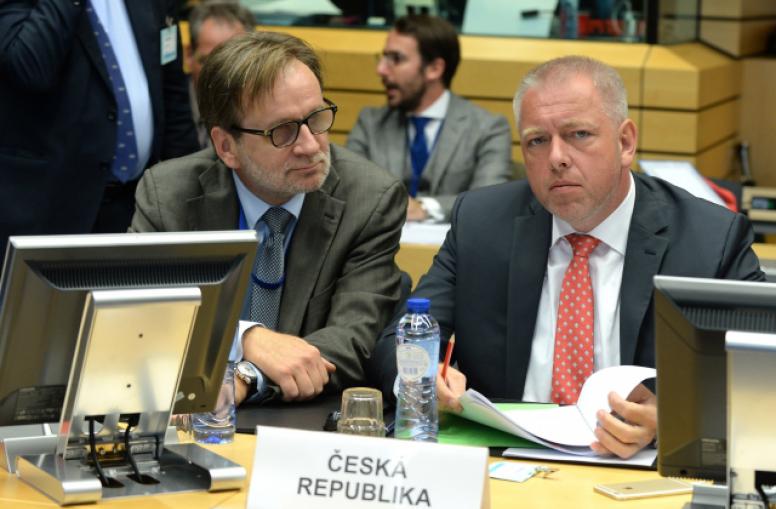
EU interior ministers have approved a relocation plan on distributing 120,000 refugees among member states. The Czech Republic, Romania, Slovakia, and Hungary, voted against it, while Finland abstained.

Under the plan, refugees will be relocated from Italy, Greece, and Hungary to other countries in the EU.

Prague’s decision did not come as a surprise, as Prime Minister Bohuslav Sobotka said hours before the meeting began that the country would reject any quota system.

He added that any attempt to impose such a scheme could end in “big ridicule for the European Commision” and the governments supporting the plan.

Czech Interior Minister Milan Chovanec expressed his distaste for the plan after the vote, tweeting:”We will soon realise that the emperor has no clothes. Common sense lost today.”

Slovakian Prime Minister Robert Fico said those who decided to push through quotas nonsensically caused a deep rift over a very sensitive issue.

However, under European law, three of the countries that voted against the proposal — the Czech Republic, Romania and Slovakia — would be required to accept migrants against their will, an EU diplomat told The New York Times on condition of anonymity after the vote.

Finland was the only country of the EU’s 28 members to abstain from the vote. Poland, which had previously opposed the proposal, voted in favor of it.

The plan has been criticized by the UN refugee agency (UNHCR), which says it is insufficient.

“A relocation programme alone, at this stage in the crisis, will not be enough to stabilise the situation,” UNHCR spokeswoman Melissa Fleming said, urging the EU to set up reception facilities able to handle tens of thousands of refugees at a time.

The UN estimates that around 480,000 migrants have arrived in Europe this year alone, and are now reaching European shores at a rate of nearly 6,000 a day.

Earlier in the day, German rail operator Deutsche Bahn suspended services to Austria and Hungary until October 4th, citing border controls introduced to manage the record surge of refugees.

Hungary has come under fire for its construction of a 110 mile fence along its border with Serbia. Budapest is expected to extend that barricade by also building fences along the Croatian and Romanian borders.

Slovakia introduced temporary controls on its borders with Hungary and Austria last week, sending an additional 220 police officers to the area.

Germany and France have been rallying for a quota system for weeks, with German Chancellor Angela Merkel saying earlier this month that such a plan would be a “first step.” She has stressed that all member states should share responsibility.

The Organisation for Economic Co-operation and Development says Europe can expect a record one million people to request asylum this year, almost half of which will likely qualify to be taken in.

Source: RT

Hungary takes out ads to warn migrants

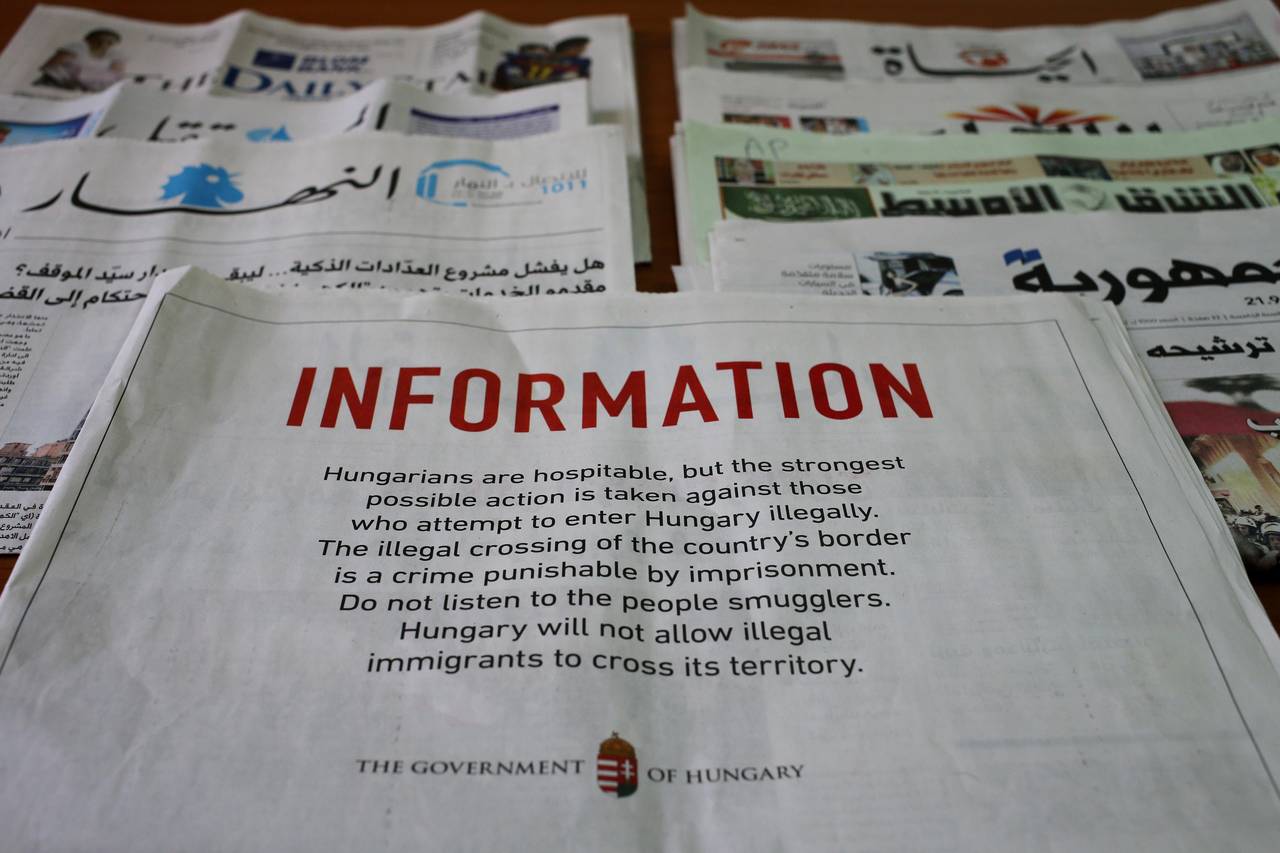
Hungary posted full-page advertisements in local Lebanese newspapers Monday warning refugees and migrants from illegally crossing into the country, two weeks after Denmark took out similar ads as Europe grapples with its biggest migration crisis since World War II.

“Hungarians are hospitable,“ read the full-page English and Arabic ad, ”but the strongest possible action is taken against those who attempt to enter Hungary illegally.”

The full cost of the campaign was unknown.

The privately-owned Annahar newspaper said it had charged the Hungarian government $17,100 for a page.

The ad likely targeted the nearly 1.2 million Syrian refugees living in Lebanon, many of whom have expressed frustration with the lack of support and infrastructure available to refugees there.

On Monday, Hungary passed legislation allowing for army deployment along its own borders as refugees and migrants camped there.

“What’s taking place now is an invasion,” Hungarian Prime Minister Viktor Orban said in a speech opening a session of parliament.

Hungary, whose conservative policies toward refugees and its police force’s use of tear gas against those massed at its borders have been criticized by some of its neighbors, including Germany, which has issued an open-door policy to refugees and promotes a unified border policy between countries in the European Union.

Last week Hungary completed the construction of a 110-mile-long fence along its border with Serbia, forcing thousands to alter their route to Germany via Croatia.

Earlier this month, Denmark took out similar cautionary ads in Lebanese newspapers. In notices that ran in four outlets, it listed tightened procedures in its immigration law, including a 50% cut to social benefits for newly-arrived refugees.

“Foreign nationals granted temporary protection in Denmark will not have the right to bring family members to Denmark during the first year,” said the ad, posted by Denmark’s Ministry of Immigration, Integration & Housing.

Denmark’s ad was posted to correct information circulating among “human traffickers and others profiting from smuggling immigrant and refugees across borders,” the ministry said.

Over 500,000 people applied to asylum for the first time in the EU since January 2015.

Source: WSJ

An estimated 35 million migrants heading for Europe

Shock estimates predict up to 35 million refugees could head for Europe due to hugely unstable situations across the world.

The huge figure was revealed today by Hungary’s minister for foreign affairs and trade Peter Szijjártó.

Speaking as the country begins work on its second fence to stop migrants heading across its border he predicted the current crisis will continue for years.

Mr Szijjártó told the Hungarian Times: “The name of the fence is ‘Temporary Security Border Fence’ but I think there is no question that in this case temporary means years.

“It’s a self delusion to call this situation a migration crisis; it is a massive migration of nations, with inexhaustible reserves.

“I don’t think that the analysis results, stating that 30-35 million people out there could possibly become migrants, would be an exaggeration.

“Libya, Yemen, Syria, Iraq and Afghanistan are all countries with a huge population and an extremely unstable situation.”

The Hungarian government also defended itself from criticism over its fences.

The first barrier was put up at its border with Serbia but, after migrants changed their route, they have now begun erecting a 41 kilometre fence at Croatia.

Migrants look to break through to Hungary as that sees them enter the European Union’s Schengen Zone which offers free movement between member countries.

He said: “The recent international political decisions created an unstable situation around Europe that makes sure that the amount of people won’t decrease.

“This is why it’s extremely important to protect our borders.

“This issue wasn’t this important until now, so the European Union neglected it a little bit.

“It became clear that – though its the border of Schengen – Greece couldn’t protect the border of the European Union.

“The Hungarian/Serbian border is another border of Schengen. If we want to follow the orders of Schengen, we have to build a physical obstruction, because this 175 km long area is quite easy to cross.

“The European Union just realised what the Schengen border means.

“If we want to keep the freedom of movement in the European Union, we have to protect the outer borders.”

Source: Express

Riot police clash with migrants on Hungarian border

Hungary detained 29 asylum seekers in clashes at the Hungarian-Serbian border on Wednesday. Among them was “an identified terrorist,” according to a PM security aide.

Gyorgy Bakondi, a security adviser to Hungarian Prime Minister Viktor Orban, said that 20 police officers were injured in the violence after refugees and migrants broke through a razor wire fence on the border between the Hungarian town of Roszke and Horgos in Serbia on Wednesday.

Twenty-nine people were detained, said Bakondi who added that “police also captured an identified terrorist” RT reported.

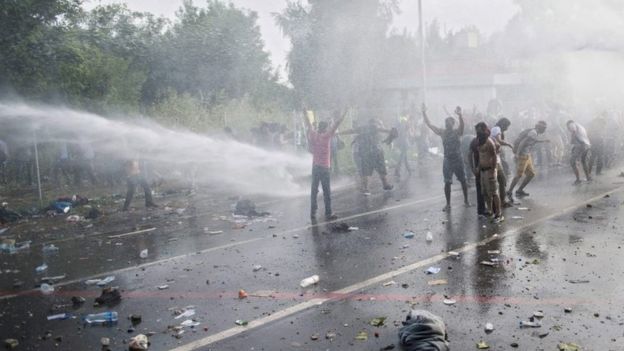
Meanwhile Hungarian riot police have fired tear gas and water cannon to force migrants back from the Serbia-Hungary border.

Hundreds of people have massed at a closed crossing point near the Serbian town of Horgos, and are involved in a tense stand-off with police on the other side of the border.

Some migrants threw missiles, including stones and water bottles.

Many of the migrants want to reach Germany, amid divisions within the EU over how to deal with the crisis.

Migrants break through police lines in Croatia

Amid chaotic scenes in Croatia, hundreds of asylum seekers surged past security forces on Thursday to continue their journey to Western Europe.

Some 9,000 migrants and refugees have now poured into Croatia after riot police and a razor wire fence thwarted their efforts to pass from Serbia into Hungary.

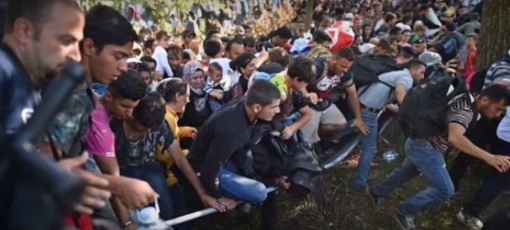
Fed up with waiting for transport to continue their journey, huge crowds at the Croatian border town of Tovarnik pushed past police lines.

Now there seems no stopping this surge of humanity – including many people fleeing the Syrian conflict – despite Croatia saying it can’t take any more migrants.

Interior Minister Ranko Ostojic said Croatia would provide migrants with safe passage to reception centres around the capital, Zagreb, but that those not seeking asylum would be considered illegal immigrants.

He said 6,500 had entered in the past 24 hours.

Source: Euronews

EU official denies reponsibility in migrant crisis

The crisis of mass migration of refugees from Africa was not caused by European countries, but by autocratic leaders, a European official said on Tuesday.

Roeland van de Geer, European Union ambassador to South Africa, said the cause of the crisis in North Africa “lies squarely with its own leaders”.

Speaking after a meeting between President Jacob Zuma and the diplomatic corps, he told reporters he believed that this lack of democratic values was driving the multitudes to risk life an limb and life to reach Europe.

“So we lay the responsibility for what is happening in the countries of the Maghreb clearly in the hands of the leaders who were dictators and did not respect democracy,” said Van der Geer.

Earlier on Tuesday, President Jacob Zuma blamed European countries for the Libyan refugee crisis.

Addressing numerous ambassadors and high commissioners in Pretoria, Zuma said European countries had ignored the African Union’s proposal for peaceful intervention in Libya, destabilising the country, and should therefore welcome refugees from the north African country.

“What has happened? The consistent, systematic bombing by NATO forces undermined the security and caused conflicts that are continuing in Libya and neighbouring countries. That is why we have this problem (of refugees). It has not just popped up from nowhere,” Zuma said at the Sefako Makgatho Presidential Guesthouse in Pretoria.

Zuma said African countries were ignored when they repeatedly proposed an alternative road map to the “destabilisation” of Libya.

“Today, those who were part of destabilising that part of the world don’t want to accept the refugees. It is their responsibility. They caused it and they must now address it. That is of absolute importance. It is the painful truth,” said Zuma.

He said South Africa was ready to assist Libya in post-conflict reconstruction and development projects. The southern African economic powerhouse also offered to help Libya with reconciliation efforts, and to formulate a Constitution for Libya.

Libya’s long time leader Muammar Gaddafi died in October 2011 during the Battle of Sirte. He was captured by National Transitional Council forces after he had been hiding in a culvert. He was killed shortly after his capture.

On Tuesday, Zuma claimed that before the 2011 Arab Spring, and the killing of Gaddafi, there were no refugees in the northern part of Africa.

“It was all quiet. Things were normal in the north of Africa. It was the action taken, the bombarding of Libya, and the killing of its leader, that opened the floodgates, firstly for serious tensions within Libya.

“The beginning of the refugee (crisis), at least from the African side, was triggered by that undermining of the security situation. As people grapple with the problem of refugees, we forget easily, we might think Africa suddenly has a problem where refugees are flooding Europe,” said Zuma.

Commenting on the Syrian crisis, Zuma said European countries should not shut down their doors to the multitudes of refugees.

“It took the painful drowning of a four-year-old Syrian child to shake the world into action. Attempts to shut the borders by some European countries will not assist the situation,” said Zuma.

He said the international community must not support external military interference “or any action in Syria” that is not in line with United Nations’ charters.

“As immediate relief for the refugees, we call on our European Union partners as well as Syria’s regional neighbours to assist the Syrian refugees, in full accordance and compliance with all Human Rights and Humanitarian laws,” said Zuma.

“We pledge our support to the EU as it grapples with this challenging situation.”

Source: ANA

Austria deploys army against migrants

The Austrian army has been sent to assist in introducing tougher border checks amid the growing migrant crisis, Reuters cited the country’s vice-chancellor as saying.

At least 2,200 soldiers will assist police in tackling the refugee crisis on the border, according to a statement from the Austrian government.

The soldiers will be deployed when their help is required, Austrian Chancellor Werner Faymann said, Krone newspaper reported.

“If Germany carries out border controls, Austria must put strengthened border controls in place,” Vice Chancellor Reinhold Mitterlehner said in a joint news conference with Chancellor Werner Faymann. “We are doing that now.”

Thousands of asylum seekers continue to pour into Austria from Hungary. Police told Reuters that 8,400 people had arrived on Sunday.

“The flow of refugees remains very high,” the spokesman said. “I don’t think I would be wrong in saying that we might exceed the threshold of 10,000 if it continues like this.”

Police spokesman Gerald Pangl told AP that some 14,000 people had arrived in the town of Nickelsdorf on Sunday, and about 2,500 in the early hours of Monday.

Slovakia has introduced temporary controls on its borders with Hungary and Austria, sending an additional 220 police officers, the country’s Interior Ministry said Monday.

The move comes after Germany introduced border checks over the weekend to tackle the flow of asylum seekers.

Source: RT

Is Europe doomed as Gadaffi promised?

As Europe’s migrant crisis grows far and wide, many Russian media are recalling the late Libyan leader Muamar Gaddafi’s gloom prophecy made several months before his violent death. “Now listen you, people of NATO. You’re bombing a wall which stood in the way of African migration to Europe, and in the way of Al-Qaeda terrorists. This wall was Libya. You‘re breaking it. You’re idiots, and you will burn in Hell for thousands of migrants from Africa and for supporting Al-Qaeda. It will be so. I never lie. And I do not lie now,” said Gaddafi in an open letter obtained by the Russian daily Zavtra and published in May 2011 several months before the Lybian leader was killed.

Since the beginning of the year 500,000 refugees have arrived in Europe. The migrant crisis has become number one priority for the EU countries, European Commission President Jean-Claude Juncker told the European Parliament in his annual message regarding the state of affairs in the European Union.

“It is Europe today that represents a beacon of hope, a haven of stability in the eyes of women and men in the Middle East and in Africa. That is something to be proud of and not something to fear,” said Juncker.

The question what caused the migrant crisis in Europe has evoked a deluge of comments from the expert community and Russian society in general. Europe is about to lose its reputation of the most stable place in the world, largely because the leading European countries and the United States have been shaking loose the regimes precisely in those countries whose people are now storming railway stations in the EU, experts say.

“That the refugee crisis is an outcome of US-European policies is clear to the naked eye,” says senior research fellow Boris Dolgov, of the Oriental Studies Institute under the Russian Academy of Sciences. “The destruction of Iraq, the destruction of Libya and attempts to topple Bashar Assad in Syria with the hands of Islamic radicals — that’s what EU and US policies are all about, and the hundreds of refugees are a result of that policy,” he told TASS.

“It’s a very serious and multi-faceted problem,” Professor Irina Zvyagelskaya, of the oriental studies department at the Moscow state institute of international relations MGIMO, told TASS. “The civil war in Syria and tensions in Iraq and Libya keep fueling the flow of migrants, but that is not the only cause. I agree with those who see the current events as a trend towards another mass resettlement of peoples, which leave the weaker countries with ineffective economies. There are systemic problems that cause people to abandon their homes and take to the road. And the liberal European legislation allows many of them to not only stay in Europe, but also to live there on social benefits without seeking employment.”

“These people are exhausted, angry and humiliated. They have no idea of European values, lifestyles and traditions, multi-culturalism or tolerance. They will never agree to abide by European laws,” says Russian author, playwright and stage director Yevgeny Grishkovets in his blog. “They will never feel grateful to the people whose countries they have managed to get into with such problems, because the very same states first turned their own home countries into a bloodbath.”

“Angela Merkel vows modern German society and Europe are prepared for problems… That’s a lie and nonsense! I am certain that many of those in France, Italy and Germany, who are pretending compassion and shaking their heads in bewilderment at the news more migrants have drowned or died of suffocation or fatigue on the way, in reality are saying to themselves something like this: ‘This serves them right! That will teach others a lesson!” says Grishkovets.

Columnist and blogger Vitaly Tretyakov wonders why the European Union has walked into this trap which it will never be able to get out of.

“The reasons are many, but all of them are confined to arrogance and exaggerated self-confidence. In most cases this high-handedness is never expressed aloud, but the ‘Europeans’ always feel superiority over everybody else in this world.”

“It remains to be seen whether the European Union succumbed to Washington’s pressures or preferred to manifest solidarity with the United States when it decided to speed up the so-called ‘process of democratization’ in North Africa and the Middle East. Whatever the case, by doing so it helped thrust open Pandora’s Box. Now a vast territory has plunged into civil wars and armed chaos and millions of refugees were forced to flee for life,” Tretyakov said.

Source: TASS

‘We face an Armageddon scenario with migrants’

The General Secretary for Danish Refugee Help, Andreas Kamm, used to be a politically correct pro-multiculturalist. But he has had a change of mind, and is not even sure if we can save our societies.

From Jyllands Posten:

The number of refugees and migrants heading towards Europe is historically high. The political institutions that are in charge of handling refugee flows are collapsing. The solidarity within the EU and international conventions are under increasing pressure.

We are therefore heading towards a greater collapse, concludes Danish Refugee Council’s longstanding Secretary General Andreas Kamm. …

“We are risking that conflicts between refugees and migrants on the one side and local populations on the other goes awry and will escalate, and in my eyes, we face an Armageddon scenario.”

He estimates that the current pressure from streams of refugees constitutes a “permanent” challenge that will not go away, and recommends the development of new tools that can address and solve the problems.

But the answer is not that “Europe should import the world’s surplus populations,” Kamm said.

“We are not obliged to destroy our own society. We must stop before that if we possibly can,” he says.

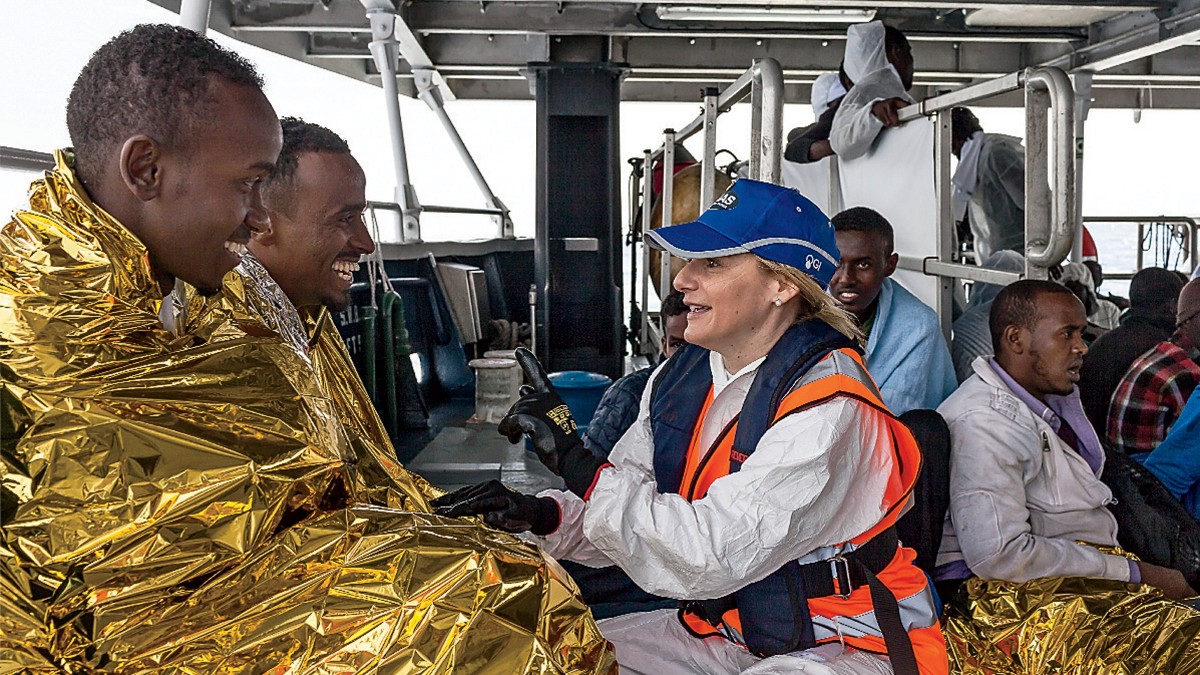
Meanwhile American volunteers aid the migrants. MOAS (the Migrant Offshore Aid Station) is a foundation helping Africans to come to Europe, based in Malta.

It is dedicated to “preventing loss of life at sea by providing assistance to migrants”. MOAS is funded by the son of an American oil engineer from Lake Charles, Louisiana, one Christopher Catrambone.

Ground Zero for migrants errupts in chaos

Keleti train station in Budapest, which has emerged as ground zero in Europe’s spiraling migration crisis, temporarily shut down its services on Tuesday under the strain of an influx of migrants trying to travel to Germany from Hungary.

Emphasizing the sense of confusion across Europe, Austria’s interior minister, Johanna Mikl-Leitner, called on Germany, the preferred destination for many of the migrants, to clarify its stance on asylum rules.

Rows of riot police officers wearing red caps tried to contain the migrants in Budapest, and the migrants erupted in protest after the station stopped allowing them to board trains. Instead, they were allowed into the courtyard of the station, which has been transformed into a makeshift camp.

The migrants, who had been gathered since 5 a.m. in the hopes of boarding a train, chanted: “Go free! Go free! Go free!” Later, they shouted, “Merkel, Merkel,” referring to Angela Merkel, the German chancellor, whose country is expected to receive 800,000 asylum seekers this year.

Train services at Keleti were restored shortly after 10 a.m., and no migrants were being allowed back into the station.

The scenes of confusion and despair at Keleti underlined the challenges facing Europe as tens of thousands of migrants, buffeted by civil war and conflict in the Middle East and Syria, are trying to make the perilous journey to Europe, only to be confronted with a patchwork of policies across a 28-member bloc that is ill equipped to deal with the surge.

In the last five days, the number of migrants trying to leave from the Budapest station has grown to 2,000 a day from about 800.

The chaotic scenes at the station came as Austria asked Germany to provide guidance about how to handle asylum seekers.

The cold reception migrants received in Budapest was a marked contrast to the one in Munich, where the police said on Tuesday that about 2,500 people had arrived on trains from Budapest, via Vienna, in the span of 24 hours. Hundreds more continued to arrive early Tuesday.

Streets around the city’s central train station were blocked off to allow the authorities to organize the migrants and bring them to the city’s refugee processing centers, where they were to be registered and begin the process of applying for asylum.

Matching the flood of people was a flow of donations of drinks, food and baby necessities from Munich residents. “There is no end to the willingness of people to help — Great!” the police said on Twitter.

In Hungary, the center-right government, under pressure from a far-right anti-immigrant party with a sizable voice in Parliament, has itself aired some of the most strident anti-immigrant speech on the Continent.

Source: NYT

Czech army should defend borders against migrants

The Czech Republic should defend its borders, using the army to expel “illegal immigrants” because the European Union isn’t curbing the influx of refugees into the bloc, President Milos Zeman said.

Zeman’s comments echoed those of other politicians calling for the EU to take action to stem the flood of people into the region from Syria and other conflict areas as they travel through Greece and the Balkan states to western Europe.

“Of course I would wish for the EU to strengthen its borders, but I don’t see any real action,” Zeman told reporters in Prague castle on Monday. “Therefore I believe the Czech Republic should take of its borders alone and expel illegal immigrants from the borders, including with the use of the army.”

The refugee crisis has escalated in central Europe this month, with Austrian police finding a Hungarian-licensed truck containing the bodies of 71 migrants last week. Scores more drowned when their boats capsized off the coast of Libya. Most refugees traveling to the EU pass through former communist countries as they head to Germany and other richer states.

Source: Bloomberg