Le Pen to face trial for ‘inciting racial hatred’

Marine Le Pen, the leader of France’s popular National Front, has been ordered to stand trial in October on charges of inciting racial hatred after comparing Muslim street prayers to the Nazi occupation, legal sources said Tuesday.

Le Pen was campaigning to take over leadership of the FN from her father in December 2010 when she made the comparison, complaining that there were “10 to 15” places in France where Muslims worshipped in the streets outside mosques when they were full.

“I’m sorry, but for those who like talking a lot about World War II, if it comes to talking about the occupation, we can talk about it, because that (Muslims praying on the street) is the occupation of territory,” she told a crowd in the southeastern city of Lyon.

“It is an occupation of part of the territory, suburbs where religious law is applied. Sure, there are no armoured vehicles, no soldiers, but it is an occupation nonetheless and it weighs on residents.”

After the comments, which provoked outrage in France, Le Pen was investigated for inciting racial hatred but the probe was later closed with no result.

But a complaint by an association led to a judicial enquiry which was opened in January 2012.

Le Pen was charged in July 2014 after her immunity as a member of the European Parliament was lifted following a vote requested by French authorities.

– ‘I’ll be at trial’ –

Le Pen told AFP she intended to attend the trial.

“Yes, of course. I wouldn’t miss such an occasion,” she said.

The party remains staunchly anti-EU and anti-immigration and Le Pen has seized upon Europe’s migrant crisis to win votes ahead of regional elections in December.

The FN is already leading opinion polls in several regions.

Le Pen has leaned on traditional party arguments, calling for an end to Europe’s borderless Schengen zone as well as actions seen as enticing migrants to France.

However she also stepped up the rhetoric, comparing the flood of migrants on Europe’s doorstep to the “barbarian invasions” of the fourth century.

Speaking to Paris-based foreign journalists on Monday, Le Pen said of migrants: “We should warm them up, feed them and then send them back where they came from.”

Source: AFP

Le Pen – US no ‘ally or friend’ to France

The leader of France’s far right Front National party, Marine Le Pen, has declared that the United States is not “an ally or a friend” to the French, in light of Wikileaks reports that the National Security Agency (NSA) spied on three French presidents.

“France should react with firmness and send out a strong signal today by pulling out of discussions over the Transatlantic Trade and Investment Partnership (TTIP) treaty,” Le Pen wrote in a statement, referring to the deal being discussed by the European Parliament to revise corporate rights in dealings with governments. She and other eurosceptics have opposed the TTIP plan.

“The US are a hegemonic power, prepared to do anything in order to increase its grip on our country” Le Pen said. “The French must recognize that the United States, which is to say its government that we clearly distinguish from its people, are not a country that is an ally or a friend.”…

Le Pen also dismissed Sarkozy’s decision to restore France to Nato’s integrated military command in 2009 as a “strategic mistake”. Former leader Charles de Gaulle removed France from the role in 1966, fearing it harmed France’s sovereignty.

In the conversation the two negotiate the possibility of Le Pen endorsing the Russian annexation of Crimea and visiting the peninsula as “an observer”.

Source: Newsweek

Marine le Pen: We must resist corporations

Leader of France’s National Front party, Marine Le Pen, has launched a month-long blitz against the Transatlantic Trade and Investment Partnership (TTIP) – a proposed EU-US treaty, which has been criticized for secretiveness and lack of accountability.

“It is vital that the French people know about TTIP’s content and its motivations in order to be able to fight it. Because our fellow countrymen must have the choice of their future, because they should impose a model for society that suits them, and not forced by multinational companies eager for profits, Brussels technocrats sold to the lobbies, politicians from the UMP [party of former president Nicolas Sarkozy], who are subservient to these technocrats,” Le Pen said during a press conference in Paris.

Since 2013, open-ended negotiations between Washington and Brussels have drawn up the framework for the agreement, intended to standardize legislation and bring down trade barriers between them.

As per US practice, the contents of all economic treaties are classified. The EU has recently set up reading rooms throughout Europe for officials with clearance – but only a few thousand people have had access to the working documents.

Le Pen hit out at the secrecy of the negotiations, which have featured mostly bureaucrats from the European Commission, the EU’s executive body, and nebulous “stakeholders” from businesses and public organizations. As a member of the European parliament, she forwarded a motion for greater transparency in negotiations last year. Le Pen’s motion was defeated.

She is now hoping for grassroots support.

“I am convinced that we can push back the TTIP if the peoples are informed of its content, and if they decide themselves to join us in order to express their disagreement concerning this treaty,” Le Pen told journalists.

Both of France’s leading parties have endorsed the treaty, but Le Pen is relying on strong the anti-European sentiment that propelled her party to first place in last year’s elections for the European parliament.

While TTIP’s authors promise that the treaty will bring an extra 0.5 percent GDP to Europe and the US, figures across the political spectrum have expressed concern.

US President Barack Obama, who is also negotiating a similar treaty with Asia, was defeated by his own party in the Senate last week when he asked for fast-track approval to handle negotiations. Additional votes will be required if the proposed legislation is not to be bogged down in the US chambers of Congress.

Meanwhile, European legislators have raised a host of issues, in particular concerning the investor-state dispute settlement (ISDS) mechanism outlined in the treaty. The controversy centers on the proposed special economic tribunal, which would operate outside the traditional legal system and allow corporations to challenge governments.

In April, thousands took to the streets of Brussels, Madrid, Berlin and Helsinki to protest against the secretive deal.

Marine says Le Pen should no longer speak for party

France’s National Front chief Marine Le Pen said Sunday her father should “no longer be able to speak in the name of” the party, as a bitter public feud between the two continues.

Jean-Marie Le Pen infuriated some last month by reiterating his long-held view that the Nazi gas chambers were merely a “detail of history”, as well as making other controversial remarks defending the “white world”.

Previously he hailed the outbreak of Ebola in Africa as welcome. His latest comments also come in the wake of a recent controversial interview with Ursula Haverbeck on Germany’s ARD channel in which Haverbeck claims that the “Holocaust was the biggest pack of lies in history“.

Le Pen earlier praised French wartime leader Philippe Petain, who collaborated with the Nazis.

Marine condemned the comments as “political suicide” and a highly-publicised spat between them saw the 86-year-old party founder forced to pull out of upcoming regional elections.

“Jean-Marie Le Pen should no longer be able to talk in the name of the National Front, his comments are against the fixed (party) line,” she told French radio.

Marine Le Pen has been actively trying to distance the party from its racist and anti-Semitic image as she plans her bid for the next French presidential election in 2017.

Jean-Marie Le Pen was conspicuously dropped from a line-up of National Front leaders on stage during the party’s traditional May 1 rally in Paris.

But determined to upstage his daughter, he nevertheless strided uninvited onto the podium to take the ovation of the crowd.

“I think that was a malicious act, I think it was an act of contempt towards me,” Marine said Sunday.

Jean-Marie Le Pen has been summoned Monday to appear before the party’s top executive authority, which will examine whether to take action against him following last month’s comments.

The FN’s honourary president was in hot water just days before because allegations emerged that he had stashed 2.2 million euros in a secret Swiss bank account.

Some protesters also tried to take the stage at the event, but the old patriarch upstaged the opportunists.

Front National at the gates of power

Manuel Valls, the French prime minister, reminded his bedraggled Socialist Party in September last year of the obvious: “The Front National is at the gates of power” as the Left tries to avert the electoral catastrophe with the usual mantras: “racism, antisemitism and homophobia“.

But the public is no longer impressed and could not care less, just like the when East-Germans no longer believed in the slogans of their lefties and started to chant: ‘we are the people’.

A low turn out today in France’s local council elections will probably play into the hands of the nationalists. The socialists are demoralized, like everywhere in Europe. Their globalist world view is collapsing. Polls predict that the National Front will be in the lead.

Marine Le Pen, leader of the Front National, already has 18 council seats, and in the European Parliament in Brussels, the party has 23 MEPs.

EU funds just reinforce the dictatorship of Brussels and impoverish the downtrodden rural and small-town folk of the region, the terror of the French establishment says. “I have to remind people ad nauseam that this is not European money. It’s part of French taxpayers’ money that transits through Brussels with the rest going to pay for central and eastern Europe,” Le Pen sighs.

Le Pen is tilling the fertile electoral soil of taxes and immigration for a run at the Élysée Palace in two years’ time.

The pro-American elite is terrified of a President Le Pen since 2002 when Jean-Marie, Marine’s father and the founder of the Front, as it is known, featured in the run-off for the presidency. He was defeated by Jacques Chirac when voters rallied to block the pariah.

With his blonde daughter now in charge of the family firm, prospects for the right look brighter.

As the New Statesman eloquently puts it:

The country is in a foul mood. The sense of dispossession at the hands of a hostile world is feeding contempt for la France d’en haut – the governing caste. President François Hollande and his Parti Socialiste (PS) have been disowned by many of their disappointed voters, discredited by scandal and economic failure.

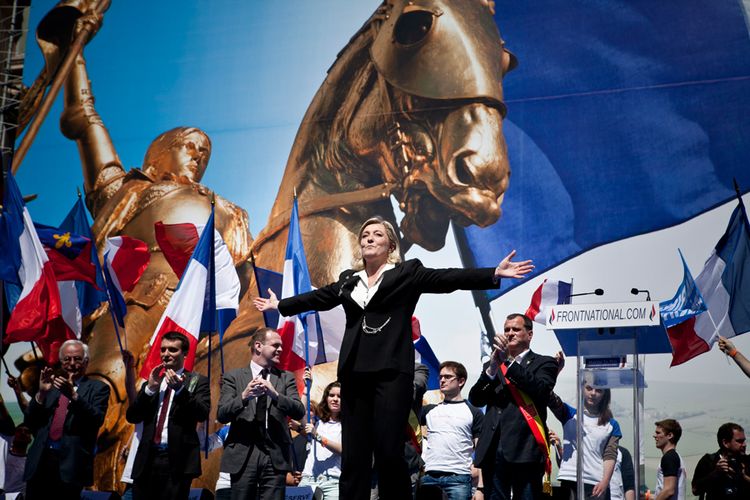
Marine Le Pen, 46, the youngest of the 86-year-old patriarch’s three daughters, is gliding above this desolate landscape, a protective Joan of Arc.

Le Pen is amused by the left’s indignation over the way that she has broadened her attraction, softening the anti-immigration rhetoric and adding Socialist voters to the party’s hard-right faithful, says Charles Bremner who interviewed her many times.

Charles de Gaulle, whom Le Pen admires, was accused of being both a fascist and a Bolshevik she says. “France is neither on the right nor the left – it’s just France . . . I don’t have the feeling that I tell patriots on the left different things from what I say to patriots of the right.”

When she was eight, a bomb destroyed the family flat. No one was ever arrested for the crime. Her father, an ex-parabat, soldiered on.

Also part of the family is Marion Maréchal-Le Pen, 24, one of the Front’s three MPs, and the daughter of Yann, Marine’s second sister. She is said to be closer to the patriarch than Marine because she opposes gay marriage, while Marine tolerates it.

Le Pen is gaining in the polls

Discontent in France has translated into a drift of power towards the far right in the form of Front National. It no longer requires a very vivid imagination to envision Ms. Le Pen achieving an electoral victory in 2017.

Despite her party’s controversial past it has become much more socially acceptable to support the FN, to the extent that Marine Le Pen draws enthusiastic crowds to official events, and Madonna, who once superimposed a swastika on an image of Ms. Le Pen’s face at a concert, wants to “sit down and have a drink” with her.

None of this changes the fact that her political agenda remains subversive. She calls for an end to the EU and has adopted policies critical of the French allies, backing Putin’s annexation of Crimea. She also wants to raise wages and pensions, restore the retirement age to 60, as well as establish border controls and reinstate the death penalty.

Meanwhile, many voters hope that she will be the one to “save France,” in the belief that only radical policy changes can do so. Yet, it is highly questionable whether Ms. Le Pen’s vision, with its populist promises and scepticism towards free markets, free movement and free trade, is a road to salvation.

The spirit that brought 4 million French closer together and onto the streets in solidarity after the attacks on Charlie Hebdo has already waned, and the polling numbers show how FN’s protectionism, conservatism and nationalism appeals to voters en masse.

FN is part of a broader trend in Europe, where the lingering economic malaise and associated unemployment of the Eurozone has led significant numbers to respond to the easy attraction of the far right or far left.

It can best be described as the politics of scapegoating, whether the blame falls on immigrants, Muslims, Euro-bureaucrats or Jews like in FN’s past, and the tactics are mirrored all across Europe. Voters are disillusioned with the political elite, and as the traditional, centrist parties lose political capital, voters turn to the fringe, where promises of sweeping, popular action sound like a welcome overhaul of politics-as-usual.

Europe’s voters are increasingly drawn to protest parties

Syriza in Greece has been the first protest party to obtain real powers of government, and its doings are monitored closely, by centre and fringe parties alike. France, however, is a much bigger fish than Greece, and if Ms. Le Pen should happen to win the presidency, it would raise a number of awkward questions about French membership in the European Union.

Currently, FN is poised to round up 30% of the vote in the first of two rounds of regional elections on March 22nd and 29th. Although it is doubtful that FN will win many local assemblies, as voters from centre-right and left may gang up to exclude it, there will still be hundreds of seats across France filled by members of FN, forming a base for the presidential campaign in two years.

The polls indicate that Ms. Le Pen will probably make it to the second round in 2017, but that her chances of winning are slim, but existent. In the end, winning the presidency is perhaps the lesser goal. Governing does not always lend itself well to extreme policies and populist views. Furthermore, FN has already succeeded in changing France from a two- to a three-party system, which is no small feat.

Until 2017, the incumbent government will be under a lot of pressure. There are plenty of problems to address, and with FN racing ahead in the polls, consciousness of public opinion is likely to affect domestic and multilateral matters.

This could slow down the reform process that has been underway, such as Macron Law, which was passed by decree following a tense vote of confidence in Parliament, and make implementation less rigorous.

Public attitudes towards EU, Germany and Greece could also be affected by disturbing trends at home, which may have been a factor in the negotiations between Eurozone finance ministers in February. Here, France took a soft stance towards Greece and advocated that the other Eurozone members show understanding and respect for the change in leadership and the Greek electorate’s decision.

There is a small risk that French voters are going to set a similar shift in motion in the not-so-distant future, and if the economic consequences of a potential Grexit would be problematic and inconvenient, the results of a “Frexit,” although rooted in different causes, would be very messy indeed.

Source: internationalpolicydigest.org

Russia turns to right-wing parties in EU

A Russian loan to France’s National Front. Invitations to Moscow for leaders of Austria’s Freedom Party. Praise for Vladimir Putin from the head of Britain’s anti-European Union party.

As the diplomatic chill over Ukraine deepens, the Kremlin is keen to enlist Europe’s far-right parties in its campaign for influence in the West.

Russia fears that NATO could spread to countries it considers part of its sphere of influence. And it has rightly served notice that it will not tolerate meddling, most recently with its Ukraine campaign.

Europe’s right-wing and populist parties, meanwhile, see an Atlanticist-dominated EU as contrary to their vision of Europe. They want to see a union of strong national states that do not toady to America.

The fact that many of Moscow’s allies are right to far-right reflects the Kremlin’s full turn. Under communism, nationalist parties were shunned as “xenophobic”.

Statements by leading critics of the EU, or euroskeptics, reflect their admiration of the Kremlin.

National Front founder Jean-Marie Le Pen told The Associated Press this month that France and Russia “have a communality of interest.”

Daughter Marine Le Pen, party president and a strong contender for the French presidency in 2017, envisions a Europe stretching “from the Atlantic to the Urals” — a “pan-European union” that includes Russia and is supported by other right-wing parties.

Nationalist Hungarian Prime Minister Viktor Orban perceives prevailing winds as “blowing from the East” and sees in Russia an ideal political model for his concept of an “illiberal state.”

The head of Britain’s euroskeptic Independence Party, Nigel Farage, has said Putin is the world leader he most admires.

Among other Moscow regulars from euroskeptic parties across Europe are members of Hungary’s anti-Semitic Jobbik and Austria’s Freedom Party.

Jobbik parliamentarian Bela Kovacs is under investigation in Hungary for allegedly “spying” for Russia.

While in Moscow recently, Freedom Party firebrand Johann Gudenus accused the European Union of kowtowing to NATO and America and denounced the spreading influence of the homosexual lobby in Europe.

Shunned at home by the liberal establishment and pro-American media, many are eager to gain air time on RT television, Russia’s international answer to CNN.

For them, “the benefit is that they can receive diplomatic support from a very high level from a superpower,” says Peter Kreko of Hungary’s Political Capital research institute.

Financial rewards are also incentives. Orban just signed a nuclear-reactor deal with Moscow. France is abuzz over the National Front’s recent 9 million euro loan from a Russian bank owned by a reputed Putin confidant.

Marine Le Pen describes it as “a perfectly legal loan that we will reimburse perfectly legally,” saying the party turned to Russia after being rejected by Western banks. But the transaction has galvanized fears among the National Front’s opponents of increased Kremlin influence, with the Socialists calling for an inquiry.

Links between Russia and the right predate the Ukraine conflict. A 2005 US diplomatic cable made public by Wikileaks noted close ties between Bulgaria’s extreme-right Ataka party and the Russian Embassy in Sofia.

And Joerg Haider, the late leader of Austria’s Freedom Party, helped powerful Russian businessmen with residency permits more than a decade ago in exchange for close to 1 million euros in campaign funding.

Putin’s friendships with German ex-Chancellor Gerhard Schroeder and Italy’s former Premier Silvio Berlusconi were also useful for the Kremlin.

Now the diplomatic gloom is settling in, their strong domestic and EU election showings this year will help further its own interests, Moscow hopes.

Of the 24 right-wing populist parties that took about a quarter of the European Parliament’s seats in May elections, Political Capital lists 15 as “committed” to Russia.

Many owe their popularity to evidence that EU-friendly parties in power are to blame for the continent’s economic woes — a view that could grow if the downturn persists.

“What Russia is saying is, ‘It’s fine for you to be the way you are’,” says analyst Melik Kaylan, in a study for the Institute of Modern Russia.

‘Marine Le Pen is at the gates of power’

French premier Manuel Valls warned on Sunday that the National Front party is at the “gates of power.”

“In France, the extreme right of Marine Le Pen is at the gates of power,” Valls said. “And I, as a man of the left, will never be able to resign myself to that because it will be the weakest who will be the first to suffer. And it will also be a terrible, perhaps fatal, blow to Europe.”

France’s National Front, known for its anti-immigrant and anti-EU rhetoric, achieved unprecedented results in the latest EU polls, claiming nearly 25 percent of the votes and winning the election.

“Our people demand one type of politics: they want politics by the French, for the French, with the French. They don’t want to be led anymore from outside, to submit to laws.”

Speaking to French media, the head of France’s right-wing National Front likened the recent reshuffle of Prime Minister Manuel Valls’ cabinet to an “illusionist performance,” calling it a “circus.”

Le Pen suggested that French President Francois Hollande should dissolve the National Assembly, France’s lower house of parliament. She added that it was “more than necessary” and “the only responsible decision” Hollande would make since he became head of state five years ago.

“Francois Hollande tries to save time, but the damage is too deep,” Le Pen argued.

In August, Hollande asked Valls to form a new government following tensions within his cabinet over the country’s economic policy.

The decision came after strong criticism of the country’s economic direction – which the outgoing economy minister, Arnaud Montebourg, voiced as he called for a “major shift.”

Source: RT

Le Pen a growing threat to mainstream politicians

The growing threat to France’s mainstream political leaders posed by Marine Le Pen, head of France’s National Front, has been underscored by an opinion poll putting her in the lead for the first time in the race for the next presidential election.

The charismatic Ms Le Pen has overtaken former centre-right president Nicolas Sarkozy in voting intentions if the first round of the election were held today, with socialist incumbent François Hollande trailing in third, according to the Ifop poll.

Ms Le Pen scored 26 per cent in the poll, up from 24 per cent in the last sounding taken in April, while Mr Sarkozy, widely expected to announce a political comeback in September, slipped six points to 25 per cent following court accusations of corruption levelled against him in early July.

The FN has been on the rise since Ms Le Pen took over leadership of the party from her father Jean-Marie Le Pen in 2011. She came third behind Mr Hollande and Mr Sarkozy in the 2012 presidential election with 18 per cent of the vote and the party has since grown as Mr Hollande’s popularity has slumped in the face of recession and rising unemployment.

In May’s European parliamentary elections, the FN won a nationwide vote for the first time, easily defeating both Mr Sarkozy’s UMP party and the socialists with a score of 25 per cent.

The latest poll, for the magazine Marianne, appeared to confirm the damage caused to Mr Sarkozy and the UMP by financial scandals and internal leadership wrangling that have sapped its ability to present a coherent opposition to Mr Hollande’s government, despite the president’s record-low personal approval ratings.

Mr Sarkozy was questioned under arrest and then placed under formal investigation on July 2 on suspicion of corruption, influence peddling and a breach of professional secrecy linked to a separate probe into his election campaign financing in 2007.

The UMP is also under investigation over allegations of covering up millions of euros in spending above legal limits in Mr Sarkozy’s 2012 campaign.

The Ifop poll underlined growing fears on both the mainstream left and right that Ms Le Pen is set to repeat the feat of her father in 2002 when he reached the second round of the presidential election by coming second, knocking out the then socialist candidate Lionel Jospin.

Most analysts continue to believe she would then be defeated in the run-off by whichever candidate she faced, as mainstream voters rallied to defeat her. The Ifop poll did not test second round voting intentions, but earlier polls have shown a narrower margin of defeat than the 82-18 per cent loss suffered by her father against Jacques Chirac in 2002, especially if her opponent were Mr Hollande.

Concerns that Mr Hollande is already heading for defeat have prompted speculation that the Socialist party might opt for another candidate. But the Ifop poll showed neither of the two likeliest alternatives, Manuel Valls, the reformist prime minister, nor Arnaud Montebourg, the leftwing economy minister, doing any better.

Source: FT

French politicians have ‘organised their own impotence’: Marion Maréchal-Le Pen

Young French politician and Front National parliamentarian, Marion Maréchal-Le Pen, said that her colleagues from the centre-right UMP and Socialist Party “have organised French political impotence”. She was participating last night in a debate on the “War of the right-wing parties” on the talkshow “Les mots croisés” on France 2, the state-owned channel.

marion_marechal-lepen
Marion Maréchal-Le Pen on last night’s programme

Maréchal-Le Pen went further and claimed, in a rare statement for a sitting parliamentarian and member of the National Assembly in her country, that “one may well ask oneself the question, whether politics still has the capacity to change things”. She blamed “successive transfers of sovereignty to Europe, as well as government by the judges of the European Court of Human Rights whose ultra-extensive jurisdiction takes precedence over internal law” for this state of affairs. Circulars from Brussels to governments constitute another source of power abuse as bureacrats dictate to politicians what to do in their home countries.

According to Marion Maréchal Le Pen, the centre-right UMP “has been an accomplice to all of that”, and regardless of their sympathies for the Gaullist tradition in France, she feels that the European issue has to be confronted as it affects “the power of politics and the maintenance of politics in France”.

Le Pen causes stir with Ebola and migration comments

Dutch politician Geert Wilders on Thursday dismissed a comment by his political ally Jean-Marie Le Pen that the ebola virus could address Europe’s immigration problem.

ebolalepen
Jean-Marie Le Pen

At a cocktail party before an election rally in Marseille on Tuesday evening in which the FN is leading the polls in France, Le Pen spoke of the “demographic explosion” in the world.

“Monseigneur Ebola could sort that out in three months,” he said in front of journalists.

“I think it was a silly remark,” the platinum-haired Dutch anti-immigration politician said shortly after casting his ballot in European parliamentary elections in a Hague suburb.

The quote was widely picked up by French media to embarrass Marine Le Pen, the current head of the FN.

Wilders reminded journalists that Marine Le Pen was in charge of the FN.

Jean-Marie Le Pen on Wednesday downplayed the comment. He is the honorary president of the National Front and is standing in this week’s European parliamentary elections.

Mr Le Pen, who will celebrate his 86th birthday on 20 June, said he did not see “how it is possible to argue about this.” “I say France must prepare itself for a shock, for a flood of migration caused by the ongoing growth of the world’s population,” the politician said.

Le Pen said later he wasn’t calling for an epidemic; his daughter’s chief of staff said his words had been misinterpreted.

Wilders and Le Pen late last year announced a historic alliance to fight the European elections and form a bloc in Brussels.

In developing her anti-euro platform, Marine Le Pen has also exchanged notes with Matteo Salvini of Italy’s Northern League.

British anti-EU and anti-immigration leader Nigel Farage, who leads the United Kingdom Independence Party (UKIP) has ruled out joining the group though, saying the FN was too tainted by “anti-Semitism”.

In the Czech Republic the Workers’ Party (DS) and National Party (NS) have stood up for Mr Le Pen on their official websites. Czech voters will be electing new MEPs this coming Friday and Saturday.

Voters among the more than 380 million Europeans in 28 countries will choose a total of 751 new MEPs.

Le Pen unknowingly joins Paul Ehrlich’s predictions. Ehrlich, a Stanford University biologist famous for his book “The Population Bomb,” doubled down on his climate change and overpopulation fears with HuffPost Live on May 21.

Ehrlich’s co-author Michael Tobias praised Ehrlich’s older predictions and said they underestimated the problem.

Ehrlich told the interviewer humans must soon begin contemplating “eat[ing] the bodies of your dead” after resources are depleted.

Ehrlich claimed that scarcity of resources will get so bad that humans will need to drastically change our eating habits and agriculture. Instead, we will soon begin asking “is it perfectly okay to eat the bodies of your dead because we’re all so hungry?” He added that humanity is “moving in that direction with a ridiculous speed.”