Le Pen a growing threat to mainstream politicians

The growing threat to France’s mainstream political leaders posed by Marine Le Pen, head of France’s National Front, has been underscored by an opinion poll putting her in the lead for the first time in the race for the next presidential election.

The charismatic Ms Le Pen has overtaken former centre-right president Nicolas Sarkozy in voting intentions if the first round of the election were held today, with socialist incumbent François Hollande trailing in third, according to the Ifop poll.

Ms Le Pen scored 26 per cent in the poll, up from 24 per cent in the last sounding taken in April, while Mr Sarkozy, widely expected to announce a political comeback in September, slipped six points to 25 per cent following court accusations of corruption levelled against him in early July.

The FN has been on the rise since Ms Le Pen took over leadership of the party from her father Jean-Marie Le Pen in 2011. She came third behind Mr Hollande and Mr Sarkozy in the 2012 presidential election with 18 per cent of the vote and the party has since grown as Mr Hollande’s popularity has slumped in the face of recession and rising unemployment.

In May’s European parliamentary elections, the FN won a nationwide vote for the first time, easily defeating both Mr Sarkozy’s UMP party and the socialists with a score of 25 per cent.

The latest poll, for the magazine Marianne, appeared to confirm the damage caused to Mr Sarkozy and the UMP by financial scandals and internal leadership wrangling that have sapped its ability to present a coherent opposition to Mr Hollande’s government, despite the president’s record-low personal approval ratings.

Mr Sarkozy was questioned under arrest and then placed under formal investigation on July 2 on suspicion of corruption, influence peddling and a breach of professional secrecy linked to a separate probe into his election campaign financing in 2007.

The UMP is also under investigation over allegations of covering up millions of euros in spending above legal limits in Mr Sarkozy’s 2012 campaign.

The Ifop poll underlined growing fears on both the mainstream left and right that Ms Le Pen is set to repeat the feat of her father in 2002 when he reached the second round of the presidential election by coming second, knocking out the then socialist candidate Lionel Jospin.

Most analysts continue to believe she would then be defeated in the run-off by whichever candidate she faced, as mainstream voters rallied to defeat her. The Ifop poll did not test second round voting intentions, but earlier polls have shown a narrower margin of defeat than the 82-18 per cent loss suffered by her father against Jacques Chirac in 2002, especially if her opponent were Mr Hollande.

Concerns that Mr Hollande is already heading for defeat have prompted speculation that the Socialist party might opt for another candidate. But the Ifop poll showed neither of the two likeliest alternatives, Manuel Valls, the reformist prime minister, nor Arnaud Montebourg, the leftwing economy minister, doing any better.

Source: FT

Why Canada is richer than the US

On July 1, Canada Day, this year, Canadians awoke to a startling, if pleasant, piece of news: For the first time in recent history, the average Canadian is richer than the average American.

According to data from Environics Analytics WealthScapes published in the Globe and Mail, the net worth of the average Canadian household in 2011 was $363,202, while the average American household’s net worth was $319,970.

A few days later, Canada and the U.S. both released the latest job figures. Canada’s unemployment rate fell, again, to 7.2 percent, and America’s was a stagnant 8.2 percent. Canada continues to thrive while the U.S. struggles to find its way out of an intractable economic crisis and a political sine curve of hope and despair.

The difference grows starker by the month: The Canadian system is working; the American system is not. And it’s not just Canadians who are noticing. As Iceland considers switching to a currency other than the krona, its leaders’ primary focus of interest is the loonie — the Canadian dollar.

As a study recently published in the New York University Law Review pointed out, national constitutions based on the American model are quickly disappearing. Justice Ruth Bader Ginsburg, in an interview on Egyptian television, admitted, “I would not look to the United States Constitution if I were drafting a constitution in the year 2012.” The natural replacement? The Canadian Charter of Rights and Freedoms, achieving the status of legal superstar as it reaches its 30th birthday.

Good politics do not account entirely for recent economic triumphs. Luck has played a major part. The Alberta tar sands — an environmental catastrophe in waiting — are the third-largest oil reserves in the world, and if America is too squeamish to buy our filthy energy, there’s always China. We also have softwood lumber, potash and other natural resources in abundance.

Policy has played a significant part as well, though. Both liberals and conservatives in the U.S. have tried to use the Canadian example to promote their arguments: The left says Canada shows the rewards of financial regulation and socialism, while the right likes to vaunt the brutal cuts made to Canadian social programs in the 1990s, which set the stage for economic recovery.

The truth is that both sides are right. Since the 1990s, Canada has pursued a hardheaded (even ruthless), fiscally conservative form of socialism. Its originator was Paul Martin, who was finance minister for most of the ’90s, and served a stint as prime minister from 2003 to 2006. Alone among finance ministers in the Group of Eight nations, he “resisted the siren call of deregulation,” in his words, and insisted that the banks tighten their loan-loss and reserve requirements. He also made a courageous decision not to allow Canadian banks to merge, even though their chief executives claimed they would never be globally competitive unless they did. The stability of Canadian banks and the concomitant stability in the housing market provide the clearest explanation for why Canadians are richer than Americans today.

Martin also slashed funding to social programs. He foresaw that crippling deficits imperiled Canada’s education and health- care systems, which even his Conservative predecessor, Brian Mulroney, described as a “sacred trust.” He cut corporate taxes, too. Growth is required to pay for social programs, and social programs that increase opportunity and social integration are the best way to ensure growth over the long term. Social programs and robust capitalism are not, as so many would have you believe, inherently opposed propositions. Both are required for meaningful national prosperity.

Martin’s balanced policies emerged organically out of Canadian culture, which is fair-minded and rule-following to a fault. The Canadian obsession with order can make for strange politics, at least in an American context. For example, of all the world’s societies, Canada’s is one of the most open to immigrants, as anyone who has been to Toronto or Vancouver will have seen. Yet Canada also imposes a mandatory one-year prison sentence on illegal immigrants, and the majority of Canadians favor deportation. Canadians insist that their compassion be orderly, too.

This immigration policy is neither “liberal” nor “conservative” in the American political sense. It just works. You could say exactly the same thing about Canada’s economic policies.

Canada has been, and always will be, overshadowed by its neighbor, by America’s vastness and its incredible versatility and capacity for reinvention. But occasionally, at key moments, the northern wasteland can surprise. Two hundred years ago last month, the War of 1812 began. Thomas Jefferson declared, “The acquisition of Canada, this year, as far as the neighborhood of Quebec, will be a mere matter of marching.” The U.S. was comparatively enormous — with almost 8 million people, compared with Canada’s 300,000. The Canadians nonetheless turned back the assault.

Through good luck, excellent policy and even some heroism, Canada survived the war. But it has taken 200 years for Canada to become winners.

(Stephen Marche is a novelist and columnist for Esquire Magazine. His most recent book is “How Shakespeare Changed Everything.” The opinions expressed are his own.)

‘African Dream about to explode’

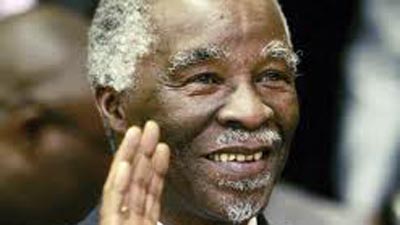
Thabo Mbeki

Former President Thabo Mbeki has warned of more Arab spring uprisings on the continent if African leaders continued to be “preoccupied” with enriching themselves and not being concerned about “the lives of the people”.

In an interview with The Sunday Independent, Mbeki said the patience of the youth and ordinary Africans was waning, and that their frustrations could explode.

He wrote in The Thinker magazine in September, quoting poet Langston Hughes, that if the African dream is deferred for much longer it will explode.

Asked this week if the explosion could amount to uprisings such as the Arab spring, Mbeki said: “If the African population continues to experience similar conditions as happened in Tunisia and Egypt, similar conditions of standards of living not improving, facing crises all the time, and a small elite which lives well and eats better every day, and flaunts its wealth… in the end these ordinary African people, like the ordinary African people of Tunisia, surely will say enough is enough, I think it is imperative of all our governments to clearly focus on this matter.”

Mbeki said he sensed some exasperation among African youth when he interacted with them throughout the continent.

“There is a level of impatience. And the determination to see things change for the better… It is the responsibility of government to respond to that voice and for the youth to understand their role, not rebellion, but to reconstruct the continent,” he said.

Mbeki wrote in The Thinker earlier that there were some African leaders, including some in SA, who came to power to accumulate wealth.

“You will see it in many parts of the continent where people assume positions of leadership… as an opportunity for self-enrichment.

“We’ve seen the same phenomenon here in South Africa, we are not immune… and somebody who is preoccupied with that is not about to be concerned about ‘what did I do wrong yesterday which has impacted negatively on the lives of the people’. [They are] not interested in that.”

He said this was partly why the AU failed to reflect on its successes and failures on its 10th anniversary this year. He told The Sunday Independent he hoped the 50th anniversary of the Organisation of African Unity, the AU’s predecessor, would provide an opportunity to review progress on continental issues.

“I think it is important not just to make speeches and say we celebrate. But say what has been our experience in the last 50 years, what has gone right and what has gone wrong.”

In The Thinker, he blasted the AU for being “consumed by the eminently subsidiary matter of who should chair the AU Commission, reflecting the malaise that is poisoning the African body politic”.