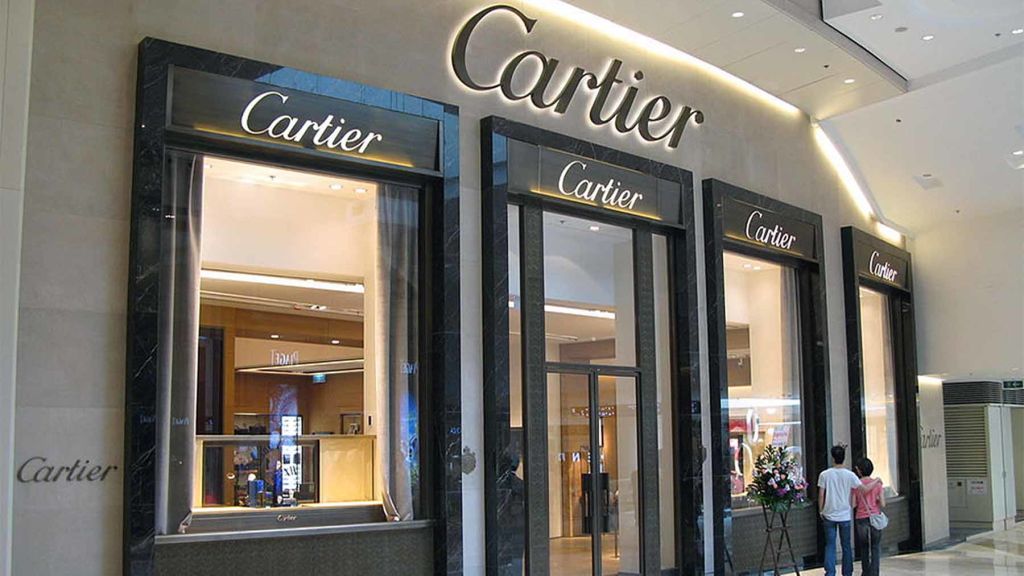
Johann Rupert, the South African who has made billions peddling Cartier jewelry and Chloe fashion, said tension between the rich and poor is set to escalate as robots and artificial intelligence fuel mass unemployment.
“We cannot have 0.1 percent of 0.1 percent taking all the spoils,” said Rupert, who has a fortune worth $7.5 billion, according to data compiled by Bloomberg. “It’s unfair and it is not sustainable.”
The founder and chairman of Richemont, whose 20 brands also include Vacheron Constantin and Montblanc, said he expects advances in technology to lead to job losses after having read books on the subject recently. Conflicts between social classes will make selling luxury goods more tricky as the rich will want to conceal their wealth, Rupert said in a speech Monday at the Financial Times Business of Luxury Summit in Monaco.
“How is society going to cope with structural unemployment and the envy, hatred and the social warfare?” he said. “We are destroying the middle classes at this stage and it will affect us. It’s unfair. So that’s what keeps me awake at night.”
Rupert, a university dropout whose father made a fortune setting up Rembrandt Tobacco Corp. and selling it off, has in the past made other social critiques. Nicknamed ‘Rupert the Bear’ for his pessimistic views on the economy, the 65-year-old refers to himself as a “reformed prostitute,” having spent a decade as an investment banker. He said in 2008 that the collateral damage from the financial crisis was yet to come.
“We’re in for a huge change in society,” he said Monday. “Get used to it. And be prepared.”
Up to 4,200 migrants sailing across the Mediterranean Sea were rescued by European ships on Friday, but 17 people died during the journey on unseaworthy boats. The number rescued in 24 hours appears to be one of the highest in recent years.
The 17 bodies were found on three inflatable dinghies, from which over 300 other migrants were rescued alive, the Italian Navy said on Twitter.
Friday’s rescue operations were led by the Italian coastguard, and involved German and Irish naval ships working under the auspices of the EU’s Frontex border agency.
A similar international maritime mission off the coast of Sicily on Thursday resulted in the rescue of over 700 migrants from Libya in six boats.
So far, the busiest days this year have been on April 12 when 3,791 migrants were rescued and the May 2 rescue of 3,690 people.
According British activist John Wight, the drowning of hundreds of refugees in the Mediterranean is “a crime against humanity,” and “the ultimate responsibility lies with Western governments that have proved themselves the enemy of everything good in the world and a friend to everything bad.”
Over 40,400 boat migrants, many of them fleeing poverty and conflict-stricken countries such as Syria and Eritrea, have arrived in Italy since the start of the year, according to the International Organization for Migration (IOM).
New statistics gathered by IOM confirm 2015 appears to be “an even deadlier year than 2014,” when nearly 3,300 migrants perished trying to enter Europe. While last year the number of migrants dying in all Mediterranean crossings from January to April was 96, this year’s toll is an estimated 1,770 so far through to April 30, IOM said.
IOM’s team in Italy has recently reported a persisting trend of growing numbers of women from Africa, particularly Nigerians.
“In the first four months of 2015, we have registered an increase in the number of incoming Nigerian women – three times as many as during the same period last year. There are well-founded concerns that many of them may be victims of trafficking,” Federico Soda, Director of the IOM Coordination Office for the Mediterranean in Rome, stated earlier this month.
By mid-May, some 62,500 people had crossed the Mediterranean, and at least 1,800 have died, the agency added.
“It happens a lot in waves, you could have a few days where nothing happens, then there can be a high number of arrivals at the same time,” Flavio di Giacomo, a spokesman for the IOM in Italy, told AFP.
Speaking in Lisbon on Friday, Tunisia’s Prime Minister Habib Essid said his country will consider the naval campaign the EU plans to curb the migrant problem “almost a military intervention.”
Essid added that it will not help, as “if you stop the boats in this area, they will just move to the other side.”
Billionaires and politicians gathering in Switzerland this week will come under pressure to tackle rising inequality after a study by Oxfam found that – on current trends – by next year, 1% of the world’s population will own more wealth than the other 99%.
The charity’s research, published on Monday, shows that the share of the world’s wealth owned by the best-off 1% has increased from 44% in 2009 to 48% in 2014, while the least well-off 80% currently own just 5.5%.
Oxfam added that on current trends the richest 1% would own more than 50% of the world’s wealth by 2016.
Winnie Byanyima, executive director of Oxfam International and one of the six co-chairs at this year’s WEF, said the increased concentration of wealth seen since the deep recession of 2008-09 was dangerous and needed to be reversed.
“The message is that rising inequality is dangerous. It’s bad for growth and it’s bad for governance. We see a concentration of wealth capturing power and leaving ordinary people voiceless and their interests uncared for.”
Oxfam made headlines at Davos last year with a study showing that the 85 richest people on the planet have the same wealth as the poorest 50% (3.5 billion people). The charity said this year that the comparison was now even more stark, with just 80 people owning the same amount of wealth as more than 3.5 billion people, down from 388 in 2010.
Separate research by the Equality Trust, which campaigns to reduce inequality in the UK, found that the richest 100 families in Britain in 2008 had seen their combined wealth increase by at least £15bn, a period during which average income increased by £1,233. Britain’s current richest 100 had the same wealth as 30% of UK households, it added.
Pope Francis and the IMF managing director Christine Lagarde have been among those warning that rising inequality will damage the world economy if left unchecked, while the theme of Thomas Piketty’s best-selling book Capital was the drift back towards late 19th century levels of wealth concentration.
Barack Obama’s penultimate State of the Union address on Tuesday is also expected to be dominated by the issue of income inequality.
He will propose a redistributive tax plan to extract more than $300bn (£200bn) in extra taxes from the 1% of rich earners in order to fund benefits specifically targeted at working families.
However, the odds of the White House having any success persuading Congress to adopt the plan, given the Republicans’ new grip on both chambers, are extremely long.
Oxfam said the wealth of the richest 80 doubled in cash terms between 2009 and 2014, and that there was an increasing tendency for wealth to be inherited and to be used as a lobbying tool by the rich to further their own interests. It noted that more than a third of the 1,645 billionaires listed by Forbes inherited some or all of their riches, while 20% have interests in the financial and insurance sectors, a group which saw their cash wealth increase by 11% in the 12 months to March 2014.
These sectors spent $550m lobbying policymakers in Washington and Brussels during 2013. During the 2012 US election cycle alone, the financial sector provided $571m in campaign contributions.
The Economic Freedom Fighters may take up arms if their “peaceful revolution” is met with violence from the state, party leader Julius Malema said on Thursday.
“We can’t rule out the possibility of an armed struggle if the state is going to meet peaceful protest with violence,” he said in a pre-recorded interview aired on SAfm radio.
“We would not do anything which seeks to compromise the 1994 breakthrough and it all depends on how the state responds to the radical demands of our people.”
He hoped the ruling party would not be tempted to adopt “apartheid tactics” when faced with serious pressure.
Malema told the radio station there was no need for a “military response” from the state, when clearly he is mulling taking up arms.
“In the Parliament, the freedom of speech and expression is unlimited. It is absolute and you need to live with that.
“All of you must begin to accept that we are exercising our rights to the limit and therefore we are not going to conduct ourselves in a manner defined by the middle class which has always hated us. It will never vote for us.”
The EFF is hoping that incitement against the “middle class”, a euphemism for whites, will lead to anarchy and revolution that would bring “hope to the working class and eliminate poverty”.
Meanwhile the EFF Commmander in Chief this week indulged in a twitter war after he was spotted wearing a black Louis Vuitton belt.
This is not the first time he’s tweaked the workers’ overall he wears to parliament with exorbitantly expensive clothing and accessories, while demanding “social justice” and “economic freedom”.
The pauper also wears a Breitling watch valued at R250 000.
Black children in Wisconsin continue to be segregated, the study by Wisconsin Council on Children and Families shows.
“Wisconsin has a great deal of work to do with regard to the success of our children of color,” reads the official report of the council published on Wednesday.
According to the study, 30 percent of white children in Wisconsin live in households below the poverty level, whereas the number of African-American children who are menaced by this level of economic insecurity amounts to 80 percent.
The study also shows that white adults between the ages of 25 and 29 are three times as likely to be in possession of an associate’s or a higher degree than their African-American or Latino peers. White children are also nearly six times more likely to have a good academic performance in eighth-grade math than their black peers.
The research was based on 12 indicators analyzing children’s success during each stage of life from birth to adulthood.
The council admits that a lot of work is yet to be done to eliminate all barriers for non-white children to “thrive as the United States continues to become a more diverse nation.”
Many middle-class families will be pushed back into poverty
As from today, Johannesburg residents will pay 7% more for electricity.
Ten other municipalities, including Cape Town, asked National Energy Regulator of SA (Nersa) for increases ranging between 7.63% and 12.11%.
Cape Town’s proposed 7.63% electricity increase would compensate for a fall in its energy sales but additional funds would be needed for the implementation of the city’s new electrification programme.
The price increases are intended to protect revenue, cover high distribution losses, fund a smart metering pilot project, and contribute to costs of electricity infrastructure maintenance and improvement.
The power price increases are part of a slew of other hikes .
Tomorrow the price of petrol will increase by 20c/l , bringing the cost of petrol to a near record high of R14.30/l. The price of diesel will increase by 13c /l to R12.90/l.
Gautrain and Metrorail users are to be hit with fare increases.
Metrorail one-way tickets will go up by 50c today; return tickets by R1. The cost of a weekly ticket will increase by between R3 and R7 and monthly tickets will increase by between R7 and R30.
Dawie Roodt, an independent economist with the Efficient Group, said more petrol-price hikes can be expected in the next few months as the rand is expected to depreciate further and the price of crude oil is poised to rise.
The writing is on the wall for many middle-class families who have only recently escaped from dire poverty. Many will be pushed back into poverty.
The American Dream is impossible to achieve in the US.
So say nearly 6 in 10 people who responded to CNNMoney’s American Dream Poll, conducted by ORC International. They feel the dream — however they define it — is out of reach.
Young adults, age 18 to 34, are most likely to feel the dream is unattainable, with 63% saying it’s impossible. This age group has suffered in the wake of the Great Recession, finding it hard to get good jobs.
Younger Americans are a cause of great concern. Many respondents said they are worried about the next generation’s ability to prosper.
Some 63% of all Americans said most children in the U.S. won’t be better off than their parents. This dour view comes despite most respondents, 54%, feeling they are better off than their own parents.
The downbeat mood is not surprising, say economic mobility experts.
“The pessimism is reflective of the financial realities a lot of families are facing,” said Erin Currier, the director of the Economic Mobility Project at Pew Charitable Trusts. “They are treading water, but their income is not translating into solid financial security.”
The vast majority of Americans have higher incomes than their parents, but that’s in large part because most families have two earners now, she said. Only half have more wealth, she said. Meanwhile, the savings rate is low and unemployment is high. College costs are rising faster than inflation and student loan debt is exploding.
People also tend to be more pessimistic about the next generation’s fortunes in general than their own children’s prospects, Currier said. In Pew’s polls and focus groups, parents say that it will be tougher for their children to succeed, but they still believe it’s possible.
Watch the white middle class of Chicago vanish before your eyes.
It shows the demise of the foundation of an American city.
Watch as the grey squares, which illustrate the middle class that dominated the most of the city’s neighborhoods in 1970s, quickly vanish over 40 years.
The poor, represented by the orange and red colors, explode across the map.
And watch what happens in the green areas representing the upper middle class and wealthy. Not surprisingly, it spreads from downtown to the north side, but not with the same ferocity as the reds and oranges.
Especially in 2000, the greens-the color of money–grow much darker. It seems the rich simply got richer. In later years, the wealthy pushed the poor out of the near West Side. It appears that area bypassed the middle.
Rising expectations and youth unemployment have been identified as some of the sources of violent protests which have increased dramatically in the country in recent months.
The South African Institute of Race Relations, SAIRR’s programme manager and researcher, Georgina Alexander, says: “We have more people on social welfare at the moment in the country than those who have employment.”
In his State of the Nation Address last week, President Jacob Zuma promised on Thursday that South Africa would enter a new radical phase of accelerated socioeconomic transformation after the May election.
“More importantly, after the elections, the country will enter a new radical phase in which we shall implement socioeconomic transformation policies and programmes that will meaningfully address poverty, unemployment and inequality.
“It is a phase of focusing on economic transformation in particular. We have achieved political freedom, now we must achieve economic freedom and ensure that the ownership, management and control of the economy is deracialised further.
More needed to be done to advance blacks, he said.
“The number of black people and women in senior management has increased from less than 10% in the 1990s to over 40% today, which is a good achievement for the country. But it is not enough. Each year, the Employment Equity report releases statistics that indicate that the economy is still controlled by white South Africans in terms of senior and top management positions.
“We must therefore intensify the implementation of affirmative action policies in order to deepen reconciliation and social cohesion in our country,” Mr Zuma said.
Alexander says, “There is a threat that these protests will increase and become more violent. […] The government can see that the delivery protests are becoming more violent. They need to address the deeper causes of these service delivery protests.”
The deeper reasons for the protest lie in levels of youth unemployment and dependency on state as well as increasing rising expectations that people have, but it’s all directly reliant on the state to do something about it.
“This is just a spark, the deeper reasons for the protest lie in levels of youth unemployment and dependency on state as well as increasing rising expectations that people have, but it’s all directly reliant on the state to do something about it like to increase people’s living standard for them.”
Police officials and the South African Human Rights Commission (SAHRC) recently met to discuss the violent protests.
The SAHRC’s Danny Titus says, “The commissioner indicated to us that she would like to have a meeting next March with the Human Rights Commission focusing specifically on human rights and policing, and the number of issues around that.”
He says, “We would like to establish this relationship where we can make each other understand each other’s picture.”
Meanwhile, National Police Commissioner Riah Phiyega says they are struggling to control violent protests because of a shortage of public order policing officers. There are only 4 000 such officers and yet there was double the number in 2006.
One of the leaders of Brazil’s flashmob movement that is sweeping across shopping centres, sparking violent clashes with police, is a soft-spoken 55-year-old piano teacher that has never organised a protest in his life.
Around 1,000 people are expected to turn up at São Paulo’s upmarket JK shopping centre on Saturday for a gathering – known as a ‘rolezinho’ – which he has organised over Facebook.
He was motivated by a crackdown on other flashmobs, which began last month as parties but have become more political. “I couldn’t bear to see the criminalisation of poor, black kids,” he says.
Similar protest-cum-rampages are planned in at least eight other states across Brazil this weekend, with more than 8,000 expected at one shopping centre in Rio de Janeiro. Popular among poor, largely black, Brazilians, the flashmobs have begun to snowball into a nationwide movement against racism and inequality, threatening the government with further violent mass protests just as the country prepares to host the football World Cup, academics say.
In June the biggest protests in 20 years spread across Brazil following complaints over a bus fare increase, bringing businesses in Latin America’s biggest economy to a standstill and prompting a plunge, albeit temporary, in President Dilma Rousseff’s popularity.
Rousseff called an emergency meeting, worried that the protests might spiral out of control, local media reported.
Many say the government has good reason to be worried, pointing to a similarity with the London riots of 2011.
São Paulo’s first major rolezinho took place at the beginning of last month, when about 6,000 teenagers occupied Shopping Itaquera in the city’s poor eastern suburbs.
Similar gatherings followed across the city but muggings and robberies prompted a tough response from the police. Last Saturday, military police used rubber bullets and tear gas to break up the crowds and were caught on camera beating teenagers with truncheons.
Messages of outrage spread quickly over social media in Brazil, which has the second biggest Facebook community in the world, turning the mass parties into a nationwide political movement.
At least four shopping centres across the city secured court orders to ban suspicious teenagers from entering, leading to accusations this week of racial segregation and even a “Brazilian apartheid”.
In spite of Brazil’s image as a harmonious melting pot of races, racial tensions run deep. The country still suffers from one of the most acute income divides. “Although Brazil has progressed in reducing poverty, we note that there’s still a great contrast between the situation of black Brazilians and the country’s rapid economic growth,” the UN concluded in a report last month on racism.
Income growth has inspired a sense of social ascension, leading to demands for greater equality, as well as allowing people to buy their first mobile phones, giving them access to social media.
The movement might also be the symptom of a disenchanted youth that is facing a slowing economy and a shrinking job market.
While Brazil’s unemployment rate remains at a record low of about 5 per cent, research by Ipea, a government agency, has shown many young people in poorer regions are dropping out of the workforce and are not going into higher education either.
North West Premier Thandi Modise’s office says the purchase of a R1.3 million vehicle was above board and ordered before Finance Minister Pravin Gordhan announced austerity measures.
Modise recently purchased a BMW 750i despite Gordhan’s announcement last year that excessive spending on cars, travel, accommodation and other luxuries would be curbed.
Her office insists that the decision to purchase the vehicle was taken by the Department of Public Works and was below the 70 percent limit prescribed by the ministerial handbook.
Modise’s spokesperson Lesiba Kgwele says it is unfair to blame the premier who had no choice in the matter.
“The question of morality goes way beyond this particular transaction. In this particular instance, we want to insist that the premier didn’t defy any cabinet directives.”
The number of boats bringing undocumented migrants from various countries other than Cuba is on the increase, according to American federal authorities, who say smugglers have turned to other nationalities as the smuggling of Cubans has dried up.
One Oct. 16, a boat carrying migrants from Haiti capsized east of Miami Beach. Just two weeks before, on Oct. 3, federal authorities spotted a boat leaving Bimini, in the Bahamas, and traveling west toward U.S. shores without navigation lights.
On Aug. 28, smugglers dumped a group of Haitian migrants near Palm Beach and ordered them to swim ashore. A 14-year-old girl was later found dead on the beach.
And between 2009 and 2010, boats traveling between the Bahamas and South Florida smuggled dozens of Brazilians who first traveled to Europe and then flew to the Bahamas to board the smuggling boats to South Florida.
Federal officials say there’s an increase in migrant boat traffic toward South Florida involving the smuggling of undocumented foreign nationals of various nationalities. The boat traffic appears to have drawn smugglers who once primarily transported Cuban migrants across the Florida Straits and who now are focusing on nationals from other countries because the Cuban migrant smuggling organization have largely been dismantled, the officials said.
“Smugglers look for business anywhere,” said a federal official familiar with the issue.
The dismantling of the Cuban migrant smuggling networks along with improved Coast Guard patrolling and interdiction tactics are credited with a dramatic decrease in the number of Cuban migrants arriving by sea.
As a result, the majority of undocumented Cuban migrants are now arriving through the Mexican border. They come not only by boat from the island to the Yucatán peninsula but also overland from South and Central America.
Homeland Security Investigations (HSI), a unit of U.S. Immigration and Customs Enforcement, is the lead agency investigating boat migrant-smuggling networks.
Over the last two or thee years, investigators have noticed an increase in the number of boats operated by smugglers and transporting undocumented migrants of various nationalities.
The federal official familiar with the issue said that while several smuggling organizations were involved, they seemed to share similar traits. A significant number of them, the official added, operated boats that began voyages toward South Florida in the Bahamas – but carried migrants who came from as far away as Brazil, Ecuador or Colombia. Some of the migrants also started out in Haiti or the Dominican Republic but then made their way to the Bahamas to board smuggling boats for the final leg to South Florida.
In some cases, small boats overloaded with migrants begin their trips in Haiti.
That was the case in the ill-fated voyage of the 25-foot fishing boat that flipped over five miles east of Miami Beach, killing four female Haitian migrants Oct. 16. It carried 15 migrants, some of whom started the voyage in the northwestern Haitian coastal city of Port-de-Paix, according to Louisias Pierre, one of the survivors interviewed recently by the Miami Herald.
An affidavit in Miami federal court from an HSI special agent quoted one of the witnesses in the tragedy as saying that people boarded the boat in the Bahamas,
Pierre told the Miami Herald that the smugglers promised to transfer the migrants to a larger boat in the Bahamas, but that never happened. The boat did stop in the Bahamas, but only to pick up more migrants.
In the Oct. 3 voyage, the 24-foot boat began its trip in Bimini, according to an affidavit from another HSI special agent.
When a Customs and Border Protection vessel intercepted the suspect boat it disobeyed orders to stop.
“The operator of the suspect vessel then proceeded to increase his speed and performed evasive maneuvers, such as aggressively making left and right turns in an S-pattern, in an attempt to avoid interdiction,” the HIS affidavit said. “Due to the failure of the suspect vessel to stop, CBP fired two warning shots forward of the bow.”
The affidavit said the boat finally stopped about 10 miles east of Elliott Key, just south of Key Biscayne.
When CBP officers approached, they saw five men on the boat. One told officers that he was testing the boat, possibly to purchase it. A second man claimed he was brokering the sale. The three other men, they claimed, were migrants they had rescued from a makeshift boat adrift in the sea.
But once everyone was brought ashore, federal agents learned that two of the men were migrant smugglers and the other three were Cuban migrants without visas.
The federal official familiar with the issue said migrants pay a wide range of prices to be smuggled in — from as little as $1,000 or $2,000 per person to cross from the Bahamas to South Florida to as much as $15,000 for a comprehensive travel package from Brazil that includes flights to Europe and the Bahamas and then the boat ride to South Florida.
It’s unclear whether most boats are interdicted or get through to South Florida.
“We don’t catch them all,” the official said. “It’s a cat-and-mouse game.” – Miami Herald
According to the UN Population Division, sub-Saharan Africa’s annual urban growth rate is 3.6%, almost double the world average. About 40% of Africa’s more than 1 billion people live in cities and towns, many having migrated from rural areas to escape poverty, drought or conflict. About 200 million people live in slums.
“Africa is urbanizing faster than any other continent, so much so that by 2030, it will cease to be a rural continent,” said Anna Tibaijuka, executive director of UN-Habitat, the UN agency for human settlements. “Despite this, few African leaders are taking the issue seriously.” African governments have done little to manage rapid urbanization and don’t formally recognize slums.
Slums are not provided with public services, like electricity, sewerage systems, waste management, roads, housing and access to health care or education. And more than a quarter of Africa’s slum dwellers don’t have access to safe drinking water, according to the UN Environment Programme. A whopping 175 million people don’t have what’s considered reasonable sanitation.
That’s not going to change soon because Africa’s annual spending on infrastructure is 45 billion dollars, African Development Bank statistics showed, while almost twice that amount is needed to address the biggest problems.
Sub-Saharan Africa’s largest city, Lagos, Nigeria, is a prime example of poor planning. The city of 11 million people, two-thirds of whom are slum dwellers, is infamous for its overcrowding, potholed streets, traffic jams, frequent power cuts and poor sanitation. “Lagos has fewer infrastructures than any of the other largest cities in the world,” Lagos Town Planning and Urbanization Commissioner Francisco Abosede told the UN news service IRIN.
As the population of Lagos grows by 8% every year, the slums and their associated problems are growing with it, fuelling crime and increasing social tensions.
The situation is not much different in Africa’s largest slum, Kibera, on the outskirts of the Kenyan capital, Nairobi. The city’s slums have become “an urban time bomb,” said James Njuguna, project officer at the Irish non-profit organization Concern International in Nairobi.
Kibera’s estimated 2 million people are a huge underclass with serious consequences for Nairobi’s security and social fabric, Njuguna warned. Frustrated young people often join violent criminal gangs. “The standard of living in the slums is constantly deteriorating,” Njuguna said. “We see rising school dropout rates, poverty, malnutrition and crime. There are no social services. “Unless governments make major political changes, cities like Nairobi might explode with social unrest.”
That’s also true of South Africa. A quarter of South Africans are unemployed, and huge numbers of jobless have been migrating to Johannesburg and Cape Town, the country’s two major cities.
“Government has been struggling to cope with the huge influx of people, to solve infrastructure problems and provide services,” said Thuthukani Ndebele, a researcher at the South African Institute of Race Relations in Johannesburg. “People feel abandoned.” For a South African slum dweller, hope turns first into frustration and then into anger. They believe they have rights.
Fresh from its landslide election victory President Robert Mugabe‘s party said on Tuesday it would intensify the transfer of economic wealth to black Zimbabweans and overhaul the country’s “British” education system.
“We are saying we have to deepen and broaden the indigenisation and empowerment programme,” Zanu-PF secretary for information Rugare Gumbo told AFP.
“It must cover a wide range of people,” he said.
In a full page advert carried only in the private media — some fiercely critical of the government — Zanu-PF said it was “ready” to start applying the policies listed in its election manifesto.
“Over the next five years, Zimbabwe is going to witness a unique wealth transfer model that will see ordinary people take charge of their economy,” the party vowed.
After a series of farm seizures, in 2007 Mugabe passed a law which stated large foreign-owned entities may be liable to cede 51 percent of their ownership.
So far only mines have been targeted.
Gumbo said there also plans to change the British-modelled school curriculum.
“We want to change the curriculum, it reflects the British education system, which is not benefiting our people,” he said.
“We want a curriculum which is indigenous, which looks at Zimbabwean history, society and culture.”
Despite its economic woes, Zimbabwe still has one of Africa’s highest literacy rates.
Investors have expressed concerns about the plans of Mugabe‘s new government.
The Zimbabwe Stock Exchange’s main Industrial Index fell 1.7 percent Tuesday, following Monday’s 11 percent plunge.
Local shares in Barclays fell 20 percent amid fears foreign banks could become the next target for Mugabe‘s indigenisation efforts.
Gumbo said the government would be looking east for funding for economic projects.
“We will also want to go to our friends in the East because the West seem not to be co-operating.”
Western powers have voiced serious concern over irregularities in last week’s election.
This website uses cookies to improve your experience. We'll assume you're ok with this, but you can opt-out if you wish. Cookie settingsACCEPT
Privacy & Cookies Policy
Privacy Overview
This website uses cookies to improve your experience while you navigate through the website. Out of these cookies, the cookies that are categorized as necessary are stored on your browser as they are essential for the working of basic functionalities of the website. We also use third-party cookies that help us analyze and understand how you use this website. These cookies will be stored in your browser only with your consent. You also have the option to opt-out of these cookies. But opting out of some of these cookies may have an effect on your browsing experience.
Necessary cookies are absolutely essential for the website to function properly. This category only includes cookies that ensures basic functionalities and security features of the website. These cookies do not store any personal information.
Any cookies that may not be particularly necessary for the website to function and is used specifically to collect user personal data via analytics, ads, other embedded contents are termed as non-necessary cookies. It is mandatory to procure user consent prior to running these cookies on your website.