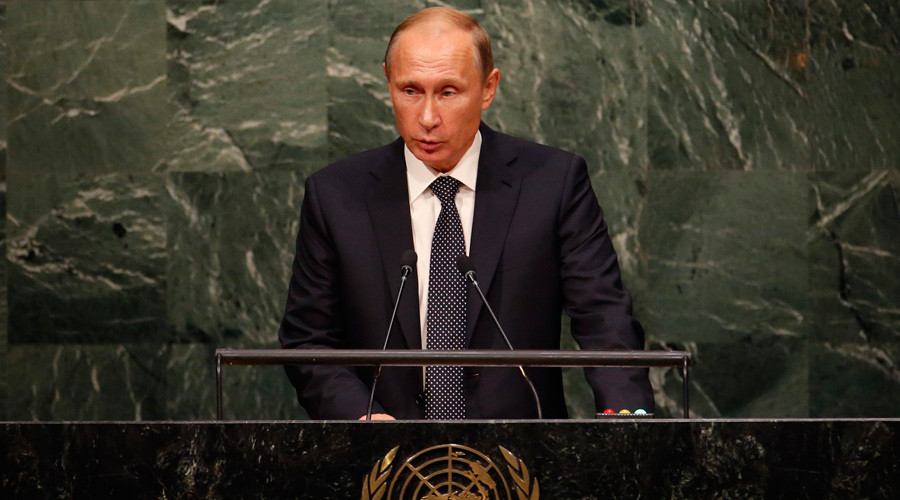
Democratic revolutions have sown violence, social disaster says Putin

The export of the so-called democratic revolutions continues, as the international community fails to learn from mistakes, which have already been made, Russian President Vladimir Putin said addressing the UNGA.

He cited the example of the revolutions in the Middle East, when people wished for change, “but how did that turn out?”

He said that instead of triumph of democracy “we have violence and social disaster,” where no one cares about human rights, including the right to life.

Actions carried out without a UN mandate could destroy the system of international relations, Putin said in his address.

“Russia is ready to work on the basis of broad consensus on the further development of the United Nations with all partners. But we believe that attempts to undermine the authority and legitimacy of the United Nations are extremely dangerous. This can lead to the collapse of the entire architecture of international relations,” Putin said.

In this case there would be no other rules left “but the rule of force,” he warned. The world would be dominated by “selfishness rather than collective work” and characterized by “dictate rather than equality.”

Putin said that the power vacuums in the Middle East and North Africa regions have led to the emergence of extremists. The Islamic State militants (IS, formerly ISIS/ISIL), who gained foothold in Iraq and Syria, are now seeking to dominate in the whole Islamic world, he said. Some of them have defected from the ‘moderate’ opposition in Syria, who has been supported by some Western states, he stressed.

ISIS trains militants from many nations, including Europe, and Russia is not an exception, he said. Putin urged to cooperate with the Syrian government forces fighting terrorists on the ground.

“We think it is an enormous mistake to refuse to cooperate with the Syrian government and its armed forces who are valiantly fighting terrorism face to face,” he said.

“We should finally acknowledge that no one but President Assad’s armed forces and [Kurdish] militia are truly fighting Islamic State and other terrorist organizations in Syria,” he added.

Source: RT

Overwhelming majority vote for Palestinian flag at UN HQ

UN General Assembly has passed a Palestinian resolution to allow its flag fly in front of the United Nations headquarters in New York, angering Israel and giving hope to Palestinians seeking to gain full UN membership.

The resolution stated that flags of non-member observer states like Palestine “shall be raised at [UN] Headquarters [in New York] and United Nations Offices following the flags of the member states.”

The vote was passed with 119 votes out of 193 in favor. Among the European countries that voted ‘yes’ were France, Russia, Sweden, Italy, Spain, Ireland, Slovenia, Luxembourg, Belgium, Malta and Poland.

The majority of EU member states were among the 45 countries that chose to abstain. A total of eight countries voted against the idea, including the US and Israel.

Palestinian Prime Minister Rami Hamdallah told reporters that he strongly believes this marks another step towards recognition of Palestinian statehood.

“It’s a step to the recognition of Palestine as a full member state of the United Nations,” Hamdallah said in Paris.

Currently, the UN has only one other non-member observer state – the Vatican. The Holy See did not demonstrate any excitement when the idea was first brought up last month, however, and rejected the Palestinians’ original proposal to introduce the resolution as a joint effort, asking the Vatican to co-sponsor the document.

The Vatican still remained unsure on Wednesday whether it will be flying its flag next to Palestine’s.

Source: RT

Thousands of Palestinian buildings to be demolished in West Bank

Palestinians have little chance of obtaining a construction permit in the West Bank, while Israel keeps issuing new demolition orders for Palestinian buildings faster than it can bulldoze them, says a new report from the local United Nations mission.

“Official data released by the Israeli authorities indicate that over 11,000 demolition orders – affecting an estimated 13,000 Palestinian-owned structures, including homes – are currently ‘outstanding’ in Area C of the West Bank,” begins a report, titled “Under Threat,” published by the United Nations Office for the Coordination of Humanitarian Affairs occupied Palestinian territory (OCHA-oPt).

While Israel has destroyed over 2,800 buildings since it began issuing demolition orders in 1988, most of them have never been carried out, remaining a Sword of Damocles hanging over the heads Palestinian residents.

“Structures built without permits are regularly served with demolition orders. While only a minority of the orders issued are executed, these orders do not expire and leave affected households in a state of chronic uncertainty and threat,” say the authors. “Where the orders have been implemented, they have resulted in displacement and disruption of livelihoods, the entrenchment of poverty and increased aid dependency.”

A shockingly low percentage of Palestinian applications for permits is ever approved. Israeli Civil Administration data reveals that Palestinians submitted 2,020 requests for building permits in Area C between 2010 and 2014 and only 33 of them (1.5 percent) were approved.

Palestinians have been demanding full recognition as a sovereign state from the UN and the international community for years now.

Recently, a number of international organizations have intensified their criticism of Israel’s stepped up demolition activities in the West Bank.

Source: RT

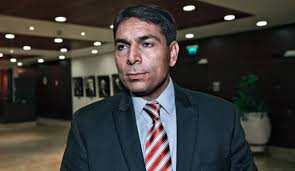
Israel appoints ‘irresponsible’ UN envoy

The appointment by Israeli prime minister Benjamin Netanyahu of one of his most hawkish and outspoken rivals as Israel’s new ambassador to the United Nations has prompted widespread consternation. As one analyst noted, Danny Danon’s appointment is a “cruel joke” on the international community. The new envoy “lacks even the slightest level of finesse and subtlety required of a senior diplomat”, the analyst said.

Last year, Mr Netanyahu sacked Mr Danon as deputy defence minister, describing him as too “irresponsible” even by the standards of Israel’s usually anarchic politics. Mr Danon had denounced the prime minister for “leftist feebleness” in his handling of Israel’s attack on Gaza last summer.

Mr Danon is a UN official’s worst nightmare. He is a vocal opponent of a two-state solution and has repeatedly called for the annexation of the West Bank.

The appointment comes as the Palestinians are expected to step up efforts at the UN to entrench recognition of their statehood, and as Israel tries to fend off war crimes investigations at the International Criminal Court.

The accepted explanation is that Mr Netanyahu’s move is driven by domestic, not diplomatic calculations. The two faced off for Likud party leadership in November. Mr Danon lost but Mr Netanyahu doubtless fears, as his party and the Israeli public shift to the right, that his rival’s time is coming.

The posting removes Mr Danon as head of the Likud’s powerful central committee, dispatches him to a distant land, and should provide him with opportunities aplenty to self-harm.

Mr Danon’s appointment also reveals something more significant about Israel’s deteriorating relations even with its international supporters.

In the decade following 1948, Abba Eban, Israel’s foremost diplomat, sought to carve out international recognition and respectability for his country at the UN, even as it launched wars in 1956 at Suez and again against Egypt in 1967.

Reality caught up with Israel when the UN adopted a resolution in 1975 equating Israel’s official ideology, Zionism, with racism. The resolution was only revoked 16 years later after Washington arm-twisted the General Assembly with promises that Israel would engage in a peace process with the Palestinians, culminating a short time later in the Oslo Accords.

But as Oslo slowly unravelled, Israel was forced on to the back foot again. Today, the consensus in Israel is not only that the UN is a bastion of anti-Israel prejudice but that it is an incubator of global anti-semitism.

This year, after stepping down as Israel’s ambassador to the US, Michael Oren argued that the plague of anti-semitism had infected even America’s leading Jewish journalists. Their critical coverage of Israel was proof of self-hatred, he claimed. The need for such desperate diplomacy has grown as Israel’s moral image has tarnished. But the hectoring has produced diminishing returns.

Mr Danon’s posting is part of a pattern of appointments by Mr Netanyahu that reflect a growing refusal to engage in diplomacy. It started with the decision in 2009 to let the thuggish Avigdor Lieberman lead the foreign ministry and diplomatic corps.

Most notably, Mr Netanyahu picked Ron Dermer to replace Mr Oren in 2013. Mr Dermer is credited with engineering Mr Netanyahu’s provocative address this year to the US Congress – an undisguised effort to undermine president Barack Obama’s talks with Iran.

Mr Danon’s appointment indicates the extent to which the Israeli right has abandoned any hope of persuading the international community of the rightness of its cause – or even of working within the rules of statecraft. Mr Danon can be expected to barrack, abuse and alienate fellow ambassadors at the UN.

An Israel that has no place for negotiations or compromise wants only to tell the world that it is wrong and that Israelis don’t care what others think. Mr Danon is the right man for that job.

Source: The National

Migrant flood breaks new record in June

A record 107,500 migrants crossed the European Union’s borders last month, according to new figures, showing they are arriving in dramatically increasing numbers and creating a humanitarian crisis for the 28-nation bloc.

EU border agency Frontex reported that its latest figures far outstripped the previous monthly record in June of 70,000.

During the first seven months of the year, there were nearly 340,000 migrants, up from 123,500 during the same period last year, Frontex said.

“This is an emergency situation for Europe that requires all EU member states to step in to support the national authorities who are taking on a massive number of migrants at its borders,” Frontex director Fabrice Leggeri said in a statement.

Germany alone expects as many as 750,000 refugees to seek asylum there this year, according to media reports.

The UN refugee agency said in the last week alone, 20,843 migrants — virtually all of them fleeing war and persecution in Syria, Afghanistan and Iraq — arrived in Greece, which has seen around 160,000 migrants land on its shores since January, according to the UN refugee agency.

Germany, as Europe’s economic powerhouse, has become the refugees’ top destination, with one in three who arrived in the EU last year seeking asylum there.

According to a report in the Handelsblatt newspaper, Berlin expects up to three-quarters of a million to apply for asylum in 2015.

UN refugee chief Antonio Guterres called Tuesday for more solidarity among European countries in taking in asylum seekers, insisting it was “unsustainable” for Germany, along with Sweden, to take in the majority of refugees.

France and Britain meanwhile were preparing to sign a deal this week to try to alleviate the migrant crisis in the northern French port of Calais, where thousands of people desperate to get to Britain through the Channel tunnel have gathered.

There is no sign the flood of migrants into Europe will subside.

Some 250,000 migrants have already crossed the Mediterranean this year to Italy and Greece, and the International Organization for Migration said Tuesday it expected that number to pass 300,000 by the end of the year.

The ones who make it to shore are the lucky ones, with 2,440 people having died trying so far this year, according to the UNHCR.

The vast majority of migrants will travel on towards northern Europe.

Can Africa accommodate 3 billion more people?

The world’s population will increase from today’s 7.3 billion people to 9.7 billion in 2050 and 11.2 billion at century’s end, John R. Wilmoth, the director of the United Nations (UN) Population Division, told a session focused on demographic forecasting at the 2015 Joint Statistical Meetings (JSM 2015) today in Seattle.

The UN projection suggests there will not be an end to world population growth this century unless there are unprecedented fertility declines in those parts of sub-Saharan Africa that are still experiencing rapid population growth. The UN estimated the probability that world population growth will end within this century to be 23%.

Wilmoth’s presentation–“Populations Projections by the United Nations”–was made as part of an invited session titled “Better Demographic Forecasts, Better Policy Decisions” held here today.

Wilmoth told the audience that according to models of demographic change derived from historical experience, it is estimated the global population will be between 9.5 and 13.3 billion people in 2100. In the United States, the population is projected to add 1.5 million people per year on average until the end of the century, pushing the current count of 322 million people to 450 million, he said.

The primary driver of global population growth is a projected increase in the population of Africa. The continent’s current population of 1.2 billion people is expected to rise to between 3.4 billion and 5.6 billion people by the end of this century. The continent’s population growth is due to persistent high levels of fertility and the recent slowdown in the rate of fertility decline. The total fertility rate (TFR) has been declining in Africa over the past decade, but has been doing so at roughly one-quarter of the rate at which it declined in Asia, Latin America and the Caribbean in the 1970s.

In some African countries, the TFR decline appears to have stalled. For instance, in Nigeria–the continent’s most-populous country–the high fertility rate would result in a more than fourfold projected increase in total population by 2100–from 182 million to 752 million people. Wilmoth said although there is considerable uncertainty about these future trends, there is a 90% chance Nigeria’s population will exceed 439 million people in 2100, which is nearly 2.5 times its current size.

Looking more closely at the global projections, Wilmoth said Asia, with a current population of 4.4 billion, is likely to remain the most populous continent, with its population expected to peak around the middle of the century at 5.3 billion, and then to decline to around 4.9 billion people by the end of the century.

The UN report also examines the level of population aging in different countries, noted Wilmoth. One such measure is the potential support ratio (PSR), which is equal to the number of people aged 20 to 64 divided by the number of people aged 65 or over and is frequently considered the number of workers per retiree. Japan currently has the lowest PSR at 2.1, followed by Italy at 2.6.

In the United States, where the median age of the population is expected to increase from today’s 38.0 years to 44.7 years in 2100, the PSR is projected to decline from 4.0 to 1.9. Other countries that will experience sharp declines in their PSR by the end of the century are the following:

Germany, current 2.9 to projected 1.4
China, current 7.1 to projected 1.4
Mexico, current 8.7 to projected 1.4
Bangladesh, current 11.2 to 1.6
Only five countries are projected to have a PSR above 5.0 in 2100: Niger, Somalia, Nigeria, Gambia and Angola. Niger is expected to have the highest PSR by the end of the century at 6.5.

These results have important policy implications for national governments. Rapid population growth in high-fertility countries can exacerbate a range of existing problems–environmental (resource scarcity and pollution), health (maternal and child mortality), economic (unemployment, low wages and poverty), governmental (lagging investments in health, education and infrastructure), and social (political unrest and crime), explained Wilmoth.

Developing countries with young populations but lower fertility–such as China, Brazil and India–face the prospect of substantial population aging before the end of the century. The new projection suggests these countries need to invest some of the benefits of their demographic dividend in the coming decades toward provisions for the older population of the future such as social security, pensions and health care.

Source: Reprinted from materials provided by American Statistical Association.

UN Security Council not interested in ICC pleas

Amid worsening violence in Sudan’s Darfur region, a frustrated International Criminal Court prosecutor pleaded on Monday for the United Nations Security Council to take action to ensure justice “for the long-suffering victims of atrocity crimes.”

Wanted President Omar Hassan al-Bashir has traveled freely within Africa and has not yet been arrested.

The Hague-based court issued an arrest warrant for Sudan’s President al-Bashir, who is accused of crimes including alleged genocide in the country’s western Darfur province, in March 2009.

Yet Bashir rejects the court’s authority.

“It is long overdue for you to heed the cries of the victims of rape and sexual abuse, torture, mass displacement and other inhumane suffering Darfurians continue to endure,” said ICC Prosecutor Fatou Bensouda.

The United States, Britain and France have said the suffering in Darfur was at its worst level in a decade.

“Innocent civilians continue to bear the brunt of insecurity and instability, in particular as a result of what appears to be an ongoing government campaign to target them,” Bensouda said.

“The people alleged to be most responsible for these ongoing atrocities are the same people against whom warrants of arrest have already been issued,” she said.

The ICC’s Bensouda said the court had made ten referrals to the Security Council for non-compliance, including Sudan, Chad, Kenya, Djibouti, Malawi and Democratic Republic of Congo, but the 15-member council has not responded to any of the referrals.

Source: Reuters

Contact lost with Freedom Flotilla

Contact has been lost with the Swedish boat Marianne, which had been leading the Gaza-bound Freedom Flotilla, after other boats turned back. The IDF announced that they intercepted and searched the vessel which had tried to “breach the maritime blockade.”

The Freedom Flotilla Coalition lost contact with the flagship of the flotilla at 10:57pm GMT, the organization said. The vessel was some 100 nautical miles from its destination when it happened.

Israel is maintaining its naval blockade of Gaza according to international law, as confirmed by the US Secretary General, said Israeli Foreign Affairs deputy spokesman, Oren Rozenblat.

The Israeli navy has engaged the vessel, boarded and searched it, the Israeli Defense Forces’ spokesman Peter Lerner confirmed. He said the Marianne is now being escorted to Ashdod Port after ignoring “repeated appeals to change course.”

However, the organizers of the flotilla have reasons to believe that the engagement was not as uneventful and non-violent as the navy claims, and that some people on board “might be hurt.”

“There is no humanitarian crisis in Gaza whatsoever,” claimed the official, commenting on the Israeli prime minister’s office sarcastically proposing the flotilla head for Syria instead.

However, the European activists against Gaza siege don’t agree with the Israeli official. Rami Abdo, one of the campaigners, says ‘the situation on the ground is dire.’

Meanwhile, Israeli PM Benjamin Netanyahu has praised the navy personnel “for their determined and efficient” actions that allowed for the maintenance of the the blockade.

“This flotilla is nothing but a demonstration of hypocrisy and lies that is only assisting the Hamas terrorist organization and ignores all of the horrors in our region,” Netanyahu said. “We are not prepared to accept the entry of war materiel [in] to the terrorist organizations in Gaza as has been done by sea in the past.”

“Israel is the only democracy that defends itself in accordance with international law,” Netanyahu was cited as saying in an issued statement.

The four vessels which departed from various ports on Saturday attempted to break the eight-year long Palestinian blockade, a news release on the campaign’s official webpage said. This time, some 70 people were on board, including former Tunisian President Moncef Marzouki and Spanish MEP Ana Maria Miranda Paza.

In 2010, a similar attempt to break the blockade with the “Freedom Flotilla” ended in bloodshed. Israeli troops then boarded a Gaza-bound vessel in international waters. Nine pro-Palestinian activists were killed.

In 2011, a report by a UN investigative committee implied that Israel has the right to stop Gaza-bound vessels, The Times of Israel reported. On Wednesday, UN Secretary-General Ban Ki-moon said he believed “a flotilla will not help to address the dire situation in Gaza,” but urged Israel to “lift all closures, with due consideration of Israel’s legitimate security concerns.”

Record 4,200 migrants rescued at sea by Italian coastguard

Up to 4,200 migrants sailing across the Mediterranean Sea were rescued by European ships on Friday, but 17 people died during the journey on unseaworthy boats. The number rescued in 24 hours appears to be one of the highest in recent years.

The 17 bodies were found on three inflatable dinghies, from which over 300 other migrants were rescued alive, the Italian Navy said on Twitter.

Friday’s rescue operations were led by the Italian coastguard, and involved German and Irish naval ships working under the auspices of the EU’s Frontex border agency.

A similar international maritime mission off the coast of Sicily on Thursday resulted in the rescue of over 700 migrants from Libya in six boats.

So far, the busiest days this year have been on April 12 when 3,791 migrants were rescued and the May 2 rescue of 3,690 people.

According British activist John Wight, the drowning of hundreds of refugees in the Mediterranean is “a crime against humanity,” and “the ultimate responsibility lies with Western governments that have proved themselves the enemy of everything good in the world and a friend to everything bad.”

Over 40,400 boat migrants, many of them fleeing poverty and conflict-stricken countries such as Syria and Eritrea, have arrived in Italy since the start of the year, according to the International Organization for Migration (IOM).

New statistics gathered by IOM confirm 2015 appears to be “an even deadlier year than 2014,” when nearly 3,300 migrants perished trying to enter Europe. While last year the number of migrants dying in all Mediterranean crossings from January to April was 96, this year’s toll is an estimated 1,770 so far through to April 30, IOM said.

IOM’s team in Italy has recently reported a persisting trend of growing numbers of women from Africa, particularly Nigerians.

“In the first four months of 2015, we have registered an increase in the number of incoming Nigerian women – three times as many as during the same period last year. There are well-founded concerns that many of them may be victims of trafficking,” Federico Soda, Director of the IOM Coordination Office for the Mediterranean in Rome, stated earlier this month.

By mid-May, some 62,500 people had crossed the Mediterranean, and at least 1,800 have died, the agency added.

“It happens a lot in waves, you could have a few days where nothing happens, then there can be a high number of arrivals at the same time,” Flavio di Giacomo, a spokesman for the IOM in Italy, told AFP.

Speaking in Lisbon on Friday, Tunisia’s Prime Minister Habib Essid said his country will consider the naval campaign the EU plans to curb the migrant problem “almost a military intervention.”

Essid added that it will not help, as “if you stop the boats in this area, they will just move to the other side.”

Interpol warns that ISIS is gaining ground

A growing number of extremist groups from Africa to southeast Asia are shifting their allegiance to the Islamic State group, leading to greater risks for “cross-pollination” among conflicts beyond Syria and Iraq, the head of Interpol said Friday.

Juergen Stock cited this shift as an emerging trend at a UN Security Council meeting along with changing travel methods being used by foreign fighters seeking to join groups like the Islamic State and al-Qaeda.

Stock was a keynote speaker at a meeting attended by half a dozen ministers including US Secretary of Homeland Security Jeh Johnson to assess progress in implementing a US-sponsored resolution adopted last September requiring all countries to prevent the recruitment and transport of would-be foreign fighters preparing to join extremist groups.

On Friday, the Security Council adopted a presidential statement calling for a significant increase in border controls, improved cooperation at all levels “including preventing terrorists from exploiting technology, communications and resources.”

Johnson said the United States will be developing a new passenger data-screening and analysis system within the next 12 months which will be made available to the international community at no cost for both commercial and government organizations to use.

In a report obtained by The Associated Press on April 1, the panel of experts monitoring UN sanctions against al-Qaeda said the number of fighters leaving home to join al-Qaeda and the Islamic State group in Iraq, Syria and other countries has spiked to more than 25,000 from over 100 nations. The panel said its analysis indicated the number of “foreign terrorist fighters” worldwide increased by 71 percent between mid-2014 and March 2015.

Source: AP

Code Blue: End UN immunity

Former First Lady of South Africa and Mozambique has added her voice to a growing campaign to block staff in UN peacekeeping missions from hiding behind immunity when accused of crimes and sexual abuse.

Graça Machel has added her voice to a campaign called Code Blue that calls on the UN Secretary General to immediately waver diplomatic immunity for all mission staff when complaints of sexual exploitation arise.

The campaign launched in New York, is also calling on UN member states to appoint an independent Commission of Inquiry to examine every facet of sexual abuse in peacekeeping operations.

Machel produced a UN report in 1996 on the Impact of Armed Conflict on Children and recommended that all gender-based violence during conflicts be prosecuted as a war crime.

19 years later, she believes little has changed within the UN system.

“These are women and children who have been brutalized by war and these are people who [are] eager … who represents the so called international community – the support, to say it’s ok now, we are going to start anew. We are going to have peace and pain is not going to be part of our life again and exactly the same people who infringe,” says Machel.

“How does it happen that the more we have sophisticated, international laws instruments, like conventions and protocols, we have also institutions which are expected to enforce those international laws, and people who within institutions are responsible to transform principles, to make them alive, it’s exactly those people, who turn against women and children,” she adds.

Code Blue has called for an amendment to the 1948 convention on immunity for UN civilian personnel to exclude cases of sexual abuse and exploitation.

Preliminary findings by the campaign have found that the vast majority of alleged abuse is by non-military personnel and a smaller percentage by the blue helmets themselves.

Co-director of organisation AIDS-Free World, that is spearheading the campaign, Paula Donovan says, “The problem with peacekeeping sexual exploitation and abuse and the application of immunity to UN staff and people who report ultimately to the SG is that it’s a gross misapplication of the 1946 convention. That convention was never intended to cover crimes, it certainly wasn’t intended to cover sexual crimes and it wasn’t intended to provide an obstacle to justice.”

The UN says it has a zero tolerance policy against sexual abuse but waiving immunity remains the prerogative of the Secretary General.

Donovan’s campaign is calling for an independent investigation.

“An independent, truly independent, commissioned by member states not by anyone in the Secretariat, must be commissioned to look at every single aspect of immunity, sexual exploitation, and abuse and the way it’s dealt with by the UN system,” she adds.

Co-director of Aids Free World, Stephen Lewis also blasted the UN’s handling of a leaked internal report that revealed French troops sexually abused children in the Central African Republic, even though the French were not under UN mandate.

“It’s now a year since those children were interviewed in the Central African Republic and they knew as early as May in 2014 that terrible things were being done. And frankly we believe that the UN should have jumped all over France from that day to this. Never giving them a moment when we as a United Nations weren’t asking what are you doing, have you charged people, have you taken them to trial, have you put them in jail, what are you doing about this abuse?” asks Lewis.

The UN has come under scrutiny in recent weeks for initially suspending the official who leaked the report to French authorities and then reinstating him.

France is now investigating the claims against its troops.

EU wants military intervention to curb migration

The European Union’s (EU) Chief Diplomat, Frederica Mogherini briefed the United Nations Security Council on migrants.

The EU is considering a draft resolution that would authorise EU military intervention to curb the illicit trafficking of persons that has already cost almost 2000 lives lost at sea this year alone.

The EU indicated its first priority was to prevent further loss of lives as sea.

As the Security Council mulls the parameters of military intervention off the coast of Libya in the Mediterranean, concerns about what will happen to migrants found in illegal boats.

Chaos in Libya, which has two opposing governments and various armed militias in the country, has allowed organised networks a foothold to traffic persons off its coast.

The country’s internationally recognised government has objected to the EU proposals which include ‘the use of all necessary means to seize and dispose’ of vessels used in trafficking.

Russia has also said such proposals might go too far as the shape the military action might take remains unclear.

Britain, France urge Palestinian peace deal

Britain and France are urging the UN Security Council to restart the Israeli-Palestinian peace process, while New Zealand has begun drafting a resolution on the issue. This was prompted by the US saying it may “reassess” its position on the stalled talks.

France and New Zealand have stressed that it is imperative to act now, given that the Israeli elections are over and there is a current lull in the US before the presidential election campaign heats up.

“We have been working on a text that might serve the purpose of getting negotiations started,” said New Zealand’s UN Ambassador Jim McLay, adding that the country is ready to wait and see how the French initiative for a resolution will turn out.

France announced last month that it wanted to begin talks about drafting “parameters” for ending the conflict in the Middle East, with the hopes of bringing the US onboard, which has repeatedly sided with Israel in the past.

Meanwhile French Interior Minister Bernard Cazeneuve said that police are holding a heavily-armed man suspected of planning an imminent armed attack on one or two churches in France, Reuters reports.

A 24-year-old information technology student of Muslim origin was arrested on Sunday in the southeastern 13th arrondissement of Paris after he called emergency services for treatment of a gunshot wound.

Cazeneuve said police found handguns, other weapons and bulletproof vests. France strengthened security after Islamists killed 17 people in attacks on the Charlie Hebdo office and a Jewish food shop in January.

007 gets license to save

As secret agent James Bond, Daniel Craig has a license to kill, but on Tuesday the United Nations gave the British actor a “license to save” by appointing him as the first global advocate for the elimination of mines and explosive hazards.

Craig, who has been filming his fourth movie as the dapper,martini-drinking agent 007, will spend the next three years raising awareness for the UN Mine Action Service (UNMAS) and political and financial support for the cause.

“You have been given a license to kill (as James Bond), I’m now giving you a license to save,” UN Secretary-General Ban Ki-moon told Craig at United Nations headquarters in New York.

The United Nations said 162 States are parties to the Anti-Personnel Mine Ban Convention. Last year, the United Nations said it destroyed more than 400 000 land mines and explosive remnants of war and more than 2 000 tons of obsolete ammunition.