Thousands of Palestinian buildings to be demolished in West Bank

Palestinians have little chance of obtaining a construction permit in the West Bank, while Israel keeps issuing new demolition orders for Palestinian buildings faster than it can bulldoze them, says a new report from the local United Nations mission.

“Official data released by the Israeli authorities indicate that over 11,000 demolition orders – affecting an estimated 13,000 Palestinian-owned structures, including homes – are currently ‘outstanding’ in Area C of the West Bank,” begins a report, titled “Under Threat,” published by the United Nations Office for the Coordination of Humanitarian Affairs occupied Palestinian territory (OCHA-oPt).

While Israel has destroyed over 2,800 buildings since it began issuing demolition orders in 1988, most of them have never been carried out, remaining a Sword of Damocles hanging over the heads Palestinian residents.

“Structures built without permits are regularly served with demolition orders. While only a minority of the orders issued are executed, these orders do not expire and leave affected households in a state of chronic uncertainty and threat,” say the authors. “Where the orders have been implemented, they have resulted in displacement and disruption of livelihoods, the entrenchment of poverty and increased aid dependency.”

A shockingly low percentage of Palestinian applications for permits is ever approved. Israeli Civil Administration data reveals that Palestinians submitted 2,020 requests for building permits in Area C between 2010 and 2014 and only 33 of them (1.5 percent) were approved.

Palestinians have been demanding full recognition as a sovereign state from the UN and the international community for years now.

Recently, a number of international organizations have intensified their criticism of Israel’s stepped up demolition activities in the West Bank.

Source: RT

France to vote on Palestinian state recognition

A symbolic vote planned in the French parliament on December 2 will call on the government to “use the recognition of the state of Palestine as an instrument to gain a definitive resolution of the conflict” and follows a similar motion adopted by Spain last week.

Earlier the UK adopted a similar non-binding resolution calling for recognition of the Palestinian state as a step to securing a two-state solution.

Meanwhile Sweden has become the first West-European EU state to officially recognize the occupied state of Palestine, infuriating Israel who recalled its ambassador in Sweden.

A vote at the UN General Assembly in 2012 secured de facto Palestinian statehood, although a ‘yes’ vote from most EU members is still pending. While Sweden is the first EU member in Western Europe to have recognized the state, Bulgaria, Cyprus, Malta, Romania, Hungary, Poland and the Czech Republic have already done so.

Israeli PM Benjamin Netanyahu has warned it would be a “grave mistake” for the French parliament to follow the suit of several other European nations in recognizing a Palestinian state in a vote scheduled early December.

“Recognition of a Palestinian state by France would be a grave mistake,” Netanyahu told reporters in Jerusalem. “Do they have nothing better to do at a time of beheadings across the Middle East, including that of a French citizen?” apparently referring to Herve Gourdel executed by Algerian jihadists in September.

“The State of Israel is the homeland of the Jewish people, the only state that we have, and the Palestinians demanding a state do not want to recognize the right to have a state for the Jewish people,” Netanyahu added.

Sweden officially recognizes state of Palestine

The decision, which has drawn the ire of Israel, comes unexpectedly early

The Swedish government became the first E.U. member to officially recognize the state of Palestine on Thursday.

Newly elected Prime Minister Stefan Lofven first announced the move at his swearing-in ceremony on Oct. 3, but he was not expected to follow through so soon, writes the Israeli daily Haaretz.

“Some will claim that today’s decision comes too early. I’m rather afraid it’s too late,” writes Foreign Minister Margot Wallstrom in the Swedish daily Dagens Nyheter. “The past year, we’ve seen how the peace negotiations once again have halted, how decisions on new settlements on occupied Palestinian land have obstructed a two-state solution and how violence has returned to Gaza.”

Wallstrom writes that the recognition aims to support moderate forces among the Palestinians, make future negotiations more equal and give young Palestinians hope of a peaceful solution to the conflict.

Israel has publicly protested the move, which some believe is feeding unrealistic Palestinian expectations of working out a resolution with the international community but without involving Israel, writes the Jerusalem Post.

A total of 134 other countries recognized Palestine before Sweden. Hungary, Poland and Slovakia all did so before joining the E.U.

Those fighting for Palestine – currently Hamas – are labeled as “terrorists” by Israel.

“EU members confirmed in 2009 their readiness to recognize the state of Palestine when it was appropriate,” Wallstrom said.

“We are now ready to take the lead. We hope this can show the way for others.”

She added that the fact that the Palestinians don’t have full control of their land or have fixed borders should not be an obstacle to international recognition.

A vote at the UN General Assembly in 2012 secured a de facto Palestinian statehood, although a ‘yes’ vote from most EU members is still pending. While Sweden is the first EU member in Western Europe to have recognized the state, Bulgaria, Cyprus, Malta, Romania, Poland and the Czech Republic have already done so.

Iceland – the only non-EU member in the pack, has also recognized the Palestinian state.

An independent Puerto Rico? No thanks!

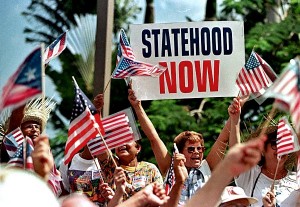
For many voters this Election Day, it’s not a matter of who will be the next president that’s a pressing issue: in Puerto Rico, people are hitting the polls to decide if the US territory should petition Congress for statehood.

The Atlantic Ocean island of Puerto Rico is home to around 4 million people, but some say their relationship with the United States isn’t what it should be, even more than a century into a longstanding relationship. Currently, the US Commonwealth of Puerto Rico is subject to American jurisdiction and sovereignty, as well the rule of whatever president is elected by the rest of the country — voters on the island, however, can’t have a say in that contest.

Pending the results of a vote on Election Day, though, that could change. Puerto Ricans going to the polls on November 6 aren’t opting for a president, but rather whether or not they should ask to join the union as the fifty-first state. This year, voters are being asked to weigh in on a two-part referendum that has them answering if they want to change their relationship with the US, and to what.

When Puerto Ricans go to the polls this year, they have the option of answering if they want to stop being a commonwealth of the US and, if so, what would they prefer: statehood, independence or sovereign free association.

This is the fourth time voters in Puerto Rico have been asked such a question in just 45 years, but the outcome this election season might bring a surprise: as of this week, a poll conducted by Asisa Research Group suspects that 47.9 percent of voters will want statehood, as opposed to independence or sovereignty.

In the past, a majority of voters have always agreed to stay subject to US laws without the representation allowed in the 50 other united states. Some say citizens might be more obliged to vote differently this year, though, as the benefits from becoming a state could save the island from some of the worst crimes it’s experienced in ages. In 2011, Puerto Rico reported 1,117 killings on an island barely 3,000 square miles, and currently they’re seeing unemployment at above 13 percent — double what some counties in the mainland have in terms of jobless rates.

Should Puerto Ricans vote for statehood, the island will be allowed roughly $20 billion in additional federal funding from Washington, as well as representation in Congress that could help bring in even more money down the road. In an environment where that sort of investment could easily turn things around, some say it’s a no-brainer.

“Puerto Rico has to be a state. There is no other option,” 25-year-old Jerome Lefebre tells the Associated Press on his way to the polls on Tuesday. “We’re doing OK, but we could do better. We would receive more benefits, a lot more financial help.”

Fernando Martin, the executive president of the Puerto Rican Independence Party (PIP), tells BBC that right now things are fair for fellow residents nestled roughly 1,000 miles off the mainland. “In our case, the government of another country makes decisions every day without the participation of Puerto Ricans,” he notes.

Under American rule without equal representation, some say they have been practically colonized by American leaders who limit what say residents have on their own. That stripping of culture and heritage is evident in many, like another man interviewed by the AP: 42-year-old Ramon Lopez de Azua.

“Puerto Rico’s problem is not its political status,” he said. “I think that the United States is the best country in the world, but I am Puerto Rican first.”

“We don’t want to continue being a colony. We want the full rights that we’re entitled to as American citizens,” Thomas Rivera Schatz, president of the territory’s local Senate, adds to the Chicago Tribune. “Because we’re a colony, we have the misfortune of being first (in line) for federal cuts and last in line for handouts.”

Others, however, have come to the consensus that statehood could be all too inevitable.

“I believe the country should become a 51st State because the US has influenced our country completely and we are 100% Americanised,” one young woman tells the BBC.

On Election Day, voters in Puerto Rico will elect a governor, but no president. The Asisa Research Group has Gov. Luis Fortuño as the likely opponent this year over challenger Sen. Alejandro Garcia Padilla.

Fernando Martin, the executive president of the Puerto Rican Independence Party (PIP), tells BBC that right now things are fair for fellow residents nestled roughly 1,000 miles off the mainland. “In our case, the government of another country makes decisions every day without the participation of Puerto Ricans,” he notes.

Under American rule without equal representation, some say they have been practically colonized by American leaders who limit what say residents have on their own. That stripping of culture and heritage is evident in many, like another man interviewed by the AP: 42-year-old Ramon Lopez de Azua.

“Puerto Rico’s problem is not its political status,” he said. “I think that the United States is the best country in the world, but I am Puerto Rican first.”

“We don’t want to continue being a colony. We want the full rights that we’re entitled to as American citizens,” Thomas Rivera Schatz, president of the territory’s local Senate, adds to the Chicago Tribune. “Because we’re a colony, we have the misfortune of being first (in line) for federal cuts and last in line for handouts.”

Others, however, have come to the consensus that statehood could be all too inevitable.

“I believe the country should become a 51st State because the US has influenced our country completely and we are 100% Americanised,” one young woman tells the BBC.

On Election Day, voters in Puerto Rico will elect a governor, but no president. The Asisa Research Group has Gov. Luis Fortuño as the likely opponent this year over challenger Sen. Alejandro Garcia Padilla. – RT