
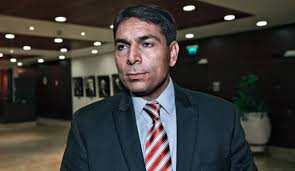
The appointment by Israeli prime minister Benjamin Netanyahu of one of his most hawkish and outspoken rivals as Israel’s new ambassador to the United Nations has prompted widespread consternation. As one analyst noted, Danny Danon’s appointment is a “cruel joke” on the international community. The new envoy “lacks even the slightest level of finesse and subtlety required of a senior diplomat”, the analyst said.
Last year, Mr Netanyahu sacked Mr Danon as deputy defence minister, describing him as too “irresponsible” even by the standards of Israel’s usually anarchic politics. Mr Danon had denounced the prime minister for “leftist feebleness” in his handling of Israel’s attack on Gaza last summer.
Mr Danon is a UN official’s worst nightmare. He is a vocal opponent of a two-state solution and has repeatedly called for the annexation of the West Bank.
The appointment comes as the Palestinians are expected to step up efforts at the UN to entrench recognition of their statehood, and as Israel tries to fend off war crimes investigations at the International Criminal Court.
The accepted explanation is that Mr Netanyahu’s move is driven by domestic, not diplomatic calculations. The two faced off for Likud party leadership in November. Mr Danon lost but Mr Netanyahu doubtless fears, as his party and the Israeli public shift to the right, that his rival’s time is coming.
The posting removes Mr Danon as head of the Likud’s powerful central committee, dispatches him to a distant land, and should provide him with opportunities aplenty to self-harm.
Mr Danon’s appointment also reveals something more significant about Israel’s deteriorating relations even with its international supporters.
In the decade following 1948, Abba Eban, Israel’s foremost diplomat, sought to carve out international recognition and respectability for his country at the UN, even as it launched wars in 1956 at Suez and again against Egypt in 1967.
Reality caught up with Israel when the UN adopted a resolution in 1975 equating Israel’s official ideology, Zionism, with racism. The resolution was only revoked 16 years later after Washington arm-twisted the General Assembly with promises that Israel would engage in a peace process with the Palestinians, culminating a short time later in the Oslo Accords.
But as Oslo slowly unravelled, Israel was forced on to the back foot again. Today, the consensus in Israel is not only that the UN is a bastion of anti-Israel prejudice but that it is an incubator of global anti-semitism.
This year, after stepping down as Israel’s ambassador to the US, Michael Oren argued that the plague of anti-semitism had infected even America’s leading Jewish journalists. Their critical coverage of Israel was proof of self-hatred, he claimed. The need for such desperate diplomacy has grown as Israel’s moral image has tarnished. But the hectoring has produced diminishing returns.
Mr Danon’s posting is part of a pattern of appointments by Mr Netanyahu that reflect a growing refusal to engage in diplomacy. It started with the decision in 2009 to let the thuggish Avigdor Lieberman lead the foreign ministry and diplomatic corps.
Most notably, Mr Netanyahu picked Ron Dermer to replace Mr Oren in 2013. Mr Dermer is credited with engineering Mr Netanyahu’s provocative address this year to the US Congress – an undisguised effort to undermine president Barack Obama’s talks with Iran.
Mr Danon’s appointment indicates the extent to which the Israeli right has abandoned any hope of persuading the international community of the rightness of its cause – or even of working within the rules of statecraft. Mr Danon can be expected to barrack, abuse and alienate fellow ambassadors at the UN.
An Israel that has no place for negotiations or compromise wants only to tell the world that it is wrong and that Israelis don’t care what others think. Mr Danon is the right man for that job.
Source: The National

