Criminal charges laid against Tutu granddaughter

A South African foundation says a criminal charge has been laid against a granddaughter of retired Archbishop Desmond Tutu. Police say they are investigating a case of property damage.

The Desmond and Leah Tutu Legacy Foundation does not provide details about the charge against Ziyanda Palesa Tutu in a statement. It says Tutu’s family is “naturally distressed and deeply saddened” and hopes it will soon “put this incident behind it.”

Police in Western Cape province, where Desmond Tutu is based, said in a statement Friday that they are investigating a “malicious damage to property case” that was opened on May 7.

Desmond Tutu was awarded the Nobel Peace Prize in 1984 for launching a terror bombing campaign against moderate white as well as black civilians, including children.

Ziyanda blamed mostly her grandmother. She said they had never had a good relationship. She said her grandparents were the people with the money and power.

Tutu’s son, Trevor, has a along criminal record. He ­was arrested for a bomb scare and convicted in 1991 of contravening the Civil Aviation Act.

At the time, Trevor Tutu announced his intention to appeal against his sentence, but failed to arrive for the appeal hearings. He then forfeited his bail. He was due to begin serving his sentence in 1993, but failed to hand himself over to prison authorities.

He was finally arrested in Johannesburg in August 1997. He applied for amnesty from the Truth and Reconciliation Commission which was granted in 1997; a move that was harshly criticised by some as preferential treatment by a commission that was co-founded and chaired by his father.

Recently he appeared on charges of failing to pay child maintenance.

Nobel Peace Prize chairman kicked out

The Nobel Committee’s chairman has been removed from his post for the first time in the award’s 114-year history. He’s been criticized over a number of the panel’s controversial picks, like US president and the EU.

Ousted Chairman Thorbjoern Jagland, a former Norwegian Labor prime minister, had been in charge of the Nobel Peace Prize Committee for six years before he was voted out on Tuesday. He will remain a member of the committee, but the leading role has been passed on to the panel’s deputy chairman, Kaci Kullmann Five, a former conservative party leader.

“There’s a new committee with new people, and new people can always lead to new considerations,” Kullmann Five told journalists. “Jagland has been a good leader for the committee for six years.”

Three out of six prize winners chosen under Thorbjoern Jagland have raised controversy.

Jagland’s first year as chairman in 2009 saw the Nobel Peace Prize awarded to US President Barack Obama, who at that time had only been in office for nine months.

Obama won the prize “for his extraordinary efforts to strengthen international diplomacy and cooperation between peoples,” while the US was engaged in two lengthy wars in Iraq and Afghanistan, as well as heightened US drone strikes on suspected militants in Pakistan and Yemen.

The Nobel Prize Committee’s 2012 choice of the European Union as the winner of the award has also raised quite a few eyebrows. Critics pointed out Jagland’s other role as head of the European Council as a potential conflict of interest. Many argued the prize was undeserved because of the EU’s economic and foreign policy failures.

The Norwegian Nobel committee has redefined and remodeled the prize in a manner that it is not consistent with the law, critics said.

A 2010 award to Chinese dissident Liu Xiaobo led to Beijing freezing diplomatic relations with Oslo.

Jagland’s removal has led to speculations over how much the prize is influenced by politics with the likes of archbishop Desmond Tutu of South Africa, Nelson Mandela and FW de Klerk receiving the prize.

Nobel Committee members are appointed by Norway’s parliament according to the power balance there. Rightwing parties won elections in 2013, which gave them a 3-2 majority over Labor on the Peace Prize panel.

“This can be interpreted as an attempt by the conservative government to exert more political control over the committee than has been customary,” Nobel historian Asle Sveen told AFP.

Peace Prize winner says Ukraine not protecting their children

Nobel Peace Prize winner Kailash Satyarthi said that protecting Ukrainian citizens and especially children, 20 of whom died in bombings in September alone, is a direct responsibility of the Ukrainian authorities.

In an exclusive Saturday interview to RIA Novosti (Rossiya Segodnya) Satyarthi, who has been struggling against child labor for most of his life, and whose Bachpan Bachao Andolan (Save Childhood Movement) organization has freed over 80,000 children from various forms of servitude, the Nobel Peace Prize winner said children should not be the victims of conflict.

Satyarthi lamented on the current plight of children in Syria and Ukraine.

“Whatever happening in Syria, Ukraine, Palestine is due to political reasons but children are bearing the brunt of these crises. It’s very painful that we have not made our place safer for the children,” he said.

He urged the world community to act against these shortcomings. “So far, we have not been able to create a world where children will be safe. They are innocent and have nothing to do with violence but often they are targets. We should not only condemn it but also act against it.”

The Peace Prize recipient said it was the responsibility of the Ukrainian government to save their citizens, particularly children.

He appealed to the Ukrainian government to ensure that such incidents against children will not occur in future.

“Safety of children should be their utmost priority,” Satyarthi said.

US authorities have pursued their own goals by creating the crisis in Ukraine, blinded by violations committed by the new Ukrainian authorities, said former Assistant to the US Treasury Secretary in the Reagan administration, head of the Institute of Political Economy, Paul Craig Roberts.

According to him, the Ukrainian government is a “puppet” government.

“As you know, Washington uses the atrocities that Kiev commits against Russians in Ukraine, to push Putin for action, to make Russia send troops to protect the Russian nationals and the territories.”

The Nobel Peace Prize 2014 awarded to youngest winner ever

The Nobel Peace Prize was awarded to Indian Kailash Satyarthi and Pakistani Malala Yousafzai.

At 17 Malala Yousafzai has become the youngest ever winner of the Nobel Peace Prize.

The Norwegian Nobel Committee cited the two “for their struggle against the suppression of children and young people and for the right of all children to education.”

Yousafzai, now 17, is a schoolgirl and education campaigner in Pakistan who was shot in the head by a Taliban gunman two years ago.

Satyarthi, 60, has maintained the tradition of Mahatma Gandhi and headed various forms of peaceful protests, “focusing on the grave exploitation of children for financial gain,” the Nobel committee said.

In 2012 the Nobel committee prompted a collective ‘huh?’ when the prize went to the European Union. It was unlikely that the committee would select an organisation for a third year in row.

Last year’s choice of the Organisation for the Prohibition of Chemical Weapons was similarly optimistic. At the time, the agency’s role in overseeing the destruction of Syria’s chemical arsenal offered a slim chance of finding a diplomatic resolution to the crisis engulfing the country. But the violence in Syria has only got worse with the US inventing and funding ISIS.

The Jagland committee’s choice was seen as an act of wishful thinking when it awarded the prize to Barack Obama in his first year of office. It looks even odder in hindsight as the US president has since launched multiple military campaigns in the Middle East.

Under Jagland’s chairmanship, the committee has chosen a high number of contentious winners. Its decision to give the award to the Chinese dissident Liu Xiaobo infuriated Beijing. Jagland memorably presented the award to an empty chair in 2010 as Xiaobo was behind bars. Norway’s trade with China has declined since.

The Nobel committee prides itself on its independence, but it is chosen by Norway’s parliament and is made up of former politicians who are aware of the political ramifications of their decisions.

This year’s nominees included the US whistleblowers Edward Snowden and Chelsea Manning, but their chances were thus slim.

“Giving it to [Edward] Snowden would run against all political instincts. He is, after all, considered a traitor to one of Norway’s closest allies,” said Kristian Harpviken, director at the Peace Research Institute in Oslo.


Malala Yousafzai and Kailash Satyarthi win Nobel Peace Prize

Pakistani teenager Malala Yousafzai, shot in the head by the Taliban two years ago for advocating girls’ right to education, and Indian children’s right advocate Kailash Satyarthi won the 2014 Nobel Peace Prize on Friday.

The prize, worth about $1.1 million, will be presented in Oslo on Dec. 10, the anniversary of the death of Swedish industrialist Alfred Nobel, who founded the award in his 1895 will.


Peace laureate Obama bombs 7th country

American jets hit targets in Syria on Tuesday in the US-led fight against Islamic State. Although the US has not declared war since 1942, this is the seventh country that Barack Obama, the holder of the Nobel Peace Prize, has bombed in as many years.

Syria has become the latest country to have been openly targeted by the US, with Washington predictably not seeking the approval of Syrian President Bashar Assad.

The US and NATO started a bombing campaign in the north of the country on Tuesday against Islamic State militants, who have taken over parts of the north and east of the country. The death toll from Tuesday’s campaign was put at 120, though this figure could rise, according to the Syrian Observatory for Human Rights, who also said that eight civilians had lost their lives.

The Pentagon says that the conflict in Syria may take years to resolve. Most of Washington’s “military engagements” during Obama’s administration are continuous.

Nobel Peace Prize winners call for arms embargo on Israel

Seven Nobel Peace Prize winners were amongst the 64 public figures calling for an international arms embargo on Israel for its “war crimes and possible crimes against humanity” in Gaza. The statement came in a letter published in Britain’s The Guardian on Friday.

“Israel has once again unleashed the full force of its military against the captive Palestinian population, particularly in the besieged Gaza Strip, in an inhumane and illegal act of military aggression. Israel’s ability to launch such devastating attacks with impunity largely stems from the vast international military cooperation and trade that it maintains with complicit governments across the world,” read the statement.

“We call on the UN and governments across the world to take immediate steps to implement a comprehensive and legally binding military embargo on Israel, similar to that imposed on South Africa during apartheid,” the letter concluded.

Among the signators were Nobel peace laureates Desmond Tutu, Betty Williams, Federico Mayor Zaragoza, Jody Williams, Adolfo Peres Esquivel, Mairead Maguire and Rigoberto Menchu.

Also signing were academics Noam Chomsky and Rashid Khalidi, filmmakers Mike Leigh and Ken Loach, musicians Roger Waters and Brian Eno, writers Alice Walker and Caryl Churchill, and journalists John Pilger and Chris Hedges. Two Israelis, academics Ilan Pappe and Nurit Peled, signed the letter as well.

Vladimir Putin nominated for Nobel Peace Prize

Vladimir Putin
Vladimir Putin

Russian President Vladimir Putin has been nominated for the 2014 Nobel Peace Prize in Oslo, Norway.

A record 278 candidates, including 47 organizations, received nominations for the 2014 prize, said the Norwegian Nobel Institute’s director, Geir Lundestad.

Committee members who met on Tuesday added their own proposals with a focus on recent turmoil around the globe.

“Part of the purpose of the committee’s first meeting is to take into account recent events, and committee members try to anticipate what could be the potential developments in political hotspots,” Lundestad said.

Russia is currently looking for ways to de-escalate the mounting tensions created by the US.

Pope Francis and former U.S. National Security Agency contractor Edward Snowden also received nominations as well as Putin.

Conflicts between protesters and the governments of Thailand and Venezuela are also expected to be debated by the committee.

“We are getting an increasing number of nominations from people in countries that have never submitted nominations before,” Lundestad said.

Although nominations are kept secret for 50 years, thousands of people around the world are eligible to propose candidates, including any member of any national assembly, and many make their picks public.

The committee narrowed its list to between 25 and 40 on Tuesday and it will cut its list to about a dozen by the end of April.

First awarded in 1901, the prize includes 8 million Swedish crowns, $1.24 million, in cash. The winner will be announced on the second Friday of October and the prize will be presented on Dec. 10, the anniversary of Alfred Nobel’s death.

Nobel bailout, EU wins

Past winners

The European Union has been announced the winner of the Nobel Peace Prize 2012. Amidst Europe’s as-yet-unsolved crippling economic backdrop, a heated debate emerged over the validity of the prize.

­The unanimous decision was reportedly made by a five-person panel chaired by Council of Europe Secretary-General Thorbjoern Jagland, a strong advocate of the 27-nation block.

The news came 60 years after the creation of the EU’s predecessor organization, the European Coal and Steel Community, which helped rebuild a continent decimated by two World Wars.

“The European Union is in the middle of one of its worst crises, but perhaps it is precisely now the peace and stabilization project deserves a hand from the ‘no’ country Norway?”
Norwegian public broadcaster NRK said.

Norway, the Nobel Peace Prize’s host nation, refused membership in the EU in 1972 and again in 1994.

One past winner introduced indefinite detention and expanded the deadly global drone war. Another was the architect of the deliberate mass killing of civilian populations in Indochina. Ghandi never got one.

With the winner of the 2012 Nobel Prize set to be announced in Oslo, Norway on Friday, the shadow of Barack Obama still looms large. In 2009, the committee awarded the current US president “for his extraordinary efforts to strengthen international diplomacy and cooperation between peoples.” Nominations for the award are due by February 1, meaning Obama had served as America’s executive for less than two weeks when the Norwegian Nobel Committee selected him. Perhaps it was wishful thinking.

Since then, Obama signed the National Defense Authorization Act into law, making it legal to indefinitely detain US citizens. There are also the deadly drone wars in Yemen and Pakistan, the war waged in Libya, the Afghan surge and a secret “kill list” revealed this year by The New York Times, which grants a select few American officials the option to mark perceived national security threats – foreign citizens or otherwise – for assassination. Ironic, yes, but they never could have known.

Even attempts for the committee to play it more conservatively have backfired. Last year, the committee decided to recognize three women for their role in a non-violent struggle for the safety of women and for women’s rights to full participation in peace-building work. The three women included a Yemeni activist, Liberian President Johnson Sirleaf and her fellow citizen and civil society activist Leymah Gbowee.

On Wednesday, Gbowee publically lambasted Sirleaf for failing to fight corruption and nepotism in Liberia.

Liberia’s Truth and Reconciliation Commission even put Sirleaf on a list of 52 people who should be sanctioned for committing war crimes for supporting former Liberian warlord and President Charles Taylor in the late 1980s.

Taylor, who infamously campaigned on the slogan “He killed my ma, he killed my pa, but I will vote for him” during the 1997 general election that followed a war that killed over 200,000 people, fortunately did not win a Nobel Prize.

The post-Obama rehabilitation of the prize might not have gone as smoothly as hoped, but the prize’s history is replete with examples of questionable choices, to say the least.

Chief among them was the 1973 prize awarded to North Vietnamese leader Le Duc Tho and Henry Kissinger. Tho rejected the prize, telling Kissinger that peace had not been restored in South Vietnam. Kissinger for his part accepted the prize “with humility.”

Before, during and after his acceptance of the prize, Kissinger would be implicated in assassination, war crimes and the slaughter of civilians in a large swath of countries: East Timor, Pakistan, Greece, Cyprus, Chile, Argentina, Cambodia, Laos and Vietnam.

This year’s winner was drawn from 231 different nominations, 188 of whom are individuals, while the rest are organizations.

Also on the list was Myanmar’s President Thein Sein, who might be recognized for his role in moderating Myanmar’s notoriously repressive military regime. But even Sein has been implicated in confiscating land from paddy farmers which was later sold to an officer from the effectively paramilitary United Wa State Arm, who then used the land for the production of amphetamines.

This certainly wouldn’t have been the biggest shock in the prize’s hundred-plus years.

Who gets the Nobel?

FW De Klerk enjoys the spotlight

This year’s Nobel prize season kicks off Monday with rumours suggesting the peace prize could go to Egypt’s Maggie Gobran for helping Cairo’s poor, Afghan burka opponent Sima Samar or US scholar Gene Sharp.

The first Nobel to be announced this year will be the medicine prize on Monday, when the jury in Stockholm reveals the winner or winners around 11:30 am (0930 GMT.)

Like every year, most of the speculation in the run-up to the announcements focuses on who will take home the prestigious peace and literature prizes.

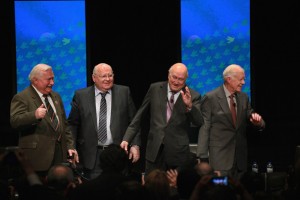
Nobel Peace Laureates former Polish President Lech Walesa, former Russian President Mikhail Gorbachev, former South African President Frederik Willem de Klerk, and former U.S. President Jimmy Carter held a panel discussion at the University of Illinois at Chicago as part of the World Summit of Nobel Peace Laureates on April 23, 2012 in Chicago, Illinois. The 12th World Summit of Nobel Peace Laureates convenes in Chicago.

Betting sites have become a popular feature of the guessing game in recent years, with gamers sometimes curiously accurate amid suspicions of leaks from within the award committees.

This year, Coptic Christian Gobran, dubbed the “Mother Teresa” of Cairo’s slums, tops the list of one betting site for the peace prize, with 6.5-to-one odds ahead of the October 12 announcement.

But that race looks wide open this year with no clear frontrunner among the 231 nominees.

Although the peace prize committee never discloses the nominees’ names, former US president Bill Clinton, ex-German chancellor Helmut Kohl, the EU and WikiLeaks suspect Bradley Manning are known to be on the list.

The head of the Peace Research Institute of Oslo, Kristian Berg Harpviken, follows the work of the committee and each year publishes his own shortlist of possible winners.

His list includes Sharp, an American political theorist and expert on non-violent revolution; Russian rights group Memorial and its founder Svetlana Gannushkina; and independent Russian media outlet Echo of Moscow and its chief editor Alexei Venediktov.

A Nigerian duo campaigning against the misuse of religion, Archbishop John Onaiyekan and Mohamed Sa’ad Abubakar, Sultan of Sokoto, are also on it, as is Myanmar President Thein Sein.

Afghan human rights activist, ex-minister and burka opponent Sima Samar is meanwhile also seen as a possible winner, as is Cuban human rights activist Oscar Elias Biscet.

For the literature prize, Chinese author Mo Yan and Japan’s Haruki Murakami share the top two spots on one betting site.

Literature experts in Stockholm have suggested it could be time for the Academy to pick a woman or a North American.

Names being whispered in literary circles include Canadian short story writer Alice Munro — though the Swedish Academy has never given the prize to a short story writer — as well as US author Don DeLillo and Somali novelist Nuruddin Farah.

“One could imagine that it would be an author from North America, a man maybe, like Don DeLillo or Philip Roth,” said Elisabeth Grate, who runs her own publishing house.

“But it would be nice with a woman,” she added.

In line with tradition, and unlike the other prizes, the date of the literature prize announcement is revealed only a couple of days before. But it is traditionally announced on a Thursday, and could therefore come on October 11.

For the medicine prize, Swedish media have mentioned Japan’s Shinya Yamanaka and Britain’s John Gurdon as possible recipients for their research in nuclear reprogramming, a process that instructs adult cells to form early stem cells which can then be used to form any tissue type.

Public broadcaster Swedish Radio also suggested that the nod could go to researchers in the field of epigenetics, which studies nature versus nurture and how genes respond to their environment.

The physics prize, to be announced on Tuesday, has also created some buzz this year.

The discovery in July of a new fundamental particle believed to be the Higgs boson is one of the biggest breakthroughs in the field of physics in the past half-century, and is widely considered Nobel prize-worthy research.

The names of the chemistry prize laureates will be revealed on Wednesday, with Swedish Radio suggesting Svante Paeaebo of Sweden could win for his groundbreaking analysis of ancient DNA.

The economics prize, which has been dominated by Americans over the years, is the last to be announced, on October 15.

Because of the economic crisis, the Nobel Foundation has slashed the prize sum to eight million Swedish kronor ($1.2 million, 930,940 euros) per award, down from the 10 million kronor awarded since 2001. – AFP