Covering Cecil John Rhodes in black poo

Chumani Maxwele threw human faeces at the statue of Cecil John Rhodes at the University of Cape Town on Monday in order to eradicate the white liberal scourge he says.

“It is not about me; it is about change. We as black students do not feel at home at UCT,” he said.

Maxwele says blacks want to end the divide between black and white students at UCT since the whites who come to black protests do not “ask us back to their big mansions”.

It appears that the ultra left-wing Max Price is not the most progressive vice chancellor UCT has ever had after all.

“We want whites to be more accommodating of us, to try to understand us,” Maxwele declared.

Maxwele, a 30-year-old political science student, said he threw faeces at the statue to highlight “our shame”.

“We want white people to know how we live – we live in poo.

“I am from a very poor family; we are using portaloos. Are you happy about that? In order for me to bring evidence, I have to give Cecil John Rhodes a poo shower and whites will have to see it.”

“Whose land was it in the first place? I have no problem with the history of Rhodes but it can stay in the books or in a museum.

“I don’t want him at UCT and I don’t want to sit in a hall named after [Leander] Starr Jameson, a brutal racist.”

Brazilian Apartheid

brazil2One of the leaders of Brazil’s flashmob movement that is sweeping across shopping centres, sparking violent clashes with police, is a soft-spoken 55-year-old piano teacher that has never organised a protest in his life.

Around 1,000 people are expected to turn up at São Paulo’s upmarket JK shopping centre on Saturday for a gathering – known as a ‘rolezinho’ – which he has organised over Facebook.

He was motivated by a crackdown on other flashmobs, which began last month as parties but have become more political. “I couldn’t bear to see the criminalisation of poor, black kids,” he says.

Similar protest-cum-rampages are planned in at least eight other states across Brazil this weekend, with more than 8,000 expected at one shopping centre in Rio de Janeiro. Popular among poor, largely black, Brazilians, the flashmobs have begun to snowball into a nationwide movement against racism and inequality, threatening the government with further violent mass protests just as the country prepares to host the football World Cup, academics say.

In June the biggest protests in 20 years spread across Brazil following complaints over a bus fare increase, bringing businesses in Latin America’s biggest economy to a standstill and prompting a plunge, albeit temporary, in President Dilma Rousseff’s popularity.

Rousseff called an emergency meeting, worried that the protests might spiral out of control, local media reported.

Many say the government has good reason to be worried, pointing to a similarity with the London riots of 2011.

São Paulo’s first major rolezinho took place at the beginning of last month, when about 6,000 teenagers occupied Shopping Itaquera in the city’s poor eastern suburbs.

Similar gatherings followed across the city but muggings and robberies prompted a tough response from the police. Last Saturday, military police used rubber bullets and tear gas to break up the crowds and were caught on camera beating teenagers with truncheons.

Messages of outrage spread quickly over social media in Brazil, which has the second biggest Facebook community in the world, turning the mass parties into a nationwide political movement.

At least four shopping centres across the city secured court orders to ban suspicious teenagers from entering, leading to accusations this week of racial segregation and even a “Brazilian apartheid”.

In spite of Brazil’s image as a harmonious melting pot of races, racial tensions run deep. The country still suffers from one of the most acute income divides. “Although Brazil has progressed in reducing poverty, we note that there’s still a great contrast between the situation of black Brazilians and the country’s rapid economic growth,” the UN concluded in a report last month on racism.

Income growth has inspired a sense of social ascension, leading to demands for greater equality, as well as allowing people to buy their first mobile phones, giving them access to social media.

The movement might also be the symptom of a disenchanted youth that is facing a slowing economy and a shrinking job market.

While Brazil’s unemployment rate remains at a record low of about 5 per cent, research by Ipea, a government agency, has shown many young people in poorer regions are dropping out of the workforce and are not going into higher education either.

Source: FT

Vote for the black guy

voteblackA white Republican unseated a 24-year African-American incumbent from office in a surprise election victory that some are saying was racially tinged and deceptive.

Still, he figured he’d have fun running, because he was fed up with what he called “all the shenanigans” at the Houston Community College System. As a conservative white Republican running in a district whose voters are overwhelmingly black Democrats, the odds seemed overwhelmingly against him.

Dave Wilson, who KHOU reports is an “anti-gay activist and former fringe candidate for mayor,” is being criticized by his opposition for his campaign that reportedly lead the overwhelmingly African-American, Democratic district to believe he was black.

Wilson said he came up with the strategy because he knew his chances of winning the election against 24-year Democratic incumbent Bruce Austin were quite thin.

“I’d always said it was a long shot,” Wilson told Houston’s KHOU. “No, I didn’t expect to win.”

Austin described Wilson’s campaign as “disgusting,” referring to Wilson’s use of fliers showing African-American faces and a caption of: “Please vote for our friend and neighbor Dave Wilson.”

Wilson admitted simply using images found on the Internet.

One of the mailers used said that Dave Wilson was “Endorsed by Ron Wilson – a longtime African-American, Democratic state legislator. However, the fine print below the slogan states, “Ron Wilson and Dave Wilson are cousins,” a reference to Wilson’s non-politically affiliated cousin who lives in Iowa.

“He’s a nice cousin,” Wilson told KHOU, suppressing a laugh. “We played baseball in high school together. And he’s endorsed me.”

In response to losing the election by 26 votes, Austin said he was seeking a recount.

“I don’t think it’s good,” he said. “I don’t think it’s good for both democracy and the whole concept of fair play. But that was not his intent, apparently.” – CBS Local

KKK, NAACP shake hands in Wyo.

From the Casper Branch?

A burning cross and men in white pointed hoods. Since its “rebirth” in 1915, the Ku Klux Klan’s (KKK) strong sentiments against blacks, is part of American history. Formed in 1909, the National Association for the Advancement of Colored People (NAACP) has long been pitted against the KKK in a historic battle on the racial divide.

So when the leaders from branches of the NAACP and the KKK held face-to-face talks in Casper, Wyo., the significance of this watershed moment was at times tempered by its sheer weirdness.

Jimmy Simmons, the president of the NAACP’s Casper [sic] Branch, reached out to John Abarr, a “kleagle” or local head of the KKK, to discuss the proliferation of Klan pamphlets and a spate of violence against black men in the neighboring town of Gillette, Wyo. With a heavy security detail, the meeting was largely driven by questions directed at Abarr by members of the NAACP. Topics ranged from the events in Gillette to Abarr’s personal motivations for being a Klan member.

The Klan leader agreed that the recent beatings of black men in Gillette were hate crimes. He made it clear that he does not condone such acts. Abarr also touted a more moderate Klan chapter, saying that the movement is fractured. Apparently, Abarr’s own group underscores that the Klan is a neighborhood watch. They toss fliers onto people’s driveways. If that’s truly the case, then why does Abarr bother aligning himself with America’s largest white supremacist group?

“I like it because you wear robes, and get out and light crosses, and have secret handshakes,” he said. “I like being in the Klan I sort of like that people think I’m some sort of outlaw.”

The “sort-of outlaw” maintained that people perpetrating racially charged violence are “hoodlums,” and insisted on the image of a non-violent KKK.

“You’re really confusing me, because I don’t think you understand the seriousness of your group,” said the NAACP’s Mel Hamilton.

“I think what Mel is saying is that based on your history, based on the Klan’s history, it’s hard to shed the skin of your group not being violent, not being killers, murderers, terrorizers,” Simmons said.

At the end of the meeting, when Abarr was offered membership, he went for it. “I wouldn’t have a problem with joining the NAACP,” he said. Then he added a $20 donation to the $30 membership fee upon filling out an application.

“We’ll have to do this again sometime,” Abarr said. “Or maybe not. I don’t know. We’ll have to keep in contact for sure, though.”

Deep South states reject black president

Before Election Day, there was widespread suspicion that enough white voters would balk at voting for an African-American candidate for president that the polls would be proved wrong.

It didn’t turn out that way.

Barack Obama won a convincing popular and electoral victory Tuesday. According to exit polls, the Illinois senator did better with white voters than the past two Democratic nominees, Massachusetts Sen. John Kerry and Vice President Al Gore, did in the 2004 and 2000 elections.

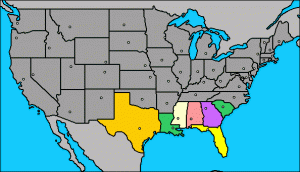
However, while Obama was improving on Kerry’s performance in most states — including such critical battlegrounds as Pennsylvania, Ohio, Michigan, Indiana and North Carolina — he did worse than Kerry among white voters in a handful of states — especially Alabama, Mississippi and Louisiana.

In Louisiana, Obama’s support among white voters was 10 percentage points below what Kerry received. That was the sharpest decline in white support for the Democratic ticket from 2004 to 2008 recorded in any state.

In other words, white voters in a select group of Deep South states proved especially resistant to Obama’s appeal, said David Bositis, an analyst at the Joint Center for Political and Economic Studies in Washington, who looked at the racial patterns in the 2008 exit polls. The exit polls, as in the past, were conducted by Edison/Mitofsky for a consortium of news agencies

“They are moving contrary to the rest of the country,” said Bositis, who said Obama’s race — and the historic pattern of racially polarized voting in these states — seemed the most obvious reason. How else, he said, to explain how Kerry, a quintessential East Coast liberal, did better than Obama with white voters in those states on his way to losing the presidency, than Obama did on his way to winning it?

Nationally, Obama won 43 percent of the white vote: 46 percent of white women and 41 percent of white men. He ran 12 percentage points behind Republican John McCain with white voters.

That’s the same percentage gap by which Gore trailed George W. Bush in the virtual dead-heat election of 2000, but it’s five points smaller than the Democrats’ deficit four years ago.

Obama built his margin by increasing the turnout and percentage of the African-American vote and dramatically improving the party’s performance with Hispanic voters. Obama also did especially well with younger and more-educated voters.

But according to demographer William Frey of the Brookings Institution in Washington, none of that diminishes how important it was for Obama to shave some points off the usual Republican advantage with white voters. And, Frey said, Obama’s big gains were among white men — usually the toughest constituency for Democrats — where he narrowed the Democratic deficit by nine percentage points.

“A lot of Obama’s demographic gains were among Hispanics, young people, the college-educated, but there is also this big chunk of white men who are almost always very reliably Republican,” Frey said. “To some degree they went to him this time — not because of any transformational change, but because of the economy.”

Charles Gallagher, a sociologist at La Salle University in Philadelphia who has studied white racial attitudes, seconded Frey’s assessment.

“What did it take for white America to want to vote for a black man? If there had not been this collapse of the economy, there would have been no Barack Obama mandate,” Gallagher said. “Class trumped race.”

White support in N.O.

Except perhaps, Frey said, in the Deep South states where Obama fared so poorly. Those states, Frey said, remain the most culturally Southern and demographically unchanged.

Frey said that 57 percent of all eligible voters in Louisiana and 60 percent in Alabama are Southern-born white people. In North Carolina, the percentage is only a little more than half, and in Virginia, Georgia and Florida, it’s well below half.

Obama won North Carolina with 35 percent of the white vote. He won Virginia with 39 percent of the white vote. And he won Florida with 42 percent of the white vote. He lost Georgia with 23 percent of the white vote.

Meanwhile, in every state with a large enough black population to create an adequate sample for exit polling, Obama’s black support was above 90 percent, often in the high 90s. In Alabama and Mississippi, Obama won 98 percent of the black vote; in Louisiana, he won 94 percent.

In Orleans Parish, according to a precinct analysis by University of New Orleans political scientist Edward Chervenak, white voters behaved very differently than white voters in the rest of the state.

According to the national exit polls, Obama won 14 percent of the white vote in Louisiana — 10 percentage points less than Kerry won in 2004 — and a lower percentage than in any state except Alabama, where Obama carried 10 percent of the white vote, and Mississippi, where he won 11 percent.

But Chervenak found that even though Kerry lost the whitest precincts in Orleans Parish in 2004 by three percentage points, Obama won those same precincts by a sliver of a percent.

Chervenak said the outcome comported with his own yard-sign observations.

Even in predominantly white neighborhoods, he said, “I saw far more Obama signs than McCain signs.”

Lower appeal elsewhere

Outside New Orleans, the white vote in Louisiana took on very different contours.

“Once you get above I-12, voters are just culturally conservative Christians who just have a natural affinity for the Republican Party,” Chervenak said. And, he said, “certainly race is a consideration. The fact is that a liberal African-American candidate is just not attractive to a large number of white voters in Louisiana.”

And unlike the results in many states, younger white voters in Louisiana, Mississippi and Alabama were hardly more likely to vote for Obama than older white voters.

By contrast, in North Carolina, Obama won 35 percent of the white vote overall, but 56 percent of white voters age 18 to 29. Similarly, in Indiana, he won 45 percent of the white vote and 57 percent of younger white voters.

Steve Suitts, vice president of the Atlanta-based Southern Education Foundation, said Tuesday’s results reveal again “how distinct the South is from the nation as a whole in racial voting.”

“We’re just maybe a few generations behind the rest of the country in understanding what (the Rev. Martin Luther) King told us about it’s not the color of your skin, but the content of your character,” said Suitts, who supported Obama.

Jonathan Tilove can be reached at jtilove@timespicayune.com or 202.383.7827.

America’s racial divide grows

In 2008, minority voters turned out in record numbers, propelling Barack Obama to the White House. Similar results fueled his second-term victory on Tuesday. A 2-percentage-point increase in nonwhite votes—to 28 percent—sealed Obama’s reelection, and data seem to indicate minority influence at the polls has grown stronger in the past four years.

Obama managed to win again, despite securing only 39 percent of white voters–who still represent the nation’s largest voting bloc at 72 percent.

Poll after poll indicated the issue atop all voters mind this election season was the still-weak economy, a color-blind issue affecting nearly everyone.

However, analysis of voter data shows that the racial divide that dominated much of the race in 2008 is getting wider. Obama failed to capture the majority of the white vote in many of the nation’s states–even the ones that traditionally bleed blue–and endured a 4-point drop among white votes over 2008.

Based on racial exit-poll data available from select states, Obama would have definitively lost 12 states to Republican nominee Mitt Romney if only white voters mattered. Add another three possible toss-up states and that’s a full 242 possible electoral votes that Obama would not have.

Using the link, toggle between the reality of the 2012 vote and a projected electoral map that uses white-only voter preferences. You can also clearly see what Obama gained and lost using white-only votes from 2008 to 2012. Hint: It’s a lot. – National Journal