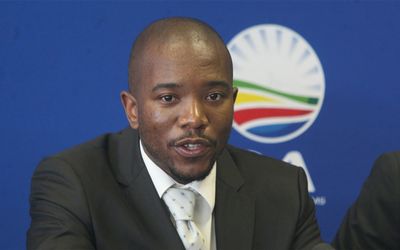
Malema threatens white land owners

South Africa’s white farmers should stop being sensitive and participate in critical debates on the transformation of the agricultural landscape and other emotive issues, Economic Freedom Fighters leader Julius Malema told a forum of agricultural roleplayers in the Western Cape on Wednesday night.

Speaking at a dinner hosted by the forum – which calls itself “Gesprek” – Malema moved to allay white fears on “expropriation without compensation”.

“As long as it’s a productive farm, we don’t have to interfere with the production on that piece of land,” Malema said.

“When there is part of a land which is not used for agriculture purposes, we would be having a problem. All we are saying is the land must be used. It must not lie idle.”

But, he wasted little time before warning farmers that they needed to play their part in empowering black people.

“You owe it to the people who have been oppressed… to mentor them,” Malema said.

“If you love this country, you must love its people. Say to them ‘I’m volunteering my services. I’m going to make sure the land is used productively and used to feed the children of this community’.”

Those who did not want to contribute to transforming the sector were free to pack up and leave.

“There is no white man… no white woman who is going to be driven into the sea,” he assured the farmers.

“Feel free to leave, but you would miss out. You will miss us. We won’t miss you.”

Source: IOL

Malema mulling an armed struggle

The Economic Freedom Fighters may take up arms if their “peaceful revolution” is met with violence from the state, party leader Julius Malema said on Thursday.

“We can’t rule out the possibility of an armed struggle if the state is going to meet peaceful protest with violence,” he said in a pre-recorded interview aired on SAfm radio.

“We would not do anything which seeks to compromise the 1994 breakthrough and it all depends on how the state responds to the radical demands of our people.”

He hoped the ruling party would not be tempted to adopt “apartheid tactics” when faced with serious pressure.

Malema told the radio station there was no need for a “military response” from the state, when clearly he is mulling taking up arms.

“In the Parliament, the freedom of speech and expression is unlimited. It is absolute and you need to live with that.

“All of you must begin to accept that we are exercising our rights to the limit and therefore we are not going to conduct ourselves in a manner defined by the middle class which has always hated us. It will never vote for us.”

The EFF is hoping that incitement against the “middle class”, a euphemism for whites, will lead to anarchy and revolution that would bring “hope to the working class and eliminate poverty”.

Meanwhile the EFF Commmander in Chief this week indulged in a twitter war after he was spotted wearing a black Louis Vuitton belt.

This is not the first time he’s tweaked the workers’ overall he wears to parliament with exorbitantly expensive clothing and accessories, while demanding “social justice” and “economic freedom”.

The pauper also wears a Breitling watch valued at R250 000.

Malema promises to shut down Joburg businesses

Julius Malema, EFF leader is planning a mass action that will shut down businesses in Johannesburg when his supporters return to protest against the ban on overalls in the Gauteng legislature.

According to the Sunday Times, Malema’s planned protest will make Tuesday’s chaotic rally look like a picnic in the park.

In an interview with the newspaper, Malema said: “We will shut down business in this Johannesburg. Once business in Johannesburg is shut down, it means business in the whole of Africa has stopped.”

Malema told thousands of supporters on Saturday at Thokoza Park in Soweto that celebrated the party’s one year anniversary, of the ANC shortcomings.

“Even if they die, there is nothing you will remember about them except that they were making babies,” said Malema.

He said the formation of the EFF had shaken the political landscape in the country and the ANC was feeling the pressure being exerted by the organisation.

“… Now you can’t listen to the media without the mention of the EFF. That is because EFF is a giant,” Malema said.

“We don’t care what people wear. We care about their will to resolve issues of people on the ground. We want people who think and not ‘domkops’ (idiots) from the ANC,” said Malema.

Source: News24

Malema targets big spenders says FT

MalemaFTThe Financial Times carried this story titled: Malema targets big game in ANC’s heartland on the front page:

Sitting in a plush lodge on the edge of Kruger National Park, the self-styled

revolutionary and spokesman for South Africa’s dispossessed outlines calmly his plans to expropriate land from white farmers, and nationalise banks and mines in Africa’s largest economy.

“We are worse than the way we were during apartheid,” he tells the Financial Times during a 90 minute interview. “The only thing that has changed is the government of white people has been replaced with a government of black people.”

The stout, boyish-looking 33-year-old, dressed in black tracksuit and black trainers, is a highly divisive figure. To critics, including many businesspeople, he is an opportunistic rabble-rouser tainted by corruption allegations. To supporters, he is a rare voice speaking to the divisions enduring in one of the world’s more unequal societies despite strides taken since the end of white rule.

Campaigning to the left of the ruling African National Congress he aspires to steal votes from the ruling party’s heartland, the rural and urban black poor, in elections on May 7. They are widely expected to be the most closely contested since the end of apartheid 20 years ago.

Mr Malema described president Jacob Zuma – the man he helped propel to the country’s top job – as a “monster”, and denounced the ANC’s 20-year record in power. He formally launched his Economic Freedom Fighters in October after being expelled from the ANC – where he led the militant youth league – for indiscipline in 2012.

He makes the point that while under the ANC more black people may have gained access to water and electricity, the water is often not clean and the electricity connection does not guarantee power. “So you are actually in more pain because these things are closer to you and, close as they are, you cannot use them,” he says.

This message resonates with the frustrated black majority in a country where youth unemployment is at least 50 per cent, and almost 40 per cent of the population live below the poverty line. It also carries weight with blacks of all classes who believe they are still economically marginalised in a country where the corporate world remains predominantly in white hands.

The challenge for Mr Malema is to turn disgruntlement into votes and survive court cases that could derail his career.

The politician, whose penchant for designer watches has come to symbolise his perceived opulent lifestyle, has had his properties auctioned off as the revenue authority has pursued him for R16m ($1.5m) in outstanding taxes. He is fighting a sequestration order and says he is willing to make a revised offer to resolve the matter.

Mr Malema has courted controversy in the past by saluting President Robert Mugabe of Zimbabwe but he says the EFF would not follow the path of Zimbabwe, where the forced and often violent seizure of white-owned land triggered a collapse of the economy.

But he says he wants government to be the custodian of land that grants licences to users and insists the state should control 60 per cent of mines.

“Foreign investors who are prepared to share with South Africans are more than welcome,” he says. “But if it is about individualism and maximisation of profit to the exclusion of indigenous people, such a foreign investor will not be entertained.”

Mr Malema and the EFF have brought a new dimension to the country’s political landscape. Pallo Jordan, an ANC intellectual, has said the ANC “might opt for more radical policies” if it faces an effective challenge from the left, “realigning South African politics in directions that few will have anticipated”.

The other threat to the ANC comes from the Democratic Alliance, the main opposition party. But it is still viewed by many – fairly or not – as a largely white party.

Yet for all his outward confidence Mr Malema acknowledges the campaign against the well-oiled ANC election machinery is a difficult one. And touting his radical policies can be a hindrance when seeking financial backers.

“It is a very difficult campaign in that we do not have resources and our policies are such that those who own resources will never finance us,” Mr Malema says. “Elections are very expensive things in South Africa, but if we had resources we would remove the ANC from power tomorrow.”

Source: FT. By Lionel Barber, Andrew England & Javier Blas

DA spokesman says ANC much better than ‘apartheid’

Mmusi Maimane
Mmusi Maimane

EFF leader Julius Malema was wrong to say that the ANC-led government is worse than the apartheid government, DA spokesman Mmusi Maimane said on Monday.

“You may have heard Julius Malema saying over the weekend that the ANC is worse than apartheid. It is wrong to create this impression among South Africans,” he said in a speech prepared for delivery.

“Apartheid was worse because it was a system of entrenched racism. Apartheid was worse because we couldn’t vote out apartheid. In fact, we couldn’t vote at all.”

The Economic Freedom Fighters’ leader said at the rally in Lethabong near Rustenburg, North West, on Saturday that black people would never own land under the African National Congress.

“Our struggle is about land. [Former president Nelson] Mandela was arrested for demanding land,” Malema said.

Maimane said “the sacrifice that so many made for our freedom” had to be remembered.

“Like so many others where I grew up, I used to be an ANC supporter. I believed that the ANC could bring about a better life for me and my family,” he said.

“Since then I have seen how that once proud movement has lost its way under the current leadership.”

He said apartheid was forced on the people against their will, while the ANC was “not compulsory”.

“The ANC is a political party in a democracy. We can vote for another party if we feel let down by the one in power.” – Sapa

Malema wants to emulate Mugabe

Malema and followers

Economic Freedom Fighters leader Julius Malema said on Tuesday that he wanted to emulate Robert Mugabe and congratulated the Zimbabwean leader on being re-elected president.

Speaking from Nigeria where he was visiting spiritual leader TB Joshua for “blessings” and “divine intervention”, Malema said that he — like Mugabe — was merely misunderstood, according to an eNCA report.

The former ANCYL leader said that Mugabe’s success at the polls should be celebrated.

“They have made their wishes very clear… and we want to congratulate President Mugabe because he has returned the land to the people and Zimbabwe will be one of the fewest African countries which is truly owned by Africans,” he said, according to the eNCA report.

Survey shows support for Malema’s policies among black youth

Julius Malema
Julius Malema

The EFF’s policies of land reform and elimination of national borders within southern Africa will boost youth support for the party, according to a survey released on Tuesday.

Thirty-eight percent of respondents believed Economic Freedom Fighters’ leader Julius Malema would gain support because of its policies, according to research conducted by Pondering Panda.

Twenty-nine percent believed he would lose support and 18 percent believed his support base would not change. Fifteen percent did not have an opinion on the matter.

The cellphone survey was conducted among 2339 people aged between 18 and 34. However, 49 percent of respondents did not support the EFF’s land reform policy, while 37 percent did.

According to the survey, 42 percent of young blacks approved of land reform. Support for the policy was also strongest in the Free State, with 56 percent of respondents approving it.

On the elimination of borders, 32 percent approved, while 54 percent disapproved.

“Although opposition to the EFF’s land and border reform policies still significantly outweighs support for them, what this survey shows us is that they are far from marginal ideas,” Pondering Panda spokeswoman Shirley Wakefield said.

“Young South Africans want change, and other parties should look carefully at the alternatives they will be offering them.”

How should we respond to calls for white genocide?

roodt_fbfoto

by Dan Roodt

[followbutton username=’danroodt’ count=’true’ lang=’en’ theme=’light’]

Like Dan Roodt’s Facebook page

This week on Twitter a former UKZN student representative council member, Sfiso “Mabhiza” Mbatha, tweeted: “We gonna kill every white cockcroach that breath(es) SA’s air”, while adding, “Would rape every 13yr old white girl after Mandela finally kick that bucket. Just for control.”

These tweets caused a lot of reaction, but no official complaints were laid. If any such statement were made about blacks, it would have provoked a far larger furore. The tweeter would have been charged with hate speech at the SA Human Rights Commission and MSM journalists would have “shamed” him with negative publicity about his “racism”.

As Mbatha explained afterwards, he thought it was something of a joke: “It was just a joke at the end of the day. But now I realise that they were uncalled for, they went overboard and pushed the limit. I did say that I was joking, but people responded by insulting me, so I insulted them back.”

A large number of whites did not react at all. This is typical of so-called “advanced groups” all over the world who almost expect to be resented and even hated by the less successful groups. The well-known ethnic expert and author of the book, Ethnic goups in conflict, David Horowitz, distinguishes between “advanced groups” and “backward groups”. I think it would be fair to say that South African whites fit the definition of an “advanced group” and therefore typically react like one. Advanced groups are more educated, entrepreneurial and occupy the higher social classes in an ethnically divided society. As Horowitz explains:

“Where backward groups seek proportionality in government employment, advanced groups seek only assurances of nondiscrimination. Where backward groups attempt to keep ethnic strangers from government service in their region, advanced groups affirm the principle of unrestricted mobility.”

Advanced groups are reluctant to secede if they find themselves living in diaspora in a “backward territory”. Significantly, Horowitz notes that advanced groups are “disproportionately victims of ethnic violence”. South Africa’s brutal farm murders are a case in point, targeting a specific language and racial group that is perceived to be in a better socio-economic position than the surrounding “backward” population.

If we are honest, we should admit that some form of white genocide or anti-white violence has always been at the core of the ANC’s “liberation strategy”. The ANC is essentially composed of elites identifying with the less successful ethnic groups in South Africa. It is therefore normal that, according to the laws of ethnic conflict, it should heap opprobium onto whites which it perceives as “the enemy” and responsible for the relative deprivation of South African blacks. It is also telling that the principle of proportional employment has been implemented, not only in the public sector, but also in the private sector in a clear attempt to curtail white social and economic prowess.

However, it would be too simplistic to transpose Horowitz’s theory of ethnic conflict onto South Africa as one might onto Nigeria, Sri Lanka or Malaysia. In addition to the ethnic dynamic at work in the South African conflict, there is also the ideological dimension in the form of political correctness, Western decadence and generalised anti-white attitudes to be found in the global mainstream media.

Against this backdrop, calls for a white genocide in South Africa seem almost normal or normalised. Foreign correspondents in Johannesburg from the BBC, the New York Times and the London Guardian who have been casting whites in the role of evil racists for years, are likely to report on anti-white animus among blacks with “understanding”. In the light of the aforegoing narrative, these correspondents might suggest: who can blame them?

White South African liberals and leftists who are loyal to Britain and share left-wing Anglo-American perspectives on their own countrymen, take an equally sanguine view of such manifestations of anti-white “racism”. Liberal Britons are indifferent to the killing of whites in South Africa, if not supportive of any would-be black genocidaires. I once spoke to an official from a London NGO who explained to me that we should not complain about being killed by blacks as “they were only getting their own back”, as if white leaders in the past had proceeded to similar public appeals to “exterminate the kaffirs”!

As we saw during the court case around Julius Malema’s “hate speech” against Afrikaner farmers, there was little media sympathy for white victims of ethnic and racial violence. Even though Malema was prohibited from singing the song, “Kill a Boer, kill a farmer”, the song kept on being sung all over the country. In fact, the governing ANC opposed the legal prohibition of the song, with its advocate Gilbert Marcus, brother of Reserve Bank governor Gill Marcus, arguing for the party’s “freedom of speech”. Singing such songs were part of “black culture”.

It may be, therefore, that calls for white genocide in South Africa are examples of the “free speech” that Marcus and many other leftists and liberals would argue are “harmless” and “not to be taken literally”. In the words of the young black tweeter from Natal, Sfiso “Mabhiza” Mbatha, it is “just a joke at the end of the day”.

It is also true that black Africans often joke about killing. “I’m going to kill you,” is quite an everyday saying. Also, killing is invoked many a time as a universal method of meting out justice for all sorts of crimes and misdemeanours.

However, as the saying goes, “many a true word is spoken in jest”. Robert Mugabe is one of the most admired black leaders in South Africa and there is no doubt that his “final solution to the white problem” by simply confiscating their assets and expelling most of the white population, would also be wildly popular in this country. There not being another country south of South Africa towards which whites could flee, a broad desire “to get rid of whites once and for all” could lead to widespread killing, massacres or even systemic genocide of the kind hinted at in “jocular” black tweets.

How then should we answer my initial question in the title above: “How should we respond to calls for white genocide?” I think there would be at least two approaches. The one would be a kind of laissez faire approach in line with leftist white responses of “not taking it literally”. That would also constitute the most typical reaction of Horowitz’s “advanced group” that sees its salvation not in mass mobilisation and ethnic agitation, but in avoiding conflict – or at worst, moving away from it. The most common reaction of whites after escaping from an armed robbery, farm attack or other form of black-on-white violence is not to join the local chapter of the AWB’s Ystergarde (Iron Guard), but to call an Australian immigration consultant.

I have just had a visit from a friend who had recently emigrated to Australia. He misses South Africa, family and friends, especially the warmth and hospitality of Afrikaners. But he does not contemplate ever returning to South Africa, because, as he put it: “I feel safe in Australia. I would be scared to live in South Africa again.”

Many whites simply ignore ethnic slogans directed at them. I once listened to a talk show on the Afrikaans radio RSG where many of the callers stated quite frankly that they had adopted a kind of ostrich-like, head-in-the-sand approach. They would simply avoid reading newspapers and websites or even listening to the news on radio because it upsets them. They choose not to know. The average white professional woman or housewife shopping at Woolworths does not care either that the chain has an anti-white employment policy. She buys the fantasy of eating well, dressing well and decorating her home in the latest mix of white and earthy, African colours.

Ever since my Afrikaans high school days, I have often heard the typical injunction from teachers and many others: “Don’t be so negative!” Within the Afrikaner mind, every problem has a solution and “being negative” is a cardinal sin. In that sense, what can be more “negative” than imputing genocidal urges to South Africa’s black majority? Or even responding to a call for white genocide that is made every so often by some tweeter or black politician?

Among my many criticisms of the Afrikaans schooling system, although one of the best in the world for churning out straight-A students in maths and science, or good writers, artists, actors and so on, is that it does not teach one the art of critical thinking. Disagreeing with someone, especially publicly, is often seen as “bad manners” or even worse, as displaying that nefarious “negative” attitude. Often I have sat in meetings with especially elderly Afrikaners who used to occupy positions of authority in the old system and, upon voicing my disagreement on some point, they would simply ignore me as if they had not heard me!

Similarly, many Afrikaners out there, including the editors of newspapers, radio stations and pay-TV channels, are “simply not hearing” any call for white genocide. Call it denial or what you will, but just as their culture predisposes blacks to easily talking about killing, local white culture tends to make them hard of hearing.

We have been educated and programmed to be decent, cooperative, “positive” in Afrikaans parlance, so behave like a typical “advanced” ethnic group, eschewing ethnic solidarity in the face of danger.

However, there is one “advanced” group, probably due to past experience, that does not take calls for genocide lying down. Here I am referring, of course, to Jews. South African Jews enjoy arguably the highest standard of living of any ethnic group in the world and a perusal of the weekly South African Jewish Report will tell you about their huge socio-economic success, as well as media and political influence.

Unlike such dreadful appeals directed against Afrikaners and Boers, no-one in South Africa has ever called for the extermination of Jews. In fact, South Africa’s much-maligned National Party government was probably responsible for the good relations not only between Jews and the rest of the white population, but also between Jews and South African Muslims.

To my surprise, I recently discovered the construction site of Johannesburg’s Holocaust Centre, with another one having been in existence in Cape Town for some years already. These centres, apart from educating the public about the history of Jewish persecution, tend to preach tolerance towards Jews and between ethnic groups generally.

There is also the international Anti-Defamation League which, according to one of its own documents, “fights anti-Semitism and all forms of bigotry, defends democratic ideals and protects civil rights for all,” doing so through “information, education, legislation, and advocacy”.

I can only imagine the international outcry, notably from Germany, that would ensue if any South African black leader had to start singing “freedom songs” about “Kill a Jew, kill a plutocrat”. Charges of hate speech would immediately be laid against the offender and he would become persona non grata in many quarters. I doubt very much whether anyone at the Johannesburg Bar, least of all Gilbert Marcus SC, would defend his “freedom of speech” and colourful metaphors.

The so-called South African Human Rights Commission is a suspect body, in itself prone to anti-white sentiment. It was created to harass whites, not to uphold their rights. As far as I know, it has never responded to complaints about anti-white hate speech, apart from acknowledging the receipt of such a complaint. For that reason, many Afrikaner groups do not even comtemplate complaining to the SAHRC about calls for white genocide.

But if we are looking for models to deal with the growing chorus calling for a white genocide in South Africa, we could do worse than to imitate the Jewish community. Either one lets these comments and invocations to kill whites slide, like the ostriches that we are, or one should draw a line and respond to each and every one of them. Even if the SA Human Rights Commission will do nothing to stop hate speech against whites, the mere fact of documenting such complaints might come in handy at some later point when our struggle for survival gets even more intense than it already is.

The current mayor of Chicago, Rahm Emanuel, made a bizarre statement in 1992 when he said: “Gays are the next Jews of fundraising.” Many people have recently quoted this.phrase to point out the vast support for Obama’s Democrats among US gays.

But in a more fundamental sense, I think we could say that Afrikaners – and by extension white South Africans – are “the next Jews”. We are already subject to vicious propaganda campaigns, vilification, hostile media reports, legal and official discrimination, stereotyping and random ethnic attacks, even pogroms.

Our famous Afrikaner poet, N.P. van Wyk Louw, once wrote: “If the Afrikaner had to lose political power in South Africa, he would be as helpless as the Jew in Nazi Germany.”

Recent history has vindicated Louw. It is high time that, while we are being treated like Jews in Czarist Russia, we should respond like modern Jews who not only react vehemently against any suggestion of genocide, but also preempt it through, in the words of the Anti-Defamation League: “information, education, legislation, and advocacy”.

[followbutton username=’danroodt’ count=’true’ lang=’en’ theme=’light’]

Like Dan Roodt’s Facebook page

Malema case to continue in Pietersburg Magistrate’s Court today

Julius Malema
Julius Malema

Expelled ANC Youth League president Julius Malema’s corruption case will continue in the Pietersburg Magistrate’s Court on Friday.

On Thursday, Malema told the court he feared that a delay in setting a trial date for his case could jeopardise the launch of his new political party.

“The sooner this case is finished, the better. I am in the process of forming a [political] party,” he said.

Malema blamed President Jacob Zuma for some of his troubles.

“It becomes impossible to convince people to join the party. President Zuma has done everything to make sure that I lost everything and block whoever is linked with Malema,” he told the court.

Malema is accused of making nearly R4 million from corrupt activities.

He is out on bail of R10,000 and faces charges of fraud, corruption, money-laundering, and racketeering.

His co-accused are his business associates Kagisho Dichabe, Lesiba Gwangwa, Helen Moreroa, and Makgetsi Manthata, who are out on bail of R40,000 each.

The State alleges Malema and the others misrepresented themselves to the Limpopo roads and transport department, leading to a R52m contract being awarded to On-Point Engineering.

According to court papers, Malema had business ties with Gwangwa, a director of On-Point Engineering. Malema’s Ratanang Family Trust was an indirect shareholder in On-Point.

The department paid the company R43m. According to the charge sheet, Malema substantially benefited from this payment, using it to buy a farm and a Mercedes-Benz. – Sapa

South African cabinet denounces ‘recent acts of racism’

Recent acts of racism in the country should be strongly condemned, Minister in the Presidency Collins Chabane said on Thursday.

In a statement following Wednesday’s fortnightly Cabinet meeting, Chabane said this should especially be stamped out in school classrooms.

“There is no room for racism in our country and democracy, let alone in our schools, where the values of our Constitution ought to be promoted and defended.”

He called on South Africans to work with government to deal with racism.

“Cabinet commends the department of basic education for its quick action in dealing with racism in schools and encourages all parents, pupils, and teachers to report racism and abuse at schools.”

In a Grade Seven classroom at the Wilgehof Primary School, in Bloemfontein, the old South African flag was reportedly on display, along with a picture of expelled ANCYL leader Julius Malema alongside that of a monkey.

The history and life orientation teacher allegedly responsible for the display and for making racist remarks, as well as the principal, have been suspended.

One of the white parents at the school had also laid a complaint with the SA Human Rights Commission (SAHRC) — who had already been to the school for an on-site inspection.

While investigating, the SAHRC learnt that some pupils had been called derogatory names. – Sapa

Malema promises bloodshed

Unlucky victim of South African violence

Axed ANC Youth League leader Julius Malema believes bloodshed will help him get South Africa’s land and mineral resources, according to a report on Tuesday.

Malema was in Harare on Saturday to attend a wedding ceremony and address Zanu-PF youth, the Zimbabwe Herald reported.

He said the youths in South Africa were calling for whites to surrender land and minerals resources they hold because “when they came from Europe they did not carry any land into South Africa”.

“What we are asking is for them to surrender our minerals because they did not come with any mineral. We want that land and those minerals for free because they never paid for those minerals.”

Malema said whites committed murder to get land.

“Actually they killed people to get that land and those minerals. We are not going to give them money when we take the land back because it will be like we are thanking them with money for killing our people.

“We will never do that, little did they know that we are not scared of blood. We are scared of defeat. We don’t want to be defeated but seeing blood is not what we are scared of as long as that blood delivers what belongs to us we are prepared to go to that extent.”

Malema told the youth he was in Zimbabwe to gain inspiration and wisdom, so that when he returned home he could “double the spirit of fighting against imperialist forces”.

He said Zimbabwe was an inspiration to Africa, in that it is now wholly independent and has divested itself of external control.

Malema faces a money-laundering charge relating to a R52m tender awarded to On-Point engineers, which he allegedly benefited from. – Sapa

Malema attacks Nkandla

Julius Malema

Julius Malema on Tuesday severely criticised President Jacob Zuma for the reported R203m upgrades to his Nkandla home in KwaZulu-Natal.

This amounted to stealing and was not right, Malema told striking mineworkers in Virginia, in the Free State.

“They want to give you [miners] R16 000 but they give another man R250m to build a house,” Malema said.

Malema was addressing a group at the Meloding Stadium. Many women and children were among the striking workers who arrived to hear him talk.

He asked why Zuma’s other three homes, in Johannesburg, Durban and Cape Town, maintained by the state, could not be used for international visitors.

“Who goes to Nkandla of all places? There’s no wisdom there, nothing to learn, unless its about cultural aspects,” Malema said.

Malema told the miners that  Zuma has no respect for the country’s Constitution.

“How can Zuma ask miners to respect the Constitution if he does not,” he asked them.

He was referring to a recent Constitutional Court judgment that found invalid the appointment of Menzi Simelane as National Director of Public Prosecutions.

In reading the unanimous judgment, Judge Zak Yacoob said the court reached a number of legal conclusions, including that the NDPP’s appointment was not a matter to be determined by the subjective opinion of the president.

Malema told the miners Zuma hired Simelane against the guidelines stipulated by the Constitution. It was Zuma’s responsibility to protect the Constitution, yet he ignored it.

He referred to a recent court decision when the National Prosecuting Authority (NPA) was ordered to hand over tapes to the Democratic Alliance in relation to corruption charges against Zuma being dropped.

The NPA dropped the charges against Zuma just before he was elected African National Congress president and president of the country.

Malema told the miners that their struggle was his struggle. He also urged the community to stand by the striking workers. – Sapa

DA backs Malema

Zille charms the Eastern Cape

Cape Town – The official opposition in Parliament, the DA, has backed Julius Malema’s demand that President Jacob Zuma stand trial for the multiple criminal charges he has faced.

On Wednesday, Malema demanded that Zuma should still face the charges in open court, instead of “running away” from the courts.

“Zuma has 700 charges against him. I only have one,” Malema said.

The axed ANC Youth League leader was granted R10 000 bail in the Polokwane Regional Court on Wednesday where he was charged with money laundering in connection with a R52 million tender in Limpopo.Malema claimed the charge was politically motivated.

DA federal chairman and correctional services spokesman James Selfe said on Wednesday: “We’re in entire agreement. That’s why we’ve gone to court on numerous occasions to have the decision to drop the charges against Mr Zuma reviewed.

“It was meant to have been the best-prepared case in history, considering all the millions of rand that had been spent in preparation. It was clear that there were members of the NPA

[National Prosecuting Authority] who believed they had a solid case against Mr Zuma. And the place to disprove that case was in open court, not by cutting deals,” Selfe charged.

“So as much the DA would disagree with much of what Mr Malema says on other matters, on this, at least, he is entirely correct. Or, more correctly, he agrees with us.”

In December 2007, Zuma was charged with various counts of racketeering, money-laundering, corruption and fraud. But in 2009, the NPA said while the merits of the case remained intact, alleged political interference and abuse of process rendered the continuation of the trial “unconscionable”.

The DA had earlier won a court case giving it access to the so-called spy tapes which formed the basis for charges to be dropped against Zuma. – Cape Argus

Is South Africa the next Liberia?

by Dan Roodt

I ended off my last column with a reference to “the dark eye of Africa”, a term used by Laurens van der Post in his eponymous lecture in 1954. Following in the footsteps of Van der Post, how are we supposed to make sense of the sadistic violence, murders and rapes taking place in South Africa every day?

Just yesterday on this website I read of a case where a 38-year old black man raped and murdered his own 92-year old grandmother. Over the last two weeks we have had at least three very high-profile murders, on 13-year old Alyssa Botha, 50-year old André Jordaan and only a few days ago, on the world-famous boxer Corrie Sanders.

According to at least one expert who has analysed our crime statistics released last week, every white person in this country will be exposed to a so-called “contact crime” – an armed robbery or violent attack on his person – over the next three and a half years. More than fifty people are murdered every day, as many as are murdered in some European countries in a whole year!

The worst is, much of the “xenophobic killings” of foreign Africans do not even get reported by the police. Some of them are in the country illegally and the local black policemen turn a blind eye when they are murdered, except where it gets video-ed. Then you might get an account published in the New York Times as happened last year when Barry Bearak described such a murder in Watching the Murder of an Innocent Man.

Many people still pretend that South Africa is a normal society, even a liberal democracy. But they are simply dishonest or blind to the reality that we have become a kind of Barbary Coast, albeit inland, where the rules of pirates prevail. Also the events and controversies surrounding Julius Malema are to be seen in this light, as manifestations of pirates quarrelling over stolen loot.

Malema is rumoured to have ties with organised gangs and black mercenaries from Zimbabwe. Against the backdrop of a sadistic society with atrocities being committed almost as part of a daily ritual like shaving or brushing one’s teeth, the internecine power struggle between Malema and the establishment ANC portend still more conflict ahead.

Both the American Stephen Ellis and the French journalist Stephen Smith characterised the civil war or anarchy in Liberia as a defining moment in Africa after the Cold War. The “paradise of cruelty” created by Charles Taylor in Liberia and Sierra Leone with child soldiers committing atrocities, resonates profoundly with present-day South Africa.

Ironically, South Africa has attained barbarism at the very moment when many international observers – let’s call them naïve do-gooders – saw the country elevating itself to Wesern-style democracy. Even the mayor of Ekurhuleni, the sprawling conglomeration of municipalities cobbled together by the ANC on the East Rand, described the murderers of Corrie Sanders as “barbarians”. And he is both black and an ANC politician, therefore an incumbent of “democracy”; which makes his use of the word so much more significant, even poignant.

Those same “angels of virtue”, the international do-gooders – but who naturally have their own interests at heart too – are fond of explaining our problems by way of institutional failure, socio-economic conditions, “inequality”, or even the ubiquitous scapegoat, “apartheid”. Yet the barbarian urge at the heart of the New South Africa goes far deeper than that. It is more a problem of consciousness. A society can only sustain so much violence. After that it becomes self-perpetuating, a conditioned reflex, a way of life.

Zuma’s little war chant, “Bring me my machine gun”, acquires a whole new meaning, as the motto not only of ANC rule, but of a whole epoch.

[ad 1]

The mine workers at Marikana seem to have opted for violence and intimidation as a far better way of negotiating with mine owners than our byzantine labour laws and regulations. Given the success of their strategy so far, they appear to have been vindicated.

South Africa has become so phantasmagorical, so far removed from any semblance of normality that one has to look to fiction, especially science fiction or a futuristic horror world to gain any understanding of what is going on here. Mad Max comes to mind. But at least Max was driven by rage at the killing of his wife, baby and best friend. Our killers are actuated by pure sadism, by the mystical pleasure of killing, raping and hurting.

 South Africa seems to be doomed to a kind of reverse narcissism. The more it stares into the mirror, especially that mirror held up to it by the mass media, the more it sees an image that is the opposite of itself. During the previous dispensation, which was mostly orderly and without the gratuitous viciousness of the present order, many people saw us as a profoundly evil society. Nowadays, with things falling apart completely and anarchy upon us, those same people and newspaper pundits discern in this utterly sick society a pristine exemplar of liberal democracy and human rights.

 Malema is already the Big Man of South African politics. He just needs a militia to take us, as they say, to the next level.