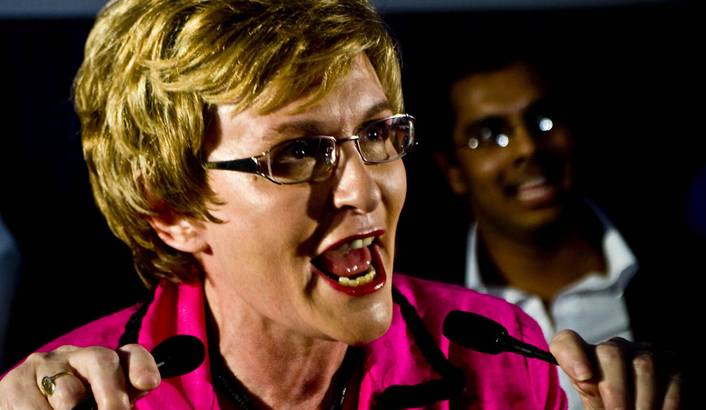
The DA has effectively outlawed the use of all racial terminology, in particular the “B-word” (boer) and the “H-word” (hotnot), both derogatory words used to describe whites and coloureds, respectively, saying they are just as bad as the “K-word” in a bid to cover-up anti-white sentiments surfacing.
Many were shocked by comments recently made in particular by a senior party member, whose name is known to the Cape Argus, who openly declared that he did not vote for “Athol Trollip because he’s white”.
Senior party members and several councillors told the Cape Argus they were “flabbergasted” when the member made the comments, stunning the meeting into silence.
In its quest to combat “across the board” racism in the party, the DA Western Cape Provincial Council met at the weekend to discuss among others the terms used to refer to white, black and coloured people living in the province.
“Boer” is not a term for all whites. It is only used against Afrikaners.
DA provincial leader Patricia de Lille, who is leading the “anti-racism” charge, confirmed that she made reference to the use of the K-word, the B-word and the H-word during discussions.
“The DA does not tolerate the use of racist language. We consider all derogatory words equally repulsive,” she said adding that the party will take disciplinary steps against any DA public representative or employee or member who uses racist language.
The meeting, chaired by provincial party chairman Anton Bredell, consisted of a three-member panel which included Premier Helen Zille, De Lille and deputy provincial leader Bongikosi Madikizela.
Members say issues that raised eyebrows included claims that the “coloured majority was being neglected for the needs of a small black voter base”.
Similarly, concerns were raised about black party leaders being chosen above coloureds, while calls were made that service delivery should be focused on the majority race in the province – the coloureds – who had faithfully voted for the DA.
The wife of DA parliamentary leader, Mmusi Maimane has taken to social media to support her husband amid rumours of a sex scandal within the party.
In a tweet from her account, she called her husband “the real deal”.
An e-mail penned under the name “Tom Jeffries” has been sent allegedly by a woman who says she is one of several colleagues used by men in the DA as “playthings”.
The email, according to its writer, is a warning to delegates to not put the wrong people in leadership.
“I am one such person and despite raising my concerns I was brushed aside by a system that protects men that use their power to get away with the worst misogyny against women,” it reads, before accusing a host of prominent DA MPs and office bearers of extra-marital affairs.
Mmusi Maimane, his contender, James Wilmot as well Athol Trollip, who is running for federal chairmanship, on Saturday collectively rejected allegations of a culture of crude sexual harassment within the party.
A mock leadership battle has begun in the DA following Zille’s announcement that she will not be available for re-election at the party’s elective congress on May 9.
The official opposition will elect a new leadership in Port Elizabeth next month.
DA parliamentary leader Mmusi Maimane has emerged as the most likely successor to Zille, but Maimane has said he will “consult with structures before making himself available”.
It is common knowledge though that Zille prefers Maimane and that her voice carries the most weight despite “democratic voting” within the party. Zille was instrumental in appointing previous parliamentary leader and political train wreck, Lindiwe Mazibuko, despite a lack of votes.
Zille said she would remain Western Cape premier for another four years and would work to grow the DA’s support base in next year’s local government elections.
Meanwhile the party has extended the deadline for nominations in a bid to look “fair”.
Maimane’s possible election and the retention of his current position as parliamentary leader would mean that once again the two roles which Zille had split, would be combined.
The turning point came when the DA attacked president Zuma together with the EFF in Parliament on Nkandla funding earlier this year, with both parties staging a notorious walk-out which led to chaos.
Before the walk-out, the DA was viewed as a white political party by the black electorate. Thus having the first black party leader articulating party policy with the help of the EFF will be important to garner more black votes in 2016.
Political analyst Daniel Silke told the Businessday that the end of Ms Zille’s reign offered just such an opportunity to the party. It provides the platform for the party to elect its first black leader and potentially expand its electoral base into new markets that until now might have been blocked, he said.
The risk, Silke added, was whether a black leader would resonate with the rank-and-file supporters on the coloured Cape Flats, a key constituency for the DA.
“Mr Maimane is the clear frontrunner and given his leadership of the parliamentary caucus, presents a much-needed and long-overdue opportunity to unify the position of national leader and caucus leader.”
On New Year’s eve, the acrimonious tone of South African public debate seems to have become even more pronounced. Just yesterday another stereotypical cultural-Marxist piece by Professor Anton van Niekerk appeared in Afrikaans on the Netwerk24 site and already conservatives are up in arms regarding his defence of permanent affirmative action and half-truths about “apartheid”, with at least three substantial responses in less than 24 hours.
Even gracing the exchange of accusations, recriminations and the perennial whipping out of the race card in South Africa with the noble term, “debate”, represents a malapropism. Under left-wing, racially-obsessed government, South Africa has descended into witch hunts, invective and farce with even our venerable parliament that used to command respect in the old days now becoming a theatre of puerile, hysterical and often physical clashes. Whereas before South Africa was caricatured as a citadel of moral rectitude and Sunday observance, not to mention strict obedience to the law, it is now the most violent country in the world with at least 50 000 homicides taking place every year. Theft and robberies are so commonplace nowadays that they are no longer reported to the police, except where insurance companies require it for claims.
Whoever may be in charge in South Africa – and it is certainly not our incompetent, venal government mired in corruption scandals – must be desperate to defend un unworkable system. That is why the mantra of “apartheid” is being recited with ever greater fervour by the Marxist and liberal Left in this country. Apartheid, or “separate development” as the old government used to call it, is not only a divine or occult source of evil that perdures in the present but also a deus ex machina conveniently invoked to explain every instance of political failure. When the lights went off due to the incompetence of our state-owned electricity utility, financially plundered and abused by greedy, corrupt bureaucrats, the state president was quick to invoke “the legacy of apartheid”.
Buy Dan Roodt’s book on this site
It gets worse. There is now such a thing as “apartheid denial”, of which both Steve Hofmeyr and I will soon be accused in a court of law, no less. Apartheid has another useful function: it justifies censorship and the suppression of facts about the present communist-inspired catastrophe known as the “New South Africa”. We all know what the “new” looks like after revolution, if we recall the French, Russian, Chinese, Cambodian and other revolutions. Apparently, a group of left-wing lawyers in Johannesburg from the firm Webber Wentzel have decided that no-one will be allowed to voice any opinion or cite any facts about history before 1994 without first putting it through the cultural-Marxist filter and making sure it embellishes their preposterous tale of pristine black innocence and white evil.
Helen Zille, the left-liberal leader of the “official opposition” in parliament – in South Africa you have a choice between voting liberal, Marxist or lunatic-Marxist – subtly blames whites for the post-1994 explosion of violence in South Africa when she says:
We must show the courage to challenge any social reinforcement for racist behaviour, because small acts of intolerance have the potential to manifest in more despicable acts of aggression and degradation as we see all too often.
When a blacks torture or hurt whites, even a baby as was recently reported by the Beeld newspaper, whites are to blame. That is the gist of Zille’s and cultural-Marxist discourse in South Africa. And if you question that dogma, as some of us are wont to do, you are an ogre, a racist, an “apartheid denialist” in the language of Webber Wentzel’s band of legal inquisitors.
What Zille understands under “challenge” is a euphemism for vilification, censorship and persecution. If you deviate from the cultural-Marxist canon of South African history, you will be fined, imprisoned or both. That is what is being planned for us and Zille’s “liberal” DA – which has of course as little to do with classical liberalism as Pol Pot’s Khmer Rouge had to do with democracy – will support these draconian measures to suppress our free speech.
However, at least one or two liberals are starting to see that the cultural-Marxist insistence on a pervasive, ubiquitous notion of “metaphysical apartheid” may not ultimately serve their cause. About ten days ago in the Business Day newspaper, Hans Pienaar wrote that the overuse of the term “apartheid” by his fellow liberals and leftists has now become counter-productive:
But the fact is “apartheid” has become just another “big word”, a tool that is now too blunt and bent for useful analysis.
While it can still serve as a label for tourists and campaigners, it narrows the debate too much and its ambiguities allow all its beneficiaries, white and black, to get off the hook of their conscience.
Whatever that last phrase might mean. Perhaps it is an oblique reference to white guilt, but he seems to open the door to black guilt too, which would in itself constitute a heresy that could land him in the “apartheid denial” court with me and Steve Hofmeyr soon.
In my Afrikaans novel Moltrein the narrator remarks somewhere that the word “apartheid” has been emblazoned on the globe like a gargantuan graffito, which will forever disturb meanings in South Africa. In a way, Pienaar is vaguely – and belatedly – cottoning on to that calamitous inheritance of decades of leftist propaganda and stereotyping.
To analyse history and to cite certain unpalatable facts, e.g. that no-one ever “withheld education from blacks”, is to stand accused of Orwellian thoughtcrime and “apartheid denialism” that Webber Wentzel’s lawyers want to equate to “holocaust denial” which must be similarly banned by means of German-style legal punishments for the crime of “denialism”.
In Anton van Niekerk’s article, which was published in its longer form in a peer-reviewed journal, no less, he states:
While white people in right-wing circles fulminate about smart, white youngsters who may no longer obtain easy admission to fields of study like medicine, we forget far too quickly that until relatively late in the 20th century black people did not have access to any South Africa university, let alone medicine. (My translation from the original Afrikaans – DR)
This is, of course, an outright lie. But the cultural-Marxist myth of “apartheid” as pure white evil has been so well-established in the media and at the universities that few would dare to challenge such a statement. However, the mood of the “white man in the street” or especially the white in front of his keyboard has soured to such an extent that policing “apartheid denialism” is becoming a well-nigh impossible task, as evidenced by the myriad of irate responses to Van Niekerk’s article.
For example, writing on the commentary section of Afrikaans praag, Joseph Secrève, dug up the following article from the Johannesburg newspaper The Star, published on 21 June 1947:
“First Native Woman to Qualify as Doctor
Mary Susan Malahlele, a soft spoken, pleasant faced Bapedi woman, took the Hippocratic Oath at the University of the Witwatersrand to-day as the first Native woman doctor to qualify in the Union of South Africa.
[…]
Dr. Malahlele will spend a year as a house doctor at the McCord Mission Hospital in Durban, and then plans to practice in the Pretoria area.
Her parents, Mr. and Mrs. T.C. Malahlele, of Roodepoort, where Mr. Malahlele is principal of the Native Primary School said they were very proud of their daughter when a representative of The Star met them to-day at the Douglas Smit Hostel – the residence for non-European medical students of the university.”
A whole university with fine facilities, MEDUNSA (the Medical University of South Africa), was built by the previous white government to train black doctors, as well as the Natal Medical School, with thousands of black doctors also being trained at the multiracial Universities of the Witwatersrand and Cape Town at the time. The first university for blacks in South Africa, Fort Hare, was established in 1916! Among its alumni are to be found many of Africa’s radical and revolutionary leaders, such as Nelson Mandela, Robert Mugabe, communist leader Chris Hani and others (see Wikipedia article). If whites had sinned at all, it was in training and educating their future enemies in the mistaken belief that their generosity and benevolence would be repaid in kind.
In the very near future, even mentioning such historical facts which anyone may read on Wikipedia, may become punishable crimes in South Africa as leftist intolerance grows and “apartheid denial” is criminalised, either by parliament or the activist judges of the Constitutional Court that unilaterally abolished the death penalty for murder and legalised same-sex marriages, against the wishes of the majority of the South African population, be they white or black.
Another reason why white liberals/cultural Marxists needs to wave the straw man of apartheid in front of us, is because they are fast losing control of the ANC which is becoming an ethnically black and Zulu party. Hence too, the current verbal attack by the liberal Max du Preez on South African president Jacob Zuma. Ironically, the South African government has described Du Preez’s article as “racist”, a case of the pot calling the kettle black. After having made a complete mess of South Africa, white leftists need a scapegoat. Either it will be whites in general – especially conservative whites who are completely without political influence – or it will be the titular head of the one-party state that liberals had wanted for us in the first place, Jacob Zuma, the dancing Zulu.
Blaming whites and metaphysical apartheid will however take precedence, as usual.
DA leader Helen Zille said on Monday the deal South Africa made with Russia for the supply of up to eight nuclear power plants means “someone is up to no good”.
Zille vented her anger in her weekly SA Today newsletter against President Jacob Zuma.
In a strongly-worded criticism of the president, she accused him of “plundering” the fiscus.
Zille ignored the rumours of fraud, corruption, racketeering and money laundering, stemming from various deals in which British darling and Boerehater Thabo Mebki and his followers are implicated.
Instead she blamed Zuma for all South Africa’s ills.
“The idea of up to a trillion rand changing hands on his say-so must be simply too good to pass over for a man with his track record. With his time at the helm running out, this Rosatom deal could be the ultimate windfall,” she said without blinking.
Britain has traditionally regarded South Africa as their piggy bank.
The co-operation agreement – to supply as many as eight nuclear plants generating up to 9.6GW of power – was announced last Monday.
South Africa’s energy department and Russia’s atomic energy agency Rosatom made the announcements.
Government has denied reports that Zuma interfered in the nuclear deal with Russia, or that he had instructed Energy Minister Tina Joemat-Pettersson to sign it.
“The department wishes to refute all allegations of ‘undue influence’ by the president towards concluding this agreement,” acting director general Wolsey Barnard said in a statement at the weekend.
He said such allegations were “baseless and at worst ludicrous, and they are purely concocted in order to tarnish the image and integrity of the president and the government of South Africa”.
Zille warned that should the deal go through, it would destroy the economy.
“How on earth does South Africa spend a trillion rand without wrecking our economy and propelling millions of people further into poverty?”
The National Development Plan and the Integrated Resource Plan have both cautioned against the expansion.
There was no way the South African economy could survive such a deal, Zille said.
“We need affordable solutions [to the country’s energy crisis] in the short to medium-term, not a trillion rand ‘legacy’ white elephant that our grandchildren will still be paying off.”
DEMOCRATIC ALLIANCE STATEMENT BY HELEN ZILLE LEADER OF THE DA A NATION UNITED IN GRIEF
06 December 2013
Today, South Africa lost the greatest son of its soil. Today the rainbow nation lost its father.
Today, we are a nation united in grief.
It is with deep and profound sadness that we say: Lala ngoxolo Tata. Asoze sikulibale (Rest in peace Tata, we will never forget you).
Our deepest condolences, thoughts and prayers are with Madiba’s wife, Graca, his former wife, Winnie, his daughters Makaziwe, Zenani and Zindziswa, his grandchildren and his great grandchildren.
May they find the strength to overcome the pain of this great loss. And may the entire Mandela family be accorded the respect they deserve at this time. May they be accorded the right to mourn in peace. The nation mourns with them.
We all belong to the South African family – and we owe that sense of belonging to Madiba. That is his legacy. It is why there is an unparalleled outpouring of national grief at his passing. It is commensurate with the contribution he made to our country.
Through his humility, moral conviction and bold leadership, Madiba gave us a gift for which we, and successive generations will be forever grateful. He gave us his vision of a free and inclusive South Africa and the unwavering belief that such a society could be achieved in his lifetime.
He was, quite simply, the greatest South African that ever lived. We shall never see his like again.
Let all South Africans join hands as we mourn Madiba’s passing and celebrate his life. Let us re-affirm his values and recapture his spirit in all we do.
Race remains a legitimate measure of disadvantage in South Africa, the DA said on Sunday.
“A non-racial society is a goal — it doesn’t exist today,” Democratic Alliance parliamentary leader Lindiwe Mazibuko told journalists, speaking at the end of her party’s federal council meeting in Cape Town.
The event, which ran over three days, was attended by about 150 delegates from around the country.
Mazibuko said the “big thing” to come out of the meeting was “the question of whether or not the DA accepts race as a legitimate proxy for disadvantage”.
“The reality is, we don’t live in a non-racial society… So we had to answer a very big policy question, which is going to underpin every redress policy we have — from social development to land reform, and many others in between.
“The question is: Do we believe that in 2013 race is still a legitimate proxy for disadvantage? And the answer was yes.”
Mazibuko stressed this was not a “permanent proxy” for disadvantage.
“It has a horizon,” she said, adding that this limit would depend on future measurements of how successful black advancement proved to be.
DA leader Helen Zille said the message from the conference could be summarised in three broad messages.
“The first is we support BBBEE [broad-based black economic empowerment] that creates jobs… The second is that black advancement benefits everyone. And the third is we support BBBEE when it is broadbased and productive.”
She said this did not imply the party supported the African National Congress approach to redress.
Zille listed what she called the fundamental principles underpinning the party’s so-called economic inclusion policy, and spelled out why the party rejected racial quotas.
“We reject racial quotas in favour of programmes that actively promote black advancement by extending opportunity.”
Responding to a question on whether there had been tensions between members of the DA’s so-called “black caucus” and its “old guard”, as reported in the media, Zille said this had never been an issue.
“There was never an issue… There never really was anything such as a ‘black caucus’… There wasn’t any division or racial polarisation on issues at all,” she said.
On whether there would be “recriminations” over the DA’s apparent confusion in Parliament over its position on employment equity and BEE legislation, Mazibuko said this would not happen. The matter had been dealt with by party structures.
“There will be no recriminations. I have re-allocated two portfolios and that is the extent of the change that will take place at a personal level,” she said.
Zille said the set of policies finalised by her party over the weekend would “drastically reduce poverty and inequality”.
Economic growth had to be inclusive.
“That is why we support corrective programmes that actively promote black advancement without hampering growth and jobs.”
Asked how she thought the party’s voters might respond to these policies in next year’s general election, Zille said black advancement was aimed at benefiting all.
“If there are South Africans who don’t like this, there are many other parties to choose from,” she said. – Sapa
One very positive side-effect of the Red October protest was that it aired the stale house of the MSM in Mandelatopia. This breath of fresh air made the usual suspects, and a few newbies, cough convulsively, as expected.
The loudest convulsion was a coarse phlegm-ejecting piece by the foul-mouthed Irish colonial reject Chris McEvoy. It is not worth reading. The second raffish algospasm was by Georgina Guedes. She tried, via an attempt at irony, to persuade her readers that it was oh so bleeding-heart symbolic of the freedom of democratic expression in Mandelatopia seeing a “dignified” black policeman escorting and “protecting” the white Red October marchers. She somehow conveniently forgot that the “dignified” policeman’s colleagues killed another peaceful protester, Mark Tatane, not so long ago – not even to speak of the Marikana massacre, the 1000-plus deaths per year in police custody since 1994, or the fact that both the ex-bosses of the “dignified” policeman are criminals.
The third bawdy paroxysm came from Lady Nicky Falkof, fresh from her 14-year sabbatical at the feet of Her Majesty the Queen of England. Her strident call for “progressive language” (e.g. rights, minorities, diversity, etc.) to remain the sole moral property of those who run Manor Mail & Guardian – at the behest of the Queen and her moneymongers – is only out-cramped by her near-autistic fixation with proper syntax and correct spelling. I’ll deal with Miss Commonwealth Spelling Bee 2013 in my next column.
The most interesting throe was thrown by the ever-so-swanky MSM darling, Sarah Britten. Her piece, albeit well-argued and neatly packaged, was pure sentiment. And it was precisely this appeal to emotion which prompted me to, once more, put my theory about white liberal irrationality to the test.
It only took six tweets of 140 letters/characters each to confirm said theory.This was how it was done. I simply asked her if she supported black lesbians protesting against “corrective” rape. She answered in the affirmative, of course. Then I pointed out that rape affects all women, not just black lesbians. Meaning that black lesbians form a sub-group protesting that which affects them specifically namely “corrective” rape. But, as mentioned before, rape affects all women, not just black lesbians.
From this it follows that it is logically and, even more importantly, morally inconsistent to laud one sub-group (black lesbians, in this case) for their “discriminatory” form of protest – i.e.they only protest against corrective rape, and not all rape – whilst demonising another (in this case, Red October whites) by accusing them of partaking in a “discriminatory” form of protest.. based on the fact that crime affects all, not just whites. Ergo, the rationale underpinning the protest by whites against their slaughter at the hands of blacks is no different to that of black lesbians protesting against corrective rape. Yet, the former is demonised while the latter is lauded and applauded by Britten and her MSM ilk.
It suffices to say that that which is good for the black lesbian goose is not good for the Red October white gander. This means that people like Britten discriminate on the basis of race – in terms of the above-mentioned biased sentiments expressed publicly. Given the above context, and what we know from all the standard definitions of racism, this would make Britten a racist.
Yet I doubt whether Britten could be classified as a racist, for she loves all those whites and blacks, et cetera, who agree with her. Meaning that her irrationality must be founded on something other than race-based zealotry. Or is it?
Britten is part and parcel of the upper-class British establishment in Mandelatopia. This group is the richest and (still) most influential collective in the country. They are just another appendage of her Majesty the Queen of England. And, as we know, England is the fons et origo of Pax Britannica. This (former) global empire was built by men like Cecil John Rhodes… whose moral motivations can best be summed up by the following quote; “
I contend that we British are the finest race in the world and that the more of the world we inhabit the better it is for the human race. Just fancy those parts that are at present inhabited by the most despicable specimens of human beings what an alteration there would be if they were brought under Anglo-Saxon influence…
At first glance the above quote seems like the paragon of racism. Not even Verwoerd ever said anything remotely similar. But I think it goes deeper than that. Is it “hate”? I mean, you really need to dislike others quite a lot to refer to them as “despicable specimens of human beings”. In short: are upper-class Brits like Britten hateful racists, like their forebearers, like Rhodes?
I think not. They are simply indifferent to all others, other than themselves. If dislike were an adjective, hate would be its comparative… and indifference its superlative. I mean it is beyond hate to, for example, kill 33 000 women and children in concentration camps and coldly go about carrying out a scorched-earth policy which reduced a unique nation to the poorest white nation on the planet, just for the sake of gold and diamonds. Similarly, it is beyond hate to try and turn the whole population of one of the oldest civilisations on the planet, the Chinese, into opium drug addicts… simply because your love of/for tea caused a huge trade deficit at the time.
It is a cardinal mistake to think that this indifference has, somehow, mysteriously vacated the non-soul of the British upper-class. Just think about the following fact: England is the only country in the Western world which (still) has such a huge divide between the upper and middle class. This divide is rigorously enforced, by complete indifference to the wishes and aspirations of the British middle and lower classes.
And this indifference is still very much present in modern South Africa. Just listen to Nobel Prize winner Nadine Gordimer – a representative of the British elite in this country:
Afrikaner women are lower than rats, closer related to plants, just fit enough to be raped in an act of genus preservation.
Lovely lady, ain’t she? She may have said “hate”, but it is clear from the magnitude of her hate that it is indifference. They only disguise their indifference as hate, so as to appear as if they actually give a continental toss… as if they actually still have one shred of humanity left.
Meaning that the imperial indifference that was once projected (and protected) by the military might of the old British Empire has simply morphed into an imperial indifference enforced by morality. In short; what the sword did for Rhodes, neo-liberalism (à la Pax Brittanica) is now doing for Gordimer, Britten and their useful idiots like Helen Zille, boy-man Fransie Cronje, Eusebius McKaiser, Piet Croucamp, Djonitin Jansen, Anton van Niekerk, Tim du Plessis, Max du Preez, Leopold Scholtz, Willie Esterhuyse, FW de Klerk and ilk.
Therefore never think that they actually care. They feel zilch for other nations, other peoples, cultures, traditions and their moral idiosyncrasies. They are completely indifferent to the plight of all others, especially poor blacks and the white farmers in this country.
The quickest way to rid this warm country of these cold bastards would be to unleash Raka in the form of a Mugabe-Malema on them. But that would lead to wanton slaughter; something the Afrikaner, unlike the British upper-class, has not got the stomach for, unfortunately. The Afrikaner hates wanton slaughter… that is why they organized the Red October protest.
The most humane way to ship their pitiless afters back to their crappy little mud-island with its Islam(ic) weather (partly Sunni, mostly Shiite) would therefore be to treat them with the exact same indifference they display towards all and sundry on the planet. Now that would be cricket, wouldn`t it, Sarah?
I have just read an interesting article by Matthew Contessini, claiming that Europeans are “more pro-white than Americans”. The piece is full of speculative insights that may not ultimately survive scrutiny, but does identify some elements undermining Western/European culture and others supporting it.
I think Anglo-Saxon culture is to some extent a victim of its own success. Many people learn English and Third Worlders especially are attracted to it as a source of power and economic prowess. British colonialism anglicised India and most of Africa. In order to maintain itself, the Empire must ultimately assume the complexion, literally and figuratively, of its inhabitants. The whole chicken tikka masala debate started by Robin Cook in 2001 is relevant here. According to Cook, the ethnic homogeneity that Britain enjoyed in the Victorian era is an illusion and “(t)he diversity of modern Britain expressed through devolution and multiculturalism is more consistent with the historical experience of our islands”.
South Africa, even more than Britain, is a country in search of its own identity. Will there be any whites left in this country in fifty years’ time? Whites are legislated against by government and attacked by black criminals. Yet English-speaking whites mostly see a solution in “better law enforcement”, “better education” and “making multiculturalism work”. Taking their cue from “chicken tikka masala Britain”, they wish to be part of a global Anglo-Saxon empire where “diversity” is celebrated. The same goes for those Afrikaners who live in mostly English-speaking areas of South Africa, some of whom send their children to English private schools (although this phenomenon is also declining).
On the other hand, Afrikaners who remain true to their language and traditions see separatism, the pursuit of a so-called “volkstaat” or ethnic state as the sole solution to the problems of white survival. Over the past two years or so, most Afrikaner organisations, sometimes meeting secretly, have endorsed the pursuit of self-determination as the only viable survival strategy.
It seems that, ultimately, having a universal culture beamed to the whole world via Hollywood and global corporations, becomes a handicap as it creates the impression that you are a master of your own destiny whereas in fact you are not. To some extent, English in South Africa has become a black language because all English institutions such as universities, state schools, media, etc., have been taken over by blacks. Despite twenty years of affirmative action, forced integration, and so on, there are still many Afrikaans state schools that are 95% white, to the frustration of the authorities. Ironically, liberal whites such as Helen Zille or Barbara Creecy, the provincial education minister of Gauteng, are more hostile to these schools than blacks and are trying their utmost to have them declared illegal.
One Christmas about 30 years ago we left Johannesburg on a bus trip to a safari park. All the other people in the bus were Afrikaners: big healthy white families in shorts. With their handful of surnames, and heavy Dutch faces utterly distinct from their African surroundings, they were a tribe.”
The “handful of surnames” he is referring to are the Dutch and French surnames that we have kept and that have been Afrikanerised over the centuries. We can tell immediately by surname if someone is “one of us” or not. As Kuper, who is generally not sympathetic to Afrikaners, admits, that makes us a “white tribe”.
On Thursday night I attended a poetry reading at my children’s high school. It breaks one’s heart to see all those talented, clever children emerging into adulthood, able to write, to compose, to think, to reason, but who have one handicap: they are white in a black world. What will become of them? Will they be overwhelmed with “diversity” and simply get assimilated, or will they survive as white Afrikaners, bearers of our language and culture?
I think Southern identity in the US has the same potential to unite at least some Americans around an ideal. Often defeat, as during the Civil War or our Anglo-Boer War, leads to loss of territory but can create a more enduring sense of identity even stronger and more valuable than territory which depends so much on demography and military power. I think as Western populations decline world-wide, we have to accept that we are going to lose vast tracts of land to others. The trick will be to keep our sense of who we are and where we come from. Teaching our children about European art history and philosophy is as important as teaching them our language and literature.
Not that territory is unimportant, but this is as much a struggle for identity as it is for anything else.
The most horrifying aspect of all is that American military might, created by a vast army of Western scientists and engineers, will ultimately fall into the hands of the imperial multiculturalists, a mixed-race America, who will use it to oppress and persecute whites globally. South Africa is a precedent for this, as the ANC is using the power of the formerly white state and its institutions, including its highly efficient revenue-gathering capability, to wage identity war against whites.
The future ownership of the US military-industrial complex is therefore of concern to us all. The sooner Europeans realise this too, the better.
The release of the Public Protectors report with the findings of maladministration and irregularities in the DA controlled Midvaal municipality in Gauteng, highlighted rampant corruption.
The FF Plus, already in April 2009, during a press briefing made information available to the media about corruption in Midvaal and in November 2009 requested an investigation by the Gauteng MEC for local government.
According to the FF+, Helen Zille, was aware of allegations of serious corruption in Midvaal from at least January 2009, after Mr. Kobus Hofmann, then a member of the mayoral committee for Midvaal revealed his concerns about corruption in the municipality to her and she, despite this, continually referred to the clean administration of the DA in Midvaal during the election campaign of 2009 and the local government elections of 2011.
Helen Zille, James Selfe, Ryan Coetzee and other senior DA leaders denied every time that there is any form of corruption in Midvaal despite numerous conspicuous pieces of evidence. The FF Plus intervened after numerous residents in Midvaal approached the party for assistance because they had been harmed by the DA council.
Zille had even in the Volksblad newspaper of 21 August 2011 denied that she knew Hofmann and James Selfe, the chairperson of the Federal Council of the DA at the time, told the same media that he was not worried about the allegations after Hofmann had laid a charge at the Meyerton police of defeating the ends of justice against Zille and other DA leaders.
The controversial leader of the DA in Midvaal, Mr. Andre Odendaal, following allegations of corruption made against the DA in public, then started a defamation case against Messrs. Corrie Pypers, FF Councillor in Midvaal, Kobus Hofmann, whistle blower and Jaco Mulder, the FF Plus’ MPL in Gauteng .
“The DA and ANC are two sides of the same coin and time will show that the DA controlled Midvaal is most probably the most corrupt municipality in South Africa ,” Mulder said. Helen Zille, James Selfe, Ryan Coetzee and Martie Wenger are therefore accessories to this corruption as it was continually brought to their attention but they denied it and neglected to take action against it.
The DA has repeatedly misled the voters and can consequently not be a credible alternative to the ANC.
FF Plus demanded that Helen Zille and every DA official who is involved in the corruption in Midvaal resign.
Despite this, the DA’s Midvaal mayor Timothy Nast was praised by MP James Selfe.
“He takes up his new position at the Gauteng Planning Commission (GPC) from August 1,” said Selfe, after news of Nast’s recent resignation became public.
The GPC is responsible for long-term city-region planning and performance monitoring and evaluation for the province. All infrastructure and development planning is co-ordinated centrally by the GPC on behalf of Gauteng premier Nomvula Mokonyane, a member of the African National Congress.
Selfe said the move to the ANC would not affect Nast’s affiliation with the DA. “He made it very clear that he remained an enthusiastic and loyal member of the DA.”
Nast, 32, became mayor of the Midvaal in 2009. He was re-elected to the post in 2011.
DA leader Helen Zille has defended the party’s controversial decision to accept abaThembu King Buyelekhaya Dalindyebo as a member, and said he would only forfeit his membership if he lost his appeal against his conviction on charges that include culpable homicide.
The decision – which has been widely criticised as expedient and lampooned by cartoonists – had been a “pragmatic” one, Zille said.
The king’s announcement of his intention to join the DA had taken the party by surprise and confronted it with the choice of accepting or rejecting him in public.
Responding “below the radar” had not been an option since the king had broadcast his plan to join the party and issued a public invitation for it to sign him up, Zille wrote in her SA Today newsletter on Monday.
She and DA Eastern Cape leader Athol Trollip had discussed the situation and decided to give Dalindyebo the opportunity to “reconsider” after informing him of the “implications of joining the DA”.
Trollip had gone to see him and spelled out the DA principles and opposition to the Traditional Courts Bill.
Trollip had made it clear that if the Appeal Court upheld Dalindyebo’s criminal conviction, he would lose his DA membership.
Dalindyebo is appealing against his conviction on charges including arson, kidnapping, assault with intent to do grievous bodily harm and culpable homicide.
UCT law professor Pierre de Vos pointed out in his blog that the DA constitution said a member of the party automatically loses that membership if convicted of any offence listed in Schedule 1, 2, 5, 6 or 7 of the Criminal Procedure Act – and stressed that this included culpable homicide, kidnapping and assault “when a dangerous wound is inflicted”.
Previously, the DA had called for President Jacob Zuma, when he was the deputy president, to be fired when his former financial adviser, Schabir Shaik, was convicted, despite Zuma himself not having been convicted of any offence.
But Zille said the DA had welcomed Dalindyebo because no one else who joined the party as an ordinary member was subject to an ideology test or “due diligence” investigation.
Politics involved converting opponents, “not creating impenetrable barriers to entry” and the party’s “core mandate” was to win more votes in order to win elections “so that we can implement our policies, to better serve all South Africans”.
This was “politics in the real world”, or “realpolitik”, and time would tell whether it had been the right choice. – IOL
The centenary of the 1913 Natives Land Act provides an opportunity for South Africa to evaluate progress made in land redistribution, the ANC said on Wednesday.
“The centenary… provides an opportune moment to evaluate how far we have come in our quest to realise the aspiration of the landless and dispossessed majority,” African National Congress spokesman Jackson Mthembu said.
Wednesday marked 100 years since the promulgation of the act, which dispossessed indigenous Africans of land.
Mthembu said ANC conferences had identified land reform and rural development as a priority for socio-economic transformation. The last national congress in Mangaung called for a radical and rapid break from the past.
It resolved to replace the willing seller, willing buyer principle with the “just and equitable” principle.
“Mangaung further resolved to expropriate land without compensation where such land is acquired through unlawful means or used for illegal purposes having due regard to section 25 of the Constitution,” Mthembu said.
Of the targeted 24.6 million hectares to be redistributed, only four million hectares had so far been transferred to black people and communities, he said.
The ANC Youth League condemned the slow pace of redistribution of land since 1994.
Earlier, the so-called Economic Freedom Fighters (EFF) said government had failed to redistribute land to previously disadvantaged groups.
“[The] government of South Africa has failed to use almost 20 years of democratic dispensation to address and redress the land question,” spokesman Floyd Shivambu said.
“Our people remain in squatter camps, informal settlements, and non-arable rural communities with no forms of subsistence because they do not have access to land.”
Shivambu said government had to pay particular attention to the country’s food economy.
“Food production, packaging, transportation, marketing, advertising, retail, and trade should constitute one of South Africa’s biggest economic sectors.”
South Africa needed to provide subsidies for small-scale farmers and open packaging and retail opportunities.
He said the EFF would demand expropriation of land without compensation.
The Food and Allied Workers’ Union (Fawu) called on all South Africans to observe a moment of silence in commemoration of the act.
“We will be calling on our government to give priority to a faster delivery of land reform and transformation of land ownership in the country,” said Fawu general secretary Katishi Masemola.
Democratic Alliance leader and Western Cape premier Helen Zille, said her province had prioritised the finalisation of land claims which had been unfinished under previous governments.
“We understand that justice delayed is justice denied. In the DA-governed Western Cape we are very happy that all but one of the land claims has been finalised and the one outstanding claim is on a clear path to resolution.” – Sapa
The legacy of the 1913 Land Act was still with South Africa and so it is the duty of the state to implement effective redress through land restitution, Western Cape premier Helen Zille said on Monday.
“This will never remove or fully compensate for the pain suffered but it is a major step towards the restoration of dignity,” Zille said in a speech prepared for delivery in Cape Town.
“Effective delivery enables our society to own our future and it creates opportunities for active citizens to create the future of their design.”
Zille was speaking at the commemoration of the Natives Land Act of 1913.
She said it was critical to fulfil the redress and reconciliation mandates and that redress enabled society to honour the good in the past and acknowledge the bad.
There would be challenges in implementing land restitution and it required a balancing of different interests.
“There is no one-size-fits-all solution and each case has to processed in its own context,” Zille said.
She said whenever laws and policies were introduced in the past there had always been people who were willing to stand up and raise their voices and the 1913 Land Act compelled a generation of anti-apartheid activists.
History had shown that “evil triggers a backlash from good”, she said.
“Wherever injustice and oppression have reared their ugly heads, they have inspired resistance and protest to challenge it.
“The reason for this backlash from good against evil is not just because principles and values like freedom and justice are violated, but because human lives are deeply affected.”
Speaking at the same event, Cape Town mayor Patricia De Lille said the city was playing its part in ensuring redress and reconciliation took place to ensure land reform happened.
“In the value chain of restitution, the City of Cape Town plays its part to ensure that the Land Claims Commission is in a position to conduct its social function with those waiting for justice,” she said in a speech prepared for delivery.
“And most significantly, land restitution is featured as an objective in our strategic blueprint for the city, the Integrated Development Plan (IDP), unlike other cities.”
She said her career had been focused on fighting to address the “imbalances of history” but that it was also a personal fight for her as she remembered how her grandmother was forced to move because of the Group Areas Act.
“Our mission is to ensure that everyone has a stake in Cape Town.
“It’s why we are working hard to build a caring and inclusive city. And to build that future, we must ensure that we face up to our history, as painful as it is,” De Lille said. – Sapa
Gauteng province, or the PWV (Pretoria=Witwatersrand-Vereeniging
South Africa’s two main political parties are setting out their stalls for the 2014 election, with the country’s key province Gauteng shaping up to be a key battleground.
In recent days the African National Congress (ANC), in power for 19 years, and main opposition the Democratic Alliance (DA) have held town hall discussions and rallies in the region, which encompasses Johannesburg and Pretoria.
The country’s smallest and most populated province, it holds the seat of government and the economic heartland of Africa’s largest economy.
President Jacob Zuma, on the hunt for a second term in office, on Friday visited the suburb where Nelson Mandela used to live in the iconic Johannesburg township Soweto.
“Get well, Mandela, get well!” was a popular chant as he spoke to cheering students and schoolchildren, the day the global peace icon marked a week in hospital for a recurring lung infection.
Meanwhile DA leader Helen Zille was clear on her party’s target for parliamentary and presidential polls.
“The DA is marching towards victory in Gauteng next year,” she told a sea of supporters dressed in the party’s blue at a rally in Johannesburg on Saturday.
“South Africa stands or falls on Gauteng’s success because of its economic might. If South Africa is to succeed, Gauteng must succeed.”
This will be a key fight in upcoming polls, agreed political analyst Cherell Africa.
“Gauteng is a very strategic province. It is a very important province economically,” she told AFP.
“It is strategic in terms of if they want to damage the ANC,” said Africa, who heads the politics department at the University of the Western Cape.
The ANC won 2009 polls with 65.9 percent nationally, against the DA’s 16.7 percent.
But the opposition’s representation in Gauteng shot to over 33 percent in a municipal vote two years later.
Though the ANC still firmly controls the province, protests over poor electricity, water and sanitation services have increased.
A massive municipal mishap in the provincial capital Johannesburg provoked scandal as residents received erroneous utility bills amounting to thousands of rand (dollars, euros).
The DA, smelling blood, has thrown its weight and funds behind a mass civil society court battle against planned tolling on Gauteng’s main highway.
The party said it wanted to win another key province after taking the Western Cape — which includes Cape Town — in the previous elections.
Zuma has defended his track record, slamming critics such as the DA who point out sluggish economic growth and 25 percent unemployment as well as massive labour unrest in the mining sector during his four years in office.
“They’ve forgotten that this government is trying to fix problems that have been there for centuries,” he told students at the University of Johannesburg’s Soweto campus on Friday.
The ANC has drawn a lot of mileage from the DA’s image as a party for whites. Black DA supporters are “un-African”, the ANC has said.
Zuma launched a charm offensive in mixed-race communities in Gauteng, focusing on an anti-drug campaign.
Many commentators saw this as an attempt to lure them away from the DA, their likely voting choice.
Both parties promise a better future, but ironically the apartheid past is prominent in the debate.
Slogans in support of 94-year-old Mandela, the country’s first black president, are an open reminder of the ANC’s past as liberation movement.
It keeps referring to that history to appeal to voters.
But the DA has hit back with a campaign showing its own leaders’ role in fighting against the white-minority regime.
A big advertisement in Soweto recalls how Zille exposed the apartheid police killing of activist Steve Biko in 1977 when she was a young journalist.
But the DA stronghold the Western Cape is the only province where blacks are a minority.
Gauteng is majority black, and in a country where race-based politics is an important factor in votes, the party has a battle on its hands.
“I don’t see it will be likely the DA wins Gauteng,” said Africa.
“The trend has been that where people are dissatisfied with the ANC they tend to opt out of voting. It’s not that they would move to the DA.” – AFP
This website uses cookies to improve your experience. We'll assume you're ok with this, but you can opt-out if you wish. Cookie settingsACCEPT
Privacy & Cookies Policy
Privacy Overview
This website uses cookies to improve your experience while you navigate through the website. Out of these cookies, the cookies that are categorized as necessary are stored on your browser as they are essential for the working of basic functionalities of the website. We also use third-party cookies that help us analyze and understand how you use this website. These cookies will be stored in your browser only with your consent. You also have the option to opt-out of these cookies. But opting out of some of these cookies may have an effect on your browsing experience.
Necessary cookies are absolutely essential for the website to function properly. This category only includes cookies that ensures basic functionalities and security features of the website. These cookies do not store any personal information.
Any cookies that may not be particularly necessary for the website to function and is used specifically to collect user personal data via analytics, ads, other embedded contents are termed as non-necessary cookies. It is mandatory to procure user consent prior to running these cookies on your website.