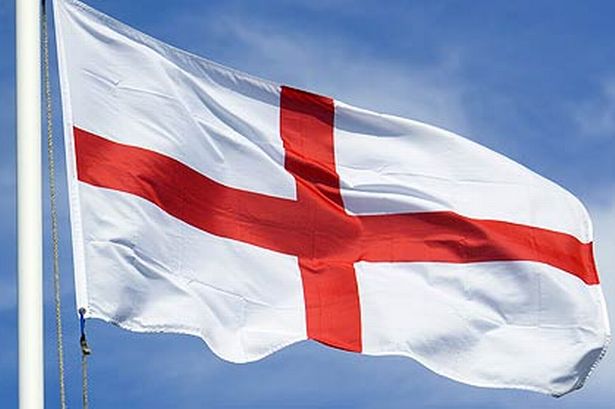
It may be St George’s Day in April, but don’t expect a sea of red and white flags to be flying across the nation.
England is the least patriotic country in Europe, according to a survey that found only 10% of people would proudly display our national emblem in public.
Political correctness and fears of being branded racist because of the flag’s links with far-right groups have left folk too “scared” to fly the cross.
But, incredibly, just one in three people actually knows when St George’s Day is, the survey by This England magazine found. Editor Stephen Garnett said: “It was shocking to see the results.
“We’re disappointed English people are afraid of displaying the St George’s Cross. We want to reclaim the flag from extremists by asking as many people as possible to fly it.
“It was shocking to see the amount of people who don’t fly the flag because of fear of being judged. It was also very worrying that so many said political correctness stopped them celebrating their national pride.”
The study found most English people gave themselves 5.8 out of 10 when asked how patriotic they felt. The Dutch are Europe’s most loyal at 7.18, narrowly ahead of the Welsh on 7.06.
Four out of 10 participants said they felt England has completely lost its identity.
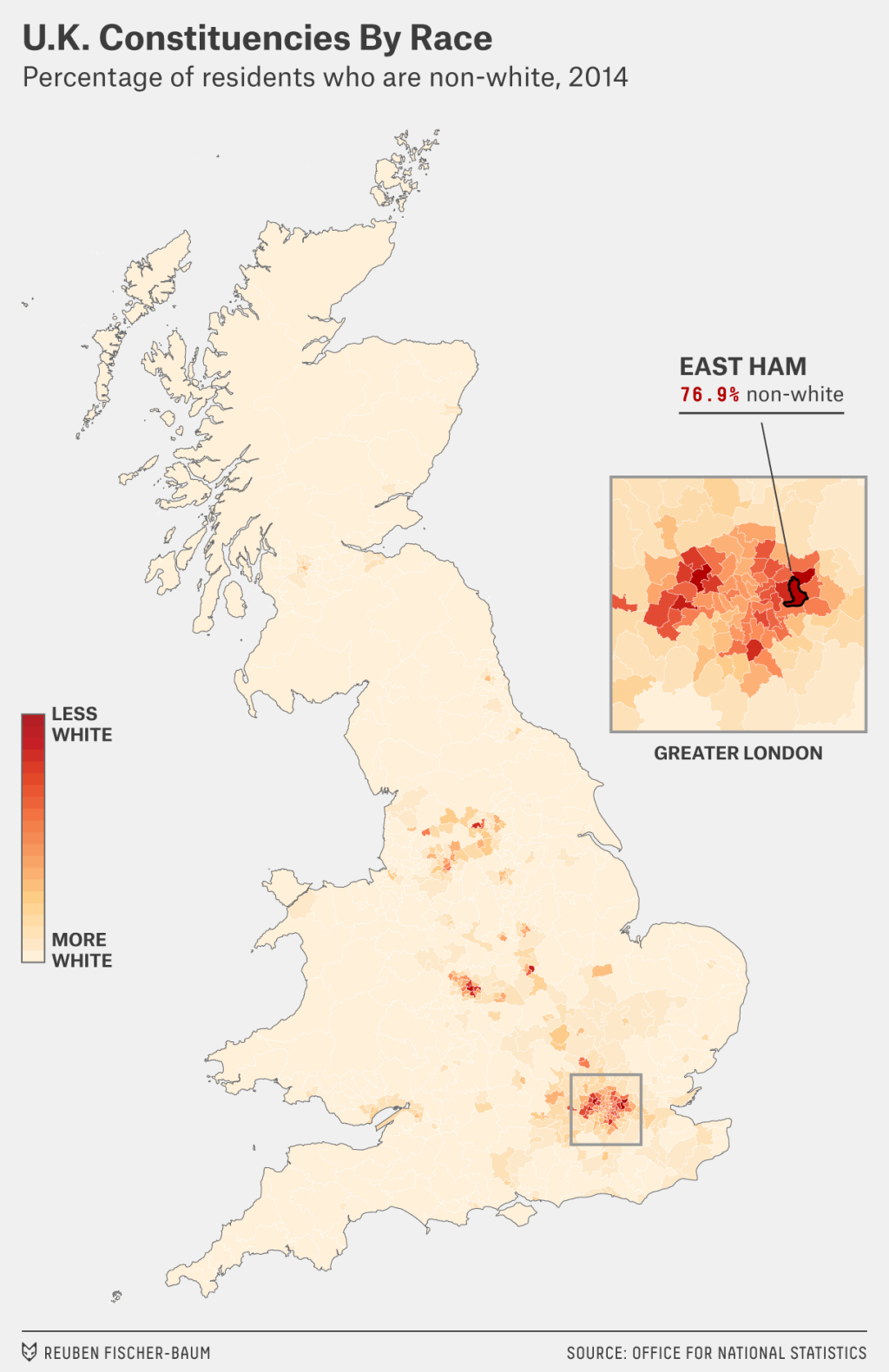
One of the safest Labour seats in Britain is its most non-white one, East Ham. It has been in Labour hands since it was formed in 1997 and will vote Labour again tomorrow in Britain’s general election. Its MP, Stephen Timms, was once stabbed by one of his constituents, Roshonara Choudhry, a 21-year-old student, who “was inspired by an al-Qaida cleric and wanted to punish Timms for voting in favor of the Iraq War”. The Labour MP downplays the incident and simply wants to represent his “diverse” ward.
Mona Chalabi writes:
There are two mosques on Church Road. I arrive at one of them just after prayers have finished one afternoon in early April, and as I peer my head around the entrance, I see a man hopping on one leg dressed in a black parking inspector’s uniform. He slips his foot into a black regulation shoe that he left on the grid of shelves that line the lobby when he went in to pray.
“Do you have time to talk to me about the election?”
“Nah, sorry,” he replies. “I’m still on my shift.”
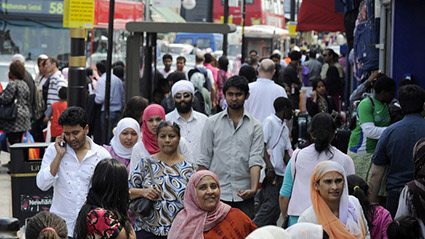
I step back outside so that I’m not in the way of the men silently filing out of the mosque. One tall man with a round stomach slowly passes me in a beige salwar kameez, his sandals flapping behind him as he talks quietly into a cell phone. I don’t recognize the language, but I’m hardly surprised — I am, after all, in East Ham. Only 58.6 percent of people in Newham, the local authority where East Ham is found, reported English as their main language in the 2011 census, the lowest share of anywhere in England and Wales.
I’m here because the residents of this East London constituency make this place an outlier in a number of ways. This is the U.K.’s most ethnically diverse constituency and one of its most religious areas. It has the highest number of residents who were born abroad — 83,223, according to the 2011 census. And, according to the Office for National Statistics (ONS), 77 percent of the population here is non-white, the highest share of anywhere in the country. The median across the U.K.’s 650 constituencies is just 5.2 percent non-white.
In other words, this place sticks out statistically.
Understanding those numbers is important in explaining why this is one of the safest Labour seats in the country. East Ham has been represented by a Labour member of Parliament (MP) since the seat was formed in 1997. In the 2010 general election, Labour won 70 percent of the vote here and is projected to win 69 percent on May 7.
But while residents here are a key part of this political continuity, they’re also in some ways the focus of calls for political change. Race and religion are rarely explicit talking points in U.K. politics, but they’re often implicit when the topic of immigration comes up — as it now so often does.
That evening, the first of two debates is aired on national television. Leaders of the seven largest political parties take to podiums to present their visions for the country, debate them and take a handful of questions from members of the audience. Race doesn’t come up once, but immigration features heavily. The politicians exchange insults about inaction and make promises about immigration policies. If those policies were different — and most of the party leaders say they should be — maybe East Ham wouldn’t look the way it does now.
In 1999, my mum started working in East Ham as a general practitioner in a National Health Service medical practice that was made up of two small terraced houses with one wall between the two knocked down. Each summer, after a few weeks of holidays had passed and the boredom had become unbearable, my best friend and I would go to the surgery to help out. We would prepare new files for new patients in a waiting area that had once been a living room. There were always new files to make because there were always new patients. Six years ago, the surgery moved to a much larger multi-story, multi-practice building half a mile away to cope with increasing demand.
Between the 1991 and 2011 censuses, the population of Newham grew 42 percent. That growth has been almost exclusively non-white, as the Centre on Dynamics of Ethnicity at the University of Manchester shows below.
Newham’s largest non-white groups reported in the 2011 census were Indian (13.8 percent of people), African (12.3 percent) and Bangladeshi (12.1 percent) — but it’s a long list.3
There’s no data on race and voting patterns at the constituency level, but it’s safe to say that the high share of ethnic minorities here has driven Labour’s success in East Ham. Between May and August 2010, the Ethnic Minority British Election Study asked almost 4,000 voters nationally who they had chosen in the general election that May. Of Brits who were ethnic minorities, 68 percent supported Labour; that compares with 31 percent of whites.
RACE
LABOUR
CONSERVATIVE
LIBERAL DEMOCRAT
African
87%
6%
6%
Caribbean
78
9
12
Bangladeshi
72
18
9
Indian
61
24
13
Pakistani
60
13
25
White
31
37
22
And religiosity in the area has probably played a role, too. Newham is the least irreligious place in the country: Only 9.5 percent of residents say they have no religion, compared with 24.7 percent in England. That’s partly because the share of the population that is Hindu is six times larger in Newham than it is at the national level — the same is true of the Muslim population.
Between February and March of last year, the British Election Study conducted a national survey on the attitudes of religious groups. Among those who said their religion was Islam, 73 percent said they would vote Labour. It’s a strikingly high figure — only 40 percent of those with no religion and 32 percent of Anglicans said they would vote Labour (the largest and second-largest groups of respondents, respectively).
FAITH
LABOUR
CONSERVATIVE
LIBERAL DEMOCRAT
UKIP
Islam
73%
15%
7%
1%
Sikhism
64
15
6
6
Hinduism
58
31
3
6
Roman Catholic
45
30
5
13
None
40
27
11
12
Buddhism
38
25
7
14
Baptist
37
32
10
16
Presbyterian
35
25
5
8
Methodist
35
41
11
10
Anglican
32
39
8
18
Judaism
30
46
5
12
Stephen Timms, who has represented East Ham in Parliament since 1994,4 is well aware that he represents an incredibly diverse constituency. He’s also probably well aware that the racial and religious makeup of his constituency has helped secure his seat as a Labour MP. But it’s not just political demographics — Timms is also well-liked by his constituents. Several people I spoke to gave examples of how he had helped them personally. He votes strongly in favor of raising welfare benefits and against reducing housing benefits, issues that are especially important in this area where 42 percent of children live in poverty.
After a string of high-profile roles, most recently as shadow employment minister, Timms, 59, is now the Labour party’s “Faith Envoy” (he took up Christianity in his teens).
But this long political career, one built on a very solid electoral majority, has not been without incident.
Just a week after re-winning his seat in the last election, Timms was stabbed twice in the stomach by a constituent at an advice surgery — a regular session for MPs to hear the concerns of the people they represent. His attacker, Roshonara Choudhry, a 21-year-old student, said she was inspired by an al-Qaida cleric and wanted to punish Timms for voting in favor of the Iraq War. Aside from giving a few interviews about it, Timms finished his most recent political term without emphasizing the attempted murder.
When I call him, hours before the first leaders debate is due to air, I ask Timms, who is seeking re-election, about race in East Ham. Timms, who is white, speaks about it comfortably.
“You’d think that a very diverse place like this was kind of, by definition, a pretty fragmented community — I actually don’t think that’s the case,” he said. “I think this is actually a quite cohesive community, and I think the reason for that is the great majority of people in this area belong to something. They belong to a church or a mosque or a temple or a gurdwara.”
A thriving religious community and a high vote share for Labour don’t mean there isn’t political debate in East Ham. The U.K. Independence Party (UKIP) has a candidate standing in East Ham who is expected to get 5 percent of the vote in this election (nowhere near enough to unseat Timms, and lower than the 11 percent median vote share that UKIP is projected to get across the U.K.). Britain’s newest political force, UKIP has the strongest stance of any party on immigration — it wants the country to get out of the EU because it believes immigration is unsustainably high.
In 2010, UKIP was politically irrelevant. But the party came in first in the 2014 European Parliament elections, which was followed by two wins in U.K. by-elections. Now, UKIP is shaping the debate on immigration — and by extension, the stakes of this election. Nationally, 27 percent of voters say immigration is the most important issue facing Britain, more than any other single issue. I told Timms that even some of the immigrants I’d spoken to in East Ham were worried that immigration was too high.
“I’m not surprised you came across that,” he said. “It is sometimes a little bit surprising to listen to someone who is clearly an immigrant complaining about immigration, but people do feel quite strongly about that. … Quite a lot of Labour supporters think this is an important issue, and they need to feel that the system is properly managed and fairly.”
The Church in East Ham is now a community centre where they play disco music, unlike in the mosques in the area that are very much used for religious purposes
From the outside, Trinity Community Centre looks like a church so typical that it could be part of a toy train set, made of plastic and placed next to the pretend railway station. I’m greeted in the hallway by a suited Sikh man in a turban holding a clipboard. I tell him that I’m looking for the advice surgery. Only the staff is here today — with the election just five weeks away, Timms is busy with “other commitments.”
Someone somewhere is playing the 1994 disco hit “U Sure Do” by Strike very, very loudly. Over the man’s shoulder, I can see through a glass window — streamers hang from the ceiling, and balloons float between adults and children. I ask if it’s a birthday party, and he tells me that it’s a therapy group for children with disabilities.
A lot of community support groups meet here. If I had arrived at another time or on another day, I might have bumped into Dost, a service for refugee, asylum-seeking, trafficked, undocumented or new migrants between the ages of 11 and 25. Or I might have seen one of the adult education classes or stumbled across Bayaan, a support group that encourages young Asian girls to get into higher education.
The man with the clipboard points above his head: “The advice surgery is upstairs.”
About a dozen constituents sit on pews, waiting to speak to a member of Timms’s staff. I’m keen to hear what they think about UKIP. People here don’t all agree about UKIP; some say the party is racist, some say the party has a point on immigration, but most of these constituents tell me they will vote Labour.
There’s no data on support for UKIP by race either nationally or at the constituency level, but there is evidence that many voters are concerned about the party’s racial politics. In a survey last May, 41 percent of people said they believed UKIP was a racist party and 46 percent said they believed UKIP was “deliberately trying to attract support from racist voters.” The Guardian recently reported that “Are UKIP racist?” was the most common Google search about the party in March.
UKIP’s public policies don’t use xenophobic language, but the party’s general position on immigration and a string of racist incidents involving UKIP members can leave British voters straining for subtext.
Given all that, it seems unlikely that UKIP will be able to win over ethnic minorities in East Ham or elsewhere in Britain. But that doesn’t mean Labour can be complacent about these voters. Britain’s political landscape has changed quite rapidly — established parties now have a smaller share of the vote, and new parties like UKIP are no longer irrelevant players.
If another party emerges that can successfully disentangle race and immigration, presenting itself as neither xenophobic nor lax on border control, Labour could be in real trouble. In 2010, the party won 79 seats with a margin of victory of less than 5 percentage points. In 19 of those seats, over a quarter of the population was non-white.5 Those seats matter; they could make the difference between being in government and being out of it. Parties that want power would do well to not neglect the voters who live in places like East Ham. – Mona Chalabi for fivethirtyeight.com
There could be up to 100 billion barrels of oil onshore beneath the South of England, says exploration firm UK Oil & Gas Investments (UKOG).
Last year, the firm drilled a well at Horse Hill, near Gatwick airport, and analysis of that well suggests the local area could hold 158 million barrels of oil per square mile.
But only a fraction of the 100 billion total would be recovered, UKOG admits.
The North Sea has produced about 45 billion barrels in 40 years.
“We think we’ve found a very significant discovery here, probably the largest [onshore in the UK] in the last 30 years, and we think it has national significance,” Stephen Sanderson, UKOG’s chief executive told the BBC.
UKOG says that the majority of the oil lies within the Upper Jurassic Kimmeridge formation at a depth of between 2,500ft (762m) and 3,000ft (914m).
Most experts believe fracking, or hydraulic fracturing, will be needed to get commercial quantities of oil from the region.
Concerns over fracking led to large-scale protests when Cuadrilla drilled at Balcombe, West Sussex, in 2013.
Just six weeks after the referendum in which Scots rejected independence by 55 to 45 percent, a new YouGov poll for the Times has found that 52 percent now back a split from the union, as Labour sees its support in Scotland gradually diminish, RT reported.
The YouGov poll put support for the union at 48 percent. The figures will give more momentum to the pro-independence Scottish Nationalist Party (SNP), which wants to see another referendum as soon as possible.
Another vote on whether Scotland should remain in the 300-year-old union with England may be triggered in 2017 if the UK votes to leave the EU. The Scottish are much more pro-European than the English, and want to stay in the European Union.
While Scots believe the results of the last referendum have left the country divided, a separate poll for STV found that two-thirds of Scots want another referendum within a decade.
The United Kingdom consists of England, Scotland, Wales, and Northern Ireland. England is home to about 85 percent of the population, but Scotland – with a small population of just under five million – is richer in natural resources and has about one-third of the UK’s land mass.
Lawrence Dallaglio says England must make a priority of beating South Africa and turning Twickenham into a fortress ahead of the World Cup.
The Red Rose legend issued his twin challenge as Stuart Lancaster claimed to already know 80 per cent of his squad for next year’s tournament.
England boss Lancaster also revealed the “pain of losing” which he admits “drives” a squad that has yet to win a Six Nations title.
Lawrence Dallaglio when he still captained England
Dallaglio believes that winning silverware in the 339 days before the World Cup kicks off in England is not the be-all and end-all.
But he said: “What England’s priority has to be is winning as many, if not all, their games at home because, come the World Cup, if they win every game at Twickenham they win the tournament.”
England, who name their squad a week tomorrow, face four autumn Tests at Headquarters – including matches against New Zealand, South Africa and Australia – and three at home in the Six Nations.
Of those, Dallaglio insists the most important is next month’s clash with the Springboks, recent conquerors of the world champion All Blacks.
“Going into a World Cup you want to know in the back of your head that you can beat every side,” he said. “And South Africa is the only side England haven’t beaten under Stuart.
“In fact the last time they played them at Twickenham they got properly beaten up. So this is a fascinating fixture.
“If England can come away with two out of three southern hemisphere victories, that would show me that they are genuine World Cup contenders.”
Lancaster insists his squad’s aim is to win every game as anything else would be an admission that they are happy to lose one, “which is not the mindset we want”.
He added: “We know we’ve been close, we’ve won some big games, but equally we’ve not nailed some as well, so we need to be better at that final hurdle.
“We’d like to have won something and it is really frustrating for all of us that we haven’t. The pain of losing certainly drives us.”
The headmistress at a primary school in a small town in England tried to order parents to send their children to a Nov. 27 workshop focused on Islam or else have the kids permanently labeled as racists for the rest of their academic careers.
On Wednesday, parents of children aged 8 to 11 received the stark warning in the form of a letter from Lynn Small, the headmistress at Littleton Green Community School in Huntington, Staffordshire — just over 20 miles from Birmingham.
The letter describes the field trip as part of a “statutory requirement” for kids “to learn about different cultures.”
“The workshop is at Staffordshire University and will give your child the opportunity to explore other religions,” Small pedantically explains. “Children will be looking at religious artefacts, similar to those that would be on display in a museum. They will not be partaking in any religious practices.”
Small then lays down the hammer for any parents who might be reticent about exposing their own kids to “other religions.”
“Refusal to allow your child to attend this trip will result in a Racial Discrimination note being attached to your child’s education record, which will remain on this file throughout their career.”
The headmistress also promises to investigate any absences closely “for their credibility.” She warns that anyone who skips the field trip had better produce a doctors’ note if they don’t want their kids tarred as racists for the next decade or so.
On top of all that, parents must pony up £5 (about $8) per kid for the Explore Islam trip.
The Daily Mail reports that parents in the Littleton Green Community School community aren’t very happy about Small’s attempts at intimidation.
“How dare they threaten to brand the children racist at such a young age?” asked Gillian Claridge indignantly. “It’s going to make them feel like little criminals.”
Stacy Waldron, the mother of an eight-year-old girl at the school, noted that her daughter would have nothing to do with any decision about going on the field trip.
“This is my choice, not hers,” Waldron told the Mail.
Local Parliament member Gavin Williamson agreed, calling the threat “bonkers.”
“The idea of attaching a ‘racial discrimination note’ to children’s education records saying it will remain on their file for the duration for their school career seems unfair, particularly when it is not the child’s decision whether or not he or she attends,” the MP told the Mail.
The story does end reasonably well. After the intense responses from parents, local government officials intervened and forced Small to apologize for her threatening letter. She has since written a second letter to parents kindly asking them to “disregard” the first missive, notes the Mail. – Daily Caller
One very positive side-effect of the Red October protest was that it aired the stale house of the MSM in Mandelatopia. This breath of fresh air made the usual suspects, and a few newbies, cough convulsively, as expected.
The loudest convulsion was a coarse phlegm-ejecting piece by the foul-mouthed Irish colonial reject Chris McEvoy. It is not worth reading. The second raffish algospasm was by Georgina Guedes. She tried, via an attempt at irony, to persuade her readers that it was oh so bleeding-heart symbolic of the freedom of democratic expression in Mandelatopia seeing a “dignified” black policeman escorting and “protecting” the white Red October marchers. She somehow conveniently forgot that the “dignified” policeman’s colleagues killed another peaceful protester, Mark Tatane, not so long ago – not even to speak of the Marikana massacre, the 1000-plus deaths per year in police custody since 1994, or the fact that both the ex-bosses of the “dignified” policeman are criminals.
The third bawdy paroxysm came from Lady Nicky Falkof, fresh from her 14-year sabbatical at the feet of Her Majesty the Queen of England. Her strident call for “progressive language” (e.g. rights, minorities, diversity, etc.) to remain the sole moral property of those who run Manor Mail & Guardian – at the behest of the Queen and her moneymongers – is only out-cramped by her near-autistic fixation with proper syntax and correct spelling. I’ll deal with Miss Commonwealth Spelling Bee 2013 in my next column.
The most interesting throe was thrown by the ever-so-swanky MSM darling, Sarah Britten. Her piece, albeit well-argued and neatly packaged, was pure sentiment. And it was precisely this appeal to emotion which prompted me to, once more, put my theory about white liberal irrationality to the test.
It only took six tweets of 140 letters/characters each to confirm said theory.This was how it was done. I simply asked her if she supported black lesbians protesting against “corrective” rape. She answered in the affirmative, of course. Then I pointed out that rape affects all women, not just black lesbians. Meaning that black lesbians form a sub-group protesting that which affects them specifically namely “corrective” rape. But, as mentioned before, rape affects all women, not just black lesbians.
From this it follows that it is logically and, even more importantly, morally inconsistent to laud one sub-group (black lesbians, in this case) for their “discriminatory” form of protest – i.e.they only protest against corrective rape, and not all rape – whilst demonising another (in this case, Red October whites) by accusing them of partaking in a “discriminatory” form of protest.. based on the fact that crime affects all, not just whites. Ergo, the rationale underpinning the protest by whites against their slaughter at the hands of blacks is no different to that of black lesbians protesting against corrective rape. Yet, the former is demonised while the latter is lauded and applauded by Britten and her MSM ilk.
It suffices to say that that which is good for the black lesbian goose is not good for the Red October white gander. This means that people like Britten discriminate on the basis of race – in terms of the above-mentioned biased sentiments expressed publicly. Given the above context, and what we know from all the standard definitions of racism, this would make Britten a racist.
Yet I doubt whether Britten could be classified as a racist, for she loves all those whites and blacks, et cetera, who agree with her. Meaning that her irrationality must be founded on something other than race-based zealotry. Or is it?
Britten is part and parcel of the upper-class British establishment in Mandelatopia. This group is the richest and (still) most influential collective in the country. They are just another appendage of her Majesty the Queen of England. And, as we know, England is the fons et origo of Pax Britannica. This (former) global empire was built by men like Cecil John Rhodes… whose moral motivations can best be summed up by the following quote; “
I contend that we British are the finest race in the world and that the more of the world we inhabit the better it is for the human race. Just fancy those parts that are at present inhabited by the most despicable specimens of human beings what an alteration there would be if they were brought under Anglo-Saxon influence…
At first glance the above quote seems like the paragon of racism. Not even Verwoerd ever said anything remotely similar. But I think it goes deeper than that. Is it “hate”? I mean, you really need to dislike others quite a lot to refer to them as “despicable specimens of human beings”. In short: are upper-class Brits like Britten hateful racists, like their forebearers, like Rhodes?
I think not. They are simply indifferent to all others, other than themselves. If dislike were an adjective, hate would be its comparative… and indifference its superlative. I mean it is beyond hate to, for example, kill 33 000 women and children in concentration camps and coldly go about carrying out a scorched-earth policy which reduced a unique nation to the poorest white nation on the planet, just for the sake of gold and diamonds. Similarly, it is beyond hate to try and turn the whole population of one of the oldest civilisations on the planet, the Chinese, into opium drug addicts… simply because your love of/for tea caused a huge trade deficit at the time.
It is a cardinal mistake to think that this indifference has, somehow, mysteriously vacated the non-soul of the British upper-class. Just think about the following fact: England is the only country in the Western world which (still) has such a huge divide between the upper and middle class. This divide is rigorously enforced, by complete indifference to the wishes and aspirations of the British middle and lower classes.
And this indifference is still very much present in modern South Africa. Just listen to Nobel Prize winner Nadine Gordimer – a representative of the British elite in this country:
Afrikaner women are lower than rats, closer related to plants, just fit enough to be raped in an act of genus preservation.
Lovely lady, ain’t she? She may have said “hate”, but it is clear from the magnitude of her hate that it is indifference. They only disguise their indifference as hate, so as to appear as if they actually give a continental toss… as if they actually still have one shred of humanity left.
Meaning that the imperial indifference that was once projected (and protected) by the military might of the old British Empire has simply morphed into an imperial indifference enforced by morality. In short; what the sword did for Rhodes, neo-liberalism (à la Pax Brittanica) is now doing for Gordimer, Britten and their useful idiots like Helen Zille, boy-man Fransie Cronje, Eusebius McKaiser, Piet Croucamp, Djonitin Jansen, Anton van Niekerk, Tim du Plessis, Max du Preez, Leopold Scholtz, Willie Esterhuyse, FW de Klerk and ilk.
Therefore never think that they actually care. They feel zilch for other nations, other peoples, cultures, traditions and their moral idiosyncrasies. They are completely indifferent to the plight of all others, especially poor blacks and the white farmers in this country.
The quickest way to rid this warm country of these cold bastards would be to unleash Raka in the form of a Mugabe-Malema on them. But that would lead to wanton slaughter; something the Afrikaner, unlike the British upper-class, has not got the stomach for, unfortunately. The Afrikaner hates wanton slaughter… that is why they organized the Red October protest.
The most humane way to ship their pitiless afters back to their crappy little mud-island with its Islam(ic) weather (partly Sunni, mostly Shiite) would therefore be to treat them with the exact same indifference they display towards all and sundry on the planet. Now that would be cricket, wouldn`t it, Sarah?
This website uses cookies to improve your experience. We'll assume you're ok with this, but you can opt-out if you wish. Cookie settingsACCEPT
Privacy & Cookies Policy
Privacy Overview
This website uses cookies to improve your experience while you navigate through the website. Out of these cookies, the cookies that are categorized as necessary are stored on your browser as they are essential for the working of basic functionalities of the website. We also use third-party cookies that help us analyze and understand how you use this website. These cookies will be stored in your browser only with your consent. You also have the option to opt-out of these cookies. But opting out of some of these cookies may have an effect on your browsing experience.
Necessary cookies are absolutely essential for the website to function properly. This category only includes cookies that ensures basic functionalities and security features of the website. These cookies do not store any personal information.
Any cookies that may not be particularly necessary for the website to function and is used specifically to collect user personal data via analytics, ads, other embedded contents are termed as non-necessary cookies. It is mandatory to procure user consent prior to running these cookies on your website.