German journalist wades into mass immigration debate

A German journalist suggested that prosecuting “Facebook rabble-rousers” – that is people who do not agree with mass immigration – while a step in the right direction, was not enough.

Reschke delivered her message just hours after Hans-Georg Maassen, head of the intelligence service, branded a right wing group “dangerous rabble-rousers”.

“These haters have to understand that society will not tolerate this,” she said. “So, if you are not of the opinion that all refugees are freeloaders who should be hunted down, burned or gassed, then you should make it very clearly known. Speak up against it.”

Anja Reschke ended by calling for a public demonstration in favor of “decency,” and told viewers that she was looking forward to “your comments on this commentary.”

She was not disappointed, as more than five million people watched a video of her remarks posted on Facebook in the first 48 hours after the broadcast, generating thousands of comments, both for and against, and more than 130,000 likes.

On Twitter, as The Guardian’s Berlin correspondent, Kate Connolly, reported, the replies to Ms. Reschke included outrage from a German-speaker who claimed to be living in England and wrote that it was “Better to be a Nazi in the street than a foreign social parasite.”

The same blogger later complained that Germany granted freedom of speech only to those who agreed with the mainstream consensus, branding dissidents as Nazis.

Most German journalists however backed Reschke.

Source: NYT/The Independent
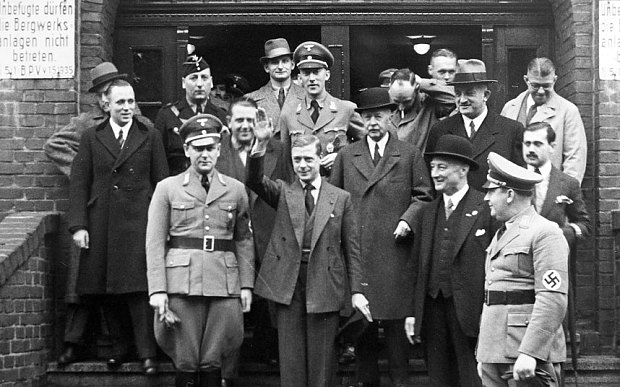
More Nazi’s in the Royal woodwork

Photographs of the Queen’s uncle Edward VIII giving Nazi salutes on a visit to Germany two years before the outbreak of war have emerged after being put up for auction.

The then Duke of Windsor, who had abdicated the previous year, is pictured making the distinctive “Heil Hitler” gesture on an unofficial visit to Germany in 1937.

He is surrounded by senior Nazis in uniform, some wearing swastika armbands, on a visit to the Friedrich Heinrich colliery in the Lower Rhine area.

His guide during the visit was Robert Ley, the Nazi head of the German Labour Front, who later committed suicide while awaiting trial at Nuremberg for war crimes.

Among the other senior Nazis who accompanied him were Joachim von Ribbentrop, the German foreign minister; Fritz Wiedemann, Hitler’s personal adjutant; Arthur Goerlitzer, the deputy political leader of Berlin and Walter Hewel, Hitler’s liaison to Ribbentrop.

The British government representative was James Harrison, third secretary at the British Embassy.

Although Edward VIII’s admiration for Hitler has always been well known – he once met the Fuhrer with his wife Wallis Simpson – the timing of the photographs’ release could not have been worse for the Royal family.

The portfolio has been held by a private collector for the last 30 years.

Edward’s visit to Germany in October 1937 had ostensibly been to learn about factories and working conditions, but he attended a political rally flanked by SS guards and met Hitler at his Alpine retreat at Berchtesgaden.

An account of the conversation between the Fuhrer and Edward was captured by the Allies, but it has never been released by the National Archives.

Edward spoke in German to his hosts, and gave a speech declaring the Nazi economic model to be “a miracle”, adding: “One can only begin to understand it when one realises that behind it all is one man and one will.”

Source: The Telegraph

Buckingham braces for more Nazi-exposure

Buckingham Palace was last night braced for new embarrassment as turmoil continued over leaked footage showing the Queen performing a Nazi salute as a child.

An explosive Channel 4 documentary is set to reveal details of how Prince Philip’s sister met and admired Adolf Hitler, whom she described as a ‘charming and seemingly modest man’.

Three of his sisters were married to senior Nazi officers – one a colonel in the SS – and when Philip attended a family funeral in Germany in 1937 he was confronted by crowds giving the Heil Hitler salute. The documentary includes previously unseen extracts from a private memoir in which one sister talks of her early admiration for Hitler.

Meanwhile the footage showing the Queen performing a Nazi salute as a child could have been accidentally leaked by Buckingham Palace, it has been reported.

The Palace will not welcome a fresh focus on links to the Third Reich while controversy continues over the footage of the Queen.

The grainy film was shot in 1933, months after Hitler came to power and six years before the start of the Second World War. It shows the then seven-year-old Princess Elizabeth playing with a dog on the lawn at Balmoral with her sister Margaret, before raising her arm in a Nazi salute.

Her mother, the future Queen Mother, and her uncle Edward – later Edward VIII – are also shown in the pose. Her uncle appears to be showing them how to perform the Nazi salute, which even then was recognised internationally as a sign of obedience to Hitler.

Royal aides are investigating how the 17-second black and white film clip came to be published by The Sun, and Buckingham Palace has not ruled out legal action.

The footage was sold to a tabloid newspaper for a four-figure sum, the Mail has learnt.

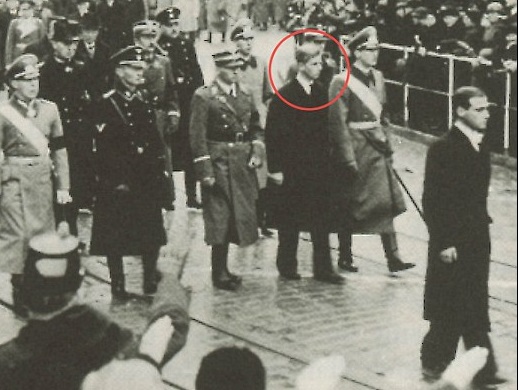
Another remarkable photograph from 1937 shows Prince Philip, then just 16, in a funeral procession for his older sister Cecile, who was killed in an air crash.

The young prince is flanked by grieving relatives, all wearing distinctive Nazi uniforms. One is clad in the uniform of the Brownshirts; another wears full SS regalia.

The street in Darmstadt, near Frankfurt, is lined with crowds – many giving the ‘Heil Hitler’ salute.

On his marriage to Princess Elizabeth, he assumed his mother’s maternal surname – Mountbatten, which is an Anglicised version of the German ‘Battenberg’.

The Queen’s real surname is also is German – Saxe-Coburg-Gotha. That was the surname of Prince Albert, Queen Victoria’s husband, who was born near Coburg in Germany.

The Royal Family’s surname was changed to Windsor in 1917, during the First World War, when Saxe-Coburg-Gotha was considered too German a name – not least because the planes coming over to bomb Britain were called Gotha bombers.

Source: Daily Mail

Marine says Le Pen should no longer speak for party

France’s National Front chief Marine Le Pen said Sunday her father should “no longer be able to speak in the name of” the party, as a bitter public feud between the two continues.

Jean-Marie Le Pen infuriated some last month by reiterating his long-held view that the Nazi gas chambers were merely a “detail of history”, as well as making other controversial remarks defending the “white world”.

Previously he hailed the outbreak of Ebola in Africa as welcome. His latest comments also come in the wake of a recent controversial interview with Ursula Haverbeck on Germany’s ARD channel in which Haverbeck claims that the “Holocaust was the biggest pack of lies in history“.

Le Pen earlier praised French wartime leader Philippe Petain, who collaborated with the Nazis.

Marine condemned the comments as “political suicide” and a highly-publicised spat between them saw the 86-year-old party founder forced to pull out of upcoming regional elections.

“Jean-Marie Le Pen should no longer be able to talk in the name of the National Front, his comments are against the fixed (party) line,” she told French radio.

Marine Le Pen has been actively trying to distance the party from its racist and anti-Semitic image as she plans her bid for the next French presidential election in 2017.

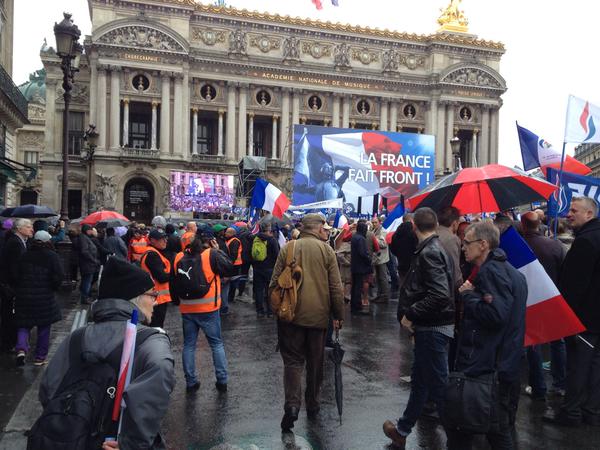
Jean-Marie Le Pen was conspicuously dropped from a line-up of National Front leaders on stage during the party’s traditional May 1 rally in Paris.

But determined to upstage his daughter, he nevertheless strided uninvited onto the podium to take the ovation of the crowd.

“I think that was a malicious act, I think it was an act of contempt towards me,” Marine said Sunday.

Jean-Marie Le Pen has been summoned Monday to appear before the party’s top executive authority, which will examine whether to take action against him following last month’s comments.

The FN’s honourary president was in hot water just days before because allegations emerged that he had stashed 2.2 million euros in a secret Swiss bank account.

Some protesters also tried to take the stage at the event, but the old patriarch upstaged the opportunists.

Germany puts pressure on Kiev

The Financial Times has disclosed the first attempt by Germany to put pressure on Kiev to implement the Minsk 2.0 peace agreement for East Ukraine.

Germany, in a bid to remain neutral amid rising trans-Atlantic tensions, may have warned the Ukrainians that unless they fulfill the Minsk Memorandum, something the Ukrainians have no intention of doing, there may be renewed aggression.

Kiev has welcomed military training missions from Canada and the US to Ukraine adding to what might become a US -Russian proxy war.

Atlanticist neocons entertain maximalist ambitions and have shown but intransigence to the bloodshed.

It seems as though Germany will exert some pressure on Kiev to back down from further escalating the conflict that have cost thousands of lives and seen the rise of modern Nazis.

From the Financial Times:

Germany and key European partners are pressing Ukraine to speed up implementing the Minsk ceasefire agreement — for fear of giving Russia excuses for renewed aggression.

The warnings from Berlin, Paris and London come as EU officials led by Jean-Claude Juncker, European Commission president, are due on Monday to start their first EU-Ukraine summit in Kiev since the Ukraine crisis broke out a year ago.

They coincide with renewed tensions between Russia and the US over Ukraine, with Washington and Moscow trading allegations of increased military involvement in conflict zones.

The latest European comments highlight EU desires to ease tensions with Russia’s President Vladimir Putin, even at the cost of irritating Kiev.

EU diplomats readily admit the separatists violate the Minsk ceasefire far more often than Kiev. But they urge president Petro Poroshenko to stick to the accord and implement its political clauses.

The word among German diplomats is that Kiev needs to be “more co-operative”. Stefan Meister, of Berlin’s DGAP foreign policy think-tank, said: “German officials are talking to both sides, but especially to the Ukrainians because if they don’t do what’s necessary, the Russians will always have the possibility of renewing the conflict.”

In France, President François Hollande said during a visit by Mr Poroshenko last week: “The only line of conduct is the full implementation of the Minsk accord.”

In the UK, which has followed the US in taking a tougher line against Moscow, an official said Ukraine should fulfil its side of the Minsk deal and “not give Russia the space to criticise them”.

The latest Minsk accord, agreed in February under pressure from Germany and France, has reduced fighting and led to the withdrawal of some heavy weapons from front lines, though soldiers and civilians still die almost daily.

But Berlin is worried that Kiev is dragging its feet over other parts of the fragile deal, notably in trying to postpone political decentralisation until after local elections are staged in separatist-held territory.

For Ukraine this is critical because it does not want to hand over power to separatist leaders in the Donbas region, who are not recognised by the international community. EU diplomats say, however, that while local elections are indeed envisaged under Minsk, the accord does not insist that they take place before decentralisation.

Dmytro Kuleba, a senior Ukrainian foreign ministry official, dismissed charges of delaying tactics as “perfect hypocrisy”, saying Russia was encouraging this perception while continuing its aggression.

Kiev has, however, acted on another EU concern. Last week, lawmakers softened recent legislation banning Soviet and Nazi symbols. The planned law had raised fears in Russia of a campaign to remove monuments and rename streets dating from the Soviet era. Now such decisions are planned to be devolved to regional authorities.

But Russia is maintaining the pressure. The foreign ministry on Friday accused Kiev of having “no political will” to implement the Minsk agreement.

Meanwhile, Berlin is also pressing EU officials to be conciliatory with Moscow. Foreign minister Frank-Walter Steinmeier wrote this month to Mr Juncker urging the EU to ease “Russian concerns” over a deep free-trade agreement with Ukraine.

The planned deal helped trigger the initial crisis when it fuelled Russian fears of losing influence in Kiev. Implementation was postponed last year in the face of Russian resistance, with the hope of discussing the matter at trilateral talks between Moscow, Kiev and Brussels.

But Kiev is loath to involve Russia in what it sees as a bilateral accord — and Moscow has warned Ukraine against unilateral implementation. Mr Steinmeier has urged a start to the three-way talks, asking Mr Juncker to “use the considerable flexibility that the agreement offers”.

Hofmeyr, Roodt vow to fight on for Afrikaans

A magistrate at the Randburg Magistrates Court, Naren Sewnarain, accepted the arguments put forward by Conrad Koch that there exists American-style freedom of speech in South Africa and everyone may insult everyone else in the grossest of manners, as well as wage open cyber war on social media. Harming your opponent in any way you see fit, apart from physically assaulting him, was given the imprimatur of the court.

According to Dr. Dan Roodt of the Pro-Afrikaans Action group said: “Although we lost the case, we succeeded in our strategic aim of safeguarding the popular Afrikaans is Groot concerts from disruption by leftist extremists over the past three weeks. That anyone would want to disrupt peaceful, non-political music concerts simply to score points in the media, shows to what extent conditions in South Africa have already degenerated into low-intensity ethnic conflict between language groups.”

The effect of the judgement, which essentially ignored the statute on harassment in favour of a vague appeal to the constitution, will be greater polarisation between groups in South Africa. Public discourse will deteriorate into invective, vituperation, calumny and other forms of what was euphemistically called “robust” speech.

In statements to the media outside the court, Dr. Dan Roodt of PRAAG said that he and Mr. Steve Hofmeyr were campaigning for a less violent and more decent society.

Evidently, decency is no longer a South African value and we may expect even greater degeneration into harmful campaigns, boycotts, race-baiting and other techniques in the cultural-Marxist arsenal.

Arguing before the magistrate, Mr. Steven Budlender, appearing for Conrad Koch, appeared to equate the previous dispensation in South Africa with Nazism, claiming that large numbers of people were wantonly killed. There was even question of it being forbidden to discuss such “facts” as it amounted to “apartheid denial”, which was akin to “Holocaust denial”.

According to both Hofmeyr and Roodt the day was “hardly a victory for free speech. Instead it was a victory for those who wish to curtail a rational and balanced debate about South African history and wish to drown it out with their hysterical exaggerations and intolerance toward dissenting viewpoints. Nonetheless we will continue to question the manufactured consent that every Afrikaner is a Nazi and that therefore our language, culture and history should simply be effaced from South Africa. We will continue to assert the right to write, sing and create in Afrikaans before our own people, regardless of how offensive a certain radical Nomenklatura might find what is after all a basic human right of all peoples and all cultures.”

Nazi-themed cafe reopens

A Nazi-themed cafe in Indonesia reopened on Saturday with its walls still bearing swastikas and a painting of Adolf Hitler.

Ninety percent of Indonesia’s 250 million people identify as Muslim, making the country home to the world’s biggest Islamic population.

The owner voluntarily shut down his SoldatenKaffee last year after media reports exposed his swastika-clad establishment, prompting death threats and accusation of inciting racial hatred.

Following the closure, his lawyer told AFP that the cafe would reopen with a broader World War II theme.

“All aspects of the SoldatenKaffee are legal. We have a lot of customers from Europe and they don’t have a problem with the World War II theme, because it is seen here from a historical perspective,” the owner said.

Nazi war criminal, 98, charged in Hungary

Laszlo Csatary
Laszlo Csatary

Top Nazi war crimes suspect Laszlo Csatary, accused of overseeing thousands of Jewish deportations during World War II, was charged with war crimes on Tuesday in Hungary, prosectors said.

The 98-year-old, under house arrest since last year after apparently living for years undisturbed in Hungary, is listed by the Wiesenthal Center as its most-wanted alleged Nazi war criminal. – Sapa

Cathedral in Nantes (Western France) vandalised with Nazi symbols

The cathedral of Saint Peter and Saint Paul in Nantes (Western France)

Agence France Presse reports that the Saint Peter’s cathedral in Nantes was vandalised last night, with “symbols of a Nazi type”, according to the prefect of the Loire-Atlantique department, Christian de Lavernée. “The damages affect the sacred part of the chorus as well as the oldest altar at the back of the chorus,” he added.

This latest incident of sacrilege against churches in France comes amid a heated controversy around the death of a young left-wing activist, Clément Méric, during a fight with skinheads, as well as recent demonstrations against homosexual marriage by conservatives, notably Catholic believers.

According to the prefect, “the signs are mixed: there is a 666 (Satan’s number) and some Nazi symbols, a bust of Fermen, as well as some stickmen in the style of (the emblem of) the anti-gay marriage protest movement Manif pour tous.” He said the act was “deplorable”.

“The facts were discovered this morning at 8h15. There was a break-in by means of the high part of the scaffolding” which is being used at the moment along the facade, he explained and “the doors on the ground floor were cracked”. Obscene inscriptions and a broken statue were visible inside, as well as angels with sex organs and little Hitler’s moustaches, someone indicated who had had access to the interior of the cathedral.

Cathedral closed for tourists

“The church does not wish to add oil to the fire,” stated the general vicar of the Nantes diocese, Father Benoît Bertrand, who “condemned this act. We want to appeal to calm and to responsibility.”

At the cathedral several offficials from the police’s forensic department were busy with investigations and banned anyone from entering. An inquiry has been opened by the prosecution under the departmental sûreté of Nantes. The first deputy mayor of the municipality of Nantes, Johanna Rolland (Socialist Party) was also present and condemned the incident “in the strongest possible terms”. For the moment, the monetary value of the damages have not been established, according to the prefect.
The cathedral will be closed for several days for tourists but will be open for religious services.

93-year old German prosecuted for being a cook at Auschwitz

Hans Lipschis (93)

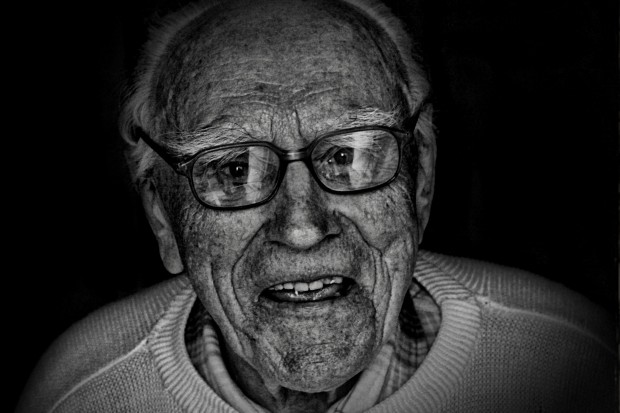
A 93-year-old man who acknowledges he served with the SS in the Nazis’ Auschwitz death camp but claims he was only a cook is under investigation by German authorities as a possible accessory to murder, a prosecutor said Wednesday.

Hans Lipschis was deported from the U.S. in 1983 for lying about his Nazi past when he immigrated to Chicago in the 1950s after the war.

With no evidence linking him to specific war crimes, however, it was impossible under previous German law to bring charges against him in Germany, said Thomas Will, a prosecutor with the German office that deals with Nazi war crimes.

But now the Lipschis case is being pursued on the same legal theory used to prosecute former Ohio autoworker John Demjanjuk, who died last year while appealing his 2011 conviction in Germany for accessory to murder on the grounds that he served as a guard at the Sobibor death camp.

Under the new line of thinking, even without proof of participation in a specific crime, a person who served at a death camp can be charged with accessory to murder because the camp’s sole function was to kill people.

Even though the Demjanjuk conviction is not considered legally binding because he died before his appeals were exhausted, Will said that his office is investigating a total of about 50 people in the same category.

The initial investigation of the Lipschis case is now done, and the case has been handed to Stuttgart prosecutors to determine whether there is enough evidence to bring charges, Will said.

In an interview this month with Die Welt newspaper at his home in southwestern Germany, Lipschis said he spent his entire time as a cook for the other SS guards of the camp, and had witnessed none of the atrocities. He did say, however, that he “heard about” what was going on.

About 1.5 million people, primarily Jews, were killed at the Auschwitz camp complex between 1940 and 1945. – AP