EU in chaos on TTIP vote

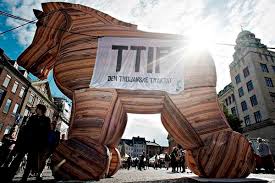
An historic vote on the biggest trade deal ever negotiated between the EU and the US has had to be postponed after the European Parliament descended into chaos.

European MPs were due to vote on the Transatlantic Trade and Investment Partnership on Wednesday. But the vote had to be delayed because there were too many proposed amendments.

“It’s panic in parliament,” Yannick Jadot, a Green MEP from France, told AFP.

David Cameron has claimed that signing the deal would add £2 billion to the UK economy every year.

But the plan has been violently opposed by campaign groups across Europe that fear it would be at the expense of national services and social and environmental welfare.

Source: The Independent

Rule By The Corporations

TTIP: The Corporate Empowerment Act

The Transatlantic and Transpacific Trade and Investment Partnerships have nothing to do with free trade. “Free trade” is used as a disguise to hide the power these agreements give to corporations to use law suits to overturn sovereign laws of nations that regulate pollution, food safety, GMOs, and minimum wages.

The first thing to understand is that these so-called “partnerships” are not laws written by Congress. The US Constitution gives Congress the authority to legislate, but these laws are being written without the participation of Congress. The laws are being written by corporations solely in the interest of their power and profit. The office of US Trade Representative was created in order to permit corporations to write law that serves only their interests. This fraud on the Constitution and the people is covered up by calling trade laws “treaties.”

Indeed, Congress is not even permitted to know what is in the laws and is limited to the ability to accept or refuse what is handed to Congress for a vote. Normally, Congress accepts, because “so much work has been done” and “free trade will benefit us all.”

The presstitutes have diverted attention from the content of the laws to “fast track.” When Congress votes “fast track,” it means Congress accepts that corporations can write the trade laws without the participation of Congress. Even criticisms of the “partnerships” are a smoke screen. Countries accused of slave labor could be excluded but won’t be. Super patriots complain that US sovereignty is violated by “foreign interests,” but US sovereignty is violated by US corporations. Others claim yet more US jobs will be offshored. In actual fact, the “partnerships” are unnecessary to advance the loss of American jobs as there is nothing that inhibits jobs offshoring now.

What the “partnerships” do is to make private corporations immune to the laws of sovereign countries on the grounds that laws of countries adversely impact corporate profits and constitute “restraint of trade.”

For example, under the Transatlantic Partnership, French laws against GMOs would be overturned as “restraints on trade” by law suits filed by Monsanto.

Countries that require testing of imported food, such as pork for trichnosis, and fumigation would be subject to lawsuits from corporations, because these regulations increase the cost of imports.

Countries that do not provide monopoly protection for brand name pharmaceuticals and chemical products, and allow generics in their place, can be sued for damages by corporations.

Obama himself has no input into the process. Here is what is going on: The Trade Representative is a corporate stooge. He serves the private corporations and will go on to a million dollar annual salary. The corporations have bribed the political leaders in every country to sign away their sovereignty and the general welfare of their people to private corporations. Corporations have paid US senators large sums for transferring Congress’ law-making powers to corporations. When these “partnerships” pass, no country that signed will have any legislative authority to legislate or enforce any law that any corporation regards as inimical to its bottom line.

Yes, the great promiser of change is bringing change. He is turning Asia, Europe, and the US over to rule by the corporations.

Only those who have sold their integrity for money sign these agreements. Apparently Merkel, a Washington vassal, is one of them.

According to news reports, both of France’s main political parties have sold out to the corporations, but not Marine Le Pen’s National Front Party. In the last EU elections, the dissident parties, such as Le Pen and Farage’s, prevailed over the traditional parties, but the dissidents are yet to prevail in their own countries.

Marine Le Pen objects to the secrecy of the agreements that establishes corporate rule. As Europe’s only leader, she speaks:

“It is vital that the French people know about TTIP’s content and its motivations in order to be able to fight it. Because our fellow countrymen must have the choice of their future, because they should impose a model for society that suits them, and not one forced by multinational companies eager for profits, Brussels technocrats bought by the lobbies, and politicians from the UMP [party of former president Nicolas Sarkozy] who are subservient to these technocrats.”

It is vital that the American public also know, but not even Congress is permitted to know.

How does it work, this “freedom and democracy” that we Americans allegedly have, when neither the people nor their elected representatives are permitted to participate in the making of laws that enable private corporations to negate the law-making functions of governments and place corporate profit above the general welfare?

Dr. Paul Craig Roberts was Assistant Secretary of the Treasury for Economic Policy and associate editor of the Wall Street Journal. He was columnist for Business Week, Scripps Howard News Service, and Creators Syndicate. He has had many university appointments. His internet columns have attracted a worldwide following. Roberts’ latest books are The Failure of Laissez Faire Capitalism and Economic Dissolution of the West and How America Was Lost.

Marine le Pen: We must resist corporations

Leader of France’s National Front party, Marine Le Pen, has launched a month-long blitz against the Transatlantic Trade and Investment Partnership (TTIP) – a proposed EU-US treaty, which has been criticized for secretiveness and lack of accountability.

“It is vital that the French people know about TTIP’s content and its motivations in order to be able to fight it. Because our fellow countrymen must have the choice of their future, because they should impose a model for society that suits them, and not forced by multinational companies eager for profits, Brussels technocrats sold to the lobbies, politicians from the UMP [party of former president Nicolas Sarkozy], who are subservient to these technocrats,” Le Pen said during a press conference in Paris.

Since 2013, open-ended negotiations between Washington and Brussels have drawn up the framework for the agreement, intended to standardize legislation and bring down trade barriers between them.

As per US practice, the contents of all economic treaties are classified. The EU has recently set up reading rooms throughout Europe for officials with clearance – but only a few thousand people have had access to the working documents.

Le Pen hit out at the secrecy of the negotiations, which have featured mostly bureaucrats from the European Commission, the EU’s executive body, and nebulous “stakeholders” from businesses and public organizations. As a member of the European parliament, she forwarded a motion for greater transparency in negotiations last year. Le Pen’s motion was defeated.

She is now hoping for grassroots support.

“I am convinced that we can push back the TTIP if the peoples are informed of its content, and if they decide themselves to join us in order to express their disagreement concerning this treaty,” Le Pen told journalists.

Both of France’s leading parties have endorsed the treaty, but Le Pen is relying on strong the anti-European sentiment that propelled her party to first place in last year’s elections for the European parliament.

While TTIP’s authors promise that the treaty will bring an extra 0.5 percent GDP to Europe and the US, figures across the political spectrum have expressed concern.

US President Barack Obama, who is also negotiating a similar treaty with Asia, was defeated by his own party in the Senate last week when he asked for fast-track approval to handle negotiations. Additional votes will be required if the proposed legislation is not to be bogged down in the US chambers of Congress.

Meanwhile, European legislators have raised a host of issues, in particular concerning the investor-state dispute settlement (ISDS) mechanism outlined in the treaty. The controversy centers on the proposed special economic tribunal, which would operate outside the traditional legal system and allow corporations to challenge governments.

In April, thousands took to the streets of Brussels, Madrid, Berlin and Helsinki to protest against the secretive deal.

How America became an Oligarchy

American democracy no longer exists

According to a new study from Princeton University, American democracy no longer exists. Using data from over 1,800 policy initiatives from 1981 to 2002, researchers Martin Gilens and Benjamin Page concluded that rich, well-connected individuals on the political scene now steer the direction of the country, regardless of – or even against – the will of the majority of voters. America’s political system has transformed from a democracy into an oligarchy, where power is wielded by wealthy elites.

“Making the world safe for democracy” was President Woodrow Wilson’s rationale for World War I, and it has been used to justify American military intervention ever since. Can we justify sending troops into other countries to spread a political system we cannot maintain at home?

The Magna Carta, considered the first Bill of Rights in the Western world, established the rights of nobles as against the king. But the doctrine that “all men are created equal” – that all people have “certain inalienable rights,” including “life, liberty and the pursuit of happiness” – is an American original. And those rights, supposedly insured by the Bill of Rights, have the right to vote at their core. We have the right to vote but the voters’ collective will no longer prevails.

In Greece, the left-wing populist Syriza Party came out of nowhere to take the presidential election by storm; and in Spain, the populist Podemos Party appears poised to do the same. But for over a century, no third-party candidate has had any chance of winning a US presidential election. We have a two-party winner-take-all system, in which our choice is between two candidates, both of whom necessarily cater to big money. It takes big money just to put on the mass media campaigns required to win an election involving 240 million people of voting age.

In state and local elections, third party candidates have sometimes won. In a modest-sized city, candidates can actually influence the vote by going door to door, passing out flyers and bumper stickers, giving local presentations, and getting on local radio and TV. But in a national election, those efforts are easily trumped by the mass media. And local governments too are beholden to big money.

When governments of any size need to borrow money, the megabanks in a position to supply it can generally dictate the terms. Even in Greece, where the populist Syriza Party managed to prevail in January, the anti-austerity platform of the new government is being throttled by the moneylenders who have the government in a chokehold.

How did we lose our democracy? Were the Founding Fathers remiss in leaving something out of the Constitution? Or have we simply gotten too big to be governed by majority vote?

Democracy’s Rise and Fall

The stages of the capture of democracy by big money are traced in a paper called “The Collapse of Democratic Nation States” by theologian and environmentalist Dr. John Cobb. Going back several centuries, he points to the rise of private banking, which usurped the power to create money from governments:

The influence of money was greatly enhanced by the emergence of private banking. The banks are able to create money and so to lend amounts far in excess of their actual wealth. This control of money-creation . . . has given banks overwhelming control over human affairs. In the United States, Wall Street makes most of the truly important decisions that are directly attributed to Washington.

Today the vast majority of the money supply in Western countries is created by private bankers. That tradition goes back to the 17th century, when the privately-owned Bank of England, the mother of all central banks, negotiated the right to print England’s money after Parliament stripped that power from the Crown. When King William needed money to fight a war, he had to borrow. The government as borrower then became servant of the lender.

In America, however, the colonists defied the Bank of England and issued their own paper scrip; and they thrived. When King George forbade that practice, the colonists rebelled.

They won the Revolution but lost the power to create their own money supply, when they opted for gold rather than paper money as their official means of exchange. Gold was in limited supply and was controlled by the bankers, who surreptitiously expanded the money supply by issuing multiple banknotes against a limited supply of gold.

This was the system euphemistically called “fractional reserve” banking, meaning only a fraction of the gold necessary to back the banks’ privately-issued notes was actually held in their vaults. These notes were lent at interest, putting citizens and the government in debt to bankers who created the notes with a printing press. It was something the government could have done itself debt-free, and the American colonies had done with great success until England went to war to stop them.

President Abraham Lincoln revived the colonists’ paper money system when he issued the Treasury notes called “Greenbacks” that helped the Union win the Civil War. But Lincoln was assassinated, and the Greenback issues were discontinued.

In every presidential election between 1872 and 1896, there was a third national party running on a platform of financial reform. Typically organized under the auspices of labor or farmer organizations, these were parties of the people rather than the banks. They included the Populist Party, the Greenback and Greenback Labor Parties, the Labor Reform Party, the Antimonopolist Party, and the Union Labor Party. They advocated expanding the national currency to meet the needs of trade, reform of the banking system, and democratic control of the financial system.

The Populist movement of the 1890s represented the last serious challenge to the bankers’ monopoly over the right to create the nation’s money. According to monetary historian Murray Rothbard, politics after the turn of the century became a struggle between two competing banking giants, the Morgans and the Rockefellers. The parties sometimes changed hands, but the puppeteers pulling the strings were always one of these two big-money players.

In All the Presidents’ Bankers, Nomi Prins names six banking giants and associated banking families that have dominated politics for over a century. No popular third party candidates have a real chance of prevailing, because they have to compete with two entrenched parties funded by these massively powerful Wall Street banks.

Democracy Succumbs to Globalization

In an earlier era, notes Dr. Cobb, wealthy landowners were able to control democracies by restricting government participation to the propertied class. When those restrictions were removed, big money controlled elections by other means:

First, running for office became expensive, so that those who seek office require wealthy sponsors to whom they are then beholden. Second, the great majority of voters have little independent knowledge of those for whom they vote or of the issues to be dealt with. Their judgments are, accordingly, dependent on what they learn from the mass media. These media, in turn, are controlled by moneyed interests.

Control of the media and financial leverage over elected officials then enabled those other curbs on democracy we know today, including high barriers to ballot placement for third parties and their elimination from presidential debates, vote suppression, registration restrictions, identification laws, voter roll purges, gerrymandering, computer voting, and secrecy in government.

The final blow to democracy, says Dr. Cobb, was “globalization” – an expanding global market that overrides national interests:

[T]oday’s global economy is fully transnational. The money power is not much interested in boundaries between states and generally works to reduce their influence on markets and investments. . . . Thus transnational corporations inherently work to undermine nation states, whether they are democratic or not.

The most glaring example today is the secret twelve-country trade agreement called the Trans-Pacific Partnership. If it goes through, the TPP will dramatically expand the power of multinational corporations to use closed-door tribunals to challenge and supersede domestic laws, including environmental, labor, health and other protections.

Looking at Alternatives

Some critics ask whether our system of making decisions by a mass popular vote easily manipulated by the paid-for media is the most effective way of governing on behalf of the people. In an interesting Ted Talk, political scientist Eric Li makes a compelling case for the system of “meritocracy” that has been quite successful in China.

In America Beyond Capitalism, Prof. Gar Alperovitz argues that the US is simply too big to operate as a democracy at the national level. Excluding Canada and Australia, which have large empty landmasses, the United States is larger geographically than all the other advanced industrial countries of the OECD (Organization for Economic Cooperation and Development) combined. He proposes what he calls “The Pluralist Commonwealth”: a system anchored in the reconstruction of communities and the democratization of wealth. It involves plural forms of cooperative and common ownership beginning with decentralization and moving to higher levels of regional and national coordination when necessary. He is co-chair along with James Gustav Speth of an initiative called The Next System Project, which seeks to help open a far-ranging discussion of how to move beyond the failing traditional political-economic systems of both left and Right..

Dr. Alperovitz quotes Prof. Donald Livingston, who asked in 2002:

What value is there in continuing to prop up a union of this monstrous size? . . . [T]here are ample resources in the American federal tradition to justify states’ and local communities’ recalling, out of their own sovereignty, powers they have allowed the central government to usurp.

Taking Back Our Power

If governments are recalling their sovereign powers, they might start with the power to create money, which was usurped by private interests while the people were asleep at the wheel. State and local governments are not allowed to print their own currencies; but they can own banks, and all depository banks create money when they make loans, as the Bank of England recently acknowledged.

The federal government could take back the power to create the national money supply by issuing its own Treasury notes as Abraham Lincoln did. Alternatively, it could issue some very large denomination coins as authorized in the Constitution; or it could nationalize the central bank and use quantitative easing to fund infrastructure, education, job creation, and social services, responding to the needs of the people rather than the banks.

The freedom to vote carries little weight without economic freedom – the freedom to work and to have food, shelter, education, medical care and a decent retirement. President Franklin Roosevelt maintained that we need an Economic Bill of Rights. If our elected representatives were not beholden to the moneylenders, they might be able both to pass such a bill and to come up with the money to fund it.

Ellen Brown is an attorney, founder of the Public Banking Institute, and author of twelve books including the best-selling Web of Debt. Her latest book, The Public Bank Solution, explores successful public banking models historically and globally.

Governments and corporations threat to internet

The British inventor of the World Wide Web warned on Saturday that the freedom of the internet is under threat by governments and corporations interested in controlling the web.

Tim Berners-Lee, a computer scientist who invented the web 25 years ago, called for a bill of rights that would guarantee the independence of the internet and ensure users’ privacy.

“If a company can control your access to the internet, if they can control which websites they go to, then they have tremendous control over your life,” Berners-Lee said at the London “Web We Want” festival on the future of the internet.

“If a Government can block you going to, for example, the opposition’s political pages, then they can give you a blinkered view of reality to keep themselves in power.”

“Suddenly the power to abuse the open internet has become so tempting both for government and big companies.”

Berners-Lee, 59, is director of the World Wide Web Consortium, a body which develops guidelines for the development of the internet.

He called for an internet version of the “Magna Carta”, the 13th century English charter credited with guaranteeing basic rights and freedoms.

Concerns over privacy and freedom on the internet have increased in the wake of the revelation of mass government monitoring of online activity following leaks by former US intelligence contractor Edward Snowden.

A ruling by the European Union to allow individuals to ask search engines such as Google to remove links to information about them, called the “right to be forgotten”, has also raised concerns over the potential for censorship.

“There have been lots of times that it has been abused, so now the Magna Carta is about saying…I want a web where I’m not spied on, where there’s no censorship,” Berners-Lee said.

The scientist added that in order to be a “neutral medium”, the internet had to reflect all of humanity, including “some ghastly stuff”.

“Now some things are of course just illegal, child pornography, fraud, telling someone how to rob a bank, that’s illegal before the web and it’s illegal after the web,” Berners-Lee added.

Source: Yahoo

Wealthy South Africans are company employees

Though South Africa has provinces full of poor people, and cities teeming with middle-class consumers, we can at least fill a World Cup soccer venue with our wealthy compatriots.

If you take all the households that earn more than R100000 a month, you would just about fill Soccer City, according to the TopEnd 2013 Survey, released by Ramsay Media Research Solutions.

And of the country’s 80000 most- affluent individuals, more than a third have a household income upwards of R200000 a month, according to the survey.

The top 10% have a monthly household income of R500000 or more.

The data shows that there are almost seven white millionaires for every black one, according to Alan Todd, a partner at RMRS. But that, he said, is changing, with black millionaires gaining ground.

“The fact that 70% of millionaires feel they are much better off now than they were five years ago speaks volumes for the onward and upward march of South Africa’s most affluent consumers.”

The Bureau of Market Research last week released its household wealth index, which showed that the economic recession of 2008 was still ringing in the average household’s ears.

“Households have lost five years of wealth, which might force some of them to postpone their retirement and/or start saving more,” read the report.

The bureau said, with the high inequality in South Africa, “chances are good that some households possess high net wealth values, while the majority possess net wealth values significantly lower”.

The Top End Survey reveals that as many as 73% of the country’s wealthy are company employees, while 20% are self-employed.

Four out of 10 have some sort of sideline income to add to the spoils of their corporate jobs, with 59% earning a monthly income from their investments. – timeslive.co.za