Here’s how tech giants profit from invading our privacy, and how we can start taking it back

Katharine Kemp, UNSW

Australia’s consumer watchdog has recommended major changes to our consumer protection and privacy laws. If these reforms are adopted, consumers will have much more say about how we deal with Google, Facebook, and other businesses.

The proposals include a right to request erasure of our information; choices about whether we are tracked online and offline; potential penalties of A$10 million or more for companies that misuse our information or impose unfair privacy terms; and default settings that favour privacy.


Read more:
Consumer watchdog calls for new measures to combat Facebook and Google’s digital dominance


The report from the Australian Competition and Consumer Commission (ACCC) says consumers have growing concerns about the often invisible ways companies track us and disclose our information to third parties. At the same time, many consumers find privacy policies almost impossible to understand and feel they have no choice but to accept.

My latest research paper details how companies that trade in our personal data have incentives to conceal their true practices, so they can use vast quantities of data about us for profit without pushback from consumers. This can preserve companies’ market power, cause harm to consumers, and make it harder for other companies to compete on improved privacy.
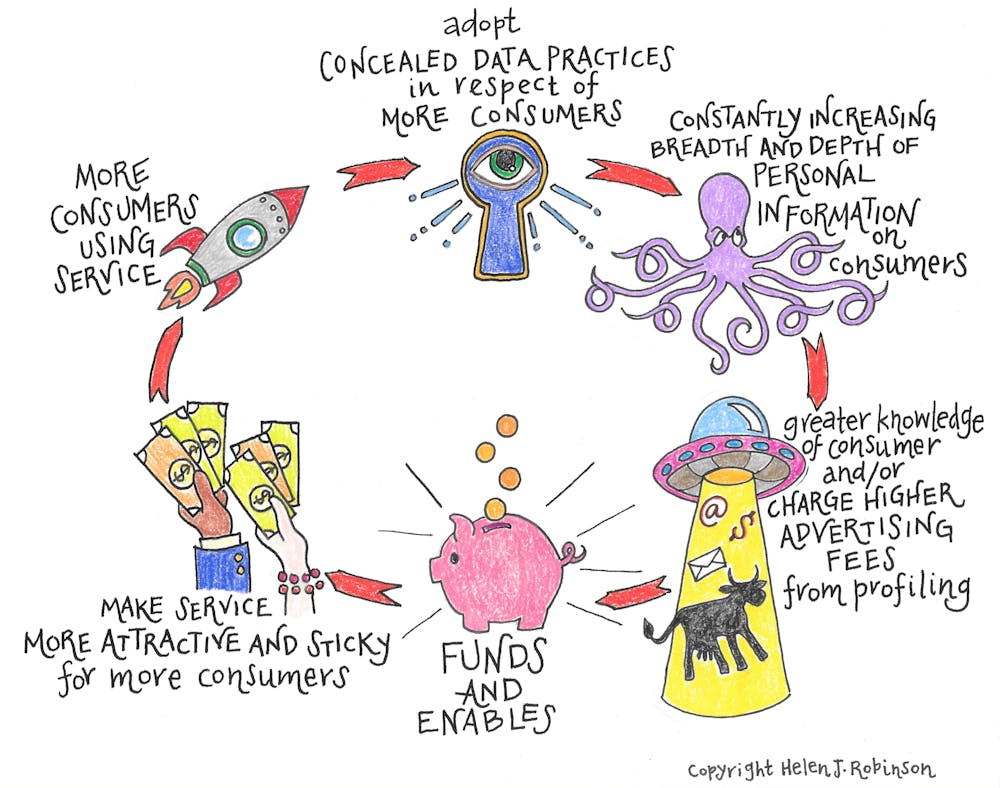
The vicious cycle of privacy abuse.
Helen J. Robinson, Author provided

Privacy policies are broken

The ACCC report points out that privacy policies tend to be long, complex, hard to navigate, and often create obstacles to opting out of intrusive practices. Many of them are not informing consumers about what actually happens to their information or providing real choices.

Many consumers are unaware, for example, that Facebook can track their activity online when they are logged out, or even if they are not a Facebook user.


Read more:
Shadow profiles – Facebook knows about you, even if you’re not on Facebook


Some privacy policies are outright misleading. Last month, the US Federal Trade Commission settled with Facebook on a US$5 billion fine as a penalty for repeatedly misleading users about the fact that personal information could be accessed by third-party apps without the user’s consent, if a user’s Facebook “friend” gave consent.

If this fine sounds large, bear in mind that Facebook’s share price went up after the FTC approved the settlement.

The ACCC is now investigating privacy representations by Google and Facebook under the Australian Consumer Law, and has taken action against the medical appointment booking app Health Engine for allegedly misleading patients while it was selling their information to insurance brokers.

Nothing to hide…?

Consumers generally have very little idea about what information about them is actually collected online or disclosed to other companies, and how that can work to their disadvantage.

A recent report by the Consumer Policy Research Centre explained how companies most of us have never heard of – data aggregators, data brokers, data analysts, and so on – are trading in our personal information. These companies often collect thousands of data points on individuals from various companies we deal with, and use them to provide information about us to companies and political parties.

Data companies have sorted consumers into lists on the basis of sensitive details about their lifestyles, personal politics and even medical conditions, as revealed by reports by the ACCC and the US Federal Trade Commission. Say you’re a keen jogger, worried about your cholesterol, with broadly progressive political views and a particular interest in climate change – data companies know all this about you and much more besides.

So what, you might ask. If you’ve nothing to hide, you’ve nothing to lose, right? Not so. The more our personal information is collected, stored and disclosed to new parties, the more our risk of harm increases.

Potential harms include fraud and identity theft (suffered by 1 in 10 Australians); being charged higher retail prices, insurance premiums or interest rates on the basis of our online behaviour; and having our information combined with information from other sources to reveal intimate details about our health, financial status, relationships, political views, and even sexual activity.


Read more:
Why you might be paying more for your airfare than the person seated next to you


In written testimony to the US House of Representatives, legal scholar Frank Pasquale explained that data brokers have created lists of sexual assault victims, people with sexually transmitted diseases, Alzheimer’s, dementia, AIDS, sexual impotence or depression. There are also lists of “impulse buyers”, and lists of people who are known to be susceptible to particular types of advertising.

Major upgrades to Australian privacy laws

According to the ACCC, Australia’s privacy law is not protecting us from these harms, and falls well behind privacy protections consumers enjoy in comparable countries in the European Union, for example. This is bad for business too, because weak privacy protection undermines consumer trust.

Importantly, the ACCC’s proposed changes wouldn’t just apply to Google and Facebook, but to all companies governed by the Privacy Act, including retail and airline loyalty rewards schemes, media companies, and online marketplaces such as Amazon and eBay.

Australia’s privacy legislation (and most privacy policies) only protect our “personal information”. The ACCC says the definition of “personal information” needs to be clarified to include technical data like our IP addresses and device identifiers, which can be far more accurate in identifying us than our names or contact details.


Read more:
Explainer: what is surveillance capitalism and how does it shape our economy?


Whereas some companies currently keep our information for long periods, the ACCC says we should have a right to request erasure to limit the risks of harm, including from major data breaches and reidentification of anonymised data.

Companies should stop pre-ticking boxes in favour of intrusive practices such as location tracking and profiling. Default settings should favour privacy.

Currently, there is no law against “serious invasions of privacy” in Australia, and the Privacy Act gives individuals no direct right of action. According to the ACCC, this should change. It also supports plans to increase maximum corporate penalties under the Privacy Act from A$2.1 million to A$10 million (or 10% of turnover or three times the benefit, whichever is larger).

Increased deterrence from consumer protection laws

Our unfair contract terms law could be used to attack unfair terms imposed by privacy policies. The problem is, currently, this only means we can draw a line through unfair terms. The law should be amended to make unfair terms illegal and impose potential fines of A$10 million or more.

The ACCC also recommends Australia adopt a new law against “unfair trading practices”, similar to those used in other countries to tackle corporate wrongdoing including inadequate data security and exploitative terms of use.

So far, the government has acknowledged that reforms are needed but has not committed to making the recommended changes. The government’s 12-week consultation period on the recommendations ends on October 24, with submissions due by September 12.The Conversation

Katharine Kemp, Senior Lecturer, Faculty of Law, UNSW, and Co-Leader, ‘Data as a Source of Market Power’ Research Stream of The Allens Hub for Technology, Law and Innovation, UNSW

This article is republished from The Conversation under a Creative Commons license. Read the original article.

Davos: Individual privacy is dead

Imagine a world where mosquito-sized robots fly around stealing samples of your DNA. Or where a department store knows from your buying habits that you’re pregnant even before your family does.

That is the terrifying dystopian world portrayed by a group of Harvard professors at the World Economic Forum in Davos on Thursday, where the assembled elite heard that the notion of individual privacy is effectively dead.

“Welcome to today. We’re already in that world,” said Margo Seltzer, a professor in computer science at Harvard University.

“Privacy as we knew it in the past is no longer feasible… How we conventionally think of privacy is dead,” she added.

Another Harvard researcher into genetics said it was “inevitable” that one’s personal genetic information would enter more and more into the public sphere.

Sophia Roosth said intelligence agents were already asked to collect genetic information on foreign leaders to determine things like susceptibility to disease and life expectancy.

“We are at the dawn of the age of genetic McCarthyism,” she said, referring to witch-hunts against Communists in 1950s America.

What’s more, Seltzer imagined a world in which tiny robot drones flew around, the size of mosquitoes, extracting a sample of your DNA for analysis by, say, the government or an insurance firm.

Invasions of privacy are “going to become more pervasive,” she predicted.

Political scientist Joseph Nye tackled the controversial subject of encrypted communications and the idea of regulating to ensure governments can always see even encrypted messages in the interests of national security.

“Governments are talking about putting in back doors for communication so that terrorists can’t communicate without being spied on. The problem is that if governments can do that, so can the bad guys,” Nye told the forum.

“Are you more worried about big brother or your nasty little cousin?”

“By and large, tech has done more good than harm,” she said, pointing to “tremendous” advances in healthcare in some rural areas of the developing world that have been made possible by technology.

And at a separate session on artificial intelligence, panellists appeared to accept the limit on privacy as part of modern life.

Rodney Brooks, chairman of Rethink Robotics, an American tech firm, took the example of Google Maps guessing — usually correctly — where you want to go.

“At first, I found that spooky and kind of scary. Then I realised, actually, it’s kind of useful,” he told the forum.

Anthony Goldbloom, a young tech entrepreneur, told the same panel that what he termed the “Google generation” placed far less weight on their privacy than previous generations.

“I trade my privacy for the convenience. Privacy is not something that worries me,” he said.

“Anyway, people often behave better when they have the sense that their actions are being watched.”

The World Economic Forum in the swanky Swiss ski resort of Davos brings together some 2,500 of the global business and political elite for a meeting that ends Saturday.

Source: AFP

Google CEO predicts totally invasive internet

Google executive chairman Eric Schmidt on Thursday predicted a totally invasive Internet.

At the end of a panel at the World Economic Forum in Davos, Switzerland, where his comments were webcast, he was asked for his prediction on the future of the web. “I will answer very simply that the Internet will disappear,” Schmidt said ironically.

“There will be so many IP addresses…so many devices, sensors, things that you are wearing, things that you are interacting with that you won’t even sense it,” he explained. “It will be part of your presence all the time. Imagine you walk into a room, and the room is dynamic. And with your permission and all of that, you are interacting with the things going on in the room.”

Concluded Schmidt: “A highly personalized, highly interactive and very, very interesting world emerges.”

The panel, entitled The Future of the Digital Economy, also featured Facebook COO Sheryl Sandberg and others.

Earlier in the debate, Schmidt discussed the issue of market dominance. The European Union has been looking at Google’s search market dominance in a long-running antitrust case, and the European parliament late last year even called for a breakup.

“You now see so many strong tech platforms coming, and you are seeing a reordering and a future reordering of dominance or leaders or whatever term you want to use because of the rise of the apps on the smartphone,” Schmidt said Thursday. “All bets are off at this point as to what the smartphone app infrastructure is going to look like” as a “whole new set” of players emerges to power smartphones, which are nothing but super-computers, the Google chairman argued. “I view that as a completely open market at this point.”

Asked about his recent trip to North Korea, Schmidt said the country has many Internet connections through data phones, but there is no roaming and web usage is “heavily supervised.” Schmidt said “it’s very much surveillance of use,” which he said was not good for the country and others.

Sandberg and Schmidt lauded the Internet as an important way to give more people in the world a voice. Currently, only 40 percent of people have Internet access, the Facebook COO said, adding that any growth in reach helps extend people’s voice and increase economic opportunity. “I’m a huge optimist,” she said about her outlook for the industry. “Imagine what we can do” once the world gets to 50 percent, 60 percent and more in terms of Internet penetration.

Gunther Oettinger, a conservative German politician serving as the European Union’s commissioner for digital economy and society, said on the panel that “we need a convincing global understanding, we need a UN agency for data protection and security.” Asked what form that “understanding” should have, he said he was looking for “clear, pragmatic, market-based regulation.” Explained Oettinger: “It’s a public-private partnership.”

Source: Hollywoord Reporter

Snowden fingers Dropbox, Facebook, Google as hostile to privacy

Edward Snowden has hit out at Dropbox and other services he says are “hostile to privacy,” urging web users to abandon unencrypted communication and adjust privacy settings to prevent governments from spying on them in increasingly intrusive ways.

“We are no longer citizens, we no longer have leaders. We’re subjects, and we have rulers,” Snowden told The New Yorker magazine in a comprehensive hour-long interview.

There isn’t enough investment into security research, into understanding how metadata could better be protected and why that is more necessary today than yesterday, he said.

The whistleblower believes one fallacy in how authorities view individual rights has to do with making the individual forsake those rights by default. Snowden’s point is that the moment you are compelled to reveal that you have nothing to hide is when the right to privacy stops being a right – because you are effectively waiving that right.

“When you say, ‘I have nothing to hide,’ you’re saying, ‘I don’t care about this right.’ You’re saying, ‘I don’t have this right, because I’ve got to the point where I have to justify it.’ The way rights work is, the government has to justify its intrusion into your rights – you don’t have to justify why you need freedom of speech.”

In that situation, it becomes OK to live in a world where one is no longer interested in privacy as such – a world where Facebook, Google and Dropbox have become ubiquitous, and where there are virtually no safeguards against the wrongful use of the information one puts there.
In particular, Snowden advised web users to “get rid” of Dropbox. Such services only insist on encrypting user data during transfer and when being stored on the servers. Other services he recommends instead, such as SpiderOak, encrypt information while it’s on your computer as well.

“We’re talking about dropping programs that are hostile to privacy,” Snowden said.

The same goes for social networks such as Facebook and Google, too. Snowden says they are “dangerous” and proposes that people use other services that allow for encrypted messages to be sent, such as RedPhone or SilentCircle.

The argument that encryption harms security efforts to capture terrorists is flawed, even from a purely legalistic point of view, Snowden said, explaining that you can still retain encryption and have the relevant authorities requesting private information from phone carriers and internet providers on a need-to-know basis.

And the penchant for close, secretive cooperation with the government will only cost companies money and jobs, Snowden added, because no one would want to buy a phone made by a company that provides inherent backdoors for third parties to access your information.

“The same rights that we inherited our children deserve to inherit the same way,” Snowden said.

“But ultimately we have to remember that political reform in the United States is not going to solve the problem globally. Governments [everywhere] are going to have their own national laws. And these can be terrible governments… so, because of that, you have to use secure communications… the real key is that companies willing to collaborate with the government and compromise their products and services do not deserve to be trusted with your data. Because if they do it for one government, they’ll do it for another government,” Snowden said.

For consumers to retain trust in the services they use, they need to fight for the very idea of privacy, to keep the topic in focus, he said, adding: “I speak with computer scientists and cryptographers every day to try to figure out how we can create solutions” for metadata to be appreciated and viewed as someone’s own private business.

“There are solutions, there are ways forward, and we need to pursue them, to work toward them,” Snowden said. “And we need to say that this is an effort worth doing.”

The whistleblower continues to lead a secretive existence in Russia, where he’s been stranded since June 2013, hiding from his own government, which is seeking to prosecute him for his crimes behind closed doors.

“I’ve told the government again and again in negotiations, you know, that if they’re prepared to offer an open trial, a fair trial in the same way that Dan Ellsberg got, and I’m allowed to make my case to the jury, I would love to do so,” Snowden said. “But to this point they’ve declined.”

Source: RT

Governments and corporations threat to internet

The British inventor of the World Wide Web warned on Saturday that the freedom of the internet is under threat by governments and corporations interested in controlling the web.

Tim Berners-Lee, a computer scientist who invented the web 25 years ago, called for a bill of rights that would guarantee the independence of the internet and ensure users’ privacy.

“If a company can control your access to the internet, if they can control which websites they go to, then they have tremendous control over your life,” Berners-Lee said at the London “Web We Want” festival on the future of the internet.

“If a Government can block you going to, for example, the opposition’s political pages, then they can give you a blinkered view of reality to keep themselves in power.”

“Suddenly the power to abuse the open internet has become so tempting both for government and big companies.”

Berners-Lee, 59, is director of the World Wide Web Consortium, a body which develops guidelines for the development of the internet.

He called for an internet version of the “Magna Carta”, the 13th century English charter credited with guaranteeing basic rights and freedoms.

Concerns over privacy and freedom on the internet have increased in the wake of the revelation of mass government monitoring of online activity following leaks by former US intelligence contractor Edward Snowden.

A ruling by the European Union to allow individuals to ask search engines such as Google to remove links to information about them, called the “right to be forgotten”, has also raised concerns over the potential for censorship.

“There have been lots of times that it has been abused, so now the Magna Carta is about saying…I want a web where I’m not spied on, where there’s no censorship,” Berners-Lee said.

The scientist added that in order to be a “neutral medium”, the internet had to reflect all of humanity, including “some ghastly stuff”.

“Now some things are of course just illegal, child pornography, fraud, telling someone how to rob a bank, that’s illegal before the web and it’s illegal after the web,” Berners-Lee added.

Source: Yahoo

Mass surveillance destroys the economy

Privacy is a prerequisite for a prosperous economy. Four ways that mass surveillance hurts the US economy.

The Information and Privacy Commissioner of Ontario, Canada – Ann Cavoukian, Ph.D. – noted last month:

Privacy is Essential to … Prosperity and Well-Being

• Innovation, creativity and the resultant prosperity of a society requires freedom;

• Privacy is the essence of freedom: Without privacy, individual human rights, property rights and civil liberties – the conceptual engines of innovation and creativity, could not exist in a meaningful manner;

• Surveillance is the antithesis of privacy: A negative consequence of surveillance is the usurpation of a person’s limited cognitive bandwidth, away from innovation and creativity.

The Financial Post reported in February: “Big Brother culture will have adverse effect on creativity, productivity“.

Christopher Lingle – visiting professor of economics at ESEADE, Universidad Francisco Marroquín – agrees that creativity is a key to economic prosperity.

Edward Snowden said last year:

The success of economies in developed nations relies increasingly on their creative output, and if that success is to continue we must remember that creativity is the product of curiosity, which in turn is the product of privacy.

Silicon Valley is currently one of the largest drivers of the U.S. economy. Do you think Bill Gates and Steve Jobs could have tinkered so creatively in their garages if the government had been watching everything they do?

Everyone who has every done anything creative knows that you need a little privacy to try different things before you’re ready to go public with it. If your bench model, rough sketch or initial melody is being dissected in real time by an intrusive audience … you’re not going to be very creative.

Moreover, surveillance hampers the free flow of information as many people begin to watch what they say. The free flow of information is a core requisite for a fast-moving economy … especially an information economy, as opposed to economies focused on resource-extraction or manufacturing.

As quoted above, the White House states:

Assuring the free flow of information [is] essential to American and global economic prosperity, security, and the promotion of universal rights.

Mass surveillance makes people more reluctant to share information … and thus hurts the economy.

Top computer and internet experts say that NSA spying breaks the functionality of our computers and of the Internet. It reduces functionality and reduces security by – for example – creating backdoors that malicious hackers can get through.

Remember, American and British spy agencies have intentionally weakened security for many decades. And it’s getting worse and worse. For example, they plan to use automated programs to infect millions of computers.

How much time and productivity have we lost in battling viruses let in because of the spies tinkering? How much have we lost because “their” computer programs conflict with “our” programs?

Microsoft’s general counsel labels government snooping an “advanced persistent threat,” a term generally used to describe teams of hackers that coordinate cyberattacks for foreign governments. It is well-known among IT and security professionals that hacking decreases employee productivity. While they’re usually referring to hacking by private parties, the same is likely true for hacking by government agencies, as well.

And the spy agencies are already collecting millions of webcam images from our computers. THAT’S got to tie up our system resources … so we can’t get our work done as fast.

Moreover, the Snowden documents show that the American and British spy agencies launched attacks to disrupt the computer networks of “hacktivists” and others they don’t like, and tracked supporters of groups such as Wikileaks.

Given that the spy agencies are spying on everyone, capturing millions of screenshots, intercepting laptop shipments, creating fake versions of popular websites to inject malware on people’s computers, launching offensive cyber-warfare operations against folks they don’t like, and that they may view journalism, government criticism or even thinking for one’s self as terrorism – and tend to re-label “dissidents” as “terrorists” – it’s not unreasonable to assume that all of us are being adversely effected to one degree or another by spy agency operations.

Bill Binney – the high-level NSA executive who created the agency’s mass surveillance program for digital information, a 32-year NSA veteran widely regarded as a “legend” within the agency, the senior technical director within the agency, who managed thousands of NSA employees – tells Washington’s Blog:

The other costs involve weakening systems (operating systems/firewalls/encryption). When they do that, this weakens the systems for all to find. Hackers around the world as well as governments too.

These costs are hard to count. For example, we hear of hackers getting customer data over and over again. Is that because of what our government has done?

Or, how about all the attacks on systems in government? Are these because of weakened systems?

Trust is KEY for a prosperous economy. It’s hard to trust when your government, your internet service provider and your favorite websites are all spying on you.

The destruction of privacy by the NSA directly harms internet companies, Silicon Valley, California … and the entire U.S. economy (Facebook lost 11 millions users as of April mainly due to privacy concerns … and that was before the Snowden revelations). If people don’t trust the companies to keep their data private, they’ll use foreign companies.

American tech companies – including Verizon, Cisco, IBM and others – are getting hammered for their cooperating with the NSA and lack of privacy protection. The costs to the U.S. economy have been estimated to be in the hundreds of billions of dollars. And see this and this.

And destruction of trust in government and other institutions is destroying our economy.

A top cyber security consultant notes:

If privacy is not protected while performing mass surveillance for national security purposes, then the people’s level of trust in the government decreases.

And as we noted in 2002:

Personal freedom and liberty – and freedom from the arbitrary exercise of government power – are strongly correlated with a healthy economy, but America is descending into tyranny.

Authoritarian actions by the government interfere with the free market, and thus harm prosperity.

U.S. News and World Report notes:

The Fraser Institute’s latest Economic Freedom of the World Annual Report is out, and the news is not good for the United States. Ranked among the five freest countries in the world from 1975 through 2002, the United States has since dropped to 18th place.

The Cato institute notes:

The United States has plummeted to 18th place in the ranked list, trailing such countries as Estonia, Taiwan, and Qatar.

So lawlessness infringement of our liberty is destroying our prosperity.

Put another way, lack of privacy kills the ability to creatively criticize bad government policy … and to demand enforcement of the rule of law. Indeed, 5,000 years of history shows that mass surveillance is always carried out to crush dissent. In other words, mass surveillance is the opposite of the principle of the rule of law (in distinction to the rule of men) upon which America was founded.

Free speech and checks and balances on the power of government officials are two of the main elements of justice in any society. And a strong rule of law is – in turn – the main determinant of GDP growth.

Source: Washington’s blog

Quacking Over Ducksters As Freedoms Go POOF

mercer_ilanaby Ilana Mercer

[followbutton username=’IlanaMercer’ count=’true’ lang=’en’ theme=’light’]

Like Ilana Mercer’s Facebook page

While the nation fretted over the ouster of one Duckster from the parallel reality of a TV reality show, more of the protections enshrined in the Fourth Amendment of the U.S. Constitution evaporated.

Just after Christmas, district-court Judge William Pauley ruled that the privacy protections afforded by the Constitution were relative freedoms, not absolute ones. As such, Fourth-Amendment rights had to be calibrated against a government’s need to maintain a database of records that would (putatively) prevent future terrorist attacks.

Paraphrased by The Guardian, “Pauley argued that al-Qaida’s ‘bold jujitsu’ strategy to marry seventh century ideology with 21st century technology made it imperative that government authorities be allowed to push privacy boundaries.”

You’d think that the purview of the justice elite is to “marry” American law with Islamist ideology, rather than uphold a timeless principle that states: “The right of the people to be secure in their persons, houses, papers, and effects, against unreasonable searches and seizures, shall not be violated, and no warrants shall issue, but upon probable cause, supported by oath or affirmation, and particularly describing the place to be searched, and the persons or things to be seized.”

“The judgment,” continued The Guardian, “directly contradicts the result of a similar challenge in a Washington court [a week earlier] which ruled the NSA’s bulk collection program was likely to prove unconstitutional and was ‘almost Orwellian’ in scale.”

Friday’s ruling, surmised the vigilant British paper, “makes it more likely that the issue will be settled by the U.S. Supreme Court, although it may be overtaken by the decision of Barack Obama on whether to accept the recommendations of a White House review panel to ban the NSA from directly collecting such data.”

Indeed, in August, media-enabled megalomaniac Obama told a rapt press corps that, in his magnanimity, he’d be prepared to “jiggle” his surveillance apparatus here and there to better allay unnecessary fears (“provide greater assurances,” as the president put it).

In his remarks, Big Daddy said—in defiance of the evidence—that he was comfortable “the NSA program [was] not being abused,” going on to promise that he’d outsource the matter to a new hire: A civil liberties officer. (CNN’s Jessica Yellin was in estrus.)

This is the inglorious history of American freedom and federalism. In the rare event that the Supreme Court refuses to play along (as nicely as plaything Justice John G. Roberts did for ObamaCare)—there is always a perfectly legal, extra-constitutional, quasi-legislative, quasi-executive, quasi-judicial, “independent” regulatory commission or executive agency to kill off or override constitutional protections.

A “civil liberties officer,” for example.

The nice men in periwigs who came up with the Fourth Amendment were recklessly naive to imagine that branches of a government, each of whose power is enhanced when the power of the other branches grows, would serve to check one another. The idea of a judiciary that would police the executive as an arm of a self-correcting tripartite government was worse than naive.

Ditto the Duck detritus: they are the new wholesome in America.

Into the Cannibal's Pot

As “luck” would have it, legislation that flouts the Fourth Amendment was previously in place to provide Pauley with all the positive-law backing the judge needed to justify an anti-constitutional ruling. To wit, the grounds upon which the New York jurist dismissed this ACLU (American Civil Liberties Union) case against the NSA were, primarily, “that bulk collection was [already] authorized under existing laws allowing ‘relevant’ data collection to be authorized by secret US courts.”

Here you have the essence of modern-day, Managerial-State America. Natural law, common-law and Constitution have been nullified; buried under the rubble of legislation, statute, precedent, ad infinitum, rights having long-since been outsourced to the “better” judgment of bureaucrats and hired “experts.”

In this case, to Eric Holder’s Department of Justice.

Not only has Obama “the sinner” trusted Holder his “sin eater” with the expansion of surveillance-state USA; he has, it would appear, charged him with dealing a one-two Knockout punch to white America.

Eric Holder’s first arrest in the string of Knockout attacks across the country is a first in more than one way.

The arrest is unique in that it is of a white offender. Knockout attacks have been, almost exclusively, black-on-white hate crimes.

Were it not so disquieting for what it portends, this single arrest would be as comical as the specter of global-warming scientists marooned in Antarctic ice so densely packed that no man-made machinery can affect it.

Heeding Holder, the U.S. attorney for the southern district of Texas has remanded Conrad Alvin Barrett (27 years old) to prison for breaking the jaw of a man (79 years old), while “laughing and saying; ‘Knockout’” as he beat it.

The question is not whether this is a good arrest. If he’s guilty, let Barrett rot. The question is, why have there been no arrests for the multiple killings and maiming of innocents by feral black thugs across the country?

Befitting a banana republic, Holder, who carries water for President Camacho, is likely attempting to deploy the law to frame the Knock-Out phenomenon as an equal-opportunity crime. This is the administration’s ultimate racial reprisal against white victims of hate crimes: “know thy place, Honky!”

MSNBC host Melissa Harris-Perry will no doubt deem the “banana” usage here to be racist, “conceived by a group of wealthy white men who needed to . . . render [a black man] inferior and unequal and diminish his accomplishments.” This is what our unsharpened pencil thinks of the word “Obamacare.”

But Obama and his fans “can’t have their banana and eat it.” It is an incontrovertible fact that under Strong Man Obama, America’s banana-republic- and surveillance-state credentials are that much stronger.

[followbutton username=’IlanaMercer’ count=’true’ lang=’en’ theme=’light’]

Like Ilana Mercer’s Facebook page

Have hackers made passwords obsolete?

Heather Adkins
Google manager of information security Heather Adkins

New startups looking for ways to keep their users secure should know one thing, a top Google security executive said Tuesday: “Passwords are dead.”

Speaking on a TechCrunch Disrupt panel called “Spies Like Us,” Heather Adkins, Google’s manager of information security, told moderator Greg Ferenstein that in the future, the “game is over for” any startup that relies on passwords as its chief method to secure users and their data.

Adkins, speaking alongside Kleiner Perkins Caufield & Byers managing partner Ted Schlein and author James Bamford, said that looking ahead, “our relationship with passwords are done,” and that “passwords are done at Google.”

She talked briefly about Google’s use of two-step authentication and the fact that the search giant has been working to innovate in the area of non-standard password security. As a result, she said, any startup that still relies on standard passwords needs to ensure that it has an abuse team set up to deal “with customers getting compromised.”

Although Adkins didn’t offer any real specifics on how Google will innovate beyond today’s security, she did say the company is experimenting with hardware-based tokens as well as a Motorola-created system that authenticates users by having them touch a device to something embedded, or held, in their own clothing. “A hacker can’t steal that from you,” she said.

Later in the conversation, which also touched on the NSA scandal, cybersecurity, and the weaponization of offensive cyber technologies, Adkins pointed out that hackers intent on making money from their bad acts had consistently found ways to exploit Google users who had yet to turn on two-factor authentication. Essentially, she explained, hackers were able to get into such users’ accounts, turn on two-factor authentication themselves, and lock the users out before utilizing those accounts to send spam. “They are finding new ways to make money off it,” she said. “Ways we hadn’t anticipated.”

Finally, Adkins argued, technology companies need to step up and build products that protect users so “they don’t rely on not getting fooled.” Ultimately, she said, anyone starting a new technology company should be sure that one person is designated to focus on security and privacy, and that one of the first 25 employees should work full time on security and privacy. – cnet.com

Journalism under threat

Alan Rusbridger
Alan Rusbridger

By Alan Rusbridger
Guardian Editor

On Sunday morning David Miranda, the partner of Guardian columnist Glenn Greenwald, was detained as he was passing through Heathrow airport on his way back to Rio de Janeiro, where the couple live. Greenwald is the reporter who has broken most of the stories about state surveillance based on the leaks from the former NSA contractor Edward Snowden. Greenwald’s work has undoubtedly been troublesome and embarrassing for western governments. But, as the debate in America and Europe has shown, there is considerable public interest in what his stories have revealed about the right balance between security, civil liberties, freedom of speech and privacy. He has raised acutely disturbing questions about the oversight of intelligence; about the use of closed courts; about the cosy and secret relationship between government and vast corporations; and about the extent to which millions of citizens now routinely have their communications intercepted, collected, analysed and stored.

In this work he is regularly helped by David Miranda. Miranda is not a journalist, but he still plays a valuable role in helping his partner do his journalistic work. Greenwald has his plate full reading and analysing the Snowden material, writing, and handling media and social media requests from around the world. He can certainly use this back-up. That work is immensely complicated by the certainty that it would be highly unadvisable for Greenwald (or any other journalist) to regard any electronic means of communication as safe. The Guardian’s work on the Snowden story has involved many individuals taking a huge number of flights in order to have face-to-face meetings. Not good for the environment, but increasingly the only way to operate. Soon we will be back to pen and paper.

Miranda was held for nine hours under schedule 7 of the UK’s terror laws, which give enormous discretion to stop, search and question people who have no connection with “terror”, as ordinarily understood. Suspects have no right to legal representation and may have their property confiscated for up to seven days. Under this measure – uniquely crafted for ports and airport transit areas – there are none of the checks and balances that apply once someone is in Britain proper. There is no need to arrest or charge anyone and there is no protection for journalists or their material. A transit lounge in Heathrow is a dangerous place to be.

Miranda’s professional status – much hand-wringing about whether or not he’s a proper “journalist – is largely irrelevant in these circumstances. Increasingly, the question about who deserves protection should be less “is this a journalist?” than “is the publication of this material in the public interest?”

The detention of Miranda has rightly caused international dismay because it feeds into a perception that the US and UK governments – while claiming to welcome the debate around state surveillance started by Snowden – are also intent on stemming the tide of leaks and on pursuing the whistleblower with a vengeance. That perception is right. Here follows a little background on the considerable obstacles being placed in the way of informing the public about what the intelligence agencies, governments and corporations are up to.

A little over two months ago I was contacted by a very senior government official claiming to represent the views of the prime minister. There followed two meetings in which he demanded the return or destruction of all the material we were working on. The tone was steely, if cordial, but there was an implicit threat that others within government and Whitehall favoured a far more draconian approach.

The mood toughened just over a month ago, when I received a phone call from the centre of government telling me: “You’ve had your fun. Now we want the stuff back.” There followed further meetings with shadowy Whitehall figures. The demand was the same: hand the Snowden material back or destroy it. I explained that we could not research and report on this subject if we complied with this request. The man from Whitehall looked mystified. “You’ve had your debate. There’s no need to write any more.”

During one of these meetings I asked directly whether the government would move to close down the Guardian’s reporting through a legal route – by going to court to force the surrender of the material on which we were working. The official confirmed that, in the absence of handover or destruction, this was indeed the government’s intention. Prior restraint, near impossible in the US, was now explicitly and imminently on the table in the UK. But my experience over WikiLeaks – the thumb drive and the first amendment – had already prepared me for this moment. I explained to the man from Whitehall about the nature of international collaborations and the way in which, these days, media organisations could take advantage of the most permissive legal environments. Bluntly, we did not have to do our reporting from London. Already most of the NSA stories were being reported and edited out of New York. And had it occurred to him that Greenwald lived in Brazil?

The man was unmoved. And so one of the more bizarre moments in the Guardian’s long history occurred – with two GCHQ security experts overseeing the destruction of hard drives in the Guardian’s basement just to make sure there was nothing in the mangled bits of metal which could possibly be of any interest to passing Chinese agents. “We can call off the black helicopters,” joked one as we swept up the remains of a MacBook Pro.

Whitehall was satisfied, but it felt like a peculiarly pointless piece of symbolism that understood nothing about the digital age. We will continue to do patient, painstaking reporting on the Snowden documents, we just won’t do it in London. The seizure of Miranda’s laptop, phones, hard drives and camera will similarly have no effect on Greenwald’s work.

The state that is building such a formidable apparatus of surveillance will do its best to prevent journalists from reporting on it. Most journalists can see that. But I wonder how many have truly understood the absolute threat to journalism implicit in the idea of total surveillance, when or if it comes – and, increasingly, it looks like “when”.

We are not there yet, but it may not be long before it will be impossible for journalists to have confidential sources. Most reporting – indeed, most human life in 2013 – leaves too much of a digital fingerprint. Those colleagues who denigrate Snowden or say reporters should trust the state to know best (many of them in the UK, oddly, on the right) may one day have a cruel awakening. One day it will be their reporting, their cause, under attack. But at least reporters now know to stay away from Heathrow transit lounges.

PRISM fears boost private search engine DuckDuckGo

duck-duck-goIf you want to know just how crazy fear over PRISM-like surveillance has made the Internet, take a look at DuckDuckGo.

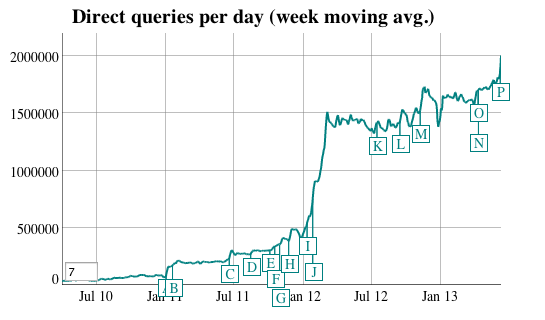
Thanks to the National Security Agency leaks and some well-timed media appearances, the private search engine is having its best traffic week ever. Visitors to the site made a record 2.35 million direct searches on Wednesday — a 26 percent increase over the previous week.

For DuckDuckGo founder Gabriel Weinberg, the numbers are proof yet again that people are eager to find and use viable alternatives to popular web services, which are prime targets for government snooping. “We offer that in web search, and there are others that offer it in other verticals. As people find out about these alternatives, they make that choice,” Weinberg said via email today.

DuckDuckGo was launched in 2008 and has since become the foremost search engine for those concerned about not just snooping by the government but Google as well. When visitors search via DuckDuckGo, the search engine doesn’t track them; it just gives them the search results they request. (Like Google, DuckDuckGo does serve contextual ads, which is how it makes its money.)

Traffic to DuckDuckGo tends to spike whenever new privacy fears pop up

While interest in the search engine has climbed over the past year, fears over PRISM surveillance have made DuckDuckGo look significantly more important and necessary seemingly overnight.

“I believe the surveillance story is paramount right now, and people are talking about it. DuckDuckGo users are telling their friends and family about the private alternatives,” Weinberg said.

On a similar note, this week designer Peng Zhong launched PRISM Break, a comprehensive site that lists private alternatives to popular web services. – Venturebeat.com

Global netizens worried over US spying

News that the U.S. government has been snooping on Internet users worldwide came as little surprise to global netizens, who said Friday they have few expectations of online privacy as governments increasingly monitor people’s digital lives, often with Internet companies’ acquiescence.

Privacy activists concerned over the U.S. National Security Agency’s selective monitoring of Internet traffic called on people to take measures to better protect their digital data ranging from emails to photos to social network posts. But most people eschew encryption and other privacy tools and seemed resigned to the open book their online lives have become.

“It doesn’t surprise me one bit. They’ve been doing it for years,” said Jamie Griffiths, a 26-year-old architect working on his laptop in a London cafe. “I wouldn’t send anything via email that I wouldn’t want a third party to read.”

From Baghdad, to Bogota, Colombia, many said they already carefully censor what they write online and assume governments are regularly spying on online activity, be it as part of global counter-terrorism or domestic surveillance efforts.

“The social networks and email have always been vulnerable because tech-savvy people know how to penetrate them,” said Teolindo Acosa, a 34-year-old education student at Venezuela’s Universidad Central who was leaving a cybercafe in Caracas.

Leaked confidential documents show the NSA and FBI have been sifting through personal data by directly accessing the U.S-based servers of Google, Facebook, Microsoft, AOL, Skype, PalTalk, Apple and YouTube.

Following Thursday’s revelation, U.S. President Barack Obama said Friday that the surveillance did not “target” U.S. citizens or others living in the U.S. – which does not mean their communications were not caught up in the dragnet.

But that didn’t dampen the outrage of people who resent what they consider Washington’s self-anointed role as the world’s policeman.

“To the United States, everyone is suspicious, even the pope!” said leftist Colombian Sen. Alexander Lopez. “Everyone is under observation these days and this should be taken up by the United Nations.”

Lopez said he has no plans to close his Google and Microsoft email accounts. He figures he’ll be spied on no matter what he does.

The revelation of global data vacuuming could hurt U.S. technology companies if Internet users become disillusioned and abandon them in favor of homegrown alternatives that offer greater security.

U.S. privacy activist Christopher Soghoian said he finds it “insane” that so many politicians outside the United States use Google gmail accounts.

“This has given the NSA an advantage over every other intelligence system in the world. The Americans don’t have to hack as much, because everyone in the world sends their data to American companies,” he said.

Hossam el-Hamalawy, a blogger with Egypt’s Revolutionary Socialists, one of the Egyptian groups that helped spearhead the 2011 uprising, said the dearth of locally developed Web tools means many around the world are simply stuck with U.S. sites, even if they know the government is monitoring them.

“The problem is that there is no alternative,” he said. “If you don’t use Facebook, what is the alternative social network available for the Internet user who is not an IT geek?”

Soghoian predicted an increasing push by governments and companies in Europe in particular, where privacy has been a much bigger issue for voters than in the United States, away from storing data in U.S.-based server farms.

Indeed, under U.S. law it is not illegal for the NSA to collect information on foreigners.

The disclosure of the NSA data-vacuuming program known as PRISM is only the latest “of many U.S. government programs created to infringe on personal freedoms,” said Carlos Affonso Pereira de Souza, a technology policy professor at FGV think tank in Rio de Janeiro.

Going back well into the 20th century, the United States, Britain, Canada, Australia and New Zealand ran a secret satellite communications interception network that became known as Echelon and searched information including telexes, faxes and emails, according to experts including U.S. journalist James Bamford. The system was the subject of a 2001 European Parliament inquiry.

According to a U.N. report released this week, such surveillance has been on a global upsurge with governments increasingly tapping into online personal data and even discouraging online anonymity by passing laws prohibiting it.

The governments of China, Iran, Bahrain are among other nations that already aggressively oversee online activity, in many cases putting people in prison for political blog posts and other messages.

Israel’s attorney general in April upheld a practice allowing security personnel to read email accounts of suspicious individuals when they arrive at the airport, arguing it prevents militants from entering the country.

The U.N. report said such activity has been expanding as technology advances, and that countries should prioritize protecting people’s online rights.

“In order to meet their human rights obligations, States must ensure that the rights to freedom of expression and privacy are at the heart of their communications surveillance frameworks,” the report reads.

Its author, Guatemalan Frank La Rue, calls for legal standards to ensure “privacy, security and anonymity of communications” to protect people including journalists, human rights defenders and whistleblowers.

Civil libertarians in the United States were much more upset about a different revelation published Wednesday, that the NSA has been collecting the phone records including the calls, numbers, times and duration of all U.S. citizen customers of the telecommunications giant Verizon.

—

Associated Press writers Vivian Sequera in Bogota, Ian Deitch in Jerusalem, Jill Lawless in London, Bradley Brooks in Sao Paulo, Fabiola Sanchez in Caracas, Sameer N. Yacoub in Baghdad and Tony G. Gabriel in Cairo contributed to this report. Jack Chang contributed from Mexico City.

First US city to ban drones

Charlottesville, Va., has become the first city in the United States to formally pass an anti-drone resolution.

The resolution, passed Monday, “calls on the United States Congress and the General Assembly of the Commonwealth of Virginia to adopt legislation prohibiting information obtained from the domestic use of drones from being introduced into a Federal or State court,” and “pledges to abstain from similar uses with city-owned, leased, or borrowed drones.”

The resolution passed by a 3-2 vote and was brought to the city council by activist David Swanson and the Rutherford Institute, a civil liberties group based in the city. The measure also endorses a proposed two-year moratorium on drones in Virginia.

Councilmember Dede Smith, who voted in favor of the bill, says that drones are “pretty clearly a threat to our constitutional right to privacy.”

“If we don’t get out ahead of it to establish some guidelines for how drones are used, they will be used in a very invasive way and we’ll be left to try and pick up the pieces,” she says.

The passed resolution is much less restrictive than the draft Swanson originally introduced, which would have sought to declare the city a “No Drone Zone” and would have tried to banned all drones over Charlottesville airspace “to the extent compatible with federal law.” The draft would have also banned all Charlottesville municipal agencies from buying, leasing, borrowing, or testing any drones.

Councilmember Dave Norris says the city has a “long tradition of promoting civil liberties.”

“It’s just part of our culture here,” he says.

Charlottesville is located 120 miles southwest of Washington, D.C., and has a population of about 43,000. The city is home to the University of Virginia, which has not tried to obtain a waiver to test drones from the Federal Aviation Administration.

The move earned praise from the Electronic Privacy Information Center. Amie Stepanovich, a lawyer with the group, says that the “Charlottesville resolution demonstrates that people care about protecting their civil liberties and Fourth Amendment rights and are willing to devote the time necessary to closely examine this issue.”

“Lawmakers should be looking at [drone privacy] issues now in order to ensure that there are safeguards in place to protect individual privacy from these invasive technologies,” she says.

Smith admits that the final legislation won’t do anything to prevent federal- or state-operated drones from operating over Charlottesville’s skies, but that the symbolic move could push other cities to follow suit.

“With a lot of these resolutions, although they don’t have a lot of teeth to them, they can inspire other governments to pass similar measures,” she says. “You can get a critical mass and then it does have influence. One doesn’t do much, but a thousand of them might. We want this on [federal and state lawmakers’] radars.”

Vice Mayor Kristin Szakos, who voted against the resolution, says she “can imagine ways in which drones might be used for positive things” and that the move was premature.

“I think drones have been used for bad things, but it’s like banning airplanes because they can drop bombs,” she says. “At this point, the city isn’t even talking about using drones. It seems premature to me to ban them altogether.”