
Here’s how tech giants profit from invading our privacy, and how we can start taking it back

Katharine Kemp, UNSW

Australia’s consumer watchdog has recommended major changes to our consumer protection and privacy laws. If these reforms are adopted, consumers will have much more say about how we deal with Google, Facebook, and other businesses.

The proposals include a right to request erasure of our information; choices about whether we are tracked online and offline; potential penalties of A$10 million or more for companies that misuse our information or impose unfair privacy terms; and default settings that favour privacy.


Read more:
Consumer watchdog calls for new measures to combat Facebook and Google’s digital dominance


The report from the Australian Competition and Consumer Commission (ACCC) says consumers have growing concerns about the often invisible ways companies track us and disclose our information to third parties. At the same time, many consumers find privacy policies almost impossible to understand and feel they have no choice but to accept.

My latest research paper details how companies that trade in our personal data have incentives to conceal their true practices, so they can use vast quantities of data about us for profit without pushback from consumers. This can preserve companies’ market power, cause harm to consumers, and make it harder for other companies to compete on improved privacy.
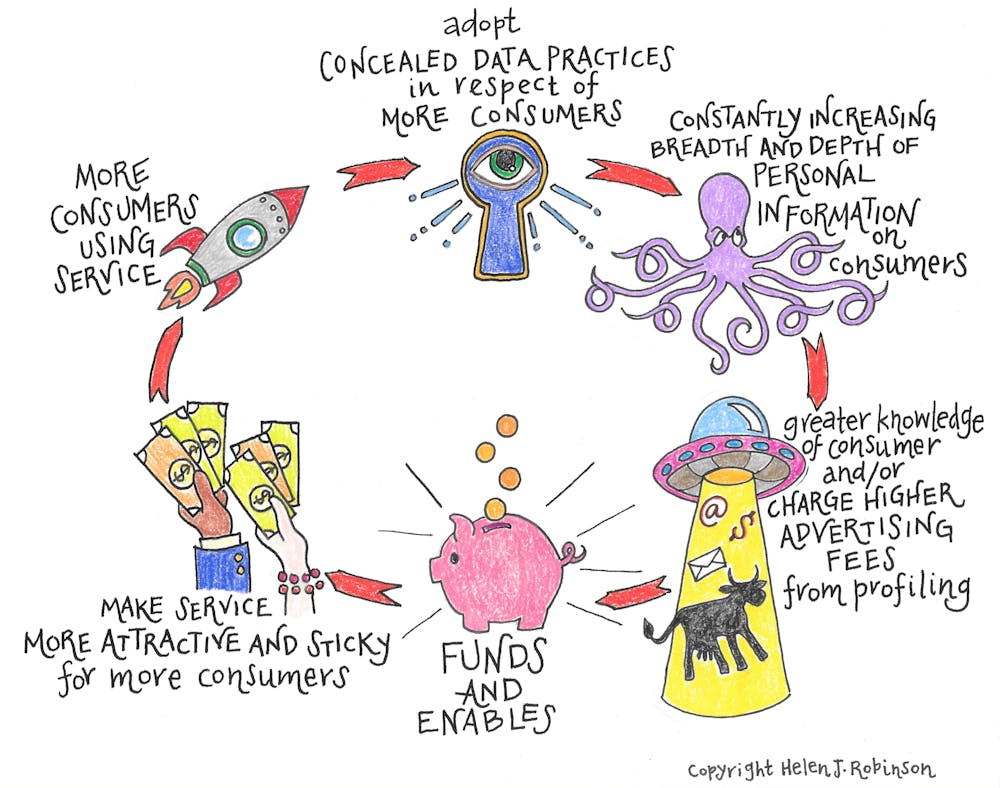
The vicious cycle of privacy abuse.
Helen J. Robinson, Author provided

Privacy policies are broken

The ACCC report points out that privacy policies tend to be long, complex, hard to navigate, and often create obstacles to opting out of intrusive practices. Many of them are not informing consumers about what actually happens to their information or providing real choices.

Many consumers are unaware, for example, that Facebook can track their activity online when they are logged out, or even if they are not a Facebook user.


Read more:
Shadow profiles – Facebook knows about you, even if you’re not on Facebook


Some privacy policies are outright misleading. Last month, the US Federal Trade Commission settled with Facebook on a US$5 billion fine as a penalty for repeatedly misleading users about the fact that personal information could be accessed by third-party apps without the user’s consent, if a user’s Facebook “friend” gave consent.

If this fine sounds large, bear in mind that Facebook’s share price went up after the FTC approved the settlement.

The ACCC is now investigating privacy representations by Google and Facebook under the Australian Consumer Law, and has taken action against the medical appointment booking app Health Engine for allegedly misleading patients while it was selling their information to insurance brokers.

Nothing to hide…?

Consumers generally have very little idea about what information about them is actually collected online or disclosed to other companies, and how that can work to their disadvantage.

A recent report by the Consumer Policy Research Centre explained how companies most of us have never heard of – data aggregators, data brokers, data analysts, and so on – are trading in our personal information. These companies often collect thousands of data points on individuals from various companies we deal with, and use them to provide information about us to companies and political parties.

Data companies have sorted consumers into lists on the basis of sensitive details about their lifestyles, personal politics and even medical conditions, as revealed by reports by the ACCC and the US Federal Trade Commission. Say you’re a keen jogger, worried about your cholesterol, with broadly progressive political views and a particular interest in climate change – data companies know all this about you and much more besides.

So what, you might ask. If you’ve nothing to hide, you’ve nothing to lose, right? Not so. The more our personal information is collected, stored and disclosed to new parties, the more our risk of harm increases.

Potential harms include fraud and identity theft (suffered by 1 in 10 Australians); being charged higher retail prices, insurance premiums or interest rates on the basis of our online behaviour; and having our information combined with information from other sources to reveal intimate details about our health, financial status, relationships, political views, and even sexual activity.


Read more:
Why you might be paying more for your airfare than the person seated next to you


In written testimony to the US House of Representatives, legal scholar Frank Pasquale explained that data brokers have created lists of sexual assault victims, people with sexually transmitted diseases, Alzheimer’s, dementia, AIDS, sexual impotence or depression. There are also lists of “impulse buyers”, and lists of people who are known to be susceptible to particular types of advertising.

Major upgrades to Australian privacy laws

According to the ACCC, Australia’s privacy law is not protecting us from these harms, and falls well behind privacy protections consumers enjoy in comparable countries in the European Union, for example. This is bad for business too, because weak privacy protection undermines consumer trust.

Importantly, the ACCC’s proposed changes wouldn’t just apply to Google and Facebook, but to all companies governed by the Privacy Act, including retail and airline loyalty rewards schemes, media companies, and online marketplaces such as Amazon and eBay.

Australia’s privacy legislation (and most privacy policies) only protect our “personal information”. The ACCC says the definition of “personal information” needs to be clarified to include technical data like our IP addresses and device identifiers, which can be far more accurate in identifying us than our names or contact details.


Read more:
Explainer: what is surveillance capitalism and how does it shape our economy?


Whereas some companies currently keep our information for long periods, the ACCC says we should have a right to request erasure to limit the risks of harm, including from major data breaches and reidentification of anonymised data.

Companies should stop pre-ticking boxes in favour of intrusive practices such as location tracking and profiling. Default settings should favour privacy.

Currently, there is no law against “serious invasions of privacy” in Australia, and the Privacy Act gives individuals no direct right of action. According to the ACCC, this should change. It also supports plans to increase maximum corporate penalties under the Privacy Act from A$2.1 million to A$10 million (or 10% of turnover or three times the benefit, whichever is larger).

Increased deterrence from consumer protection laws

Our unfair contract terms law could be used to attack unfair terms imposed by privacy policies. The problem is, currently, this only means we can draw a line through unfair terms. The law should be amended to make unfair terms illegal and impose potential fines of A$10 million or more.

The ACCC also recommends Australia adopt a new law against “unfair trading practices”, similar to those used in other countries to tackle corporate wrongdoing including inadequate data security and exploitative terms of use.

So far, the government has acknowledged that reforms are needed but has not committed to making the recommended changes. The government’s 12-week consultation period on the recommendations ends on October 24, with submissions due by September 12.The Conversation

Katharine Kemp, Senior Lecturer, Faculty of Law, UNSW, and Co-Leader, ‘Data as a Source of Market Power’ Research Stream of The Allens Hub for Technology, Law and Innovation, UNSW

This article is republished from The Conversation under a Creative Commons license. Read the original article.
Facebook to help Merkel censor anti-migrant posts

Facebook CEO Mark Zuckerberg was caught discussing the censorship of anti-migrant posts at the United Nations development summit Saturday while speaking with German Chancellor Angela Merkel.

According to CNBC, the pair were picked up by a hot mic after Merkel confronted Zuckerberg on social media posts critical of “the wave of Syrian refugees entering Germany.”

After being asked about Facebook’s efforts to curtail speech, Zuckerberg stated, “We need to do some work,” confirming he’d already started looking at ways to hinder comments in opposition to Merkel’s immigration stance.

“Are you working on this?” Merkel asked. “Yeah,” Zuckerberg responded before their microphone was cut.

In response to the shocking revelation, media outlets such as Bloomberg immediately leapt to the defense of the tech giant, insinuating that any critique of the German government’s response to the migrant crisis would be “racist” and “xenophobic.”

Only just last week, an article by Infowars’ Kit Daniels examining the pope’s controversial comments on mass immigration was pulled and barred from Facebook without explanation.

Since the migrant crisis began, news outlets across the globe have both covered up crucial facts, specifically NATO’s responsibility in destabilizing Syria, and gone out of their way to outright ignore any stories that highlight the criminal acts of migrants.

Zuckerberg’s penchant for censoring speech deemed politically incorrect is unsurprising given his meeting late last year with Lu Wei, the czar of China’s authoritarian Internet censorship system.

Source: Infowars

Facebook pledges to combat German racism

Facebook pledged Monday to combat racist hate speech on its German-language network amid an upsurge in xenophobic comments online as Germany faces an unprecedented influx of refugees.

The US social media network said it would encourage “counter speech” and step up monitoring of anti-foreigner commentary, as company representatives were due to meet German Justice Minister Heiko Maas later Monday.

Facebook said it would work with other organisations in Germany “to develop appropriate solutions to counter xenophobia and racism and to represent this online”.

It also urged users to report offensive postings and announced a partnership with the group Voluntary Self-Monitoring of Multimedia Service Providers (FSM).

As Germany faces a record influx of refugees and a backlash from the far right, social media such as Facebook have seen an upsurge of xenophobic commentary.

Opposition Greens party co-chief Katrin Goering-Eckardt several days ago read out in a YouTube clip a litany of verbal attacks that had been posted on her Facebook page, and urged the company to “finally ensure that such hatred and filth” is deleted.

She said freedom of expression is important but “has its limits when it comes to agitation to commit violence, or sickening hate speech”.

Many users say that when they complain to Facebook about offensive posts, the network often responds that after a review the post does not violate its community standards.

Users also accuse the company of double standards for cracking down swifter and harder on nudity and sexual content than on hate-mongering.

Maas said Facebook was required to delete posts in violation of German laws against incitement of racial hatred.

In his invitation to company executives he said he wanted to talk about “improving the effectiveness and transparency of your community standards”.

Facebook said it was “convinced that social media can be used effectively to discuss and question views such as xenophobia”.

Weeks ago Germany’s most popular film star, Til Schweiger, blasted fans who left dozens of anti-immigrant comments on his Facebook page after he appealed for donations for a “refugee charity”.

And a German TV journalist’s impassioned appeal last month for an “uprising of decent people against racism and attacks on asylum-seekers” was viewed more than five million times via Facebook alone within 48 hours, drawing an outpouring of both support and scorn.

Facebook said in April it would not allow the social network to be used to promote hate speech or terrorism as it unveiled a wide-ranging update of its global community standards.

Source: AFP

Facebook comes to Africa

Social media network company Facebook, has opened its first office in Africa and South Africa is the host country.

The office is based in Melrose Arch in Johannesburg. It is aimed at furthering the company’s commitment to help businesses connect with people and to grow locally and in the region.

The number of Facebook active users in Africa has grown by 20% from 100 million users in September 2014 to 120 million in June 2015.

Facebook Vice President for Europe, Middle East and Africa, Nicola Mendelsohn says they are inspired by the ways people and businesses in the continent are using Facebook to connect.

She says Africa is important to Facebook and this office is a key part of their strategy to expand their investment and presence. Over 80% of the Africans who are on Facebook use their mobile devices for access.

Last week, the social network announced its partnership with Cell C to provide free internet services to the mobile network’s subscribers via Internet-dot-org.

Hitler photo delivers blow to Pegida

In Pegida’s first ever press conference in Dresden on Monday, Lutz Bachmann insisted that the group was not racist, and distanced themselves from footage during a lively television debate showing Pegida demonstrators delivering racist remarks.

Bachmann has been most keen to stress his Muslim credentials, showing photographs on his Facebook site of his Turkish best man.

Meanwhile a Catholic priest who took part in a demonstration organised by the Pegida-offshoot group Dügida in the western city of Duisburg in Germany on Monday has been banned from preaching by his religious elders, after he compared the movement to the Crusades.

The head of the German anti-Islamisation has stepped down after a picture of him jokingly posing as Adolf Hitler was unearthed. Bachmann, 41, is a butcher’s son from Dresden.

Bachmann’s Facebook page, was accompanied by the line: “He’s Back,” after Timur Vermes’ best-selling 2012 satirical novel of the same name about Hitler.

The Dresden Morgenpost somehow got hold of a private Facebook conversation between Bachmann and one of his Facebook contacts, in which he described immigrants as “cattle”, “scumbags” and “trash”. The comments were posted on 19 September.

Pegida spokeswoman Kathrin Oertel, told Spiegel Online Bachmann’s resignation was the “only possibilty for the movement”.

A spokesman for Bernd Lucke, the head of the political party Alternative für Deutschland, an anti-euro party which has publicly expressed an allegiance with the aims of Pegida, said that with his “sad utterings and disgusting jokes”, Bachmann had “embarrassed the people of Pegida who have been compelled by honest concerns to take to the streets”.

Responding to the picture, Bachmann told Wednesday’s Bild: “I took the photo at the hairdresser’s, for the publication of the audiobook of the satire He’s Back … you need to be able to joke about yourself now and then”. Asked about the derogatory comments he allegedly made about immigrants, Bachmann replied: “We don’t comment about private matters.”

Bachmann, who has multiple convictions for burglary, assault and drug possession, was said by German intelligence services to be a target for Islamist terrorists who said on social media sites they intended to kill him.

Snowden fingers Dropbox, Facebook, Google as hostile to privacy

Edward Snowden has hit out at Dropbox and other services he says are “hostile to privacy,” urging web users to abandon unencrypted communication and adjust privacy settings to prevent governments from spying on them in increasingly intrusive ways.

“We are no longer citizens, we no longer have leaders. We’re subjects, and we have rulers,” Snowden told The New Yorker magazine in a comprehensive hour-long interview.

There isn’t enough investment into security research, into understanding how metadata could better be protected and why that is more necessary today than yesterday, he said.

The whistleblower believes one fallacy in how authorities view individual rights has to do with making the individual forsake those rights by default. Snowden’s point is that the moment you are compelled to reveal that you have nothing to hide is when the right to privacy stops being a right – because you are effectively waiving that right.

“When you say, ‘I have nothing to hide,’ you’re saying, ‘I don’t care about this right.’ You’re saying, ‘I don’t have this right, because I’ve got to the point where I have to justify it.’ The way rights work is, the government has to justify its intrusion into your rights – you don’t have to justify why you need freedom of speech.”

In that situation, it becomes OK to live in a world where one is no longer interested in privacy as such – a world where Facebook, Google and Dropbox have become ubiquitous, and where there are virtually no safeguards against the wrongful use of the information one puts there.
In particular, Snowden advised web users to “get rid” of Dropbox. Such services only insist on encrypting user data during transfer and when being stored on the servers. Other services he recommends instead, such as SpiderOak, encrypt information while it’s on your computer as well.

“We’re talking about dropping programs that are hostile to privacy,” Snowden said.

The same goes for social networks such as Facebook and Google, too. Snowden says they are “dangerous” and proposes that people use other services that allow for encrypted messages to be sent, such as RedPhone or SilentCircle.

The argument that encryption harms security efforts to capture terrorists is flawed, even from a purely legalistic point of view, Snowden said, explaining that you can still retain encryption and have the relevant authorities requesting private information from phone carriers and internet providers on a need-to-know basis.

And the penchant for close, secretive cooperation with the government will only cost companies money and jobs, Snowden added, because no one would want to buy a phone made by a company that provides inherent backdoors for third parties to access your information.

“The same rights that we inherited our children deserve to inherit the same way,” Snowden said.

“But ultimately we have to remember that political reform in the United States is not going to solve the problem globally. Governments [everywhere] are going to have their own national laws. And these can be terrible governments… so, because of that, you have to use secure communications… the real key is that companies willing to collaborate with the government and compromise their products and services do not deserve to be trusted with your data. Because if they do it for one government, they’ll do it for another government,” Snowden said.

For consumers to retain trust in the services they use, they need to fight for the very idea of privacy, to keep the topic in focus, he said, adding: “I speak with computer scientists and cryptographers every day to try to figure out how we can create solutions” for metadata to be appreciated and viewed as someone’s own private business.

“There are solutions, there are ways forward, and we need to pursue them, to work toward them,” Snowden said. “And we need to say that this is an effort worth doing.”

The whistleblower continues to lead a secretive existence in Russia, where he’s been stranded since June 2013, hiding from his own government, which is seeking to prosecute him for his crimes behind closed doors.

“I’ve told the government again and again in negotiations, you know, that if they’re prepared to offer an open trial, a fair trial in the same way that Dan Ellsberg got, and I’m allowed to make my case to the jury, I would love to do so,” Snowden said. “But to this point they’ve declined.”

Source: RT

Gaza: Pupil goes to HRC

A pupil at King David School, in Linksfield, Johannesburg, has complained to the SA Human Rights Commission that he has been bullied and discriminated against for his views on Israel.

The Grade 12 pupil said: “If you are critical of Israel once, you will be written off by the leadership at King David for the rest of your school career.”

The pupil identified himself and posted a comment on the Facebook page criticising Israeli policy.

King David principal Marc Falconer wrote to pupils and parents explaining that the pupil’s appointment as a “student leader”, or prefect, would be deferred because he “had engaged in a debate that was not appropriate in the forum of Facebook ” and the debate was not “complimentary for the school”.

Falconer did not name the pupil, but the boy’s lawyers said everyone knew who he was.

In the newsletter, Falconer said that “debate was important and the school had learned from the Facebook page that there was a need to discuss the Jewish people’s complex relationship with Israel in a different forum”.

In his complaint to the SAHRC, the pupil says he was singled out in the newsletter, “humiliated” and that his rights to freedom of expression were violated.

A pupil at King David School, in Linksfield, Johannesburg, has complained to the SA Human Rights Commission that he has been bullied and discriminated against for his views on Israel.

His lawyer, Andre Bloem, said the pupil was “criticised for participating in open debate” and accused of acting in a “dangerous” manner.

Last week King David Victory Park deputy head prefect Joshua Broomberg posted a photograph of himself on Facebook wearing a “Palestinian scarf” and expressed support for the people of the Gaza Strip. This led to the compilation of a petition of more than 2000 signatures calling for him to be stripped of his prefect status.

All school leaders at King David must sign an undertaking that they will at all times support Israel.

Source: timeslive.co.za

Facebook massively manipulates feed for psy-ops

Facebook secretly manipulated the feelings of 700 000 users to understand “emotional contagion” in a study that prompted anger and forced the social network giant on the defensive.

For one week in 2012, Facebook tampered with the algorithm used to place posts into users’ news feeds to study how this affected their mood, all without their explicit consent or knowledge.

The researchers wanted to see if the number of positive or negative words in messages the users read determined whether they then posted positive or negative content in their status updates.

The study, conducted by researchers affiliated with Facebook, Cornell University and the University of California at San Francisco, appeared in the June 17 edition of the Proceedings of the National Academy of Sciences.

Results of the study spread – and with that anger and disbelief – when the online magazine Slate and The Atlantic website wrote about it on Saturday.

“Emotional states can be transferred to others via emotional contagion, leading people to experience the same emotions without their awareness,” the study authors wrote.

“These results indicate that emotions expressed by others on Facebook influence our own emotions, constituting experimental evidence for massive-scale contagion via social networks.”

While other research has used metadata to study trends, this experiment appears to be unique because it manipulated the data to see if there was a reaction.

The social network, which counts more than one billion active users, said in a statement that “none of the data used was associated with a specific person’s Facebook account”.

“We do research to improve our services and to make the content people see on Facebook as relevant and engaging as possible,” it added.

“A big part of this is understanding how people respond to different types of content, whether it’s positive or negative in tone, news from friends or information from pages they follow. We carefully consider what research we do and have a strong internal review process.”

Source: Daily Mail

Facebook plans drones for Africa

facebookFacebook is in negotiations to buy a drone manufacturer with the aim of using high-altitude autonomous aircraft to beam internet connections to isolated communities in Africa.

The social networking company is one of the main backers of the internet.org project, which aims to connect the large parts of the world that remain offline.

Only 2.7billion people – just over one-third of the world’s population – have access to the internet, according to Facebook. Other project backers include Ericsson, MediaTek, Nokia, Opera, Qualcomm and Samsung.

TechCrunch reports that Facebook intends to buy the maker of advanced solar-powered drones that can remain in the air for up to five years at a time.

Titan Aerospace’s drones fly at up to 20000m, effectively operating as satellites, with far lower operating costs, which the company calls “atmospheric parking”. The Solara models can carry up to 100kg of equipment.

TechCrunch says Facebook plans 11000 drones for blanket internet coverage to places with patchy or nonexistent connections.

Neither Facebook nor Titan Aerospace would comment.

The project would be in direct competition with Google’s Project Loon, which envisages 30 balloons in the stratosphere using varying wind currents at different altitudes to remain in a geostationary position.

Source: Daily Telegraph

UK boasts most jihadis

One man's terrorist is another man's freedom fighter
One man’s terrorist is another man’s freedom fighter

We mapped the Facebook fans of some of the most violent jihadi organizations in the world.

Pop stars, sports teams and Hollywood actors aren’t the only ones with global followings on Facebook. Jihadis, too, have lots of rabid fans from around the world.

This global fandom to some degree mirrors the diversity of fighters on the ground in Syria, where the combatants have come from more than 80 countries, including Western nations like the U.K., France and the Netherlands.

Of those Facebook jihadi fans we were able to identify via their publicly available data, many express a strong religious affiliation, citing the likes of Al Qaeda or U.K., France and the Netherlandsas their employer. But despite a growing concern for privacy, and a near-ubiquitous trend for Western employers using social media profiles to screen employees, a large percentage of people who had liked extreme jihadi groups on Facebook did so side-by-side with listings for their actual places of work and study in Western countries. They list themselves as attending well-to-do high schools, Ivy League universities and military academies in the U.K., U.S. and elsewhere. They work at Google, Microsoft, Pizza Hut, JCPenney, Aeropostale and other globally recognized businesses.

Where in the West are the biggest pockets of radical Islam fandom? To find out, we picked 10 outspoken jihadis on Facebook and identified some of the groups they follow. We chose a total seven groups, covering a range of different countries, and then looked at where the people who follow those groups’ Facebook pages said they live. We also sorted the results to get rid of duplications among the people doing the liking.

As more jihadi groups use social networks to proselytize and even communicate with one another, governments and law-enforcement agencies halfway around the world are eager to know where the receptive audiences are located.

Turns out, Europe has way more jihadi fans than the U.S. does. Of the total 49,631 members in the groups we selected, 1,463 identify themselves as coming from European countries, while about 325 say they’re in the United States.

In Europe, the U.K. boasts 548 fans of the same pages—and London, with 260 fans, is far and away the most well-represented city in the data. Paris a distant second. Three of the four most well-represented cities in Europe are in the United Kingdom, with Birmingham and Manchester joining the capital on the list.

The U.S. numbers are much smaller, with New York City topping the city scales, and California taking the title for the state where most people are active on the jihadi Facebook pages we identified.

This ISIS page was deleted soon after we concluded our analysis.

Judging by their profiles, it’s clear that some are most likely expressing a passing interest or curiosity, while others may be monitoring the pages for work (journalists and academics). But others express consistently extreme views on their own page and also like a broad network of jihadi pages.

And some of these fans may be doing more than just liking the jihadi pages. While studies suggest that larger jihadi networks still rely on their own trusted forums, some rebel groups are using Facebook as a supplementary mechanism for contacting potential fighters.

Indeed, a large population of web-savvy European fighters have already made the trip to Syria, and they circulate that intelligence back to would-be jihadis. You can find long online conversations on social media that delve into the specifics of how to cross borders, how much money to bring, and what to expect upon arriving in the war zone.

So it stands to reason that the first contact a jihadi-curious teen or young adult may have with someone on the front line could be through Facebook.

Source: vocative.com

Backlash from Newt Gingrich’s supporters over his praise of Mandela

Newt Gingrich
Newt Gingrich

Former House Speaker Newt Gingrich (R-Ga.) said Sunday he was “very surprised” at people who were critical of his decision to praise Nelson Mandela this week, standing by his admiration for Mandela’s “very long, deep commitment to freedom.”

On Thursday, upon hearing of the former South African president’s death, Gingrich put up a post on Facebook, expressing his condolences.

“President Nelson Mandela was one of the greatest leaders of our lifetime,” he wrote. “When he visited the Congress I was deeply impressed with the charisma and the calmness with which he could dominate a room. It was as if the rest of us grew smaller and he grew stronger and more dominant the longer the meeting continued.”

Gingrich’s statement, however, was met with backlash from many of his followers.

“Newt, I was rooting for you to win the primaries and become the next president; please tell me your joking!! Mandela was a commie murderer!!” read one comment that was popular with other users.

“You’re forgetting Mandela’s extreme racism! There are YouTubes of Mandela singing songs about murdering the white man. I spit on his grave….,” read another.

When asked about the criticism in an interview on CNN’s “State of the Union” on Sunday, Gingrich replied, “I was very surprised by it. [My wife] Callista posted my statement on her Facebook page and was amazed at some of the intensity — some of whom came back three, four and five times repeating how angry they were.”

In response, on Saturday, Gingrich put out a new statement and video to his supporters, challenging critics to put themselves in Mandela’s shoes.

“I was surprised by the hostility and vehemence of some of the people who reacted to me saying a kind word about a unique historic figure,” he said. “So let me say to those conservatives who don’t want to honor Nelson Mandela, what would you have done?”

Responding to conservatives who dismiss Mandela as a communist, Gingrich added, “Actually Mandela was raised in a Methodist school, was a devout Christian, turned to communism in desperation only after South Africa was taken over by an extraordinarily racist government determined to eliminate all rights for blacks.”

As Ta-Nehisi Coates at the Atlantic pointed out, Gingrich’s support for Mandela is not new or an attempt to rewrite history.

“Newt Gingrich was among a cadre of conservatives who opposed the mainstream conservative stance on Apartheid and ultimately helped override Reagan’s unconscionable veto of sanctions,” he wrote, adding, “When Gingrich compliments Mandela on his presidency he doesn’t do so within the context of alleged African pathologies, but within the context of countries throughout the world. It’s a textbook lessons in ‘How not to be racist,’ which is to say it is a textbook lesson in how to talk about Nelson Mandela as though he were a human being.” – excerpted from Huffington Post

Vietnamese activist convicted for Facebook posts

Dinh Nhat Uy
Dinh Nhat Uy

A Vietnamese activist received a 15 month suspended prison sentence Tuesday for “abusing democratic freedoms” through his Facebook posts –part of an escalating crackdown on dissent by the communist regime.

Dinh Nhat Uy, 30, was convicted at the end of a one-day trial in the southern province of Long An on charges related to an Internet campaign against his brother’s imprisonment for spreading anti-government propaganda, his lawyer said.

Uy’s case was apparently the first time a Vietnamese activist has gone on trial only for comments made on social media.

In Vietnam, convicts serving suspended sentences are effectively placed under house arrest, with severe restrictions on their movements and a requirement to check in regularly with police.

“Uy was given a 15 month suspended sentence,” his lawyer Ha Huy Son told AFP, adding that he would have to serve an additional year of house arrest after completing his probation.

“I told the court that Uy was innocent, that the charges against him were not objective,” he said, adding that he had called for Uy’s immediate release.

“He is the victim of an injustice,” he added.

Uy was sentenced for violations of article 258 of the penal code, which covers “abusing democratic freedoms against the interests of the state”.

The charges, regularly used by authoritarian Vietnam to silence dissidents and activists, carry a maximum sentence of seven years in prison.

A handful of supporters, wearing printed t-shirts and waving signs calling for his release, gathered near the Long An court but were met with a heavy security presence, photos posted online showed.

Vietnam, branded an “enemy of the Internet” by Reporters Without Borders, is a one-party state that bans private media and controls all newspapers and television channels.

According to Uy’s indictment — a copy of which was posted online on the banned but popular blog Dan Lam Bao — he was charged solely for Facebook postings. Usually charges for dissidents and activists relate to blog postings.

In June Uy’s brother Dinh Nguyen Kha, a computer technician, was sentenced to eight years in prison — reduced to four years on appeal –for anti-government propaganda.

His co-defendant, Nguyen Phuong Uyen, was sentenced to six years in jail but freed on appeal after widespread public disapproval over the harsh sentence for the 21-year-old, who was shown hugging a teddy bear in photographs posted online.

After his brother’s trial Uy began campaigning online for his release.

The indictment said Uy “posted bad and false information about the state, organisations and individuals”.

“Those above-mentioned images and articles were seen and read by many people. Many people shared, pressed ‘like’, and gave comments, of which many comments smeared and insulted the state, organisations and citizens,” it added.

New York-based Human Rights Watch — which had called for Uy’s immediate release — noted that at least 61 activists and dissidents have been jailed this year — up from roughly 40 in 2012.

“Vietnam has significantly intensified its repressive tactics against peaceful activists, pursuing what is essentially a scorched earth policy against prominent public dissidents,” HRW’s deputy Asia director Phil Robertson said.

Vietnam recently introduced a sweeping new Internet law that bans bloggers and social media users from sharing news stories online, in a move seen as a further crackdown on online freedom.

However, Uy has not been charged under the new legislation and it remains unclear how it will be implemented. – AFP

Data privacy goes offshore

deutschetelecomAmerican technology companies like Google and Facebook were put on the defensive when Edward Snowden’s allegations about U.S.-government surveillance of Internet traffic emerged this spring. Outside the U.S., some companies and politicians saw an opportunity.

Three of Germany’s largest email providers, including partly state-owned Deutsche Telekom AG teamed up to offer a new service, Email Made in Germany. The companies promise that by encrypting email through German servers and hewing to the country’s strict privacy laws, U.S. authorities won’t easily be able to pry inside. More than a hundred thousand Germans have flocked to the service since it was rolled out in August.

“We can say that we protect the email inbox according to German law,” says Jorg Fries-Lammers, a spokesman for one of the German companies, 1&1 Internet AG. “It’s definitely a unique selling point.”

The U.S. National Security Agency has acknowledged collecting email data about Americans through phone and Internet companies. Silicon Valley companies have said that they don’t give the government unfettered access to user data but that they are barred from disclosing details.

Fueled by the controversy, countries are seeking to use data-privacy laws as a competitive advantage—a way to boost domestic companies that long have sought an edge over Google, Microsoft Corp. MSFT +1.50% and other U.S. tech giants.

“Countries are competing to be the Cayman Islands of data privacy,” says Daniel Castro, a senior analyst at the Information Technology and Innovation Foundation, a nonpartisan Washington, D.C., think tank that receives funding from the tech industry.

While establishing these islands of privacy might make for good marketing, the initiatives face hurdles. Laws demanding that data be stored in-country can give domestic Internet-service providers a boost but also could raise their customers’ costs.

And creating domestic walls for online service runs into a hard reality.

“It basically ignores the entire Internet,” says Ronaldo Lemos, director of the Institute for Technology & Society, a Rio de Janeiro think tank. “This data has to circulate. It’s going to be sent to Miami, to Europe. It’s not going to be sitting idle.”

Nevertheless, some European leaders are renewing calls for a “euro cloud,” in which consumer data could be shared within Europe but not outside the region. Brazil is fast-tracking a vote on a once-dormant bill that could require that data about Brazilians be stored on servers in the country. And India plans to ban government employees from using email services from Google and Yahoo Inc. YHOO +2.38%

U.S. companies are watching such developments with trepidation.

“We should all be nervous when countries impose costly new requirements on companies as a condition of serving their citizens,” says Facebook Chief Operating Officer Sheryl Sandberg. “It means fragmenting the Internet and putting the economic and social opportunities it creates at risk.”

Google declined to comment for this article, and Yahoo didn’t respond.

It is too soon to tell if a major shift is under way. But the Information Technology and Innovation Foundation estimates that fallout from revelations about NSA activities could cost Silicon Valley up to $35 billion in annual revenue, much of it from lost overseas business. A survey conducted this summer by the Cloud Security Alliance, an industry group, found that 56% of non-U.S. members said security concerns made it less likely that they would use U.S.-based cloud services. Ten percent said they had canceled a contract.

“We talk to our sales leaders, who talk to customers every day, and this has the potential to significantly erode the trust of customers around the world,” says John Frank, a deputy general counsel at Microsoft.

It could be tough for U.S. companies to undo any damage, particularly when the extent of NSA activities is secret and other nations have been critical of the U.S. On Tuesday, Brazilian President Dilma Rousseff in a United Nations address assailed U.S. snooping on her country. Last week she canceled a planned visit to Washington.

European Commission Vice President Neelie Kroes, who supervises the European Union’s digital portfolio, has been encouraging the bloc’s companies to tout their privacy creds. “Privacy is not only a fundamental right,” she said in Estonia this summer. “It can also be a competitive advantage.”

For small German companies competing against big ones—like online-security company Symantec Corp. SYMC -1.32% and Amazon.com Inc., AMZN -0.67% which provides corporate cloud services—the NSA surveillance program “is a present from heaven,” says Oliver Dehning, chief executive of antispameuropeGmbH, which builds spam-protection software. “It’s kind of an opportunity to strike back and protect our home market.”

He turned the Snowden leaks into a marketing campaign, tweeting about the news and speaking at industry conferences about how Germans can protect themselves from spying.

Symantec and Amazon declined to comment for this article.

Some of the promises of the would-be data islands could be tough to meet.

While much of the legislation proposes that information about citizens be located in-country, that overlooks that the data may need to be transferred elsewhere.

And laws requiring domestic hosting could raise the price of computing. The in-country hosts could have trouble competing with the economies of scale enjoyed by big U.S. companies, says Jim Reavis, president of the Cloud Security Alliance. Also, it could well be less expensive to use a data center in another country than to build one at home.

Country-specific computing can have its own privacy concerns, meanwhile. Some countries pushing domestic hosting—Brazil, for example—don’t protect the privacy of citizens’ Internet data, so consumers wouldn’t be safe from their own governments’ eyes. Brazil made 715 requests for Facebook user data in the first half, according to the company.

Because Germany has strict privacy laws, Email Made in Germany says customers who send email to fellow subscribers can be assured the U.S. and German governments will have a difficult time accessing the users’ messages. Customers see a bright-green check mark next to messages sent by fellow subscribers. A gray check appears next to messages from other email providers. That means Germans can ensure their privacy only for email to people on German soil.

Even some companies that seek to profit from fears about U.S. snooping acknowledge that law-enforcement agencies in other countries want to catch up with Washington’s capabilities.

“In the long run, there won’t be any difference between what the U.S. or Germany or France or the U.K. is doing,” says Roberto Valerio, whose German cloud-storage company, CloudSafe GmbH, reports a 25% rise in business since the NSA revelations.

“At the end of the day, some agency will spy on you,” he says. – WSJ

Turkey hires 6 000 trolls

trollsSay you’re a government that recently faced massive public opposition that organized through social media, bad enough you considered banning Twitter outright. What’s your next step?

If you’re Turkey, you start playing that game yourself.

The country’s ruling Justice and Development (AKP) party has announced plans to develop a 6,000-member team devoted to shaping public opinion through social media, the Wall Street Journal has reported.

The goal is to mostly hire young people, and will focus primarily on Twitter and Facebook, though Instagram and YouTube will get some attention too.

A senior party official quoted in the Journal described the project as “aim[ed] at developing a positive political language which we are teaching to our volunteers,” and that “when the opposing camp spreads disinformation about the party, we correct them with valid information, always using positive language.”

A handful of other countries officially employ similar propaganda tactics. Such countries are ranked far more harshly on Reporters Without Borders’ “Enemies of the Internet” index.

In May and June, the AKP received resounding international criticism for its violent crackdown of a popular uprising surrounding the government’s attempt to replace Istanbul’s Gezi Park. The party apparently was caught completely off guard with how protesters can organize through Twitter, especially as Turkey’s traditional media barely mentioned the protests.

At the time, Turkey arrested at least 29 people were for tweeting “misleading information” or “propaganda.” The head of AKP, Recep Tayyip Erdoğan, has yet to tweet the Turkish word for irony. – The Daily Dot