EU approves migrant quota plan despite massive opposition

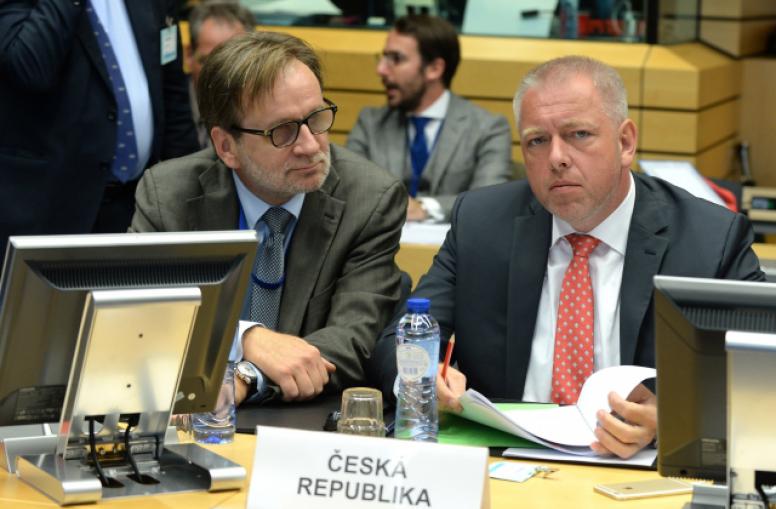
EU interior ministers have approved a relocation plan on distributing 120,000 refugees among member states. The Czech Republic, Romania, Slovakia, and Hungary, voted against it, while Finland abstained.

Under the plan, refugees will be relocated from Italy, Greece, and Hungary to other countries in the EU.

Prague’s decision did not come as a surprise, as Prime Minister Bohuslav Sobotka said hours before the meeting began that the country would reject any quota system.

He added that any attempt to impose such a scheme could end in “big ridicule for the European Commision” and the governments supporting the plan.

Czech Interior Minister Milan Chovanec expressed his distaste for the plan after the vote, tweeting:”We will soon realise that the emperor has no clothes. Common sense lost today.”

Slovakian Prime Minister Robert Fico said those who decided to push through quotas nonsensically caused a deep rift over a very sensitive issue.

However, under European law, three of the countries that voted against the proposal — the Czech Republic, Romania and Slovakia — would be required to accept migrants against their will, an EU diplomat told The New York Times on condition of anonymity after the vote.

Finland was the only country of the EU’s 28 members to abstain from the vote. Poland, which had previously opposed the proposal, voted in favor of it.

The plan has been criticized by the UN refugee agency (UNHCR), which says it is insufficient.

“A relocation programme alone, at this stage in the crisis, will not be enough to stabilise the situation,” UNHCR spokeswoman Melissa Fleming said, urging the EU to set up reception facilities able to handle tens of thousands of refugees at a time.

The UN estimates that around 480,000 migrants have arrived in Europe this year alone, and are now reaching European shores at a rate of nearly 6,000 a day.

Earlier in the day, German rail operator Deutsche Bahn suspended services to Austria and Hungary until October 4th, citing border controls introduced to manage the record surge of refugees.

Hungary has come under fire for its construction of a 110 mile fence along its border with Serbia. Budapest is expected to extend that barricade by also building fences along the Croatian and Romanian borders.

Slovakia introduced temporary controls on its borders with Hungary and Austria last week, sending an additional 220 police officers to the area.

Germany and France have been rallying for a quota system for weeks, with German Chancellor Angela Merkel saying earlier this month that such a plan would be a “first step.” She has stressed that all member states should share responsibility.

The Organisation for Economic Co-operation and Development says Europe can expect a record one million people to request asylum this year, almost half of which will likely qualify to be taken in.

Source: RT

Hungary takes out ads to warn migrants

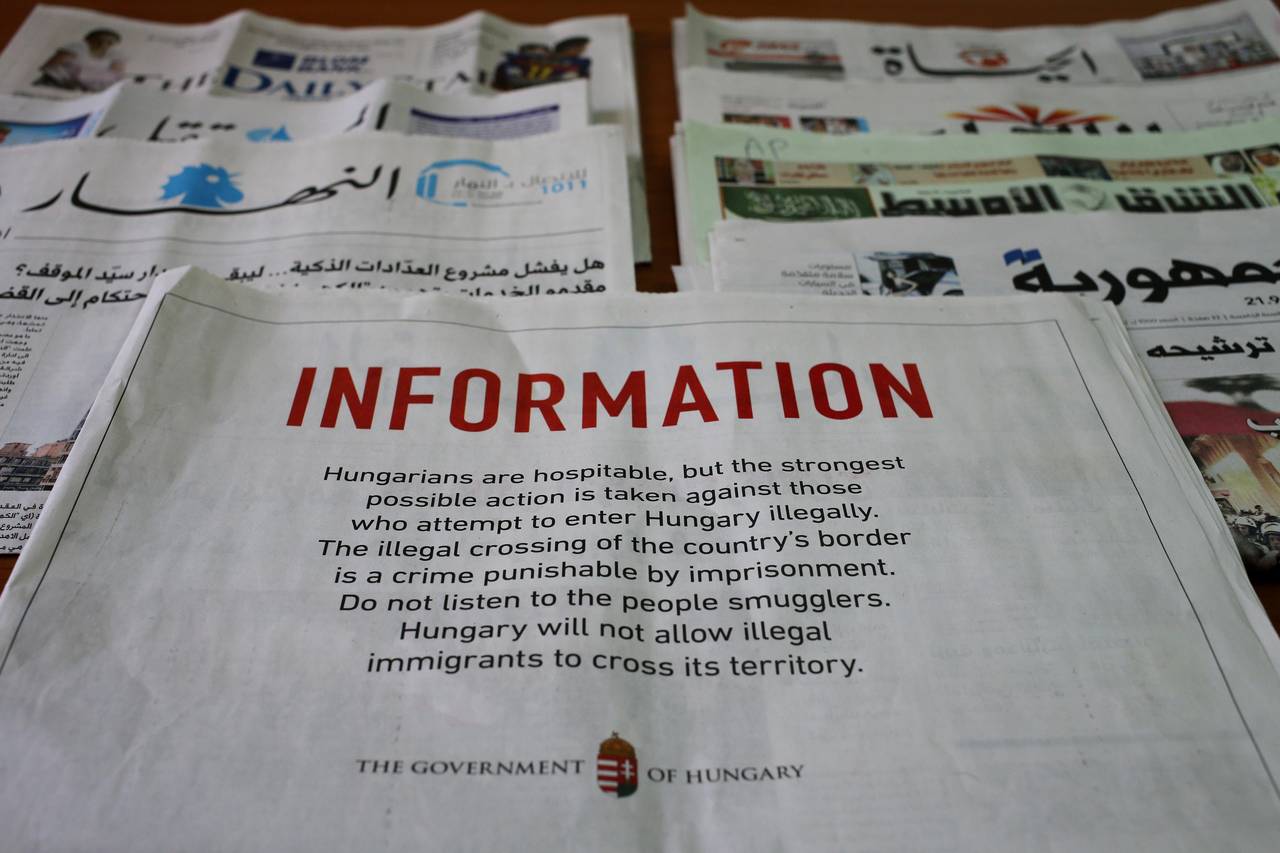
Hungary posted full-page advertisements in local Lebanese newspapers Monday warning refugees and migrants from illegally crossing into the country, two weeks after Denmark took out similar ads as Europe grapples with its biggest migration crisis since World War II.

“Hungarians are hospitable,“ read the full-page English and Arabic ad, ”but the strongest possible action is taken against those who attempt to enter Hungary illegally.”

The full cost of the campaign was unknown.

The privately-owned Annahar newspaper said it had charged the Hungarian government $17,100 for a page.

The ad likely targeted the nearly 1.2 million Syrian refugees living in Lebanon, many of whom have expressed frustration with the lack of support and infrastructure available to refugees there.

On Monday, Hungary passed legislation allowing for army deployment along its own borders as refugees and migrants camped there.

“What’s taking place now is an invasion,” Hungarian Prime Minister Viktor Orban said in a speech opening a session of parliament.

Hungary, whose conservative policies toward refugees and its police force’s use of tear gas against those massed at its borders have been criticized by some of its neighbors, including Germany, which has issued an open-door policy to refugees and promotes a unified border policy between countries in the European Union.

Last week Hungary completed the construction of a 110-mile-long fence along its border with Serbia, forcing thousands to alter their route to Germany via Croatia.

Earlier this month, Denmark took out similar cautionary ads in Lebanese newspapers. In notices that ran in four outlets, it listed tightened procedures in its immigration law, including a 50% cut to social benefits for newly-arrived refugees.

“Foreign nationals granted temporary protection in Denmark will not have the right to bring family members to Denmark during the first year,” said the ad, posted by Denmark’s Ministry of Immigration, Integration & Housing.

Denmark’s ad was posted to correct information circulating among “human traffickers and others profiting from smuggling immigrant and refugees across borders,” the ministry said.

Over 500,000 people applied to asylum for the first time in the EU since January 2015.

Source: WSJ

Austrian far-right leader blames US, NATO for migrant crisis

The leader of Austria’s far-right Freedom Party (FPO) has blamed the United States and the NATO Western military alliance for triggering the refugee crisis that has overwhelmed Europe.

“The USA and NATO have destroyed Iraq and Libya with their military intervention, bombs and missiles; provided financial, logistical and military support to the opposition against President Assad in Syria, and thus made possible the destruction, chaos, suffering and radical Islamism (IS) in the region,” Heinz-Christian Strache said on his Facebook page.

Strache’s opposition FPO party, which leads opinion polls ahead of the centrist Social Democrats and People’s Party coalition partners, typically espouses anti-Muslim and isolationist approaches to dealing with foreign policy.

Source: Jerusalem Post

‘We face an Armageddon scenario with migrants’

The General Secretary for Danish Refugee Help, Andreas Kamm, used to be a politically correct pro-multiculturalist. But he has had a change of mind, and is not even sure if we can save our societies.

From Jyllands Posten:

The number of refugees and migrants heading towards Europe is historically high. The political institutions that are in charge of handling refugee flows are collapsing. The solidarity within the EU and international conventions are under increasing pressure.

We are therefore heading towards a greater collapse, concludes Danish Refugee Council’s longstanding Secretary General Andreas Kamm. …

“We are risking that conflicts between refugees and migrants on the one side and local populations on the other goes awry and will escalate, and in my eyes, we face an Armageddon scenario.”

He estimates that the current pressure from streams of refugees constitutes a “permanent” challenge that will not go away, and recommends the development of new tools that can address and solve the problems.

But the answer is not that “Europe should import the world’s surplus populations,” Kamm said.

“We are not obliged to destroy our own society. We must stop before that if we possibly can,” he says.

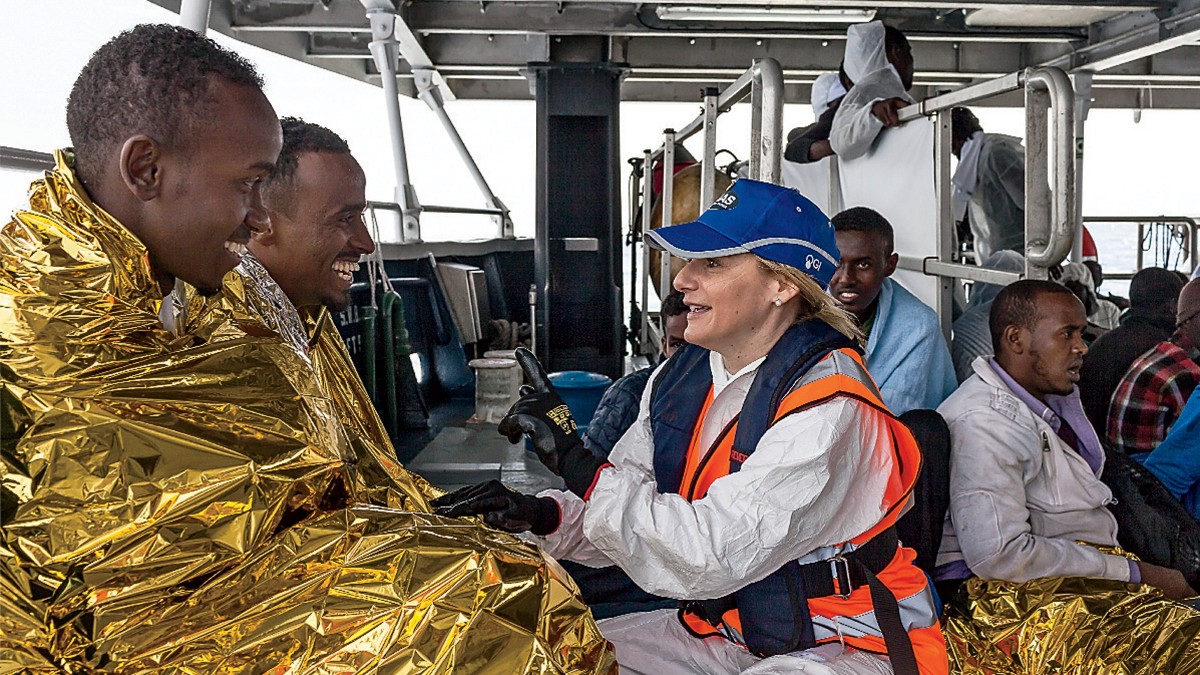
Meanwhile American volunteers aid the migrants. MOAS (the Migrant Offshore Aid Station) is a foundation helping Africans to come to Europe, based in Malta.

It is dedicated to “preventing loss of life at sea by providing assistance to migrants”. MOAS is funded by the son of an American oil engineer from Lake Charles, Louisiana, one Christopher Catrambone.

Ground Zero for migrants errupts in chaos

Keleti train station in Budapest, which has emerged as ground zero in Europe’s spiraling migration crisis, temporarily shut down its services on Tuesday under the strain of an influx of migrants trying to travel to Germany from Hungary.

Emphasizing the sense of confusion across Europe, Austria’s interior minister, Johanna Mikl-Leitner, called on Germany, the preferred destination for many of the migrants, to clarify its stance on asylum rules.

Rows of riot police officers wearing red caps tried to contain the migrants in Budapest, and the migrants erupted in protest after the station stopped allowing them to board trains. Instead, they were allowed into the courtyard of the station, which has been transformed into a makeshift camp.

The migrants, who had been gathered since 5 a.m. in the hopes of boarding a train, chanted: “Go free! Go free! Go free!” Later, they shouted, “Merkel, Merkel,” referring to Angela Merkel, the German chancellor, whose country is expected to receive 800,000 asylum seekers this year.

Train services at Keleti were restored shortly after 10 a.m., and no migrants were being allowed back into the station.

The scenes of confusion and despair at Keleti underlined the challenges facing Europe as tens of thousands of migrants, buffeted by civil war and conflict in the Middle East and Syria, are trying to make the perilous journey to Europe, only to be confronted with a patchwork of policies across a 28-member bloc that is ill equipped to deal with the surge.

In the last five days, the number of migrants trying to leave from the Budapest station has grown to 2,000 a day from about 800.

The chaotic scenes at the station came as Austria asked Germany to provide guidance about how to handle asylum seekers.

The cold reception migrants received in Budapest was a marked contrast to the one in Munich, where the police said on Tuesday that about 2,500 people had arrived on trains from Budapest, via Vienna, in the span of 24 hours. Hundreds more continued to arrive early Tuesday.

Streets around the city’s central train station were blocked off to allow the authorities to organize the migrants and bring them to the city’s refugee processing centers, where they were to be registered and begin the process of applying for asylum.

Matching the flood of people was a flow of donations of drinks, food and baby necessities from Munich residents. “There is no end to the willingness of people to help — Great!” the police said on Twitter.

In Hungary, the center-right government, under pressure from a far-right anti-immigrant party with a sizable voice in Parliament, has itself aired some of the most strident anti-immigrant speech on the Continent.

Source: NYT

Greece asks for 3-year facility from EU, agrees to ‘quick reforms’

Greece has officially asked for a three-year loan facility from the European Stability Mechanism (ESM) and agreed to quick reforms, promising to present a new plan on July 9 at the latest.

“The loan will be used to meet Greece’s debt obligations and to ensure stability of the financial system,” reads the letter sent by the new Greek finance minister.

Greece proposed to immediately implement a set of measures starting from the beginning of the next week, such as tax reform related measures and pension related measures. It also promised action to further strengthen and modernize the country’s economy.

“The Greek government will on Thursday 9 July at the latest set out in detail its proposals for a comprehensive and specific reform agenda for assessment by the three institutions to be presented to the Eurogroup,” the document added.

The requested 3-year bailout package from the IMF is estimated to be over €51 billion, however there is no exact amount.

On June 30 Greece asked for a 2-year bailout program hours before the deadline to repay €1.6 billion to the IMF expired. That request also included a debt restructuring plan, which the Eurogroup rejected that day.

Greece: Faint hopes for a last-minute deal over the weekend

BRUSSELS  — The latest developments involving Greece and its bailout negotiations:

___

5:35 p.m./ 1535GMT/ 11:35 a.m. EDT

The eurozone’s top official, Jeroen Dijsselbloem, says new proposals from Greece came in too late for a proper assessment during the European Union summit, which will end on Friday. That has forced the negotiations to stretch into the weekend.

He says the international creditors “will have a last look at the last Greek proposals which came in very late.”

A eurozone finance ministers’ meeting broke up Thursday without a deal for Greece. It will resume Saturday.

Dijsselbloem says the issues are so technical it is pointless to keep the ministers in Brussels while technical experts assess the new proposals’ validity. “The door is still open for the Greek side to come with new proposals or to accept what is on the table.”

He insists it would not be easy: “We are very — on a number of issues — quite far apart. So it is going to be difficult.”

___

5:30 p.m./ 1530GMT/ 11:30 a.m. EDT

The head of the International Monetary Fund, Christine Lagarde, says Greece’s creditors need more time to examine new offers Athens has made.

She said Thursday after a meeting on Greece broke up without a deal: “We were given a proposal by the Greek parties at the last hour. We need to so some more work to examine their proposals, to see how it can be reconciled.”

She added: “We really want to show flexibility and we want to be as growth friendly as possible and we want to work. But it has to be balanced.”

___

4:50 p.m./ 1450GMT/ 10:50 a.m. EDT

Finnish Finance Ministrer Alexander Stubb says that the eurozone meeting on Greece has wrapped for the day without an agreement on new bailout loans for the country.

Stubb wrote on his official Twitter account: “Eurogroup back later, but not today.”

The decision is a big setback since there had been hopes to wrap up the bailout negotiations in time for European leaders to approve a deal later in the day.

Greece needs new loans by June 30, when it has a debt repayment it cannot otherwise afford.

___

10:45 a.m. EDT/ 1445GMT

The International Monetary Fund says Greece will not get any extra time to make a debt repayment it owes the organization on June 30.

Greece owes the IMF 1.6 billion euros on June 30 but does not have the money to pay it. It is in talks with creditors, including the IMF, on getting more loans before then.

IMF spokesman Gerry Rice says “We’re expecting the payment to be made June 30,” adding that Greece will be granted no extensions.

He says creditors are “on the same page” about the need for Athens to introduce deeper reforms. The creditors say a Greek proposal this week didn’t go far enough and needs to make deeper cuts in the costly pension system, while sparing the poor.

Despite the impasse in talks, the IMF says it would be flexible. “The IMF doesn’t do take it or leave it,” Rice said. “That’s not how we work. It’s always give and take.”

___

4:15 p.m./ 1415GMT/ 10:15 a.m. EDT

French President Francois Hollande is exhorting Greece and its international creditors to speed up talks on new loans for the country, as a default would affect the entire continent.

With decisive talks between dragging on for days, Hollande says that “when Greece, Europe, the eurozone is at stake, we have to know how to finish negotiations.”

He said Thursday as he entered a summit of European Union leaders: “There is nothing to gain by letting time go by. I think Greece has none left.”

The leaders were meant to rubberstamp any deal on Greece, but an agreement remains elusive.

___

4:00 p.m./ 1400GMT/ 10:00 a.m. EDT

German Chancellor Angela Merkel says officials have “not yet made the necessary progress” in the talks to get Greece more financial aid.

As she arrived for a summit of European Union leaders Thursday, she told reporters that “in some places we even have the impression that we are falling back a bit.”

She said the negotiating was a matter for the eurozone finance ministers and technical experts. The talks are about what reforms Greece should adopt in exchange for loans.

Creditors, which include eurozone states like Germany as well as the International Monetary Fund, have made their reform proposals and Greece has submitted its own. Differences remain, however.

___

2:40 p.m./ 1240 GMT/ 8:40 a.m. EDT

The head of Germany’s national central bank is warning that the lifeline keeping Greece’s banks afloat may run afoul of European rules.

Jens Weidmann, who sits on the governing council of the European Central Bank, says the long-term provision of emergency credit to Greek banks “has become the banks’ only source of funding.”

He said lending to banks that can’t borrow elsewhere so they can lend to a government in similar straights “raises serious monetary financing concerns.” That means Weidmann questions whether the practice violates the European Union’s legal prohibition on using central bank powers to finance governments.

The ECB must decide at regular intervals whether to continue to permit Greece banks to draw such emergency credit. Turning off the credit could deepen financial turmoil. Weidmann has only one vote on the 25-member ECB board but a significant one since represents Germany, the eurozone’s largest member.

___

1:55 p.m./ 1155 GMT/ 7:55 a.m. EDT

German Finance Minister Wolfgang Schaeuble says he’s not hopeful about the prospects for Thursday’s meeting of finance ministers because Greece’s negotiating stance appears to have gone backward.

Greece and its creditors are in talks on what reforms the country should make to get more loans it needs to avoid default next week.

Schaeuble says the Greek government so far has “not moved, rather moved backward, and so I am not very confident for our meeting today.”

He says there is nothing new on the table and added that “there is a bigger difference rather than a coming together.”

Schaeuble insists “the decision lies exclusively with those responsible in Greece.”

___

1:50 p.m./ 1150 GMT/ 7:50 a.m. EDT

The eurozone’s top official says creditors are presenting Greece today with a new proposal on reforms it should make in return for loans.

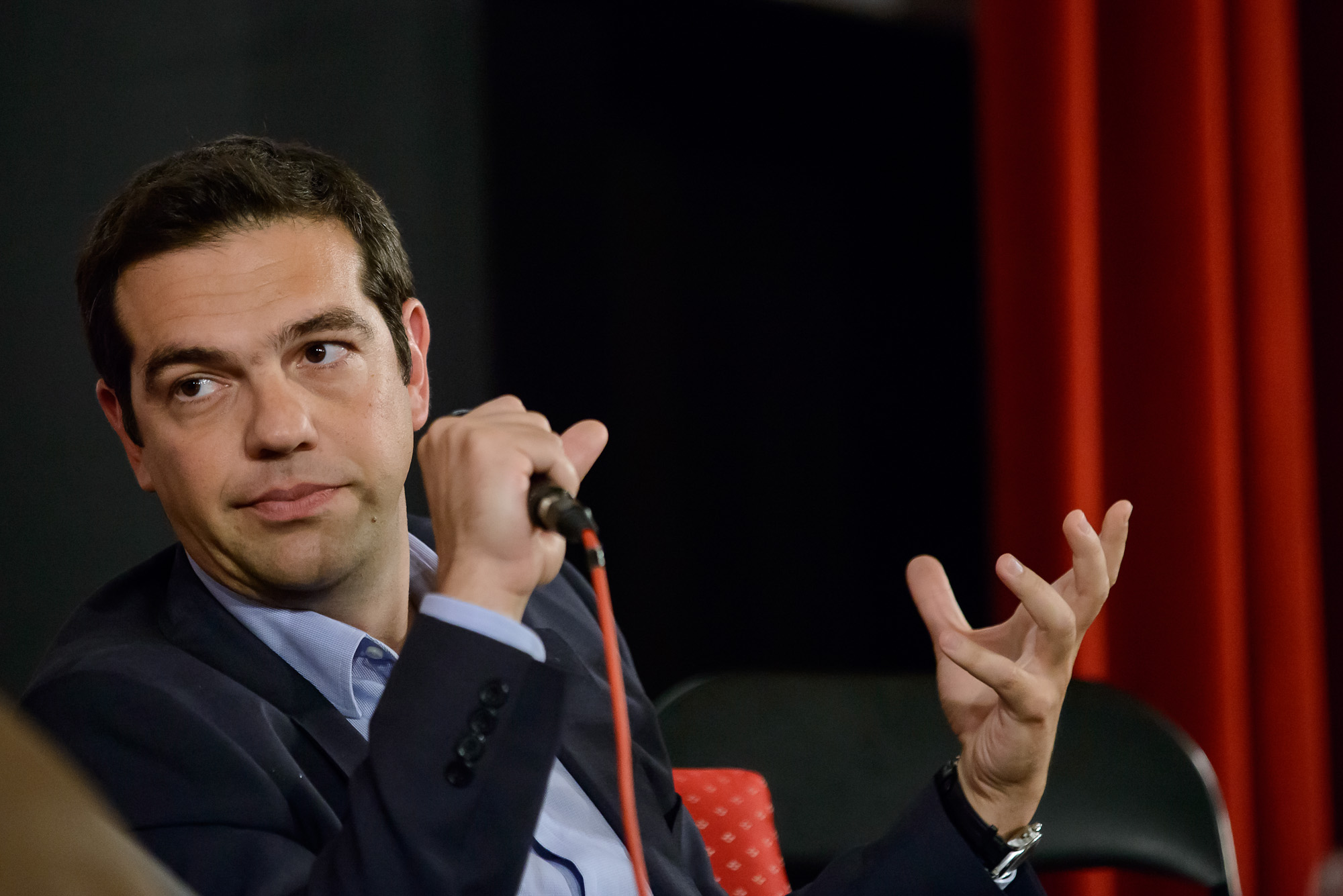
Jeroen Dijsselbloem, the Dutchman who heads the eurozone finance ministers’ meetings, held talks with Greek Prime Minister Alexis Tsipras earlier in the day to seek a breakthrough.

He said the creditors have made proposals, but says that “we don’t have an agreement on the Greeks from that.”

He says eurozone finance ministers will hear “from the Greek side what their ideas are, what they could agree to, what they could not agree to.”

___

1:00 p.m./ 1100 GMT/ 7:00 a.m. EDT

Austrian Finance Minister Hans Joerg Schelling is amazed at the apparent lack of urgency in Greece’s negotiations over a bailout deal.

With the clock clicking down to Tuesday, when Greece has a debt repayment it cannot afford, Schelling says “it is really surprising how carefree Greece deals with its business and constantly comes up with new requests.”

After days of talks, Greek Prime Minister Alexis Tsipras has made changes to proposed reforms his country would make in exchange for loans.

Tsipras, meanwhile, has complained that the International Monetary Fund came up with last-minute conditions on how the Greek reform program should work.

___

12:45 p.m./ 1045 GMT/ 6:45 a.m. EDT

Greek Prime Minister Alexis Tsipras has wrapped up the latest round of talks in Brussels with the leaders of the International Monetary Fund and European Central Bank.

Tsipras gave a thumbs-up as he left, but participants and other senior officials have otherwise declined to speak about the state of the negotiations.

Greece and the creditors are in talks on what reforms it should make to get more bailout loans.

Meanwhile, eurozone finance ministers begin arriving for their meeting. They will assess what technical experts have made of reform proposals made by Greece.

___

12:30 p.m./ 0930 GMT/ 5:30 a.m. EDT

A Greek banking official says the European Central Bank has approved a request from Athens to increase the amount of emergency liquidity Greek lenders can tap from the country’s central bank.

The ECB approved the request Thursday, as it has done every day since Friday as Greece headed into the final stretch of tough bailout negotiations with no clear solution in sight. The banking official, who spoke on condition of anonymity because the decision was not publicly released, said the ECB would meet again within the next 24 hours if necessary.

Worried Greeks have been withdrawing their money from their country’s banks, fearing the imposition of restrictions on banking transactions. An estimated more than 4 billion euros ($4.5 billion) left Greek banks last week. – AP