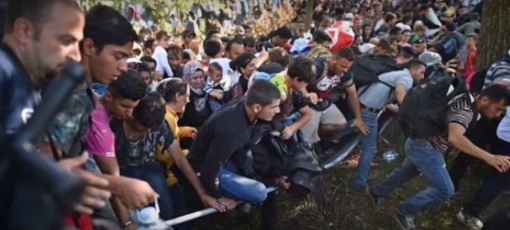
Amid chaotic scenes in Croatia, hundreds of asylum seekers surged past security forces on Thursday to continue their journey to Western Europe.
Some 9,000 migrants and refugees have now poured into Croatia after riot police and a razor wire fence thwarted their efforts to pass from Serbia into Hungary.
Fed up with waiting for transport to continue their journey, huge crowds at the Croatian border town of Tovarnik pushed past police lines.
Now there seems no stopping this surge of humanity – including many people fleeing the Syrian conflict – despite Croatia saying it can’t take any more migrants.
Interior Minister Ranko Ostojic said Croatia would provide migrants with safe passage to reception centres around the capital, Zagreb, but that those not seeking asylum would be considered illegal immigrants.
Unidentified assailants on Sunday attacked a Roma schoolgirl, whose deportation from France sparked controversy, along with her family in Kosovo where they have been living since their eviction, police said.
“The Dibrani (family) were walking in Mitrovica with their children when they were attacked by unknown” people, a police officer, who requested to remain anonymous, told AFP.
The mother of 15-year-old Leonarda, Xhemaili, was “beaten and is in hospital while the children, who are traumatised, are at a police station”, the officer said.
Meanwhile, another police officer told reporters that four people were detained over the incident which, according to first findings, may have been caused by some previous private affairs.
“The incident occurred between two families, the Dibranis and the Bislimis,” police captain Ahmet Gjosha said.
“It turned out that Mr Bislimi was Xhemaili Dibrani’s husband 25 years ago and we assume that this fact sparked the incident.”
The Beslimi family was repatriated from Switzerland four months ago, he said.
Police said they were taking the incident very seriously and a probe was launched.
Shortly after the incident a police officer had told AFP that “it shows that the Dibranis are not safe here”.
Leonarda’s father Resat Dibrani, 47, was at the hospital by his wife’s side.
On Saturday, French President Francois Hollande offered Leonarda the chance to go back to France, but without her family.
Hollande’s offer was immediately rejected by the girl while her father said that the family, deported on October 9, would not be divided and would return to France by any means.
Her parents and five brothers and sisters had lived in France for four years while their asylum bid was processed. It was eventually rejected in the summer.
Leonarda Dibrani’s eviction caused an outcry in France because she was detained during a school trip before being deported with her family, and students took to the streets demanding she return and Interior Minister Manuel Valls resign.
In an interview with AFP Thursday, Resat Dibrani said he was born in Kosovo and that his wife and five of his six children, including Leonarda, were born in Italy.
He said he had lied about his family’s Kosovo origins to have a better chance of obtaining asylum.
Earlier on Sunday, the father told AFP that his “children are afraid to go out”.
“I cannot adapt myself, I left 35 years ago. I do not recognise the town any more,” he said stressing that he had only 200 euros ($275) left to feed his family.
The father, who wants to return to France, said: “The problem is to get into (EU member) Croatia and afterwards the way is open.”
“I would have to get 20,000 euros” for people who would take us into Croatia, he added.
The results of a formal probe published in France on Saturday found that the deportation was lawful but that police could have used better judgement in the way they handled it.
They also found that Leonarda and her sister were taken in by French social services after having accused their father of violence — a claim they later retracted.
Last year, 36,822 immigrants, many of them Roma, were deported from France, a nearly 12 percent rise from 2011. – AFP
It’s not likely to ease Americans’ concerns about going to war, but the White House announced Monday that Albania is on board with the Obama administration’s plans to punish Syria.
Tiny Estonia, too, has agreed that Syria must be held accountable for using chemical weapons. The Coalition of the willing on Syria includes such superpowers as Albania, Estonia, Honduras.
Croatia, Denmark, Germany, Honduras, Hungary, Kosovo, Latvia, Lithuania and Morocco are the willing nations. And let’s not leave out Qatar, Romania and the United Arab Emirates.
They are the latest countries to sign on to a statement condemning the Syrian regime and calling for a “strong international response,” although not necessarily the missile strikes proposed by President Obama. A total of 25 nations support the statement, including the U.S. and Great Britain. – Washington Times
The European Union flag, left, and Croatian national flag fly from the Croatian state parliament building in Zagreb, Croatia.
Tens of thousands of Croatians cheered the country’s entry into the European Union at midnight Sunday as fireworks lit up the skies above Zagreb.
It was a historic moment for the former Yugoslav republic, coming nearly two decades after it emerged from a bloody independence war in the 1990s.
Some 20,000 people gathered at Zagreb main square, joining more than 100 European dignitaries to mark event on the stroke of midnight (2200 GMT) when Croatia officially became the bloc’s 28th member.
“Welcome to the European Union!” European Commission President Jose Manuel Barroso told the crowd.
Countdown celebrations were held in towns throughout the country as crowds cheered to the EU anthem, Beethoven’s “Ode to Joy”, waving EU and Croatia’s flags in joy.
Welcoming Croatia into the bloc, European President Herman Van Rompuy said the country had “crossed an important threshold.
“It will change the life of this nation for good,” Van Rompuy told the festive crowd in Zagreb.
As thousands of Croatians took to the city squares to celebrate, officials removed the “Customs” sign at a border crossing with fellow EU member Slovenia.
At the same time, the “EU” sign appeared at the land border with Serbia, another ex-Yugoslav republic which on Friday got a green light from Brussels to open membership talks by January 2014.
But the celebrations were overshadowed by economic worries that the membership would only burden already recession-hit Croatia’s economy.
“There is nothing to celebrate, it will not get better, prices will jump and we will become a cheap workforce,” said 30-year old Zagreb administrator Branka Horvat.
The centre-left government hopes that EU entry will attract badly needed foreign investment and boost the economy with 11.7 billion euros ($15 billion) of potential financial aid.
Croatia’s tourism-oriented economy has been either in recession or stagnant for the past four years, while unemployment stands at around 20 percent.
The country’s per capita gross domestic product is 39 percent below the EU average, with only Romania and Bulgaria lagging behind, the bloc’s figures show.
But Croatian President Ivo Josipovic vowed not to “let the cloud of the economic crisis overshadow our vision and optimism.”
“The crisis is a challenge, an invitation to make tomorrow better than today,” Josipovic said in his celebratory speech in Zagreb.
A lavish EU entry celebration in Zagreb included performances by some 700 singers, musicians and dancers at three stages decked out in the EU’s trademark blue colour.
Nik Kolveshi, 23-year-old student from Zagreb, said Croatia was “finally joining its family.”
“Many opportunities will open as we will be officially linked with Europe,” he said.
“I am satisfied that we are finally there where we belong, but we are not ecstatic as we have a pile of problems to deal with,” said psychiatrist Lukrecija Pavicevic.
But Croatia’s branch of global Occupy movement declared: “EU entry is an economic genocide against our citizens.”
Prime Minister Zoran Milanovic earlier dismissed fears that Croatia, with a population of 4.2 million, would be an economic burden on the EU.
“At the end of the day we are not a part of the eurozone,” he said referring to the crisis-ridden single currency bloc.
In a toast at the official dinner on Sunday, Josipovic described the EU accession as the “end of one stage in Croatia’s history and the beginning of a new, European age for us.
“The moment of Croatia’s accession to the EU is a time of many doubts and questioning. In Croatia also there are similar dilemmas,” Josipovic added, in a reference to the eurozone debt crisis.
Zagreb has aspired to join the EU club ever since it proclaimed independence from the former Yugoslavia, a move that sparked the bloody 1991-1995 war against rebel Serbs backed by Belgrade.
Croatia becomes only the second former Yugoslav republic to join the bloc, after Slovenia, following the bloody breakup of the ex-communist federation in the 1990s.
Heads of state from all six ex-Yugoslav republics were among the guests, but the leaders of many EU member states including Britain, France and notably Germany did not attend.
German Chancellor Angela Merkel cited a full workload to excuse herself from the event, but both Croatian media and the opposition labelled her decision a “diplomatic slap”.
This website uses cookies to improve your experience. We'll assume you're ok with this, but you can opt-out if you wish. Cookie settingsACCEPT
Privacy & Cookies Policy
Privacy Overview
This website uses cookies to improve your experience while you navigate through the website. Out of these cookies, the cookies that are categorized as necessary are stored on your browser as they are essential for the working of basic functionalities of the website. We also use third-party cookies that help us analyze and understand how you use this website. These cookies will be stored in your browser only with your consent. You also have the option to opt-out of these cookies. But opting out of some of these cookies may have an effect on your browsing experience.
Necessary cookies are absolutely essential for the website to function properly. This category only includes cookies that ensures basic functionalities and security features of the website. These cookies do not store any personal information.
Any cookies that may not be particularly necessary for the website to function and is used specifically to collect user personal data via analytics, ads, other embedded contents are termed as non-necessary cookies. It is mandatory to procure user consent prior to running these cookies on your website.