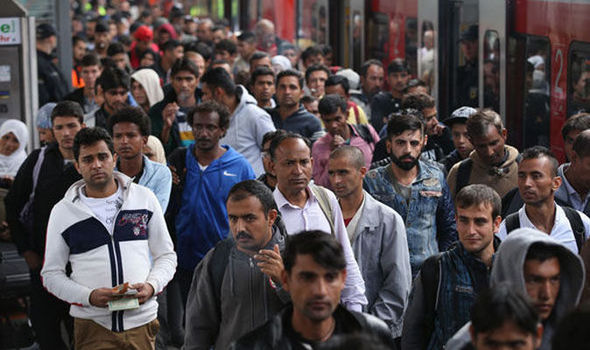
Research poll: 70% of Germans want migrants to be sent back

A new study has revealed that the vast majority of Germans do not see the migrants coming across the Mediterranean as legitimate refugees and want to see them deported back to North Africa.

The study, conducted by research institute Civey shows that 69.8 per cent of Germans do not regard the migrants rescued and transported by NGOs in the Mediterranean as legitimate refugees despite claims from the NGOs themselves.

Many of the NGOs have called for Germany to stop cooperating with the Libyan coastguard which has been turning back migrant boats, but according to the survey, most Germans disagree with them, Die Welt reports.

When the survey data is broken down by age, it shows that the largest section of those who want to return the migrants to North Africa are aged 65 and older at 74.6 per cent. The data also differs depending on the region of Germany the participant comes from with East Germans being the most favourable to deportations.

Along political lines, a majority of members of all parties support the deportation of Mediterranean migrants except for the left-wing Green party with only 34.7 per cent approving of the idea and 48.8 per cent rejecting the idea.

The Green party have long been in favour of the NGOs and their rescue missions in the Mediterranean, including Hamburg Green politician Anna Gallina who joined the crew of the Sea Eye NGO earlier this year. Ms. Gallina justified her actions saying: “I am going to Libya in the next few weeks because I want to contribute to the salvation of the people.”

The survey deeply divided the far-left Die Linke, or Left Party, with the number of those agreeing and disagreeing being close to equal. Some members of the far-left party, which finds its origins in the Communist party of former East Germany, have been against mass migration while others like Left Party politician Diether Dehm are so pro-migrant that Dehm was accused of smuggling migrants himself.

Perhaps least surprisingly, anti-mass migration Alternative for Germany (AfD) members voted 98.8 percent in favour of deporting Mediterranean migrants. The AfD has consistently been against mass migration and for the strengthening of Germany’s borders since the start of the migrant crisis.

A new poll, from Insa, shows the AfD regaining some of the momentum they had in regional and local elections last year. The poll shows the party once again in third place nationally behind German Chancellor Angela Merkel’s Christian Democrat/Christian Social Union (CDU/CSU) coalition and the Social Democrats (SPD) led by former European Union parliament president Martin Schulz.

Germany gets black members of parliament

Karamba Diaby
Karamba Diaby

A chemist and an actor — both with family roots in Senegal — have become Germany’s first black federal lawmakers, according to official election results released Monday.

They were among 34 lawmakers with immigrant backgrounds to win seats in Sunday’s election, up from 21 in the previous term, said the Migration Media Service, a group that provides facts and figures on immigration in Germany.

Although nearly one in five of Germany’s 80 million people are immigrants, or the children or grandchildren of immigrants, relatively few have made it into the federal legislature. Until now there were no black lawmakers in Parliament, despite more than 500,000 people of recent African origin believed to be living in Germany.

“My election into the German Parliament is of historical importance,” said Karamba Diaby, a Senegalese-born chemist who moved to the city of Halle in 1986 after receiving a scholarship to study in communist East Germany.

The 51-year-old, who gained German citizenship in 2001, said his priority would be to promote equal opportunities in education. “Every child born in Germany should have the chance to be successful in school regardless of their social background or the income of their parents,” he said.

The other black lawmaker elected Sunday was Charles M. Huber, a 56-year-old actor born in Munich to a Senegalese father and a German mother. Huber is a member of Chancellor Angela Merkel’s Christian Democratic Union, which won the election with 41.5 percent of the vote.

Merkel’s party also now has its first Muslim lawmaker in the Bundestag. Cemile Giousouf was elected in the western town of Hagen. The 35-year-old was born in Germany to Turkish immigrant parents.

Several lawmakers of Turkish origin have previously been elected to the lower house, but most were with the Social Democratic Party, which Diaby represents, the environmentalist Green Party or the Left Party.

“Measured against the 630 seats in Parliament, some 5.4 percent of deputies now come from immigrant families,” the Migration Media Service noted. “In the population as a whole their share is more than three times as high, with about 19 percent. – AP

Merkel to host EU talks on sky-high youth unemployment

Angela Merkel
Angela Merkel

Chancellor Angela Merkel on Wednesday hosts EU talks on felling sky-high youth unemployment less than three months before German elections after coming under fire for championing austere spending cuts and helping to create a “lost generation”.

Days after EU leaders okayed up to eight billion euros ($10.4 billion) for initiatives to help get the region’s 5.6 million jobless under 25-year-olds into work, Merkel will gather leaders and labour ministers in Berlin to thrash out the ways and means.

Merkel, whose conservatives have been cruising high in the polls, has shifted tone on fighting Europe’s financial woes in recent months, tempering her earlier insistence on budgetary rigour with an emphasis on growth.

And while she began co-opting major social policies from the main opposition Social Democratic Party (SPD) years ago, she has hardly missed a chance of late to warn that if Europe fails to foster more growth, it faces losing a whole generation.

Hard on the heels of a warning by US President Barack Obama on his Berlin visit this month that a change of tack was needed to avoid just that, Merkel said last week that Europe’s young people were “owed” chances for the future.

“And we particularly owe them it because they, the youth, are in no way to blame for the failures which have arisen in recent years,” she said in the Bundestag lower house of parliament.

French President Francois Hollande and EU Commission head Jose Manuel Barroso are due at the talks, which, according to a German government spokesman, will focus on “concrete measures” and “an exchange of best practices”.

“We want to share particular national experiences with each other — and Germany has broad experience from the time of German reunification — on advancing youth employment, and identify the most promising measures,” Merkel said.

Germany, Austria, the Netherlands and Denmark have experience to share on their systems of offering youngsters an apprenticeship at a company that combines vocational education, she added.

EU leaders agreed in Brussels Friday that the funding could be used from January to promote work placement programmes and help job seekers find work in other parts of the EU, although critics have called the amount a mere “drop in the ocean”.

The EU executive had announced in February its seven-year plan to ensure that young people are guaranteed either training, further education or employment within four months of leaving school.

Twice bailed-out Greece leads the way, with youth unemployment having reached more than 62 percent in April, but young adults in Spain, Portugal and Italy are also badly affected, while Germany struggles with a skilled labour shortage.

In Germany, some 34,000 apprenticeships in industry and trade were still unfilled shortly before programmes were due to begin, the Association of German Chambers of Commerce and Industry (DIHK), announced earlier this month.

DIHK Vice President Achim Drecks warned against too-high expectations. “When you speak of a ‘guarantee’ (of training, jobs or education), you hamper the acceptance of Europe” if it is not met, he told reporters.

But he said the jobs conference showed concern, after Germany and in particular Merkel have been skewered over their anti-crisis policies by angry protesters in the likes of Greece and Spain.

Gero Neugebauer, political scientist at Berlin’s Free University, said the conference had no bearing on the campaign for September 22 elections in which Merkel is seeking a third term — but also did her no harm.

“Germans are basically interested in what is happening here. They would like to be protected from the effects of the crisis.

“When Mrs Merkel then says ‘we’re giving money to fight youth unemployment in poor or economically weak countries…’ then they’ll say ‘as long as I don’t pay individually, that’s OK’ and Mrs Merkel is seen as a woman who only wants to do good.

“And who can have anything against that?” he said.

Her chief SPD rival Peer Steinbrueck heaped some of the blame for Europe’s high youth unemployment on what he called Merkel’s “one-sided” focus on austerity, criticising a “vicious circle of savings and growth setbacks”.

But labour market expert Karl Brenke, of the German Institute for Economic Research, cautioned against “disproportionately high” expectations over the migration of jobless youngsters to regions where labour is needed.

“The first thing to do isn’t to carry out action at the European level but to think about how at national level one can organise more solid training,” he said. – AFP