Except for Afrikaners, South Africans prefer their children to be taught in English

Steven Gordon, Human Sciences Research Council and Jaqueline Harvey, Human Sciences Research Council

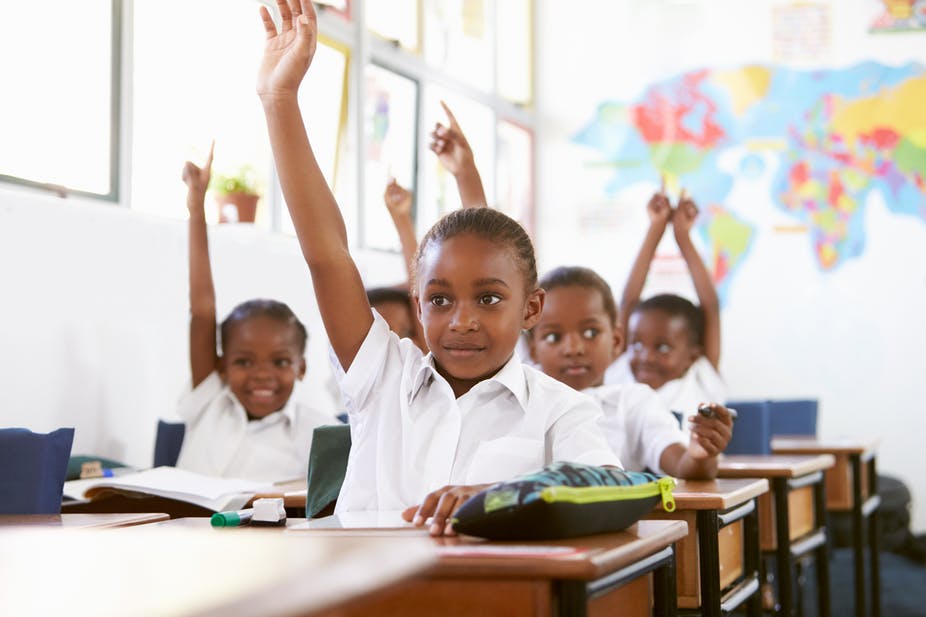
English is only one of 11 official languages spoken in South Africa. It’s currently the preferred language of education and is used in many of the nation’s schools. But most children entering the education system are not native English speakers and many are still in the process of learning English by the time they arrive at school.

The main language of instruction in education influences academic and career progress. Oral language proficiency is a foundational skill that’s required to develop the ability to read which in turn is required, together with writing, for all types of learning.

Language use in schools has been a focus in both national and international research. It is largely agreed that learners should be taught in their home language. However, many countries continue to promote English instruction including Kenya, India, and South Africa. The conflict between what is being implemented in schools and what is recommended by the available research remains unresolved.

There is a strong body of work that shows that learning problems can develop if the language in which a child has oral proficiency is not the same as the language of instruction. As a result, policymakers in most countries now recommend home language instruction for the first years of education after which a gradual transition to another language can be made.

But the policy won’t succeed unless there is buy-in from the general public. In designing and implementing education language policy, it’s therefore necessary to understand peoples’ preferences.

We set out to find out what these are in South Africa. We examined public attitudes towards main language of instruction at different levels in the South African education system. Preferences for language of instruction at different stages of education was examined for the period 2003–2016 and this allowed us to map any changes in attitude.

We found that a majority of the population favoured English as the language of instruction at all levels of education. It is clear that people are unaware of the benefits of home language instruction and may resist efforts to promote the teaching of African languages in South African schools.

The research

We used data from the South African Social Attitudes Survey for this study. The survey series is nationally representative and is used to track public attitudes on important social and political issues. The series is administered by the Human Sciences Research Council and has been conducted annually since 2003.

In each round of the survey, people were asked: “What do you think should be the main language of instruction in: (1) grade 1–3; (2) grade 4–9; (3) grade 10–12; and (4) higher education?”

In 2003 about half (55%) of the population preferred English as the language of instruction against about two-fifths (41%) selected home language at the foundation phase (grades 1-3).

Thirteen years later popular support for English as the language of instruction during the foundational phase had gone up to 65% – the highest level since polling began. The most recent survey, the results of which have not yet been published, found little change in 2018.

The preference for English extended into later years of education too. In fact, we found that the number of people supporting English rose the higher up the education ladder went. In other words, the more advanced the phase of education the smaller the share of the public supporting options other than English.

There was remarkably little variation in attitudes for the last decade indicating the durability of these preferences. And over the ten years attitudes among South Africa’s population groups remained very similar.

The best way forward

A preference for English over home language may be motivated by economic concerns. Research has shown that English proficiency in South Africa is linked to socio-economic advancement.

Another reason for the popularity of English as a language of instruction could be the general lack of school resources and training required for educators to teach in many of the country’s African languages. When compared to other languages, greater resources are devoted to helping teachers educate learners in English.

The disparity in resources could, in turn, reinforce the view that English is superior to African languages.

What next

We believe that post-colonial education policies should nurture multilingualism and promote all languages. This will require a well-resourced programme to overcome common misconceptions about the alleged inferiority of African languages. The development of compelling teaching materials for African languages is required as well as educating teachers on how to use such materials. Although there may be opposition from some, learners will ultimately benefit from such a programme.

The government is moving in this direction. The Department of Basic Education recently launched the Incremental Implementation of African Languages programme which aims to strengthen the teaching of African languages in South African schools.

The goal is to reach 3,558 public schools across all grades by 2029.

But, as our research shows, South African policymakers must convince the public to support home languages as the main language of instruction if the programme is going to succeed.The Conversation

Steven Gordon, Senior research specialist, Human Sciences Research Council and Jaqueline Harvey, Researcher, Human Sciences Research Council

This article is republished from The Conversation under a Creative Commons license. Read the original article.

Dan Roodt: Anglicising Afrikaans schools will speed up the country’s decline

It is astonishing that Mary Metcalfe, whose educational legacy in Gauteng was characterised by one foolish, abandoned experiment after the other, should pontificate on the issue of Afrikaans schools (“War talk won’t end language row”, June 5). The very prowess of those schools and their exceptional results depended for years on avoiding, sometimes even surreptitiously, the more disastrous policies and decisions emanating from the provincial education minister’s office.

Metcalfe is also blindly ethnocentric, judging from the zeal with which she argues the case for ramming even more English down our throats. What she calls a “legal war of attrition” over the Afrikaans schools is, more fundamentally, a prolongation of the Anglo-Boer wars and the quest for total English supremacy and monoculture.

In many societies, such attempts at cultural and political domination of one group over another have led not to legal bellicosity, but to more literal war and ethnic conflict. Metcalfe refers to “challenges of perception”, among which is the “perception” (of white liberals with children in ­private English schools?) “that language exclusion operates as a proxy for racial exclusion”.

Before we argue about perceptions, there is a reality that Afrikaners are, by and large, politically and culturally excluded from the current system that is run by ex-terrorists, ­former exiles and an Anglomaniac elite that takes its own colonial Anglo-American or even Afro-American culture as a given. McDonald’s and KFC are in; boerewors and biltong are out.

The operative term here, and which Metcalfe in her Anglomaniac self-righteousness uses quite freely, is “imposition”: “the imposition of English as a parallel medium of instruction in Afrikaans-medium schools”. By what right do Metcalfe, Barbara Creecy and their puppet, Panyaza Lesufi, want to “impose” their killer language on us? English enjoys unheard-of dominance, funding (also by the Afrikaans taxpayer, who is financing English imperialism) and exclusive privilege on all levels of government, yet this is apparently not enough. The Afrikaans school must be stifled, given its final solution – all in the name of “diversity”, that nauseatingly politically correct concept. There are ­thousands of all-black schools all over South Africa without any white children, yet no one is bemoaning their “lack of diversity”.

It follows that the assault on Afrikaans schools has nothing to do with improving education, but more with the ethnic hatred of Afrikaners in some Anglophone, cultural-Marxist circles whose covert objective is not only to eradicate the Afrikaans language but also to rid the country of Afrikaners. Either we will be made to feel so unwelcome and hated that we will simply emigrate or there will be some more violent solution to the “Afrikaner problem”.

If the remaining 124 Afrikaans schools in Gauteng succumb to English political fanaticism, the country will lose many young engineers and scientists, further hastening its current decline. But those schools have a wider function too: in a violent, decadent society that is hostile to cultural minorities, they care for our children.

Afrikaans schools manage to give children from single-parent, lower middle-class homes a chance in life. They also represent the last havens of Afrikaans culture menaced by an Anglocentric state and corporate behemoths constantly imposing their monoculture on everyone.

It is not true that “from 1994, many historically Afrikaans schools have opted to offer parallel streams of English and Afrikaans in one school”. In all the cases I know of, there was some degree of threat or coercion from the provincial education department concerned.

The notion that Afrikaans schools “belong” to the state and not to the community that created them must also be challenged. Metcalfe and education MEC Lesufi are the landlords of public schools, lording it over their hapless tenants as they see fit. Most Afrikaans schools in Gauteng were financed by Afrikaner taxes and are maintained as semi-private institutions by fee-paying parents, often grappling with financial problems.

Ever since the British took control of South Africa in 1806, there has been a Dutch and Afrikaans taalstryd (language struggle), perhaps interrupted by 40 years of National Party rule, during which an Afrikaner government did not dare to force English schools to become Afrikaans medium.

After two centuries of language struggle, the very existence of Afrikaans and Afrikaans schools is still under threat from a hostile, fundamentalist, Anglomaniac government that makes British colonialists look tame by comparison.

First pulblished on 11 June 2015 in the Mail & Guardian, Johannesburg.

Ilana Mercer: Alas, Donald Trump is no cultural Marxist

Trump Walking The Culturally Conservative Talk
By Ilana mercer

WHEN IN THE US, SPEAK ENGLISH. Donald Trump’s retort to Jeb Bush’s rattling off in Spanish on the campaign trail conjures an old joke told in Israel of my youth. It was aimed at the ultra-orthodox Jew who dresses weirdly and won’t speak Hebrew. Here goes:

Walking down the street is a Sabra (a Jew born in Israel), clad in the pioneer’s outfit of shorts and a Tembel Hat. (“Tembel” is Hebrew for silly. The image below illustrates how not even a beautiful Israeli girl can dignify a hat so useless as to provide no protection from the merciless sun.)

From across the street, in Yiddish—the language of the diaspora—an ultra-orthodox Jew clad in black garb shouts obscenities at the Sabra. The minuscule ultra-orthodox community believes that speaking Hebrew before Messiah arrives is heretic and will delay the coming of Messiah (also known as the longest coming in history). For Messiah to materialize, the Jew must remain weak, dispossessed and persecuted—a sickly spirit without a corporeal country to call his own.

The Israeli shouts back, “Speak Hebrew, goy!” Goy meaning non-Jew.

Trump took a jab at Jeb for using Spanish to dismiss the mogul’s conservative credentials. Via CNN:

“‘I like Jeb,’ Trump told Breitbart News. ‘He’s a nice man. But he should really set the example by speaking English while in the United States.'”

The Trumpian reference was to the former Florida governor’s comments to reporters … about Trump’s policies. “‘El hombre no es conservador,’ Bush said, which translates to, ‘This man is not a conservative.'”

Not only was Trump’s visceral retort in defense of English righteous; it was also culturally conservative in the best of ways.

RESTORING TRUTH TO LANGUAGE. Paraphrased, here is a collection of Trumpian straight-talk on the Zeitgeist. (Donald’s “most notable insults,” as The Hill would have it):

  • We are led by stupid people. Very, very stupid people.
  • Media are dishonest.
  • Talking to Anderson Cooper is a waste of time.
  • War-all-the-time Charles Krauthammer is an overrated, clueless clown.
  • Anthony Weiner is the definition of a perv. [Or, as one Jewish writer you’ll recognize put it, the “Weiner worm is a poster boy for anti-Semitism.”]
  • Elizabeth Beck is disgusting. [She’s the wild-eyed attorney who turned a deposition of the busy businessman into a legal brief on pumping breast-milk.]
  • The once-great National Review … [Trump translated: NR is no longer great.]
  • “George Bush sends our soldiers into combat, they are severely wounded, and then he wants $120,000 to make a boring speech to them?” [Yet another insight about Genghis Bush shared by yours truly. My past post was referring, in particular, to Bush charging the “Helping a Hero” charitable fund for speaking (in tongues) to their beneficiaries. First Bush sent these soldiers to die for nothing in Iraq and Afghanistan. Next he robbed those who came back broken.]
  • Penn Jillette’s show is terrible. [A self-evident truth.]

“Do we believe in the gene thing?” roared Trump at a crowd that had assembled to hear him speak in Mobile, Alabama, last month. Yes, he mentioned the G Factor. Trump was touting his genetic lineage; says he comes from a family of high-achievers.

Hasn’t the guy received any briefings on the prevailing linguistic Cultural Marxism—euphemized as political correctness—in the country he seeks to govern? It is an axiom of liberal establishmentarians like Jeb, George and the rest that the nature-nurture debate has been settled, politically, at least.

According to liberal liturgy, of which Trump appears to know nothing; if not for largely exogenous circumstances—all human beings would be capable of similar accomplishments. Many a co-opted scientist will second the political dictum that there is no such thing as general intelligence. Speak, if you must, about the phenotype—even genotype—of all individual traits other than intelligence. As for the possibility of group genotypic intelligence: Don’t go there!

On America’s conflict-of-interest riddled, corrupt press corps, Trump quipped: “Shouldn’t George Will have to give a disclaimer every time he is on Fox News that his wife works for Scott Walker?”

That brings me back to the topic of intelligence, to which Scott Walker relates as Trump relates to the tyranny of political correctness. In the course of vying for the Republican Party’s nomination in the 2016 presidential election, the governor from Wisconsin came up with another “conservative,” cogent idea: equal opportunity fencing. Reflexively—and laboring to show he does not discriminate against Mexico—Walker showed himself to be an indiscriminate bumpkin. To wit:

Walker has called building a wall along the border between the US and Canada a “legitimate issue.”

Illegal immigration and the security of the southern border with Mexico have been major issues in the Republican race for president, but the northern border has not been discussed.

Mr. Walker made the comments in response to a question from a NBC News reporter.

“That is a legitimate issue for us to look at,” he said …

Like the official left, these self-styled “conservatives” are in revolt against nature and reality. Canadian or Mexican; to the Bush and Walker egalitarian, the potential of all people is the same. Therefore all borders must be similarly defended or undefended.

Does the US have a problem with a deluge of illegal immigrants pouring over the Canadian border? No. Canada is a high-wage area. The US is a high-wage area. Latin America is a low-wage area. Migratory pressure, Mr. Walker, flows from low-wage to high-wage regions; from the Third World to the First World (until migratory equilibrium is reached when First World becomes Third World).

Donald Trump’s tone is unhelpful, Jeb Bush keeps sniveling in that soporific singsong of his. On the contrary. Not for nothing do our linguistic tormentors (like their communist-party mentors) seek to regulate language. For to be vested in linguistic accuracy, is to be vested in the truth. The closer the language we use approximates reality—and, by extension, the truth—the greater the likelihood that our actions will follow.

In this sense, Trump’s blunt, in-artful language is immensely helpful.

**
Ilana Mercer is a paleolibertarian writer, based in the U.S. She pens WND’s longest-standing, exclusive paleolibertarian column, “Return to Reason.” She is a contributor to The Unz Review, America’s smartest webzine, and is a fellow at the Jerusalem Institute for Market Studies. Her latest book is “Into the Cannibal’s Pot: Lessons For America From Post-Apartheid South Africa.” Her website is www.IlanaMercer.com. She blogs at www.barelyablog.com
Follow her on Twitter: https://twitter.com/IlanaMercer “Friend” her on Facebook: https://www.facebook.com/ilanamercer.libertarian

Letter: By what right may government decide what language I should use?

I write in English to accomodate readers who aren’t bright enough to speak more than one language; those who do not understand Afrikaans.

I write anonymously as I am not pursuing a career in politics or in media. Further I don’t want to be tarred and feathered or championed by any group.

Also as I am not a politician or a pundit, so I will keep it brief, relying on the reader’s pre-existing knowledge of affairs to set the context and situation.

I refer to the current controversy on racial transformation in our society, specifically with regards to Stellenbosch University and the Open Stellenbosch movement.

It has been reported that Stellenbosch University has removed the memorial plague of the Villain Verwoerd and renamed the Malicious Malan hall.

I find this ironic. It’s ironic as the government and associated intellectuals and press still think that they are within their rights to socially engineer South Africans into their vision of society, curtailing the rights of individuals and free associations that don’t fit the plan.

Furthermore they won’t blink whilst classifying individuals into racial categories and deciding for themselves what the rights will be that these categories shall enjoy or forgo.

I find it very ironic that a movement such as Open Stellenbosch is fighting for language rights at Stellenbosch University (not Universiteit) when that institution is already a majority English university with almost all textbooks in English; the majority of classes are presented in English, not translated but presented in English.

All exams can be completed either in English or in Afrikaans.

Nobody is intuitionally/bureaucratically excluded from Stellenbosch on the basis of race and there have been major efforts to accommodate students who are not Afrikaans-speaking at undergraduate level, while all post-graduate studies are already in English.

Fighting for language rights at the only bilingual university in South Africa?

Are there any English universities who even make this concession to language preference? Stellenbosch is already a de facto English university and de jure a bilingual university.

Within all popular frames of reference it is not only allowed, but morally just and desirable for government to impede individual freedoms by disallowing the right to free association, language and cultural rights.

In this philosophy it is just for national government to interfere in the future of it citizens and decide no longer will this be an all-white team/university/company/person but it must now be 79.2% black.

By what right can government classify me according to race, and if this right exists for government what is the process, where do I appeal and when will the SA bureau of Standards(SABS) release the race specs?

By what right can the Communist Party tell me in what language I may receive instruction?

This is pure arrogance to interfere in my life and disturb my peace. Was it gained from Baas Verwoerd?

Koos Kleurvol
‘n Vryburger

US now has more Spanish speakers than Spain

The United States is now the world’s second largest Spanish-speaking country after Mexico, according to a new study published by the prestigious Instituto Cervantes.

The report says there are 41 million native Spanish speakers in the US plus a further 11.6 million who are bilingual, mainly the children of Spanish-speaking immigrants. This puts the US ahead of Colombia (48 million) and Spain (46 million) and second only to Mexico (121 million).

Among the sources cited in the report is the US Census Office which estimates that the US will have 138 million Spanish speakers by 2050, making it the biggest Spanish-speaking nation on Earth, with Spanish the mother tongue of almost a third of its citizens.

By state the highest concentration is in the former Spanish colonies of the south and south-west, with New Mexico top at 47%, followed by California and Texas (both 38%) and Arizona (30%). Some 18% of New Yorkers speak Spanish while only 1.3% of West Virginians do. Perhaps surprisingly, more than 6% of Alaskans are Spanish speakers.

The report, El español, una lengua viva – Spanish, a living language – estimates that there are 559 million Spanish speakers worldwide, a figure that includes 470 million native speakers and those with some command of the language.

The Index of Human Development ranks Spanish as the second most important language on earth, behind English but ahead of Mandarin. It is also the third most widely used language on the internet, although less than 8% of internet traffic is in Spanish. The report says that Spanish is the second most used language on Twitter in London and New York. It also comes second on Facebook, a long way behind English though well ahead of Portuguese, Facebook’s third language.

Source: Guardian

Afrikaans schools win first round against forced anglicization

Disgruntled parents of single-medium Afrikaans schools dragged Gauteng education MEC Panyaza Lesufi to court and won the first round.

Fedsas said Lesufi’s decision to make parents apply for admission electronically was merely an effort to take control of the placement of pupils.

The Federation of Governing Bodies of SA Schools’ (Fedsas) chief executive officer, Paul Colditz, said Lesufi’s decision undermined the Schools Act, which stated school governing bodies are responsible for schools’ admissions policy.

The South Gauteng High Court on Tuesday reinforced the status quo when it ordered that a process by which school governing bodies submit to school district directors lists of both successful and unsuccessful candidates for the 2016 school year, should continue.

After lengthy court proceedings, the Federation of Governing Bodies of South African Schools (Fedsas) won part of its battle in an urgent interdict against what it sees as a deliberate strategy by the Gauteng education department to turn Afrikaans-only schools into English institutions.

The MEC announced earlier this year no parent should have to queue outside school buildings to try to ensure admission to a school of their choice. These application should be done electronically at all Gauteng schools.

Fedsas had sent an urgent letter to the head of education in Gauteng, Boy Ngobeni, demanding the allegedly irregular requirements of the electronic system be retracted.

Fedsas came into possession of leaked departmental documents last month, in which only Afrikaans single-medium schools, 124 of them, were to be targeted to become English schools.

The education department insisted on moving forward with the electronic admission selection, which resulted in Fedsas taking the department to court. Colditz said the e-platform in its current form does not allow for schools’ admissions and language policy, which also goes against the Schools Act.

“The e-platform takes into account two criteria for placement: whether a parent or guardian lives or works within the school’s area and whether an applicant has a sibling in the same school.”

Colditz said Lesufi’s copy-and-paste project would destroy schools instead of building them up.

“Parents take their children to school looking at the culture, language and the standard of the school. Letting this e-platform take over would mean the school would not have control over who they admit.

“We request parents to apply at the school of their choice as a matter of urgency and to avoid applying electronically. Applications via the central e-platform will lead to schools having no record of applications,” said Colditz.

“It is shocking that, even though Fedsas was successful with a court case in which large sections of the admissions regulations were scrapped in 2013, the department is still interfering with schools’ admissions and language policies.

“We want to make it very clear Fedsas is in favour of cooperating with education role-players.”

Colditz said improved processes “should not complicate matters further”.

Source: The Citizen

The Killer language takes Cannes

This year’s Cannes Film Festival was greeted with consternation when a commonality was noticed across many of the festival’s in-competition selections: the Killer language, English.

Though there are only two American filmmakers in competition for Cannes’ Palme d’Or and no British directors, this year’s festival is littered with Europe’s elite filmmakers working in a language not their own. On a continent that has warily watched English become a kind of de facto common language, fears flared that contemporary European cinema was being lost in translation.

The Guardian said that an “Anglophone virus” was rampaging.

Italy’s Paolo Sorrentino will on Wednesday premiere his second English language film, “Youth,” with Michael Cain and Harvey Keitel. Four other notable names in international film – Norway’s Joachim Trier, Italy’s Matteo Garrone, Greece’s Yorgos Lanthimos and Mexico’s Michel Franco – are all making their English language debuts. And Quebecois filmmaker Denis Villenueve, an Oscar-nominee for his French language “Incendies,” premiered his English language drug war thriller “Sicario” on Tuesday.

As the festival has unspooled, many directors have defended their decision to switch languages

Directors are eyeing the American market and big money, say some:

“If you want to go to the American market maybe you need to have a film in English, but I still think all the great directors make films in their own languages,” said festival director Thierry Fremaux, who said English functions like “the new Esperanto.” ”I’m not sure if it’s a trend. We’ll see.”

UCT discovers that English is a barrier to black students

The University of Cape Town’s College of Accounting, concerned by high drop-out rates, has developed English, Xhosa, and Zulu videos to teach financial and accounting concepts to second-language black students.

Adding up numbers, it seems, is much easier in your home language.

The videos are between four and 10 minutes long and are available free on the learnaccounting.uct.ac.za website.

They allow students to watch a lecture in Zulu or Xhosa while reading a script to help them learn the main financial terms in English.

College Associate Professor Jacqui Kew said: “For many students there is a double translation process that should happen. They need to understand accounting concepts at the same time as interpreting nuances in English.”

Kew said most black accounting students did not pass all subjects in their first year. This forced them to extend a four-year degree to five years, which increased the financial pressure on them.

Lecturers from Walter Sisulu University present the Zulu and Xhosa videos.

Get Smarter, an online education company, produced the videos, which can be downloaded and watched on cellphones.

The company used graphics, animation and actors, including a ballerina, to explain concepts in an engaging way.

Kew said: “Poor black students face many barriers at university, including language difficulties.”

She said only 24% of chartered accountants were black and language difficulties led to many accounting students dropping out of university.

The Finance and Accounting Services Sector Education and Training Authority funded the making of the instructional videos.

The college hopes to extend the range to include Sotho.

The 3 codes of political correctness

South Africa has arguably become the most politically correct country in the world where even the most innocuous statement may invoke hysterical denunciations, complaints to the South African Human Rights Commission or terminate an academic career.

For example, saying that “women do not run as fast as men” could land you in hot water as a sexist, mysogynist and patriarchal denialist.

roodt_fbfotoHowever, amid the plethora of politically correct utterances that confront us daily, I have made a minor discovery, with the help of old-fashioned literary theory, applied by people like Roland Barthes and Umberto Eco to both classical realism and popular novels by Ian Fleming.

Almost any PC statement invariably contains three codes:

  1. I’m so clever (with its corollary, you are mentally retarded).

  2. That’s racist.

  3. I laugh at you.

Number 1 (the IQ code) stems from an amazing explosion of self-conscious genius in South Africa. I suppose if you obtain two distinctions in matric, one for Mathematical Literacy and one for English Third Additional Language it is only natural that you could take yourself for Einstein. I call it “South African IQ narcissism”.

Code 2 (some call it the race card) is of course a kind of nuclear weapon in the arsenal of PC semantic war and is liberally employed. Although most people do not know what the integral of x is, they are au fait with the finer subtleties of Afrocentrism as taught at American universities. So if you disagree with the statement, “Europe stole its culture and technology from Africa”, someone will cast the first “j’accuse”, after which a whole mob will join in.

Code 3 is the class code. Yes, apart from race, there is still class. It is the clincher, employed by the speaker after he has posited his unassailable intellectual and moral superiority. It also has some connection with the British class system which many South Africans emulate and secretly hanker after. So appealing to old-fashioned logic will expose you to sneering snobbery and ridicule: “I am descended from Peers whereas you are a real low-life miscreant, a single-passport holder born in Klerksdorp. I spit on your velskoens.”

Do yourself a favour and read all the newspaper columns, blogs and tweets. You will spot at least one or two of the PC codes, if not all three in one go!

Just don’t take yourself for a genius, or you might lapse into PC discourse yourself.

Excerpt from ‘Raiders of the lost Empire’ by Dan Roodt

The English proclivity for drink, getting drunk, even the pub culture, has taken root in South Africa.

From Vanuatu ‘our’ flag and penchant for imitation

South Africa, especially these days, is trying to decide whether we should emulate Idi Amin’s Uganda or some cargo cult on the island of Vanuatu. You could call the system here a “cargo-cult democracy” and as long as we spend about a billion dollars or so every five years on an election, in between elections it’s anything goes. Anarchy, or close to it.

Raidersblad2However, elections only serve to give the imprimatur of “democracy” to a system in which power changes hands elsewhere: in the ruling party’s headquarters or in dark deals cut with whomever benefits from the system financially.

Speaking of Vanuatu, I first became aware of the existence of this island in the early nineties when I noticed the remarkable resemblance between “our” flag and that of Vanuatu. If there were such a thing as plagiarism in flags, South Africa would be guilty of it. Yet, South Africanness, at least after the decline of Afrikaner influence, is proudly imitatory. The closer one gets in passing oneself off as British, the more “South African” one becomes. Plagiarism at university, at both under- and postgraduate level, is absolutely rife as students “copy and paste” the words and thoughts of others in order to obtain one of our increasingly worthless degrees.

Buy this book in printed or ebook form and pay via PayPal, credit card or other means in our Ebook shop.

In other societies a lack of authenticity, or ersatz, showing no originality, or being a copy of something else, a simulacrum, is frowned upon. Not so in South Africa. It is part of “our” colonial heritage. Paradoxically, those revolutionary blacks who fulminate against “colonialism and capitalist exploitation” are the first to adopt the outward trappings of what they imagine a British gentleman to be. They play golf and drive expensive cars. They also drink whisky, of the expensive so-called “single malt” kind, in copious amounts. The English proclivity for drink, getting drunk, even the pub culture, has taken root in South Africa. In fact, in its aspiration to become more and more English, the country has produced the second-biggest beer company in the world, SABMiller. This is a remarkable feat, given that our GDP is only about an eighth of that of Germany, another beer-drinking nation, who was no rival to us in the beer business. As we shall see, beer and being “a nation of one beer” is fundamental to what is called the “new South African identity”.

The English and American taste for drugs has also been adopted. The other day my 18-year old daughter visited the campus of the University of the Witwatersrand and spoke to some first-year students there. (Despite its Afrikaans name, “Wits”, as it is colloquially known, is a decidedly English institution.) According to her, all they could talk about was drugs, what different narcotics they had already tried and what others they still intended to experiment with. With her Afrikaans upbringing and schooling, my daughter takes a keen interest in literature, art and philosophy, and was looking forward to an intellectual exchange with people who may have different perspectives to hers. Yet, alas, all they could talk about was drugs. There is a kind of snobbery around drugs and the English look down upon others who do not use narcotics. I strongly suspect that a lot of the opinions that we encounter in English newspapers or in the media in South Africa, were also concocted while on some form of stupefying substance. The French word for drugs, stupéfiants, expresses it very succinctly, for in the act of drugging oneself one also succumbs to stupor or becomes stupid. South Africa has plumbed such levels of stupidity over the last few years that we are regressing back to primitive, early Stone Age, or even hominid levels. Very soon South African English, which is already considerably creolised and ugly, will consist of screeches and grunts. Like the vuvuzela, a monotonous plastic instrument habitually blown at soccer matches, all communication will eventually descend to a very basic level.

There is something tragic about English consciousness, which is fundamentally unhappy, hence the need to be drugged, inebriated or numbed. Perhaps this has some connection with the global multicultural project, which aspires to the destruction of all identity, including personal identity. Only when we achieve an undifferentiated herd consciousness, an atavistic “we”, are we to become “fully human” or whatever cliché it may be called. In South Africa’s business schools, they even teach courses in “ubuntu” as an ethical principle which translates into “I am a person through others”, another way of expressing the longing for a collective, hive consciousness.

Today in South Africa, it is part of the English creed that we should in no way be “divided”. This is almost a world-wide Anglo-Saxon principle. All progress towards becoming an undifferentiated human mass, a bit like the science-fiction concept of “the Borg” in the American Star Trek series, is applauded. Anyone relinquishing his language and culture in favour of English is seen as having taken a step towards becoming part of the “greater mass” which may even be seen as a global or planetary mass.

Being English in South Africa, and not quite British (yet), is a very painful experience. Like the person who does not quite pass his matric or does not quite make the team, he is forever devoured by “what could have been”. This explains the radicalism, hatred and extremism of many English people who have committed terrorism or espoused communism or Boerehaat (hatred of the Boers) as their motto and been prepared to kill or attack civilians in the name thereof. Why is South Africa so alien to the English mind? one may ask. Of course, there is the ordinary anglophone South African, not part of the academic, media or political elite, and who is probably not seething with Boerehaat and Marxist ideals. But he or she hardly plays any role in defining what it means to be English in South Africa.

At the risk of digressing somewhat, let us look for a moment at what George Orwell had to say about being English. Among Afrikaners, the French, Germans, Spanish and many other nations, reflecting on one’s national identity, style and character is done almost naturally. To Afrikaners, it is even more, a national obsession. The reason for the Afrikaner obsession with identity is not hard to find: it is because we have been forced to share a country with a peculiarly nihilistic, overbearing, colonialist group that is so destructive of identity and culture that we have had to constantly question ourselves.

Why do they hate us so much? Why do they want to prohibit our language, traditions and customs? Is there indeed something wrong with us? The Afrikaner, being given to guilt-ridden, Calvinist introspection and self-doubt, is always trying to locate the problem within himself instead of looking at his hostile, sneering compatriot and his pathological intolerance to any other culture besides his own. In fact, although thousands of novels, essays and theses have been written about what it means to be an Afrikaner, no Afrikaner has ever tried to understand the Englishman. I could have written this essay in Afrikaans, but probably people will only agree with what I have to say and it will not be seen for the unique piece of analysis that it is, an attempt to find out what it means to be English today, in South Africa, but perhaps even globally. I strongly suspect that much of what we experience here, is also felt by people in other non-English countries. The recent essays of Richard Millet (2012) on the decline of French literature in favour of global Anglo-Saxon bestsellers, come to mind.

George Orwell is normally associated with his two dystopian novels, 1984 and Animal Farm. However, he was also one of the few English authors who ventured to reflect on what it means to be English, in his essay “England your England”. Among other things, he has this to say:

“Here are a couple of generalizations about England that would be accepted by almost all observers. One is that the English are not gifted artistically. They are not as musical as the Germans or Italians, painting and sculpture have never flourished in England as they have in France. Another is that, as Europeans go, the English are not intellectual. They have a horror of abstract thought, they feel no need for any philosophy or systematic ‘world-view’. Nor is this because they are ‘practical’, as they are so fond of claiming for themselves. One has only to look at their methods of town planning and water supply, their obstinate clinging to everything that is out of date and a nuisance, a spelling system that defies analysis, and a system of weights and measures that is intelligible only to the compilers of arithmetic books, to see how little they care about mere efficiency. But they have a certain power of acting without taking thought. Their world-famed hypocrisy – their double-faced attitude towards the Empire, for instance – is bound up with this.” (Orwell 1946)

There is a kind of cliché that one may often find in Afrikaans newspapers and uttered by know-it-all Afrikaner academics: that “the Afrikaner feels inferior to the Englishman”. Of course, being an Afrikaner academic today means that you have actually accepted, not only the Anglo-American world-view, but also the ANC and Communist Party’s way of thinking, otherwise you would not have a job! So such opinions do not carry much weight. Here I am merely signalling that such a notion exists.

However, I have come across very few Afrikaners who actually feel that way, or who see themselves as inferior. Most of the time, it is the opposite. As Afrikaners dominate the English in most English sports and games that they actually play, there is rather a complacency in the Afrikaner mind that he is physically and mentally superior to the Englishman. The idea that the English are lazy and tend to concentrate on activities that are both lucrative and require little effort, is also widespread. As a farmer once explained to me, in the English-speaking province of Natal (now officially Kwazulu-Natal) sugar plantations became popular as the cane plant “grows like a weed and does not need any special attention, unlike most other agricultural crops”.

On the other hand, I would say that the liberal or communist Afrikaner has interiorised a sense of inferiority. That is because many of them have actually been to some extent anglicised, living and working in an English world, often associated with politics or the universities, where not subscribing to English stereotypes of Afrikaners would be detrimental to their careers. Frederik van Zyl Slabbert, the liberal politician, as well as author André Brink are two such people. Brink has even gone so far as to proclaim that “my people do not deserve to exist and should disappear”, thereby fully embracing Anglo-Saxon ideology. Bram Fischer, the communist leader who lived in Johannesburg, surrounded by mostly internationalist communists, is another case in point.

Regarding Orwell’s observations above, the lack of artistic talent among the English, especially out here in the colonies, is highly evident. Even people without any artistic training or talent, such as William Kentridge, to name but one, are eulogized as great artists by the English media. Wherever there is artistic endeavour in South Africa, there have always been Afrikaners. Even the Nobel prizewinner, Nadine Gordimer, was first introduced to writing and literature by an Afrikaner, Uys Krige.

This is the first cause of anglophone animosity towards Afrikaans and Afrikaners. One of the first things that the new English administration did after 1994, was to destroy all cultural institutions created by Afrikaners, such as the provincial arts councils, after which Afrikaans schools and universities were attacked. Recently, the minister of higher education and leader of the South African Communist Party, Blade Nzimande, announced that “there were no longer any Afrikaans universities”, by which he meant that the anglicisation process had been completed.

In many respects, white English people and blacks share a common rancour towards Afrikaners. “Why do you think you are so special, with your own culture?” they often ask. Having a culture and language of one’s own, a strong identity, is taboo and one should join the Borg. But underlying all of this is also envy and jealousy. There will never be another Voortrekker Monument in South Africa, or the Afrikaans Language Monument at Paarl. Until recently, ninety percent of all monuments in South Africa had been erected by Afrikaners! The efforts expended by Afrikaners in commemorating their history or in maintaining their language are seen as daunting, even intimidating. There is something “unnatural” or “fascistic” in wanting to construct one’s own culture and tradition when you could be out there on the golf course, or drinking in the pub and making jokes.

Recently, the English principal of the University of Pretoria decided to ban the study of European philosophy at that institution, ostensibly as it was suspected of leading to “racism”. Studying Kant, Descartes, Bergson, Nietzsche or Heidegger was not politically correct when one could peruse American feminism, multiculturalism, gender studies, black studies, as well as Anglo-American language philosophy. Not so long ago, a female member of staff with an interest in Nietzsche wrote an article critical of feminism on a website and she was immediately threatened with disciplinary action and eventually hounded out of the university. English “tolerance” has its limits! But the suspicion that in the dark corners of European thought, especially as read by Afrikaners, could lurk ideas challenging the Afro-Saxon and Anglo-Saxon hegemony in South Africa, led to this Soviet-style ban on Continental philosophy.

So the great European philosophers have been reduced to silence in South Africa, in our “becoming English”. But some of our English are even calling for the silence of the white race itself. A few years ago, an English professor of philosophy at Rhodes University, Samantha Vice (2010), caused a stir when she argued that whites or people of European descent should remain completely silent in relation to a black government. Even where that government engaged in corruption, mismanagement, cronyism, nepotism and abuse of power, we had “no moral right to criticise”. That must certainly be the height of English political correctness. Her essay was aptly entitled, “How Do I Live in This Strange Place?” What is even more odd, is that the title was derived from an Afrikaans song from an album by Bernoldus Niemand, but as Vice opines: “While I am not an Afrikaner and so have escaped the taint that identity brings with it, I am a white South African, undeniably a product of the Apartheid system and undeniably still benefiting from it.

While Vice wallows in her white guilt, aided by the American concept of “whiteness”, she cannot help but add as an aside that Afrikaner identity is “tainted”. But at least she refers to an Afrikaans song, just like many English people are irritated by the majestic sight of the Voortrekker Monument to the left of the highway as one enters Pretoria from Johannesburg. Some years ago, another would-be British movie critic and man-about-town, Barry Ronge, said that the Voortrekker Monument should be painted pink and turned into a gay disco, which expressed his particular appreciation for Afrikaans culture. He also repeated various anti-Afrikaans slurs such as “rock spider” and “rocks”, which led to complaints from no fewer than 26 Afrikaans organisations to the South African Broadcasting Complaints Commission (1999):

“Barry Ronge: ‘I have always looked at that old stupid monument to the past, called Voortrekkermonument and have decided that the only sensible thing to be done with is to paint it pink and turn it into an enormous gay disco at which they can have drug crazed raves. Now that would be exactly what it deserves. (instemmende gelag) They are not going to do that, BUT they’re going to make it rock. Now how the rocks (rocks =rock spiders, rock heads =neerhalende term vir Afrikaner, Boere) that built it will feel about it (lag van plesier) a rock concert being held at the Voortrekkermonument a du du … but the people that are doing that very thing are with me in the studio, Graham Scott who is the guy who came up with this idea and Claire Johnston who is going to be there Mango Grooving her way through the first ever rock concert at the Voortrekkermonument – amazing stuff, your wicked mind mister.’”

Needless to say, the Commission found Ronge’s comments to fall entirely within the ambit of free speech, whereas the opposite would have been the case if any Afrikaner had had to have insulted an English monument, let alone a black English one.

According to Orwell then, lack of artistic talent and suspicion towards ideology, or at least attempts to systematize one’s understanding of a culture or discipline, are two characteristics of the English. The third one, hypocrisy, or what he politely calls “the power of acting without taking thought”, we also have experience of. Whereas throughout our history, Afrikaners have mostly had to deal with blacks directly on farms or in the state administration, the Englishman has kept himself aloof, residing in all-white suburbs but at the same time fulminating about “racism”. This is a common complaint also levelled at liberal journalists and academics in the United States, that something like 96% of them live in majority-white neighbourhoods, send their children to majority-white schools, and so on. These same people will then intone endless jeremiads about “the lack of integration” and “rising inequality”. Most English people in the South African government, black or white, actually send their children to private schools, use private healthcare, apart from staying in the “formerly white suburbs”. It would be too much to expect of them that they should practise their anti-racism and move to Soweto or Diepsloot, places whose “vibrancy” and “warmth” they praise in articles and books.

Even on a personal level, one must be aware that English people rarely speak their minds and would falsely bring you under the impression that they agree with you. Only later would you find out that you have actually made a tremendous mistake and it was all a ruse. During the twentieth century, Afrikaners have not only suffered a devastating betrayal by their own leaders, but also by the entire Anglo-Saxon Empire. Here and there a figure like Ronald Reagan or Margaret Thatcher stands out, but for the most part it was one betrayal after the other, by the local and the overseas English. Many of our forebears had fought on the Allied side during the two world wars and in Korea, but eventually we were simply thrown to the dogs! That includes the patriotic English South Africans and Rhodesians. Ian Smith, the former leader of Rhodesia and an RAF fighter pilot who nearly died several times during World War II, suffered the same fate. It is simply mind-boggling that Anglo-Saxons can betray not only their friends but even their own people for the sake of currying favour with the likes of Robert Mugabe or the devious little East European communist, Joe Slovo, a former leader of the South African Communist Party.

There seems to be a fundamental duplicity at work in English thought and culture that is having devastating effects on the world. Some honest Americans feel the same way about their country and what it is doing to the planet. Paul Craig Roberts (2014)recently said the following about Washington:

“The fraud perpetuated on the world by the United States in the 21st century is extraordinary. Nothing comparable has ever been witnessed in history. Not only are there the frauds of the numerous wars (Afghanistan, Iraq, Somalia, Iraq, Syria, Ukraine, almost Iran and Washington’s illegal military actions within the borders of Pakistan and Yemen), but also the vast financial frauds perpetuated on the world. Among the costs of Wall Street’s frauds are the European debt crisis, the infringements of national sovereignty of European countries by the IMF bailouts of sovereign debt, and the impoverishment of ‘rescued’ Greece, Italy, Spain, Portugal, and Ireland, along with Eastern Europe.”

Often have I wondered: Do the Anglo-Saxons have no principles? It is fine to quote Lord Palmerston, “England has no eternal friends, England has no perpetual enemies, England has only eternal and perpetual interests”, but did our local English and the wider Anglo-Saxon world really serve their interests in betraying South Africa, which will in the long run lead to Chinese domination in South Africa, as well as in the rest of Africa? Perhaps due to their hostility towards systematic thought, they “act without thinking” in a piecemeal fashion.

Buy this book in printed or ebook form and pay via PayPal, credit card or other means in our Ebook shop.

Of English moral hysteria and student pranks

South Africa is apparently experiencing another tedious outburst of moral outrage about an innocuous case of “blackface” put on by two women students at the University of Pretoria for a 21st-birthday party.

I try to keep the mass media at a safe distance and therefore do not listen to radio, watch TV or buy any newspapers. The internet is a more clinical way of accessing information without background shrieks, unless it is YouTube.  Yet, judging from responses on Twitter, there is some hullabaloo going on and the two students have now been “charged” by the university and will be subjected to a disciplinary hearing. They could face expulsion or some other form of punishment.

roodt_fbfotoSouth Africa has slid so far down into an abyss of sadism, crime, murder and rape that it seems entirely risible that anyone should care about how white students make up their faces at a fancy-dress party. Yet, as one of the zealous anti-racists in Johannesburg, Gillian Schutte, once intoned in desperation: “Where is the outrage?”

Indeed. We need outrage to distract us from our abject failure as a society and even the increasing signs of a failed state in what used to be called the “Republic of South Africa”. Hardened and jaded by armed robberies, shootings in broad daylight, car hijackings, murder and torture of farmers, endemic corruption and the highest incidence of rape on the planet, the average South African – black or white – could hardly care about the latest student prank in Pretoria.

Yet the media and academic elite, in their slavish imitation of American political correctness, have to have their outrage and moral hysteria. There is something particularly British about moral hysteria which I suppose one could trace back to the time of Cromwell’s puritanical rule and which Fleet Street still has on tap whenever the United Kingdom has to rally public opinion behind another BP or Shell oil war somewhere.

It is certainly ironic that these days British moral hysteria is often projected towards Russia where once the rigours of communist zeal held sway. I was surprised to learn that anti-Semitism in the USSR carried the death penalty. As I do not know any Russian, I could not tell you which words merited a bullet in the head. Were it not for the fact that the death penalty had been abolished in 1994, one could well imagine how “racism” or politically incorrect utterances might soon become a capital offence in South Africa.

Thus South Africa gets its propensity for anti-racist outbursts from both Britain and the ex-USSR where many of the post-1994 leadership spent their formative years. Also, the Marxist-Leninism of the USSR has migrated to the USA in the form of so-called “cultural Marxism” which is the staple at most American universities, slavishly imitated by our local campuses. As Paul Craig Roberts put it recently in one of his sharply-worded commentaries on US-UK war-mongering:

If we are honest and have the strength to face reality, we will realize that the Soviet Union did not collapse. It simply moved, along with Mao and Pol Pot, to Washington and London.

In 1934 or so, shortly before the University of Pretoria completely abolished tuition in English in favour of Afrikaans, a Union Jack was burnt in front of the Old Arts Building by a young poet, WJP Erlank, who wrote under the pen name Eitemal. The English press was outraged, leading to his expulsion as a student but he instantly became an Afrikaner hero.

How the tables have been turned! It is certainly indicative of Afrikaner powerlessness that an English-speaking student, Thorne Godinho of the liberal DA’s youth movement DASO on the campus, was able to engineer the current outburst by publishing the photograph of the two Afrikaans girls dressed up as black servants on Facebook and get the university to punish them. If you want to know the meaning of “kowtow”, just watch today’s Afrikaans university administrators in action.

In more senses than one, Afrikaners find themselves completely at the mercy of latter-day zealots who are endlessly beating their quasi-religious precepts about race and racism into them. The slightest semantic or symbolic deviation is immediately punished and the guilty ones pilloried or subjected to a witch-hunt that will ruin their careers or “shame” them for years to come. It was the case during the so-called “Reitz 4” incident, as well as earlier this year during the photographing of a women’s residence initiation ceremony in Potchefstroom where for one split second and from a certain angle it could resemble a Nazi salute. Now the University of Pretoria is experiencing the same spate of orchestrated “outrage”.

Mr. Ponty Thuynsma, 76, in hospital. Photo: Lisa Hnatowicz, Beeld
Mr Ponty Thuynsma, 76, in hospital. Photo: Lisa Hnatowicz, Beeld

Over the past few days an elderly Afrikaner, Koos Jonker, was literally beaten to death by blacks near Ellisras. In a separate incident, Mr. Ponty Thuynsma was tortured with a hot iron and made to drink petrol in his home east of Pretoria. Thuynsma had to be admitted to the intensive care unit of the Wilgers hospital (see picture). However, these murderous, sadistic incidents pale into insignificance next to purely linguistic or symbolic transgressions of the dominant anti-racist theology committed by Afrikaans students.

In the USA, African Americans have been endowed with a special “minority” status akin to a sacerdotal class with special privileges protecting them against public criticism. As a special caste they also need to be treated with above-average respect. All of this dogma has been imported wholesale into South Africa, where blacks form a majority. Declaring the majority, who already has a monopoly on political power, in need of special protection and beyond criticism or occasional mocking quickly leads to a Soviet-style totalitarian society.

There is increasing censorship and after this latest “blackface” incident, some people think that the movies of comedian Leon Schuster should be banned as he often dons blackface and imitates black slang and speech patterns.

It is also beyond my comprehension how the South African “nation” as it has been defined, can be so criminal and morally depraved, yet at the same time given to an acute sensitivity or what we call in Afrikaans kleinserigheid, touchiness. Logically, the same rapist or murderer who finds torture acceptable conduct, would object to a white girl in “blackface” or someone using a term that is ethnically off-colour.

Of course, in the media and the universities there is an entire language and thought police force waiting to denounce anyone who deviates from their increasingly puritanical norms. By force of “outrage” and moral hysteria, they impose their contradictory values on us. Everyone who does not agree with them is vilified as a “Nazi”, “fascist”, “racist”, “white supremacist”, “sexist”, “homophobe” or other label within their impoverished catechism.

I almost wrote “secular catechism”. But there is nothing secular about it and its acolytes certainly do not subscribe to the values of the European Enlightenment. Tolerance and freedom of speech are not part of their belief system. It is a real religion with a fairly simple dogma and enough zealots to patrol the boundaries of our words and our actions. They do not countenance any form of heresy and at best will allow “sinners” to repent and submit to a programme of re-education.

Or “discipline”, that Leninist word for those deviating from the party line.

However, the strategic thrust of the current campaign around the Afrikaans universities is to oust the last remaining Afrikaners from those institutions so that they may be entirely controlled by English cultural Marxists. In its wisdom, the ANC government has decided that “South Africa needs more PhDs” and is throwing money at the problem. So apart from serving the “Red Church” as Albert Camus called it, one may also eject some hapless Afrikaner academic from his post amid rising incomes in the tertiary-education sector. Hence the witch-hunts against dissident students and lecturers at all the Afrikaans universities.

In the nineteenth century, anglicisation in South Africa was justified by British imperialism; now it is based on race and political correctness. Signs of “racism”, as defined, detract from the language and cultural rights of Afrikaners and even their access to tertiary education.

Until the final victory of Sovietised English over Afrikaans is trumpeted in South Africa, the semantic war is bound to intensify. We might as well all put on “war paint”; if that can still be said without causing offence to native Americans.

On the prejudices of ‘progressives’

roodt_dan_wiki

by Dan Roodt

[followbutton username=’danroodt’ count=’true’ lang=’en’ theme=’light’]

Like Dan Roodt’s Facebook page

My first question upon reading this sorry little ego trip from a Daily Maverick columnist who obviously thinks she deserves the Nobel prize for literature in a few days, is: Why don’t you go back to the UK where you spent 14 halcyon years? Why return to this backward country where English is mostly a second language to everyone – even to people like you who are hardly on the English peerage list – and therefore in various states of creolisation, pidginisation, etc.?

Many sub-editors and journalists at English-language newspapers in this country are actually Afrikaners. Maybe you should go on a campaign and get them fired and replaced by born-and-bred Englishmen?

Recently the Coloured champion of English and anglicisation in South Africa, Jonathan Jansen, claimed that “English will unite us”, where Afrikaans divided us, or some such lunatic fallacy. The truth is that English, like any language, unites as well as divides. In the UK, the British class system has created almost two worlds, an upper class gossiped about in the tabloid press and an anomic, drug-ridden white underclass whose children pass out in public places as reported here.

In the USA, which until recently used to be an English-speaking country, there is the Mason-Dixon line which no longer exists politically, but which still defines two cultures. The New York Times regards Southern identity with the same suspicion as a Soviet commissar would look upon stirrings of nationalism in any satellite state. We Afrikaners have a lot in common with Southern Americans, having lost an important war in the nineteenth century but also being puritans and Calvinists. The other day I read a comment by the Austrian intellectual Erik von Kuehnelt-Leddihn describing American folk music, especially country, as Calvinist and I must admit, he is right! The contemptuous American-liberal view of “red-state fascism” corresponds very much to the Johannesburg leftist’s supercilious “interest in the oddities of post-Apartheid whiteness”, as Nicky Falkof puts it.

To me English is also a foreign language, like French. But I really love reading books in French and even sometimes, more rarely, in English. When a black taxi knocked me over on my bicycle in DF Malan Drive a few years ago, I lost a lot of what Falkof would call my white skin, and spent a week immobile on my side. To ease the pain and discomfort, I read three Jean Echenoz novels and I think his quirky, ironic prose anaesthetised me a little and took my mind away from my immediate inability to even get up and go to the toilet without help.

I have never come across a Frenchman or -woman who held me in contempt because I was not a mother-tongue writer of French. Yet, Nicky Falkof, this is what you seem to be doing: you despise people who do not happen to be “to the manner born”, to quote J.P. Donleavy. I gather you were raised in some deep corner of Houghton where anglophilia was part of your noble upbringing.

By implication you are also saying that Afrikaners like Sunette Bridges and others are foreigners because they do not speak or write British English properly. The theme of alienation, becoming-foreign in the land of one’s birth – my forebears only came here in 1701 so I have not been properly naturalised as a “South African” – is one that really interests me. We named most of the country’s towns and cities, yet we are now seen as strangers. Farm murders are also an expression of xenophobia because, at least since the revolution, Afrikaners are considered foreigners or settlers, as Thabo Mbeki, Ruth First and many others have assured us.

That said, and being a foreigner/stranger, an “étranger” – if you know the famous novella by Albert Camus bearing that title, you will understand the existential alienation concomitant with being “not of this place”, the RSA, which is now oh so English – I cannot say that I know too much about your exalted language.

Yet the one thing I do know about South African English is that it is really horrible, lacking in aesthetic sense and coherence. Even mother-tongue speakers – although that might be a contradiction in terms – make lots of mistakes all the time and of course spelling and grammar have fallen by the wayside since the revolution and Kader Asmal importing something called “outcomes-based education”. Have you heard how blacks speak English? Have you seen how some of them write it, even ones with university degrees? Because it is not their own language, but also because since 1994 they have had sub-Bantu education. Maybe you should apply some of your heart-felt linguistic snobbery there?

Or is it not politically correct to put blacks down on account of their English style, but in relation to those local whites who object to being killed, tortured and raped, it is almost de rigueur?

Your other concern, that these hapless non-English are not amenable to being manhandled and executed by Foucauldian freedom fighters, and are actually usurping the register of genteel leftist diction, might be more problematic than you think. You describe it as “a ham-fisted attempt at adopting progressive discourse”.

First of all, I regard as ham-fisted the attempts by English people such as yourself to adopt some kind of local identity. Why does Woolworths sell boerewors and koeksisters? Why are you not proud to say that you are English, hoist the Union Jack or preferably the St. George’s Cross, and leave us in our benighted enjoyment of sosaties and pap, dubious Afrikaans poetry and popular songs, including Steve Hofmeyr, much like British peers on a visit to Africa would gaze from a distance at the dancing natives in colonial times?

At its simplest level: why do you want to correct our grammar? Lately, you or your underlings have even taken to correcting Afrikaans grammar, something about which you know absolutely nothing.

At a more theoretical level – and this might be another primitive display of non-English mores, as we are straying from “common sense” now – what you call “progressive discourse” probably means some variation of Marxism. To the extent that Karl Marx used Hegel and German indealism to construct his little dogma of the class struggle, we “naive people of the veld” could level exactly the same accusation at you “progressives”: Why did you pollute Hegel with your quasi-religious social eschatology? Progressivism in itself stands revealed as a perverted – more precisely perverse, even in a sexual sense – form of idealism.

By the way, the expression “naive people of the veld” is derived from a statement made by Gillian Slovo, the daughter of South African Communist Party leader Joe Slovo who characterised all of Afrikaans culture, everything from Eugène Marais to Mimi Coertse or Arnold van Wyk, I suppose, as “the naive culture of the veld”. Gillian Slovo is English enough to remain in London and I sometimes wonder when all you “progressives” will follow her example.

Being “naive people of the veld”, we find some things difficult to understand. The cognitive limitations of the proverbial “dumb Dutchman”… One is the depths of sadism that the freedom fighters stoop to in their orgies of killing in rural areas, but sometimes in the cities too. The mutilation of the victim’s body is supposed to be a sign of clinical sadism, so we are not being semantically naive in referring to it as sadism.

The second conundrum is the depths of “progressive” contempt for our “naive culture of the veld”, our language, music, architecture, cuisine, art, literature, place names, and so on. How do we explain that contempt, even apart from the “progressive” penchant for everything British and colonial?

Is there some innate or structural connection between the sadism of the “natural born killers” stalking the countryside and the “progressive” need for humiliating, putting down and ultimately affirming a cultural and perhaps even racial superiority on the part of the cultural-Marxist nobility that rules the roost in South Africa, particularly in the media and the universities?

A phenomenon of which, needless to say, Nicky Falkof has just given us an exemplary demonstration.

[followbutton username=’danroodt’ count=’true’ lang=’en’ theme=’light’]

Like Dan Roodt’s Facebook page

Six Americans among Nairobi mall attackers

kenyamall
Shopping hostages set free

Al-Shabab has released the names of the attackers in the weekend mall siege in Nairobi, Kenya, and they include at least six Americans, two from Minnesota, one from Kansas City, as well as one each from Maine, Illinois, and Arizona.

The attackers sparked a two-day hostage crisis at the upscale Westgate Mall which has killed at least 68 and has fueled concerns about al-Shabab’s revitalization in the region, despite many, many times when they were predicted to be on the verge of defeat.

The attack is believed to be retaliation against Kenya for its military operations in southern Somalia.

Though the group’s rank-and-file are overwhelmingly Somalis, the attackers were predominantly ethnic Somalis from overseas, and mainly Western countries including not only the Americans, but Canadians, English, Swedish and Finnish citizens.

Journalists and their cameras have been moved and no longer have a clear sight of the mall, but can see its perimeter.

Gunfire and explosions have been heard throughout the day from the Nairobi mall where fighters are holed up, possibly holding a number of civilians hostage.

Three al-Shabab fighters have been killed and ten soldiers wounded in the military operation to end the standoff, Kenya’s Cabinet Secretary for the Interior Ole Lenku said on Monday.

“We don’t want to give you a definitive position on when we think the process will come to an end, but we are doing anything reasonably possible, cautiously though, to bring this process to an end,” Lenku told a news conference.

Black smoke was seen rising over the mall complex, two days after it was stormed by al-Shabab fighters. Lenku said the smoke came from a fire set by the fighters.

Television images on Monday showed troops in camouflage running to new positions, while an armoured personal carrier was also seen shifting position

“They’ve got a huge job to secure the premises,” a former officer in the British special forces regiment, the SAS, told Al Jazeera, adding that the operation would likely take another 24 hours. – Al Jazeera/antiwar.com

Blacks impose English on coloured children of N. Cape

languageMr. Zolile Prusente is the curriculum specialist with the regional education department in Upington. Recently, he sent a complaint to the South African Human Rights Commission regarding a problematic shift in language policy in the past year.

He alleges that the school principal and the school management team implemented a language policy that designated English as the first language of instruction for all subjects against the advice of the law or parental preference. Afrikaans, isiXhosa and Setswana were set aside and offered as alternative languages. The decision was an abrupt change from the former policy which provided for instruction in the students’ first languages rather than English.

For Prusente, the shift in policy is most harmful for the students. “[This situation] clearly shows that the SGB [school governing board] is not in control of language policy and that language policy is dictated by educators to suit their needs,” he wrote in his statement to the Human Rights Commision. Prusente believes that the students’ constitutional rights are violated by the “one-way” decision to teach primarily in English. Those responsible, he said, acted “without… taking cognisance of the additive bilingual approach promoted by the language-in-education policy.” In his statement, he refers to the Northern Cape Education Department circular 37 which also highlights “the importance of mother tongue instruction in the Foundation phase.” In their response, the principal, Ms. AB Silwana, and the chairperson of the SGB, Mr. Themba Smith, denied Prusente’s claims and said that the “overwhelming majority of parents” voted for their children to be taught in English.

While most teachers have agreed to the change, there are some who doubt the validity of the vote and who have consequently received “warning letters” from Silwana. Mrs. Thembisa Magodi, who is an SGB member and one of the two grade two teachers who refused to implement the English-only medium, said she and her colleague were not aware of any parents meeting or voting. They have refused to acknowledge Silwana’s warnings and stated that any policy “that [asks] us to teach in a foreign language [English] is not reasonable [and] unlawful because the Law encourages mother tongue teaching.”

Magodi and her colleague point to the 2007 whole school evaluation report that “has shown that learners do not understand English” as further proof that the new policy is not beneficial to students. Both teachers have announced that, ignoring the new policy, they “will continue in the third quarter to teach in the home language of learners and English only as an additional language.”

Silwana and Smith contend that the South African schools act No. 84 of 1996 gives the SGB the power to determine the language policy. They state that, since 2009, the SGB has engaged in thoughtful deliberations regarding “the complexity of formulating a language policy” for a “multi-cultural and multi-lingual learner population.” Furthermore, they maintain that the adoption of English-only policy is based on a “research/survey” taken during the 2011-2012 year that demonstrated that “parents preferred English as the language of learning and teaching.”

Prusente believes that the policy change is rooted in the SGB’s biased aversion to multi-lingual education. He claims that the boards sees “many languages spoken by learners as a problem instead of a resource.” This leads them to favor English instruction, he explained, and makes them “guilty of killing [the home] languages of the learners and community.” He challenges the SGB to provide evidence of the minutes and attendance register where the language policy was decided upon.

Mrs. Miriam Gatyeni (54) is the grandmother of a grade two and grade three learner. She remembers the survey looking into language preferences, but denies that English was the overwhelming favorite. She, for one, chose Afrikaans. “Another parent chose isiXhosa and another man preferred English,” Gatyeni recalled.

The new language policy has forced her to consider different options for her grandchildren’s schooling. If the mother tongue of her grandchildren is not used to teach them, she will be forced to take them to an Afrikaans school in Blikkies, known as Progress, which is “far” from her home. “Home language is the best. It is [the] language [in which] I talk to them at home, just like it was with my mother,” said Gatyeni.

When asked for a copy of the language policy, Silvana referred this writer to Smith who said that while the policy “is not closed or classified information”, it has to be handled “carefully”. He also said that only the documents guiding the policy formulation process can be availed.

The site steward at Vela-Langa, Mr. Daniel Mokopi, said they reported the language policy chaos to the South African Democratic Teachers Union and decided that they “don’t want to interfere in individual school matters.”

The South African Human Rights Commission will hold a meeting regarding the matter today. – groundup.org.za