Two white students photographed dressed up as black nannies for a private party, have been kicked out of their campus residence, the University of Pretoria (UP) said on Thursday.
The fancy dressers were called “racist” by a group of well-organised black haters on social networks with the hashtag #blackface.
The picture was taken at a private 21st birthday party but because they were white students at the institution a witch hunt was quickly launched against UP as well as the two girls.
The SA Students Congress (Sasco) said it felt “particularly angered” by the picture and accused all white people collectively as well as the university of teaching “its” youth to disrespect black people. The institution is actually a functioning multi-racial university.
The display of outrage to maintain and enforce current South African societal norms, once again showed how low whites are in the social hierarchy of tenderpreneurs, nepotists and freeloaders.
“It is clear to us that the white community assisted by institutions of white privilege, like UP, are teaching white youth to disrespect and poke fun at black suffering,” Sasco president Ntuthuko Makhombothi said on Wednesday.
“We have absolutely no confidence in the supposed disciplinary action the university seeks to institute against their precious white students,”
Makhombothi said the picture was distasteful and “racist to the extreme.”
“Black women in our country continue to suffer from triple oppression as black, female, and working class. This incident ridicules the situation of black women in our country and reinforces racist stereotypes about our mothers.”
He said the continued existence of “institutions of white privilege” was an untenable “crisis”, and that the patience of black people in South Africa was “quickly diminishing”.
“Black students will not fold their arms as their suffering and that of their parents is made fun of. The dignity of Africans cannot be trampled on without consequences to the perpetrators.”
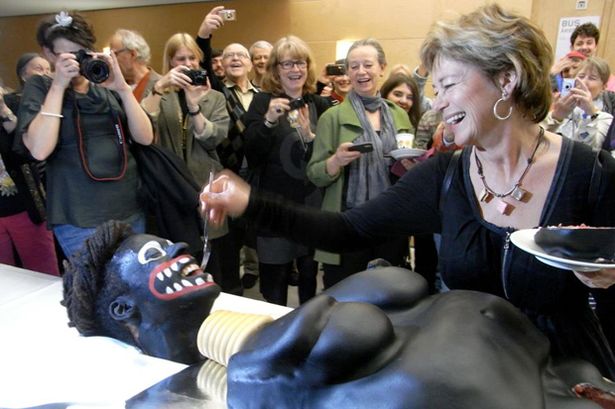
Praag has learned that Sasco also plans to write to the Swedish Embassy about a disturbing racist black face cake from 2012 that was discovered only yesterday by its members.
The National Afro-Swedish Association called for a minister of culture’s resignation after she was pictured laughing while cutting the racial stereotype cake and eating it. The event was branded a “racist spectacle” by the National Afro-Swedish Association.
Spokesman Kitimbwa Sabuni told The Local: “In our view, this simply adds to the mockery of racism in Sweden.
“According to the Moderna Museet, the ‘cake party’ was meant to problematize female circumcision but how that is accomplished through a cake representing a racist caricature of a black woman complete with ‘black face’ is unclear.”
Sabuni added that the fact that the minister particiapted in the event, which he argued was also marked by “cannibalistic” overtones, betrays her “incompetence and lack of judgement”.
In a statement, he added: “Her participation, as she laughs, drinks, and eats cake, merely adds to the insult against people who suffer from racist taunts and against women affected by circumcision.
South Africa is apparently experiencing another tedious outburst of moral outrage about an innocuous case of “blackface” put on by two women students at the University of Pretoria for a 21st-birthday party.
I try to keep the mass media at a safe distance and therefore do not listen to radio, watch TV or buy any newspapers. The internet is a more clinical way of accessing information without background shrieks, unless it is YouTube. Yet, judging from responses on Twitter, there is some hullabaloo going on and the two students have now been “charged” by the university and will be subjected to a disciplinary hearing. They could face expulsion or some other form of punishment.
South Africa has slid so far down into an abyss of sadism, crime, murder and rape that it seems entirely risible that anyone should care about how white students make up their faces at a fancy-dress party. Yet, as one of the zealous anti-racists in Johannesburg, Gillian Schutte, once intoned in desperation: “Where is the outrage?”
Indeed. We need outrage to distract us from our abject failure as a society and even the increasing signs of a failed state in what used to be called the “Republic of South Africa”. Hardened and jaded by armed robberies, shootings in broad daylight, car hijackings, murder and torture of farmers, endemic corruption and the highest incidence of rape on the planet, the average South African – black or white – could hardly care about the latest student prank in Pretoria.
Yet the media and academic elite, in their slavish imitation of American political correctness, have to have their outrage and moral hysteria. There is something particularly British about moral hysteria which I suppose one could trace back to the time of Cromwell’s puritanical rule and which Fleet Street still has on tap whenever the United Kingdom has to rally public opinion behind another BP or Shell oil war somewhere.
It is certainly ironic that these days British moral hysteria is often projected towards Russia where once the rigours of communist zeal held sway. I was surprised to learn that anti-Semitism in the USSR carried the death penalty. As I do not know any Russian, I could not tell you which words merited a bullet in the head. Were it not for the fact that the death penalty had been abolished in 1994, one could well imagine how “racism” or politically incorrect utterances might soon become a capital offence in South Africa.
Thus South Africa gets its propensity for anti-racist outbursts from both Britain and the ex-USSR where many of the post-1994 leadership spent their formative years. Also, the Marxist-Leninism of the USSR has migrated to the USA in the form of so-called “cultural Marxism” which is the staple at most American universities, slavishly imitated by our local campuses. As Paul Craig Roberts put it recently in one of his sharply-worded commentaries on US-UK war-mongering:
If we are honest and have the strength to face reality, we will realize that the Soviet Union did not collapse. It simply moved, along with Mao and Pol Pot, to Washington and London.
In 1934 or so, shortly before the University of Pretoria completely abolished tuition in English in favour of Afrikaans, a Union Jack was burnt in front of the Old Arts Building by a young poet, WJP Erlank, who wrote under the pen name Eitemal. The English press was outraged, leading to his expulsion as a student but he instantly became an Afrikaner hero.
How the tables have been turned! It is certainly indicative of Afrikaner powerlessness that an English-speaking student, Thorne Godinho of the liberal DA’s youth movement DASO on the campus, was able to engineer the current outburst by publishing the photograph of the two Afrikaans girls dressed up as black servants on Facebook and get the university to punish them. If you want to know the meaning of “kowtow”, just watch today’s Afrikaans university administrators in action.
In more senses than one, Afrikaners find themselves completely at the mercy of latter-day zealots who are endlessly beating their quasi-religious precepts about race and racism into them. The slightest semantic or symbolic deviation is immediately punished and the guilty ones pilloried or subjected to a witch-hunt that will ruin their careers or “shame” them for years to come. It was the case during the so-called “Reitz 4” incident, as well as earlier this year during the photographing of a women’s residence initiation ceremony in Potchefstroom where for one split second and from a certain angle it could resemble a Nazi salute. Now the University of Pretoria is experiencing the same spate of orchestrated “outrage”.
Mr Ponty Thuynsma, 76, in hospital. Photo: Lisa Hnatowicz, Beeld
Over the past few days an elderly Afrikaner, Koos Jonker, was literally beaten to death by blacks near Ellisras. In a separate incident, Mr. Ponty Thuynsma was tortured with a hot iron and made to drink petrol in his home east of Pretoria. Thuynsma had to be admitted to the intensive care unit of the Wilgers hospital (see picture). However, these murderous, sadistic incidents pale into insignificance next to purely linguistic or symbolic transgressions of the dominant anti-racist theology committed by Afrikaans students.
In the USA, African Americans have been endowed with a special “minority” status akin to a sacerdotal class with special privileges protecting them against public criticism. As a special caste they also need to be treated with above-average respect. All of this dogma has been imported wholesale into South Africa, where blacks form a majority. Declaring the majority, who already has a monopoly on political power, in need of special protection and beyond criticism or occasional mocking quickly leads to a Soviet-style totalitarian society.
There is increasing censorship and after this latest “blackface” incident, some people think that the movies of comedian Leon Schuster should be banned as he often dons blackface and imitates black slang and speech patterns.
It is also beyond my comprehension how the South African “nation” as it has been defined, can be so criminal and morally depraved, yet at the same time given to an acute sensitivity or what we call in Afrikaans kleinserigheid, touchiness. Logically, the same rapist or murderer who finds torture acceptable conduct, would object to a white girl in “blackface” or someone using a term that is ethnically off-colour.
Of course, in the media and the universities there is an entire language and thought police force waiting to denounce anyone who deviates from their increasingly puritanical norms. By force of “outrage” and moral hysteria, they impose their contradictory values on us. Everyone who does not agree with them is vilified as a “Nazi”, “fascist”, “racist”, “white supremacist”, “sexist”, “homophobe” or other label within their impoverished catechism.
I almost wrote “secular catechism”. But there is nothing secular about it and its acolytes certainly do not subscribe to the values of the European Enlightenment. Tolerance and freedom of speech are not part of their belief system. It is a real religion with a fairly simple dogma and enough zealots to patrol the boundaries of our words and our actions. They do not countenance any form of heresy and at best will allow “sinners” to repent and submit to a programme of re-education.
Or “discipline”, that Leninist word for those deviating from the party line.
However, the strategic thrust of the current campaign around the Afrikaans universities is to oust the last remaining Afrikaners from those institutions so that they may be entirely controlled by English cultural Marxists. In its wisdom, the ANC government has decided that “South Africa needs more PhDs” and is throwing money at the problem. So apart from serving the “Red Church” as Albert Camus called it, one may also eject some hapless Afrikaner academic from his post amid rising incomes in the tertiary-education sector. Hence the witch-hunts against dissident students and lecturers at all the Afrikaans universities.
In the nineteenth century, anglicisation in South Africa was justified by British imperialism; now it is based on race and political correctness. Signs of “racism”, as defined, detract from the language and cultural rights of Afrikaners and even their access to tertiary education.
Until the final victory of Sovietised English over Afrikaans is trumpeted in South Africa, the semantic war is bound to intensify. We might as well all put on “war paint”; if that can still be said without causing offence to native Americans.
A judge has ordered that a case about racial transformation between the HETN lobby group and Tuks, a former Afrikaans institution, may be heard in the Equality Court.
The lobby group Higher Education Transformation Network (HETN) on Wednesday made measurable progress in its court battle against the University of Pretoria, following a judgment that a matter between the two can be heard in the Equality Court.
The HETN has challenged the slow pace of racial change in the governing structures of the university.
Acting chief magistrate Daniel Thulare ruled in favour of the HETN at the Pretoria Magistrate’s Court. The university and its alumni board argued that the Equality Court does not have jurisdiction to hear the matter brought to it by the network earlier this year. The Tuks council, the highest governance, should also join as a respondent, ordered Thulare.
Thulare said the complaint that the university, together with its council and the Tuks Alumni Association, “are failing to take steps to reasonably accommodate the needs of blacks, women and the disabled, in order to meet the need to redress the imbalances of the past to achieve representation”, should be heard in the Equality Court.
Lucky Thekisho, chairperson of the predominantly black organisation, described the ruling as a “preliminary victory” for them.
“We are relieved and encouraged to note that contrary to the arguments presented by the UP and Tuks Alumni Board, that the Equality Court has agreed with our contentions and re-established the supremacy of the Constitution of the [country], the need for transformation and equality in higher education,” he said.
“We knew that we shall prevail against the might of the University of Pretoria. This battle for transformation has just begun,” said Thekisho.
Tuks spokesperson Nicolize Mulder told the Mail & Guardian the judgment had nothing to do with merits of the network’s claims. Declining to comment further, she said: “
From our side, it was merely a direction hearing to determine where the case should go from here.”
After a long-standing, bitter racial battle for control of the university, the litigation was triggered by the election of AfriForum member Willie Spies into the university’s council late last year.
A date for the hearing will soon be set. “We remain confident that we will attain victory in the overall outcome of the case and that justice will take its course for the benefit of the broader society,” said Thekisho. – M&G
This website uses cookies to improve your experience. We'll assume you're ok with this, but you can opt-out if you wish. Cookie settingsACCEPT
Privacy & Cookies Policy
Privacy Overview
This website uses cookies to improve your experience while you navigate through the website. Out of these cookies, the cookies that are categorized as necessary are stored on your browser as they are essential for the working of basic functionalities of the website. We also use third-party cookies that help us analyze and understand how you use this website. These cookies will be stored in your browser only with your consent. You also have the option to opt-out of these cookies. But opting out of some of these cookies may have an effect on your browsing experience.
Necessary cookies are absolutely essential for the website to function properly. This category only includes cookies that ensures basic functionalities and security features of the website. These cookies do not store any personal information.
Any cookies that may not be particularly necessary for the website to function and is used specifically to collect user personal data via analytics, ads, other embedded contents are termed as non-necessary cookies. It is mandatory to procure user consent prior to running these cookies on your website.