Race war erupts as Coloureds refuse black teachers

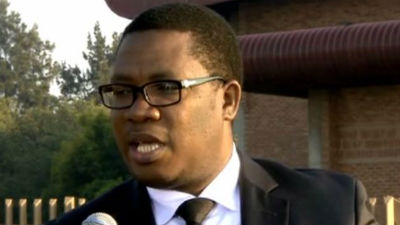
“It’s a full-blown colour war.” This was all Gauteng Education MEC Panyaza Lesufi could say to describe the crisis paralysing Roodepoort Primary School.

On Tuesday, the row over his appointment of Nomathemba Molefe as principal spilt over into a fist fight between angry parents from the mostly coloured community and a black official from the Gauteng Department of Education.

On Monday, Lesufi had vowed to close down the school permanently if teachers continued to be threatened with violence by parents.

Black teachers have stayed away from school for a week, unprepared to subject themselves to either the intimidation or the risk to their lives. The school has already been shut down twice.

Given an ultimatum to return on Tuesday morning, they didn’t.

Angry parents thronged the reception area, swearing and cursing at the staff. They were incensed at being accused of arson attacks at the school, including a recent petrol bombing of the deputy principal’s car and firebombing the offices of the principal and her deputy.

“We won’t burn the school down, we built it ourselves,” the enraged group shouted at the official.

Black teachers have refused to report for duty for fear of being assaulted by members of the local coloured community.

Source: IOL

‘Racist attack’ charges withdrawn

Delia Adonis, a coloured woman, has spent the weekend in tears after charges against three men, who she claimed had assaulted her during a racist attack, were withdrawn on Thursday.

It’s a bitter end to a trial almost a year in the making for the Cape Town cleaner who feels she has been denied justice.

Constable Andy Hendricks will learn his fate on Monday after he was arrested last year for allegedly accepting a bribe from one of the accused, Chad de Matos.

Police spokesman Lieutenant Colonel André Traut said the internal disciplinary hearing against Hendricks will conclude on Monday.

“The outcome thereof will be a matter between the employer and the employee. The criminal aspect of the case is still being heard in court.”

Hendricks allegedly accepted the bribe and promised to make the matter against De Matos and his co-accused “disappear”.

William Booth, the attorney who represented the three men in this case, said evidence showed that Adonis, 52, had fabricated “material aspects” involving his clients.

He said his clients had been unfairly demonised and wrongfully accused after it was, in fact, Adonis and her son who had instigated the attack.

Prosecutor Nathan Johnson likened the trio to the Waterkloof Four, who were convicted of murder of an unidentified vagrant in Pretoria’s Moreleta Park in 2001.

But on Thursday, during a court appearance at Wynberg Magistrate’s Court, the Director of Public Prosecutions Office revealed that the charges against De Matos and company had been withdrawn.

This was after Booth submitted a docket, which included evidence collected by a private detective, to the office of the director. In it, it was revealed that a number of independent witnesses had “directly contradicted the evidence of Adonis and her son”.

“Adonis and her son were in fact the instigators as they were responsible for the attack. Adonis’s son was armed with a broken bottle and she with a broom,” Booth said.

Adonis said she wasn’t even aware that the three had appeared in court.

“If we started this, why am I the one who was hurt?”

Source: IOL

‘Black’ NAACP president outed as white

An NAACP leader’s parents have made a startling revelation: their daughter, for years a highly visible civil rights activist in Eastern Washington, is white.

Rachel Dolezal, Spokane’s NAACP Chapter President and part-time Africana Studies professor at Eastern Washington University, has been misleading people about her ethnicity for years, her parents say.

Her mother even offered photographic proof. While today the 37-year-old divorcee currently sports tight, dark curls, her mom Ruthanne Dolezal showed KREM photos of the fair and freckled blonde daughter she once knew.

Dolezal is now facing a city ethics probe after she identified herself as black in an application to serve on a local police ombudsman commission – a position she secured.’It’s very sad that Rachel has not just been herself,’ Ruthanne Dolezal told the Spokesman-Review. ‘Her effectiveness in the causes of the African-American community would have been so much more viable, and she would have been more effective if she had just been honest with everybody.’

The Dolezals remain in Northwest Montana, where Dolezal grew up. It is not clear why they have now shared the revelations but Dolezal has previously said that she no longer has any contact with her parents. In articles in the Easterner, she claimed they were violent towards her.

But her father denies this and said that Dolezal cut off all communication with them and doesn’t want them to be seen in Spokane ‘because we’re Caucasian’, Buzzfeed News reported. According to her mother, Ruthanne began to ‘disguise herself’ in 2006 or 2007.

Other than some ‘faint traces’ of Native American blood, Ruthanne said the family background is Czech, Swedish and German.

However, that’s not how her daughter identified herself when she became chairwoman of Spokane’s Office of Police Ombudsman Commission.

In her application for the volunteer appointment, Dolezal marked herself down as white, black and American Indian, reports the Spokesman-Review. She has also previously claimed that her white father is her step-father. In January, a photo showing Dolezal and a black man on the Spokane NAACP’s Facebook erroneously identified the man as her father.

On Wednesday, a reporter from KXLY confronted Dolezal a photo of her with the African-American man while on camera.

‘Ma’am, I was wondering if your dad really is an African-American man,’ the KXLY reporter asked.

‘I don’t understand the question,’ Dolezal replied. ‘I did tell you [that man in the picture] is my dad.’

‘Are your parents white?’ the reporter asked. Dolezal then removed her mic and walked away.

Reached by the Spokesman-Review, Dolezal answered questions about her ethnicity by saying: ‘That question is not as easy as it seems… There’s a lot of complexities … and I don’t know that everyone would understand that… We’re all from the African continent.’

According to her staff biography at Eastern Washington University, Dolezal received her master’s degree from Howard University, a historically black college in Washington, D.C. As Buzzfeed notes, Dolezal’s blog posts and interviews often reference her ‘black sons’.

However, her mother told CDAPress.com that one of those boys is Izaiah Dolezal – who was, in fact, one of four African American infants Rachel’s parents adopted in the 1990s, meaning the boy is Dolezal’s brother, rather than her son.

Izaiah, now 21, has since gone to live with Dolezal and no longer speaks with his adopted parents.

Publicly available birth records, list her biological parents as Ruthanne and Lawrence Dolezal of Montana.

Her Eastern Washington University bio also says that Dolezal has been the victim of at least eight ‘documented hate crimes’.

While in the position, Dolezal filed multiple police reports ranging from theft to harassment to racially motivated hanging of a nooses in her home.

In a more recent claim of racially motivated harassment, Dolezal made local headlines early this year when hate mail was supposedly sent to her at the NAACP post office box in Spokane.

However, police reports on the case revealed this week that whoever placed the letters and packages into the box would have had to have the key because none had bar codes or stamps.

In an official statement, the NAACP said on Friday: ‘NAACP Spokane Washington Branch President Rachel Dolezal is enduring a legal issue with her family, and we respect her privacy in this matter.

‘One’s racial identity is not a qualifying criteria or disqualifying standard for NAACP leadership. The NAACP Alaska-Oregon-Washington State Conference stands behind Ms. Dolezal’s advocacy record.

‘In every corner of this country, the NAACP remains committed to securing political, educational, and economic justice for all people, and we encourage Americans of all stripes to become members and serve as leaders in our organization.’

Source: Daily Mail

Open letter to Dan Roodt

Leadership

by Brian Faul

First off I am writing this mail in English in order for the message to be available to everyone. I am deeply concerned as to what is presently taking place in South Africa.

I am a white Afrikaans-speaking male in my 40’s. For all intents and purposes, this makes me enemy number one for those currently ruling South Africa.

I am a highly qualified professional in my field of expertise with many years’ experience. Among the problems I currently face is the total onslaught against people with similar profiles to mine. For the sake of correcting issues of twenty and more years ago, I am now after all this time being victimized to the extent of total poverty.

I have a forced financial commitment toward the state regarding rates and taxes. I am also taxed on the little revenue I generate on the side and I pay tax in the form of fuel levies and VAT every time I go to the shop. In return for this I get zero back from government. I am not allowed to parcipate in the formal job sector because I am not black enough..

A number of years ago I was destroyed financially by an unfair land claim that was eventually thrown out to my knowledge. During this time my business went insolvent as we were unable to operate on the property during the course of this bogus land claim.

As a result 15 people – all African – lost their jobs and the means to feed and house their families on the property and were put on the streets as a result. This, after living and working on the property with me for 16 years.

It later came to light that a very high-ranking police official who was later found guilty of fraud charges and corruption was behind the entire bogus claim. This is only one claim; there were many in surrounding areas that had exactly the same outcome: unemployment and poverty for hundreds of families.

Currently South Africa is living within a bubble.This bubble is bound to burst as more and more corruption comes to light and unemployment increases due to restrictive labour legislation being implemented. The problem by and large is that the people who are supposed to benefit most from this are standing to lose the most in the end.

I want to reiterate that this is not just an Afrikaner problem but a national problem for any white, coloured and Indian person in South Africa.

It is time for people to unite in thought and action before it is too late. There is still a small window open in this regard and this relates to the upcoming elections. It will in fact be the last chance for any white, Indian or coloured person to make a difference. After this election has passed and there is no significant opposition, the writing will be on the wall for all South Africans, including African people who are going to suffer the most, as in Zimbabwe. There will be no new dawn in South Africa, only poverty and strife leading to civil unrest and economic chaos.

The current government is essentialy anti-South African as it is embracing people from all over the world such as the Chinese who hold their allegiance to China and not to South Africa. Their interest is to take whatever they can back to build their own country, using our resources. In the long run millions of Chinese may settle in South Africa claiming our resources and living off our welfare system that is already overburdened and in a shambles as it is. It is known that the Chinese make the worst slave masters in the world.

Time is running out for creating an alternative. In this regard a formidable opposition is not yet available that will hear the concerns of the people. As far as I am concerned, Helen Zille and the Democratic Alliance have sold us out, following upon recent events. They have clearly unmasked their long-term intentions and they are not going to be acting in the interest of the minority voters.

In general South African people are hospitable, hardworking and honest, seeking a better life. By and large people of all races are not out to deliberately cause harm and conflict with each other. There is a very bad criminal element at present that is committing the most horrific crimes and gving a political slant to their actions. These crimes are often committed by people born after the democratic dispensation of 1994. They are often uneducated individuals that have been swept up by the words of a man such as Julius Malema that is forging ahead with a revolution based on self-enrichment and hatred because he was born black.

If one views what is taking place in South Africa at the moment a lot of it can be traced back to revolutionary tactics put in place by the ANC and Communist Party during their so-called struggle phase, including cadre deployment. It is as if no-one has given them the instruction to stop using these tactics as the struggle ended 20 years ago.

The cadre deployment tactics is what is currently driving economic collapse in many sectors including the most important: that of the future generation’s education.

The solution to this and many other issues is not a simple process and should be well thought through while we still have some time and this leads me to the following question.

Dan Roodt, will you be willing to lead us? I can only speak for myself and my family, yet I am sure that thousands of people in similar circumstances would ask you the same question.

The fact is, we the Afrikaans and English white people, as well as the coloured and Indian people, do not have leadership or rather coherent leadership at the moment. We are floating in a sea of doubt and despair, seeing civil strife ahead. This question is asked by people that have noticed your leadership skills. People that are willing to trust you and give you the support necessary to obtain this objective.

Those that do not arrach value to this letter, let them simply skip it and move on. This is a question raised by your followers and not by your enemies.

I believe you have been a victim of an onslaught by certain individuals to undermine your financial and moral support base.To those people I say: go to hell.

I have been made to understand that there is obviously a financial implication for yourself to enter the political domain. I believe the white people holding the same values as myself who are currently at the receiving end of this onslaught will commit financially to a few rand here and there. If people can donate cash to a host of causes without a direct impact on their future surely they will commit a few rand to this critical issue?

Perhaps you can set up a fund in this regard and outline the cost factor as I don’t believe people are actually aware that there are large amounts of funds needed for a venture such as this.

Time is of the essence so the sooner people are made aware and there is a manifesto in place the sooner people can act and commit to this.

Dr Dan Roodt, I urge you to consider this option and to at least put it out there for the general public and your support base to see.

Kind regards,

Brian Faul

Blacks impose English on coloured children of N. Cape

languageMr. Zolile Prusente is the curriculum specialist with the regional education department in Upington. Recently, he sent a complaint to the South African Human Rights Commission regarding a problematic shift in language policy in the past year.

He alleges that the school principal and the school management team implemented a language policy that designated English as the first language of instruction for all subjects against the advice of the law or parental preference. Afrikaans, isiXhosa and Setswana were set aside and offered as alternative languages. The decision was an abrupt change from the former policy which provided for instruction in the students’ first languages rather than English.

For Prusente, the shift in policy is most harmful for the students. “[This situation] clearly shows that the SGB [school governing board] is not in control of language policy and that language policy is dictated by educators to suit their needs,” he wrote in his statement to the Human Rights Commision. Prusente believes that the students’ constitutional rights are violated by the “one-way” decision to teach primarily in English. Those responsible, he said, acted “without… taking cognisance of the additive bilingual approach promoted by the language-in-education policy.” In his statement, he refers to the Northern Cape Education Department circular 37 which also highlights “the importance of mother tongue instruction in the Foundation phase.” In their response, the principal, Ms. AB Silwana, and the chairperson of the SGB, Mr. Themba Smith, denied Prusente’s claims and said that the “overwhelming majority of parents” voted for their children to be taught in English.

While most teachers have agreed to the change, there are some who doubt the validity of the vote and who have consequently received “warning letters” from Silwana. Mrs. Thembisa Magodi, who is an SGB member and one of the two grade two teachers who refused to implement the English-only medium, said she and her colleague were not aware of any parents meeting or voting. They have refused to acknowledge Silwana’s warnings and stated that any policy “that [asks] us to teach in a foreign language [English] is not reasonable [and] unlawful because the Law encourages mother tongue teaching.”

Magodi and her colleague point to the 2007 whole school evaluation report that “has shown that learners do not understand English” as further proof that the new policy is not beneficial to students. Both teachers have announced that, ignoring the new policy, they “will continue in the third quarter to teach in the home language of learners and English only as an additional language.”

Silwana and Smith contend that the South African schools act No. 84 of 1996 gives the SGB the power to determine the language policy. They state that, since 2009, the SGB has engaged in thoughtful deliberations regarding “the complexity of formulating a language policy” for a “multi-cultural and multi-lingual learner population.” Furthermore, they maintain that the adoption of English-only policy is based on a “research/survey” taken during the 2011-2012 year that demonstrated that “parents preferred English as the language of learning and teaching.”

Prusente believes that the policy change is rooted in the SGB’s biased aversion to multi-lingual education. He claims that the boards sees “many languages spoken by learners as a problem instead of a resource.” This leads them to favor English instruction, he explained, and makes them “guilty of killing [the home] languages of the learners and community.” He challenges the SGB to provide evidence of the minutes and attendance register where the language policy was decided upon.

Mrs. Miriam Gatyeni (54) is the grandmother of a grade two and grade three learner. She remembers the survey looking into language preferences, but denies that English was the overwhelming favorite. She, for one, chose Afrikaans. “Another parent chose isiXhosa and another man preferred English,” Gatyeni recalled.

The new language policy has forced her to consider different options for her grandchildren’s schooling. If the mother tongue of her grandchildren is not used to teach them, she will be forced to take them to an Afrikaans school in Blikkies, known as Progress, which is “far” from her home. “Home language is the best. It is [the] language [in which] I talk to them at home, just like it was with my mother,” said Gatyeni.

When asked for a copy of the language policy, Silvana referred this writer to Smith who said that while the policy “is not closed or classified information”, it has to be handled “carefully”. He also said that only the documents guiding the policy formulation process can be availed.

The site steward at Vela-Langa, Mr. Daniel Mokopi, said they reported the language policy chaos to the South African Democratic Teachers Union and decided that they “don’t want to interfere in individual school matters.”

The South African Human Rights Commission will hold a meeting regarding the matter today. – groundup.org.za

South Africa in breach of its treaty obligations to minorities

by Anton Alberts

I refer to the column “Massacre reveals our deficit in human solidarity” (Business Day, September 18) by Aubrey Matshiqi.

In his introductory remark Mr Matshiqi attacks the Freedom Front Plus (FF Plus) for daring to propose a national department for minorities, to assist in protecting national minorities such as coloured, Indian and white communities.

While I enjoy reading Mr Matshiqi’s insights, this broadside from him is disconcerting.

First, it shows up his prejudices against minorities by making assumptions without actually researching the merits of the proposal, and without contacting the FF Plus to properly gauge the party’s position.

Second, it stifles debate about an important issue that can contribute tremendously towards social cohesion, which can go a long way to wiping out the country’s “deficit in human solidarity”.

The FF Plus is on record as saying that a department of minorities will be an appropriate institutional tool to safeguard the rights of the coloured, Indian and white communities.

We have members from all those communities who believe in the value of minority rights.

The very fact that President Jacob Zuma has stated in Parliament that only the majority has rights, and given the structural de facto economic discrimination against coloureds and Indians, and the de jure discrimination against whites, such a department is an imperative to bring about an equilibrium against the unfolding “tyranny of the majority”.

SA is in breach of its international obligations to give effect to minority rights as prescribed by the United Nations. This department can therefore go a long way to fulfilling that obligation and drawing minorities back into the mainstream that have been alienated by, amongst others, the likes of African National Congress apparatchiks such as Julius Malema and Jimmy Manyi.

Further to this, should pent-up minority expertise and capital be released as a result, one can only imagine the broader socioeconomic effects thereof. This can indeed be a case of win-win for everyone in SA. Therefore, this should become a national debate.

Anton Alberts is an MP for the Freedom Front Plus

70% of whites reject both Zuma and Motlanthe as SA presidential candidates – survey

Young South Africans prefer Kgalema Motlanthe to Jacob Zuma as a presidential candidate, although neither of them are that popular, according to a survey released on Monday.

“Given the choice of the two candidates, Kgalema Motlanthe is a clear winner,” said Butch Rice, market analyst for consumer insights company Pondering Panda.

In a survey of 4637 South Africans aged between 18 and 34, some 23 percent said they would like President Zuma to continue his presidency in 2014.

Thirty-six percent of respondents chose Deputy President Motlanthe, when given the choice between him and Zuma.

“It is clear that the youth of South Africa have lost faith in President Zuma. If he were to continue his presidency, it is likely to alienate young South Africans even more,” Rice said.

Forty-one percent of respondents rejected both candidates.

“However, what is most concerning is the high percentage of the youth who reject both candidates. We expect this to affect their propensity to vote in the next election, which could have a significant impact on the outcome for the different political parties.”

The survey found significant demographic differences, particularly in terms of race and region.

Young black South Africans (25 percent) were most likely to select Zuma as their preferred president.

However, 42 percent chose Motlanthe, and 33 percent disliked both candidates.

Eighty-one percent of Indians, 75 percent of coloureds, and 70 percent of whites rejected both candidates.

KwaZulu-Natal was the only region in which Zuma was preferred to Motlanthe. Here, 45 percent of respondents chose Zuma, compared to 22 percent for Motlanthe.

Motlanthe was most popular in Limpopo, where 56 percent of respondents chose him, compared to 17 percent for Zuma.

The interviews were conducted across South Africa using cellphones during the first two weeks of August. – SAPA

South African businesses to pay crippling affirmative-action fines

Businesses could pay an enormous price – up to 10% of their turnover – if they do not strictly observe provisions regarding affirmative action, says a report on the Sake24.com site.

Attempts at Nedlac to reach a compromise about proposed radical amendments to the Employment Equity Act came to naught and the next step is to take them through the parliamentary process. The proposed amendments are said to be so radical that the business sector will have them tested in court if they remain unchanged by the parliamentary process. Should the proposals be accepted not only could considerably larger fines be levied, but they would also make it much easier for government to impose them, notes the report. The 1998 Employment Equity Act prescribes relatively small fines of between R500 000 and a maximum of R900 000. The new fines being proposed follow the model of competition legislation and are linked to companies’ turnover. They range from 2% of a company’s annual turnover to 10% for repeated violations. The report says the proposed fines are largely in line with those outlined at the end of 2011 in the Black Empowerment Bill for companies using fronts to claim that they are empowered. Not only are fines of up to 10% envisioned, but also imprisonment of up to 10 years for those who lie about their company’s empowerment status.
Full Sake24 report

Meanwhile, the controversy over proposed changes to the Act, which it was feared would cause coloured and Indian workers to lose their jobs in some provinces, turned out to be a storm in a teacup, says a Business Day report. The contentious issue of whether employers should use national or regional demographic statistics to calculate the employment equity target for their workforce has not been significantly changed, says the report. Under the present law, employers have a choice to use national or regional demographics to determine their racial targets. There was an uproar last year when an initial draft of the amendments proposed that employers be forced to use national demographics as a measure, which would have meant that the workforce had a disproportionate number of coloureds in the Western Cape and of Indians in KZN. However, the amendment Bill is believed to leave the present regulatory regime much the same, with the exception that the Labour Minister will have the power to produce regulations on the matter. The regulations will allow a company – that is designated as a national company – to use national demographics as its employment equity measure. Companies that are not national will not use national demographics, notes the report.
Full Business Day report

– LegalBrief