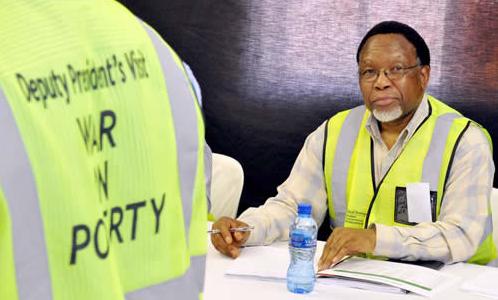
According to presidential spokesman Mac Maharaj in a statement, “The Presidency strongly rejects the allegations made in the Media24 titles this weekend that President Jacob Zuma had a hand in an alleged withdrawal of an academic honour for Deputy President Kgalema Motlanthe in the People’s Republic of China and that they no longer work together.
“The reports are baseless and ridiculous. Neither the President nor his Private Office had any knowledge of this honour that was apparently turned down until enquiries came from Media24 or Naspers newspapers.
“Earlier this year the Presidency was also surprised by fictitious reports in the Sunday Independent newspaper that President Zuma was apparently preventing the Deputy President from travelling outside the country.
“We explained then that the international programme of the President and Deputy President is coordinated with DIRCO in consultation with the Presidency.
“The President and the Deputy President continue to work well together and share responsibilities including Cabinet.
“It would thus assist greatly if the media probed deeper before believing and publishing spurious allegations of this nature so as not to peddle falsehoods.”
Shifts in ANC membership within South Africa’s provinces have given President Jacob Zuma a fighting chance of holding on to the party leadership and the presidency.
The number of ANC members in the southeastern province of KwaZulu-Natal might seem like a detail only of interest to South African political scientists.
In fact, the number may well be decisive in helping Zuma remain in charge of Africa’s most powerful nation and her largest economy.
This December 4,500 ANC delegates will gather to elect a party leader for the next five years.
He or she will almost certainly become the next president of the country, thanks to the party’s electoral predominance.
Five years after ousting president Thabo Mbeki in an act of political regicide at the last ANC electoral conference, Zuma could face the same fate in December.
Deputy President Kgalema Motlanthe is widely tipped as one possible challenger. He could announce his candidacy as soon as this week.
According to a recent TNS poll Motlanthe has a 51 percent approval rating to Zuma’s 48 percent.
But as the race gets underway, the ANC announced Wednesday that a surprising 36-percent rise in membership in KwaZulu-Natal means at least 974 of the 4,500 conference delegates will come from Zuma’s home province.
It is by far the biggest representation of any province.
For an incumbent whose administration has been marred by rolling strikes, high unemployment and social unrest, that is nothing short of a godsend.
In the race for 2,250-plus ANC delegates, every vote will count, according to Mari Harris, managing executive at local pollsters Ipsos Markinor.
A complex mix of loyalty, personal advancement and ideology, as well as regional and tribal politics, will all play a role in corralling delegates.
Harris predicts that the largely rural Eastern Cape, home to Nelson Mandela and long the heartland of the ANC, will back Motlanthe.
Although the dominant tribe in the Eastern Cape is Xhosa, members are more likely to go for Tswana-speaking Motlanthe, than Zuma, who is a Zulu.
“The Xhosa don’t have a candidate,” said Harris.
She also predicts that Gauteng — which includes Johannesburg and the capital Pretoria — will favour Motlanthe.
Indeed, ANC rising star, Gauteng province chairman and culture minister Paul Mashatile has already said the “ANC must change this year,” while calling for a “renewal of leadership.”
Together, Gauteng and the Eastern Cape account for 1,176 delegates. By striking the right pacts Motlanthe could significantly increase that total.
His recent courting of ousted party firebrand Julius Malema appeared to have paid off Wednesday when the ANC’s Youth League, which still backs Malema, called for a “radical and urgent change” within the party and backed Motlanthe as leader.
With only 45 delegates, the Youth League is unlikely to tip the balance of the leadership contest — but it could prove a thorn in Zuma’s side.
Malema could help deliver some or all of the 574 delegates in his home province of Limpopo.
It is against this backdrop then that KwaZulu-Natal’s increase from 608 votes in 2007 to 974 today may prove crucial for Zuma.
“At this stage I think he will still carry the vote, with a small majority,” said Harris. “But everything can change.” – Sapa
Deputy President Kgalema Motlanthe is the ANC Youth League’s choice for the position of ANC president, it said on Wednesday.
It would nominate him for this post at the African National Congress’s elective conference in Mangaung in December, ANCYL spokeswoman Khusela Sangoni-Khawe said in a statement.
“We are calling on all our structures and ANC branches… to ensure that our generational (sic) mission is fulfilled and that… tried, tested and competent comrades are elected.”
The ANCYL’s candidate for ANC secretary general was former ANCYL leader Fikile Mbalula, and for deputy president ANC treasurer Mathews Phosa or Human Settlements Minister Tokyo Sexwale. Sexwale could also be nominated as treasurer general.
The names of North West Premier Thandi Modise, Arts and Culture Minister Paul Mashatile, and former ANC deputy secretary general Thenjiwe Mtitso were also put forward.
Sangoni-Khawe said: “Primarily, the kind of political leadership that we need is leadership that adheres to our political programme for economic freedom in our lifetime.”
The next leadership needed to take a firm stand on economic policy to realise the Freedom Charter.
“What scares any investor is not nationalisation of mines or expropriation of land without compensation, but an endless discussion on the aforementioned.”
A leader needed the ability to inspire people and reinforce confidence in the ANC and transformation.
In the run-up to the elective conference in December, the party needed to take a stand against political violence and intimidation, she said.
“The ANC must act decisively to ensure that all comrades are afforded an opportunity to voice, without fear or favour, their preferences on leadership without the spectre of victimisation and even death hanging over them.” – Sapa
Young South Africans prefer Kgalema Motlanthe to Jacob Zuma as a presidential candidate, although neither of them are that popular, according to a survey released on Monday.
“Given the choice of the two candidates, Kgalema Motlanthe is a clear winner,” said Butch Rice, market analyst for consumer insights company Pondering Panda.
In a survey of 4637 South Africans aged between 18 and 34, some 23 percent said they would like President Zuma to continue his presidency in 2014.
Thirty-six percent of respondents chose Deputy President Motlanthe, when given the choice between him and Zuma.
“It is clear that the youth of South Africa have lost faith in President Zuma. If he were to continue his presidency, it is likely to alienate young South Africans even more,” Rice said.
Forty-one percent of respondents rejected both candidates.
“However, what is most concerning is the high percentage of the youth who reject both candidates. We expect this to affect their propensity to vote in the next election, which could have a significant impact on the outcome for the different political parties.”
The survey found significant demographic differences, particularly in terms of race and region.
Young black South Africans (25 percent) were most likely to select Zuma as their preferred president.
However, 42 percent chose Motlanthe, and 33 percent disliked both candidates.
Eighty-one percent of Indians, 75 percent of coloureds, and 70 percent of whites rejected both candidates.
KwaZulu-Natal was the only region in which Zuma was preferred to Motlanthe. Here, 45 percent of respondents chose Zuma, compared to 22 percent for Motlanthe.
Motlanthe was most popular in Limpopo, where 56 percent of respondents chose him, compared to 17 percent for Zuma.
The interviews were conducted across South Africa using cellphones during the first two weeks of August. – SAPA
ANC leaders on Tuesday condemned the “shockingly crude, disrespectful and un-ANC” remarks recently made by some within the party.
“The brazen and often rude and crude rhetoric to detract from real issues facing our youth does nothing to add value to the integrity of the ANC and its leagues,” secretary general Gwede Mantashe told reporters in Johannesburg.
“As national officials of the ANC, we believe the time has come to put an end to the blustering and often incomprehensible remarks that are made by various leaders and members of the ANC.”
Mantashe was joined by President Jacob Zuma, his deputy Kgalema Motlanthe, treasurer Mathews Phosa, national chairwoman Baleka Mbete and deputy secretary general Thandi Modise.
This followed ANCYL leader Julius Malema’s remarks at a centenary lecture at Wits University on Friday, that Zuma was a dictator and suppressing the league.
Mantashe said the attack on Zuma was an attack on the African National Congress.
“It makes it sound like we can’t think for ourselves. It is not a leadership of dwarfs around a dictator. This is an insult to many of us.”
Mantashe said Malema’s claim that new ideas were suppressed and that the ANC’s current leaders were dictators was a “deliberate falsehood”.
It was unfortunate that the league had chosen the ANC’s centenary year to call the party undemocratic and to try sow division within the organisation. Mantashe said these statements would be investigated.
Party leaders also bemoaned the Umkhonto we Sizwe Military Veterans Association’s call, made at another press briefing earlier in the day, for Malema to be summarily expelled from the party.
The ANC Youth League called its own media briefing at Luthuli House after the veterans had held theirs, and accused them of looking for attention and trying to impress their girlfriends.
Mantashe said the ANC’s top officials were united on discipline within the organisation. The leaders were also not fighting for positions ahead of the party’s elective conference in Bloemfontein in December.
“We remain loyal to all decisions taken. National officials are not at odds with each other.”
Mantashe said the ANC had not yet met with the league, as it was being cautious. The ANC did not want to cause confusion while disciplinary processes were ongoing, he said.
Malema is still awaiting the result of his appeal against his expulsion from the party by its national disciplinary committee.
Thandi Modise likened the ANCYL to a teenager and said tensions between it and the ANC were a given. She cautioned against a situation where antagonism replaced militancy. She also cautioned against the “bastardising” of internal ANC processes.
Asked why he did not reprimand Malema when he verbally attacked Zuma and his leadership on Friday, Phosa said he did not have the urge to immediately respond, but did so late in his speech.
“I said in response… The masses of our country do not appreciate it when leaders engage in public spats.”
He was invited to the event as a replacement for Sports Minister Fikile Mbalula, a former ANCYL leader and reportedly a Malema supporter.
Speculation was also rife that Phosa and Motlanthe were staunch Malema allies.
However, Motlanthe warned against those who used the ANC leaders’ names to divide the organisation, saying they would not be successful. Last month, he reprimanded ANCYL members in Limpopo who wore T-shirts bearing his face.
-SAPA
This website uses cookies to improve your experience. We'll assume you're ok with this, but you can opt-out if you wish. Cookie settingsACCEPT
Privacy & Cookies Policy
Privacy Overview
This website uses cookies to improve your experience while you navigate through the website. Out of these cookies, the cookies that are categorized as necessary are stored on your browser as they are essential for the working of basic functionalities of the website. We also use third-party cookies that help us analyze and understand how you use this website. These cookies will be stored in your browser only with your consent. You also have the option to opt-out of these cookies. But opting out of some of these cookies may have an effect on your browsing experience.
Necessary cookies are absolutely essential for the website to function properly. This category only includes cookies that ensures basic functionalities and security features of the website. These cookies do not store any personal information.
Any cookies that may not be particularly necessary for the website to function and is used specifically to collect user personal data via analytics, ads, other embedded contents are termed as non-necessary cookies. It is mandatory to procure user consent prior to running these cookies on your website.