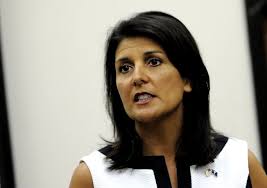
The Indian governor of South Carolina Nimrata Nikki Randhawa Haley called for the removal of the Confederate flag from the grounds of the state Capitol Monday, less than a week after a 21-year-old white man gunned down nine people at a historic African American church.
Support for the flag to come down from leaders around the state and around the country has been steadily growing in the wake of the attack.
“Today, we are here in a moment of unity in our state, without ill will, to say it is time to move the flag from the Capitol grounds,” Haley said during a news conference attended by Republican senators Lindsey Graham and Tim Scott, along with other state leaders.
Haley called on Monday for South Carolina to do what just a week ago seemed politically impossible. The announcement was met by applause and cheers from those in attendance.
Haley said The flag “does not represent the future of our great state”. Jeb Bush, who ordered the removal of the flag from the Florida statehouse while governor, said he was confident that South Carolina would “do the right thing”.
The MSM is still strangely silent on the shooting in Philidelphia.
Haley is one of two sitting Indian American governors in the United States, the other being fellow Republican Bobby Jindal of Louisiana. She is also the third non-white person to have been elected as governor of a Southern state.
Meanwhile doubts were raised about the authenticity of the shooter’s “manifesto”. It is highly unlikely that a 9th grade dropout somehow attained exceptional writing skills, yet there has been no investigation by the media into the matter.
The two black shooters from West-Philidelphia have not issued a manifesto yet.
A trip to Darrenwood Shopping Centre in Randburg, Gauteng, ended in a tragic death when an Indian man in his late 30s was shot dead during a robbery in the evening of 16 April.
According to Linden Police Operations Manager Captain Alex Vermaak, six to eight men entered a bottle store and a café at 7.15pm demanding cash.
“While this was going on, a customer stopped outside [in the parking lot] and got out of his car. As he tried to step onto the walkway, he was shot three times in the lower body and head,” said Capt Vermaak.
The Windsor West resident died on scene. Capt Vermaak said, “The suspects regrouped and jumped into a silver single cab [van] and drove off.” According to him, the owner of the café was hit on the head but refused to open a case. Instead, he closed shop and “ran off”. Linden Police are investigating the murder and robbery.
Capt Vermaak urged the community to assist the police with the investigations. “There were a lot of people around who might have information on the senseless act.”
The bottle store manager, who preferred to remain anonymous, said three of the suspects got away with R2 000.
His visibly shaken employee said they would have taken more money if one of their accomplices hadn’t opened fire on the deceased.
The deceased was described by his friends and family as a family man.
Brother-in-law Harold Reddy said, “He was a very kind-hearted person. He loved his family and did everything for his family.”
Reddy informed that the deceased’s wife had given birth to their second daughter a mere two weeks ago.
His older daughter is nine-years-old.
Colleague Peenesh Pillay says he was a very friendly person. “It’s very shocking to hear such news. We never expected anything like this to happen,” Pillay said.
Hip-hop group AmaCde yesterday said a complaint against one of its songs will give “African employees who experience abuse, mistreatment and exploitation at the hands of Indian employers a chance to make submissions” to the SA Human Rights Commission.
“We remain convinced that the song does not constitute hate speech and we hope that those who tasked the commission to probe the song are indigenous Zulu people as only they [would] be able to understand the Zulu idioms in the verses,” the Durban group said.
“The complainant alleges that the lyrics of the song are derogatory and incite hatred [of] Indians,” said Human Rights Commission spokesman Isaac Mangena. “The matter is being assessed by the commission with a view to investigating it.”
The group’s song Umhlab’ Uzobuya (The Land Will Return) has caused widespread anger. Its lyrics call for Indians to “go back across the ocean” or face “action”.
The song’s second verse describes a black man’s unhappiness at his ill-treatment at the hands of his employer, referred to as “Naicker”.
The song was released on social media and has become increasingly popular since the outcry over it broke.
On Monday 18 August 2014, at approximately 08:30, police received a call of a decapitated body at the Shallcross Stadium, Chatsworth and immediately responded to the scene. On arrival they found a body of a woman who had been murdered. She was identified as Desiree Murugan (37) who resides in Chatsworth. A case of murder was then registered at Chatsworth SAPS for further investigation.
A crack team of Detectives under the Commander of Colonel Bongani Biyela was assembled. The team worked around the clock and assured the deceased’s family that they will recover her missing head and arrest the perpetrators before the end of the week. On Thursday 21 August 2014, at approximately 16:00 members of the Chatsworth Serious and Violent Crimes Task Team detained six suspects at Chatsworth including a woman and a traditional healer. After further investigation the missing head was located in Imfume on the south coast on Friday, 22 August. The six suspects aged between 18 and 32 years will be charged for murder and are expected to appear in the Chatsworth Magistrates Court on Monday 25 August 2014.
“I want to congratulate Detectives at Chatsworth for breaking open this case so swiftly. It is shocking that a woman has been killed in such a barbaric manner while we are celebrating women’s month. Even more disturbing is that a women was involved in this brutal murder. We will ensure that we do everything that is within our own control to bring the culprits to book,” said Provincial Commissioner of KwaZulu-Natal, Lieutenant General Mmamonnye Ngobeni.
First off I am writing this mail in English in order for the message to be available to everyone. I am deeply concerned as to what is presently taking place in South Africa.
I am a white Afrikaans-speaking male in my 40’s. For all intents and purposes, this makes me enemy number one for those currently ruling South Africa.
I am a highly qualified professional in my field of expertise with many years’ experience. Among the problems I currently face is the total onslaught against people with similar profiles to mine. For the sake of correcting issues of twenty and more years ago, I am now after all this time being victimized to the extent of total poverty.
I have a forced financial commitment toward the state regarding rates and taxes. I am also taxed on the little revenue I generate on the side and I pay tax in the form of fuel levies and VAT every time I go to the shop. In return for this I get zero back from government. I am not allowed to parcipate in the formal job sector because I am not black enough..
A number of years ago I was destroyed financially by an unfair land claim that was eventually thrown out to my knowledge. During this time my business went insolvent as we were unable to operate on the property during the course of this bogus land claim.
As a result 15 people – all African – lost their jobs and the means to feed and house their families on the property and were put on the streets as a result. This, after living and working on the property with me for 16 years.
It later came to light that a very high-ranking police official who was later found guilty of fraud charges and corruption was behind the entire bogus claim. This is only one claim; there were many in surrounding areas that had exactly the same outcome: unemployment and poverty for hundreds of families.
Currently South Africa is living within a bubble.This bubble is bound to burst as more and more corruption comes to light and unemployment increases due to restrictive labour legislation being implemented. The problem by and large is that the people who are supposed to benefit most from this are standing to lose the most in the end.
I want to reiterate that this is not just an Afrikaner problem but a national problem for any white, coloured and Indian person in South Africa.
It is time for people to unite in thought and action before it is too late. There is still a small window open in this regard and this relates to the upcoming elections. It will in fact be the last chance for any white, Indian or coloured person to make a difference. After this election has passed and there is no significant opposition, the writing will be on the wall for all South Africans, including African people who are going to suffer the most, as in Zimbabwe. There will be no new dawn in South Africa, only poverty and strife leading to civil unrest and economic chaos.
The current government is essentialy anti-South African as it is embracing people from all over the world such as the Chinese who hold their allegiance to China and not to South Africa. Their interest is to take whatever they can back to build their own country, using our resources. In the long run millions of Chinese may settle in South Africa claiming our resources and living off our welfare system that is already overburdened and in a shambles as it is. It is known that the Chinese make the worst slave masters in the world.
Time is running out for creating an alternative. In this regard a formidable opposition is not yet available that will hear the concerns of the people. As far as I am concerned, Helen Zille and the Democratic Alliance have sold us out, following upon recent events. They have clearly unmasked their long-term intentions and they are not going to be acting in the interest of the minority voters.
In general South African people are hospitable, hardworking and honest, seeking a better life. By and large people of all races are not out to deliberately cause harm and conflict with each other. There is a very bad criminal element at present that is committing the most horrific crimes and gving a political slant to their actions. These crimes are often committed by people born after the democratic dispensation of 1994. They are often uneducated individuals that have been swept up by the words of a man such as Julius Malema that is forging ahead with a revolution based on self-enrichment and hatred because he was born black.
If one views what is taking place in South Africa at the moment a lot of it can be traced back to revolutionary tactics put in place by the ANC and Communist Party during their so-called struggle phase, including cadre deployment. It is as if no-one has given them the instruction to stop using these tactics as the struggle ended 20 years ago.
The cadre deployment tactics is what is currently driving economic collapse in many sectors including the most important: that of the future generation’s education.
The solution to this and many other issues is not a simple process and should be well thought through while we still have some time and this leads me to the following question.
Dan Roodt, will you be willing to lead us? I can only speak for myself and my family, yet I am sure that thousands of people in similar circumstances would ask you the same question.
The fact is, we the Afrikaans and English white people, as well as the coloured and Indian people, do not have leadership or rather coherent leadership at the moment. We are floating in a sea of doubt and despair, seeing civil strife ahead. This question is asked by people that have noticed your leadership skills. People that are willing to trust you and give you the support necessary to obtain this objective.
Those that do not arrach value to this letter, let them simply skip it and move on. This is a question raised by your followers and not by your enemies.
I believe you have been a victim of an onslaught by certain individuals to undermine your financial and moral support base.To those people I say: go to hell.
I have been made to understand that there is obviously a financial implication for yourself to enter the political domain. I believe the white people holding the same values as myself who are currently at the receiving end of this onslaught will commit financially to a few rand here and there. If people can donate cash to a host of causes without a direct impact on their future surely they will commit a few rand to this critical issue?
Perhaps you can set up a fund in this regard and outline the cost factor as I don’t believe people are actually aware that there are large amounts of funds needed for a venture such as this.
Time is of the essence so the sooner people are made aware and there is a manifesto in place the sooner people can act and commit to this.
Dr Dan Roodt, I urge you to consider this option and to at least put it out there for the general public and your support base to see.
Idle No More is forcing many Canadians to be Willfully Blind No More.
Ostensibly, the movement spearheaded by Attawapiskat Chief Theresa Spence is about the protection of First Nations’ treaty rights. At its core, though, might be something more profound, perhaps best described as a demand for all of us in this country to re-think the relationship between Aboriginal and non-Aboriginal Canadians. The relationship is, of course, an uneven one, though it might be far more uneven than most of us in this country care to acknowledge.
Against this backdrop, policy makers and average Canadians alike would be well advised to ring in the New Year by considering the lessons Michelle Alexander highlights in her important book, The New Jim Crow: Mass Incarceration in the Age of Colorblindedness. The context is American, but the lessons may hit closer to home. In the book, Alexander writes the following in regards to African-Americans and the United States’ criminal justice system:
“It is fair to say that we have witnessed an evolution in the United States from a racial caste system based entirely on exploitation (slavery), to one based largely on subordination (Jim Crow), to one defined by marginalization (mass incarceration). While marginalization may sound far preferable to exploitation, it may prove to be even more dangerous. Extreme marginalization, as we have seen throughout world history, poses the risk of extermination.”
It’s a narrative equally provocative and compelling. Alexander argues that Americans’ obsession with ‘law and order’ began as a conservative attempt to breed white opposition to the burgeoning civil rights movement. Politicians on the right labeled civil disobedience a precursor to criminality, and branded supporters of civil rights legislation as promoters of lawlessness. Exploiting the fears of poor and rural whites, Republican politicians invented and propagated the ‘War on Crime’ and, more specifically, the ‘War on Drugs’ as a means to incarcerate, and thus control, the black population.
The scheme was so successful that any politician that questioned the effectiveness or morality behind the supposedly colour-blind ‘War on Drugs’ was accused of being ‘soft on crime’ — the death knell for one seeking public office. In 1992, Bill Clinton recognized that Democrats could peel off right leaning white voters by outflanking the Republicans on issues like crime and welfare reform, and promptly advocated for a number of policies that resulted in the largest increases in federal and state prison inmates of any president in the history of the United States, the overwhelming majority of which were people of colour. The normalization of racial marginalization, according to Alexander, was finally, quietly complete.
The book is more than a lament; it’s a warning. Alexander paints a bleak portrait of a future in which the majority of African Americans — increasingly economically vulnerable in a nation of skyrocketing inequality — being under the control of the criminal justice system is not entirely inconceivable. It’s an ugly commentary on contemporary American society. Canadians should pay attention.
One in five Canadian prisoners are Aboriginal
Troublingly, there are significant parallels between the plight of African Americans in the United States, and the Aboriginal population in Canada.
As American history is steeped in institutional savagery toward African Americans, Canada’s history, too, is pockmarked by the white majority’s mistreatment of Indigenous peoples. Most notable among a litany of gross violations of justice are the permanent occupation of ancestral lands beginning in the 18th century, the noxious attempt to ‘civilize’ Aboriginal people in residential schools in the early 1900s, and the refusal to recognize Aboriginal Canadians as legal ‘persons’ until the middle of the 20th century. And the similarities, unfortunately, are not only historical.
Though Canada doesn’t yet lock up the same percentage of its citizenry as its southern neighbor — the most heavily incarcerated society in the world — measures passed by Prime Minister Harper’s Conservative government have resulted in a steady increase in the number of Canadians behind bars. Canadians of Aboriginal ancestries have borne the brunt of the surge of prisoners.
The proportion of African Americans and Aboriginal Canadians in prison far exceed their representation in the U.S. and Canada, respectively. In the U.S., black Americans account for 12 per cent of the total population, but represent nearly 40 per cent of the prison population. In Canada, Aboriginal peoples make up four per cent of the total population, but 20 per cent of the prison population.
These significant discrepancies are not shrinking. In the U.S., over 40 per cent of new offenders to state and federal prisons are African American. In Canada, more than one in five new admissions to men’s prisons are of Aboriginal descent. Among women offenders, over one in three are Aboriginal. In the U.S., one in three black men can expect to be incarcerated at some point in their lives. In Canada, young Aboriginal men are more likely to go to prison than complete a high school diploma. And once in custody, a significantly larger proportion of African American and Aboriginal Canadian prisoners are recommended for maximum levels of security than white prisoners charged with similar crimes.
Structural discrimination
While it might be unfair to claim that Canadian politicians and the Canadian criminal justice system have joined forces to consciously ensure that our Aboriginal communities remain repressed and disenfranchised, it cannot be denied that Aboriginals across the country suffer from poverty, injustice and lack of opportunity more than other type of Canadian. One in four Aboriginal children live in poverty.
The life expectancy for Indigenous people in Canada is eight to 20 years less than non-Aboriginal Canadians. On First Nations reserves, 60 per cent of children do not graduate high school, and the lack of suitable housing and access to clean water is endemic. To be Aboriginal in Canada today is to be a second-class citizen.
As a new year begins, we should take this opportunity to look closely at the society that we have created, and address the appalling inequalities of our criminal justice system. There is still time to prevent the prison state of our southern neighbors, but only if we hurry.
In his introductory remark Mr Matshiqi attacks the Freedom Front Plus (FF Plus) for daring to propose a national department for minorities, to assist in protecting national minorities such as coloured, Indian and white communities.
While I enjoy reading Mr Matshiqi’s insights, this broadside from him is disconcerting.
First, it shows up his prejudices against minorities by making assumptions without actually researching the merits of the proposal, and without contacting the FF Plus to properly gauge the party’s position.
Second, it stifles debate about an important issue that can contribute tremendously towards social cohesion, which can go a long way to wiping out the country’s “deficit in human solidarity”.
The FF Plus is on record as saying that a department of minorities will be an appropriate institutional tool to safeguard the rights of the coloured, Indian and white communities.
We have members from all those communities who believe in the value of minority rights.
The very fact that President Jacob Zuma has stated in Parliament that only the majority has rights, and given the structural de facto economic discrimination against coloureds and Indians, and the de jure discrimination against whites, such a department is an imperative to bring about an equilibrium against the unfolding “tyranny of the majority”.
SA is in breach of its international obligations to give effect to minority rights as prescribed by the United Nations. This department can therefore go a long way to fulfilling that obligation and drawing minorities back into the mainstream that have been alienated by, amongst others, the likes of African National Congress apparatchiks such as Julius Malema and Jimmy Manyi.
Further to this, should pent-up minority expertise and capital be released as a result, one can only imagine the broader socioeconomic effects thereof. This can indeed be a case of win-win for everyone in SA. Therefore, this should become a national debate.
Young South Africans prefer Kgalema Motlanthe to Jacob Zuma as a presidential candidate, although neither of them are that popular, according to a survey released on Monday.
“Given the choice of the two candidates, Kgalema Motlanthe is a clear winner,” said Butch Rice, market analyst for consumer insights company Pondering Panda.
In a survey of 4637 South Africans aged between 18 and 34, some 23 percent said they would like President Zuma to continue his presidency in 2014.
Thirty-six percent of respondents chose Deputy President Motlanthe, when given the choice between him and Zuma.
“It is clear that the youth of South Africa have lost faith in President Zuma. If he were to continue his presidency, it is likely to alienate young South Africans even more,” Rice said.
Forty-one percent of respondents rejected both candidates.
“However, what is most concerning is the high percentage of the youth who reject both candidates. We expect this to affect their propensity to vote in the next election, which could have a significant impact on the outcome for the different political parties.”
The survey found significant demographic differences, particularly in terms of race and region.
Young black South Africans (25 percent) were most likely to select Zuma as their preferred president.
However, 42 percent chose Motlanthe, and 33 percent disliked both candidates.
Eighty-one percent of Indians, 75 percent of coloureds, and 70 percent of whites rejected both candidates.
KwaZulu-Natal was the only region in which Zuma was preferred to Motlanthe. Here, 45 percent of respondents chose Zuma, compared to 22 percent for Motlanthe.
Motlanthe was most popular in Limpopo, where 56 percent of respondents chose him, compared to 17 percent for Zuma.
The interviews were conducted across South Africa using cellphones during the first two weeks of August. – SAPA
Businesses could pay an enormous price – up to 10% of their turnover – if they do not strictly observe provisions regarding affirmative action, says a report on the Sake24.com site.
Attempts at Nedlac to reach a compromise about proposed radical amendments to the Employment Equity Act came to naught and the next step is to take them through the parliamentary process. The proposed amendments are said to be so radical that the business sector will have them tested in court if they remain unchanged by the parliamentary process. Should the proposals be accepted not only could considerably larger fines be levied, but they would also make it much easier for government to impose them, notes the report. The 1998 Employment Equity Act prescribes relatively small fines of between R500 000 and a maximum of R900 000. The new fines being proposed follow the model of competition legislation and are linked to companies’ turnover. They range from 2% of a company’s annual turnover to 10% for repeated violations. The report says the proposed fines are largely in line with those outlined at the end of 2011 in the Black Empowerment Bill for companies using fronts to claim that they are empowered. Not only are fines of up to 10% envisioned, but also imprisonment of up to 10 years for those who lie about their company’s empowerment status. Full Sake24 report
Meanwhile, the controversy over proposed changes to the Act, which it was feared would cause coloured and Indian workers to lose their jobs in some provinces, turned out to be a storm in a teacup, says a Business Day report. The contentious issue of whether employers should use national or regional demographic statistics to calculate the employment equity target for their workforce has not been significantly changed, says the report. Under the present law, employers have a choice to use national or regional demographics to determine their racial targets. There was an uproar last year when an initial draft of the amendments proposed that employers be forced to use national demographics as a measure, which would have meant that the workforce had a disproportionate number of coloureds in the Western Cape and of Indians in KZN. However, the amendment Bill is believed to leave the present regulatory regime much the same, with the exception that the Labour Minister will have the power to produce regulations on the matter. The regulations will allow a company – that is designated as a national company – to use national demographics as its employment equity measure. Companies that are not national will not use national demographics, notes the report. Full Business Day report
The University of KwaZulu-Natal’s Westville campus is probing racial comments posted on its facebook page earlier this week, spokeswoman Nomonde Mbadi said on Friday.
“All matters in this regard are currently under investigation. The university’s internal disciplinary processes will be applied,” she said.
The Times reported that a facebook post on Wednesday said: “Indians will never understand us blacks because we are raced [sic] differently. We are born to kill that why tomorrow we will wipe out all the Indians on campus.
“Don’t come, otherwise you will go straight to heaven.”
Another posting on Friday read: “Blacks are stupid and want everything for free.”
A third one called for Indians and whites to be killed.
The comments have since been removed from the university’s facebook page.
Mbadi said: “We are extremely disappointed that at this point in our democracy young students, who are the future leaders of our country, are engaging in racial slander on the social media network.”
Students at the university protested on Monday and Tuesday because they wanted funding to be made available to over 1000 students.
They also wanted the university to provide housing for more students.
The students went on a rampage on Tuesday after being told about a court interdict against the protests of the past weeks.
Police spokesman Colonel Vincent Mdunge said students barricaded roads with burning tyres and rocks, preventing vehicles from coming entering or leaving the institution.
Four students were arrested for malicious damage to property and three students were injured.
Mbadi said the protests were not about racial prejudices.
“The university prides itself as a diverse institution of higher learning where different cultures are welcomed and celebrated.” – SAPA
This website uses cookies to improve your experience. We'll assume you're ok with this, but you can opt-out if you wish. Cookie settingsACCEPT
Privacy & Cookies Policy
Privacy Overview
This website uses cookies to improve your experience while you navigate through the website. Out of these cookies, the cookies that are categorized as necessary are stored on your browser as they are essential for the working of basic functionalities of the website. We also use third-party cookies that help us analyze and understand how you use this website. These cookies will be stored in your browser only with your consent. You also have the option to opt-out of these cookies. But opting out of some of these cookies may have an effect on your browsing experience.
Necessary cookies are absolutely essential for the website to function properly. This category only includes cookies that ensures basic functionalities and security features of the website. These cookies do not store any personal information.
Any cookies that may not be particularly necessary for the website to function and is used specifically to collect user personal data via analytics, ads, other embedded contents are termed as non-necessary cookies. It is mandatory to procure user consent prior to running these cookies on your website.