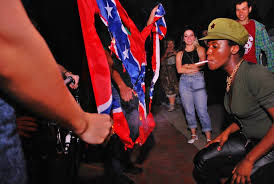
A Facebook petition is calling for a National “Burn The Confederate Flag” Day.
Only 8,000 people have “liked” the petition as of Monday morning.
“The Confederate flag has flown in America for 150 years too long. The Civil War is long over. Fortunately, our First Amendment right gives us the power of free speech that will allow us to display our feeling by burning the flag of slavery from sea to shining sea. Join us for a PEACEFUL DAY OF PROTEST and burn the Confederate flag,” the petition reads.
It continues, “This is our day to demonstrate that it is no longer acceptable to fly this flag anywhere. Organize a Confederate flag burning event in your area on Saturday, June 27th, and flood social media with pictures and videos using the hashtags #FeelTheBurn and #TakeItDown.”
The Confederate flag has become a topic of debate once again after a white gunman opened fire during Bible study at Emanuel AME Church in Charleston, South Carolina, last week, killing nine. Suspect Dylann Roof, 21, has been charged with nine counts of murder.
In an op-ed for the Detroit Free Press, Joe Lapointe called for the Confederate flag to be burned.
“In that South Carolina will never willingly take down the flag, the time has come for opponents to exercise their First Amendment right to free speech and burn the Confederate flag – at the state Capitol in South Carolina, in front of the White House, in front of Fox News or maybe even outside the Grand Ol’ Opry,” Lapointe wrote.”
Lapointe said the Confederate flag is as “evil and vicious to African Americans as the Nazi swastika flag is to Jews.”
“The display of the Confederate flag – anywhere – is a nonverbal statement of race hate. Its burning would be a nonverbal response to its crude attitude,” he wrote. “You’re sure not going to change their attitudes with sweet reason. Fight their figurative fire with the real thing.”
South Carolina was the last state to fly the Confederate battle flag from its Capitol dome. A compromise in 2000 moved the flag to a 30-foot flagpole elsewhere on Statehouse grounds, where it has been flying at full staff.
The Indian governor of South Carolina Nimrata Nikki Randhawa Haley called for the removal of the Confederate flag from the grounds of the state Capitol Monday, less than a week after a 21-year-old white man gunned down nine people at a historic African American church.
Support for the flag to come down from leaders around the state and around the country has been steadily growing in the wake of the attack.
“Today, we are here in a moment of unity in our state, without ill will, to say it is time to move the flag from the Capitol grounds,” Haley said during a news conference attended by Republican senators Lindsey Graham and Tim Scott, along with other state leaders.
Haley called on Monday for South Carolina to do what just a week ago seemed politically impossible. The announcement was met by applause and cheers from those in attendance.
Haley said The flag “does not represent the future of our great state”. Jeb Bush, who ordered the removal of the flag from the Florida statehouse while governor, said he was confident that South Carolina would “do the right thing”.
The MSM is still strangely silent on the shooting in Philidelphia.
Haley is one of two sitting Indian American governors in the United States, the other being fellow Republican Bobby Jindal of Louisiana. She is also the third non-white person to have been elected as governor of a Southern state.
Meanwhile doubts were raised about the authenticity of the shooter’s “manifesto”. It is highly unlikely that a 9th grade dropout somehow attained exceptional writing skills, yet there has been no investigation by the media into the matter.
The two black shooters from West-Philidelphia have not issued a manifesto yet.
The senior leadership of the US Navy’s SEAL community—the commander and force master chief of Naval Special Warfare Command (NSWC)—have officially distanced themselves from a so-called SEAL Team Six member, labeled in the media as ‘The Shooter’.
The man claims to have been the operator who shot Osama Bin Ladin in the 2011 raid that killed the Al-Qaeda leader. Eyewitnesses on the scene have since contradicted the White House’s story of the raid.
Thousands of sailors on the US aircraft carrier from which Bin Laden was said to have been dumped into the Indian Ocean also wrote home that no such burial took place.
In a letter signed by both the senior commander and enlisted man of Naval Special Warfare Command, the SEAL leadership denied that the so-called Shooter was part of their team, pointing out that to reveal such classified information is a violation of the law.
Rear Admiral Brian Losey, Commander of NSWC, and Force Master Chief Michael Magaraci state that violators of that ethos “are neither teammates in good standing, nor teammates who represent Naval Special Warfare.”
Osama bin Laden became the only human in history to survive renal failure for ten years. There was no dialysis machine in what was said to be Bin Laden’s hideout. The Obama administration have also ignored the numerous obituaries of bin Laden’s death in December 2001.
It was reported earlier that 22 Navy SEALs, most of whom belonged to Team 6, died after their helicopter was shot down in Afghanistan. This was the largest loss of life in a single day since the 2001 invasion.
Several more members of the team that allegedly carried out the dubious raid on Bin Laden’s compound, have also wound up dead.
Unlike Bradley Manning who received jail time for leaking classified military information, SEAL Team Six members who speak out are somehow not punished.
A military jury sentenced a US Army officer to death Wednesday for carrying out an Al-Qaeda inspired mass shooting on the Fort Hood base in Texas that left 13 dead.
After a short deliberation, the forewoman of a jury of military officers said it was their unanimous verdict that 42-year-old Major Nidal Hasan should be executed.
“It is my duty as president of this jury to inform you that… the court martial in closed session in a secret ballot of all members concurs to the sentences, to forfeit all pay and allowances, to dismissal from service, to be put to death,” said the forewoman, a colonel.
Hasan, who elected to conduct his own defense during the trial but who called no witnesses and gave no testimony, sat in his wheelchair staring ahead of himself the verdict was read.
Under US military justice, death penalty verdicts are automatically reviewed under an appeals procedure that could take years.
It can then be appealed through the civilians courts, and any execution would have to be approved by the US president.
Death penalty verdicts are often overturned, and no soldier has been executed since 1961.
Hasan has nevertheless made no attempt to deny the charges and court appointed defense attorneys had expressed concern that he is seeking execution.
The US-born Muslim of Palestinian descent is the first member of the army to receive a death sentence since the 2005 conviction of Hasan Akbar, who killed two in an attack on fellow soldiers in Kuwait in 2003.
On November 5, 2009, Hasan opened fire at a medical facility in the sprawling Fort Hood base in Texas that serves as a staging point for soldiers to deploy to combat zones.
Twelve of the dead and 30 of the wounded were soldiers. Hasan was himself shot by a civilian police officer who responded to the attack and he is now partially paralyzed.
The court had heard that Hasan was opposed to the US military’s occupations of Iraq and Afghanistan, and that he had spoken online with an alleged Al-Qaeda figure, radical cleric Anwar al-Awlaki, an American citizen subsequently killed in a US drone strike in Yemen.
Following the sentence, Hasan was rushed quickly out of the military courtroom, which is in Fort Hood, to be transported back to a local civilian jail where he has been held for more than three years.
He is to be taken to military death row in Fort Leavenworth, Kansas, to await execution.
Seven relatives of victims slain in the shooting held back tears during the sentencing after repeatedly being warned not to not make any public declarations of support or opposition to the sentence.
“We are thankful for the just verdict that has finally been rendered. However, we are also dissatisfied with the media attention to Hasan and his extremist views,” Melissa Czemerda, daughter of Hasan’s victim Lieutenant Colonel Juanita Warman, said after the hearing.
“These types of murderers thrive on media attention. It promotes violence from other disturbed individuals seeking a platform for their sick and twisted views.”
Former Fort Hood police officer Sergeant Kimberly Munley, who was wounded in a gun battle with Hasan, immediately took to Twitter to welcome the sentence.
“He will wither away to nothing in his jail cell while waiting on the appellate courts!” she wrote
And Teena Nemelka, mother of slain Private First Class Aaron Nemelka, said: “We have all heard that Hasan believes with the death penalty that we will be seen as a martyr, but I feel that he is a coward, a traitor and a murderer.” – AFP
OAK CREEK, Wis. (AP) — Before he strode into a Sikh temple with a 9mm handgun and multiple magazines of ammunition, Wade Michael Page played in white supremacist heavy metal bands with names such as Definite Hate and End Apathy.
The bald, heavily tattooed bassist was a 40-year-old Army veteran who trained in psychological warfare before he was demoted and discharged more than a decade ago.
A day after he killed six worshippers at the suburban Milwaukee temple, fragments of Page’s life emerged in public records and interviews. But his motive was still largely a mystery. So far, no hate-filled manifesto has emerged, nor any angry blog or ranting Facebook entries to explain the attack.
Oak Creek Police Chief John Edwards suggested Monday that investigators might never know for certain why the lone attacker targeted a temple full of strangers.
“We have a lot of information to decipher, to put it all together before we can positively tell you what that motive is — if we can determine that,” Edwards said.
Page, who was shot to death by police, joined the Army in 1992 and was discharged in 1998. He was described Monday by the Southern Poverty Law Center as a “frustrated neo-Nazi” who had long been active in the obscure underworld of white supremacist music.
Page wrote frequently on white supremacist websites, describing himself as a member of the “Hammerskins Nation,” a skinhead group rooted in Texas that has offshoots in Australia and Canada, according to the SITE Monitoring Service, a Maryland-based private intelligence firm that searches the Internet for terrorist and other extremist activity.
In online forums, Page promoted his music while interacting with other skinheads. He posted 250 messages on one site between March 2010 and the middle of this year, and appeared eager to recruit others. In March 2011, he advertised for a “family friendly” barbeque in North Carolina, exhorting those online to attend.
“If you are wanting to meet people, get involved and become active, then you really need to attend,” he wrote, according to SITE. “Stop hiding behind the computer or making excuses.”
In November, Page challenged a poster who indicated he would leave the United States if Herman Cain were elected president.
“Stand and fight, don’t run,” he replied.
In an April message, Page said: “Passive submission is indirect support to the oppressors. Stand up for yourself and live the 14 words,” a reference to a common white supremacists mantra.
Mark Potok, a senior fellow at the law center, a nonprofit civil rights organization in Montgomery, Ala., said Page played in groups whose often sinister-sounding names seemed to “reflect what he went out and actually did.” The music talked about genocide against Jews and other minorities.
In a 2010 interview, Page told a white supremacist website that he became active in white-power music in 2000, when he left his native Colorado and started the band End Apathy in 2005. The band’s MySpace page listed the group as based in Nashville, N.C.
Page joined the military in Milwaukee in 1992 and was a repairman for the Hawk missile system before switching jobs to become one of the Army’s psychological operations specialists assigned to a battalion at Fort Bragg, N.C.
As a “psy-ops” specialist, Page would have trained to host public meetings between locals and American forces, use leaflet campaigns in a conflict zone or use loudspeakers to communicate with enemy soldiers.
He never deployed overseas in that role, Army spokesman George Wright said.
Page was demoted in June 1998 for getting drunk while on duty and going AWOL, two defense officials said, speaking on condition of anonymity because they were not authorized to release information about the gunman.
Page also received extra duty and was fined. The defense officials said they had no other details about the incident, such as how long Page was gone or whether he turned himself in.
Outside Fayetteville, N.C., a brick ranch house Page bought in 2007 with help from a Veterans Administration mortgage stood boarded up Monday with knee-high weeds in the yard. A notice taped to the front indicated the home was in foreclosure and had been sold to a bank in January.
Before buying the home, Page lived with Army soldier Darren Shearlock, his wife and young children in a doublewide trailer in a rural community near Fort Bragg, records show.
Shearlock, dressed in his military fatigues, declined to comment about Page or the shooting when approached Monday by The Associated Press.
Page’s former stepmother said she was devastated to learn of the bloodshed.
“He was a precious little boy, and that’s what my mind keeps going back to,” said Laura Page of Denver, who was divorced from Page’s father around 2001.
In Wisconsin, Page responded to a recent online ad seeking a roommate in Cudahy, a small city outside Milwaukee.
He rented a room in Kurt Weins’ house in June, telling Wein he had recently broken up with his girlfriend and needed a place to stay.
Weins said Page stayed in that room all the time, declining invitations to watch TV with him. Several weeks later, Page rented an apartment in a duplex owned by Weins across the street. Page explained that he wanted to bring some belongings out of storage.
“We talked, but it was really about nothing,” Weins said. “He seemed pretty calm. He didn’t seem like the type to raise his voice.”
After the FBI searched the apartment in the duplex, Weins returned and found only a computer desk, chair and an inflatable mattress.
Suburban Milwaukee police had no contact with Page before Sunday, and his record gave no indication he was capable of such intense violence.
The FBI was leading the investigation because the shooting was considered domestic terrorism. The agency said it had no reason to believe anyone other than Page was involved.
Page entered the Sikh Temple of Wisconsin as several dozen people prepared for Sunday services. He opened fire without saying a word.
The president of the temple died defending the house of worship he founded.
Satwant Singh Kaleka, 65, managed to find a simple butter knife in the temple and attempted to stab the gunman before being shot twice, his son said Monday.
Amardeep Singh Kaleka said FBI agents hugged him, shook his hand and told him his father was a hero.
“Whatever time he spent in that struggle gave the women time to get cover” in the kitchen, Kaleka said.
With their turbans and long beards, Sikhs are often mistaken for Muslims or Arabs, and have inadvertently become targets of anti-Muslim bias in the United States.
Federal officials said the gun used in the attack had been legally purchased. Page was issued five pistol-purchase permits in 2008 in North Carolina, paying a $5 fee for each.
On Sunday, the first officer to respond was shot eight to nine times as he tended to a victim outside the temple. A second officer then exchanged gunfire with the suspect, who was fatally shot.
The six dead ranged in age from 39 to 84 years old. Three people were critically wounded, including the police officer.
Online records show Page had a brief criminal history in other states, including pleading guilty to misdemeanor criminal mischief after a 1994 arrest in El Paso for getting drunk and kicking holes in the wall of a bar. He received six months’ probation.
Page also pleaded guilty to driving under the influence in Colorado in 1999 but never completed a sentence that included alcohol treatment, records show.
Page was arrested on suspicion of drunk driving again in 2010 in North Carolina after running his car off the side of a highway. The case was dropped a year later for lack of evidence, according to court records.
This website uses cookies to improve your experience. We'll assume you're ok with this, but you can opt-out if you wish. Cookie settingsACCEPT
Privacy & Cookies Policy
Privacy Overview
This website uses cookies to improve your experience while you navigate through the website. Out of these cookies, the cookies that are categorized as necessary are stored on your browser as they are essential for the working of basic functionalities of the website. We also use third-party cookies that help us analyze and understand how you use this website. These cookies will be stored in your browser only with your consent. You also have the option to opt-out of these cookies. But opting out of some of these cookies may have an effect on your browsing experience.
Necessary cookies are absolutely essential for the website to function properly. This category only includes cookies that ensures basic functionalities and security features of the website. These cookies do not store any personal information.
Any cookies that may not be particularly necessary for the website to function and is used specifically to collect user personal data via analytics, ads, other embedded contents are termed as non-necessary cookies. It is mandatory to procure user consent prior to running these cookies on your website.