Black US cities see sharp rise in murders

Black cities across the US are seeing a startling rise in murders after years of declines. Milwaukee, has had more killings this year already than all of 2014.

As in places like Ferguson and Baltimore, tensions over race and police conduct have risen in Milwaukee, where the population is 40 percent black, compared with 6 percent statewide.

Demonstrators took to Milwaukee’s streets after the death of Dontre D. Hamilton, 31, a black man who was shot in a downtown park last year by a white police officer.

With the summer not yet over, 104 people have been killed this year — after 86 homicides in all of 2014.

More than 30 other cities have also reported increases in violence from a year ago. In New Orleans, 120 people had been killed by late August, compared with 98 during the same period a year earlier.

In Baltimore, homicides had hit 215, up from 138 at the same point in 2014. In Washington, the toll was 105, compared with 73 people a year ago. And in St. Louis, 136 people had been killed this year, a 60 percent rise from the 85 murders the city had by the same time last year.

Law enforcement experts say disparate factors are at play in different cities, though no one is claiming to know for sure why murder rates are climbing.

Some officials say intense national scrutiny of the use of force by the police has made officers less aggressive and emboldened criminals, though many experts dispute that theory.

Rivalries among organized street gangs, often over drug turf, and the availability of guns are cited as major factors in some cities, including Chicago.

But more commonly, many top police officials say they are seeing a growing willingness among disenchanted young men in poor neighborhoods to use violence to settle ordinary disputes.

A criminologist from the University of Missouri-St. Louis, said homicides in St. Louis had already begun an arc upward in 2014 before a white police officer killed an unarmed teenager, Michael Brown, in nearby Ferguson.

Capt. Mike Sack, a homicide commander in the St. Louis Metropolitan Police Department, cited killings there that had grown out of arguments over girlfriends, food and even characters on a TV show.

“Most remarkable is that individuals get so upset over things that I or others might consider petty but resort to such a level of violence,” he said.

In Milwaukee critics say low investment in the city’s African-American neighborhoods and mistreatment of black residents by the police, contribute to murders.

Most of the victims in Milwaukee and the suspects in their killings are black men under 30, police data shows, who come from neighborhoods where foreclosures, joblessness and poverty are high.

The most common motive in the slayings was not robbery or gang rivalry but an argument.

Source: NYT

Black man rips Confederate flag off moving truck

Some black people are so whipped up over the Confederate flag — and eager to silence the free speech of others — they’re willing to be run over by moving vehicles to do it.

Video captures a black man running up to a semi in slow-moving traffic on the highway to rip off a Confederate flag from the truck’s tailgate.

The Grio, a black news website, grabbed the video from Twitter and posted it, with James Brown’s “The Payback.”

The video shows the unidentified man trotting behind the truck, struggling to remove the flag. After several moments, he rips it off and gets out of the road.

The site reports the truck “appears to be a part of ‘TRIBE Transportation, Inc.,’ a company ironically owned by a Native American woman.”

For whatever reason, Grio called the company to tell on the driver and get reaction.

“Any issue like that we’d handle internally,” TRIBE Executive Vice-Preisdent Matt Handte said. “Regardless of what happened, that’s something we’d handle internally.”

Source: The American Mirror

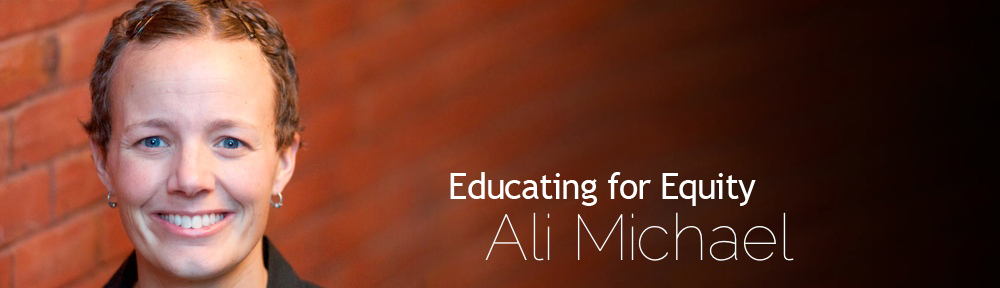
Rachel Dolezal is right: White self-hate is only logical, says US ‘academic’

Writing in the Huffington Post, a US author and “Director of P-12 Consulting and Professional Development at the Center for the Study of Race Equity in Education at the University of Pennsylvania”, Ali Michael, argues that she dan identify with Rachel Dolezal’s attempt to disguise herself as a black and renounce her white identity. Below, Michael says:

“I definitely experienced this. There was a time in my 20s when everything I learned about the history of racism made me hate myself, my Whiteness, my ancestors… and my descendants. I remember deciding that I couldn’t have biological children because I didn’t want to propagate my privilege biologically.”

Here is a slightly shortened version of Ali Michael’s column, originally entitled, I sometimes don’t want to be white either.

Rachel Dolezal is a fascinating case study in White racial identity development.* She is stuck in the immersion/emersion stage, in which White people, having learned extensively about the realities of racism, and the ugly history of White supremacy in the U.S., “immerse” themselves in trying to figure out how to be White in our society, and “emerge” with a new relationship to Whiteness. Only in the case of Dolezal, her way of dealing with the pain of the reality of racism, was to deny her own Whiteness and to become Black.

She is an extreme example of a common phenomenon. The “immersion” stage is typified by White people taking more responsibility for racism and privilege and often experiencing high levels of anger and embarrassment for racism and privilege, which they sometimes direct towards other Whites. They sometimes try to immerse themselves in communities of color, as Dolezal did. She’s not alone.

I definitely experienced this. There was a time in my 20s when everything I learned about the history of racism made me hate myself, my Whiteness, my ancestors… and my descendants. I remember deciding that I couldn’t have biological children because I didn’t want to propagate my privilege biologically.

If I was going to pass on my privilege, I wanted to pass it on to someone who doesn’t have racial privilege; so I planned to adopt. I disliked my Whiteness, but I disliked the Whiteness of other White people more. I felt like the way to really end racism was to feel guilty for it, and to make other White people feel guilty for it too. And then, like Dolezal, I wanted to take on Africanness. Living in South Africa during my junior year abroad, I lived with a Black family, wore my hair in head wraps, shaved my head. I didn’t want to be White, but if I had to be, I wanted to be White in a way that was different from other White people I knew. I wanted to be a special, different White person. The one and only. How very White of me…

Beverly Daniel Tatum has written that White people don’t choose to identify as White because the categories to choose from are loaded from the start. Traditionally, one can identify as a colorblind White person, a racist White person or an ignorant White person: those are the three ways White people get talked about as White. If those are the options, who would choose to identify as White? And so White people identify as “normal” and “Irish” and “just American” and do not self-identify racially. And that leaves us with a society in which only people of color have a race, where only people of color seem to be responsible for racialized problems. It makes it hard for all of us to know and tell our racial stories — because White people think we don’t have any. And it makes it hard for us to own our history, because we don’t see it as ours.

Many White people also feel like we don’t have culture, and this isn’t a coincidence.

Throughout the 20th century, countless immigrant groups abandoned the artifacts of cultures that racialized them as immigrants (language, religion, food, styles of speaking, gesticulations, family structures, traditions, etc.) in order to become White. And this was not just a matter of fitting in; it was about accessing rights that were reserved for White people: citizenship, land ownership, police protection, legal rights, etc.

The more one could cast off the markers of otherness, the more likely it was that one could become White. And so while the desire to become White is really the opposite of what Rachel Dolezal had, the process of becoming White that her ancestors undoubtedly went through in the great American star-off machine, may be connected to her desire to un-become White, to lose that feeling of being cultureless, of being part of an unidentified group, and to leave behind that identity that has no positive way to be. And lots of White people — myself included — do this in thousands of tiny ways as we appropriate the cultures of others (from Africa, India, Compton, Guatemala, Harlem, Mexico…) to fill in the blanks in our own.

Daniel Tatum said we need to change this. We need to give White people new ways to identify as White. Because at the end of the day, we need White people to see that we are White. When we recognize and own our Whiteness, we can account for our own portion, our one 1/billionth of responsibility for what White people have done throughout history. We can work with other White people to begin to challenge bias, ignorance and colorblindness. We can use our privilege to confront the sources of that unfair favoring.

I was lucky. The Black family I embedded myself in during my “Rachel Dolezal phase” insisted on my inherent goodness, and that of my family and even — I thought this was a stretch — of my ancestors. They helped me focus on my capacity to make change as a White person. They appreciated my desire to be Black, they teased me, they let me know in no uncertain terms that I would never be Black. I read James Baldwin, Toni Morrison, Steve Biko. I swore off White authors. But the Black authors I read saw the immersion stage coming, and they reminded me that Black people don’t need White people to help them pursue liberation, that the job of White people lies with teaching other White people, seeing ourselves clearly, owning our role in oppression.

I’m not sure what happened with Rachel Dolezal. Maybe it was mental illness. Maybe it was a desire to connect to her adopted brothers. Maybe she felt safer and more loved in Black communities. Maybe it felt good to distance herself from the overwhelming oppressiveness of Whiteness — her own and that of her country and of her ancestors. But the lesson for me is remembering how deep the pain is, the pain of realizing I’m White, and that I and my ancestors are responsible for the incredible racialized mess we find ourselves in today. The pain of facing that honestly is blinding. It’s not worse than being on the receiving end of that oppression. – Ali Michael


*White racial identity development was first theorized and written about by Dr. Janet Helms.


Fake black Dolezal accuses brother of sexual abuse

Even as Rachel Dolezal, the Spokane NAACP president whose parents outed her as white, resigned from the organization on Monday ahead of a “Today” show interview, another Dolezal was thrust into the spotlight.

It was revealed Monday that Dolezal’s older brother Joshua Dolezal is awaiting trial on charges he sexually abused a black child — charges that the Dolezal family, in their own television appearance, implied Rachel Dolezal may have helped orchestrate. Joshua Dolezal is contesting the charges and is free on $15,000 bail while awaiting trial, according to the Denver Post.

Joshua Dolezal’s troubles could explain at least one piece of the complicated puzzle behind this saga, the question of why Rachel Dolezal’s parents would expose their daughter to such public humiliation and perhaps legal jeopardy.

Joshua Dolezal, 39, is the eldest child of the Dolezal clan. Rachel is his only biological sibling — Lawrence and Ruthanne Dolezal have four adopted children, some of whom are black. Joshua now faces four felony counts of sexual assault in Colorado, according to reports in the New York Daily News, the Denver Post and other local outlets that have been confirmed by The Washington Post.

The alleged incidents of sexual assault, according to a Clear Creek County affidavit in support of an arrest warrant obtained by the Daily News and reviewed by The Post, occurred at Lawrence and Ruthanne’s house in Colorado “in 2001 or 2002.” The victim, whose name was redacted in the affidavit, “was 6 or 7 years old,” and Joshua Dolezal was “19 years older.”

Among other accusations: On two occasions, according to the affidavit, Joshua Dolezal allegedly forced the victim to perform oral sex on him. On “7 or 8″ other occasions, Dolezal performed oral sex on the victim.

“Don’t tell anyone or I’ll hurt you,” Joshua allegedly said.

The affidavit included claims that an older incident of alleged abuse of another victim in 1991 had a racial element.

“The family had a subscription to National Geographic magazine,” it read. “… Joshua Dolezal showed [redacted] his collection of photos of topless and naked African women.”

It continued: “Joshua Dolezal was turned on by the black body and was curious about black women sexually.”

The abuse was reported in 2013, and Joshua Dolezal was arrested last year. The victim, according to the affidavit, “wanted to report the incident now because Joshua Dolezal has a one year old daughter and [redacted] does not want the daughter to be victimized.”

Dolezal will be tried in August, as ABC 7 Denver reported.

The allegations against Joshua Dolezal are significant because, in interviews with The Post and other outlets, the Dolezals alleged Rachel orchestrated them to win custody of her brother Izaiah. Izaiah, who is black, lives with Rachel Dolezal in Spokane — and Rachel says he is her son, the family alleged.

The parents of Rachel Dolezal, the civil rights activist under fire for her disputed racial identity, say they don’t know what caused their biological daughter to call herself African American.

Lawrence and Ruthanne Dolezal, without specifically addressing the charges against their son, broadly denied such behavior as well as Rachel Dolezal’s allegations that she was physically abused as a child.

“If she’s alleging there was abuse in our family from years past, then it’s false and there’s no need to comment on anything of that nature,” Lawrence Dolezal told The Post last week. “That’s just utter falsehood.”

“The allegations are totally false and malicious,” Ruthanne Dolezal told Megyn Kelly of Fox News when she asked about them Monday. “They’re fabricated.”

“Rachel Dolezal dismisses the controversy as little more than an ugly byproduct of contentious litigation between other family members over allegations of past abuse that has divided the family,” the paper said. “She’s particularly suspicious of the timing, noting that the allegations broke on her son’s birthday and come as the Colorado lawsuit … nears a key juncture.” While she referred to a lawsuit, the charges in Colorado are criminal.

Though it’s not clear when and how the Dolezals became so divided, insight into the warring family comes from an unlikely source: the published writing of Joshua Dolezal, the accused.

Joshua Dolezal is an English professor at Central College, a private liberal arts college in Pella, Iowa. His work, much of it nonfiction, has appeared in respected publications such as the Kenyon Review, and the University of Iowa Press published his memoir — which includes many references to his sister Rachel.

“Down from the Mountaintop: From Belief to Belonging” offers the most complete picture heretofore of Rachel Dolezal’s broken marriage. According to Lawrence Dolezal, she was married to a black man, Kevin Moore, and the couple divorced in 2004.

Joshua Dolezal saw signs of trouble. In many passages, Rachel Dolezal is portrayed as the victim of an unhappy marriage whose husband won’t let her and their young child leave the house — a woman who does what her spouse says when he says it.

Joshua Dolezal was angry. “I murdered him hundreds of times in my sleep,” he wrote of his former black brother-in-law. Eventually, the couple separated.

Of course, a memoir isn’t a fact-checked, reported news story and the ex-husband has been unavailable for comment and has not responded to numerous published accounts of her claims. But Joshua Dolezal said he did his best.

“To remember is to reconstruct and interpret,” he wrote in an author’s note, “and this is as truthful a story as my memory can tell.”

Source: Washington Post

‘Black’ NAACP president outed as white

An NAACP leader’s parents have made a startling revelation: their daughter, for years a highly visible civil rights activist in Eastern Washington, is white.

Rachel Dolezal, Spokane’s NAACP Chapter President and part-time Africana Studies professor at Eastern Washington University, has been misleading people about her ethnicity for years, her parents say.

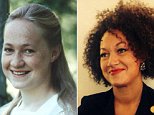
Her mother even offered photographic proof. While today the 37-year-old divorcee currently sports tight, dark curls, her mom Ruthanne Dolezal showed KREM photos of the fair and freckled blonde daughter she once knew.

Dolezal is now facing a city ethics probe after she identified herself as black in an application to serve on a local police ombudsman commission – a position she secured.’It’s very sad that Rachel has not just been herself,’ Ruthanne Dolezal told the Spokesman-Review. ‘Her effectiveness in the causes of the African-American community would have been so much more viable, and she would have been more effective if she had just been honest with everybody.’

The Dolezals remain in Northwest Montana, where Dolezal grew up. It is not clear why they have now shared the revelations but Dolezal has previously said that she no longer has any contact with her parents. In articles in the Easterner, she claimed they were violent towards her.

But her father denies this and said that Dolezal cut off all communication with them and doesn’t want them to be seen in Spokane ‘because we’re Caucasian’, Buzzfeed News reported. According to her mother, Ruthanne began to ‘disguise herself’ in 2006 or 2007.

Other than some ‘faint traces’ of Native American blood, Ruthanne said the family background is Czech, Swedish and German.

However, that’s not how her daughter identified herself when she became chairwoman of Spokane’s Office of Police Ombudsman Commission.

In her application for the volunteer appointment, Dolezal marked herself down as white, black and American Indian, reports the Spokesman-Review. She has also previously claimed that her white father is her step-father. In January, a photo showing Dolezal and a black man on the Spokane NAACP’s Facebook erroneously identified the man as her father.

On Wednesday, a reporter from KXLY confronted Dolezal a photo of her with the African-American man while on camera.

‘Ma’am, I was wondering if your dad really is an African-American man,’ the KXLY reporter asked.

‘I don’t understand the question,’ Dolezal replied. ‘I did tell you [that man in the picture] is my dad.’

‘Are your parents white?’ the reporter asked. Dolezal then removed her mic and walked away.

Reached by the Spokesman-Review, Dolezal answered questions about her ethnicity by saying: ‘That question is not as easy as it seems… There’s a lot of complexities … and I don’t know that everyone would understand that… We’re all from the African continent.’

According to her staff biography at Eastern Washington University, Dolezal received her master’s degree from Howard University, a historically black college in Washington, D.C. As Buzzfeed notes, Dolezal’s blog posts and interviews often reference her ‘black sons’.

However, her mother told CDAPress.com that one of those boys is Izaiah Dolezal – who was, in fact, one of four African American infants Rachel’s parents adopted in the 1990s, meaning the boy is Dolezal’s brother, rather than her son.

Izaiah, now 21, has since gone to live with Dolezal and no longer speaks with his adopted parents.

Publicly available birth records, list her biological parents as Ruthanne and Lawrence Dolezal of Montana.

Her Eastern Washington University bio also says that Dolezal has been the victim of at least eight ‘documented hate crimes’.

While in the position, Dolezal filed multiple police reports ranging from theft to harassment to racially motivated hanging of a nooses in her home.

In a more recent claim of racially motivated harassment, Dolezal made local headlines early this year when hate mail was supposedly sent to her at the NAACP post office box in Spokane.

However, police reports on the case revealed this week that whoever placed the letters and packages into the box would have had to have the key because none had bar codes or stamps.

In an official statement, the NAACP said on Friday: ‘NAACP Spokane Washington Branch President Rachel Dolezal is enduring a legal issue with her family, and we respect her privacy in this matter.

‘One’s racial identity is not a qualifying criteria or disqualifying standard for NAACP leadership. The NAACP Alaska-Oregon-Washington State Conference stands behind Ms. Dolezal’s advocacy record.

‘In every corner of this country, the NAACP remains committed to securing political, educational, and economic justice for all people, and we encourage Americans of all stripes to become members and serve as leaders in our organization.’

Source: Daily Mail

Baltimore gets even bloodier

A 31-year-old woman and a young boy were shot in the head Thursday, becoming Baltimore’s 37th and 38th homicide victims so far this month, the city’s deadliest in 15 years.

The most recent killings claimed the lives of Jennifer Jeffrey and her seven-year-old son, Kester Anthony Browne. They were identified by Jeffrey’s sister, Danielle Wilder.

Jeffrey and her son were found dead early Thursday, each from gunshot wounds to the head.

As family members cried and held each other on the quiet, leafy block in Southwest Baltimore where they lived, Wilder said she felt as if “my heart has been ripped out.”

Wilder said a neighbor called their other sister early Thursday, concerned that she hadn’t hear any noise coming from Jeffrey’s house: no footsteps, Wilder said, no voices, and no gunshots. But when her brother let himself into the house to check on the mother and son, he discovered their bodies.

“She was in the living room,” Wilder said. “The baby was upstairs, in the bed.”

Wilder said police told her there were no signs of forced entry, and that whoever killed Jeffrey and Browne were let into the house sometime yesterday. Wilder said she thinks whoever killed Jeffrey, who also lived with her niece and grand-niece, wanted to catch her alone, and that the boy was collateral damage.

Thursday’s deaths continue a grisly and dramatic uptick in murders across Baltimore that has so far claimed the lives of 38 people. Meanwhile, arrests have plunged: Police are booking fewer than half the number of people they pulled off the streets last year.

Arrests were already declining before Freddie Gray died on April 19 of injuries he suffered in police custody, but they dropped sharply thereafter, as his death unleashed protests, riots, the criminal indictment of six officers and a full-on civil rights investigation by the U.S. Justice Department that has officers working under close scrutiny.

“I’m afraid to go outside,” said Antoinette Perrine, whose brother was shot down three weeks ago on a basketball court near her home in the Harlem Park neighborhood of West Baltimore. Ever since, she has barricaded her door and added metal slabs inside her windows to deflect gunfire.

“It’s so bad, people are afraid to let their kids outside,” Perrine said. “People wake up with shots through their windows. Police used to sit on every corner, on the top of the block. These days? They’re nowhere.”

West Baltimore residents worry they’ve been abandoned by the officers they once accused of harassing them, leaving some neighborhoods like the Wild West without a lawman around.

“Before it was over-policing. Now there’s no police,” said Donnail “Dreads” Lee, 34, who lives in the Gilmor Homes, the public housing complex where Gray, 25, was chased down. “People feel as though they can do things and get away with it. I see people walking with guns almost every single day, because they know the police aren’t pulling them up like they used to.”

The Baltimore Fraternal Order of Police Lodge 3 on Thursday posted a statement from President Gene Ryan on social media saying that the police are “under siege.”

“The criminals are taking advantage of the situation in Baltimore since the unrest,” Ryan wrote. “(Police) are more afraid of going to jail for doing their jobs properly than they are of getting shot on duty.”

Protesters said Gray’s death is emblematic of a pattern of police violence and brutality against impoverished African-Americans in Baltimore.

The 38 homicides so far in May is a major spike, after 22 in April, 15 in March, 13 in February and 23 in January.

With one weekend still to go, May 2015 is already the deadliest month in 15 years, surpassing the November 1999 total of 36.

Ten of May’s homicides happened in the Western District, which has had as many homicides in the first five months of this year as it did all of last year.

Non-fatal shootings are spiking as well — 91 so far in May, 58 of them in the Western District.

The mayor said her office is “examining” the relationship between the homicide spike and the dwindling arrest rate.

Source: AP

Rising US black population foreign born

Rapidly growing numbers of black immigrants have reshaped the overall black population in the United States in recent decades, particularly in Washington and other cities with large U.S.-born African American communities, a new report says.

A record 3.8 million foreign-born blacks now live in the United States, the Pew Research Center reported Thursday. The influx means that the share of foreign-born blacks, largely from Africa and the Caribbean, has grown from 3.1 percent of the black population in 1980 to 8.7 percent in 2013. By 2060, 16.5 percent of the U.S. black population will be foreign-born, the report says.

The report highlights the degree to which America’s black population is less homogenous than in previous generations, experts said.

“I think when you’re talking about the black population, it’s increasingly important to be able to pull apart the distinctions between U.S.-born blacks of several generations compared to the new immigrants,” said William H. Frey, a demographer and senior fellow with the Metropolitan Policy Program at the Brookings Institution.

“Just because they’re new immigrants,” Frey added, “they have different needs and patterns, probably in terms of language in many cases, in terms of assimilation. And so they probably shouldn’t be confused with native-born blacks in lots of ways, who have their own needs to be addressed.”

Frey, in his 2014 book “Diversity Explosion,” estimated that black immigrants made up about 10 percent of all blacks and differed from U.S.-born blacks in important socioeconomic respects. That was also reflected in the Pew report, which said black immigrants tend to be older, more likely to have a higher education and a higher income, and less likely to live in poverty.

The impact of black immigration has been particularly strong in cities that already had some of the nation’s largest black populations. For instance, in the District, 15 percent of the black population was born outside the United States. In Miami, 34 percent of the black community was born elsewhere. In New York’s metro area, that figure is 28 percent. Nearly half of the influx has occurred since 2000, the report says.

Most of the nation’s 40 million U.S.-born blacks trace their heritage to African ancestors who were brought here as slaves. The report also notes that blacks accounted for nearly one-fifth of the U.S. population at the end of the 18th century.

The most recent wave of black immigration began in the 1960s after U.S. immigration laws were changed. In recent years, the pace has increased. The most recent Census Bureau estimates show that immigration accounted for 25 percent of the growth in the U.S. black population between 2010 and July 2013, Frey said.

Half of the black immigrants arrived from the Caribbean, the Pew report says. The largest source is Jamaica, with 682,000, followed by Haiti, with 586,000. Jamaican immigrants make up 18 percent of the black population in the United States; those from Haiti represent about 15 percent of the U.S. black population.

But a rapidly growing proportion of foreign-born blacks who arrived in the United States in recent years came from Africa, led almost entirely by immigrants from sub-Saharan Africa, the report says. Nigeria and Ethiopia rank first and second, respectively, in the number of African immigrants in the United States. Many sub-Saharan immigrants — 28 percent — were refugees or others seeking asylum.

Source: Washington Post

Whiteface causes a stir

Azealia Banks is at the center of another racially charged controversy after posting a picture of herself being transformed into an ice princess for a new music video and tagging it “#WhiteFace.” Later explaining herself on Twitter, the outspoken rapper created a firestorm.

In recent months, Banks has frequently made headlines with her Twitter rants about everything from the Bill Cosby rape allegations to slave reparations. She’s repeatedly slammed Iggy Azalea, called out Kendrick Lamar, and generally been a lightning rod for debates about race and society. On Monday, she decided to post her “whiteface” photo. People got upset. Banks took to Twitter:

Lol u crackers wish I cared enough to be doing whiteface. I’m becoming the ICE PRINCESS YAAAAAAS. I use the word crAcker just as much as I use the word n*gger… Don’t get mad now… You lot are all so easily moved… DAMN… Yall really r hype. This is not white face this is my Ice Princess makeup. Calm tf down LOL… And sidebar.. When snoop did whiteface YALL all thought that sh*t was hilarious and funny right? #MISOGYNOIR at its finest!!

Banks then turned her attention to what she claims are the media’s constant, wrong accusations of homophobia. Here’s what she had to say about that:

Gay media has to stop using homophobia as a means to try and victimize itself and scar the names of its opponents… Phobia would imply that I am scared of gay men or dislike them because of what they choose to do sexually… I promise, no one gives a f*ck what u decide to do in your private lives. But I also promise, that no matter how bitchy and clever you think you are.. That I will out-bitch you… But I’m just going to ignore yall from here on out cause YALL are really just reaching and looking for any reason to insert ur selves In the Azealia Banks story.

Banks concluded by declaring, “The gay white media is so evil, ugly and delusional.”

Trayvon’s father speaks at black excellence gala

Tracy Martin, father of Trayvon Martin, will speak at Texas Tech’s Black Excellence Gala, according to KFYO.

Trayvon Martin was killed by George Zimmerman in Florida in 2012. In a 2013 trail, Zimmerman was acquitted of second-degree and manslaughter charges.

The event is being hosted by the Iota Upsilon Chapter of Kappa Alpha Psi Fraternity, to commemorate Black History month.

Martin will speak on “the importance of African-American lives and bring awareness about the African-American population in the Texas Tech and Lubbock communities,” according to organizers.

“The commitment the men of Kappa Alpha Psi have made to emphasize the importance of community service, social welfare and academic scholarship reinforces the university’s dedication to student success,” said Harriette Baker, assistant director of Texas Tech’s fraternity and sorority life, according to the news release.

“It is important for the student leaders at Texas Tech to take the time each year to remind the greater university community of our shared responsibility to uphold the principles and values the organization and institution were founded on.”

The fraternity will also be featuring broadcaster Tavis Smiley and former Black Panther and professor Angela Davis.

The February 2012 shooting death of 17-year-old Martion might never have happened if school officials in Miami-Dade County had not instituted an unofficial policy of treating crimes as school disciplinary infractions.

Revelations that emerged from an internal affairs investigation explain why Martin was not arrested when caught at school with stolen jewelry in October 2011 or with marijuana in February 2012. Instead, the teenager was suspended from school, the last time just days before he was shot by George Zimmerman.

Trayvon Martin was not from Sanford, the town north of Orlando where he was shot in 2012 and where a jury acquitted Zimmerman of murder charges.

Martin was from Miami Gardens, more than 200 miles away, and had come to Sanford to stay with his father’s girlfriend Brandy Green at her home in the townhouse community where Zimmerman was in charge of the neighborhood watch.

Trayvon was staying with Green after he had been suspended for the second time in six months from Krop High School in Miami-Dade County, where both his father, Tracy Martin, and mother, Sybrina Fulton, lived.

Both of Trayvon’s suspensions during his junior year at Krop High involved crimes that could have led to his prosecution as a juvenile offender.

Miami-Dade School Police Department (MDSPD) in 2010 had implemented a policy that reduced the number of criiminal reports, manipulating statistics to create the appearance of a reduction in crime within the school system.

What was actually happening was that crimes were not being reported as crimes, but instead treated as disciplinary infractions.

Either of those incidents could have put Trayvon Martin into the custody of the juvenile justice system.

In fact, the reason Zimmerman was patrolling the townhouse community the night of the February 2012 shooting was that there had been a rash of burglaries in the neighborhood.

President Obama addressed the verdict in the Zimmerman trial and declared that “Trayvon Martin could have been me 35 years ago.”

Obama also said that he had experienced “racial profiling”, and suggested that white Americans express guilt about the shooting. He said the incident required all Americans to “do some soul searching.”

He added: “My main message is to the parents of Trayvon Martin: If I had a son he’d look like Trayvon. And I think they are right to expect that all of us as Americans are gonna take this with the seriousness it deserves.”

US whites a minority by 2050

A new baby boom of Hispanic, Asian and black children is coming to America – and it will make whites a minority by 2050.

The surge is not due to new immigrants coming to the United States – but instead stems from the immigrants who are already here having children, according to Brookings Institution demographer William Frey.

His new book, Diversity Explosion, recounts how falling white birth rates and rising birth rates for minorities will change way the United States of America looks – and votes – forever.

There are already nearly as many non-white babies being born as white children, according to Census Bureau statistics. It’s only a matter of time before minorities children outnumber white ones.

The result, Frey tells the Atlantic, will be very similar to the Baby Boom after the Second World War – except this time it will be minority children being born.

‘Back in the 1950s, we had a lot of Americans across the board in their childbearing years – we had all these babies,’ he said.

‘Now, that’s really only the case for some of the newer minorities.’
And it’s not just cities that will be changing. The suburbs are already becoming more diverse and are likely to become progressively less white year after year.

Between 2000 and 2010, the population of Hispanics in suburbs grew by more than eight million. Major cities added just three million Hispanics.

Even among black Americans, the population of suburban dwellers is growing. In the last decade, the population of suburban blacks grew by three million and the population of urban blacks shrank by several hundred thousand.

Source: Daily Mail


‘I have ebola, I’ve been to Africa’

Amid cries of racism from black leaders including Jesse Jackson, cases of Ebola have topped 8,000 now, according to official data from the World Health Organization, though many cases could actually be unreported.

The death toll continues to climb near 4,000, and officials have stressed the outbreak is unprecedented and may continue to get worse.

Dallas County Commissioner John Wiley Price made similar arguments this week that Thomas Duncan, the first patient diagnosed with Ebola in the United States, died because his race and lack of “privilege” kept him from receiving the care he needed.

“It is historical what has happened in this community,” said Mr. Price, who is black. “If a person who looks like me shows up without any insurance, they don’t get the same treatment.”

An American passenger was booted off a US Airways flight and screened after reportedly joking that he had Ebola and telling the rest of the flyers they were “screwed.”

During a flight from Philadelphia to the Dominican Republic, the 54-year-old American – who remains unidentified – reportedly yelled, “I have Ebola, you are all screwed,” according to the Dominican news outlet Diario Libre.

He also yelled out, “I’ve been to Africa!” an airport official told Fox News Latino.

He didn’t yell “bomb,” but he might as well have. After the supposed joke was aired, there was noticeable panic and concern on the airplane, which was carrying 290 passengers. The plane was isolated as soon as it landed in Punta Cana, where a medical team outfitted with hazmat suits boarded the aircraft and removed the passenger.

After conducting a medical check, the passenger was found not to be infected with the virus. Though he was coughing on the flight, he had no fever when he was inspected. He had never been to Africa, either.

In a video captured by a passenger, an African-American can be seen being taken out of the plane by medical officials.

Fifty-eight percent of Americans supported the flight ban, according to a poll conducted in a collaboration between NBC News and SurveyMonkey.

Only twenty percent of respondents did not support a travel ban from the likes of Guinea, Liberia, and Sierra Leone.

As of earlier this week, neither the World Health Organization nor the White House endorsed an all-out travel ban to the US from affected nations.

Airplane cabin cleaning crews at New York’s LaGuardia International Airport began a 24-hour strike on Wednesday, citing, in part, possible exposure to the Ebola virus. Meanwhile, a poll found most Americans want flights banned from Africa.

“The whole country is shivering, worried about the problems of Ebola,” said Hector Figueroa, President of 32BJ Service Employees International Union, according to CBS New York.

Cabin cleaners per plane at LaGuardia have been reduced by up to half, and the time to clean planes has been cut down to as little as five minutes, workers said, as reported by CBS New York.


‘Black is all that matters’

While the migration of black Africans is not new, the number of sub-Saharan immigrants has grown swiftly, an influx that is shifting the demographic landscape across the country, including in New York City.

Between 2000 and 2010, the number of legal black African immigrants in the United States about doubled, to around one million. During that single decade, according to the most reliable estimates, more black Africans arrived in this country on their own than were imported directly to North America during the more than three centuries of the slave trade.

And while New York State is home to the largest proportion and many have gravitated to ethnic enclaves like Little Senegal in West Harlem or the Concourse Village section of the West Bronx, to live among fellow Ghanaians, black immigrants from Africa have tended to disperse more widely across the country — to California, Florida, Georgia, Illinois, Maryland, Texas and Virginia — than Caribbean-born blacks.

About a third of black New Yorkers were born abroad, mostly in the Caribbean. Africans constitute about 4 percent of the city’s foreign-born population, but as much as 10 percent in the Bronx. At last count, according to an analysis of census estimates by the Department of City Planning, from 2000 to 2011 the African-born population increased 39 percent to 128,000, although other estimates suggest that many more are living here without legal residency.

“They’ve been doubling every 10 years since 1980,” said Kim Nichols, an executive director of the African Services Committee, which is based in Harlem. “There’s a more established family and community network here to come to.”

Some come as refugees, some with work visas or special skills, many to stay and others to hone their talents and eventually apply them back home.

“Many black immigrants do not identify with the historical experiences of discrimination encountered by blacks in the United States,” said Kevin D. Brown, a law professor at Indiana University’s Maurer School of Law.

Kobina Aidoo, director of “The Neo-African-Americans,” a documentary, said, “I’ve heard people refer to themselves as everything from ‘African African-American’ to ‘Halfrican American’ to ‘White African-American’ to ‘Real African-American’ to ‘American African” to ‘Just black.’ ”

Dr. Khalil Gibran Muhammad, director of the New York Public Library’s Schomburg Center for Research in Black Culture, recalling the shooting by the police of Amadou Diallo, an unarmed immigrant from Guinea in the Bronx in 1999, and of Michael Brown, an unarmed teenager in Ferguson, Mo., last month, said color still trumped place of origin.

“Diversity among African-descended communities remains a black box and a mystery to most Americans,” he said. “[Being] Black is all that matters [to blacks].”

Source: NYT

Whiteface is a ‘racist attack’

A Florida Republican congressional candidate’s campaign sign was vandalized with whiteface paint last week in a district with overwhelmingly Democratic voter registration. The attack follows a string of bias incidents against black Republicans.

Glo Smith, who reports that she has also had a number of signs stolen, tells National Review Online she became aware of the racist defacement of an eight-foot-by-four-foot sign Tuesday.

The sign was situated on private property in view of Interstate 10 in Jacksonville. The vandal sprayed white paint over the face of Smith, who is African-American. The paint job appears to be carefully done and leaves the eyes untouched, creating a very creepy effect.

Two Republican contenders joined in deploring the racist attack, however.

“We expect signs to be tampered with or stolen,” Smith says, “but not to this extent.” She has not reported the episode to police, but a tweet from the Smith campaign blew up over the weekend.

“There have been some comments out there that this may have been caused by bigotry. This is a message that she is an African American woman who is a Republican and therefore has a white point of view.”

Source: NRO

Obama blames his failing popularity on race

racecardPresident Barack Obama said that racial tensions may have softened his popularity among white voters within the last two years, according to a story posted on the New Yorker magazine’s website today.

“There’s no doubt that there’s some folks who just really dislike me because they don’t like the idea of a black president,” Obama said in the article by David Remnick.

Obama said this in his most direct comment on how race has affected his political standing since he’s been in office. His wife Michelle has spoken openly about race before.

Obama’s second term has been marked by controversies including a partial government shutdown in October, revelations that the National Security Agency has gathered personal mobile phone data and the troubled rollout of health-insurance expansion.

Obama’s approval rating among all voters is 39 percent and his disapproval rating is 53 percent, according to a Gallup Poll conducted Jan. 14-16. In the 2012 presidential election, Republican candidate Mitt Romney won 59 percent of the white vote, compared with Obama’s 39 percent, according to exit polling by a consortium of major news outlets. Obama won 43 percent of the white vote in 2008 against 55 percent for opponent John McCain, a Republican senator from Arizona.

Source: Bloomberg