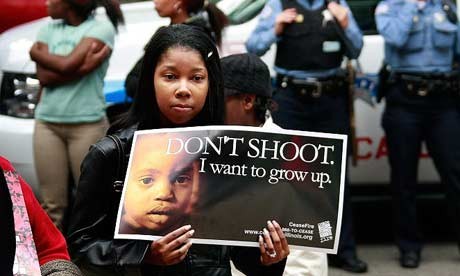
Black US cities see sharp rise in murders

Black cities across the US are seeing a startling rise in murders after years of declines. Milwaukee, has had more killings this year already than all of 2014.

As in places like Ferguson and Baltimore, tensions over race and police conduct have risen in Milwaukee, where the population is 40 percent black, compared with 6 percent statewide.

Demonstrators took to Milwaukee’s streets after the death of Dontre D. Hamilton, 31, a black man who was shot in a downtown park last year by a white police officer.

With the summer not yet over, 104 people have been killed this year — after 86 homicides in all of 2014.

More than 30 other cities have also reported increases in violence from a year ago. In New Orleans, 120 people had been killed by late August, compared with 98 during the same period a year earlier.

In Baltimore, homicides had hit 215, up from 138 at the same point in 2014. In Washington, the toll was 105, compared with 73 people a year ago. And in St. Louis, 136 people had been killed this year, a 60 percent rise from the 85 murders the city had by the same time last year.

Law enforcement experts say disparate factors are at play in different cities, though no one is claiming to know for sure why murder rates are climbing.

Some officials say intense national scrutiny of the use of force by the police has made officers less aggressive and emboldened criminals, though many experts dispute that theory.

Rivalries among organized street gangs, often over drug turf, and the availability of guns are cited as major factors in some cities, including Chicago.

But more commonly, many top police officials say they are seeing a growing willingness among disenchanted young men in poor neighborhoods to use violence to settle ordinary disputes.

A criminologist from the University of Missouri-St. Louis, said homicides in St. Louis had already begun an arc upward in 2014 before a white police officer killed an unarmed teenager, Michael Brown, in nearby Ferguson.

Capt. Mike Sack, a homicide commander in the St. Louis Metropolitan Police Department, cited killings there that had grown out of arguments over girlfriends, food and even characters on a TV show.

“Most remarkable is that individuals get so upset over things that I or others might consider petty but resort to such a level of violence,” he said.

In Milwaukee critics say low investment in the city’s African-American neighborhoods and mistreatment of black residents by the police, contribute to murders.

Most of the victims in Milwaukee and the suspects in their killings are black men under 30, police data shows, who come from neighborhoods where foreclosures, joblessness and poverty are high.

The most common motive in the slayings was not robbery or gang rivalry but an argument.

Source: NYT

Baltimore gets even bloodier

A 31-year-old woman and a young boy were shot in the head Thursday, becoming Baltimore’s 37th and 38th homicide victims so far this month, the city’s deadliest in 15 years.

The most recent killings claimed the lives of Jennifer Jeffrey and her seven-year-old son, Kester Anthony Browne. They were identified by Jeffrey’s sister, Danielle Wilder.

Jeffrey and her son were found dead early Thursday, each from gunshot wounds to the head.

As family members cried and held each other on the quiet, leafy block in Southwest Baltimore where they lived, Wilder said she felt as if “my heart has been ripped out.”

Wilder said a neighbor called their other sister early Thursday, concerned that she hadn’t hear any noise coming from Jeffrey’s house: no footsteps, Wilder said, no voices, and no gunshots. But when her brother let himself into the house to check on the mother and son, he discovered their bodies.

“She was in the living room,” Wilder said. “The baby was upstairs, in the bed.”

Wilder said police told her there were no signs of forced entry, and that whoever killed Jeffrey and Browne were let into the house sometime yesterday. Wilder said she thinks whoever killed Jeffrey, who also lived with her niece and grand-niece, wanted to catch her alone, and that the boy was collateral damage.

Thursday’s deaths continue a grisly and dramatic uptick in murders across Baltimore that has so far claimed the lives of 38 people. Meanwhile, arrests have plunged: Police are booking fewer than half the number of people they pulled off the streets last year.

Arrests were already declining before Freddie Gray died on April 19 of injuries he suffered in police custody, but they dropped sharply thereafter, as his death unleashed protests, riots, the criminal indictment of six officers and a full-on civil rights investigation by the U.S. Justice Department that has officers working under close scrutiny.

“I’m afraid to go outside,” said Antoinette Perrine, whose brother was shot down three weeks ago on a basketball court near her home in the Harlem Park neighborhood of West Baltimore. Ever since, she has barricaded her door and added metal slabs inside her windows to deflect gunfire.

“It’s so bad, people are afraid to let their kids outside,” Perrine said. “People wake up with shots through their windows. Police used to sit on every corner, on the top of the block. These days? They’re nowhere.”

West Baltimore residents worry they’ve been abandoned by the officers they once accused of harassing them, leaving some neighborhoods like the Wild West without a lawman around.

“Before it was over-policing. Now there’s no police,” said Donnail “Dreads” Lee, 34, who lives in the Gilmor Homes, the public housing complex where Gray, 25, was chased down. “People feel as though they can do things and get away with it. I see people walking with guns almost every single day, because they know the police aren’t pulling them up like they used to.”

The Baltimore Fraternal Order of Police Lodge 3 on Thursday posted a statement from President Gene Ryan on social media saying that the police are “under siege.”

“The criminals are taking advantage of the situation in Baltimore since the unrest,” Ryan wrote. “(Police) are more afraid of going to jail for doing their jobs properly than they are of getting shot on duty.”

Protesters said Gray’s death is emblematic of a pattern of police violence and brutality against impoverished African-Americans in Baltimore.

The 38 homicides so far in May is a major spike, after 22 in April, 15 in March, 13 in February and 23 in January.

With one weekend still to go, May 2015 is already the deadliest month in 15 years, surpassing the November 1999 total of 36.

Ten of May’s homicides happened in the Western District, which has had as many homicides in the first five months of this year as it did all of last year.

Non-fatal shootings are spiking as well — 91 so far in May, 58 of them in the Western District.

The mayor said her office is “examining” the relationship between the homicide spike and the dwindling arrest rate.

Source: AP

Violence in Baltimore spikes

Mayor Stephanie Rawlings-Blake called the Baltimore’s recent spike in violence “disheartening” Thursday as police work to address a dramatic increase in homicides and nonfatal shootings in the black American city.

“It’s extremely frustrating,” the mayor told reporters at a news conference. “It is disheartening, but I am still resolved to continue to reduce violent crime in our city.”

Rawlings-Blake said the city’s faced spikes in crimes in the past and police have been able to successfully reverse them. She said she’s “confident” police will do so again.

The city has experienced 100 homicides this year, compared with 71 at this time last year, the police department said. It’s the fastest the city has reached 100 homicides since 2007. Last year, the city reached the mark on July 4. Nonfatal shootings are up more than 70 percent with at least 19 people shot on Tuesday and Wednesday.

Baltimore has raised a less-examined racial divide than the obvious one between black and white America. Not only in Los Angeles and Baltimore, but in Ferguson and other cities caught up in racially charged confrontations, Asian-American shopkeepers, including Chinese, Indian, Pakistani, and Arab Americans as well as Koreans, appear to have been the victims of racial profiling.

The New York Times reported April 27 that gang members in Baltimore had specifically “stood in front of stores that they knew were black-owned businesses to protect them from looting and vandalism,” pointing the rioters instead “toward Chinese- and Arab-owned stores.”

The Korea Times reported April 30, quoting the Korean-American Grocers Association International and the Korean Society of Maryland, that at least 40 Korean-owned businesses in Baltimore were damaged in the riots. One Korean-American-owned business, Fireside North lounge and liquor store, was set on fire, with its owner and the owner of another business, Uptown Liquor, reportedly sustaining injuries.

The Associated Press stated that a total of 200 small businesses, many owned by Asian-Americans, were shut down as a result of damage caused by rioters.

Baltimore’s WBAL News reported the same day that “42 Korean grocers, delis, and carry-outs” had been “destroyed or damaged during the unrest,” with the total number still being tallied. The television station also noted that the Korean consulate and the Korean-American wife of Maryland governor Larry Hogan subsequently held meetings with some business owners to discuss reconstruction.

Source: Baltimore Sun/ The Weekly Standard

650 000 homicides in South Africa in 20 years!

Kevin_Kingby Kevin King

[followbutton username=’djkevking’ count=’true’ lang=’en’ theme=’light’]

The SAPS stats confirm that towards the end of 2014, we will have had 650,000 homicides since 1994.

Here are the facts:

  • SAPS reports show 392,886 (56.65 per day) murders in last the 19 years. During the 2012/2013 year they reported 16,259 (44.54 per day).
  • SAPS reports show 221,273 (31.91 per day) cases of culpable homicide in the 18 years up to 2011/2012. During the 2011/2012 year they reported 11,788 (32.26 per day).
  • Our homicide rate per capita is 11.5 times higher than the gun crazy USA, and we are ranked top 5 in the world under the most homicidal countries.
  • In the SAPS crime report for 2012/2103, there was NO mention of culpable homicide (the killing of another human being) under “serious crimes”, “contact crimes” or anywhere in the entire report.
  • Taking an estimate of the 2012/2013 cases of culpable homicide (12,300) and a forecast for the combined murders and culpable homicides in 2013/2014 (28,000), we will pass 650,000 homicides by late this year, 90 per day since 1994.

Culpable homicide

  • Why remove 12,300 unlawful deaths from the crime statistics, surely this is a serious crime and should be reported directly below murder? (Previously culpable homicide was reported in the bottom half of the report under “negligent and ill treatment of children”)
  • Why is our murder rate reported excluding culpable homicide and compared to international homicide rates that include culpable homicide?
  • In our country you can be executed in your home during a robbery (eg Father Louis Blondel) and it will be recorded as culpable homicide which means your death will not even make it only the crime stats. If this was America it would be recorded as “non-negligent homicide” which together with “murder” is the reported murder rate over there. Apples with apples?

The matric pass rate is reported excluding all the students who drop out. Similarly, South Africans being murdered are excluded from the crime stats and the murder rate. It’s not difficult to draw conclusions from this…

 [followbutton username=’djkevking’ count=’true’ lang=’en’ theme=’light’]

18 years of crime – counting the dead

Kevin_Kingby Kevin King

[followbutton username=’djkevking’ count=’true’ lang=’en’ theme=’light’]

With the release of the latest crime stats imminent, I’d like to recap what’s happened in the last 18 years in South Africa.

Homicide

Firstly, it’s interesting to note that the SAPS and the media only report the murder rate but ignore the actual number of victims killed in homicides, the act of killing another human being illegally.  There is a very thin line between murder and culpable homicide but fact is that death is the result.

In the 1994/1995 year, 38,525 homicides were reported by the SAPS.  25,965 murders and 12,560 culpable homicides.  105.55 killed per day.

In total, for the last 18 years including the 2011/2012 year, 597,500 were killed in homicides at a rate of 91 per day.

In the last reported statistics, the SAPS reported 27,397 homicides in the 2011/2012 year, a slight decrease from the previous year and a 29% decrease from the4 1994/1995 year.

The most unexpected discovery I made when analysing the stats was regarding the ratio of culpable homicides to total homicides.  There is a clear, undeniabletrend in the last 18 years.  From 33% in 1994/1995, the ratio increases consistently each year until 2011/2012 where it ends on 43%.  There are three possible reasons for this:

  1. There has been a steady change in the courts/law, every year, for the last 18 years, that has seen a greater percentage of homicides being classified as culpable homicide instead of murder, thus the law is being more lenient.
  2. Criminals themselves have been changing their behaviour, every year, for the last 18 years, in a manner that has seen them committing more unintentional homicides.
  3. Homicides are being incorrectly classified as culpable homicides in order to make the murder rate look rosier, because as mentioned, the murder rate is the main indicator of the crime situation in South Africa and the only figure that is reported, so there is motive to manipulate this figure.

Serious contact crimes

5,216,629 reported victims of serious contact crimes in the 18 years from 1994/1995 to 2011/2012.  That comprises:

  1. 597,900 victims of homicide who are now dead
  2. 443,551 victims of attempted murder
  3. 4,175,178 victims of assault with intent to do grievous bodily harm

There is a thin line between category 2 and 3 but fact remains, there were 794 cases per day where someone’s life was in serious danger.

Sexual assault

Always a horrific stat, 1,111,425 reported cases of sexual offences took place in the 18 years from 1994/1995 to 2011/2012.  As mentioned in my previous articles, cases of sexual assault are severely under-reported in South Africa.  So here is a look at estimates of actual sexual assaults in the last 18 years based on the reported cases by the SAPS:

  1. Conservative estimate (1 in 5 reported) – 5,557,125 (846 per day)
  2. Moderate estimate (1 in 10 reported) – 11,114,250 (1,692 per day)
  3. Aggressive estimate (1 in 20 reported) – 22,228,500 (3,383 per day)

Most surveys and experts indicate that between 1 in 10 and 1 in 20 cases of sexual assault are reported.

Arrests made, where do the criminals go?

According to NathiMthethwa, over 800,000 arrests were made in the 2012/2013 year for “serious crimes” and 352,513 of these were convicted, I’m however surprised that Nathi never expected anyone to do the maths…

Earlier this year our prison population stood at 156,000 and that was at 130% over capacity.  So Nathi, where do these serious criminals go?  352,513 arrested and convicted in only ONE year but our prisons were over capacity before these convictions?  Assuming all these serious criminals stay behind bars for 2 years, where will next year’s 350,000 serious criminals go?  Because I promise you now, at the end of the 2013/2014 year there will not be more than 160,000 prisoners in jail, so how can there be 352,513 arrested, convicted and jailed for serious crimes, unless most of these never see a day behind bars?  Taking your stats Nathi, there should be over 2 million criminals in jail for serious offences…

[followbutton username=’djkevking’ count=’true’ lang=’en’ theme=’light’]

Setting a new record: Chicago’s murder rate

With still a few days to go until the new year, 40-year-old Nathaniel T. Jackson became the five-hundredth person killed in Chicago, Illinois since the start of 2012.

In 2011, the city saw only 435 homicides.

Superintendent Garry McCarthy confirmed to the Chicago Tribune late Thursday night that the passing of Mr. Jackson marked murder number 500 for the Windy City, and that no suspect had been identified by the police at that point. On Friday afternoon, though, the department issued a statement to the press reclassifying a death earlier in the week as being still under investigation. With that update, the slaying of Jackson makes him one murder shy of the 500 mark, but with a homicide rate of more than one per day, that milestone is expected to be met before 2012 comes to a close.

Discussing the grim news on Friday, Chicago Mayor Rahm Emanuel said it was “an unfortunate and tragic milestone, which not only marks a needless loss of life but serves as a reminder of the damage that illegal guns and conflicts between gangs cause in our neighborhoods.”

Emanuel, a former Obama administration staffer known like the president for his staunch pro-gun control stance, condemned the National Rifle Association earlier this month after the NRA’s vice president asked for armed guards in every school across America.

“That is not the right answer for our society, our schools and most importantly our children,” Emanuel said.

Even as adamantly opposed to guns on the streets as Emanuel is, however, the mayor has a seemingly impossible task of turning around a surge in violent crimes as murders have skyrocketed under his administration. According to the police statistics provided to the Tribune, “homicides were up 17 percent over last year in Chicago, and shootings had increased by 11 percent.”

All the way back in June, Roseanna Ander of the University of Chicago Crime Lab warned The Daily that Chicago was already on the path to having a particularly bloody year.

“Violence has always been most pronounced on summer weekends in Chicago,” Ander said, adding, “One likely factor is the warmer-than-usual weather and the early spring. Over 80 percent of shootings occur outdoors and in public places.”

Ander’s prediction proved right, and as the summer months progressed matters were only made worse. In late August, 19 people were shot in a single evening in Chicago. It may have been a big number at the time, but was only a few shots beyond what the city saw months earlier.

“Over the Memorial Day weekend, in a 72-hour period, we had 12 people killed and another 45 people shot.” WBEZ Chicago Public Radio host Robert Wildeboer told National Public Radio during a July 10 interview.

“Thirteen people were shot in one 90-minute stretch, and so that’s really focusing public attention on this issue right now,” Wildeboer added. “You know, just last night, eight people were shot in the city of Chicago. But some of the numbers were just so shocking, A, that murder’s up 40 percent over last year. B, there have been a number of really violent weekends in Chicago where the numbers are just so striking, everybody’s just, like, what in the world?”

The last time Chicago saw this many deaths in a single year was 2008, when 512 people were killed. Meanwhile in New York, Police Commissioner Raymond Kelly says the murder rate in the Big Apple is down nearly 19 percent in 2012.

“I’m thankful for the fact that this year there will be the lowest number of murders that we’ve had since we started to record them in 50 years, even though the population is as high as it’s ever been,” Kelly tells reporters this week.