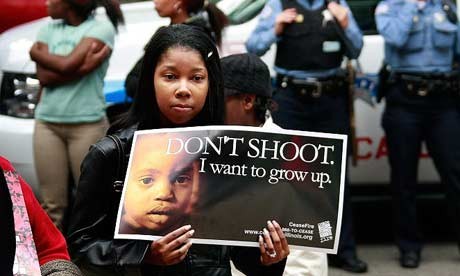
How a black city cheats to lower the murder rate

It’s always dangerous to put too much value into government statistics. Even when it comes to murders, which you would think would be difficult to hide, the numbers can be manipulated.

Matthew Yglesias writes:

The big problem with making murders disappear (apart from it being illegal and immoral) is that, compared to other crimes, it’s much more likely that you’ll be caught. For example, Patrick Walker was found injured and unresponsive in a crashed automobile, taken to a hospital where he died, then during an autopsy they found a gunshot wound in his head and a bullet casing in the back seat of the car. Owing to the fact that he was clearly shot and killed, this was filed on his death certificate as a murder. But the Chicago Police Department has classified the case as a death investigation, making it disappear from their stats.

Chicago Magazine reports:

On October 28, a pathologist ruled the death of Tiara Groves a homicide by “unspecified means.” This rare ruling means yes, somebody had killed Groves, but the pathologist couldn’t pinpoint the exact cause of death.

Given the finding of homicide—and the corroborating evidence at the crime scene—the Chicago Police Department should have counted Groves’s death as a murder. And it did. Until December 18. On that day, the police report indicates, a lieutenant overseeing the Groves case reclassified the homicide investigation as a noncriminal death investigation. In his writeup, he cited the medical examiner’s “inability to determine a cause of death.”

That lieutenant was Denis Walsh—the same cop who had played a crucial role in the alleged cover-up in the 2004 killing of David Koschman, the 21-year-old who died after being punched by a nephew of former mayor Richard M. Daley. Walsh allegedly took the Koschman file home. For years, police officials said that it was lost. After theSun-Times reported it missing, the file mysteriously reappeared.

But back to Tiara Groves. With the stroke of a computer key, she was airbrushed out of Chicago’s homicide statistics.

The change stunned officers. Current and former veteran detectives who reviewed the Groves case at Chicago’s request were just as incredulous. Says a retired high-level detective, “How can you be tied to a chair and gagged, with no clothes on, and that’s a [noncriminal] death investigation?” (He, like most of the nearly 40 police sources interviewed for this story, declined to be identified by name, citing fears of disciplinary action or other retribution.)

Was it just a coincidence, some wondered, that the reclassification occurred less than two weeks before the end of the year, when the city of Chicago’s final homicide numbers for 2013 would be tallied? “They essentially wiped away one of the murders in the city, which is crazy,” says a police insider. “But that’s the kind of shit that’s going on.”

For the case of Tiara Groves is not an isolated one. Chicago conducted a 12-month examination of the Chicago Police Department’s crime statistics going back several years, poring through public and internal police records and interviewing crime victims, criminologists, and police sources of various ranks. We identified 10 people, including Groves, who were beaten, burned, suffocated, or shot to death in 2013 and whose cases were reclassified as death investigations, downgraded to more minor crimes, or even closed as noncriminal incidents—all for illogical or, at best, unclear reasons.

SA’s killing fields

South Africa still has one of the highest murder rates in the world with 31 murders per 100000 people in 2012 – five times the global average of 6.2 per 100000, according to the UN Office on Drugs and Crime’s latest report, released yesterday. 

murdersCrime statistics released by Minister of Police Nathi Mthethwa in September showed that murder increased by 650 cases, to 16259, a 4.2% increase from 2012.

An AFP report this week puts South Africa’s murder rate at 31.3 per 100000 people, a 2.8% increase from 2012.

Nevertheless, the UN report hailed South Africa’s “encouraging trend” in halving the murder rate from 64.5 per 100 000 in 1995 to 31 in 2012.

But Institute for Security Studies senior researcher Gareth Newham says this country could reduce the murder rate to 2.1 per 100 000.

“Reduction of the murder rate relies on the police, but what we need is a plan that involves more social workers, education and role-modelling because most people [in this country] are killed by people known to them,” Newham said.

The UN reported that over half of all murder victims were under 30, with children under 15 accounting for just over 8% of all murder victims, at 36 000.

The UN report notes that though most men globally are killed by someone they did not know, almost half of the female victims were killed by someone close to them.

About 80% of murder victims and 95% of perpetrators were men, with 15% of all murders stemming from domestic violence (63 600).

Almost 70% of all domestic violence fatalities in South Africa are women (43 600).

“Home can be the most dangerous place for a woman,” said Jean-Luc Lemahieu, the UN’s director for policy analysis and public affairs

The UN names Honduras as the world’s most murderous country, with 90.4 murders per 100000. The US overtook Africa as the region with the most murders because of a surge in drugs-funded organised crime.

The report ignored the scourge of farm murders on whites, much higher still than the current murder rate.

Source: Timeslive

Setting a new record: Chicago’s murder rate

With still a few days to go until the new year, 40-year-old Nathaniel T. Jackson became the five-hundredth person killed in Chicago, Illinois since the start of 2012.

In 2011, the city saw only 435 homicides.

Superintendent Garry McCarthy confirmed to the Chicago Tribune late Thursday night that the passing of Mr. Jackson marked murder number 500 for the Windy City, and that no suspect had been identified by the police at that point. On Friday afternoon, though, the department issued a statement to the press reclassifying a death earlier in the week as being still under investigation. With that update, the slaying of Jackson makes him one murder shy of the 500 mark, but with a homicide rate of more than one per day, that milestone is expected to be met before 2012 comes to a close.

Discussing the grim news on Friday, Chicago Mayor Rahm Emanuel said it was “an unfortunate and tragic milestone, which not only marks a needless loss of life but serves as a reminder of the damage that illegal guns and conflicts between gangs cause in our neighborhoods.”

Emanuel, a former Obama administration staffer known like the president for his staunch pro-gun control stance, condemned the National Rifle Association earlier this month after the NRA’s vice president asked for armed guards in every school across America.

“That is not the right answer for our society, our schools and most importantly our children,” Emanuel said.

Even as adamantly opposed to guns on the streets as Emanuel is, however, the mayor has a seemingly impossible task of turning around a surge in violent crimes as murders have skyrocketed under his administration. According to the police statistics provided to the Tribune, “homicides were up 17 percent over last year in Chicago, and shootings had increased by 11 percent.”

All the way back in June, Roseanna Ander of the University of Chicago Crime Lab warned The Daily that Chicago was already on the path to having a particularly bloody year.

“Violence has always been most pronounced on summer weekends in Chicago,” Ander said, adding, “One likely factor is the warmer-than-usual weather and the early spring. Over 80 percent of shootings occur outdoors and in public places.”

Ander’s prediction proved right, and as the summer months progressed matters were only made worse. In late August, 19 people were shot in a single evening in Chicago. It may have been a big number at the time, but was only a few shots beyond what the city saw months earlier.

“Over the Memorial Day weekend, in a 72-hour period, we had 12 people killed and another 45 people shot.” WBEZ Chicago Public Radio host Robert Wildeboer told National Public Radio during a July 10 interview.

“Thirteen people were shot in one 90-minute stretch, and so that’s really focusing public attention on this issue right now,” Wildeboer added. “You know, just last night, eight people were shot in the city of Chicago. But some of the numbers were just so shocking, A, that murder’s up 40 percent over last year. B, there have been a number of really violent weekends in Chicago where the numbers are just so striking, everybody’s just, like, what in the world?”

The last time Chicago saw this many deaths in a single year was 2008, when 512 people were killed. Meanwhile in New York, Police Commissioner Raymond Kelly says the murder rate in the Big Apple is down nearly 19 percent in 2012.

“I’m thankful for the fact that this year there will be the lowest number of murders that we’ve had since we started to record them in 50 years, even though the population is as high as it’s ever been,” Kelly tells reporters this week.

Crime killed the South African dream

The high murder rate in South Africa has killed the idealism and dreams people had after the 1994 elections, which saw the advent of democracy in the country, the Freedom Front Plus said on Tuesday.

“Since 1994 more than 300 000 people have been murdered (328 244) in South Africa,” FF Plus leader Pieter Mulder said in an excerpt from a speech delivered in Potchefstroom.

“That is an average of 60 people a day.

“The world average for murders is five in every 100 000, but in South Africa it is 38 in every 100 000. Nearly eight times as (much as) the world average.

“Since 1994 more than 3 000 farmers and farm workers have been murdered in more than 10 000 farm attacks. That gives a figure of more than 200 in every 100 000.

It was these figures which destroyed the idealism and dreams of South Africans post 1994.

Mulder said South Africa is racially more divided at the moment than at any other time since it held its first democratic election.

“With Malema (ANC Youth League president Julius Malema) on the one hand and radical comments on the other side, South Africa is today more polarised than any time since 1994.”

He said racism was “easy politics”.