Cape farm attackers still on the run

Western Cape police on Monday released the identikits of two suspects wanted in connection with a robbery at a farm in Wolseley in the Breede River Valley.

The two men robbed the farm owner of several firearms and personal items on July 22.

“According to information the suspects, two males in bullet proof vests, entered the premises and tied up the owner and staff in a room and robbed them of six firearms, cash and jewellery,” said police spokesperson Noloyiso Rwexana.

Rwexana appealed to anyone with information on the suspects to call the investigating officer Warrant Officer Officer Mornè Terblanche on 082 411 2391.

‘Farm attackers wanted to kill’

It appears as if the suspects who attacked an elderly couple on their farm Brakdam in the Vrede area in the Freestate on Sunday were trying to murder them.

This is according to the Transvaal Agricultural Union’s Henry Geldenhuys, who says the suspects lay in wait for 70-year-old Johannes Kritzinger and his 66-year-old wife Rita.

Geldenhuys says Johannes was shot four times and Rita twice. He says Johannes remains in critical condition in a hospital in Johannesburg after undergoing surgery, while Rita is believed to be in a serious but stable condition.

One suspect has been arrested and the hunt continues for a second suspect. Geldenhuys has praised the response by farmers, saying the cooperation by members of other agricultural unions and even private farmers made all the difference.

The farm attack on the elderly couple is the 36th violent crime related incident on a farm in the province this year.

Free State Agriculture’s Tommie Esterhuyse says this includes farm murders and attacks, as well as attacks on farm workers.

According to the organisation’s statistics, arrests were made by police in 19 of these incidents.

Esterhuyse says the organisation condemns the cruel attack on Johannes Kritzinger and his wife Rita on their farm near Vrede.

Esterhuyse says according to the couple’s son-in-law Emile Malan from Heilbron, his in-laws were returning home from church when two armed suspects attacked them in their house. According to Malan they gained entrance to the house by breaking burglar bars in front of a window.

Police say a 38-year-old suspect who was allegedly previously employed on the farm, is expected to appear in court soon in connection with the attack.

Woman survives brutal farm attack

While recuperating in hospital, a white farm attack victim Mariette Saaiman, 45, found comfort in the possibility that two of her three attackers had been apprehended.

However, police later confirmed the suspects arrested could not be positively linked to the brutal assault on Saaiman and her husband, Aneil, 38, in Sudwala, Mpumalanga, Lowvelder reported.

According to Shaun Terblanche of J&M Security, who attended the scene, the apprehended black suspects were responsible for stealing copper after vandalising a transformer on a nearby farm.

The couple was overpowered on Boschkom Estate on Sunday morning.

The Saaimans sustained severe injuries after three black men entered their property, tied them up and assaulted them for more than an hour.

Saaiman got a torn earlobe, for which she had to get surgery, and sustained a wound to the head as well as several bruises to her body.

Provincial police spokesperson Sergeant Gerald Sedibe said no one had been arrested and that the suspects were still at large. Bossies Community Justice has offered a reward of up to R50 000 for information leading to the apprehension and successful prosecution of the criminals.

In March, five black men were arrested after an alleged farm attack outside Memel in the Free State.

Police said the incident occurred shortly after 2.30pm yesterday when six suspects entered the farm premises.

However, farm workers immediately notified authorities, and the men escaped in the farmer’s two vehicles towards Memel.

At Memel, the suspects in the smaller vehicle were reportedly pushed off the road, and gunfire was exchanged between them and police officers. One suspect was injured during the shootout and taken to Vrede hospital by ER24 paramedics.

Three black men were reportedly arrested. The last suspect is still at large.

Source: The Citizen

The killing continues: White doctor murdered on game farm

The mutilated body of a retired doctor was found on his game farm in Limpopo on Monday, after he was presumably murdered on Saturday.

Netwerk24’s Marietie Louw-Carstens reported on Tuesday that Louis-John Botha, 64, is the second farmer in the just the Waterberg district of Limpopo to be killed this year. Susan Kotze, 76, was murdered on her farm near Lephalale in January.

According to the report, Botha had practised as a doctor in Swartwater for many years. He lived on the farm Gwelo Safaris about 12km from Swartwater.

Limpopo police are not sure exactly how Botha was killed. Trackers and the canine unit are searching the area and looking for clues.

Blood was found on the porch and inside the double-storey thatch home after neighbours were alerted when the doctor did not answer his phone. The safe had been opened and some items were missing.

Police were called and a search was launched. The body was only found on Monday morning, hidden about 200 metres from the house.

The police have not released official farm murder figures for seven years. The figures showed that 271 were murdered on farms or small-holdings in the past five years.

However, the Transvaal Agricultural Union disputed the figures saying that according to their own information, including social media, there were at least 63 murders in 2012, 62 in 2013, and 67 in 2014, noting a steady increase in farm attacks and farm murders against whites across South Africa.

Eldery white farm couple tortured with steam iron

An elderly white couple was badly injured after being tortured in the latest farm attack at De Wildt near Brits, North West police said on Wednesday.

Three armed black men wearing blue overall pants attacked Hannes (80) and his wife Annetjie on Tuesday, Brigadier Thulani Ngubane said.

“Three black men covered in balaclavas came to the farm, assaulted him, tied him and his wife up, started torturing them and burnt them with a steam iron on most of their body parts.”

The men took firearms and cash from a safe and ransacked the house before fleeing on foot. No arrests had been made. Police had opened a case of robbery, assault, and attempted murder.

The couple were transported to the Mediclinic in Brits. Had Annatjie not alerted the neighbours by making an very risky emergency call, both victims would have been tortured to death.

Before the black attackers fled, they slashed the tyres of the owner’s vehicle.

One white farmer killed every second day in SA

The killing-spree against white farmers continues unabated.

Two black men were arrested for the murder of an elderly white woman at Erfbloem farm near Theunissen, Free State police said on Tuesday.

The two blacks, aged 21 and 22, were accused of killing an Afrikaner woman Martie Bester, 68, whose body was found inside a burnt house on the farm, said Captain Harry Nagel.

“Police recovered three of the stolen firearms as well as ammunition, a computer, jewellery, compact discs and clothing.”

Bester’s Toyota Hilux was found burnt on the farm.

The pair would appear in the Theunissen Magistrate’s Court on Wednesday.

On Monday, too, another two black suspects were arrested for the murder of an elderly white couple on Kwaagakraal farm near Bainsvlei, Bloemfontein.

The bodies of the couple, aged 70 and 72, were dumped near the farm at Waaikraal, Nagel said at the time.

“The couple had been shot and killed during a robbery in which a television set, firearms and vehicle were taken.”

Nagel said they arrested the two blacks, aged 20 and 25, after receiving a tip-off about a suspicious vehicle in the area. The pair then showed the police where the bodies were.

A third black suspect, aged 19, was later arrested at Kelly’s View. He was in possession of a stolen television set and firearm.

The three would appear in the Bloemfontein Magistrate’s Court on Wednesday.

Seven whites have been killed on farms by blacks since the beginning of the year, which means one murder almost every second day.

Three whites were killed in the past 48 hours on farms in the Free State province alone.

President Jacob Zuma recently warned white farmers about “living conditions” of black farm workers, but agricultural unions say the claims are unfounded.

Worryingly, the president who entertains his audience with singing “Kill a Boer, kill a farmer” and “Bring me my machine gun”, has remained silent on the scourge.

British woman murdered at game lodge

A British woman, owner of a game lodge near Thabazimbi was murdered.

Limpopo police said on Wednesday they were alerted by her staff.

The 59-year-old Christine Robinson’s body was found in her bedroom early in the morning, police spokesperson Ronel Otto said.

“It seems she was stabbed in her neck… money she withdrew to pay salaries seems to be missing,” Otto said.

No arrests have been made.

ANC’s plan to make white owners hand their land over to workers

Since 1994 white farmers have been murdered in alarming numbers.

Rural Development and Land Reform Minister Gugile Nkwinti wants white commercial farmers to hand over half their farms to black farmworkers.

Nkwinti said in an interview this week that stakeholders in commercial agriculture, including farmers, trade unions, farmworkers and the agricultural business sector, have until April next year to react to his proposals.

  • The commercial farmers retain 50% of the farm;
  • The labourers on the land assume ownership of the remaining 50%, proportional to their contribution to the development of the land based on the number of years they had worked on the land;
  • The government pays for the 50% to be shared by the labourers, but the money will not go to the farmer. It will go to an investment and development fund to be jointly owned by the parties constituting the new ownership regime. The investment and development fund will be used for reinvestment in the farm, skills improvement and to pay out those who want to opt out of the arrangement;
  • Current tenancy protection remains and it will be balanced by a regime of duties and responsibilities that worker-dwellers must comply with if they want to stay on the farm;
  • Of the 50% to be shared by labourers, all labourers with a history of between 10 and 25 consecutive years of disciplined service will share 10%, those with 25 to 50 years’ consecutive service will share 25%, those with more than 50 years’ consecutive service will share 50% and 15% will be available for household subsistence farming; and
  • Land rights management committees, consisting of local people, will be established to solve local disputes.

Nkwinti said he had come up with the proposal because the previous system had “many deficiencies”.

Land reform has been brought into sharp focus by the decline of agriculture in neighbouring Zimbabwe, where many white commercial farmers have been violently evicted and their property rights trampled by the state.

Some 90% of farms redistributed to South Africa’s black population from white farmers are not productive.

Since 1994 white farmers have been murdered in alarming numbers.

About 50 people on average are murdered in South-Africa per day, of which at least 20 are white(95+ % black on white murder rate), although whites make up only 9% (4 500 000) of the demographics in South-Africa.


Five attacks on white farmers in one week

farmmurdersThis week has seen at least five farm attacks on white farmers in South Africa.

In the latest incident, a farmer and his wife were attacked by two armed men on their farm outside Barkly-East.

The white farmer, Sarel Pretorius from the farm Rooipoort, was shot dead. His wife was locked in the bathroom.

Farm watch groups were mobilised to find the attackers, who had fled in the direction of Elliot.

The attackers stole a white Toyota Hilux bakkie and firearms.

The community of Barkly East is still traumatised by the brutal murder of David (87) and Rallie de Villiers (86) in October of 2013.

The other four farm attacks are as follows:

11 January – Bloemspruit. Dr Jacob Swart and his wife Elise were attacked on their farm with knives and steel pipes by two men. The attackers fled with a .22 revolver, a rifle, two cell phones and an undisclosed amount of cash.

12 January – Wallmansthal area. An R5 attack rifle, allegedly issued only to the SAPS, was used in an attack on two victims in their sixties. The farmer was wounded and electrical appliances were stolen.

14 January – Waterval area near Pretoria. The farmer was lured outside and attacked with a machete.

14 January – Wallmansthal area. A farmer was held hostage and attacked.

Another farm murder rattles KZN farming community

law4A crowd of 350 farmers, farmworkers and others from the rural community protested outside the Himeville Magistrate’s Court on Tuesday, as three men appeared for the grisly murder of timber contractor Daniel Knight last week.

The protest was held just a day after another KwaZulu-Natal farmer was murdered on his Vryheid dairy farm, The Witness reported.

Willem Weites, 78, was killed while trying to rescue his daughter, who was being held at knife-point

His son, Frederik Weites, 50, said a white car came to the dairy store with men carrying a bucket as people often do when they come to buy milk.

Weites said the three black men got out of the car and grabbed his sister Everlien, 49, after asking where her father was.

“They held a knife to her neck and when my father tried to intervene, they just shot him in the head and chest and he died on the spot,” he said.

He said they then dragged his sister to the main house threatening to rape her. They thus forced his mother to hand over keys to the safe.

They tied up both women, took an undisclosed sum of money and drove off in his father’s bakkie, he said.

Another attacker tied up farm workers and took their cellphones.

The bakkie was later recovered about eight kilometres away as in most farm attacks.

“We are devastated. I mean why do you need to kill people for money when you can take the money and leave them alive?” Frederik asked. Weites had often helped local blacks grind their maize at his mill.

Police spokesperson Captain Thulani Zwane said Ngome SAPS were investigating charges of murder and “business robbery”. No arrests had been made, he said.

In Himeville, Tsepiso Sthembiso Ramanyane, 20, Bonginkosi Eric Nyawose, 33, both from Bulwer, and Thabo Dlamini, 22, from Himeville, appeared for the murder of Knight and robbery with aggravating circumstances for taking property of Knight’s valued at R651 000.

While white farmers fear the escalating farm attacks, black workers fear that 300 households who had family members working for Knight may be hit by job losses following his murder.

Knight’s murder was particularly brutal. He was struck on the head with a heavy hammer while his partner, her eyelids forced open, was made to watch.

Graham Acutt, a dairy farmer, said: “This affects the community more than it affects the farmers; more families in the community will lose jobs because of some individuals that want quick cash. This picketing shows everyone that we are sick and tired of criminals that attack us.”

Sue Acutt asked: “Why did they want her to watch them doing this? Later, they even tried to suffocate her using a plastic glove as they covered her face with it. They left her thinking she had also died after she passed out.”

Vice-chairperson of the Vryheid Agricultural Chamber Horst Hellberg, referring to Weites’ death, said it was with shock “that we had to hear of another farm murder, this time one of our senior farmers”.

“It is unacceptable that farm murders are getting out of control again and government is not treating it as a priority.”

He suggested the government would address these issues more seriously only once there was not enough food to put on the nation’s tables.

KwaZulu-Natal Agricultural Union (KwaNalu) security desk Koos Marais said they were disturbed by the latest callous murder.

Dr Johan Burger of the South African Institute for Security Studies said in 2012, 63 farm murders were recorded. This year up to September there had been 54 farm murders recorded already.

“The brutality with which these murders are carried out makes us believe that there is something behind these attacks,” he said.

He said it was interesting to note that last year 39 farmers were killed and of those only three were black farmers.

Crime stats: Farm attacks trending

killboer2It is a dark day for the country when its National Commissioner claims that crime is under control, while the murder rate has risen to 16,259 cases per year. This means that almost two murders a day more occurred to bring the total number of murders committed daily to almost 45!

Farm murders shows an even more alarming picture. In the same period farm murders increased by 34% to 68 in 2012/2013 compared to the 50 murders in 2011/2012. Farm attacks increased from 112 cases to 176 cases. Farm attacks in fact are violent crimes against people and not on property. Therefor it can be assumed that many of these attacks are nothing less than attempted murder, which were successfully averted.

“What is even more disturbing is the apparent ignorance of the police in this regard. On the police`s official website the page titled ‘Farm Attacks` under `Crime Prevention` has been ‘under construction’ for months now, leaving the impression that the police do not regard this category of crime as a seriousness matter,” said Mr Henry Geldenhuys, Deputy President of TAU SA and Chairman of the Safety and Security Committee. “Because the police stubbornly refuse to list farm murders as a separate crime category in their statistics, they are not even aware of this alarming increase in farm attacks. Furthermore it has to be borne in mind that TAU SA`s database on farm attacks and farm murders is probably incomplete because it relies on the feedback of members or on media reports which are then verified. Therefore the true picture could be worse,” says Mr Geldenhuys.

Since April 1 this year to date TAU SA`s database lists 37 murders and 110 farm attacks. If this trend was to continue until the end of the current year 74 murders and 220 attacks could be expected, which will represent a further increase of 24%.

“The fact that the National Commissioner considers crime to be under control indicates that farmers should not expect any increased police interest in their problems, and therefore should continue their need to ensure that they are versed in self defence and the upgrading of their physical safety- and security measures,” said Mr Geldenhuys.

Police bungle another farm attack case

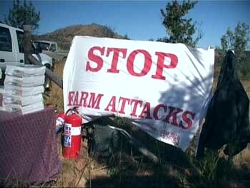
stopfarmattacksAfriForum is considering legal action against a police investigator after a case was thrown out of court and a farm attacker was freed due to gross negligence by the police.

The victims of the attack, Mr Noël McSeveney, and his wife, Alta, were attacked by two men in June 2013 on their farm just outside of Malelane, Mpumalanga. Mr McSeveney was wounded in the attack, and in his efforts to protect himself and his wife, he killed one attacker and wounded the other.

According to Nantes Kelder, Head of the Investigative Unit at AfriForum, the case against the accused took place in absentia. The investigating officer allegedly failed to present a medical report to the court to confirm that the accused was still in hospital, receiving treatment. As a result, the case was thrown out.

The Investigative Unit of AfriForum also made a report available earlier this year on mistakes made by the police during their investigations of farm attacks. “The blatant negligence of the police means that an attacker is now free and the victims have to live in fear. The investigator should be held responsible,” said Kelder.

AfriForum will take on the case on behalf of Mr McSeveney. Kelder added that the incidence of farm attacks and violent crimes is unacceptably high. One would think that such cases would be handled with great care, in order to ensure that justice is served.

A warrant for the arrest of the accused has been issued, but AfriForum has heard that he could not be traced.

Crime killed the South African dream

The high murder rate in South Africa has killed the idealism and dreams people had after the 1994 elections, which saw the advent of democracy in the country, the Freedom Front Plus said on Tuesday.

“Since 1994 more than 300 000 people have been murdered (328 244) in South Africa,” FF Plus leader Pieter Mulder said in an excerpt from a speech delivered in Potchefstroom.

“That is an average of 60 people a day.

“The world average for murders is five in every 100 000, but in South Africa it is 38 in every 100 000. Nearly eight times as (much as) the world average.

“Since 1994 more than 3 000 farmers and farm workers have been murdered in more than 10 000 farm attacks. That gives a figure of more than 200 in every 100 000.

It was these figures which destroyed the idealism and dreams of South Africans post 1994.

Mulder said South Africa is racially more divided at the moment than at any other time since it held its first democratic election.

“With Malema (ANC Youth League president Julius Malema) on the one hand and radical comments on the other side, South Africa is today more polarised than any time since 1994.”

He said racism was “easy politics”.

White farmers 13 times more likely to be attacked

SAIRR has amended their view on farm attacks. According to Institute’s calculations white farming families may be 13 times more likely to be attacked.

This Research and Policy Brief paper seeks to determine the extent to which farmers are uniquely vulnerable to armed attack in South Africa. It draws comparisons between the rate of attack on farmers and their families to that of other citizens in South Africa.

On 5 October 2012 the South African Institute of Race Relations released a statement on farm attacks in South Africa. The statement was based on farm attack data by the Transvaal Agricultural Union (TAU). It has since been drawn to our attention by James Myburgh that the TAU data is compromised by a significant undercount of as much as 7:1 in terms of the actual number of farm attacks. Our initial analysis has therefore been revised accordingly. The revised analysis follows below.

The table below compares the farm attack rate for farmers and their families to the house robbery rate, aggravated robbery rate, and combined aggravated robbery and murder and attempted murder rates for the broader population.  It is based on three assumptions. The first is that there are 47 000 commercial farmers in South Africa. This is based on StatsSA’s Census of Commercial Agriculture 2007. The second is that the average household size for farmers is 3. This is the average household size for white South Africans. The third is that, following from James Myburgh’s analysis, TAU undercounts farm attacks by an average of 7 to 1. The fourth is that attacks on smallholdings should be included as attacks on farms.

  47 000 farmers + 2 dependants each = 141 000 people National population = 50.6 million people Ratio of farm attacks to attacks on general population
 

Rate per 100 000 people

Farm attacks vs house robberies 422 33 12.8 to 1
Farm attacks vs aggravated robbery 422 200 2.1 to 1
Farm attacks vs aggravated robbery + murder + attempted murder 422 260 1.6 to 1

Table 1: Attacks on farmers and their families compared to other citizens (smallholdings included)

The table shows that based on those four assumptions the number of attacks on farmers and their dependants is 422/100 000. The number of house robberies in the broader population is 33/100 000. In this comparison farming families are 13 times more likely to be attacked than other families. However, farm attacks also include all forms of robbery and not just house robbery.

For that reason the table also compares the farm attack rate to the broader armed robbery rate in the country. Here the farm attack rate, which remains at 422/100 000, must be compared to the national armed robbery rate of 200/100 000. In terms of this comparison farmers and their families are twice as likely to be attacked as other citizens. Farm attacks also involve murder and attempted murder.

For this reason the table also compares the farm attack rate to the joint aggravated robbery/murder/attempted murder rate for the broader population. Here the farm attack rate, which remains at 422/100 000, can be compared to the national murder and aggravated robbery rate of 260/100 000. Even on this analysis farmers remain more vulnerable to attack by a ratio of 1.6 to 1.

However, the argument can be made that smallholdings are basically large urban plots and not really farms. For that reason we have published the table below which compares farm attacks, excluding attacks on smallholdings, to criminal attacks in the broader population. The other three assumptions made about the data (above) are unchanged.

  47 000 farmers + 2 dependants each = 141 000 people National population = 50.6 million people Ratio of farm attacks to attacks on general population
 

Rate per 100 000 people

Farm attacks vs house robberies 262 33 7.9 to 1
Farm attacks vs aggravated robbery 262 200 1.3 to 1
Farm attacks vs aggravated robbery + murder + attempted murder 262 260 1 to 1

Table 2: Attacks on farmers and their families compared to other citizens (smallholdings excluded)

This table shows that when smallholdings are taken out of the equation the farm attack rate declines to 262/100 000 farmers and their families. Compared to the national house robbery rate of 33/100 000 farmers are on this measure eight times more likely to be attacked than other citizens.

However, the table shows that when this new farm attack rate is compared to the broader aggravated robbery rate of 200/100 000 this ratio comes down to 1.3 to 1. Furthermore, when the farm attack rate is compared to the broader aggravated robbery/murder/attempted murder rate of 260/100 000 that ratio reaches a level of parity of 1 to 1. In other words, on this measure farming families are no more likely to be attacked than other citizens.

We have also conducted an analysis of the murder of farmers, based on TAU’s more complete murder figures. In order to produce a figure for the highest possible murder rate the table below assumes that only the 47 000 farmers, and not their families, are targeted in farm murders.

  47 000 farmers National population = 50.6 million Ratio of farmer murders attacks to murders in the general population
 

Rate per 100 000 people

Farm murders vs all murders 68 31 2.2 to 1

Table 3: The murder of farmers

On this measure the table shows that in 2011 some 68/100 000 farmers in the country were murdered. This compares to a national murder rate of 31/100 000. On this analysis farmers are twice as likely to be murdered as ordinary citizens.  However, while farmers are particularly likely to be murdered, it is true that family members may also be murdered in attacks. It is for this reason that we have prepared the final table below, which compares the murder rate for farmers and their families to that of other citizens.

  47 000 farmers + 2 dependants each = 141 000 National population = 50.6 million Ratio of farmer/family murders to murders in the general population
 

Rate per 100 000 people

Farm murders vs all murders 33 31 1.1 to 1

Table 4: The murder of farmers and their families

This table shows that in 2011 the murder rate for farmers and their families was 33/100 000. The murder rate for the broader population was 31/100 000. On this comparison farmers and their families are not more likely to be murdered than other citizens.

Keep in mind that our analysis has excluded the 220 000 emerging commercial farmers, some of whom are large producers, who may also be attacked. We have also excluded from this analysis farm managers and extended families that may live on farms and become victims of attack. Our figures therefore suggest worst-case scenarios for farming families.

What conclusions can be drawn? The first is that the past week has seen a sharp increase in the quality and level of analysis of farm attacks in South Africa. It has also focused considerable media attention on the problem. Both of these are good things.

The second is that it is possible to argue that farmers are uniquely vulnerable to attack contrary to our initial conclusions drawn from the incomplete TAU data. This is especially so where a straight comparison is drawn between the house robbery rate and the farm attack rate. The same is true for the murder rate of farmers (excluding family members).

The third is that by changing some assumptions it is possible to reach somewhat different conclusions. For example, it is reasonable to compare farm attacks, which is a term inclusive of robbery and murder, to the broader robbery and murder rates of the society. When this is done farmers remain more at risk, although by a smaller measure. However, it is when the assumptions shift to exclude smallholdings that the picture changes significantly. Then the comparisons suggest that farmers are not uniquely vulnerable to violent attack.

However, even this result should not be taken to suggest that farmers are safe. Analysts of our data must consider that South Africa’s crime rates are uniquely high. Our murder rate, for example, is 500% higher than that of the United States and 3000% higher than parts of Western Europe such as the United Kingdom and Germany. This brings us to our fourth conclusion that all South Africans face an extraordinary criminal onslaught. People who have previously regarded farm attacks as a somewhat distant problem, nothing to do with them, must realise that they arguably live in as much peril as farmers do. It is clear therefore, regardless of how they rank compared to other citizens, that as a best-case scenario, farmers live a perilous existence in a largely lawless society.

The fifth conclusion is that, unlike urban middle class residents, farmers do not have the benefit of armed response companies or nearby police stations. Rather they depend on their own defences to secure themselves and their families. In addition, no analysis of the security position of farmers would be complete without noting the role of the State in exacerbating their vulnerability. The closure of the commandos and the Government and the African National Congress’s ambivalence at best toward the incitement by some of their own members to kill farmers creates an environment in which South Africa’s farmers are likely to be killed.

The final conclusion is that there can ultimately be no solution to farm attacks without a broader solution to the general problem of criminal violence in our society. In other words, farmers will not be safe until other citizens are safe and vice-versa. This is a point that advocacy groups can use to great effect in their important campaigns to alert policy makers and the international community to the murder of farmers in South Africa.

Issued by Frans Cronje, Lucy Holborn, Boitumelo Sethlatswe, South African Institute of Race Relations, October 10 2012