Nearly two decades after the fall of apartheid, a black South Africa is struggling to sell high-profile, white-dominated cricket and rugby teams as “non-racial”.
Sporting authorities have reintroduced racial quotas for domestic professional teams in a bid to encourage more black Africans to emerge through the ranks
The latest to adopt quotas is cricket with the country’s six franchises ordered to field at least one black African in each starting line-up.
Teams that field more than one black player will get a cash bonus.
The only black African coach among the domestic professional teams, Geoff Toyana of the Highveld Lions, backs the idea of quotas.
“It’s not a bad thing, it’s spot-on,” Toyana said.
“Hopefully, more players will be exposed and more will play. Hopefully, in the next two to three years we will see a black African batsman playing for South Africa … or guys like Mangaliso Mosehle [of Titans] might come in as a wicketkeeper.
“You cannot explain that a population of 80% black African people cannot produce one Test player – it doesn’t make sense,” said Toyana.
Cricket officials speak of a “huge drop out” of black African players between under-19 and franchise levels.
“Black African players need to get quality and meaningful opportunities and, therefore, the incentive-based transformation policy was introduced,” said Corrie van Zyl, general manager of Cricket South Africa (CSA).
But the restoration of a quota system, two decades into democracy, is seen by observers as a sign of failure by both sporting administrators and government to develop sport among previously disadvantaged racial groups.
The problem, according to Frans Cronje of the South African Institute of Race Relations is that “we are not investing in young people”.
“How do you think players are going to be produced when the best you produce is a dusty sports field? Unless you learn to bat with a soccer ball in some dust of the Eastern Cape, you are not going to do it,” said Cronje.
Only five black Africans have played for South Africa’s national cricket side since 1991 when the country was accepted into international competitions.
“It is not a statistic that we are proud of,” admitted Van Zyl. “It shows just how important it is for us to bring many more African players through the system.”
“Next year we celebrate 20 years of democracy in our land and it is simply not acceptable for 80-plus percent of the population not to feel represented in one of our national sides.”
Previously, racial quotas generated heated debate in South Africa, but now there appears to be a general consensus.
The majority of players accept that “transformation is imperative”, said Tony Irish, chief executive of the South African Cricketers’ Association.
A quota system was introduced in 1999 but scrapped in 2007. Blacks remain under-represented in cricket and rugby, but dominate in football, where the national team is faring terribly.
The latest round of quota systems were adopted at a 2011 meeting of all sporting bodies and government.
Rugby quotas will take effect next year and seven players in each 22-man Vodacom Cup (a second-tier competition below the Currie Cup) squad must be black, including at least two forwards.
But the move has brought into question the possibility of sidelining other racial groups – Coloureds and Indians. Van Zyl said the early attempt at quotas was “a huge success” for the development of Coloured and Asian cricketers. – AFP
In a recent article in the Sunday Independent, Gillian Schutte mistakenly blames so-called “white conservative narratives” for the appalling sexual violence that is sweeping South Africa at present. As rape is notoriously underreported, most estimates put the number of such crimes at more than a million per year or approximately three thousand per day.
The macabre forms of dehumanising torture during farm murders provide another clue to the societal breakdown that is occurring in our country. Even calling it “our country” might be a malapropism in that Afrikaners like myself are no longer considered full citizens in an Afro-Saxon state that is slouching towards some incarnation of Mugabe’s Zimbabwe or, better still, Charles Taylor’s Liberia. This week, Taylor’s conviction as a war criminal was confirmed by an international court, the first head of state to be jailed for such crimes committed in Sierra Leone while he was in office.
South Africa has become a sadists’ apocalypse. No amount of “reframing”, circumlocution or leftist pseudo-intellectualism can disguise it any longer. Nor can the seemingly desperate massaging of the crime statistics. In the age of social media, people communicate their horror and despair at being captives in this, our “paradise of cruelty”. Policing our language as in the cowardly attack upon Louise Mabille is a poor substitute for the lack of policing elsewhere.
As the twentieth century has shown, utopias are always dangerous, be they fascist or communist. Every utopia has turned into its mirror image, a dystopia replete with genocide. South Africa’s pursuit of a racial biopolitics known as “transformation”, as well as extreme forms of cultural relativism, have unleashed hitherto unknown social consequences. In the domain of sexual violence at least, the country has earned the dubious title of “rape capital of the world” and it regularly tops international murder tables too.
Understanding the causes of this immense violence, unknown in peacetime, represents a rare analytical challenge. None of the usual explanations actually fit. The same people denouncing “colonialism” are the most accomplished colonialists in their slavish subordination to US or British racial discourse and political correctness.
However, neither Britain nor America has absorbed any significant African cultural influence so it is of no use applying the sociology of New York or London to an outbreak of sadistic violence in Limpopo province. It is risible to see ostensibly educated people constantly blaming either “apartheid” or “poverty” for the horrors and cruelties afflicting this society.
The retreat of Afrikaner power in South Africa has been coterminous with the resurgence of African belief systems, including witchcraft and ritual murders. In the early nineties South Africa experienced hundreds of killings associated with witchcraft and occult beliefs, leading to the Commission of Inquiry into Witchcraft Violence and Ritual Murders. We still do not understand the role that occult beliefs played during the revolution, especially in establishing hegemonic black politics and racial nationalism. The necklace, that symbol of revolution, is pregnant with ethnographic and cultural meaning. There is also evidence that young “comrades” intimidated traditional healers to extract money from clients and that the accusation of being a witch was used to eliminate political opponents.
Mrs. Winnie Madikizala-Mandela, that international heroine and former wife of Nelson Mandela, subscribed to the Maoist doctrine – ‘kill one, scare a thousand’ – that support is gained through terror and horror. She notoriously stated in 1986:
…with our boxes of matches and our necklaces we shall liberate this country.
A necklace killing whereby a tyre is placed around the victim’s neck, filled with petrol and then set alight
Child and even baby rape is another ghastly phenomenon indicating that South Africa has navigated to a new, alien moral code. Stating that white men sometimes do it in some other country too, hardly mitigates the particular horror that it has assumed here.
The British Guardian ran an article on 12 March 2009 entitled, “Raped and killed for being a lesbian: South Africa ignores ‘corrective’ attacks“. The Guardian’s website contains an accompanying video interview with lesbian rape victims, as well as young black men who are outspoken in their support of “corrective rape”. One of them says:
Me, I have no time to rape them, but if there are some of the other guys who want to teach them the way, they must rape them, they must rock them.
But perhaps white conservatives are a bigger problem: they might go to church or caution their children against drugs and sexual promiscuity, which would undermine the libertine morals that so many have advocated for so long in South Africa. In Hillbrow, as recounted to me by a former policeman, young white female drug addicts are employed as prostitutes by Nigerian gangsters. When they are no longer useful to their pimps, they simply get injected with heroine and pushed off highrise buildings in what gets officially recorded by the police as “suicides”. In South Africa, the crime reality show is so much better than the fiction.
The country’s academics are all but ignoring the scourge of rape, including infant rape, judging from the paucity of published articles in the field. To some extent they have acculturated to the witch-hunting culture in persecuting dissidents in their own ranks. Otherwise they engage in repetitive denunciations of “patriarchy” as if there were still a father left somewhere that has not been killed.
South Africa’s “transformed” universities have been turned into the “armed brothels” Erik von Kuehnelt-Leddihn spoke about when he said:
Rousseau is the grandfather of the concentration camps and also of those armed brothels that we continue to call universities. We have with us on one hand the Old Left, a finished product of L’éducation sentimentale, with its bent for social engineering and its tendency to identify its own plans and policies with the volonté générale; on the other the New Left which has taken up the slogan Retournons à la nature! exemplified in the rabble of unwashed, unkempt, debauched, unbridled ignoble savages who look to the Third World of the underdeveloped for inspiration. Its heroes are Chairman Mao with his Little Red Book, Ché Guevara, Ho Chi Minh, Holden Roberto, the Harlem criminals and the pistol-packing priests.*
That is why leftist university intellectuals find any form of criticism of traditional African culture to be inherently “racist” and eschew references to practices such as ukuthwala(the kidnapping and forced marriage of young maidens). Recent legislation has placed about 18 million black South Africans under so-called customary law in which such practices are legal.
Everybody in South Africa, whether white or black, fears a witch-hunt in some or other form. Especially the kind of witch-hunt whereby you are called a “racist”, lose your tenured university job and spend the rest of your life in ignominy. Therefore white academics are completely silent on ukuthwalaor the so-called “virgin cleansing myth” if the professors do not actually deny in writing that such phenomena exist!
Here and there information filters through the iron curtain of political correctness. The only academic article worth reading on the “virgin cleansing myth” is that by Suzanne Leclerc-Madlala which appeared in The African Journal of AIDS Research in 2002 under the title, “On The Virgin Cleansing Myth: Gendered Bodies, AIDS and Ethnomedicine“. It provides a fascinating glimpse into the psycho-sexual paradigm in which, as she puts it, “virgin cleansing is believed to have both a therapeutic and a prophylactic effect” (against HIV-AIDS). Raping a child or a disabled person is therefore seen as a form of AIDS prevention or cure.
But even the virgin cleansing myth obliquely alluded to by Dr. Mabille in her critique of insipid Western feminism does not go far enough in explaining South Africa’s journey upriver into the heart of darkness. We really lack the concepts to understand the enormity of what we are faced with.
Much of what passes for analysis of sex and culture in South Africa consists of rehashed hippie or New Left thinking from 1960s America. Get liberated, man, is more or less the gist of it. Call it Marcuse on Durban Poison. Repression or any form of “holding back” is invariably seen as “bad”. But sometimes repression might be desirable, even imperative. Freud was old-fashioned enough to advocate a balance between the pleasure principle and the reality principle.
The old Afrikaner government, while encouraging African ethnic identities, saw fit to suppress witchcraft and ritual murder by making it a criminal offence. Prior to becoming the first president of a united South African republic, Charles Robberts Swart introduced the Suppression of Witchcraft Act 3 of 1957. To the principled cultural relativist, the act – which is still on the statute books – is an affront and he would probably agree with the Marquis de Sade that “morality is just geography misapplied”, meaning that a crime in one culture is a harmless pastime in another.
One could even argue that the very structure of the South African political system is tending towards sado-masochism. Last Sunday the new CEO of the liberal Institute of Race Relations, Dr Frans Cronjé, argued in Rapport that whites should assume a far more submissive role in South Africa, lest they expose themselves to some form of collective revenge during a Second Revolution. According to Cronjé, such a revolution will be
…a violent, racist and destructive transition from a reconciling democratic state to a hostile, black nationalist state… After the Second Revolution, white South Africans will lose their homes, their jobs and their businesses.
Apart from exhortations to submissiveness, white guilt and even “vows of silence” à la Samantha Vice of Rhodes University, South Africa’s academic sycophants contribute little to our grasp of contemporary violence. In this respect, French literature is more instructive. Sade’s amoral theory of nature, of course. But also his notion of the sovereignty of sexual instincts that should not be tamed by any man-made law or religious scruple.
The Marquis de Sade had a disciple in the surrealist author Georges Bataille who espoused a theory of “transgression”. He took an interest in violence, punishment and eroticism. Bataille also collected photographs of Chinese executions which included horrific torture.
South Africa’s army of sadists regularly commit acts that shock a weaker Eurocentric sensibility. At the same time they are creating a world without limits, revelling in a new-found innocence that to them must represent the perfect freedom, the sovereignty of Sade’s libertine who pursues excess in celebration of pristine nature, a nature that punishes the weak and rewards the strong. To impose one’s will on a woman is also a gift of nature to all men. As Sade writes in Philosophy in the Bedroom:
If then it becomes incontestable that we have received from Nature the right indiscriminately to express our wishes to all women, it likewise becomes incontestable that we have the right to compel their submission, not exclusively, for I should then be contradicting myself, but temporarily. It cannot be denied that we have the right to decree laws that compel woman to yield to the flames of him who would have her; violence itself being one of that right’s effects, we can employ it lawfully. Indeed! has Nature not proven that we have that right, by bestowing upon us the strength to bend women to our will?**
Human rights or even a puritanical code such as feminism is not incompatible with sadism. As Bataille would argue, morality is needed for transgression to take place.
Sylvia Plath wrote in her poem “Daddy” that “Every woman adores a Fascist”. She was wrong. Every woman adores a sadist. Especially if she happens to be a feminist.
* Erik van Kuehnelt-Leddihn. “The Western Dilemma: Calvin or Rousseau?” in Modern Age, Winter 1971, p. 55.
** The Marquis de Sade. The complete Justine, Philosophy in the Bedroom and other writings, transl. RIchard Seaver and Austryn Wainhouse. New York: Grove Press, 1965, p. 319.
The greatest bogeyman ever conjured up in order to keep rebellious white South Africans in line, comes in the form of an amorphous, same-thinking, same-feeling, black entity. This all-dominant Jungian (archetypal) mass of collective agency was reinvigorated by the half-wit CEO of the South African Institute of Race Relations (SAIRR), Fransie Cronjé, in a Rapport (read Naspers Pravda) column last weekend.
According to Fransie, whites in Mandelatopia must stop rebelling against their de facto enslavement forthwith, lest blacks destroy them utterly in a “second revolution”. In short – in line with the finest Stockholm Syndrome diagnosis – Fransie is screaming; “Keep quiet, otherwise they will kill us!”.
Now the thing is just whether the little bald pseudo-intellectual shyster is actually dim-witted or just plain ignorant. For he neither knows or represents white South Africans, nor does he know or represent black South Africans. Yet he presumes to do both, in public!
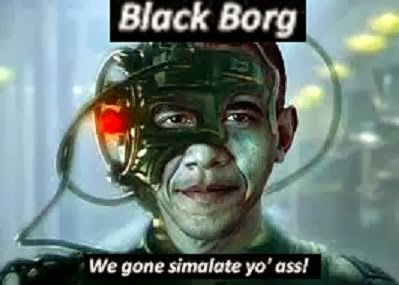
The simple fact is that this amorphous collective black entity that he so dreads, simply does not exist. It is simply another bogeyman created by the MSM and Hollywood – an entity akin to the Borg in the science-fiction series Star Trek. The former fictional being – written in the singular because they all share the same consciousness, and conscience – is famous for their (dreaded) command; “This is the Borg. We`ll assimilate you now. Resistance is futile”!
All fiction, all guano… in the real world. Never in recorded history has there been absolute hegemony among Africans – and, especially not in South Africa. The various black groupings – mostly tribal, in nature – were at each others throat before Apartheid, during Apartheid, and even now… after Apartheid.
To even think that all blacks share the exact same thoughts, feelings, moral sentiments, et cetera, – just because they share the same skin colour – is not only incredibly naive, it is also downright patronising and racist. In short; there is no absolute hegemony among the other races; so why should blacks be different in this regard?!
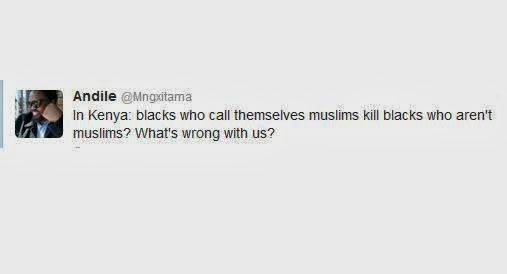
It therefore beggars belief when even (self-appointed) black intellectuals, like the awfully trite Hegel-emulating “Bikoist”, Andile Mngxitama, throw tantrums when blacks – wherever they may find themselves in space and time – do not act as “one” (see picture below).
Be that as it may; the “Black Borg” myth is only topped by its inverse, the myth of the Noble Savage. The latter, a neo-Romantic Rousseauian-regurgitating MSM/Hollywood creation, sees all blacks as inherently cherubic beings who only want the best for humanity, the universe… and the environment, of course. All little Mandela`s in heart, soul and suffering… all “one” in their eternal victimhood at the hands of the White Devil.
It is, frankly, beyond belief that even blacks themselves ascribe to this sickening denigration of their very being. I mean honestly, how can they acquiesce to a perception that only allows them collective agency, and not individual agency? But then, hey; they have been baby-sat for so long by bleeding-heart White Guilt-driven liberals that they, blacks, have left it up to others, like little lentil Fransie, to speak on their behalf.
Whatever the moral weather on that one; it is a fact that blacks have never, and will never, act as “one”. And the threat by the SAIRR vegetable, Fransie, that disillusioned (`”bitter”) whites will cause the Black Borg to suddenly appear from the Delta-quadrant wormhole just because they, the whites, are justifiably recalcitrant, is equally preposterous. Nothing, in the context of Mandelatopia, illustrates this more succinctly than the transition period to black rule in the early 90s.
During this time, the blacks did not rise up as “one” to take revenge on their Tutu-myth Holocaust oppressors, the whites. On the contrary; once the blacks realised that FW (fuck-wit) De Klerk was just going to hand over the whole caboodle, they went straight for each other’s throats…to get at the loot first.
Near-civil war circumstances prevailed as the Zulus of Buthulezi’s IFP fought the (mostly Xhosa) ANC of Mandela. More than 16 000 blacks died during that period. Hardly any whites were harmed, except for the cowardly APLA attacks on the St George’s Pub and the Roseview Church.
In her brilliant bookThe People’s War, Anthea Jeffery painstakingly researched the true facts behind the so-called “liberation struggle”. Her findings illustrate, beyond any doubt, how blacks used fellow blacks as a mere means to an end. It is an indisputable fact that the vast majority of blacks in South Africa were coerced, by threat of physical violence, to partake in Joe Slovo’s callous revolution.
`”the ANC had little compunction about attacking black civilians, including its own supporters, for the formula for people’s war draws no distinction between combatants and others and regards all civilians (irrespective of their political affiliation) as expendable in conflict;
the ANC had a motive to unleash violence, for it wanted to create enough mayhem and unrest either to spark an insurrection or to weaken its opponents to the point where it could triumph in negotiations;
the ANC had the means to unleash violence, for the peace process allowed it to bring back into South Africa some 13 000 armed and trained combatants whom it then refused to disarm or disband; and
the ANC was the only organisation to draw benefit from the 15 000 political killings that took place in the early 1990s (after all major apartheid laws had been repealed), for it used these to;
stigmatise De Klerk and the IFP,
stampede negotiators into giving it what Joe Slovo called ‘a famous victory’ in negotiations, and
put great pressure on the first all-race election, while making it unthinkable for anyone to demand a re-run of the deeply flawed April 1994 poll in which it was accorded (no accurate count being possible) some 63% of the vote.” (source)
The above-quoted just illustrates, once more, that Fransie is as dumb as mud… especially given the fact that Dr Jeffery is his chief researcher at the SAIRR!
Hell, one does not even need to read a single book to understand that blacks are not “one”. Just look at the dismal moral state of all post-colonial sub-Saharan countries. The chief “liberator” and his inner circle have always enriched themselves shamelessly, at the expense of their own people.
In Mandelatopia, Mandela, like his cronies Sexwale, Zuma, Ramaphosa, et cetera, are drowning in money, while the vast majority of their fellow blacks are suffering under extreme poverty. It suffices to say that they, the former, couldn’t`t give a continental damn. There is no “oneness”, no ubuntu, no Noble Savage and no Black Borg. Period!
That a “second revolution” will take place in Mandelatopia is a fact. But it will not be because whites are standing up for their rights. It will be because blacks will revolt against their own leaders because of the broken promises of the past 20 years of typically-African mis-governing. That whites will bear the brunt of the coming (inevitable) revolution is obvious, because they (still) have those things that the black leaders promised their black sheeple, but failed to deliver… as always.
It is thus abundantly clear that the motive behind Fransie`s reinvigoration of the Black Borg myth is everything but noble, in the sense of heroically”saving” the enslaved backsides of whites in Mandelatopia.
For you see, for Fransie – as one of the main Afrikaner H-G men in Mandelatopia – it is all about keeping his ill-earned privileges and prestige. Had the playing-field with his white peers been level, half-wits like Fransie, Piet Croucamp, JP Landman, Tim du Plessis, Pierre de Vos, etc. would never have reached the level they have attained now.
But then; Fransie`s DNA is coward-based. His survival instincts and skills were honed in his dad’s nutsack… where he used to cower in the most remote corner because he was the lesser of 60 million. Now he is still cowering, in front of 60 million blacks. But that is his saving grace, his claim to fame. For unlike the one million whites who were forced to emigrate in order to seek employment, Fransie is in league with the new Master of South Africa. He is a made-man!
So the next time Fransie screams at you, as a white South African, to shut the fcuk up and continue paying unquestioningly for the `”sins of your forefathers”, just think of the picture below.
In today’s City Press newspaper, Frans Cronjé of the South African Institute of Race Relations claim that whites live in some kind of paradise.
He cites statistics claiming the following:
“Between 1994 and 2012, the rate of unemployment among white people increased from 3% to 5.7%…
The white unemployment rate was low, even when compared to a host of international benchmarks. In the US, for example, the rate in 2012 was 7.6%, in Britain 7.9% and in Canada 7.2%.”
Apparently praising South African white entrepreneurship, he goes on to say that “while a black university graduate is more likely than a white graduate to find a job within 12 months of graduation (due to strict affirmative-action laws-DR), white graduates are four times more likely to start and operate businesses”.
I would treat these statistics about low white unemployment with a great deal of caution. Many whites are not on the unemployment statistics as they do not claim benefits from the government. Driving around many white areas, you notice their old, decrepit cars, lack of maintenance to their properties and other signs of economic distress.
Go to any five-star hotel now and you will find blacks sitting around in designer clothes. The only whites there are foreign tourists. Most cars costing R1 million (about $100 000) and more that I see every day in Johannesburg are owned by blacks, not whites. Blacks get all the lucrative corporate directorships and make easy money as “tenderpreneurs” to the state and municipalities.
I know of thousands of whites who literally had to leave the country to find jobs, in the Middle and Far East where they do dismal work as part-time English teachers or pack groceries in Australian supermarkets.
Many small businesses started by whites have failed, not least because of the racial laws and regulations imposed by government and the corporate sector. The corporate sector – banks and large companies – are now arguably more anti-white than government. They do not trade with white-owned businesses and generally sue or harass small businesses at the drop of a hat. Many whites have lost their homes which the banks require them to pledge as collateral for a simple overdraft for their small businesses.
More whites now live in so-called “informal housing” than at any time since the Great Depression. Solidarity estimates that up to 800 000 whites – educated, literate and previously taxpayers – now live in squatter camps and other “informal areas” such as this one:
Poor South African whites living in cabins normally used as garden sheds
We are witnessing the greatest social-engineering programme whereby one race is economically subjugated to another that this country and perhaps the world has ever seen.
The very notion that whites could be “liberated” by such an unfair and racist system is so fundamentally cynical that it has an Orwellian ring to it. But that is why the mainstream media no longer has any credibility among middle-class whites.
The South African media are loyal to foreign and corporate interests who see South African whites as an unwanted presence in the country, preventing them from bribing their way into looting most of the remaining assets in South Africa. That is why the SA mass media are constantly attacking whites, accusing them of racism, “apartheid privilege”, and the like. White males even get blamed for the intense crime and lawlessness in the country! Every white person knows that 99% of the violence is committed by other races, yet we are blamed for everything. If all else fails, there is always ever-increasing “the legacy of apartheid” to blame.
What I find amazing is that Frans Cronjé published two contradictory articles today, one in Rapport and this one in City Press. The one in Rapport, written in Afrikaans and therefore intended for a mainly white audience, shows how 500 000 middle-class taxpayers essentially contribute 50% of all personal taxes in South Africa. White readers of that article would be understandably outraged that, while still contributing a large share of the country’s taxes, they are treated as second-class citizens.
English in South Africa is increasingly the language of blacks and the internationalist whites who are hostile to Afrikaners and the white middle class, for reasons explained in the paragraph above, namely that their ownership of land and role in the judiciary and the accounting profession prevents the wholesale looting of our country. Even though looting is already taking place, there is still some semblance of legality left. Clearly, this has to go.
This article in English about whites is therefore intended for a black and foreign audience, to convince them that South African whites “have never had it so good”. Understandably the very real hostility felt for those dastardly Nazis and perpetrators of a “crime against humanity” will only rise upon reading this article. It will undermine any inchoate sympathy whites enjoy with their less brainwashed brethren in the West and Europe.
The most absurd sentence of all is the following: “(Whites) were liberated, first, from the guilt and pariah status that had been attached to their support and enforcement of apartheid.”
On the contrary, South African whites are now more hated and stigmatised than ever! Over the past twenty years the SABC and the mainstream media have played their quasi-communist propaganda about white evil and viciousness over and over in South Africa. Most of the time this propaganda is literally the work of unreconstructed communists who occupy powerful positions in South Africa, being the “white face” of the ANC government, the SABC and other state agencies. The British media, including the BBC, see us whites as free game now that we are utterly without any political power and lack any form of state support. More
unfair and one-sided news stories have been published and broadcast about us since 1994 than ever before, barring perhaps the 1890s when the Uitlander press and the London newspapers were publishing war propaganda about the Boer republics.
As for white guilt, there is a whole industry meant to inculcate it into us, almost from birth. At school our children are exposed to compulsory subjects such as “Life Orientation” containing political propaganda of the worst kind, meant to persuade them that their parents were all war criminals killing thousands, if not millions, of blacks. In reality, of course, only 500 blacks died at the hands of the SA police from 1948 to 1994, fewer than die every year as a result of police brutality under black rule! However, the foreign whites and media do not write about police brutality anymore because it is now committed by blacks and therefore of no interest.
More than 80 000 whites have been murdered since 1994 and up to a million white women have been raped. Four thousand farmers, their wives and children have been killed, many of them spending their last hours under dehumanising torture.
While all this is going on in the ghoulish present, not a week goes by without newspapers and radio programmes calling for whites to “repent about apartheid”, surrender the meagre assets that they still control or simply leave the country as they “have outstayed their welcome”. People are constantly telling me to “go back to Europe” or “get lost”, even though my forebears came here in the early 1700s.
Apart from racial quotas in education that prevent whites from obtaining a tertiary education, especially in medicine and other fields, an aging white population now endures a third-world system of medical care. Prior to 1994, whites had one of the best healthcare systems in the world, with both a private and a well-managed public hospital system.
Corruption and mismanagement have reduced the public system to a shambles while the costs of private healthcare have gone through the roof. Only the corporate elite can now afford private healthcare. Whites are almost banned from studying medicine by the universities so that their parents and grandparents may just die from neglect in the state hospital system.
Despite being well-educated and hard-working, affirmative action and so-called BEE (black-economic empowerment) have reduced most South African whites to poverty. Their mean income per capita is far less than the minimum wage in many European countries.The following table shows annual per capita income growth from 2001 to 2011 for all racial groups in South Africa:
Source: Moneyweb/SA census
If the R365 134 earned by the average SA white is translated into dollar terms at $40 970, this is way below minimum wage levels in most European countries. However, this very modest white income gets taxed at 40% to fund the megalomaniac dreams of this make-believe government whose only interest is in seeking international prestige while it cannot even mend our roads, nor deliver school books on time. In a real sense, white poverty is caused by government, either through its high taxes or its racially interventionist policies.
SAIRR has amended their view on farm attacks. According to Institute’s calculations white farming families may be 13 times more likely to be attacked.
This Research and Policy Brief paper seeks to determine the extent to which farmers are uniquely vulnerable to armed attack in South Africa. It draws comparisons between the rate of attack on farmers and their families to that of other citizens in South Africa.
On 5 October 2012 the South African Institute of Race Relations released a statement on farm attacks in South Africa. The statement was based on farm attack data by the Transvaal Agricultural Union (TAU). It has since been drawn to our attention by James Myburgh that the TAU data is compromised by a significant undercount of as much as 7:1 in terms of the actual number of farm attacks. Our initial analysis has therefore been revised accordingly. The revised analysis follows below.
The table below compares the farm attack rate for farmers and their families to the house robbery rate, aggravated robbery rate, and combined aggravated robbery and murder and attempted murder rates for the broader population. It is based on three assumptions. The first is that there are 47 000 commercial farmers in South Africa. This is based on StatsSA’s Census of Commercial Agriculture 2007. The second is that the average household size for farmers is 3. This is the average household size for white South Africans. The third is that, following from James Myburgh’s analysis, TAU undercounts farm attacks by an average of 7 to 1. The fourth is that attacks on smallholdings should be included as attacks on farms.
47 000 farmers + 2 dependants each = 141 000 people
National population = 50.6 million people
Ratio of farm attacks to attacks on general population
Rate per 100 000 people
Farm attacks vs house robberies
422
33
12.8 to 1
Farm attacks vs aggravated robbery
422
200
2.1 to 1
Farm attacks vs aggravated robbery + murder + attempted murder
422
260
1.6 to 1
Table 1: Attacks on farmers and their families compared to other citizens (smallholdings included)
The table shows that based on those four assumptions the number of attacks on farmers and their dependants is 422/100 000. The number of house robberies in the broader population is 33/100 000. In this comparison farming families are 13 times more likely to be attacked than other families. However, farm attacks also include all forms of robbery and not just house robbery.
For that reason the table also compares the farm attack rate to the broader armed robbery rate in the country. Here the farm attack rate, which remains at 422/100 000, must be compared to the national armed robbery rate of 200/100 000. In terms of this comparison farmers and their families are twice as likely to be attacked as other citizens. Farm attacks also involve murder and attempted murder.
For this reason the table also compares the farm attack rate to the joint aggravated robbery/murder/attempted murder rate for the broader population. Here the farm attack rate, which remains at 422/100 000, can be compared to the national murder and aggravated robbery rate of 260/100 000. Even on this analysis farmers remain more vulnerable to attack by a ratio of 1.6 to 1.
However, the argument can be made that smallholdings are basically large urban plots and not really farms. For that reason we have published the table below which compares farm attacks, excluding attacks on smallholdings, to criminal attacks in the broader population. The other three assumptions made about the data (above) are unchanged.
47 000 farmers + 2 dependants each = 141 000 people
National population = 50.6 million people
Ratio of farm attacks to attacks on general population
Rate per 100 000 people
Farm attacks vs house robberies
262
33
7.9 to 1
Farm attacks vs aggravated robbery
262
200
1.3 to 1
Farm attacks vs aggravated robbery + murder + attempted murder
262
260
1 to 1
Table 2: Attacks on farmers and their families compared to other citizens (smallholdings excluded)
This table shows that when smallholdings are taken out of the equation the farm attack rate declines to 262/100 000 farmers and their families. Compared to the national house robbery rate of 33/100 000 farmers are on this measure eight times more likely to be attacked than other citizens.
However, the table shows that when this new farm attack rate is compared to the broader aggravated robbery rate of 200/100 000 this ratio comes down to 1.3 to 1. Furthermore, when the farm attack rate is compared to the broader aggravated robbery/murder/attempted murder rate of 260/100 000 that ratio reaches a level of parity of 1 to 1. In other words, on this measure farming families are no more likely to be attacked than other citizens.
We have also conducted an analysis of the murder of farmers, based on TAU’s more complete murder figures. In order to produce a figure for the highest possible murder rate the table below assumes that only the 47 000 farmers, and not their families, are targeted in farm murders.
47 000 farmers
National population = 50.6 million
Ratio of farmer murders attacks to murders in the general population
Rate per 100 000 people
Farm murders vs all murders
68
31
2.2 to 1
Table 3: The murder of farmers
On this measure the table shows that in 2011 some 68/100 000 farmers in the country were murdered. This compares to a national murder rate of 31/100 000. On this analysis farmers are twice as likely to be murdered as ordinary citizens. However, while farmers are particularly likely to be murdered, it is true that family members may also be murdered in attacks. It is for this reason that we have prepared the final table below, which compares the murder rate for farmers and their families to that of other citizens.
47 000 farmers + 2 dependants each = 141 000
National population = 50.6 million
Ratio of farmer/family murders to murders in the general population
Rate per 100 000 people
Farm murders vs all murders
33
31
1.1 to 1
Table 4: The murder of farmers and their families
This table shows that in 2011 the murder rate for farmers and their families was 33/100 000. The murder rate for the broader population was 31/100 000. On this comparison farmers and their families are not more likely to be murdered than other citizens.
Keep in mind that our analysis has excluded the 220 000 emerging commercial farmers, some of whom are large producers, who may also be attacked. We have also excluded from this analysis farm managers and extended families that may live on farms and become victims of attack. Our figures therefore suggest worst-case scenarios for farming families.
What conclusions can be drawn? The first is that the past week has seen a sharp increase in the quality and level of analysis of farm attacks in South Africa. It has also focused considerable media attention on the problem. Both of these are good things.
The second is that it is possible to argue that farmers are uniquely vulnerable to attack contrary to our initial conclusions drawn from the incomplete TAU data. This is especially so where a straight comparison is drawn between the house robbery rate and the farm attack rate. The same is true for the murder rate of farmers (excluding family members).
The third is that by changing some assumptions it is possible to reach somewhat different conclusions. For example, it is reasonable to compare farm attacks, which is a term inclusive of robbery and murder, to the broader robbery and murder rates of the society. When this is done farmers remain more at risk, although by a smaller measure. However, it is when the assumptions shift to exclude smallholdings that the picture changes significantly. Then the comparisons suggest that farmers are not uniquely vulnerable to violent attack.
However, even this result should not be taken to suggest that farmers are safe. Analysts of our data must consider that South Africa’s crime rates are uniquely high. Our murder rate, for example, is 500% higher than that of the United States and 3000% higher than parts of Western Europe such as the United Kingdom and Germany. This brings us to our fourth conclusion that all South Africans face an extraordinary criminal onslaught. People who have previously regarded farm attacks as a somewhat distant problem, nothing to do with them, must realise that they arguably live in as much peril as farmers do. It is clear therefore, regardless of how they rank compared to other citizens, that as a best-case scenario, farmers live a perilous existence in a largely lawless society.
The fifth conclusion is that, unlike urban middle class residents, farmers do not have the benefit of armed response companies or nearby police stations. Rather they depend on their own defences to secure themselves and their families. In addition, no analysis of the security position of farmers would be complete without noting the role of the State in exacerbating their vulnerability. The closure of the commandos and the Government and the African National Congress’s ambivalence at best toward the incitement by some of their own members to kill farmers creates an environment in which South Africa’s farmers are likely to be killed.
The final conclusion is that there can ultimately be no solution to farm attacks without a broader solution to the general problem of criminal violence in our society. In other words, farmers will not be safe until other citizens are safe and vice-versa. This is a point that advocacy groups can use to great effect in their important campaigns to alert policy makers and the international community to the murder of farmers in South Africa.
Issued by Frans Cronje, Lucy Holborn, Boitumelo Sethlatswe, South African Institute of Race Relations, October 10 2012
This website uses cookies to improve your experience. We'll assume you're ok with this, but you can opt-out if you wish. Cookie settingsACCEPT
Privacy & Cookies Policy
Privacy Overview
This website uses cookies to improve your experience while you navigate through the website. Out of these cookies, the cookies that are categorized as necessary are stored on your browser as they are essential for the working of basic functionalities of the website. We also use third-party cookies that help us analyze and understand how you use this website. These cookies will be stored in your browser only with your consent. You also have the option to opt-out of these cookies. But opting out of some of these cookies may have an effect on your browsing experience.
Necessary cookies are absolutely essential for the website to function properly. This category only includes cookies that ensures basic functionalities and security features of the website. These cookies do not store any personal information.
Any cookies that may not be particularly necessary for the website to function and is used specifically to collect user personal data via analytics, ads, other embedded contents are termed as non-necessary cookies. It is mandatory to procure user consent prior to running these cookies on your website.