Mandela: muti for white guilt

roodt_dan_wiki

by Dan Roodt

Ever since Nelson Mandela died, but even before, one was utterly flabbergasted before the intensity of media fervour pouring out en hommage to the Big Man. In Africa, of course, there are all kinds of theories about Big Men, some more politically correct than others. The tribal elder meets the Soviet personality cult, and we get Idi Amin Dada. Or Charles Taylor. Or Robert Mugabe.

If there is one thing I can stand even less than African Big Men, it is British journalists convulsing on the ground in effusive praise of them. Who still remembers the blasts of praise from Fleet Street when Mugabe assumed power in the ex-Rhodesia? For much of the past ten days while South Africa lit the long-awaited Big Candle, visible from outer space without a doubt, we had to endure near-hysterical outpourings exalting the deceased ex-terrorist. One such scribe from the island north of the Continent – I forget which, there were so many this week – wrote: “Mandela could have been president for life but he chose to stay a single term, for the sake of democracy in Africa!”

Democracy in Africa. Oh, yes. If Mandela’s successor at the helm of this decaying country, Thabo Mbeki, were to be believed, democracy was invented in Africa. No less. The point is that there is now such an Afrocentric phantasmagoria, cultivated in Britain and the United States, that anything is now possible, even Mbeki’s “African century”. The notion that Africa will come to dominate the globe economically, politically and militarily, was first articulated by another African Big Man, born Joseph-Desiré Mobutu but whose full regal appellation afterwards became Mobutu Sese Seko Kuku Ngbendu wa Za Banga.

Novelist V.S. Naipaul wrote somewhat ironically about Mobutu’s dreams of impoverished Europeans beseeching African countries for much-needed aid in 2000. Yet the notion of Nelson Mandela being “the greatest leader of the twentieth century” and voted as the most respected global leader in at least one poll. must inspire some doubt in Naipaul himself. Contemplating the “transformed” inner city of Johannesburg in our postapartheid paradise, Naipaul wrote in The masque of Africa:

It sent my mind back to other places of dereliction and ruin I had seen: the wartime rubble of East Berlin kept as a monument in the communist days. But it seemed easier even in the bad days for that part of East Berlin to be rebuilt than it would be for the half-life of this part of Johannesburg to be restored to something like its original meaning. Where would one begin? One would have to begin with the idea of the city, the idea of civilisation; and already, before one had even begun, one would be swamped by protest.

There were further discoveries to be made within that new slum. A sturdy old warehouse had been given over to new merchandise, which would have been like a parody of what had been here. It was a market of witchdoctors’ goods, and it was extensive. These were the muti goods that witchdoctors required their customers to get, to be used by the witchdoctor as he pleased, usually to make medicines, which the unfortunate bewitched man or woman had to drink.

I have often thought that Mandela had bewitched a good portion of the Anglo-American ruling class that in turn infected the stupid Europeans who are progressively losing the capacity for independent thought. All this talk of “Madiba magic” might be code for some supernatural, Harry Potter-like influence.

As everone knows, some forms of muti are taken as a cure for an evil spell, while others are used precisely to bewitch the victim. A black man who has designs on a woman who is rejecting him could buy some muti from a sangoma to ensure that she falls in love with him.

In Europe, Nietzsche and others wrote about the “twilight of the idols”. However, in Africa the idols are thriving, with the messianic Mandela being the biggest idol of them all. It seems only a few cantankerous Christians still refuse to bow to him, but not the Clintons, the king of the Netherlands or Barack Obama. Even George W. Bush came as a pilgrim to South Africa this week.

During his speech at Soccer City on the outskirts of black Soweto, Obama cast himself in the role of Mandela’s understudy, a humble disciple to the famous Xhosa.

I suppose in the days of the Roman Empire, people were also nonplussed about the seemingly inexorable rise of a strange new cult, Christianity. In the face of global grief over Mandela’s “exchanging the temporary for the eternal”, as the local Afrikaans saying goes, most mainstream conservatives have joined in eulogizing Mandela. British PM David Cameron, who had wanted to “hang Mandela”, together with other Young Conservatives, reacted to Mandela’s death with:

A great light has gone out in the world. Nelson Mandela was a hero of our time.

The normally truculent George W. Bush who had unleashed a war on other terrorists had only kind words for the man who had co-authorized the Church Street and Amanzimtoti bombs:

President Mandela was one of the great forces for freedom and equality of our time. He bore his burdens with dignity and grace, and our world is better off because of his example.

How do we explain such empathy, nay admiration, for a card-carrying member of the South African Communist Party in so-called Western conservative leaders? After all, I cannot recall similar expressions of sorrow when Georges Marchais of the French Communist Party or the East German stalwart, Erich Honecker, expired in 1997 and 1994, respectively.

The answer is that, unlike the venerable European leftists Marchais and Honecker, who had also waged a life-long struggle against fascism and racism – both leaders were among Mandela’s staunchest allies – Comrade Mandela assuages white guilt.

Susan Sontag’s notorious adage, that “the white race is the cancer of human history”, has become almost an official doctrine in the United States and Great Britain, eagerly emulated by the hapless Europeans. Few people have written about this phenomenon, except French “new philosopher” Pascal Bruckner who published two books about it, aptly entitled The tears of the white man: compassion as contempt and The tyranny of guilt: an essay on Western masochism.

Throughout the past week, here in South Africa and elsewhere, whites indulged in moral self-flagellation. A Dutch journalist, resident in South Africa, declared apropos of Mandela as symbol: “We had 40 years of apartheid, but 400 years of colonialism.” I daresay, four hundred years will not be enough to atone for the sins of colonialism and apartheid.

Probably I have referred to this process before, but one of the most repulsive aspects of white, Western guilt, is how South African whites in general, and Afrikaners in particular, have been made into literal scapegoats for it. Every time one of us gets murdered, raped or tortured under the mayhem that Mandela’s ANC regime has brought to South Africa, the West’s burden is proportionately leavened.

For all the odes to Mandela’s “wisdom”, sense of politics and so on, most of his public pronouncements consist of commonplaces and homilies befitting a school boy of very young age. His listeners melt away in awe when he says: “Let bygones be bygones.” His theatrical, even cheap and calculated trick of putting on the Springbok rugby jersey in 1995 is praised as a stroke of genius.

Buy Dan Roodt's book through Amazon.com
Buy Dan Roodt’s book through Amazon.com

Many Afrikaners have experienced this from Western whites. To them, nothing that we can say, write or compose is even remotely interesting. The handful of modern Afrikaner composers are arguably among the most creative and interesting in the world, yet their music is almost completely unknown. Afrikaans poetry is arguably among the best, even compared to that in much larger languages, yet besides Afrikaners and a few Flemings, no-one has ever taken cognisance of its existence. White guilt excludes the recognition of white talent, especially in the ranks of other “guilty” whites.

Once a young, blonde woman from here recounted to me how she was sent to a European country on a scholarship, together with a black counterpart. Although attractive, intelligent and educated, her European hosts evinced a degree of disinterest in her bordering on rudeness. Despite having been born and bred in Africa, she was white and therefore deemed to be just some displaced European like themselves. The exact opposite behaviour was de rigueur when it came to her fellow black student. She was seen as an object of immense fascination and hidden wisdom, almost like Mandela. Every white European in her presence smiled broadly, addressed her in overly polite terms and posed unending questions about her past and her upbringing. In the same way, the fact that Mandela had herded cattle as a boy according to Xhosa custom arouses far more curiosity than the pedestrian upbringing of some white in Pretoria who learned the cello and read Greek myths and Grimm’s fairytales as a child.

It is as if whites have taken on the behaviour of blacks described by black revolutionary, Frantz Fanon in Black skin, white mask:

The black man has two dimensions. One with his fellows, the other with the white man. A Negro behaves differently with a white man and with another Negro. That this self-division is a direct result of colonialist subjugation is beyond question…

After his organisation had placed bombs on city sidewalks, in bars and restaurants and killed thousands of blacks in internecine power struggles, including by the infamous necklace method, Mandela was praised for preaching moderation and “reconciliation”. Mandela presided over hordes of sadists wantonly looting, burning and killing their fellows. Such incidence of violence and destruction was, as usual, reinterpreted and recoded by guilt-complexed white journalists and pundits as being pleas for democracy and togetherness. Or free housing, affirmative action and racial quotas in sport, all of which South African blacks deserve in copious amounts, as liberals and leftists clamorously assure us. Of course, riots, violence and sadism continue unabated in South Africa, but because there is now a black government and the perpetrators of such violence are black too, any criticism of such behaviour is expressed in muted tones, if at all.

The Western world expected of South African whites to commit political suicide, which they meekly did. De Klerk and his National Party’s vague dreams of power-sharing came to nought and the former so-called Afrikaner leaders are too embarrassed to admit their abject failure in securing any kind of reasonable future for their constituents.

The corollary of white surrender in South Africa has been the sudden birth of a ready-made black state, a kind of African dream. Whites have been simply pushed aside and most of the state, industrial and mining apparatus taken over by blacks and those communist whites having clearly demonstrated their loyalty to the ANC and SACP through participation in terror and sabotage.

Through the sheer effects of the vast propaganda campaign conducted around Mandela and the apartheid stereotype, many people assume that prior to 1994 South Africa had been as backward as Burkina Faso or Malawi where locals subsist on slightly more than a dollar a day. It is routinely supposed by outsiders that under white rule there were hardly any schools or universities, except ones reserved for whites where they were taught some form of Nazi/racist doctrine. Presumably the roads, multi-storey buildings, concrete bridges and highways, hospitals and more than twenty universities were constructed by Mandela himself or those in his immediate entourage. After all, as the BBC journalists and others in the know assure us, he was the “father of modern South Africa”. A miracle worker, indeed.

Many whites in Europe and North America feel extremely uncomfortable about the fact that Africa is so backward and poor – “underdeveloped” – compared to other continents and regions of the world. European colonialism is usually blamed for this state of affairs, except that it has endured under African rule since the early nineteen-sixties. Also, countries like Haiti, Liberia and Ethiopia that have been independent of white rule for centuries, have not fared any better. Both Liberia and Ethiopia are classified among the poorest countries in the world, with Haiti – “the world’s first black republic” as Thabo Mbeki called it – being not only among the world’s poorest, but also the poorest country in the western hemisphere. Eighty percent of Haitians live under the poverty line and fifty-four percent in abject poverty. According to the Red Cross, seven out of Haitians survive on less than US$2 per day.

However, thanks to the “miracle” brought by Mandela and his backers in the ex-Warsaw Pact countries, as well as the UK, the USA, Sweden, Norway and the Netherlands, everyone may now point to a successful “black state”, the Republic of South Africa. Even the names of towns and cities founded by Afrikaner pioneers are changed to Bantu ones to make them “more African”, completing the illusion of black engineering, scientific, architectural, financial and economic success.

It is no wonder that FW de Klerk is so popular in the West and was cheered in Soweto this week. He had his own people subjugated and their hard-earned assets taken away so that not only South African blacks could feel better about themselves, but in order that the white man shedding tears over his guilt in Western Europe and North America could breathe a sigh of relief.

In a real sense, Mandela and his myth are the muti of the West. But his fame and glory come at a terrible price: the disenfranchisement of the white minority, the hijacking of their public and private assets, as well as their ultimate expulsion from their fatherland as in the Zimbabwean example.

Unless South African whites are able to shake off the stupor in which they find themselves as a result of their decades-long brainwashing into left-extremist illusions by the viciously lying Western media, their ultimate fate will be far more tragic than that of their Zimbabwean counterparts. as many more will be killed than are already dying in the ubiquitous farm murders and suburban house attacks.

The indigenous Afrikaners are now seen as foreigners in the country they had built, together with – ironically – the illegal immigrants from other African countries who are also randomly massacred by South African blacks in so-called “xenophobic attacks”.

All those Africans elsewhere on the continent who cheer Mandela for his “victory over the hated whites” should be aware that Mandela’s followers would kill you too, if ever you set foot here.

While the West and its media perverts will maintain its silence over such atrocities.

Donate or subscribe to praag!

This foreign African was set alight by locals, with a white SA policeman dousing the flames just in time

‘SA’ is for Sadists’ Apocalypse

roodt_dan_wiki

by Dan Roodt

[followbutton username=’danroodt’ count=’true’ lang=’en’ theme=’light’]

Like Dan Roodt’s Facebook page

In a recent article in the Sunday Independent, Gillian Schutte mistakenly blames so-called “white conservative narratives” for the appalling sexual violence that is sweeping South Africa at present. As rape is notoriously underreported, most estimates put the number of such crimes at more than a million per year or approximately three thousand per day.

The macabre forms of dehumanising torture during farm murders provide another clue to the societal breakdown that is occurring in our country. Even calling it “our country” might be a malapropism in that Afrikaners like myself are no longer considered full citizens in an Afro-Saxon state that is slouching towards some incarnation of Mugabe’s Zimbabwe or, better still, Charles Taylor’s Liberia. This week, Taylor’s conviction as a war criminal was confirmed by an international court, the first head of state to be jailed for such crimes committed in Sierra Leone while he was in office.

South Africa has become a sadists’ apocalypse. No amount of “reframing”, circumlocution or leftist pseudo-intellectualism can disguise it any longer. Nor can the seemingly desperate massaging of the crime statistics. In the age of social media, people communicate their horror and despair at being captives in this, our “paradise of cruelty”. Policing our language as in the cowardly attack upon Louise Mabille is a poor substitute for the lack of policing elsewhere.

As the twentieth century has shown, utopias are always dangerous, be they fascist or communist. Every utopia has turned into its mirror image, a dystopia replete with genocide. South Africa’s pursuit of a racial biopolitics known as “transformation”, as well as extreme forms of cultural relativism, have unleashed hitherto unknown social consequences. In the domain of sexual violence at least, the country has earned the dubious title of “rape capital of the world” and it regularly tops international murder tables too.

Understanding the causes of this immense violence, unknown in peacetime, represents a rare analytical challenge. None of the usual explanations actually fit. The same people denouncing “colonialism” are the most accomplished colonialists in their slavish subordination to US or British racial discourse and political correctness.

However, neither Britain nor America has absorbed any significant African cultural influence so it is of no use applying the sociology of New York or London to an outbreak of sadistic violence in Limpopo province. It is risible to see ostensibly educated people constantly blaming either “apartheid” or “poverty” for the horrors and cruelties afflicting this society.

The retreat of Afrikaner power in South Africa has been coterminous with the resurgence of African belief systems, including witchcraft and ritual murders. In the early nineties South Africa experienced hundreds of killings associated with witchcraft and occult beliefs, leading to the Commission of Inquiry into Witchcraft Violence and Ritual Murders. We still do not understand the role that occult beliefs played during the revolution, especially in establishing hegemonic black politics and racial nationalism. The necklace, that symbol of revolution, is pregnant with ethnographic and cultural meaning. There is also evidence that young “comrades” intimidated traditional healers to extract money from clients and that the accusation of being a witch was used to eliminate political opponents.

Mrs. Winnie Madikizala-Mandela, that international heroine and former wife of Nelson Mandela, subscribed to the Maoist doctrine – ‘kill one, scare a thousand’ – that support is gained through terror and horror. She notoriously stated in 1986:

…with our boxes of matches and our necklaces we shall liberate this country.

A necklace killing whereby a tyre is placed around the victim's neck, filled with petrol and then set alight
A necklace killing whereby a tyre is placed around the victim’s neck, filled with petrol and then set alight

Child and even baby rape is another ghastly phenomenon indicating that South Africa has navigated to a new, alien moral code. Stating that white men sometimes do it in some other country too, hardly mitigates the particular horror that it has assumed here.

The British Guardian ran an article on 12 March 2009 entitled, “Raped and killed for being a lesbian: South Africa ignores ‘corrective’ attacks“. The Guardian’s website contains an accompanying video interview with lesbian rape victims, as well as young black men who are outspoken in their support of “corrective rape”. One of them says:

Me, I have no time to rape them, but if there are some of the other guys who want to teach them the way, they must rape them, they must rock them.

But perhaps white conservatives are a bigger problem: they might go to church or caution their children against drugs and sexual promiscuity, which would undermine the libertine morals that so many have advocated for so long in South Africa. In Hillbrow, as recounted to me by a former policeman, young white female drug addicts are employed as prostitutes by Nigerian gangsters. When they are no longer useful to their pimps, they simply get injected with heroine and pushed off highrise buildings in what gets officially recorded by the police as “suicides”. In South Africa, the crime reality show is so much better than the fiction.

The country’s academics are all but ignoring the scourge of rape, including infant rape, judging from the paucity of published articles in the field. To some extent they have acculturated to the witch-hunting culture in persecuting dissidents in their own ranks. Otherwise they engage in repetitive denunciations of “patriarchy” as if there were still a father left somewhere that has not been killed.

South Africa’s “transformed” universities have been turned into the “armed brothels” Erik von Kuehnelt-Leddihn spoke about when he said:

Rousseau is the grandfather of the concentration camps and also of those armed brothels that we continue to call universities. We have with us on one hand the Old Left, a finished product of L’éducation sentimentale, with its bent for social engineering and its tendency to identify its own plans and policies with the volonté générale; on the other the New Left which has taken up the slogan Retournons à la nature! exemplified in the rabble of unwashed, unkempt, debauched, unbridled ignoble savages who look to the Third World of the underdeveloped for inspiration. Its heroes are Chairman Mao with his Little Red Book, Ché Guevara, Ho Chi Minh, Holden Roberto, the Harlem criminals and the pistol-packing priests.*

That is why leftist university intellectuals find any form of criticism of traditional African culture to be inherently “racist” and eschew references to practices such as ukuthwala (the kidnapping and forced marriage of young maidens). Recent legislation has placed about 18 million black South Africans under so-called customary law in which such practices are legal.

Everybody in South Africa, whether white or black, fears a witch-hunt in some or other form. Especially the kind of witch-hunt whereby you are called a “racist”, lose your tenured university job and spend the rest of your life in ignominy. Therefore white academics are completely silent on ukuthwala or the so-called “virgin cleansing myth” if the professors do not actually deny in writing that such phenomena exist!

Here and there information filters through the iron curtain of political correctness. The only academic article worth reading on the “virgin cleansing myth” is that by Suzanne Leclerc-Madlala which appeared in The African Journal of AIDS Research in 2002 under the title,  “On The Virgin Cleansing Myth: Gendered Bodies, AIDS and Ethnomedicine“. It provides a fascinating glimpse into the psycho-sexual paradigm in which, as she puts it, “virgin cleansing is believed to have both a therapeutic and a prophylactic effect” (against HIV-AIDS). Raping a child or a disabled person is therefore seen as a form of AIDS prevention or cure.

But even the virgin cleansing myth obliquely alluded to by Dr. Mabille in her critique of insipid Western feminism does not go far enough in explaining South Africa’s journey upriver into the heart of darkness. We really lack the concepts to understand the enormity of what we are faced with.

Much of what passes for analysis of sex and culture in South Africa consists of rehashed hippie or New Left thinking from 1960s America. Get liberated, man, is more or less the gist of it. Call it Marcuse on Durban Poison. Repression or any form of “holding back” is invariably seen as “bad”. But sometimes repression might be desirable, even imperative. Freud was old-fashioned enough to advocate a balance between the pleasure principle and the reality principle.

The old Afrikaner government, while encouraging African ethnic identities, saw fit to suppress witchcraft and ritual murder by making it a criminal offence. Prior to becoming the first president of a united South African republic, Charles Robberts Swart introduced the Suppression of Witchcraft Act 3 of 1957. To the principled cultural relativist, the act – which is still on the statute books – is an affront and he would probably agree with the Marquis de Sade that “morality is just geography misapplied”, meaning that a crime in one culture is a harmless pastime in another.

One could even argue that the very structure of the South African political system is tending towards sado-masochism. Last Sunday the new CEO of the liberal Institute of Race Relations, Dr Frans Cronjé, argued in Rapport that whites should assume a far more submissive role in South Africa, lest they expose themselves to some form of collective revenge during a Second Revolution. According to Cronjé, such a revolution will be

…a violent, racist and destructive transition from a reconciling democratic state to a hostile, black nationalist state… After the Second Revolution, white South Africans will lose their homes, their jobs and their businesses.

Apart from exhortations to submissiveness, white guilt and even “vows of silence” à la Samantha Vice of Rhodes University, South Africa’s academic sycophants contribute little to our grasp of contemporary violence. In this respect, French literature is more instructive. Sade’s amoral theory of nature, of course. But also his notion of the sovereignty of sexual instincts that should not be tamed by any man-made law or religious scruple.

The Marquis de Sade had a disciple in the surrealist author Georges Bataille who espoused a theory of “transgression”. He took an interest in violence, punishment and eroticism. Bataille also collected photographs of Chinese executions which included horrific torture.

South Africa’s army of sadists regularly commit acts that shock a weaker Eurocentric sensibility. At the same time they are creating a world without limits, revelling in a new-found innocence that to them must represent the perfect freedom, the sovereignty of Sade’s libertine who pursues excess in celebration of pristine nature, a nature that punishes the weak and rewards the strong. To impose one’s will on a woman is also a gift of nature to all men. As Sade writes in Philosophy in the Bedroom:

If then it becomes incontestable that we have received from Nature the right indiscriminately to express our wishes to all women, it likewise becomes incontestable that we have the right to compel their submission, not exclusively, for I should then be contradicting myself, but temporarily. It cannot be denied that we have the right to decree laws that compel woman to yield to the flames of him who would have her; violence itself being one of that right’s effects, we can employ it lawfully. Indeed! has Nature not proven that we have that right, by bestowing upon us the strength to bend women to our will?**

Human rights or even a puritanical code such as feminism is not incompatible with sadism. As Bataille would argue, morality is needed for transgression to take place.

Sylvia Plath wrote in her poem “Daddy” that “Every woman adores a Fascist”. She was wrong. Every woman adores a sadist. Especially if she happens to be a feminist.

* Erik van Kuehnelt-Leddihn. “The Western Dilemma: Calvin or Rousseau?” in Modern Age, Winter 1971, p. 55.

** The Marquis de Sade. The complete Justine, Philosophy in the Bedroom and other writings, transl. RIchard Seaver and Austryn Wainhouse. New York: Grove Press, 1965, p. 319.

[followbutton username=’danroodt’ count=’true’ lang=’en’ theme=’light’]

Like Dan Roodt’s Facebook page

Charles Taylor’s victims hail war crimes verdict

Charles Taylor in 1990

Victims of the bloody regime of Liberian warlord Charles Taylor spoke of their relief after his 50-year jail term for war crimes and crimes against humanity in Sierra Leone was upheld by an international court on Thursday.

The final verdict handed down by the UN-backed Special Court for Sierra Leone (SCSL) draws a line under a seven-year trial of the 65-year-old former Liberian president, sentenced in May last year for “some of the most heinous crimes in human history”.

“As a government, we believe that justice has been done and impunity is over,” Sierra Leone government spokesman Abdulai Bayraytay told AFP.

“The message for sitting heads of state not only in Africa but beyond is that when you are in power you must exercise it judiciously, have respect for the rule of law and human rights and uphold the dignity of others.”

Around 100 people, including human rights activists and survivors of the Sierra Leone civil war, watched a live broadcast of the ruling in the capital Freetown.

For Sullay Turay, who lost a hand and a foot to Taylor-backed rebels, the outcome “showed that no matter what you do, justice will finally catch up with you and this is what has happened in Taylor’s case.”

The former warlord, who was jailed initially for 50 years for arming rebels during Sierra Leone’s brutal 1990s civil war, is likely to spend the rest of his life behind bars, possibly in a British jail.

He sparked a 13-year civil war in his own country when he led a rebellion in 1989 to oust President Samuel Doe which deteriorated into one of Africa’s bloodiest conflicts.

His National Patriotic Front of Liberia (NPFL) earned a reputation for extreme violence, conscripting child soldiers and terrorising citizens of certain ethnic groups.

After taking Monrovia, Taylor was elected president in 1997, but violence again erupted in 1999 when another rebellion started and he lost control of much of the country, fleeing in 2003 to Nigeria.

The conflicts resulted in 270,000 deaths, with many civilians displaced and several thousand becoming victims of atrocities, according to the United Nations.

As Liberia’s president from 1997 to 2003, Taylor supported Revolutionary United Front rebels in neighbouring Sierra Leone by supplying them with guns and ammunition as they waged a campaign of terror during a civil war that claimed 120,000 lives between 1991 and 2002.

He was finally arrested and transferred to The Hague in 2006, where he was convicted in 2012 of aiding and abetting the rebels during the conflict, known for its mutilations, drugged child soldiers and sex slaves, trial judges found.

“Full justice has now been done and the victims should move on with their lives. The violations they suffered have been addressed through the judicial process,” said Ibrahim Tommy, chairman of the Centre for Accountability and the Rule of Law campaign group.

“The government now should work to strengthen the justice system and work for the socio-economic prosperity of the victims.”

Some victims of the conflict remain bitter and voiced frustration that Taylor had not received the 80-year sentence requested by the prosecution.

“Let Taylor rot in jail. I only wish he would have served his sentence in an African prison to suffer the more,” said Freetown taxi driver Andrew Lebbie.

But there was also a note of reconciliation among the crowd gathered for the ruling in Freetown.

“Forgiveness is all I would ask for. The court should have tempered justice with mercy,” said vicar Sam Fergusson.

But Taylor has never been charged for his role in Liberia’s bloody history, only that in neighbouring Sierra Leone. – AFP

Charles Taylor to hear Sierra Leone appeal verdict

Charles Taylor during his trial at The Hague

Former Liberian President Charles Taylor will hear Thursday whether appeals judges uphold or overturn his landmark conviction and 50-year sentence for aiding murderous rebels in Sierra Leone’s civil war.

Taylor, 65, became the first former head of state convicted by an international war crimes court since World War II when the Special Court for Sierra Leone found him guilty on April 26, 2012, of 11 counts of war crimes and crimes against humanity including terrorism, murder, rape and using child soldiers.

Judges said he provided crucial aid to rebels and helped plan attacks in return for “blood diamonds” mined by slave laborers in Sierra Leone and political influence in the volatile West African region. His conviction was hailed as ushering in a new era of accountability for heads of state.

“The trial and judgment of Charles Taylor sets out a clear marker that even those at the highest levels of power can be held to account,” Elise Keppler, associate international justice director at Human Rights Watch said in a statement. “The Taylor trial, and the Sierra Leone Special Court’s work overall, have made a major contribution to justice for brutal crimes committed during Sierra Leone’s conflict.”

About 50,000 people died in the 11-year civil war that ended in 2002. Thousands more were left mutilated in a conflict that became known for the extreme cruelty of rival rebel groups who gained international notoriety for hacking off the limbs of their victims and carving their groups’ initials into opponents. The rebels developed gruesome terms for the mutilations that became their chilling trademark: They would offer their victims the choice of “long sleeves” or “short sleeves” – having their hands hacked off or their arms sliced off above the elbow.

Taylor was convicted not only of aiding and abetting Sierra Leone rebels from Liberia, but also for actually planning some of the attacks carried out by Sierra Leone rebel groups, the Revolutionary United Front and the Armed Forces Revolutionary Council.

It isn’t clear if the Sierra Leone court’s appeal panel will take into account a February appeals judgment by the U.N. Yugoslav war crimes tribunal that acquitted the former chief of staff of the Yugoslav National Army, Gen. Momcilo Perisic, of aiding forces fighting in a neighboring country. Perisic was freed after appeals judges said it hadn’t been proven that he sent supplies to Bosnian Serb forces with the “specific intent” that they be used to commit atrocities.

The ruling was seen as raising the bar on the level of proof needed to uphold such aiding and abetting charges, though the Sierra Leone court isn’t bound to follow in the Yugoslav tribunal’s footsteps.

Taylor’s lawyers say he should be acquitted on all counts. Prosecutors asked appeals judges to rule that he was even more closely involved in the crimes in Sierra Leone than was laid out in his original conviction and urged judges to increase Taylor’s sentence to 80 years, saying the 50-year sentence wasn’t “reflective of the inherent gravity of the totality of his criminal conduct and overall culpability.”

If Taylor’s sentence is upheld, he will be transferred to Britain, which has agreed to provide a cell for him.

Taylor’s trial was moved from the Special Court of Sierra Leone’s headquarters in the capital, Freetown, to the Netherlands because of fears it could destabilize the West African region if held in Sierra Leone.

The Taylor appeals ruling will be the final judgment at the court, which indicted 13 of the main architects of the atrocities in Sierra Leone. Two died before trial and one more remains unaccounted for and possibly dead. Another died before hearing a verdict and all the others were tried and convicted.

The court’s trial chamber in Freetown will be converted to house Sierra Leone’s Supreme Court in the future. Another part of the court is being turned into a peace museum and its detention facility has been put to use as a prison by local authorities. – AP

Ethnic clashes in Guinea leave dozens wounded

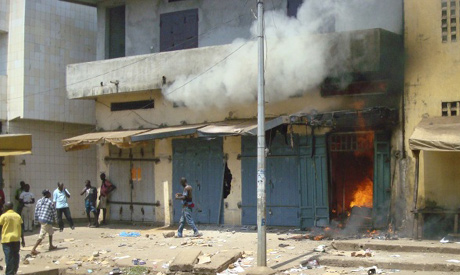
Rival gangs set a store alight in Conakry, Guinea

Dozens of people were wounded Monday in ethnic clashes in the west African state of Guinea, officials told AFP, after petrol station guards killed a youth from a rival tribe.

A police source said the violence broke out in the southern forest region when the guards from the Guerze tribe accused the youth, an ethnic Konianke, of stealing before torturing and beating him.

The victim’s family told their fellow Konianke tribespeople who “rose up against these medieval practices” in the town of Koule, the source said.

The violence spread to the nearby provincial capital N’Zerekore, 570 kilometres (350 miles) southeast of Conakry, leaving dozens injured and several homes destroyed.

Security forces deployed to break up the fighting had been unable to restore calm in N’Zerekore by the afternoon, witnesses told AFP, while the police source said there were “dozens wounded by machetes”.

“The two communities are now fighting with machetes, axes, sticks and stones. I cannot say the exact number of casualties in the districts or even the number in hospital. The situation is extremely serious,” he added.

“Since the clashes broke out in Koule overnight and moved to N’Zerekore, we have registered one death and at least 50 injured, 20 in Koule and 30 in N’Zerekore,” a hospital source told AFP.

Communal violence is common in the region, near the border with Liberia, where clashes between the two tribes regularly break out over religious and other grievances. The indigenous Guerze are mostly Christian or animist, while the Koniankes — seen as newcomers — are Muslims considered to be close to Liberia’s Mandingo ethnic community.

In Liberia’s civil war, which ended in 2003, rebels fighting the forces of then president Charles Taylor drew much of their support from the Mandingo community.

The Guerze, known as Kpelle in Liberia, were generally considered to be supporters of forces loyal to Taylor, who was jailed last year for “aiding and abetting” war crimes in neighbouring Sierra Leone. – AFP

Sierra Leone rebels helped by Charles Taylor ‘to kill, rape and mutilate thousands’

Charles Taylor during his trial at The Hague

Sierra Leone rebels depended on Charles Taylor’s logistics to kill, rape and mutilate thousands during the west African nation’s savage civil war, prosecutors said Wednesday at the end of the Liberian ex-president’s appeal.

The Revolutionary United Front “relied on Taylor’s logistical assistance”, Nicholas Koumjian told the west African nation’s UN-backed special court, where the former warlord is appealing a 50-year prison sentence.

“Without this support, thousands would not have been killed, would not have been amputated, would not have been taken as sex slaves,” he told the second and final day of the appeals hearing at the court’s headquarters in Leidschendam just outside The Hague.

Dressed in a grey suit, white shirt and dark tie, with rimless round glasses perched on his nose, Taylor frowned often as he listened intently to the prosecution’s arguments.

The former strongman who was given an opportunity to address judges at the end of the hearing and told the Special Court for Sierra Leone (SCSL) that he was “very appreciative of the handling of the proceedings so far”.

“I have the belief that the right thing will be done with the grace of Almighty God,” said Taylor, who once famously compared himself to Jesus.

The SCSL in April last year convicted Taylor, 64, of aiding and abetting the RUF and its allies who waged a terror campaign during a civil war that claimed 120,000 lives between 1991 and 2001.

His sentence in May for “some of the most heinous crimes in human history” was widely welcomed around the world and was the first handed down by an international court against a former head of state since the Nazi trials at Nuremberg in 1946.

As neighbouring Liberia’s president from 1997 to 2003, Taylor gave rebels guns and ammunition in their fight against Freetown during the conflict, know for its mutilations, drugged child soldiers and sex slaves, trial judges found.

In return, Taylor was paid in “blood diamonds” mined by slave labour in areas kept under the countrol of ruthless Sierra Leonean rebels.

Taylor’s defence again argued on Wednesday that there was no evidence linking him to crimes committed by Sierra Leone’s brutal rebel forces, nor did he provide logistics, guns and ammunition.

“There was no support from Charles Taylor,” said one of his lawyers, Christopher Gosnell.

The defence has argued that trial judges made legal mistakes in their findings against Taylor and are asking appeals judges to reverse the conviction and quash the sentence.

Prosecutors argued Taylor’s sentence was too light and asked, on appeal, for 80 years, with Koumjian telling judges: “Charles Taylor knew about these crimes.”

“He knew what was happening and how the RUF operated.”

Taylor’s trial, which ended in March 2011, saw a number of high-profile witnesses testify including British supermodel Naomi Campbell, who told the court she received a gift of “dirty diamonds”, said to be from the flamboyant Taylor.

Appeals judges are expected to have a decision by September at the earliest, with the Liberian ex-president remaining behind bars at the UN’s detention unit in The Hague until appeals proceedings are finalised.

If his appeal fails, Taylor will serve his sentence in a British jail.