US college bans all students from Ebola countries in Africa

“Navarro College is not accepting international students from countries with confirmed Ebola cases.”

It was with shock that 33-year-old Nigerian-American academic Idris Bello read this sentence, signaling the rejection of a friend’s Nigerian brother-in-law to the Texas community college based solely on his citizenship. “I didn’t believe it, I was so surprised. I thought: This cannot be,” Bello says.

A lead entrepreneur in Africa, with a master’s degree in global health from Oxford University, Bello received a copy of the letter from Dr. Kamor Abidogun, a mechanical engineer and friend of his in Houston. Abidogun’s brother-in-law also decided to apply to Navarro, and used his address as the point of contact. Along with the letter he received rejecting his 29-year-old brother-in-law, Abidogun received an identical one for his 20-year-old nephew, who had also decided to apply from Nigeria.

ebola-letter

According to the letter, the small community college 20 miles outside of Dallas has decided to stop accepting students from places with confirmed cases of Ebola. Nigeria, it seems, is an odd place to enact that policy. The country of 174 million has only registered 20 total cases of Ebola since the index patient in July, a response so strikingly effective that the CDC dispatched a team to the country to study their methods.

Already through the first 21-day incubation period following the initial cases, the country is now just five days away from being officially declared by the World Health Organization as Ebola-free. Much of the response is believed to center around what WHO has declared “world-class epidemiological detective work,” which traced all 20 cases back to one passenger at the Lagos airport—ironically, an American.

Unlike its three most affected neighboring countries, Liberia, Sierra Leone, and Guinea, Nigerian citizens are under no threat of becoming infected with the disease within their borders, or at least no more than the threat we face in our country—and definitely not as much risk as an institution merely minutes away from its own outbreak.

The country of 174 million has only registered 20 total cases of Ebola since the index patient in July, a response so strikingly effective that the CDC dispatched a team to the country to study their methods.

Seven days after receiving the letter from Navarro, Abidogun had yet to break the “bad news” to his brother-in-law and his nephew. Neither applied to other universities. Living in Ibadan, Oyo State, neither are anywhere close to the small epidemic that swept through Nigeria in July—nor have either of them ever visited the most affected countries.

While Bello says he’s faced this kind of misinformed fear himself—he was recently stopped at a gym in Houston and asked if he’s Liberian, for example—he was most shocked to find an actual college making the same judgments. “I’ve had several people in the community act that way, but this is the first time I was going [heard] that from an institution,” says Bello. “An institution of learning, for that matter.”

He wasn’t the only one appalled by the news. When Bello posted the letter on his website, many took to Twitter to express similar feelings of disappointment. “@NavarroCollege so you won’t be accepting any Americans given Texas has confirmed cases? Seems like your enrollment will plummet. #messedup,” wrote one user. “I’m sure they didn’t mind discriminating against students from Africa beforehand, but this just gives them a new easy out,” posted another. “What a gross display of open bias. They descended too low. My brother, just choose another school,” said a third.

For Bello, spreading the message of this case isn’t about Navarro. Instead, it’s about influencing how American universities handle the epidemic in relation to their admissions moving forward. “I understand the fear about Ebola, but we’re not going to tackle epidemics by being scared or by misinformation, it’s going to be true education,” says Bello. “They are teaching students to be leaders in the future. Someone from that school needs to step forward and say, listen we made a mistake we are going to fix that mistake.” – thedailybeast.com

Ebola threatens chocolate industry

Ebola is threatening much of the world’s chocolate supply.

Ivory Coast, the world’s largest producer of cacao, the raw ingredient in M&M’s, Butterfingers and Snickers Bars, has shut down its borders with Liberia and Guinea, putting a major crimp on the workforce needed to pick the beans that end up in chocolate bars and other treats just as the harvest season begins. The West African nation of about 20 million — also known as Côte D’Ivoire — has yet to experience a single case of Ebola, but the outbreak already could raise prices.

The world’s chocolate makers have taken notice.

The World Cocoa Foundation is working now to collect large donations from Nestlé, Mars and many of its 113 other members for its Coca Industry Response to Ebola Initiative. The initiative hasn’t been publicly unveiled, but the WCF plans to announce details Wednesday, during its annual meeting in Copenhagen, Denmark, on how the money will fuel Red Cross and Caritas Internationalis work to help the infected and staunch Ebola’s spread.

Ivory Coast, which produces about 1.6 million metric tons of cacao beans per year — roughly 33 percent of the world’s total, according to data from the United Nations Food and Agriculture Organization — closed its borders in August to Guinea and Liberia. More than 8,000 have been diagnosed with Ebola, and nearly 4,000 have died in those two countries and Sierra Leone. Next to Ivory Coast is Ghana, the world’s third-largest producer of cacao beans — 879,348 metric tons per year — or 15 percent of the world’s total.

Source: Politico

Doctor that discovered ebola fears ‘unimaginable tragedy’

I am more worried about the many people from India who work in trade or industry in west Africa… that really is the apocalyptic scenario

Peter Piot was a researcher at a lab in Antwerp when a pilot brought him a blood sample from a Belgian nun who had fallen mysteriously ill in Zaire. Now, the Director of the London School of Hygiene and Tropical Medicine warns, “around June it became clear to me there was something different about this outbreak. I began to get really worried.

“It is rather medieval. But what can you do? Even in 2014, we hardly have any way to combat this virus… There will certainly be Ebola patients from Africa who come to us in the hopes of receiving treatment. And they might even infect a few people here who may then die… I am more worried about the many people from India who work in trade or industry in west Africa… that really is the apocalyptic scenario.”

The Guardian spoke to Piot.

After Yambuku, you spent the next 30 years of your professional life devoted to combating Aids. But now Ebola has caught up to you again. American scientists fear that hundreds of thousands of people could ultimately become infected. Was such an epidemic to be expected?

No, not at all. On the contrary, I always thought that Ebola, in comparison to Aids or malaria, didn’t present much of a problem because the outbreaks were always brief and local. Around June it became clear to me that there was something fundamentally different about this outbreak. At about the same time, the aid organisation Médecins Sans Frontières sounded the alarm. We Flemish tend to be rather unemotional, but it was at that point that I began to get really worried.

Why did WHO react so late?

On the one hand, it was because their African regional office isn’t staffed with the most capable people but with political appointees. And the headquarters in Geneva suffered large budget cuts that had been agreed to by member states. The department for haemorrhagic fever and the one responsible for the management of epidemic emergencies were hit hard. But since August WHO has regained a leadership role.

There is actually a well-established procedure for curtailing Ebola outbreaks: isolating those infected and closely monitoring those who had contact with them.

How could a catastrophe such as the one we are now seeing even happen?

I think it is what people call a perfect storm: when every individual circumstance is a bit worse than normal and they then combine to create a disaster. And with this epidemic there were many factors that were disadvantageous from the very beginning. Some of the countries involved were just emerging from terrible civil wars, many of their doctors had fled and their healthcare systems had collapsed. In all of Liberia, for example, there were only 51 doctors in 2010, and many of them have since died of Ebola.

The fact that the outbreak began in the densely populated border region between Guinea, Sierra Leone and Liberia …

… also contributed to the catastrophe. Because the people there are extremely mobile, it was much more difficult than usual to track down those who had had contact with the infected people. Because the dead in this region are traditionally buried in the towns and villages they were born in, there were highly contagious Ebola corpses travelling back and forth across the borders in pickups and taxis. The result was that the epidemic kept flaring up in different places.

For the first time in its history, the virus also reached metropolises such as Monrovia and Freetown. Is that the worst thing that can happen?

In large cities – particularly in chaotic slums – it is virtually impossible to find those who had contact with patients, no matter how great the effort. That is why I am so worried about Nigeria as well. The country is home to mega-cities like Lagos and Port Harcourt, and if the Ebola virus lodges there and begins to spread, it would be an unimaginable catastrophe.

Have we completely lost control of the epidemic?

I have always been an optimist and I think that we now have no other choice than to try everything, really everything. It’s good that the United States and some other countries are finally beginning to help. But Germany or even Belgium, for example, must do a lot more. And it should be clear to all of us: This isn’t just an epidemic any more. This is a humanitarian catastrophe. We don’t just need care personnel, but also logistics experts, trucks, jeeps and foodstuffs. Such an epidemic can destabilise entire regions. I can only hope that we will be able to get it under control. I really never thought that it could get this bad.

What can really be done in a situation when anyone can become infected on the streets and, like in Monrovia, even the taxis are contaminated?

We urgently need to come up with new strategies. Currently, helpers are no longer able to care for all the patients in treatment centres. So caregivers need to teach family members who are providing care to patients how to protect themselves from infection to the extent possible. This on-site educational work is currently the greatest challenge. Sierra Leone experimented with a three-day curfew in an attempt to at least flatten out the infection curve a bit. At first I thought: “That is totally crazy.” But now I wonder, “why not?” At least, as long as these measures aren’t imposed with military power.

A three-day curfew sounds a bit desperate.

Yes, it is rather medieval. But what can you do? Even in 2014, we hardly have any way to combat this virus.

Do you think we might be facing the beginnings of a pandemic?

There will certainly be Ebola patients from Africa who come to us in the hopes of receiving treatment. And they might even infect a few people here who may then die. But an outbreak in Europe or North America would quickly be brought under control. I am more worried about the many people from India who work in trade or industry in west Africa. It would only take one of them to become infected, travel to India to visit relatives during the virus’s incubation period, and then, once he becomes sick, go to a public hospital there. Doctors and nurses in India, too, often don’t wear protective gloves. They would immediately become infected and spread the virus.

The virus is continually changing its genetic makeup. The more people who become infected, the greater the chance becomes that it will mutate …

… which might speed its spread. Yes, that really is the apocalyptic scenario. Humans are actually just an accidental host for the virus, and not a good one. From the perspective of a virus, it isn’t desirable for its host, within which the pathogen hopes to multiply, to die so quickly. It would be much better for the virus to allow us to stay alive longer.

Could the virus suddenly change itself such that it could be spread through the air?

Like measles, you mean? Luckily that is extremely unlikely. But a mutation that would allow Ebola patients to live a couple of weeks longer is certainly possible and would be advantageous for the virus. But that would allow Ebola patients to infect many, many more people than is currently the case.

But that is just speculation, isn’t it?

Certainly. But it is just one of many possible ways the virus could change to spread itself more easily. And it is clear that the virus is mutating.

You and two colleagues wrote a piece for the Wall Street Journal supporting the testing of experimental drugs. Do you think that could be the solution?

Patients could probably be treated most quickly with blood serum from Ebola survivors, even if that would likely be extremely difficult given the chaotic local conditions. We need to find out now if these methods, or if experimental drugs like ZMapp, really help. But we should definitely not rely entirely on new treatments. For most people, they will come too late in this epidemic. But if they help, they should be made available for the next outbreak.

Testing of two vaccines is also beginning. It will take a while, of course, but could it be that only a vaccine can stop the epidemic?

I hope that’s not the case. But who knows? Maybe.

In Zaire during that first outbreak, a hospital with poor hygiene was responsible for spreading the illness. Today almost the same thing is happening. Was Louis Pasteur right when he said: “It is the microbes who will have the last word”?

Of course, we are a long way away from declaring victory over bacteria and viruses. HIV is still here; in London alone, five gay men become infected daily. An increasing number of bacteria are becoming resistant to antibiotics. And I can still see the Ebola patients in Yambuku, how they died in their shacks and we couldn’t do anything except let them die. In principle, it’s still the same today.

Chief Ebola doctor contracts the virus

The head doctor fighting the deadly tropical virus Ebola in Sierra Leone has himself caught the disease, the government said.

The 39-year-old Sheik Umar Khan, hailed as a “national hero” by the health ministry, was leading the fight to control an outbreak that has killed 206 people in the West African country. Ebola kills up to 90 percent of those infected and there is no cure or vaccine.

Across Guinea, Liberia and Sierra Leone, more than 600 people have died from the illness, according to the World Health Organisation, placing great strain on the health systems of some of Africa’s poorest countries.

Khan, a Sierra Leonean virologist credited with treating more than 100 Ebola victims, has been transferred to a treatment ward run by medical charity Medecins Sans Frontieres, according to the statement released late on Tuesday by the president’s office.

“Health workers are prone to the disease because we are the first port of call for somebody who is sickened by disease. Even with the full protective clothing you put on, you are at risk,” Khan said earlier.

Three days ago, three nurses working in the same Ebola treatment centre alongside Khan died from the disease.

The Ebola outbreak started in Guinea’s remote southeast in February and has since spread across the region.

Source: Reuters

Cameroon’s mothers ‘iron’ daughters’ breasts to delay puberty

Scene in Cameroon with Mount Cameroon in the background

by Anne Mireille Nzouankeu and Kristin Palitza

It happened a long time ago, two full decades, but Raissa Nana’s painful memories have remained fresh.

“My mother began to flatten my chest when I was 11. Every evening, she heated a stone in boiling water and pressed it on my breasts,” the 31-year-old remembered, her anger still written all over her face.

Dressed in a plain T-shirt that betrayed her flat chest, Nana recalled the physical abuse and humiliation she endured throughout puberty: “I cried out in pain, while my aunts were holding me down.”

By “ironing” her bust for years, the mother damaged Nana’s breast tissue irreparably.

The practice of “breast ironing,” in which mothers try to flatten their daughters’ developing breasts with heavy, heated objects is common in Cameroon as well as in many other West African countries, including Nigeria, Togo, Guinea, Chad and Ivory Coast.

Some women use stones or pestles to prevent breast growth, while others pound the tissue with heated plantain peels.

In nations where teenage pregnancy and rape are rife, trying to forcibly eliminate signs of puberty to protect their daughters seems worth the pain to many mothers.

A quarter of girls fall pregnant under the age of 15 in Cameroon, according to 2011 government statistics, while an estimated four per cent of women and girls are being raped.

“Mothers don’t want their daughters to get involved in early sexual activity, become pregnant and drop out of school,” explained Dr. Flavien Ndonko, technical adviser and anthropologist of aid organization German Society for International Cooperation (GIZ) in Cameroon.

In a society, where discussing sexuality with children is a taboo for cultural and religious reasons, mothers resort to methods that have serious implications on their daughters’ health and psyche, according to Ndonko.

“They don’t realize how traumatizing breast ironing is,” he said. “It’s a very, very painful practice.”

But behavioural patterns are hard to change and myths difficult to set straight.

Even today, Nana’s mother, 52-year-old Emilienne, continues to believe the “benefits” of breast ironing outweigh the physical and emotional suffering it causes.

“I myself underwent breasts ironing. I did it to my daughter because I wanted the best for her,” she told dpa.

In Cameroon, 12 per cent of women have had their breasts ironed, according to a new study, for which GIZ surveyed about 6,000 girls and women between the ages of 10 and 82.

Contrary to general assumptions, breast ironing is not an old tradition. “It’s a social issue that is much more prevalent in urban than in rural areas. It originates from modern problems around sexuality,” explained Ndonko.

The psychological trauma the practice induces is immense.

“Girls get to understand that it’s not normal to have breasts, which has a long-term impact on their body image and sexual life,” said Ndonko.

“More than half of the women we interviewed associate breasts with shame,” he added.

Although Cameroon’s ministry for family and women’s empowerment classified breast ironing as a “violation of women’s rights” in 2011, the government has not legislated against the practice.

Eighty per cent of the women surveyed by GIZ said their breasts were permanently deformed by breast ironing. Nine per cent said they had difficulty breastfeeding their babies.

“We have seen girls developing cysts, infections, deformation and dissymmetry of the breast and psychological illness,” explained Sarah Ako, spokesperson of women’s rights group National Network of Aunties, which works closely with GIZ in capital Yaounde.

More than 10,000 women across Cameroon have joined the network to fight for the rights of younger generations. They run educational campaigns in schools, churches and on national radio to mobilize against breast ironing.

The good news is that the campaign has shown success. The 12 per cent of women suffering today from breast ironing represents a halving of the number in 2006, when an initial GIZ survey found that one in four women were affected by the practice.

“That’s a positive trend. It’s encouraging, but we’ll only be happy when we have zero cases,” said Ndonko.

Nana is one of the women who want to help break the cycle. As part of the Aunties network, she consults young women on issues relating to their sexuality.

Nana says she certainly won’t flatten the breasts of her own daughter, who just turned 14: “I don’t think it’s a solution to prevent premature sexuality.” – dpa

African entrepreneurs seek their Chinese dream

africa-phone-sellerFrom a windowless room in a dilapidated Hong Kong high-rise, Ali Diallo sells Chinese electronics to retailers across Africa. The modest surroundings belie the multi-million dollar business the West African trader has built in the five years since he moved to the city.

The 39-year-old from Guinea is part of a growing number of African entrepreneurs thriving in southern China, as trade between the world’s second-largest economy and fastest-growing continent soars.

Sitting in a small room cluttered with cardboard boxes destined for Nigeria, Diallo welcomes the latest delivery of Chinese-made mobile phones to his office in Chungking Mansions — a bustling labyrinth better known for budget hotels and no-frills restaurants.

The building is also the go-to place in Hong Kong for African buyers in search of cheap electronics, with phones selling from around $8 each.

“In China there are opportunities for people who can start from scratch and build up their own business. Obviously not in one day but through hard work and networking you can do it,” says the trader, whose company sees an annual turnover of $11 million a year through the sale of phones and tablets alone.

Trade between China and Africa hit new highs of nearly $200 billion last year, according to official Chinese data, driven by Chinese industry’s appetite for African raw materials.

The African traders in southern China are the flipside of this deepening relationship. Entrepreneurs like Diallo have made Chungking Mansions one of the most important passageways for Chinese gadgets air-freighted to Africa.

According to Gordon Mathews, professor of anthropology at the Chinese University of Hong Kong, up to a fifth of all mobiles in Africa have passed through the building’s corridors in recent years.

But while this 17-storey hive is the storefront, the engines behind this trade lie in the industrial heartland of neighbouring Guangdong province in southern China.

This mecca for low-cost manufacturing has drawn entrepreneurs from across Africa, creating one of the largest black communities in Asia.

In the provincial capital Guangzhou, at least 20,000 Africans live in the city, research from local Sun Yat-sen University shows.

Though their number is a fraction of the million Chinese now living in Africa, these migrants are playing a pivotal role in their new home.

“Traders bring with them vast skills and capital, supporting large amounts of Chinese manufacturers… If all the African traders were to vanish it would have an enormous effect on the south China economy and business people realise this rather strongly,” says Mathews.

Many traders work in and around a downtown neighbourhood dubbed “Little Africa”, or more insensitively “Chocolate City” by the local media. Along its winding central alley, a restaurant serves Tilapia with fufu — a staple Congolese meal of fried fish and cassava — as well as traditional Chinese fried rice and steamed fish.

A few kilometres away at Canaan Export Clothes Trading Centre, a vast complex where Igbo is spoken as often as the local Cantonese language, Lamine Ibrahim loads thousands of jeans into bags destined for Africa.

He is one of several hundred Africans who has forged a deeper connection to the city by marrying a local Chinese woman — a relationship founded on love but also economic prudence.

“For (communication) with the Chinese people… she can do. I buy my car, she is there, I open my own factory, she is there. So if I have no wife it’s not easy,” says the Muslim trader from Guinea in broken English.

Five months ago Ibrahim and his wife Choi Zoung-mai — renamed Maryam Barry after converting to Islam — opened their first factory hiring 43 Chinese workers. With this latest investment they hope to secure a bright future for their four-year-old son who speaks fluent Mandarin as well as French, English and Fula.

While there are several success stories, not all African entrepreneurs make it in China — for some rising costs and intense competition make it difficult to stay afloat. But this migrant community, which began forming in Guangzhou in the 1990s, has built a network of groups to support each other’s ambitions.

This is vividly apparent in the handful of African Pentecostal churches that have sprung up across the city. Tucked away on the ninth floor of a building behind Guangzhou railway station, 150 worshippers crowd into Royal Victory Church.

“Our prayer is that you will prosper,” the pastor preaches to cries of agreement from a mostly male congregation drawn from Nigeria, Cameroon and Ghana.

The African entrepreneurs who are flourishing in Guangzhou are succeeding where many foreigners fail. Not only are they navigating the notorious Chinese bureaucracy but at times overt racism in a country where prejudices can run high.

This can range from mild snubs from taxi drivers who refuse to pick up black customers to more serious accusations of traders being unfairly targeted by police when they conduct raids for illegal immigrants.

Even so others report good relations with the Chinese. “Many traders feel much more comfortable working in China than they do in Europe,” says Roberto Castillo, a Lingnan University researcher in Guangzhou.

Ojukwu Emma, president of the local Nigerian community, says the main problem for Africans trading in China are the increasing clampdowns on visas. He says it is getting harder for African residents in the city to renew visas, or for those travelling back and forth to gain re-entry.

“You cannot allow foreigners to come in and not give the foreigner confidence to stay. Once you are out to the world, you must be open,” says the businessman who has lived in the city for 16 years.

But for now booming Sino-African trade continues to draw new waves of African entrepreneurs, drawn to the shores of Guangzhou in search of the Chinese dream. – AFP

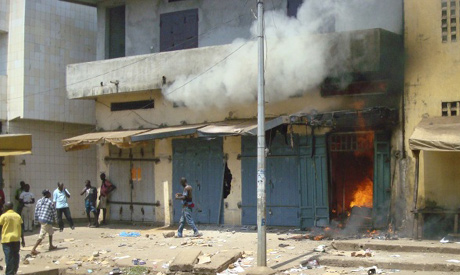
Ethnic clashes in Guinea leave dozens wounded

Rival gangs set a store alight in Conakry, Guinea

Dozens of people were wounded Monday in ethnic clashes in the west African state of Guinea, officials told AFP, after petrol station guards killed a youth from a rival tribe.

A police source said the violence broke out in the southern forest region when the guards from the Guerze tribe accused the youth, an ethnic Konianke, of stealing before torturing and beating him.

The victim’s family told their fellow Konianke tribespeople who “rose up against these medieval practices” in the town of Koule, the source said.

The violence spread to the nearby provincial capital N’Zerekore, 570 kilometres (350 miles) southeast of Conakry, leaving dozens injured and several homes destroyed.

Security forces deployed to break up the fighting had been unable to restore calm in N’Zerekore by the afternoon, witnesses told AFP, while the police source said there were “dozens wounded by machetes”.

“The two communities are now fighting with machetes, axes, sticks and stones. I cannot say the exact number of casualties in the districts or even the number in hospital. The situation is extremely serious,” he added.

“Since the clashes broke out in Koule overnight and moved to N’Zerekore, we have registered one death and at least 50 injured, 20 in Koule and 30 in N’Zerekore,” a hospital source told AFP.

Communal violence is common in the region, near the border with Liberia, where clashes between the two tribes regularly break out over religious and other grievances. The indigenous Guerze are mostly Christian or animist, while the Koniankes — seen as newcomers — are Muslims considered to be close to Liberia’s Mandingo ethnic community.

In Liberia’s civil war, which ended in 2003, rebels fighting the forces of then president Charles Taylor drew much of their support from the Mandingo community.

The Guerze, known as Kpelle in Liberia, were generally considered to be supporters of forces loyal to Taylor, who was jailed last year for “aiding and abetting” war crimes in neighbouring Sierra Leone. – AFP