PVV leader Geert Wilders’ anti-refugee, anti-Islam comments have caused many ruffled feathers in the immigration debate in the Tweede Kamer, lower house of the Dutch parliament, this week.
According to the PVV leader, the refugees are safe enough in the refugee camps in their own regions.
The only ones coming to northwest-Europe are “economic refugees”, NU reports. He spoke of an “Islamic invasion” of “men with beards” flooding into Europe.
Wilders insisted on closing the borders and abandoning the Schengen Treaty. He closed his speech with a statement to Prime Minister Mark Rutte: “Stop building refugee centers. Stand up for your own people, your own culture.”
During his speech Wilders had used phrases such as ‘Islamic asylum tsunami’ and described refugees as ‘testosterone bombs’ who ‘threaten our girls’.
Prime minister Rutte launched a strong attack on Wilders.
Rutte said on Thursday such terminology is ‘terrible’ and failed to make any contribution to finding a solution.
While agreeing with Wilders that some councils had not properly consulted their residents about the arrival of refugee centres, the prime minister said he had ‘very great faith’ in the Dutch people.
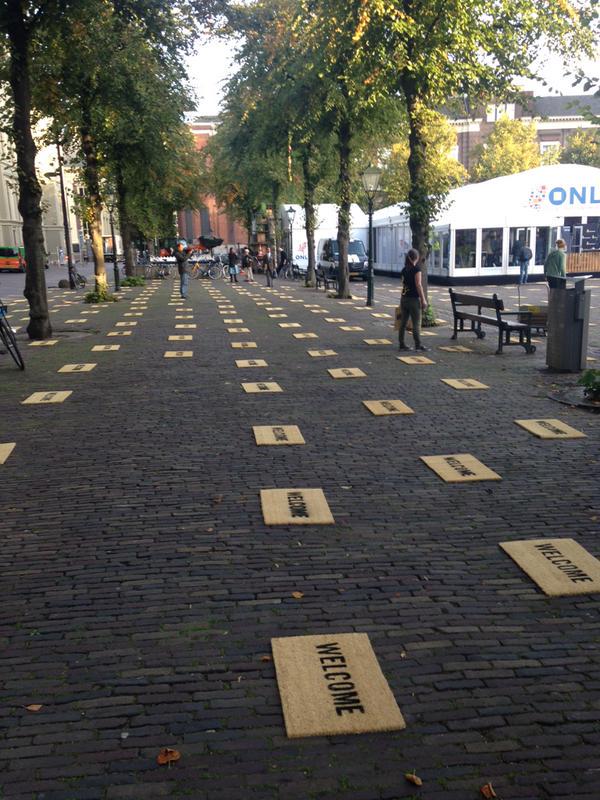
In support of Rutte, Amnesty International placed hundreds of welcome mats on the Plein in The Hague on Thursday morning. This is a call on Prime Minister Mark Rutte to be more welcoming to refugees.
A French lawyer said on Friday that he had filed a complaint on behalf of the Palestinian justice minister at the International Criminal Court (ICC), accusing Israel’s military of having carried out “war crimes” in the Gaza Strip.
More than 800 Palestinians have been killed in Israel’s offensive in Gaza, launched on July 8 in response to Hamas militants firing rockets into the Jewish state.
The complaint targets “war crimes committed by the Israeli army in June and July 2014 in Palestine” in the context of the operation known as Protective Edge, Gilles Devers told reporters.
“Israel, the occupying power, is carrying out a military operation which in principle and form violates the basis of international law,” he said. “Every day new crimes are committed and over 80 percent of the victims are civilians. Children, women, hospitals, UN schools… the Israeli soldiers respect nothing.
“This is a military attack against the Palestinian population.”
The Israeli offensive has left more than 5,200 Palestinians injured, according to emergency services in Gaza, and 33 Israeli soldiers and two civilians have died, too.
The Palestinian Authority, which has non-member observer state status at the United Nations, has not yet signed up to the Hague-based ICC, due to what Devers said were “political” quarrels over the Palestinians’ status.
But according to Devers, the complaint is still valid.
The UN Human Rights Council is launching a probe into Israel’s offensive in Gaza, with rights chief Navi Pillay saying the Jewish state’s military actions could amount to war crimes.
Palestinian Foreign Minister Riad al-Malki said there was clear evidence of war crimes by Israel during its offensive in Gaza as he met International Criminal Court prosecutors on Tuesday to push for an investigation.
Malki visited The Hague shortly after Israel and the Palestinian Islamist Hamas movement that dominates Gaza entered a 72-hour truce mediated by Egypt in an effort to secure an extended ceasefire.
Last week, the United Nations launched an inquiry into human rights violations and crimes alleged to have been committed by Israel during its offensive, given the far higher toll of civilian deaths and destruction on the Palestinian side.
“Everything that has happened in the last 28 days is clear evidence of war crimes committed by Israel, amounting to crimes against humanity,” Malki said. “There is no difficulty for us to show or build the case. Evidence is there for people to see and collect. Israel is in clear violation of international law.”
As neither Israel nor the Palestinians are ICC members, the court lacks jurisdiction over Gaza. This could be granted by a U.N. Security Council resolution, but Israel’s main ally, the United States, would probably veto any such proposal.
Malki told reporters that the Palestinian Authority (PA) wanted to give the ICC jurisdiction to investigate alleged crimes by both sides in the Gaza conflagration and that he had discussed a timeline with prosecutors to join the court.
Unless the Palestinians do so, no investigation is possible.
Malki said the PA’s current status at the United Nations, upgraded to “non-member state” from “entity” by a vote of the General Assembly in 2012, qualified it to become an ICC member and a decision on whether to apply could happen “very soon”.
But he pointed to possible complications by saying this could go ahead only with the cooperation of Hamas, which is shunned by the West as a designated terrorist group and is a strong political rival of the Western-backed PA, which governs only in parts of the West Bank not occupied by Israel.
By joining the court, the Palestinian territories would automatically open themselves up to war crimes both committed by adversaries and by themselves within their borders.
“We want really to be assured that if we undertake that decision (for ICC membership), then all Palestinian factions adhere to that decision and know in advance its consequences and ramifications,” Malki said.
“If it (includes) action committed by Palestinian groups (against Israelis), then we are ready to accept that. But nothing compares to the atrocities, the carnage, committed by Israel,” he added, accusing Israel of destroying schools, hospitals and water grids in Gaza during its incursion.
African leaders will debate the continent’s “relationship” with the International Criminal Court at a special summit on October 11, officials said Friday, amid growing opposition to the tribunal.
The 54-member African Union has accused The Hague-based ICC of singling out Africans for prosecution and has previously called for the court to drop crimes against humanity trials of Kenya’s leadership.
“They will discuss African relationship with ICC,” the deputy head of the AU’s executive branch, Erastus Mwencha, himself a Kenyan, told AFP.
Diplomats say member states of the court, which was founded primarily to try genocide, war crimes and crimes against humanity, are expected to discuss a possible united pullout from the ICC.
African countries account for 34 of the 122 parties to have ratified the Rome Statute, the court’s founding treaty, which took effect on July 1, 2002.
Mwencha said the cases of Kenyan President Uhuru Kenyatta and his deputy William Ruto were not specifically earmarked for discussion, saying only that the “agenda is very broad.”
Kenyatta and Ruto, as well as former radio boss Joshua Arap Sang, face crimes against humanity charges for their alleged roles in orchestrating ethnic violence after disputed 2007 elections. The violence left at least 1 100 dead and more than 600 000 homeless.
Last month, Kenyan lawmakers voted on a motion to withdraw recognition of the court’s jurisdiction.
Any move by the AU to leave the ICC’s Rome Statute will have no effect on the current trials, and pulling out is a lengthy process that must be done by nations on an individual basis.
The pan-African bloc in May accused the ICC of “hunting” Africans, and has requested that the cases against Kenyatta and Ruto be transferred to Kenya.
The trial of Ruto and Sang is already under way, and Kenyatta’s trial is set to begin in November. The three have pledged their cooperation with the court and maintain their innocence.
The ICC maintains that it is not targeting Africa as a continent, pointing out that many of the cases under investigation in Africa were referred to the court by the countries themselves.
It could lead to a breakdown in relations between the court and African leaders. Tensions between the African Union (AU) and the court (ICC) are nothing new, but the meeting in Addis Ababa, the Ethiopean capital, has the potential to irretrievably damage relations between them.
“The Kenyans were criss-crossing Africa in search of support for their cause even before their parliament voted to withdraw from the ICC,” said one AU diplomat. “A complete walkout by signatories is certainly a possibility – but other requests are also possible.”
Ruto and Kenyatta have been seen as stalwarts in the fight against Islamic extremism and have argued that their absence for months on end, particularly in the case of Mr Kenyatta, is not just dangerous but also untenable.
It is not just Kenya that is promoting the anti-ICC agenda and pointing out that all eight cases it is investigating are in Africa.
Sudanese president Omar al-Bashir, wanted for genocide and crimes against humanity in Darfur, visited Kenya last month but was not arrested, despite an ICC request. He says the charges are “exaggerated” and describes the ICC as part of a “western plot” against him.
Last week, Ivory Coast’s government decided not to transfer former first lady Simone Gbagbo to join her husband in The Hague on charges of crimes against humanity in connection with the 2010 presidential election, and said it would try her at home.
Rwanda’s ambassador to the African Union, Joseph Nsengimana, observed: “It is not only the case of Kenya. We have seen international justice become more and more a political matter.”
President Jacob Zuma said it was the impression that the ICC was being “unreasonable” – that led directly to the Addis Ababa summit on October 13th.
Countries that support the court and its work, notably Botswana, are likely to do so again. Those who oppose it are hoping it will be “a game-changer”, most immediately perhaps in the case against Mr Kenyatta. – Sapa/AFP/Irish Times
Ivory Coast said Friday it would not transfer former first lady Simone Gbagbo to the International Criminal Court in the Hague, but would try her at home instead.
The decision came 18 months after the ICC issued a warrant for her arrest over suspected crimes against humanity, charges which her husband and former president Laurent Gbagbo is also facing.
Ivory Coast’s cabinet decided to file a “motion to dismiss” the warrant. Her husband also awaits trial in The Hague over months of deadly violence that followed 2010 polls.
“The decision of the cabinet aims to have Mrs Gbagbo brought to trial… by Ivorian courts whose good reputation has been restored and which can hold a fair trial that will guarantee the rights of the defence,” said a government statement.
The government will inform the ICC of its decision shortly, the statement added.
Ivory Coast turned over Laurent Gbagbo to the ICC in late 2011 but now seems inclined to try other suspects in the 2010-11 unrest under its own jurisdiction.
“If we had the slightest doubt about the fairness of the Ivorian legal system, we would have extradited her to the Netherlands,” government spokesman Bruno Kone told AFP.
The former president’s Ivorian Popular Front (FPI) party welcomed the decision, expressing hope that it was “made with the sole aim of delivering… justice that is to the benefit of all.”
But the former first lady’s lawyer, Habiba Toure, expressed concerns about her client’s “arbitrary and unjustified detention.”
The lawyer said Simone Gbagbo was suffering from “serious health problems” and could not be treated properly under detention.
Simone Gbagbo was detained at Odienne in the country’s northwest after the post-election crisis caused by her husband’s refusal to acknowledge his defeat in the November 2010 presidential elections.
The post-poll violence left around 3,000 people dead in the west African country, which is the world’s number one cocoa producer.
The former first lady, who was born in 1949, is also under investigation for suspected genocide, harming state security and white-collar crimes.
Last month, an Abidjan court released on bail 14 close aides to Gbagbo, including his son Michel.
Gbagbo’s supporters accuse President Alassane Ouattara, the winner of the 2010 election, of carrying out “victor’s justice” as no one from his own camp has had to face prosecution.
Ivory Coast has become the second African country to refuse to cooperate with the ICC in just two weeks.
Kenyan lawmakers backed a motion on September 6 to pull out of the ICC, just ahead of the trial of Vice President William Ruto at the world court.
Ruto is on trial on three counts of crimes against humanity. He is accused of having organised 2007-2008 post-election unrest that killed at least 1,100 people and forced more than 600,000 people to flee their homes. – AFP
Kenyan Vice-President William Ruto left Nairobi to fly to The Hague Monday, a day before the start of his crimes against humanity trial at the International Criminal Court.
Ruto, 46, charged with masterminding deadly post-election violence five years ago, is the most senior politician to date to face ICC judges, and his trial will start just days after Kenyan MPs voted to abandon the court in a world first.
He waved to the small crowd at the airport as he left, but made no comment.
Ruto is accused by the ICC of masterminding some of the 2007-2008 post-election unrest that left at least 1,100 dead and more than 600,000 homeless.
Fellow accused Joshua arap Sang, a radio boss accused of inciting and helping coordinate attacks during the violence, is already in The Hague, after flying there over the weekend.
Both will plead not guilty.
On Sunday, Ruto prayed in church alongside President Uhuru Kenyatta, also accused of organising a campaign of murder, rape, persecution and deportation, whose ICC trial begins on November 12.
However, Kenyatta on Sunday said that he will not allow both leaders to be away from Kenya at the same time.
“We will work with ICC, and we have always promised to do this,” Kenyatta told a rally of supporters. “But it must understand that Kenya has a constitution, and Ruto and myself won’t be away at the same time.”
Kenyatta, who will also plead not guilty, said the “charges are false and will be dismissed”.
“The plotters of this scheme will be named and shamed. The victory won’t be Ruto’s, Sang’s or mine, but for Kenya,” he said to cheering crowds.
Kenya’s 2007 elections were marred by allegations of vote rigging, but what began as political riots quickly spiralled into a wave of ethnic killings and reprisal attacks, the worst violence in the country since independence in 1963.
A bid to reconcile hardened enemies in Ivory Coast has all but broken down, according to participants and observers, and time is running out for a commission set up to heal the wounds of bitter strife.
More than two years after a political and military crisis that claimed at least 3,000 lives in the west African country in the wake of disputed elections, statements by rival sides reveal their deep differences.
Yet the word “reconciliation” is still on many lips in political circles. Supporters of President Alassane Ouattara make it an article of faith. So do members of the opposition Ivorian Popular Front (FPI) of former president Laurent Gbagbo, who triggered the crisis by refusing to accept defeat at the polls in November 2010.
In an early July tour of the cocoa-rich north, his electoral stronghold, Ouattara urged the FPI to “ask pardon of the victims” of the bloodshed, which lasted from December 2010 to April 2011 in a country already weakened by civil war and partition.
The FPI this week curtly rejected the call to “repent”. Many in the party still consider Gbagbo their champion, though he is detained by the International Criminal Court in The Hague facing charges of crimes against humanity. His supporters argue that Ouattara’s side was to blame for the post-electoral violence.
Created by Ouattara in September 2011, a national Dialogue, Truth and Reconciliation Commission (CDVR) with a two-year mandate has endeavoured to resolve differences and has joined in the debate.
“In what happened to Ivory Coast, the wrongs are shared,” said the commission chairman, former prime minister Charles Konan Banny, closing a forum last week on the “profound causes” of a decade of hostilities.
“It’s up to all those who committed violations of human rights to acknowledge them and make an act of repentance,” he added, but the commission has less than three months to complete an enormous task.
Banny has indicated that he might ask for an extension of the commission’s mandate. “A time limit (is) not the best” of solutions, he told AFP, suggesting that two years are not enough for the work to be done.
Asked whether he would take up his post again if the mandate is prolonged, Banny evades the question. In political circles, many are speculating that the ex-premier might want to take up another challenge: the presidential election of 2015.
According to these observers, Banny may try to take control of his political party, the once all-powerful Democratic Party of Ivory Coast (PDCI), which has now become the main ally of Ouattara’s Rally of Republicans (RDR). The PDCI’s leading bodies are due for renewal in October.
‘A great national catharsis’
Now that the reconciliation commission is nearing the end of its mandate, politicians, diplomats, observers and non-governmental organisations are taking stock of its record, often with great severity.
“The CDVR is at a dead end,” says Rene Legre Hokou, the chairman of the Ivorian League of Human Rights, (LIDHO), arguing that the panel has kept a low profile and shown few concrete results.
The commission has for months promised public hearings across the country in which the “executioners” would directly confront their “victims”, but they have yet to begin. Many Ivorians eagerly await what Banny has termed a “great national catharsis”.
Under fire from its critics, some members of the panel complain of a lack of sufficient financial resources and also argue that their task is being complicated by political and legal interference.
In the most recent episode they cite, 84 people who were part of Gbagbo’s regime or close to it, including former first lady Simone Gbagbo, have been summoned before an assize court to answer for their suspected roles in the crisis of 2010-2011. However, the date for the hearing has not yet been set.
While for Ouattara, there can be no reconciliation without justice, Gbagbo supporters see the latest move by the judiciary as a new illustration of “conqueror’s justice”. Ivorian prosecutors have so far taken no steps to deal with serious crimes blamed on pro-Ouattara forces during the crisis.
Scant grounds exist for a resumption of talks between the government and the opposition FPI, which have been stalled for months. Yet such dialogue is essential to pave the way for the presidential election in two years’ time, with Ouattara already a candidate.
CDVR member Simeon Ahouana, the bishop of the central town of Bouake -long the stronghold of rebels involved in a 2002 coup bid against Gbagbo – has annnounced that he has “concerns” about the forthcoming poll.
LIDHO’s chairman Hokou is more blunt. In his eyes, if there is no progress in reconciliation by 2015, “we must fear that we’ll fall back into even worse violence”. – AFP
Sierra Leone rebels depended on Charles Taylor’s logistics to kill, rape and mutilate thousands during the west African nation’s savage civil war, prosecutors said Wednesday at the end of the Liberian ex-president’s appeal.
The Revolutionary United Front “relied on Taylor’s logistical assistance”, Nicholas Koumjian told the west African nation’s UN-backed special court, where the former warlord is appealing a 50-year prison sentence.
“Without this support, thousands would not have been killed, would not have been amputated, would not have been taken as sex slaves,” he told the second and final day of the appeals hearing at the court’s headquarters in Leidschendam just outside The Hague.
Dressed in a grey suit, white shirt and dark tie, with rimless round glasses perched on his nose, Taylor frowned often as he listened intently to the prosecution’s arguments.
The former strongman who was given an opportunity to address judges at the end of the hearing and told the Special Court for Sierra Leone (SCSL) that he was “very appreciative of the handling of the proceedings so far”.
“I have the belief that the right thing will be done with the grace of Almighty God,” said Taylor, who once famously compared himself to Jesus.
The SCSL in April last year convicted Taylor, 64, of aiding and abetting the RUF and its allies who waged a terror campaign during a civil war that claimed 120,000 lives between 1991 and 2001.
His sentence in May for “some of the most heinous crimes in human history” was widely welcomed around the world and was the first handed down by an international court against a former head of state since the Nazi trials at Nuremberg in 1946.
As neighbouring Liberia’s president from 1997 to 2003, Taylor gave rebels guns and ammunition in their fight against Freetown during the conflict, know for its mutilations, drugged child soldiers and sex slaves, trial judges found.
In return, Taylor was paid in “blood diamonds” mined by slave labour in areas kept under the countrol of ruthless Sierra Leonean rebels.
Taylor’s defence again argued on Wednesday that there was no evidence linking him to crimes committed by Sierra Leone’s brutal rebel forces, nor did he provide logistics, guns and ammunition.
“There was no support from Charles Taylor,” said one of his lawyers, Christopher Gosnell.
The defence has argued that trial judges made legal mistakes in their findings against Taylor and are asking appeals judges to reverse the conviction and quash the sentence.
Prosecutors argued Taylor’s sentence was too light and asked, on appeal, for 80 years, with Koumjian telling judges: “Charles Taylor knew about these crimes.”
“He knew what was happening and how the RUF operated.”
Taylor’s trial, which ended in March 2011, saw a number of high-profile witnesses testify including British supermodel Naomi Campbell, who told the court she received a gift of “dirty diamonds”, said to be from the flamboyant Taylor.
Appeals judges are expected to have a decision by September at the earliest, with the Liberian ex-president remaining behind bars at the UN’s detention unit in The Hague until appeals proceedings are finalised.
If his appeal fails, Taylor will serve his sentence in a British jail.
The International Criminal Court’s first convict, Congolese warlord Thomas Lubanga, on Wednesday appealed his 14-year sentence for using children in his rebel army, his lawyers said.
Former militia commander Lubanga, 51, was sentenced in July for his part in a war in the eastern Democratic Republic of Congo, where aid groups say 60,000 people have been killed in conflicts since 1999.
“The defence gives notice of appeal and asks for an acquittal,” Lubanga’s lawyers said in a document filed with The Hague-based court.
He was convicted in March of war crimes in the central African country, specifically for enlisting and using child soldiers in 2002-03, in what was the ICC’s first verdict since starting work a decade ago.
Lubanga, who has been detained in The Hague since 2006, is the founder of the Union of Congolese Patriots (UPC) and commander of its military wing the Patriotic Forces for the Liberation of Congo (FPLC).
He has pleaded not guilty to two counts of war crimes.
The ICC, the world’s only independent permanent tribunal to try genocide, war crimes and crimes against humanity has issued four arrest warrants for crimes in DR Congo since starting work in 2003.
Two militia leaders, Germain Katanga, 34 and Mathieu Ngudjolo Chui, 41, who fought against Lubanga, are currently facing trial on similar charges.
Former UPC leader Bosco Ntaganda, a Lubanga ally, is yet to be arrested to face the ICC on war crimes charges.
The ICC is investigating seven cases, all based in Africa. – AFP
This website uses cookies to improve your experience. We'll assume you're ok with this, but you can opt-out if you wish. Cookie settingsACCEPT
Privacy & Cookies Policy
Privacy Overview
This website uses cookies to improve your experience while you navigate through the website. Out of these cookies, the cookies that are categorized as necessary are stored on your browser as they are essential for the working of basic functionalities of the website. We also use third-party cookies that help us analyze and understand how you use this website. These cookies will be stored in your browser only with your consent. You also have the option to opt-out of these cookies. But opting out of some of these cookies may have an effect on your browsing experience.
Necessary cookies are absolutely essential for the website to function properly. This category only includes cookies that ensures basic functionalities and security features of the website. These cookies do not store any personal information.
Any cookies that may not be particularly necessary for the website to function and is used specifically to collect user personal data via analytics, ads, other embedded contents are termed as non-necessary cookies. It is mandatory to procure user consent prior to running these cookies on your website.