SACP denies mounting attack on judiciary

A summit should be held to discuss the country’s judiciary in the light of recent court judgments involving the executive, SA Communist Party secretary Blade Nzimande told delegates at the party’s special national congress on Wednesday.

”We are not attacking the judiciary, but are saying there has been a deliberate overreach by the judiciary. It can’t be the mandate of the judiciary to rule on matters of the executive…it is against the spirit of the separation of powers,” said Nzimande.

”As the SACP we are going convene a summit on the judiciary and the issue of separation of powers, because we want to open a debate and not attack… we’ve been told we are attacking the judiciary whenever we raise this issue,” he said.

Nzimande added that the SACP was not friends with Sudanese president Omar Al-Bashir, but agreed with government’s decision to not arrest him when he was in South Africa for the 25th African Union summit in Johannesburg in June.

”We are not friends with Bashir, he has committed serious atrocities…but South Africa is not a colony. This issue was a direct attack on our national sovereignty,” he explained. “Government was correct to not arrest Bashir.”

Bashir has been indicted by the ICC for war crimes, crimes against humanity, and genocide against some of the tribes of Sudan’s western Darfur region. Two warrants of arrest were issued against him in 2009 and 2010.

Source: ANA

ANC to review ICC participation

The minister in the Presidency Jeff Radebe has announced that South Africa will review its participation in the International Criminal Court.

Small business development minister, Lindiwe Zulu, said during a parliamentary debate “Africa’s newest state‚ the Republic of South Sudan‚ would not be in existence today had the parties placed the issue of justice above all others.

“This does not mean that there is no role for justice for victims of conflicts. It means that recognising the complexities inherent in conflict resolution‚ it is best to address the question of justice in the context of a political settlement.”

The main thrust of her argument was that Africa required a special political dispensation.

“It should therefore be noted that‚ our efforts for the renewal of the continent will remain void if the fundamentals elements which include peace and stability are not realised. Peace and stability is therefore an important ingredient for development,” she said.

When the speaker called time on her, she concluded that South Africa would not allow the prosecution of a sitting head of state.

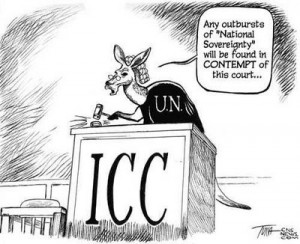
The consensus reached between the ANC and EFF is that the International Criminal Court has an anti-African bias, that it is tool of western powers to undermine “the weak” as Mantashe’s stated.

The largest bloc of countries consists of 34 African states, followed by 27 Latin American and Caribbean States. There are 19 from the Asia-Pacific region and 18 from eastern Europe. A further 25 come from western Europe and elsewhere.

Under the ICC’s Rome Statute terms‚ heads of state do not enjoy immunity.

Radebe said SA has to balance its obligations to the ICC with its obligations to the AU and individual states. In addition‚ he asserted‚ the ICC must have been aware that SA‚ in execution of the warrant‚ would breach its agreement with the AU.

President Jacob Zuma’s government is facing the risk of criminal charges over its handling of Al Bashir’s departure from the country last week.

Pretoria High Court Judge Dunstan Mlambo yesterday said the departure of the Sudanese president – who is wanted for war crimes – despite a court ruling barring him from leaving pending a decision on whether to execute a warrant of arrest against him‚ demonstrated the state’s disregard for the order.

The judge issued a grave warning‚ stating: “If the state or an organ of state‚ or state officials don’t abide by court orders‚ the democratic edifice will crumble stone by stone until it collapses and chaos ensues”.

Ban Ki Moon hints UN may halt ICC cases

Ban Ki-moon
Ban Ki-moon

The United Nations has sent a signal of giving in to pressure by the African Union to stop the cases Kenyan leaders are facing at the International Criminal Court (ICC), The People has reliably learnt. This came about as it emerged that UN Secretary General Ban Ki Moon personally called all the African Heads of State attending the AU extra-ordinally summit in Addis Ababa on Saturday, to prevail upon them not to pass a resolution to withdraw from the Rome Statute, promising each that he would push for dialogue at the Security Council over their demand. The mood at the AU African hall in Addis on Friday and Saturday had been for en masse withdrawal of African member states from the Rome Statute.

However, high ranking diplomats and AU officials told The People in Addis Ababa yesterday that the tone changed to giving the Security Council and ICC until November 12, 2013 to make a ruling on the Kenyan cases, after Moon made his high level lobbying. Withdrawal by Africa which has 34 member states in the Rome Statute could deal a fatal blow to the ICC. One AU official said Moon made a promise that he would raise the African grievances with United Nations Security Council. The Security Council meeting is scheduled to be held in November with the main agenda being the threat posed by the African states to pull out. Previously the Security Council has largely brushed off the call to cause the ICC to halt the Kenyan cases, but AU sources said the tone is highly bound to change, following the ultimatum.

“Moon called each of the attending Heads of State pleading with each not to endorse the resolution to pull out of the Rome Statute and promising to have their grievances addressed,” said a top source who did not wish to be named as he is not authorisied to speak for AU. The Heads of States and government appeared to have heeded Moon’s plea as the agenda to pull out was put on hold until after another summit scheduled to be held in late November, that will assess the response to the ultimatum. The summit, to be held in Addis Ababa, will have the sole agenda of discussing the next course of action should the Security Council fail to address the issues raised during the weekend. Reports from Addis claimed the UN Secretary General did not call the Sudanese President Omar El Bashir, who has an ICC arrest warrant issued in 2009. Yesterday, Sudan expressed its frustration with the failure by the African Union Summit to withdraw from the Rome Statute.

The summit meeting which ended on Saturday agreed on a resolution stating that no sitting African Head of State should appear before an international court until they leave office. Members states made it clear that should their concerns be ignored, total withdrawal will not be negotiated. Sudan formally complained over the stand taken at the AU summit with her Foreign Minister Ali Karti stating, “The AU summit decision did not meet our aspirations of withdrawing from this neo-colonialism tool, but it’s a positive step in the right direction.” “The summit has delegated to demand the ICC to freeze the arrest warrant against President Omar Bashir, but we have nothing to do with this appeal to the ICC by the African leaders, because our declared stance is not to cooperate with the ICC and not to deal with it,” the minister said. “The absence of the signatories from the meetings has weakened the movement towards the withdrawal,” he added. Sources said there were three proposals on the table for the Heads of State Summit, namely; Withdrawal from the Rome Statute; deferral or stoppage of the Kenyan cases; a push to reform the ICC.

There has been a hue and cry among the AU leaders that the court has not been fair to the African continent. Indeed, no person less than the President of the Assembly of State Parties to the Rome Statute, Ambassador Tiina Intelmann, acknowledged that the ICC should constantly review its engagements. While calling for a regular session of the 122 state parties to be held next month at The Hague, Ms Intelmann admitted the court has faced several challenges discharging its duties of rooting out impunity. She said several state parties had expressed their wish to address issues of concern with fellow member states. The Rome Statute was created to avert any mass slaughter of human beings by any regime. Its overall aim is to rid the world of atrocious massacre of people like the Nazi Holocaust, the Rwanda genocide, the killings in Sierra Leone, the DR Congo, Liberia, Sudan and lately in Kenya after the disputed 2007 presidential election.

The ICC is also a court of last resort, that takes up cases when local mechanisms fail to provide justice for victims of mass killings and other atrocities. The pullout debate is expected to take a new dimension after a member of Parliament yesterday vowed to introduce a motion seeking a local resolution to postpone the trial until Uhuru and Ruto serve their term. Kasarani MP John Njoroge opposed the prosecution of the two leaders in a foreign country, saying it ridicules Kenyans who elected them in a competitive and democratic election. The legislator pointed out the requirement to have them physically present at The Hague could distract the Jubilee from their effective management of national affairs.

“They must be allowed to lead the country in the consolidation of peace, reconciliation, reconstruction, democracy and development as per the will of the Kenyan people, expressed in elections in March this year,” said the MP.  “The passage of the motion that I intend to file in Parliament this week will make it official that no sitting president or vice president should ever be charged or tried at The Hague based court,” he said The MP who spoke after attending a fund-raiser to complete the construction of St Francis Catholic Church in Kasarani called on leaders from Cord to support his cause to maintain the dignity of the country. – The People

Kenya pushing for AU-split from ICC

iccAfrican leaders will debate the continent’s “relationship” with the International Criminal Court at a special summit on October 11, officials said Friday, amid growing opposition to the tribunal.

The 54-member African Union has accused The Hague-based ICC of singling out Africans for prosecution and has previously called for the court to drop crimes against humanity trials of Kenya’s leadership.

“They will discuss African relationship with ICC,” the deputy head of the AU’s executive branch, Erastus Mwencha, himself a Kenyan, told AFP.

Diplomats say member states of the court, which was founded primarily to try genocide, war crimes and crimes against humanity, are expected to discuss a possible united pullout from the ICC.

African countries account for 34 of the 122 parties to have ratified the Rome Statute, the court’s founding treaty, which took effect on July 1, 2002.

Mwencha said the cases of Kenyan President Uhuru Kenyatta and his deputy William Ruto were not specifically earmarked for discussion, saying only that the “agenda is very broad.”

Kenyatta and Ruto, as well as former radio boss Joshua Arap Sang, face crimes against humanity charges for their alleged roles in orchestrating ethnic violence after disputed 2007 elections. The violence left at least 1 100 dead and more than 600 000 homeless.

Last month, Kenyan lawmakers voted on a motion to withdraw recognition of the court’s jurisdiction.

Any move by the AU to leave the ICC’s Rome Statute will have no effect on the current trials, and pulling out is a lengthy process that must be done by nations on an individual basis.

The pan-African bloc in May accused the ICC of “hunting” Africans, and has requested that the cases against Kenyatta and Ruto be transferred to Kenya.

The trial of Ruto and Sang is already under way, and Kenyatta’s trial is set to begin in November. The three have pledged their cooperation with the court and maintain their innocence.

The ICC maintains that it is not targeting Africa as a continent, pointing out that many of the cases under investigation in Africa were referred to the court by the countries themselves.

It could lead to a breakdown in relations between the court and African leaders. Tensions between the African Union (AU) and the court (ICC) are nothing new, but the meeting in Addis Ababa, the Ethiopean capital, has the potential to irretrievably damage relations between them.


“The Kenyans were criss-crossing Africa in search of support for their cause even before their parliament voted to withdraw from the ICC,” said one AU diplomat. “A complete walkout by signatories is certainly a possibility – but other requests are also possible.”

Ruto and Kenyatta have been seen as stalwarts in the fight against Islamic extremism and have argued that their absence for months on end, particularly in the case of Mr Kenyatta, is not just dangerous but also untenable.

It is not just Kenya that is promoting the anti-ICC agenda and pointing out that all eight cases it is investigating are in Africa.

Sudanese president Omar al-Bashir, wanted for genocide and crimes against humanity in Darfur, visited Kenya last month but was not arrested, despite an ICC request. He says the charges are “exaggerated” and describes the ICC as part of a “western plot” against him.

Last week, Ivory Coast’s government decided not to transfer former first lady Simone Gbagbo to join her husband in The Hague on charges of crimes against humanity in connection with the 2010 presidential election, and said it would try her at home.

Rwanda’s ambassador to the African Union, Joseph Nsengimana, observed: “It is not only the case of Kenya. We have seen international justice become more and more a political matter.”

President Jacob Zuma said it was the impression that the ICC was being “unreasonable” – that led directly to the Addis Ababa summit on October 13th.

Countries that support the court and its work, notably Botswana, are likely to do so again. Those who oppose it are hoping it will be “a game-changer”, most immediately perhaps in the case against Mr Kenyatta. – Sapa/AFP/Irish Times