SACP denies mounting attack on judiciary

A summit should be held to discuss the country’s judiciary in the light of recent court judgments involving the executive, SA Communist Party secretary Blade Nzimande told delegates at the party’s special national congress on Wednesday.

”We are not attacking the judiciary, but are saying there has been a deliberate overreach by the judiciary. It can’t be the mandate of the judiciary to rule on matters of the executive…it is against the spirit of the separation of powers,” said Nzimande.

”As the SACP we are going convene a summit on the judiciary and the issue of separation of powers, because we want to open a debate and not attack… we’ve been told we are attacking the judiciary whenever we raise this issue,” he said.

Nzimande added that the SACP was not friends with Sudanese president Omar Al-Bashir, but agreed with government’s decision to not arrest him when he was in South Africa for the 25th African Union summit in Johannesburg in June.

”We are not friends with Bashir, he has committed serious atrocities…but South Africa is not a colony. This issue was a direct attack on our national sovereignty,” he explained. “Government was correct to not arrest Bashir.”

Bashir has been indicted by the ICC for war crimes, crimes against humanity, and genocide against some of the tribes of Sudan’s western Darfur region. Two warrants of arrest were issued against him in 2009 and 2010.

Source: ANA

ANC to appeal Bashir ruling

The government is to appeal the North Gauteng High Court’s judgment relating to Sudanese President Omar Al-Bashir.

A statement released by the government’s communications department on Monday said the reasons for the appeal would be stated in the affidavit.

Bashir left the country while the ruling was being made by the court on whether or not he should be detained under an International Criminal Court indictment for war crimes in Darfur.

In leaving the country, Bashir violated of an interim court interdict ordering him to stay.

The government’s affidavit stated that the reason Bashir left the country was that his passport had not been handed in at immigration control at the Waterkloof Air Force Base.

The court has asked the National Prosecuting Authority to investigate the possibility of pursuing criminal charges against the government for its role in allowing him to leave.

Source: eNCA

ANC to review ICC participation

The minister in the Presidency Jeff Radebe has announced that South Africa will review its participation in the International Criminal Court.

Small business development minister, Lindiwe Zulu, said during a parliamentary debate “Africa’s newest state‚ the Republic of South Sudan‚ would not be in existence today had the parties placed the issue of justice above all others.

“This does not mean that there is no role for justice for victims of conflicts. It means that recognising the complexities inherent in conflict resolution‚ it is best to address the question of justice in the context of a political settlement.”

The main thrust of her argument was that Africa required a special political dispensation.

“It should therefore be noted that‚ our efforts for the renewal of the continent will remain void if the fundamentals elements which include peace and stability are not realised. Peace and stability is therefore an important ingredient for development,” she said.

When the speaker called time on her, she concluded that South Africa would not allow the prosecution of a sitting head of state.

The consensus reached between the ANC and EFF is that the International Criminal Court has an anti-African bias, that it is tool of western powers to undermine “the weak” as Mantashe’s stated.

The largest bloc of countries consists of 34 African states, followed by 27 Latin American and Caribbean States. There are 19 from the Asia-Pacific region and 18 from eastern Europe. A further 25 come from western Europe and elsewhere.

Under the ICC’s Rome Statute terms‚ heads of state do not enjoy immunity.

Radebe said SA has to balance its obligations to the ICC with its obligations to the AU and individual states. In addition‚ he asserted‚ the ICC must have been aware that SA‚ in execution of the warrant‚ would breach its agreement with the AU.

President Jacob Zuma’s government is facing the risk of criminal charges over its handling of Al Bashir’s departure from the country last week.

Pretoria High Court Judge Dunstan Mlambo yesterday said the departure of the Sudanese president – who is wanted for war crimes – despite a court ruling barring him from leaving pending a decision on whether to execute a warrant of arrest against him‚ demonstrated the state’s disregard for the order.

The judge issued a grave warning‚ stating: “If the state or an organ of state‚ or state officials don’t abide by court orders‚ the democratic edifice will crumble stone by stone until it collapses and chaos ensues”.

Government to present affidavit on Bashir’s departure

Government is expected to present an affidavit to the High Court in Pretoria on Wednesday on why it let Sudanese President Omar al-Bashir leave the country against the interim court order prohibiting his departure.

The court also ruled that al-Bashir should be detained under an International Criminal Court (ICC) indictment on war crime charges.

Government will have to explain why it allowed the Sudanese President to leave the country.

Government earlier said it offered al-Bashir immunity because he was attending an African Union summit in Johannesburg. The ICC in Hague indicted al-Bashir for war crimes in Sudan’s western Darfur in 2003.

The ANC is calling on government to temporarily suspend South Africa’s membership of the International Criminal Court.

It follows controversy over Sudanese president Omar al-Bashir’s recent trip to South Africa.

The ANC has already urged government to work with other African states to protect the ICC from so-called undue influence from non-member states.

The party says the ICC is no longer useful.

Instead, the ANC says the court has allowed itself to be a proxy for powerful non-member states who want to persecute African leaders and effect regime change on the continent.

Opposition MPs said the government had undermined the rule of law it had sworn to protect by helping al-Bashir, who is facing genocide and crimes against humanity in the International Criminal Court, leave South Africa.

The ANC insisted the issue was sub judice.

Said DA MP Stevens Mokgalapa: “The government, under President [Jacob] Zuma, has failed to uphold the constitution, has failed the people of South Africa and those who were murdered and displaced in Darfur.”

DA MP James Selfe asked the government to stop referring to al-Bashir as “his excellency”.

“The only thing he is excellent at is killing people,” said Selfe.

He pointed out that al-Bashir stood accused of a leading role in the genocide of 300000 black Africans.

Several MPs acknowledged that the International Criminal Court is unfairly targeting African leaders.

The Economic Freedom Fighters’ Chief Whip Floyd Shivambu says the court’s prosecution selection process needs to be reviewed.

“We do not agree with the selective prosecution of the ICC for Africans, because it looks like it has only existed for Africans since its establishment.”

“Also it was naive for whoever took the government to court to think that it can be wise to arrest a head of state here in South Africa. It was going to lead to instability in the origin country where he came from, it was going to even threaten our security in South Africa, but also it was going to lead to the undermining of the statute of South Africa in the international context,” Shivambu added.

COPE leader Mosiuoa Lekota said what had been done in the name of South Africa was a serious crime.

The Freedom Front Plus says government has exposed the ANC as a party that does not respect human rights.

“Sir, forget about Fifa. The Al-Bashir crisis makes the Fifa version look like a Sunday school picnic,” Freedom Front Plus leader, Pieter Mulder said.

“No other executive act has ever exposed the ANC as a human rights violator on such a grand scale to the whole world. Ons gaan die prys betaal hiervoor vir baie jare nog.”

SA troops ‘held hostage’ in Sudan

The Sudanese government of president Omar al-Bashir literally held a gun to South Africa’s head to secure his safe return to Khartoum.

Netwerk24 can reveal that about 800 South African soldiers in Darfur were held “hostage” by Sudanese troops when the drama around Al-Bashir’s possible arrest in South Africa escalated.

According to military experts, this effectively means Sudan blackmailed South Africa and the soldiers’ lives served as a guarantee for Al-Bashir’s safe return.

Only after Al-Bashir safely touched down in Khartoum on Monday, were Sudanese troops withdrawn. President Jacob Zuma is the commander-in-chief of the defence force.

“We were so scared – we were surrounded by soldiers. We handed out extra ammunition to all our troops in case they needed it,” said one South African soldier in Sudan on Tuesday.

“I am so thankful that South Africa did not arrest Bashir. The battalion commander said after Bashir touched down safely in Khartoum, all the [Sudanese] troops were withdrawn. The calamity has returned to normal,” reads a message sent by a soldier in Darfur to his friends in South Africa.

About 1 400 South African soldiers are serving in Darfur as part of a combined African Union/United Nations peace mission (Unamid). The current group are from 8 SA Infantry Battalion in Upington.

“Our nerves were shot and we were very relieved when the militants withdrew on Monday evening. We knew we were sitting ducks,” said a South African soldier.

Unamid said it was unaware of the situation.

Israel tells Africans to leave or face prison

Israel is telling black Africans they must leave now or face an indefinite stay in prison.

Israeli authorities are sending letters to the first of 45,000 Eritrean and Sudanese refugees, informing them they have 30 days to accept Israel’s offer of $3,500 in cash and a one-way ticket home or to an unnamed third country in Africa, or face incarceration at Saharonim prison.

Israeli leaders have proclaimed that their tough approach — building a fence along its border, denying work permits for illegal migrants, forcing them into a detention center in the desert — may ultimately save lives by dissuading migrants from attempting a perilous journey. Critics of the Israeli policy counter that a country built by refugees should be more accepting of those fleeing war, poverty and oppression.

But these days, even liberal Europe is considering a more muscular approach. The European Union began a push Monday for U.N. authorization to deploy military force in the Mediterranean to stop migrant smuggling ships.

The new measures to press the Africans to leave Israel comes at a time of heightened fears among the refugees, who were stunned last month by a widely circulated video allegedly showing three Eritreans who left Israel killed by Islamic State militants in Libya. Friends and relatives said they had traveled there in a bid to reach Europe.

“We saw the video, but we thought maybe it wasn’t true, maybe it was just a hoax,” said Aman Beyene, an Eritrean asylum seeker who has spent 14 months at an Israeli detention center.

“Then we spoke to an Eritrean boy who had witnessed the killings, and we knew it was true,” Beyene said.

The 38-year-old Eritrean accountant sat at a picnic table in the dirt parking lot of the Holot detention facility, a compound of single-story cement-block dormitories housing 2,000 Africans, surrounded by a fence spooled with razor wire in the Negev desert.

Beyene spoke slowly as he recalled watching the video showing a man thought to be his friend Tesfay Kidane, 29, dressed in an orange jumpsuit beheaded on a beach in Libya by Muslim extremists. He said Kidane felt despondent being cooped at the Holot facility, so he accepted the Israelis’ offer to be flown to a third country — likely Uganda or Rwanda — and from there made his way to Libya, where he was kidnapped by the Islamic State.

Though the detainees at Holot are free to leave the compound during the day, the nearest city is an hour’s bus ride away and the men are forbidden to work. If they fail to return by nightfall, they are sent to a prison across the street.

Interviews with Eritreans and Sudanese at Holot suggest that many are still dreaming of reaching Europe through the chaos of Libya — despite knowing that more than 1,800 Africans have drowned in the Mediterranean Sea this year and others have been taken captive by the Islamic State.

“Being beheaded by ISIS or sinking on a boat is scary,” said Mutasim Ali, 28, who arrived in Israel in 2009 from the Darfur region in Sudan and has spent the past year detained in the detention center. “But you can’t really stay here, wasting your life, doing nothing.”

He pointed to the men like him who spend their days milling about in circles, staring at their mobile phones, waiting for the next meal.

Before Israel began cracking down on African migrants a few years ago, the Africans were highly visible in bustling cities, working in kitchens and doing menial labor. There are still neighborhoods in south Tel Aviv filled with Africans. Many Israelis complained they were being “invaded.”

Source: Washington Post

Sudan army ready to battle Facebook imposter

sudanSudan’s military spokesman is ready to battle a Facebook imposter who has been making online comments about the country’s armed forces, official media say.

Somebody has been using an account on social networking site Facebook to impersonate army spokesman Sawarmi Khaled Saad, the state SUNA news agency reported late Saturday.

The pretender “makes dialogue with friends on issues including matters related to the work of the armed forces”, SUNA reported.

Saad will “take the necessary measures toward that criminal act”, it added.

“Al-Sawarmi affirmed that he has no account in Facebook and has nothing to do with the comments made by the person (who) impersonates him over the Internet,” SUNA said.

Sudan’s military is battling rebels in the far-west Darfur region as well as in South Kordofan and Blue Nile states, while tensions persist along the border with South Sudan.

Analysts say authorities were humiliated in April and May when insurgents widened their offensive, and the military took one month to retake an area in South Kordofan from the rebels. – AFP

US deploys forces in 18 countries against Muslim anger

Washington said it was deploying forces to cope with violence in as many as 18 different locations as deadly Muslim anger spreads over a US-made movie that mocks Islam.

Two US marines were killed in Afghanistan when insurgents armed with guns and rockets stormed a heavily fortified air base late on Friday in an attack that the Taliban militia said was to avenge the film.

The attack on Camp Bastion in Helmand province, which continued until Saturday morning, was a major security breach at a base where Britain’s Prince Harry is stationed and has been the target of specific death threats.

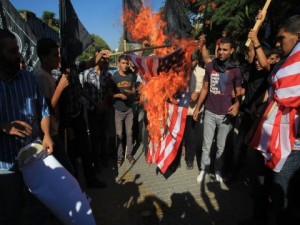
It came after at least six protesters died in Egypt, Tunisia, Lebanon and Sudan on Friday as local police battled to defend American missions from mobs of stone-throwers.

Symbols of US influence in cities across the Muslim world came under attack — embassies and schools as well as fast food chains — as protesters vented their fury at the low-budget American-made YouTube film, “Innocence of Muslims”.

US Defence Secretary Leon Panetta said Washington was configuring its forces to be able to cope with widespread violence following its deployment of Marine counter-terrorism units to Libya and Yemen and its stationing of two destroyers off the North African coast.

“We have to be prepared in the event that these demonstrations get out of control,” Panetta told Foreign Policy magazine.

He did not offer any specifics. But the magazine said that the Pentagon was discussing, but had not yet decided, whether to send a third platoon of 50 specially trained Marines to protect the US embassy in Khartoum.

Guards on the roof of the embassy fired warning shots on Friday as the compound was breached by protesters waving Islamic banners, after earlier ransacking parts of the British and German missions in the Sudanese capital.

The US embassy compounds in Egypt and Yemen have also been breached in the past week, and on Tuesday the US ambassador to Libya, Chris Stevens and three other Americans were killed when a mob torched the consulate in Benghazi.

Panetta said Friday that it was still too early to say exactly what happened in Benghazi where there have been suggestions that Al-Qaeda sympathisers rather than angry Muslim protesters may have been responsible.

“It’s something that’s under assessment and under investigation, to determine just exactly what happened here,” he said.

The assault on the consulate came on the anniversary of the September 11, 2001 attacks in the United States and the head of Libya’s national assembly, Mohammed al-Megaryef, on Friday blamed Al-Qaeda as he laid a bouquet of flowers in front of the devastated mission.

Protests spread across continents

In Friday night’s attack in Afghanistan, the assailants managed to penetrate the air base and damaged several aircraft although military spokesman Major Adam Wojack declined to say what type or how many.

Wojack said 18 insurgents were killed — including a suicide bomber. Prince Harry was never in danger, officials confirmed.

A Taliban spokesman said the attack was to avenge the YouTube movie.

“Last night, a number of mujahedeen fighters have carried out suicide attacks on Camp Bastion of Helmand in revenge for the insulting movie by the Americans,” spokesman Qari Yousuf Ahmadi told AFP by telephone.

Britain’s Ministry of Defence said in June that the massive base, spread over several square kilometres (miles) of desert, is home to more than 28,000 people and the attack raised serious questions about security.

Police in Sydney fired pepper spray to contain protesters trying to enter the building housing the US consulate on Saturday, as Australia became the the latest focus of disturbances.

Bottles, shoes and other objects were hurled during the clashes with police which resulted in eight arrests, with six police officers injured as the unexpected protest brought parts of the city to a standstill.

Shoppers looked on in surprise as protesters, including children, shouted “Down, down USA” and waved banners such as “Behead all those who insult the prophet”.

Hundreds also demonstrated in Indonesia and the Maldives.

In Somalia, the Al-Qaeda-linked Shebab militia, which controls large swathes of the country called on Muslims to launch revenge attacks on Western targets.

“The Shebab mujahedeen are urging people of Somalia to show their love for Islam and particularly to our Prophet Mohammed by making attacks against the West,” Shebab spokesman Ali Mohamud Rage told AFP by telephone.

US President Barack Obama urged Americans not to be disheartened by images of anti-American violence in the Islamic world, expressing confidence that the ideals of freedom America stands for would ultimately prevail.

“I know the images on our televisions are disturbing,” Obama said in his weekly radio and Internet address. “But let us never forget that for every angry mob, there are millions who yearn for the freedom, and dignity, and hope that our flag represents.”

Obama said his administration was doing everything it could to protect Americans serving abroad.

“We are in contact with governments around the globe, to strengthen our cooperation, and underscore that every nation has a responsibility to help us protect our people,” he said. – AFP

Sudan embassy staff safe: German foreign minister

German Foreign Minister Guido Westerwelle said that staff at the country’s embassy in Sudan were safe after the building came under siege by protesters Friday.

“The German embassy in Khartoum is currently the target of attacks by violent demonstrators. The embassy staff are safe. The crisis cell at the foreign ministry (in Berlin) is meeting and is in contact with the embassy,” he said in a statement. – AFP