Murder of elderly couple fuels anti-immigrant sentiment in Italy

Italy’s simmering anti-immigrant sentiment has been stoked by the murder of an elderly couple in their home in Sicily, allegedly by an African asylum seeker.

Mamadou Kamara, an 18-year-old from the Ivory Coast, allegedly slit the throat of Vincenzo Solano, 68, and then attacked his Spanish-born wife, Mercedes Ibanez, 70.

Ms Ibanez fell to her death from a second-floor balcony, during a robbery that turned violent.

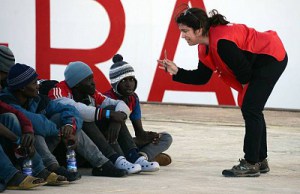
Mr Kamara is one of thousands of migrants and refugees living at a vast reception centre at nearby Mineo, in south-eastern Sicily.

They are accommodated there after arriving by boat from Libya, and wait sometimes for months to have their asylum applications assessed.

The migrants are allowed to come and go freely from the facility, a former US military base where prostitution, links with organised crime and the trade in illicit goods is said to be rife.

Mr Kamara, who was rescued in the Mediterranean on June 8 and brought with other migrants to the port of Catania in Sicily, allegedly broke into the pensioners’ flat in the village of Palagonia, six miles away, and slit the throat of Mr Solano.

The elderly man’s wife was found dead in the courtyard of their three-storey apartment block.

Mr Kamara was arrested after police searched his bag on Sunday as he returned to the migrant centre.
Inside they found a mobile telephone, a laptop computer, a video camera and a pair of trousers, allegedly belonging to Mr Solano, that were covered in blood.

The young African man claimed to have “found” the items, but police arrested him and are expected to charge him with two counts of murder.

Source: The Telegraph

One dead after migrants storm Eurotunnel

At least 1,500 migrants desperate to reach England made new attempts to enter the Eurotunnel terminal overnight in the French port town of Calais, a police source said Wednesday, adding that one person was found dead.

“Our team found a corpse this morning and the firefighters have confirmed the death of this person,” added a spokesman for Eurotunnel.

The migrant, a man of Sudanese origin believed to be aged between 25 and 30, was hit by a truck that was leaving a cross-Channel ferry, the police source said.

The latest fatality brings the number of migrants who died near the Channel Tunnel terminal site to nine since June. It comes a day after some 2,000 migrants were pushed back near the terminal entrance, in the largest single attempt to enter the tunnel linking France to Britain.

Calais, where the French end of the Channel Tunnel is located, has seen an explosion in recent years in the number of migrants, who live mainly in makeshift camps in the port city after fleeing war and poverty from countries including Eritrea, Libya and Syria.

The situation in Calais has been exacerbated by strikes by workers and farmers in the region, causing further disruption at the key port.

British police last week raised their estimate of the number of migrants in Calais to 5,000 from 3,000, with thousands of attempts made each day to board lorries and trains headed to the UK.

Authorities stopped more than 8,000 attempts at crossing the Channel over a six-week period in June and July, according to the British interior ministry.

British Prime Minister David Cameron on Wednesday expressed concern over the worsening crisis.

“This is very concerning,” he told reporters during a visit in Singapore, adding that “we are working very closely” with French authorities to address the situation.

Increasing Paris-London tension

The Calais encampments have soured relations between Britain and France, which blame each other for failing to cope with the crisis.

The mayor of Calais, Natacha Bouchart, has threatened to shut down the port if Britain does not do more to tackle the crisis. A report by the French interior ministry released earlier this month criticised a lack of cooperation between the UK and France on sharing information and resources.

Another Eurotunnel spokesman said later on Tuesday: “This is an issue that is a really for the government to sort out. We need them to stop the migrant flow from Calais but it appears to be too much for them to handle.”

Last week Eurotunnel said it would demand nearly €10 million from the French and British governments to help cover the extra security costs involved in combatting the flow of migrants.

French Interior Minister Bernard Cazeneuve and British Home Secretary Theresa May held a UK-France summit Tuesday in London to discuss the ongoing crisis.

“The French and UK governments are working in close collaboration on this issue which affects us both,” said May following the talks with Cazeneuve.

The UK minister said that intelligence and law enforcement specialists will be posted to combat the “terrible” gangs of people smugglers “making a profit out of human misery”.

France and Britain also vowed to work together to return migrants, mainly to West Africa, “to ensure that people see that making this journey does not lead to them coming to Europe and being able to settle”, May added.

The Conservative government minister also announced an extra £7 million ((€10.8 million) for security at Coquelles, the French suburb which is home to the Eurotunnel terminal, which is in addition to the £15 million already pledged.

Source: France24/AFP/Reuters

Africans are not refugees

We’re supposed to believe that everybody scrambling to get into Europe is a refugee from some kind of war. But the Wall Street Journal sends reporter Drew Hinshaw to look at the flow of migrants out of Senegal, a country that is currently peaceful and (relatively) prosperous:

Allure of Wealth Drives Deadly Trek
Young Men in Senegal Join Migrant Wave Despite Growing Prosperity at Home
BY DREW HINSHAW

… Mr. Ba represents a puzzling segment of the migrant population: Unlike those fleeing war, famine or economic desperation, this group is risking rising living standards to brave banditry, starvation and stormy seas to make a better life in Europe.

Officials here say five men from this village of several thousand—which in recent years has welcomed smartphones, laptops and satellite television—are known to have perished this year. More are missing, their fate unknown. Another man leaves every week, officials say.

Senegal is a stable West African democracy, and Kothiary has profited from the currents of globalization transforming rural Africa’s more prosperous areas. Flat screen TVs and, increasingly, cars—mostly purchased with money wired home by villagers working in Europe—have reshaped what was once a settlement of mud huts. The wealth has plugged this isolated landscape of peanut farms and baobab trees into the global economy and won respect for the men who sent it.

But it has also put European living standards on real-time display, and handed young farm hands the cash to buy a ticket out.

They leave behind a proud democracy whose steady economic growth has brought American-style fast food chains, cineplexes and shopping malls to this nation of 15 million, but hasn’t kept pace with the skyrocketing aspirations of the youthful population. Dusty and remote villages like Kothiary have become an unlikely ground zero for this exodus.

The number of Senegalese jumped 123% from the first four months of last year, which also saw record emigration. West Africa houses several of the world’s faster-growing economies but is also sending some of the most migrants out.

Students there, Mr. Sidibé included, have cashed out their scholarships to pay traffickers for a ride to Tripoli. Even their professors have traded in paychecks to journey north, joining policemen, civil servants and teachers, said Souleymane Jules Diop, the country’s minister for emigrants.

“People don’t go because they have nothing, they go because they want better and more,” said Mr. Diop. “It’s aspiration.”

An aide walked into his office to list the countries that had seen spiking numbers of Senegalese showing up without papers—places the minister would have to visit in the next two weeks: Cuba, Brazil, Venezuela, Turkey, Morocco, France and the U.S.

“What is happening now is not that different from the time of slavery,” Mr. Diop said. “We are losing the arms we need to build this country.”

For policy makers on the world’s poorest continent, the experience of Kothiary highlights a predicament. Senegal has followed almost every Western prescription on how to push Africa out of poverty: holding free and fair elections for four decades, liberalizing trade, building some of Africa’s better infrastructure.

And yet many of its best and brightest young people are leaving. Almost 75% of people here surveyed in a 2013 Oxford University study said they wanted to emigrate in the next five years. Last year, the ministry of emigration nearly tripled the number of passports it printed from the previous year.

Legal entry to most nations for a Senegalese citizen would require a visa—and, to obtain that, steady salaried work of a sort rare in Senegal.

The exodus is spurred by Senegal’s youthfulness. Half the population of Senegal, and of Africa, is under 19.

These African youth are coming of age in a bleak job market. Just 11% of Senegalese adults were employed full time during a 2012 Gallup poll, a rate the poll showed was typical for the continent. For many young men who acquire extra cash, the best place they see to invest it is on a ticket out.

The result is a cycle that is making Senegal’s expanding economy hooked on remittances. … More than half the houses in Senegal have at least one family member abroad. In Kothiary, they are the homes with satellite TV. …

More than half the houses in Senegal have at least one family member abroad. In Kothiary, they are the homes with satellite TV.

Four cellphone towers climb over the settlement. Constant electricity and treated tap water, their bills paid for with remittances, flow into its homes. Outside, some children still chase tires together down the dusty roads. More and more, however, hang by themselves, thumbing soccer games on their new smartphones.

In the home of 72-year-old Amadou Kanté, four satellite TV dishes poke out from the walls of a two-story compound. There are TVs in several of his living rooms. Four Lenovo laptops are scattered on the furniture. Asked how many members of this family have a smartphone, his daughter Oumou Kanté replied, “everyone.”

Mr. Kanté lavishes praise on the son—a nurse in France—who sends him home the €225, or about $250, each month that buys these gadgets.

And yet this year, a younger son sneaked out, calling his father to say he was a few days from the Libyan border and needed $600 to get to Tripoli. The old man wired the cash.

It’s not mentioned, but I’m guessing that this 72 year old patriarch who owns a compound with several living rooms is a polygamist:

A ‘polygamy belt’ stretches across Africa, from Senegal through to Tanzania, in which it is not uncommon for a third of married women to share their husbands (Jacoby 1995). In the present day, this prevalence is almost unique to Africa. All Demographic and Health Survey (DHS) data sets report that at least 92% of married women are monogamous – except for those from Haiti and sub-Saharan Africa.

Liberal MP calls African migrants a threat to white race

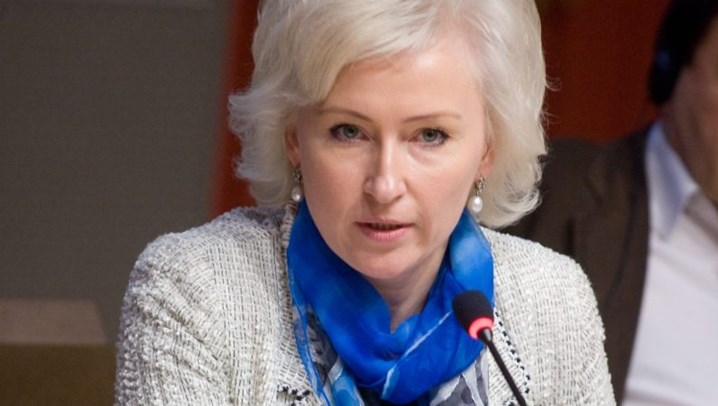
Kristiina Ojuland, a former Foreign Minister of Estonia and former member of the European Parliament, voiced her disapproval of the European Commission’s migrant quota plan on her official Facebook page, by calling for a pan-European campaign against admitting any refugees in the EU.

In a post that was more reminiscent of a far-right extremist, than a former Vice President of the European Liberal Democrat and Reform Party (ALDE), Ojuland said that the “white race is threatened” by dark-skinned immigrants (Ojuland actually used an Estonian word “neeger” which is not officially considered offensive in Estonia, but nevertheless becoming socially unacceptable).

“Today yet again I see a fully able young Negro begging for money in Italy, from people who have worked hard to earn a lunch. I think that we should start a pan-European campaign to collect signatures to ensure that not a single so-called refugee gets across the Mediterranean. Enough of this nonsense!” Ojuland, the former high-ranking politician who for years campaigned Estonia to join the EU, wrote.

Her posting has so far gathered over 2,000 “likes”, 500 shares and 300 comments. While many people pointed out her offensive remarks and some called her racist, one would have thought that the former foreign minister would back down, but it didn’t turn out to be so. Instead, Ojuland chose to rigorously defend her statement and even went offensive against the moderate commentators who asked for common sense.

“Stop using a word ‘racist’! As a white person, I feel that the white race is threatened today! Are Estonians also so brain-washed now that they start talking some kind of politically correct bullshit?” Ojuland said.

Another reasonable commentator was told by former liberal MEP that by being a member of the European Union does not mean “accepting people who would squeeze Estonia’s social system”. “Estonia needs to say clear no to Mediterranean migrants!” exclaimed Ojuland.

Ojuland was the Foreign Minister of Estonia from 2002-2005. In June 2004 she ran for the post of secretary-general of the Council of Europe, but was defeated. She was a member of the Estonian Reform Party from 1995-2013 and from 2009-2014 served as 1 of the 6 Estonian MEPs in the European Parliament. Ojuland was expelled from the Reform Party in June 2013 over alleged vote rigging in the party board elections and subsequently founded Party of People’s Unity, which failed to gain enough votes to enter the Parliament, effectively ending Ojuland’s major political career in Estonia.

Source: Estonian Public Broadcasting

Israel tells Africans to leave or face prison

Israel is telling black Africans they must leave now or face an indefinite stay in prison.

Israeli authorities are sending letters to the first of 45,000 Eritrean and Sudanese refugees, informing them they have 30 days to accept Israel’s offer of $3,500 in cash and a one-way ticket home or to an unnamed third country in Africa, or face incarceration at Saharonim prison.

Israeli leaders have proclaimed that their tough approach — building a fence along its border, denying work permits for illegal migrants, forcing them into a detention center in the desert — may ultimately save lives by dissuading migrants from attempting a perilous journey. Critics of the Israeli policy counter that a country built by refugees should be more accepting of those fleeing war, poverty and oppression.

But these days, even liberal Europe is considering a more muscular approach. The European Union began a push Monday for U.N. authorization to deploy military force in the Mediterranean to stop migrant smuggling ships.

The new measures to press the Africans to leave Israel comes at a time of heightened fears among the refugees, who were stunned last month by a widely circulated video allegedly showing three Eritreans who left Israel killed by Islamic State militants in Libya. Friends and relatives said they had traveled there in a bid to reach Europe.

“We saw the video, but we thought maybe it wasn’t true, maybe it was just a hoax,” said Aman Beyene, an Eritrean asylum seeker who has spent 14 months at an Israeli detention center.

“Then we spoke to an Eritrean boy who had witnessed the killings, and we knew it was true,” Beyene said.

The 38-year-old Eritrean accountant sat at a picnic table in the dirt parking lot of the Holot detention facility, a compound of single-story cement-block dormitories housing 2,000 Africans, surrounded by a fence spooled with razor wire in the Negev desert.

Beyene spoke slowly as he recalled watching the video showing a man thought to be his friend Tesfay Kidane, 29, dressed in an orange jumpsuit beheaded on a beach in Libya by Muslim extremists. He said Kidane felt despondent being cooped at the Holot facility, so he accepted the Israelis’ offer to be flown to a third country — likely Uganda or Rwanda — and from there made his way to Libya, where he was kidnapped by the Islamic State.

Though the detainees at Holot are free to leave the compound during the day, the nearest city is an hour’s bus ride away and the men are forbidden to work. If they fail to return by nightfall, they are sent to a prison across the street.

Interviews with Eritreans and Sudanese at Holot suggest that many are still dreaming of reaching Europe through the chaos of Libya — despite knowing that more than 1,800 Africans have drowned in the Mediterranean Sea this year and others have been taken captive by the Islamic State.

“Being beheaded by ISIS or sinking on a boat is scary,” said Mutasim Ali, 28, who arrived in Israel in 2009 from the Darfur region in Sudan and has spent the past year detained in the detention center. “But you can’t really stay here, wasting your life, doing nothing.”

He pointed to the men like him who spend their days milling about in circles, staring at their mobile phones, waiting for the next meal.

Before Israel began cracking down on African migrants a few years ago, the Africans were highly visible in bustling cities, working in kitchens and doing menial labor. There are still neighborhoods in south Tel Aviv filled with Africans. Many Israelis complained they were being “invaded.”

Source: Washington Post

Black boys attacked at NY school and called ‘Ebola’

A group that advocates for Africans in the Bronx is calling for action after it says two brothers who had recently immigrated to the borough from Senegal were beaten and badly injured by several people who called them “Ebola” in school.

The 11- and 13-year-old boys, in sixth and eighth grade, respectively, were attacked Friday afternoon at I.S. 318 in Tremont, according to the African Advisory Council. Their father, Ousame Drame, said they were pummeled by other students in the schoolyard during lunch after enduring weeks of taunts.

The boys, who have been in the U.S. for about a month, were taken to the hospital after the attack.

Drame said his sons have been cruelly harassed for two weeks over Ebola. Days after news broke that the deadly disease was in the United States, he said students, whispering the word, “Ebola,” told other students not to talk to the boys. They were treated like cancers, he said.

“If they go to the gym they don’t want them touching the ball – ‘Oh, you have Ebola, don’t play with us,'” Drame said.

Though the children were raised in Senegal, they were born in America — and have every right to be here, their father said.

But Drame didn’t blame the students.

“They don’t know nothing. They’re babies,” he said.

Instead, Drame insisted the school system wasn’t doing enough to protect his children and others like them. He called on politicians and educators to spread awareness about the disease — and to step in when necessary.

Calling the attack “unacceptable,” advocates say it is just the latest incidence of disrespect and bullying of Africans since the outbreak of Ebola in West Africa.

“Where was the school administrators, where was the school staff when all of this was happening?” asked Charles Cooper of the African Advisory Council as he demanded more action.

Drame said his sons will return to school, but he wants confirmation they’ll be safe — physically and emotionally.

The Department of Education says it’s aware of the complaint and that it dispatched additional security to the boys’ school. The agency said it would instruct teachers and principals to be on high alert for any potential instances of bullying or discrimination. It also said it would send information to parents to help them better understand the issue and dispel any misconceptions their children might have.

“We will not tolerate intimidation or bullying of our students, especially in this moment when New Yorkers need to come together,” Schools Chancellor Carmen Farina said in a statement.

Senegal is one of several West African countries where Ebola cases have been reported, but there have been no new cases in that country since late August, according to the CDC. The World Health Organization has declared the country “Ebola-free.”

Cases continue to be reported in Guinea, Liberia and Sierra Leone. A few health care workers and travelers coming from those countries have also been diagnosed with the disease in other countries, including one person in New York City.

Source: nbcnewyork.com

Entitlement: Attacking whites for black shortcomings

White South Africans don’t just have an unexamined sense of entitlement, but also an embedded sense of superiority, writes Eusebius McKaiser in IOL:

What, black people, do you want from whites? To leave the country, to be denied jobs or never be promoted again? Share or give up their assets?

It’s a serious and popular set of questions many white South Africans often raise, or ask themselves but might not raise openly. And so it’s actually worth engaging the issues.

There are several problems with this set of questions.

The very framing of these questions lets white South Africans off the moral hook too easily.

These questions place the burden for thinking about the place and role of white South Africans in post-apartheid South Africa on black South Africans.

That’s like asking victims of violence against women, “What do you want men to do differently?!”

That kind of question is music to the misogynist guy’s ears. He can go fishing, and respond to the feminist critique of gender injustices by demanding that they call him when they’ve figured out what the heck they want him “to do”.

Unless and until they send him a “concrete” list of demands, he can chill and go about his unthinking male ways as usual. After all, he’s not sure what women want from him!

This, of course, is rubbish. Dangerous rubbish. The first observation to be made is that the history of oppression is not only about the material consequences of oppression. Of course colonialism and apartheid resulted in black life being materially worse off than white life. That’s still the case.

It’s right in focusing questions on the material conditions which we want to change. In that sense, we cannot as a country avoid asking, indeed, what needs to be done, practically.

But oppression, and its ongoing legacy, has many more features which this lazy demand of “what must I do?!” hides.

Focus for a minute on the psychological and moral impact anti-black racism had on whites. You’d be hard-pressed to find more than a handful of white South Africans who think of themselves as being as capable of excellence, or less capable of excellence, than black South Africans. Most regard themselves as more capable of excelling at anything.

This is in part why so many white South Africans who don’t get their desired job are shocked when that happens (and we’re talking about a thin minority among whites compared to unemployment in the rest of the population). The shock doesn’t just reflect an unexamined sense of entitlement. It also reflects an embedded, internalised sense of superiority that gets shaken in the face of a black candidate succeeding where you didn’t.

At this point, confirmation bias sets in: I didn’t get the job because I’m white; he got the job only because of affirmative action; whites have it worse in the job market than blacks; young white graduates are treated badly in democratic South Africa; etc.

Isn’t it remarkable that these thoughts are expressed not only by a racist Afrikaans oke in khaki shorts on the outskirts of Ventersdorp, but also by self-identifying progressive English whites who often fancy themselves more morally conscious than the average Beeld reader?

There is sheer arrogance involved here on the part of the white South African who can’t make sense of his or her failure without sustaining a secret belief that they are intrinsically more capable than blacks. You can only lament and be shocked by fewer job offers or promotions in the job sector if you think you deserve these more than blacks.

Nothing innocent anchors such shock and disappointment. A sense of superiority, left over from apartheid, fuels this misplaced sense of being democracy’s victim. If you conceived of the possibility you might not be the best, other responses to failure beyond shock will open up. Apartheid’s beneficiaries aren’t yet in that head-space.

This shows the psychological and moral work whites still need to do. And that’s why soem questions are so irritating. They reduce the discussion of racism’s reach to a simple transactional conversation.

Giving me your house, as a white South African, doesn’t tell me anything about your psyche. It doesn’t tell me whether you understand that past discrimination, not genetic superiority or sheer effort, explains why you’re materially better off than me and my family.

This is why the project of undoing the legacy of apartheid must address all these lingering dark truths. This in turn requires white South Africans to do much more work, a lot of it not related to policy questions about redress.

You can’t restore moral parity between whites and blacks with a cheque handed over by each white person for the material benefit of blacks.

Similarly, gender discrimination in the corporate sector, for example, cannot be adequately eliminated and addressed if men only agreed to equal pay, or reserving job spots for women, etc. Those matter, for sure. I wouldn’t oppose these interventions.

But gender equality requires deeper work. Attitudes and behaviour that exemplify the false beliefs men hold about their intrinsic superiority over women need to be addressed and corrected. If you don’t, discrimination will simply pop up in new forms beyond questions of, say, wage equality or job reservation.

More importantly, approaching the quest for gender equality as a narrow, material project simply reveals an inadequate understanding of misogyny’s full character.

The project of addressing anti-black racism’s many manifestations is equally complex, and not neatly reducible to a transactional demand.

The final point to make is that racism is about the relationship between members of different groups, even if those groups are social and political constructions. This relational element should be obvious, yet we forget about it very often. It doesn’t just take two to tango; it takes two for racism to even be possible.

By asking blacks what they want from whites you focus on one party in that stinking relationship.

If the very core of racism is about a morally warped interaction between parties, then the project of undoing that harm must be relational too.

You can’t ask the bully to do no work, to go play outside and call him in after you’ve got an answer from the victim about what she wants from the bully. Then you’ve misdiagnosed the exact nature of the wrong you’re trying to correct.

Sure, the victim may unhelpfully play along and demand concrete things – like land – but then be clear about one certainty: this will at most give you an outcome that soothes the sense of injustice of victims.

You will have failed to deal with the full might of the evil that had been experienced, leaving both the victim and the bully deeply wounded still.

The victim will remain haunted by a sense of inferiority. The arrogant bully will remain, well, bullish.

So next time a white person asks “What do you want me to do?”, tell him or her they’re asking the wrong question. They should start with reflection on the psychological and moral stains on their whiteness.

PS: I deliberately don’t qualify “white” and “black” with words like “most” or “some” here. Why? Some truths are black and white. Such qualifications allow those with most work to do to pretend they are exceptional. Let’s stop the denial by recognising reality.

Exceptions don’t change ugly patterns. We have work to do, including progressive whites helping out those whites who are blinded by their whiteness.

Stop asking blacks what you should do. That’s objectionably lazy.

Bantu imperialism

roodt_dan_wiki

by Dan Roodt

[followbutton username=’danroodt’ count=’true’ lang=’en’ theme=’light’]

Like Dan Roodt’s Facebook page

I was still pondering the implications of “black colonialism” as set out in a previous column when it struck me that some of South Africa’s ethnic categories are completely wrong.

Afrikaners were the first group in the country to refer to themselves as “Africans”, as long ago as 1707 when Hendrik Biebouw said: “Ik ben een Afrikaander.” However, today Afrikaners have been defined as an out-group by South African legislation that simply classes them as “whites”.

Most of our affirmative-action legislation has been imported from the USA and BEE is just an adapted form of what is called “minority procurement” over there. So there is nothing “African” about the current race-classification system!

In German, “Afrikaner” means simply “African”, yet the current laws define Afrikaners as Europeans. The ultimate irony is that ANC and especially SACP ideology has been constructed by recent immigrants from Lithuania (like Joe Slovo) and, of course, Britain.

Imposing racial quotas on everything from the medical schools at Afrikaans universities to the Blue Bulls rugby team is bad enough. But stripping us of our age-old Africanness by legislative fiat represents the ultimate insult, making us interlopers in our own country.

Searching for answers, I reread Thabo Mbeki’s “I am an African” speech, but it is simply a fanciful restatement of American multiculturalism, with echoes of (Swedish) Gunnar Myrdal’s “melting pot” idea. So nothing “African” there, either.

We urgently need to bring back the term “Bantu” and I have begun to recommend its use on social media and everywhere else. There seems to be a certain squeamishness about using this word, meaning “people”, which is unfathomable. Even the famous Xhosa definition of “ubuntu” contains it: “Ubuntu ungamntu ngabanye abantu.”

Anthropologists, linguists and other people in need of proper definitions have never stopped referring to the “Bantu peoples”, “Bantu languages”, etc. Even Bantu education has been rehabilitated by such leading authorities as Dr. Mamphela Ramphele and a lecturer at Wits Business School, Mr. Rabelani Dagada, both of whom consider it better than the current schooling system.

The first ANC-supporting newspaper in the 1920s was called Abanthu-Batho and today there is a clothing brand which is thus advertised: “Abantu is a ladies wear brand which creates timeless pieces which speak to the South African audience.”

The Bantu peoples inhabit East and Southern Africa. For them or their Lithuanian theorists to arrogate unto themselves the sole right to being called “Africans” is not only intellectually unsound, but also unfair. After all, there are 200 million North Africans, including Egyptians, Arabs, Berbers, Copts and so on, who are Africans, by definition. West Africa too, is given the cold shoulder by Bantu imperialism.

In the nineteen-twenties some leading German and French anthropologists claimed, upon the basis of very ancient mining activity in these parts, that whites may have inhabited both South Africa and Zimbabwe as long ago as 3500 B.C. They must have been the first Afrikaners and we should venerate them as our true founding fathers, together with the Khoi and San.

Either we must qualify for affirmative action like other “Africans” – and even the Chinese! – or the Bantu must clearly announce their pretensions to being a kind of continental nobility with special privileges.

[followbutton username=’danroodt’ count=’true’ lang=’en’ theme=’light’]

Like Dan Roodt’s Facebook page

This column also appeared as a letter in Business Day.

Whites not welcome!

colored_no_whites-jim_crow_metal

by Albert Brenner

It has been 19 years now since the ex-European South Africans voluntarily handed over power to the black majority, and still there is no end in sight to the moral criminalization of all things white.  

And there will never be!

The revisionist feel-good perception has been created that the “evil” whites stole the innocence of the cherubic blacks who were living in eternal beatitude in a pre-colonial Eden called Afro-Atlantis. Asking Beelzebub’s brood (the Afrikaner) to commit collective suicide would be counter-productive because who will be at hand to accept blame when things go awry in Mandelatopia.

The only viable solution for restoring purity to paradise would be for the white devils to build a huge Noah’s Ark, and leave the country for good. And just before they embark for heaven-knows-where, they should all kneel down and pray for forgiveness for all the times they’ve raped South Africa and, to wipe the slate completely clean, take their satanic legacy with them – like, inter alia, building up a superb infrastructure, a world-class health-care system, exceptional retail and banking sectors, and – their ultimate sin – foisting a Written Language and the Wheel on angelic Southern Africa.

To be fair, apartheid was morally warped, but didn’t the Americans, Australians and Kiwis take it one step further in history – by all but wiping out the indigenous peoples who stood in their way!?

How many Native American Indians, Aborigines and Maoris really control their own destinies in these three so-called paragons of civilization? Mind you, how many Africans in Africa can claim they live on Cloud Nine?

To drop the political correctness for one day: Africa is a bloody mess, and no civilized human being can live here anymore! How much bla bla (blame it on slavery, colonialism and apartheid) is still pending before people like Desmond Tutu finally realize that sucking on the worn-out tit of Western penance will not guarantee Africa’s survival anymore – as has been the case since the post-colonial 70s!?

And (ab)using Mandela’s legacy as a moral soap to cleanse their hands of all stains of corruption, rape, murder and mayhem will never suffice as an acceptable excuse for the 500 000 (mostly black) South Africans who have been slaughtered since the supposed champions of 21-century morality came into power in 1994.

The holier-than-thou West should take heed: the fate of the whites in South Africa will be the ultimate fate of the rest of the West – be it in 50 or 500 years.

And that will be the time when all whites will have to prostrate themselves and ask for absolution from all their sins throughout the ages… even Socrates, Einstein, Shakespeare, Gutenberg, Da Vinci and Mozart!

First published in The Conservative Voice in January 2003.

Read more columns by Albert Brenner.

Young Africans commit more crime in Australia

Young Somalis celebrate Australia Day

Police have expressed concern over new figures that show Somali and Sudanese-born Victorians are five times more likely to commit crime than the wider community.

While the volume of crime is not significant, police say the trend needs to be stopped.

Assistant Commissioner Stephen Fontana says he is also concerned about the age of the offenders.

“A lot of the offences that we’re concerned about are assaults and street robberies,” he said.

“We’re particularly concerned about the violence on occasions and also the age of the individuals involved.

“The vast majority are under 21 years of age.”

Mr Fontana says police are doing a lot of work with the communities.

He dismissed suggestions, however, that the social unrest experienced during the Cronulla riots could be replicated in Melbourne.

 “If we don’t stop the trend now, in the future we could have concerns.”

But Ross Barnett, the director of the Ethnic Communities Council of Victoria, has dismissed the statistics.

“Police data is notoriously unreliable, so I think we need to take it with a grain of salt,” he said.

“We do need a broader approach.

“I think, as has been pointed out by other people, there is a significant level of disengagement with African youth.”

You can’t have your banana and eat it

“In his ‘Wrath of dethroned white males’ (see underneath), Professor Malegapuru Makgoba has dared to offer a biological explanation for the power structure that prevails in the new South Africa. Makgoba is perhaps the leading theoretical Africanist in our country today. I am sorry, therefore, to bother him with Eurocentric logic, but his argument represents a tautology,” writes Dan Roodt.

In his “Wrath of dethroned white males” Professor Malegapuru Makgoba has dared to offer a biological explanation for the power structure that prevails in the new South Africa. According to him, the white male has been “dethroned” and should now learn to adapt to a subservient, even submissive, role within our society.

Until now, Social Darwinism or the model of society as a competition for resources where the fittest will survive and prosper, has often been associated with notions of European superiority. After all, Europeans from a minute area in north-western Europe managed to get on to little sailing boats to colonise and rule the greater part of the Earth for a few hundred years. Britain is said to have conquered 100-million people in the Indian sub-continent with 800 soldiers and 2 000 Indian auxiliaries.

Makgoba’s view of African male dominance therefore represents a novel departure from a previously Eurocentric idea. However, he is not the first South African to take an interest in biological explanations for human behaviour or politics. Two of his predecessors would be Eugene Marais and Jan Smuts.

Marais was keen on the study of primates, especially baboons, and wrote two books about them, The Soul of the Ape and Burgers van die Berge. The great Afrikaner physician, journalist, poet and intellectual stressed the similarity between human and baboon behaviour, including an occurrence where he observed human boys and young baboons playing together, making clay figures and imitating one another.

This extraordinary incident is recounted in Burgers van die Berge. It fits in with Makgoba’s view that imitation and “aping” are normal features of both human and baboon societies. Nowhere would Marais, however, advance the notion that imitation was solely linked to hierarchy and dominance.

Makgoba is perhaps the leading theoretical Africanist in our country today. I am sorry, therefore, to bother him with Eurocentric logic, but his argument represents a tautology. Because black males are in power, he deduces that they are both dominant and “fitter” than white males. However, it could be that they are dominant for reasons other than their fitness.

Not so long ago, Mathatha Tsedu, the then editor of the Sunday Times, caused quite a ripple when he wrote in his column on July 13 2003 that black men sometimes display a lack of prowess. He quoted an anonymous Cabinet member who had told him: “When you come from where we come from and you then have to realise that if you want something done quickly you have to rely on whites, it is really debilitating. You bleed internally, but our very own comrades do not work. There is generally no work ethic.”

Of course, there could be a debate about what attributes an alpha male should have in human society. Should he be intelligent, physically strong or both? Should he be a good manager, highly numerate and literate, disciplined and with a good work ethic? Or are these but the traits of a tame white baboon and are universal criteria for primate success such as aggression, reproductive prowess and dominant behaviour more important?

Makgoba’s assessment leans toward the latter interpretation. However, I do not think that the same conditions of Darwinian survival pertain in the human world as opposed to the animal world. Human beings display altruistic behaviour uncommon in many species so that they would not necessarily subjugate the weaker members of their society as happens in a primate hierarchy.

Take the nuclear project at Pelindaba that existed under the previous government, for example. A handful of white Afrikaner males produced six nuclear bombs, deadly enough to kill millions of people in one fell swoop. In a straight Darwinian contest, they should have used that power to eliminate their black male rivals forever, thereby ensuring their own dominance within Makgoba’s scheme of rivalry between white and black males. Yet not only did they refrain from using the bombs, but they handed over power to the black males and peacefully dismantled their own lethal weapons.

Biologically speaking, such behaviour is absurd. No male baboon would be caught dead playing into the hands of his rival. Yet this is precisely what we have seen in South Africa.

At another level, however, one could argue that a form of social Darwinism is still operative at every level in a capitalist society where individuals and companies are selected for fitness through economic competition. This leads to a further contradiction in Makgoba’s argument, for while exalting black male fitness over white male weakness, he insists on affirmative action and black economic empowerment.

Because of racial-preference measures in our society, Darwinian competition, even at the more civilised economic level — as opposed to brute contests with bared teeth and flailing limbs — is flawed.

Either black males such as Makgoba will have to discard racial preference so that the real Darwinian contest may begin, or they will have to continue invoking sympathy for the poor, downtrodden black male having been disadvantaged by centuries of colonial oppression and racism. In other words, they will have to choose between Darwinism and altruism.

As they would say in the baboon world: you can’t have your banana and eat it.

Originally published in the Mail & Guardian on 1 April 2005

Wrath of dethroned white males

by Malegapuru Makgoba
In the primate family, to which humankind belongs, there are certain heritage features which display “clear dominance relationships among members, and the proclivity to imitate”, hence such terms as “aping and monkey business”. Alienated. Quarrelsome. Spoilers. Certain white males exhibit all the symptoms of the dethroned male baboon.

A critical factor of human development and leadership is “our primate heritage” as defined in the book Leading Minds: An Anatomy of Leadership, by Howard Gardner, Harvard University’s distinguished psychologist and professor of education.

In the primate family, to which humankind belongs, there are certain heritage features which display “clear dominance relationships among members, and the proclivity to imitate”, hence such terms as “aping and monkey business”.

These heritage features are most pronounced in males who compete for control of the social cluster, for protection of offspring and possession of the most desirable females.

Baboons or bonobos, for example, are often headed by a dominant male with pretenders to the throne hanging around. The dominant male ensures that progeny are not only his through reproduction, but also that all members of the colony imitate him. He becomes the “gold standard”. Ultimately the dominant male is dethroned by a younger and fitter male, only to repeat another variation cycle of hierarchy, dominance and imitation.

The dethroned male becomes depressed, quarrelsome and a spoiler of the new order until he gets ostracised from the colony to lead a frustrated, lonely and unhappy life. This is our “primate heritage”.

I use this example because baboons are familiar to most South Africans; they are among our closest primate relatives genetically and a totem for some Africans. African people have been referred to as bobbejaan and at times shot and killed by certain white males who apparently “confuse or mistake” us for baboons.

More importantly, I use this example because humankind is reflective and should do better than our primate relatives; also because the dethroned white male in South Africa is playing the same role as dethroned baboon troop leaders do.

The primate practice teaches us that information is not sufficient to bring about change; that change often only occurs when it is enforced on even such a highly sophisticated species as humankind.

A group of dethroned white males called “Die Boeremag” are recently alleged to have been plotting a coup and even entertaining the exciting thought of assembling all Africans on the N1 and then chasing or marching them to Zimbabwe. In their naïve logic, Zimbabwe belongs to Africans and South Africa belongs to whites.

Another group of white males are languishing in a Zimbabwean jail for masterminding a coup in Equatorial Guinea; a group of white male farmers have emigrated to Nigeria; and some white males are alleged to be causing “instability in the Free State”.

Recently, Justice John Hlophe to his credit raised the issue of racism within the Cape Division of the judiciary as largely ascribed to and associated with white males. Many prominent Africans have complained repeatedly and with increasing frequency over the decade about “alienation and institutionalised racism” within the academic, church, corporate, media, sports and public/government sectors of our country.

As the transformation of our society deepens, like the peeling of an onion, more racist white males are being caught, fingered out and revealed. Surely we must by now recognise and respect that Africans who have been victims of racism over centuries and generations understand better than the perpetrators about what racism is, means and feels.

We must equally accept that 350 years of racist experiences and socialisation cannot be overcome in 10 years of freedom. The request for “reconciliation” and “forgiveness” masquerades as a quest for memory loss. Regrettably, whenever an African raises this issue, the white male response has been “to play the man rather than the ball”.

Racism, a socially constructed phenomenon with no biological basis, is a complex system of symbols and meanings that continues to modify over time as a consequence of both societal structural changes and political struggles. A segment of white males continues to deny the collective body of African experiences and instead wants to monopolise and to dictate the definition and appropriate meaning to racism. If and when they do accept the existence of racism, it is often detached and projected. Lately, many African students at campuses of higher learning are complaining about “racism, alienation and social exclusion”. The main culprits are the younger generation of white males imitating their elders.

Similar symptoms of the dethroned are evident in the caustic, negative terms in which the debate about black economic empowerment is framed; in the ways in which black executives are vilified; and in the way in which employment equity is always viewed through the prism of its impact on the longevity and well-being of the (dethroned) white male.

The dawn of the new dispensation has retired a segment of previously dominant and ambitious white males prematurely. This segment has lost its power, authority and a sense of purpose in society. Whether intended or unintended, conscious or unconscious, a sector of white males have an adaptation problem.

They have become bitter; but this also has become a serious problem for our society and a major obstacle to our democratic transformation. Some members of this group, which is out of kilter with the mindset of liberated African society, have become spoilers — across a wide range of activities. It has become not only ungrateful but also oblivious to Ubuntu. This group does not seem to understand the word “reconciliation”.

All these take place in the midst of a society making every effort to reconcile its horrible past and to transform itself into a just, equitable and non-racial society. The creation of a non-racist society will emerge to a large extent through the conscious confrontation of the current pervasive racism by all.

It is crucial here to indicate that not all white males display this obnoxious, arrogant, racist behaviour we continue to experience 10 years after liberation. In fact, to the contrary, many white males have made great strides, great sacrifices and significant contributions to this evolving equitable, non-racist and non-sexist South Africa we are creating through our Constitution and our African renaissance vision.

But the group of spoiler white males, just like the male baboon or bonobo, was once a dominant force through colonial and apartheid conquests. Over centuries this group defined that which was civilisation as opposed to that which was barbarism. He defined that which was liberal as opposed to that which was autocratic. Even when he excluded women, blacks and the uneducated classes in society, he still called this liberal philosophy.

He defined culture, morality, ethics and the shape and form of wealth distribution according to the way it suited and advantaged him. He created and bequeathed the world an illiberal, unjust, unequal, racist and sexist society. Over centuries and through dominant enforcement he ensured that his mindset or world view was imitated without question by those he presided over. This dominant white male has had an unparalleled and unrivalled opportunity in which to shape the history and future of the world and humankind according to his image.

But as history and nature would have it, unfortunately the white male in his prime was never able to conquer everyone. The great Arab and Chinese histories and cultures continued to challenge the monolithic culture of the white male. The indestructible and experiential cultures of the Africans remained impervious and alive despite centuries of imperial invasion and concerted efforts to obliterate these.

With the demise of the empires and of Western values, even the stiff upper lips of these white males begun to quiver. This white male feels ostracised from society and is leading “a frustrated, lonely and an unhappy life away from the herd”.

We now have a predominantly African government presiding over an African country and a predominantly African society with dominant African values. This African force will follow our primate heritage of cultural social clusters, dominance and imitation, with modifications made by our Constitution, which respects human dignity, diversity and non-sexism. It will also be influenced by the context of the 21st century, globalisation and the greater mosaic of interdependent cultures.

Africans will transform and reconcile this society by ensuring that the fingerprints of their African culture, value and knowledge systems and notions of social order are embedded in and are the blueprints of a future South African society.

Africans will not transform this country through previously dominant foreign rules, values or cultures. No dominant group ever transforms society through subservience and alien values. This would simply be against our primate heritage. When the English were dominant we were anglicised, when the Afrikaners were dominant we were Europeanised, now that Africans are dominant we must Africanise and not apologise for our Africanness.

The white male should instead be excited by the new prospects of imitating Africans. When we say “Mayibuye iAfrika” we mean it and mean business. Democratic governments are representative of the will, values and aspirations of the majority and not the will and aspirations of a whingeing white male minority.

While Ubuntu will continue to influence our drive for reconciliation, let there be no doubt that sooner or later African dominance and the imitation of most that is African shall permeate all spheres of South African society

This message should be loud and clear just as the writing is on the wall for all to whom South Africa belongs. All modern democratic societies celebrate diversity around a common vision, in our case an African vision. It should therefore become common sense that the white male soon learns to speak, write and spell in an African language; that he, like Johnny Clegg, learns to dance and sing like Ladysmith Black Mambazo. He should learn kwaito, dance like Lebo, dress like Madiba, enjoy eating “smiley and walkies” and attend ‘“lekgotla” and socialise at our taverns.

He must soon accept, value and imitate the things that matter dearly to Africans. The sooner this white male gets out of his denial mode, the sooner he will receive treatment and proper African rehabilitation. Surely, our white male group can and should do better than the baboon or the bonobo.

Malegapuru Makgoba is the vice-chancellor of the University of KwaZulu-Natal and writes in his personal capacity

Originally published in the Mail & Guardian on 25 March 2005

South Africa swamped by African asylum seekers

The Refugees Appeal Board and the Standing Committee on Refugee Affairs are swamped by appeals to review previously rejected asylum applications, an official said on Thursday

This was causing a delay in issuing asylum certificates, home affairs director general Mkhuseli Apleni told reporters in Pretoria.

He said 87,602 asylum applications were being reviewed by the Refugees Appeal Board (RAB).

Another 68,740 applications which were initially rejected and deemed manifestly unfounded were being reviewed by the Standing Committee on Refugee Affairs (SCRA).

“If an application is found to be manifestly unfounded, the decision is automatically reviewed by the SCRA,” said Apleni.

“If the initial decision to reject an application is upheld by the RAB or the SCRA, a final rejection letter is issued to the applicant.”

He said the department was struggling with the processing of large numbers of applications.

“South Africa is the recipient of some of the highest volumes of asylum seekers in the world… at this stage we are receiving an average of between 3,500 and 4,000 new applications for asylum each month.” He said as of Monday next week, the department would operate its refugee reception offices at extended hours.

He said to ease the application process, all Southern African Development Community nationals would be assisted on Mondays and Tuesdays, while East Africans would be helped on Wednesdays and Saturdays and West Africans on Thursdays.

Apleni said Asians and other nationals who fell outside the African groups would be assisted on Fridays.

If applicants arrived at the Refugee Reception Offices on a day that had not been allocated to them, they would not be assisted. He said the department was especially concerned about the long queues at the Marabastad offices, and that police officers would be assigned there to manage those queues.

‘Africans are less intelligent than Westerners’

One of the world’s most eminent scientists was embroiled in an extraordinary row last night after he claimed that black people were less intelligent than white people and the idea that “equal powers of reason” were shared across racial groups was a delusion.

James Watson, a Nobel Prize winner for his part in the unravelling of DNA who now runs one of America’s leading scientific research institutions, drew widespread condemnation for comments he made ahead of his arrival in Britain today for a speaking tour at venues including the Science Museum in London.

The 79-year-old geneticist reopened the explosive debate about race and science in a newspaper interview in which he said Western policies towards African countries were wrongly based on an assumption that black people were as clever as their white counterparts when “testing” suggested the contrary. He claimed genes responsible for creating differences in human intelligence could be found within a decade.

The newly formed Equality and Human Rights Commission, successor to the Commission for Racial Equality, said it was studying Dr Watson’s remarks ” in full”. Dr Watson told The Sunday Times that he was “inherently gloomy about the prospect of Africa” because “all our social policies are based on the fact that their intelligence is the same as ours – whereas all the testing says not really”. He said there was a natural desire that all human beings should be equal but “people who have to deal with black employees find this not true”.

His views are also reflected in a book published next week, in which he writes: “There is no firm reason to anticipate that the intellectual capacities of peoples geographically separated in their evolution should prove to have evolved identically. Our wanting to reserve equal powers of reason as some universal heritage of humanity will not be enough to make it so.”

The furore echoes the controversy created in the 1990s by The Bell Curve, a book co-authored by the American political scientist Charles Murray, which suggested differences in IQ were genetic and discussed the implications of a racial divide in intelligence. The work was heavily criticised across the world, in particular by leading scientists who described it as a work of ” scientific racism”.

Dr Watson arrives in Britain today for a speaking tour to publicise his latest book, Avoid Boring People: Lessons from a Life in Science. Among his first engagements is a speech to an audience at the Science Museum organised by the Dana Centre, which held a discussion last night on the history of scientific racism.

Critics of Dr Watson said there should be a robust response to his views across the spheres of politics and science. Keith Vaz, the Labour chairman of the Home Affairs Select Committee, said: “It is sad to see a scientist of such achievement making such baseless, unscientific and extremely offensive comments. I am sure the scientific community will roundly reject what appear to be Dr Watson’s personal prejudices.

“These comments serve as a reminder of the attitudes which can still exists at the highest professional levels.”

The American scientist earned a place in the history of great scientific breakthroughs of the 20th century when he worked at the University of Cambridge in the 1950s and 1960s and formed part of the team which discovered the structure of DNA. He shared the 1962 Nobel Prize for medicine with his British colleague Francis Crick and New Zealand-born Maurice Wilkins.

But despite serving for 50 years as a director of the Cold Spring Harbor Laboratory on Long Island, considered a world leader in research into cancer and genetics, Dr Watson has frequently courted controversy with some of his views on politics, sexuality and race. The respected journal Science wrote in 1990: “To many in the scientific community, Watson has long been something of a wild man, and his colleagues tend to hold their collective breath whenever he veers from the script.”

In 1997, he told a British newspaper that a woman should have the right to abort her unborn child if tests could determine it would be homosexual. He later insisted he was talking about a “hypothetical” choice which could never be applied. He has also suggested a link between skin colour and sex drive, positing the theory that black people have higher libidos, and argued in favour of genetic screening and engineering on the basis that ” stupidity” could one day be cured. He has claimed that beauty could be genetically manufactured, saying: “People say it would be terrible if we made all girls pretty. I think it would be great.”

The Cold Spring Harbor Laboratory said yesterday that Dr Watson could not be contacted to comment on his remarks.

Steven Rose, a professor of biological sciences at the Open University and a founder member of the Society for Social Responsibility in Science, said: ” This is Watson at his most scandalous. He has said similar things about women before but I have never heard him get into this racist terrain. If he knew the literature in the subject he would know he was out of his depth scientifically, quite apart from socially and politically.”

Anti-racism campaigners called for Dr Watson’s remarks to be looked at in the context of racial hatred laws. A spokesman for the 1990 Trust, a black human rights group, said: “It is astonishing that a man of such distinction should make comments that seem to perpetuate racism in this way. It amounts to fuelling bigotry and we would like it to be looked at for grounds of legal complaint.”

Postscript: A week after this report was published in 2007, Professor Watson was forced to retire from this post amid an international scandal over his remarks. According to him, “I turned against the left wing because they don’t like genetics, because genetics implies that sometimes in life we fail because we have bad genes. They want all failure in life to be due to the evil system.”