The Australian government is offering asylum seekers on Manus Island and Nauru detention centres up to $10,000 to abandon their hope of resettlement in Australia and voluntarily return to the country they fled from.
The revelation comes as the High Court on Friday issued a stunning rebuke to the Abbott government’s border protection policy, striking down its decision to to refuse to issue permanent protection visas to boat arrivals found to be refugees.
In two unanimous decisions, with implications for thousands of boat arrivals, the court ruled that Immigration Minister Scott Morrison’s decision to impose a cap on the number of places in Australia’s refugee intake for boat arrivals was invalid.
The sudden boost in payments is the latest tactic being used by the Abbott government to cement its hardline stance against asylum seekers who come to Australia without a visa.
In what are dubbed as “return packages”, the Coalition has dramatically increased monetary incentives for asylum seekers to return home that range from $3300 to $10,000 based on “individual circumstances”, compared with Labor’s offering of between $1500 and $2000 last year.
The UN High Commissioner for Refugees on Friday showed Australia’s efforts to help alleviate the crisis have stagnated or worsened, with the country sliding backwards in the global rankings, according to some measures.
Australia now ranks 17th in the world to resettle refugees, according to the Refugee Council of Australia.
Asylum seekers who take up the cash offer are transported to the Hideaway Hotel in Port Moresby that is paid for by the International Organisation of Migration before being flown back to their country of origin.
Fairfax Media understands Lebanese asylum seekers are being paid $10,000 if they voluntarily return to Lebanon, while Iranians and Sudanese are being offered $7000, Afghans are being given $4000 and Pakistani, Nepalese and Burmese asylum seekers are receiving $3300.
Immigration Minister Scott Morrison confirmed that 283 people had voluntarily returned home since September 2013.
It is understood the payments, which are administered by the IOM but funded by the Australian Immigration Department, are made once the asylum seeker has returned to their home country.
Mr Morrison said the packages were tailored to each individual case. “The process of voluntary return is conducted in direct partnership with the International Organisation for Migration which has extensive experience in such matters worldwide,” a spokesman for Mr Morrison said. “All such returns are voluntary. The IOM does not facilitate involuntary returns,” he said.
Yet in a motion before the Senate, the Greens are urging the government to put a moratorium on sending asylum seekers back to Iraq, where a violent uprising continues to swallow the country.
It is not known whether any money has been offered to Iraqi asylum seekers to leave the centres. Only two days before the violent clashes in the north of the country, an Iraqi man on a bridging visa was forced back to Basra, Iraq by the Australian government, it was revealed on Friday.
From spats over halal meat in Danish schools to asylum seekers in Sweden, anger about immigration has fuelled the march of populist parties across Nordic countries, leading one such group to the brink of government in prosperous Norway.
The anti-tax and anti-immigration Progress Party, which once had among its members mass killer Anders Behring Breivik, won 16 percent of votes on Monday and could be kingmaker in a new center-right coalition after eight years of center-left rule.
Its strength reflects both worries about an influx into the Nordics of asylum seekers from countries like Syria and economic migrants from Spain, as well as disenchantment with mainstream parties that have dominated the political landscape for decades.
“We’ll ensure a solid footprint in a new government,” Progress leader Siv Jensen said. “We have reason to celebrate.”
Even without entering government, right-wing populists have managed to toughen public policies ranging from immigration to euro zone bailouts, drag political debate to the right and become a permanent feature of the parliamentary landscape.
The backlash has surfaced even though Nordic economies have outperformed languishing southern European countries. Their success has attracted thousands of “euro refugees”, vying for scarce jobs as their home states endure grinding austerity.
Economic conditions may be different, but many voters around Europe share the same perception that the established parties are out of touch with ordinary people and their concerns.
From Greece to France and the Netherlands, unemployment and economic grievances have combined with suspicion of European integration, Islam and multiculturalism, to propel both the far right and far left.
In Italy, the grassroots 5-Star Movement, born of disgust at the entire political establishment, surged to prominence in a general election in February. Britain’s UK Independence Party has gained ground and spooked mainstream politicians by harnessing an anti-EU platform with hostility to immigration.
BACK FROM THE SIDELINES
Breivik’s killing of 77 people in Norway in 2011 initially set back hard right parties in the Nordics.
But the Danish People’s Party now has the support of nearly one in six voters. The anti-immigrant Sweden Democrats have almost doubled their support since the last general election to touch 10 percent, and Finland’s opposition Finns party stands second in opinion polls with 19 percent support.
Populist groups are nowhere near winning an election and the majority of Nordic voters still express tolerance to immigrants. But any of these parties could secure the balance of power and hold a coalition government hostage on issues like immigration.
Consensus around the post-war Nordic model of high taxes and generous welfare was long sustained by a homogenous society. But immigration, global competition and fear for jobs have put that ideal of equality based on civic trust under strain.
“There exist groups that don’t feel this trust,” said Swedish Prime Minister Fredrik Reinfeldt. “These people as voters are more easily seduced by populist forces seeking short-sighted answers and which often are more or less hostile to immigrants.”
Rising immigration has been coupled with economic troubles that have seen iconic Nordic companies such as Ericsson and Nokia shed jobs. Worries about the affordability of welfare have put the once taboo subject of immigration high on the agenda.
The nightmare for mainstream Nordic parties would be the experience of Denmark’s last government, when an anti-immigrant party held the balance of power and pushed for tighter border controls that fuelled tension with European neighbors.
Under Denmark’s current center-left government, immigration had faded as an issue until controversy surfaced when it was discovered that halal meat, slaughtered under Muslim dietary laws, was being served routinely at schools and hospitals – raising protests by anti-Islam groups.
Danish Prime Minister Helle Thorning-Schmidt waded into the debate – earning the nickname “meatball Helle’ after calling for voluntary labeling of halal meat but also urging that traditional Danish food including pork dishes be served.
The construction of a mosque in Copenhagen sparked accusations from the Danish People’s Party that it was being used for radical Islamist groups.
In Sweden, immigration has become part of the mainstream debate in a country where 15 percent of people are foreign-born, the highest rate in the Nordics. Riots in poor immigrant suburbs of Stockholm in May led to further debate about how Sweden was integrating its immigrants.
“Immigration is questioned by pretty considerable portions of the populace,” said Folke Johansson, a professor of political science at Sweden’s Gothenburg University. “It’s largely been taboo to discuss these issues, and therefore other mainstream parties haven’t been able to discuss it. It was really an open goal once they (anti-immigration parties) arrived on the scene.”
In Finland, the Finns party, whose anti-euro rhetoric struck a chord with voters in 2011, when they finished a close third in parliamentary elections, aims to join the next government.
Formerly known as True Finns, The Finns leapt to prominence during the euro zone debt crisis by opposing bailouts for troubled countries. They effectively forced the government to demand collateral in exchange for helping Greece and Spain.
Calling themselves a “nationalistic and center-left working class party”, the Finns would curb immigration by trimming immigrant social benefits and adjusting refugee quotas to Finland’s financial situation.
These parties have benefited from media-savvy leaders. The Sweden Democrats’ Jimmie Akesson, whose aim is to reduce immigration by 90 percent, wears a suit and as a lawmaker has changed the party’s former image of street ruffians.
Populists are expected to poll strongly in many countries in European Parliament elections next May, surfing a wave of Euroscepticism due to the financial and economic crisis.
But analysts say these Nordic parties may have hit a ceiling in national elections and are facing greater pushback even as they complicate coalition politics around the region.
Hundreds of Swedish women posted photographs of themselves with headscarves across social media this year to protest an attack on a Muslim woman in Stockholm who was wearing a veil.
Community leaders worry about aggressive rhetoric against migrants, and there have been other attacks. But violent incidents in Nordic countries have been isolated compared with, for example, far right attacks on migrants in Greece.
Reinfeldt’s government recently made headlines by giving Syrians an automatic right of residence.
Support for Norway’s Progress is actually down from 22 percent at the last election four years ago, although the parliamentary arithmetic gives it more leverage.
“The way Progress communicates is somewhat old fashioned and a bit cheesy,” said Daniel Gaim, 37, a teacher. “But when it comes to real policy, they don’t differ much from other parties. I’m not very concerned about giving them a bigger influence.” – yahoo.com
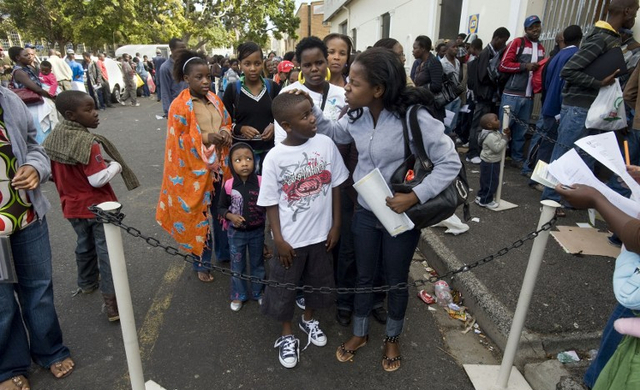
Asylum seekers queuing in front of a Home Affairs office in Pretoria
Government should take measures to assimilate foreigners into the diversified South African community, an asylum-seeker rights group said on Wednesday.
Foreigners in South Africa lived on a knife’s edge, International West Africa Asylum Seekers Foundation managing director Victoria Philips-Olaboye said.
“You need to see the multitude of people which gathers at Marabastad [home affairs offices]. They come from all over to get asylum papers in Pretoria and it is not easy.
“Some have to sleep on the ground through the night. We have a lot of rape victims there and the people are being robbed. Some of the people are pregnant, some have small children.”
She said the influx of immigrants to South Africa, particularly from West Africa, was influenced by political upheavals, economic hardship, and family disputes.
“The belief is that South Africa is better than any country in West Africa so they think they can make it here. Some have sex-related issues, they are not accepted because they are gay.”
She said her organisation wanted to engage South African authorities to help provide housing for asylum seekers.
“We have not seen much from the government. We would like to see more being done regarding the welfare of asylum seekers,” said Philips-Olaboye.
“Around 90 percent of asylum seekers are not working. They tell us that even though they are qualified, South Africans are preferred for job opportunities.”
According to Philips-Olaboye, the organisation had more than 700 members who were constantly exposed to xenophobia, discrimination, and crime.
Providing jobs for immigrants would also discourage them from venturing into crime, she said.
Nigerian immigrant Omokhagbor Michael said he arrived in South Africa two months ago in the hope of finding better economic opportunities in the entertainment sector. He said his stay so far had been horrific.
“Most of the language used in addressing us [foreigners] is vulgar; we just have to bear it. Being Africans, I think we should be treated politely,” he said.
“We had a number of challenges, including riots and [a] political crisis [in Nigeria]. In these days you find yourself in a situation where you have to go and seek shelter. In running for your life, you find yourself anywhere.”
Michael’s renewable asylum-seeker permit had since expired and he said he had not been able to renew it.
“The South African government has been wonderful to us. Somebody who gives you a house definitely wants you to be there. We face the problem of individuals who want to satisfy their pride.
“I have been trying to renew my asylum-seeker permit for two weeks. I was initially given one month to stay. One becomes scared and you keep turning left and right,” he said.
On Monday, the Somali government called on South Africa to protect Somali nationals living in the country after a spate of attacks on foreigners.
Residents in a township near Johannesburg rioted against the Somali community last week. Tensions also flared in Port Elizabeth and other parts of the country.
Scores of people were arrested following the attacks, which were reminiscent of the wave of xenophobic violence that left at least 60 foreigners dead in 2008. – Sapa
Australian Immigration Minister Chris Bowen on Monday said he hoped to begin sending asylum-seekers who arrive by boat to the tiny Pacific nation of Nauru later this week.
With Australia facing a record influx of asylum-seekers arriving by sea, Canberra last month announced plans to send them to Nauru and Papua New Guinea’s Manus Island in a policy aimed at stemming the flow.
Bowen tabled a document in parliament Monday designating Nauru as a regional processing country under the Migration Act so boatpeople can be sent to the small state to await their visa decision.
“Subject to both houses (of parliament) passing a resolution approving the designation, the designation will allow for the transfer of irregular maritime arrivals who arrived after 13 August to Nauru,” Bowen said.
Canberra announced its intention to transfer asylum-seekers to Nauru and Papua New Guinea in mid-August as part of a tough new policy to deter them from paying people-smugglers to attempt the dangerous sea voyage.
Since then 2,087 asylum-seekers have arrived by boat — close to capacity for the camps on Manus and Nauru, which will accommodate a total of 2,100 once completed.
Bowen would not comment on who would be part of the first transfer to Nauru or whether children would be sent but said that he hoped the first group would be transferred within days.
“Construction work on the temporary facility is nearing completion and the government expects to be able to begin transferring people to Nauru later this week,” Bowen said in a statement.
More than 9,796 asylum-seekers have arrived in Australia on boats in 2012, many of them Afghans, Iraqis and Iranians who have paid people-smugglers to ferry them from Indonesia to Australia.
Offshore processing is a sensitive issue in Australia, with Prime Minister Julia Gillard adopting the policy after months of bitter political debate and after several boats capsized en route, drowning scores of people.
The policy signals a return to the practice of the previous conservative government, which sent asylum-seekers to Nauru and Manus, that centre-left Labor rolled back soon after taking office in late 2007.
The opposition supports offshore processing but said the government’s promise that asylum-seekers won’t be resettled quicker just because they are processed on Nauru or PNG will see them stranded in the Pacific for years.
“The policy that (they) have adopted means people could expect to wait on Nauru for five years,” opposition spokesman Scott Morrison said. – AFP
The Refugees Appeal Board and the Standing Committee on Refugee Affairs are swamped by appeals to review previously rejected asylum applications, an official said on Thursday
This was causing a delay in issuing asylum certificates, home affairs director general Mkhuseli Apleni told reporters in Pretoria.
He said 87,602 asylum applications were being reviewed by the Refugees Appeal Board (RAB).
Another 68,740 applications which were initially rejected and deemed manifestly unfounded were being reviewed by the Standing Committee on Refugee Affairs (SCRA).
“If an application is found to be manifestly unfounded, the decision is automatically reviewed by the SCRA,” said Apleni.
“If the initial decision to reject an application is upheld by the RAB or the SCRA, a final rejection letter is issued to the applicant.”
He said the department was struggling with the processing of large numbers of applications.
“South Africa is the recipient of some of the highest volumes of asylum seekers in the world… at this stage we are receiving an average of between 3,500 and 4,000 new applications for asylum each month.” He said as of Monday next week, the department would operate its refugee reception offices at extended hours.
He said to ease the application process, all Southern African Development Community nationals would be assisted on Mondays and Tuesdays, while East Africans would be helped on Wednesdays and Saturdays and West Africans on Thursdays.
Apleni said Asians and other nationals who fell outside the African groups would be assisted on Fridays.
If applicants arrived at the Refugee Reception Offices on a day that had not been allocated to them, they would not be assisted. He said the department was especially concerned about the long queues at the Marabastad offices, and that police officers would be assigned there to manage those queues.
This website uses cookies to improve your experience. We'll assume you're ok with this, but you can opt-out if you wish. Cookie settingsACCEPT
Privacy & Cookies Policy
Privacy Overview
This website uses cookies to improve your experience while you navigate through the website. Out of these cookies, the cookies that are categorized as necessary are stored on your browser as they are essential for the working of basic functionalities of the website. We also use third-party cookies that help us analyze and understand how you use this website. These cookies will be stored in your browser only with your consent. You also have the option to opt-out of these cookies. But opting out of some of these cookies may have an effect on your browsing experience.
Necessary cookies are absolutely essential for the website to function properly. This category only includes cookies that ensures basic functionalities and security features of the website. These cookies do not store any personal information.
Any cookies that may not be particularly necessary for the website to function and is used specifically to collect user personal data via analytics, ads, other embedded contents are termed as non-necessary cookies. It is mandatory to procure user consent prior to running these cookies on your website.