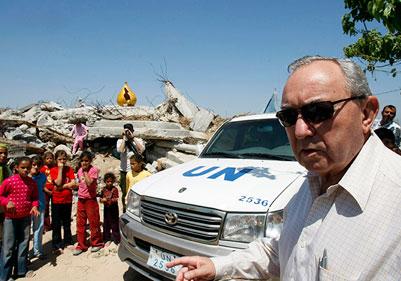
The United Nations peacekeeping operation in the Central African Republic (CAR) today condemned a recent series of armed attacks perpetrated by rebel elements.
“The United Nations Multidimensional Integrated Stabilization Mission in the Central African Republic (MINUSCA) strongly condemns the marked increase of armed attacks on the Main Supply Road 1 (MSR1) attributable to members of the rebel group Front démocratique du peuple centrafricain (FDPC),” said a press release issued today.
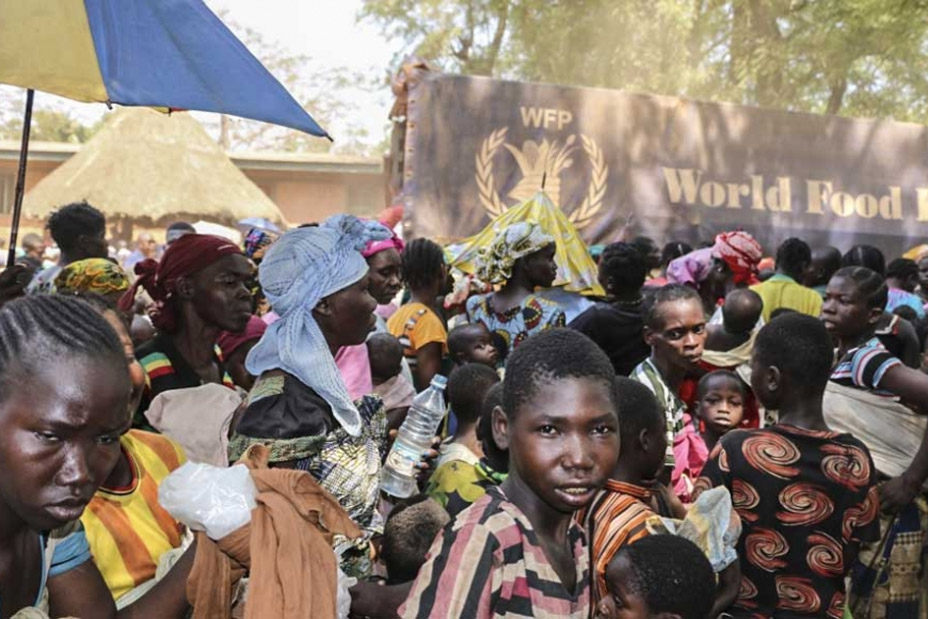
The latest incident took place over the weekend when gun shots were fired against a convoy with World Food Programme (WFP) supplies, escorted by MINUSCA peacekeepers, in the North-Western part of the country.
The driver was fatally wounded after being shot by three times in the chest and his truck shoved on the side, causing serious injuries to other passengers.
“This violence goes against the current momentum aimed at peace and national reconciliation following the conclusions and recommendations of the Bangui Forum and of the agreement signed between the government and armed groups on the cessation of hostilities and on disarmament,” underlines the Mission.
MINUSCA added that it will reinforce the “robust measures” aimed at raising the level of security on this vital route that supplies the Central African Republic.
More than two years of civil war and sectarian violence have displaced thousands of people in CAR amid ongoing clashes between the mainly Muslim Séléka alliance and anti-Balaka militia, which are mostly Christian. The UN estimates that some 450,000 people remain displaced inside the country while thousands of others have sought asylum across the borders. – UN News Centre
It is not yet certain if climate change is the result of anthropogenic-sourced carbon emissions or, on the contrary, is a Sun-influenced phenomenon. As the debate on global warming versus global cooling continues, results of recent research draw attention towards an equally worrying side-effect of industry greenhouse gas emissions – the fatal implications of air pollution on human health. Earlier this month, 24 experts from 11 countries met at the International Agency for Cancer Research (IARC) headquarters in Lyon to assess the correlation between cancer and air pollution. IARC is the cancer specialized agency of the World Health Organization (WHO), the coordinating authority for health within the United Nations.
Cancer and air pollution: two widespread phenomena
The scientists evaluated over 1000 papers analysing the carcinogenicity of particulate matter and transport-related pollutants, and the results of the study will be published as Volume 109 of the IARC Monographs. According to the study’s Press release published on 17th October 2013, “outdoor air pollution [is] a leading environmental cause of cancer deaths”. This conclusion is the first paper to officially link the two: both the worldwide rate of cancer and global air pollution have become alarmingly widespread phenomena in the past decades. Cancer has become so common, that the international medical industry was revolutionized in order to address the problem in evermore effective ways. As Licensed Prescriptions explain, it has become possible to diagnose, prevent and treat cancer quickly, in some cases even without the need of a biopsy. One of the reasons why cancer has become such a frequent problem may be that “the air we breathe has become polluted with a mixture of cancer-causing substances” as summarized by Dr. Kurt Straif, Head of IARC Monographs.
Sources and effects of air pollution
The IARC study reports that although air pollution comes from a mixture of natural and anthropogenic sources, “the predominant sources of outdoor air pollution are transportation, stationary power generation, industrial and agricultural emissions, and residential heating and cooking. Generally, the burning of fuels – oil, coal, gas or wood – release elements such as particulate matter, carbon monoxide, sulphur oxides, and metals (lead, in particular) into the air. Humans breathe in these particles, which get stuck in the lung tissue and produce breathing affections and cancer on the long term.
South Africa air pollution
The University of Western Cape’s Biodiversity and Conservation Biology Department (BCB) also discusses air pollution, stating that “pollution from exhaust gases of vehicles is responsible for 60% of all air pollution and in cities up to 80%”, with lead being one of the most dangerous chemicals emitted by the transport industry. Combustion of coal is also acknowledged as a major source of air pollution leading to possible fatal effects. For South Africa in particular, one of the dangerous side effects of burning coal is acid rain, affecting stone, metal and brick elements. Highly acid rain, snow, hail or fog is produced when sulphur and nitrogen dioxides combine with the atmospheric moisture. “Coal in South Africa is rich in sulphur and the power stations in the Mpumalanga Province could be responsible for acid rain over other areas of our country”, explains the BCB.
Indeed, as announced by Greenpeace in August 2013, Witbank, a town outside of Johannesburg, has “some of the world’s most polluted air”. This can be linked with the activity of the 11 coal-fired power stations situated across Mpumalanga. Witbank is also the place where 83% of South Africa’s coal is mined.
Improving the National Ambient Air Quality
South African air is polluted by the high sulphur dioxide and particulate matter concentrations resulted from power-generation and industrial burning of coal. This urgent matter was addressed by the most recent air quality governance approach, the Air Quality Act of 2004 and the recent National Ambient Air Quality Standards 2010. Key directions of the new approach include: Decentralisation of air quality management responsibilities; Requirements that all significant sources be identified, quantified and addressed; Setting of ambient air quality targets as goals to achieve emission reductions. The National Standards sets limits for the following airborne particles: Sulphur dioxide (SO2), Nitrogen dioxide (NO2), Particulate matter (PM 10 – 10 micrometre diameter), Ozone (O3), Benzene (C6H6), Lead (Pb) and Carbon monoxide (CO). The required date of compliance with the standards depends on each element, from “immediate” (2010) to January 1st 2015.
The United Nations has sent a signal of giving in to pressure by the African Union to stop the cases Kenyan leaders are facing at the International Criminal Court (ICC), The People has reliably learnt. This came about as it emerged that UN Secretary General Ban Ki Moon personally called all the African Heads of State attending the AU extra-ordinally summit in Addis Ababa on Saturday, to prevail upon them not to pass a resolution to withdraw from the Rome Statute, promising each that he would push for dialogue at the Security Council over their demand. The mood at the AU African hall in Addis on Friday and Saturday had been for en masse withdrawal of African member states from the Rome Statute.
However, high ranking diplomats and AU officials told The People in Addis Ababa yesterday that the tone changed to giving the Security Council and ICC until November 12, 2013 to make a ruling on the Kenyan cases, after Moon made his high level lobbying. Withdrawal by Africa which has 34 member states in the Rome Statute could deal a fatal blow to the ICC. One AU official said Moon made a promise that he would raise the African grievances with United Nations Security Council. The Security Council meeting is scheduled to be held in November with the main agenda being the threat posed by the African states to pull out. Previously the Security Council has largely brushed off the call to cause the ICC to halt the Kenyan cases, but AU sources said the tone is highly bound to change, following the ultimatum.
“Moon called each of the attending Heads of State pleading with each not to endorse the resolution to pull out of the Rome Statute and promising to have their grievances addressed,” said a top source who did not wish to be named as he is not authorisied to speak for AU. The Heads of States and government appeared to have heeded Moon’s plea as the agenda to pull out was put on hold until after another summit scheduled to be held in late November, that will assess the response to the ultimatum. The summit, to be held in Addis Ababa, will have the sole agenda of discussing the next course of action should the Security Council fail to address the issues raised during the weekend. Reports from Addis claimed the UN Secretary General did not call the Sudanese President Omar El Bashir, who has an ICC arrest warrant issued in 2009. Yesterday, Sudan expressed its frustration with the failure by the African Union Summit to withdraw from the Rome Statute.
The summit meeting which ended on Saturday agreed on a resolution stating that no sitting African Head of State should appear before an international court until they leave office. Members states made it clear that should their concerns be ignored, total withdrawal will not be negotiated. Sudan formally complained over the stand taken at the AU summit with her Foreign Minister Ali Karti stating, “The AU summit decision did not meet our aspirations of withdrawing from this neo-colonialism tool, but it’s a positive step in the right direction.” “The summit has delegated to demand the ICC to freeze the arrest warrant against President Omar Bashir, but we have nothing to do with this appeal to the ICC by the African leaders, because our declared stance is not to cooperate with the ICC and not to deal with it,” the minister said. “The absence of the signatories from the meetings has weakened the movement towards the withdrawal,” he added. Sources said there were three proposals on the table for the Heads of State Summit, namely; Withdrawal from the Rome Statute; deferral or stoppage of the Kenyan cases; a push to reform the ICC.
There has been a hue and cry among the AU leaders that the court has not been fair to the African continent. Indeed, no person less than the President of the Assembly of State Parties to the Rome Statute, Ambassador Tiina Intelmann, acknowledged that the ICC should constantly review its engagements. While calling for a regular session of the 122 state parties to be held next month at The Hague, Ms Intelmann admitted the court has faced several challenges discharging its duties of rooting out impunity. She said several state parties had expressed their wish to address issues of concern with fellow member states. The Rome Statute was created to avert any mass slaughter of human beings by any regime. Its overall aim is to rid the world of atrocious massacre of people like the Nazi Holocaust, the Rwanda genocide, the killings in Sierra Leone, the DR Congo, Liberia, Sudan and lately in Kenya after the disputed 2007 presidential election.
The ICC is also a court of last resort, that takes up cases when local mechanisms fail to provide justice for victims of mass killings and other atrocities. The pullout debate is expected to take a new dimension after a member of Parliament yesterday vowed to introduce a motion seeking a local resolution to postpone the trial until Uhuru and Ruto serve their term. Kasarani MP John Njoroge opposed the prosecution of the two leaders in a foreign country, saying it ridicules Kenyans who elected them in a competitive and democratic election. The legislator pointed out the requirement to have them physically present at The Hague could distract the Jubilee from their effective management of national affairs.
“They must be allowed to lead the country in the consolidation of peace, reconciliation, reconstruction, democracy and development as per the will of the Kenyan people, expressed in elections in March this year,” said the MP. “The passage of the motion that I intend to file in Parliament this week will make it official that no sitting president or vice president should ever be charged or tried at The Hague based court,” he said The MP who spoke after attending a fund-raiser to complete the construction of St Francis Catholic Church in Kasarani called on leaders from Cord to support his cause to maintain the dignity of the country. – The People
The President of the United Nations General Assembly has also thrown his weight behind calls for reform of the Security Council. Serbian Vuk Jeremic met International Relations and Cooperation Minister Maite Nkoana-Mashabane in Pretoria.
Reiterating that an urgent call for change to have a more transparent and representative Security Council, the Minister says the UN body cannot mark 70 years in its current form.
“There will be no change without us, 70% of the issues that go to the Security Council for discussion are about us. So it cannot continue to be without us,” she added.
The council has five permanent members with veto powers and 10 elected non-permanent members with a two year term with no veto powers. South Africa has served two terms as a non-permanent member.
“If it does not encompass Africa then we better not have any change at all. And change is needed, otherwise the UN will slowly drift into irrelevance.”
The main challenge is to get the Security Council to agree on expanding the body. Another is for Africa to find a consensus candidate.
Scholars, campaigners and lawyers can for the first time readily access more than 2,200 documents from a largely unknown archive housed at the United Nations that documents thousands of cases against accused World War II criminals in Europe and Asia.
The unrestricted records of the United Nations War Crimes Commission were put online in early July by the International Criminal Court after an agreement with the U.N., a move spurred by British academic Dan Plesch, who has been leading the push for greater access to the archive. The documents relate to more than 10,000 cases.
Plesch said Friday that following his research at the archive in New York he was invited to give a guest lecture on the War Crimes Commission at the International Criminal Court in The Hague, Netherlands, in March 2012 by Hans Bevers, the head of the prosecutor’s research office. Bevers suggested the ICC might be interested in obtaining the archive and Plesch said he put him in touch with the U.N. office that manages the archives.
“It was a happy coincidence of him doing research here, him doing research there, and the ICC wanting to put as many archives as possible online,” U.N. chief archivist Bridget Sisk said Friday.
“Our goal is to make available as widely as possible open archives of the organization,” she said. “The collaboration with ICC adds to the world’s permanent war crimes tribunal the historical record in international criminal justice.”
U.N. spokesman Martin Nesirky said putting the unrestricted part of the archive online “will greatly enhance the availability of these materials to those engaged in research into the development of international criminal law, as well as to researchers from other academic disciplines.”
The War Crimes Commission was established in October 1943 by 17 allied nations to issue lists of alleged war criminals – ultimately involving approximately 37,000 individuals – and examine the charges against them and try to assure their arrest and trial.
The commission was shut down in 1948, three years after the now 193-member United Nations officially came into existence. In 1949, the U.N. Secretariat drew up rules making the archive available only to governments on a confidential basis. In 1987, limited access was granted only to researchers and historians.
Plesch and his colleagues continue to seek access for researchers to the still restricted sections of the files, which he said contain some 30,000 sets of pre-trial documents submitted to the commission by national and military tribunals to judge whether the case should be pursued.
“These files contain details of many charges of crimes that are not being prosecuted extensively today, including rape and forced prostitution, and crimes by ordinary soldiers,” Plesch said.
He said that following representations by his team to the U.S. State Department, the U.S. Holocaust Memorial Museum, which is a federal agency, is pursuing access to the commission’s entire archive – hundreds of thousands of pages in 400 boxes.
The International Criminal Court said more than 2,240 documents, totaling 22,184 pages, with search data for each document, have been added to the ICC Legal Tools Database.
The records include meeting minutes and other documents from the commission and its subordinate bodies as well as “a small but wide-ranging portion of the war crimes trial reports sent to the commission by national authorities” from Australia, Canada, China, Czechoslovakia, France, Greece, the Netherlands and Norway, the ICC said.
Research on the War Crimes Commission conducted by Plesch and colleague Shanti Sattler will be presented at a conference Sept. 10-11 at the University of London’s School of Oriental and African Studies where Plesch heads the Center for International Studies and Diplomacy. The conference is supported by the International Bar Association and will be chaired by South African Judge Richard Goldstone.
President Robert Mugabe on Thursday reiterated the Zimbabwe government’s position to bar Western observers from general elections set for Wednesday, insisting that only officials from friendly nations would be allowed to monitor the polls.
The veteran Zimbabwean leader said the United States, United Kingdom and other Western countries would never be invited to observe elections in Zimbabwe until they remove economic sanctions against top Harare officials.
“Our position is very clear. We will never allow the Americans and the British to come and observe our elections as long as their sanctions continue to burden our people,” he told supporters during a campaign rally in Chinhoyi farming town, about 100km northwest of Harare.
Zimbabwe has since 2002 refused to allow Western observers to witness the country’s general elections, accusing them of bias in favour of the opposition.
The Zimbabwe government however, said it has no problems welcoming election observers from the United Nations, Asia, the Southern African Development Community, the African Union and the BRICS group of countries comprising Brazil, Russia, India, China and South Africa.
Mugabe also said Thursday that the US and UK had no moral ground to lecture Zimbabwe on democracy when their own histories are tainted with cases of human rights abuses.
The US said earlier this week that it was concerned about the conditions prevailing in Zimbabwe ahead of general elections set for July 31.
A State Department spokesperson said Washington was wary about lack of transparency in electoral preparations and continued partisan behaviour by security organs, particularly the army and police. – APA
An agreement has been reached on the repatriation of Libyan funds and assets from South Africa, the Treasury said on Thursday.
“The Minister of Finance, Pravin Gordhan, has agreed with the Libyan government that the repatriation from South Africa of Libyan funds and assets will be handled in terms of United Nations (UN) protocols,” it said in a statement.
The agreement was reached at a meeting between Gordhan and a Libyan government delegation on June 4. The Libyan delegation was led by Usama al Abid, the Minister in the Office of the Libyan prime minister.
“The decision was informed by the fact that the government of Libya established a single body in 2012 to co-ordinate the repatriation of assets to Libya,” Treasury said.
This body co-operated with the committee formed in terms of the UN Security Council Resolution 1970 (2011) and the panel of experts which co-ordinated repatriation to Libya of assets frozen in various countries.
In particular, the panel identified and monitored hidden assets of the Libya Investment Authority, the Libya Africa Investment Portfolio and the Libya Africa Investment Company, as well as the assets of individuals listed under the relevant UN Security Council resolutions. – Sapa
A rebel group believed to be backed by Rwanda seized the strategic, provincial capital of Goma in eastern Congo on Tuesday, home to more than 1 million people as well as an international airport in a development that threatens to spark a new, regional war, officials and witnesses said.
Explosions and machine-gun fire rocked the lakeside city as the M23 rebels pushed forward on two fronts: toward the city center and along the road that leads to Bukavu, another provincial capital which lies to the south. Civilians ran down sidewalks looking for cover and children shouted in alarm. A man clutched a thermos as he ran.
Thousands of residents fled across the border to Rwanda, the much-smaller nation to the east which is accused of funneling arms and recruits to the M23 rebels.
By early afternoon the gunfire had stopped and M23 soldiers marched down the potholed main boulevards, unimpeded. Their senior commanders, who the United Nations has accused of grave crimes including recruiting child soldiers, summary executions and rape, paraded around the town in all-terrain vehicles, waving to the thousands of people who left their barricaded houses to see them.
The United Nations peacekeepers, known by their acronym MONUSCO, were not helping the government forces during Tuesday’s battle because they do not have a mandate to engage the rebels, said Congolese military spokesman Olivier Hamuli, who expressed frustration over the lack of action by the peacekeepers.
“MONUSCO is keeping its defensive positions. They do not have the mandate to fight the M23. Unfortunately, the M23 did not obey the MONUSCO warnings and went past their positions (at the airport). We ask that the MONUSCO do more,” he said.
A U.N. spokesman said in New York said that the nearly 1,500 U.N. peacekeepers in Goma held their fire to avoid triggering a battle. The peacekeepers “cannot substitute for the efforts of national forces” in Congo, said spokesman Eduardo del Buey.
On Wednesday the Security Council will review the mandate of the U.N. peacekeeping force in Congo. A resolution adopted Tuesday by the Security Council asks the U.N. secretary-general to recommend possible redeployment, and possible “additional force multipliers.”
The resolution approved unanimously by the council imposes targeted sanctions, including a travel ban and assets freeze on the M23 rebel group leadership. But it did not name two countries accused by Congo of supporting the rebels: Rwanda and Uganda.
The council demanded that the M23 rebels withdraw from Goma, disarm and disband, and insisted on the restoration of the crumbing Congolese government authority in the country’s turbulent East.
The resolution also calls for an immediate end to external support to the rebels and asks the U.N. secretary-general to report on the allegations of foreign support while expressing its readiness to take appropriate measures.
French Foreign Minister Laurent Fabius said Tuesday that the mandate of the U.N. forces in Congo “must be reviewed.” Speaking in Paris, he said it is “absurd” that the U.N. has 17,000 peacekeepers in all of Congo but they “couldn’t stop several hundred men” in Goma.
The French minister also said a rapprochement between Congo and Rwanda was critical to solving the crisis. Fabius said he’s been in touch with officials in both countries.
The rebels are believed to be backed by Rwanda, and to a smaller extent by Uganda, which are accused of equipping them with sophisticated arms, including night vision goggles and 120 mm mortars. Evidence is mounting of the involvement by the neighboring country and on Friday, the United Nations Group of Experts is expected to release its final report, detailing the role the neighboring nations played in the recruitment, financing and arming of the rebel movement, which was born in April.
Congolese government spokesman Lambert Mende said that Rwandan soldiers had crossed into Goma, hiking over footpaths across a volcano that looms between the two countries.
“Goma is in the process of being occupied by Rwanda,” said Mende, speaking from Congo’s distant capital of Kinshasa. “We have people who saw the Rwandan army traverse our frontier at the Nyamuragira volcano. They have occupied the airport and they are shooting inside the town. Our army is trying to riposte but this poses an enormous problem for them -this is an urban center where hundreds of thousands of people live,” he said.
A Congolese colonel, who was at the frontline in Goma before the city fell, said that the soldiers he saw were Rwandan. Neither his claim nor Mende’s could be independently verified.
Congo’s President Joseph Kabila flew to Uganda Tuesday for talks with President Yoweri Museveni, a Ugandan government spokesman confirmed. The official spoke in Kampala on condition of anonymity because he was not authorized to divulge the information.
M23 rebel spokesman Col. Vianney Kazarama confirmed that they had taken the airport and the city. “We are now inside the city of Goma,” he said.
Goma, a city of low-lying buildings, many topped by rusted corrugated roofs, was last threatened by rebels in 2008 when fighters from the now-defunct National Congress for the Defense of the People, or CNDP, stopped just short of the city. Their backs to the wall, the Congolese government agreed to enter into talks with the CNDP and a year later, on March 23, 2009, a peace deal was negotiated calling for the CNDP to put down their arms in return for being integrated into the national army.
The peace deal fell apart this April, when up to 700 soldiers, most of them ex-CNDP members, defected from the army, claiming that the Congolese government had failed to uphold their end of the deal. Like in 2008, they again advanced toward Goma. This time, the city fell and the disastrous consequences for the population were already on display.
At a municipal hospital, 19-year-old Nene Lumbulumbu described how she was cleaning her house, when she was hit by a stray bullet in the torso. A father stood over his little girl’s bed, clutching an X-ray showing the bullet lodged in her chest. He had sent her to fetch water in this city where most live without running water. She was brought back by neighbors, after being hit by a bullet.
The hospital was treating children whose arms were sheared off by exploding shells, and teenagers paralyzed from the neck down. Hospital director Justin Lussy said the injuries were just the tip of the iceberg.
“Regional and international actors must now prevent this turning into a new regional war,” said the International Crisis Group in a statement. “The past week has shown history repeating itself in eastern Democratic Republic of Congo, with the same tragic consequences for civilians in the region.”
If the rebels succeed in taking Bukavu, it will mark the biggest gain in rebel territory since at least 2003, when Congo’s last war with its neighbors, including Rwanda and Uganda, ended.
Jean-Claude Bampa, who lives near the road to Sake, the first town on the drive to Bukavu, spoke on the telephone over loud gunfire in the background. “I can hear gunshots everywhere, it is all around my home,” he said on Tuesday morning. “We are stuck inside and are terrified. I pray this will be over soon.” – AFP
After many letters and three overseas visits to bring violent attacks on Afrikaner farmers to the attention of the international community, PRAAG welcomes the imminent visit of a UN delegation to investigate the possibility of genocide in South Africa.
The Pro-Afrikaans Action Group’s leader, Dr. Dan Roodt, said: “The announcement (video link to E-TV news bulletin underneath) by Mr. Castro Wesamba that the United Nations is sending an expert delegation to investigate farm murders and other forms of ethnic violence in our country shows that the international community has not forgotten us. But it had also been necessary for PRAAG and an anonymous farmer from Rustenburg to wage an international campaign around the issue before we got the necessary response.”
Within the context of the Malema trial currently taking place in the Johannesburg High Court, South Africa finds itself already, according to Roodt, “in the midst of what the United Nations has been calling in their most recent terminology an identity conflict. For considerable time now, we have been maitaining that the level of violence, dehumanisation, hate speech and open incitement to ethnic conflict and even genocide is not normal, not at all. However, the South African public and Afrikaners in particular have been conditioned to accept these extreme conditions as normal with some attempting to protect themselves against these by means of ad hoc and individual measures.”
PRAAG is planning to step up its communication with the UN, as well as the American and other foreign governments in the run-up to the UN visit. “We feel that there should be a national and international debate and concern about the identity conflict in South Africa. We blame the South African media and academics for not addressing the issue with greater insight and seriousness. Thousands of murders and tens of thousands of attacks could have been prevented.”
Roodt was also of the opinion that “the duty of every government to protect its citizens, which is also a principle of international law, is not being applied in our country. We should demand the right to protection. Otherwise, there should be tax incentives and funding for more private security, if the state and the police cannot perform its duties.”
This website uses cookies to improve your experience. We'll assume you're ok with this, but you can opt-out if you wish. Cookie settingsACCEPT
Privacy & Cookies Policy
Privacy Overview
This website uses cookies to improve your experience while you navigate through the website. Out of these cookies, the cookies that are categorized as necessary are stored on your browser as they are essential for the working of basic functionalities of the website. We also use third-party cookies that help us analyze and understand how you use this website. These cookies will be stored in your browser only with your consent. You also have the option to opt-out of these cookies. But opting out of some of these cookies may have an effect on your browsing experience.
Necessary cookies are absolutely essential for the website to function properly. This category only includes cookies that ensures basic functionalities and security features of the website. These cookies do not store any personal information.
Any cookies that may not be particularly necessary for the website to function and is used specifically to collect user personal data via analytics, ads, other embedded contents are termed as non-necessary cookies. It is mandatory to procure user consent prior to running these cookies on your website.