Ramaphosa calls for closer Asian ties

Deputy President Cyril Ramaphosa told delegates at the Asia-Africa Business Summit in Jakarta, Indonesia on Tuesday that Afro-Asian economic and cultural ties needed to be strengthened.

Ramaphosa said Asia and Africa could collaborate in a number of areas, such as agriculture, News24 reported.

“Because of the diversity of crops cultivated on the continent, Africa has the potential to increase the nutritional value of global food supply more than any other region in the world.

“However, for African farmers to benefit fully from their contribution to global food supply, they need to be more involved in the food value chain – from seed to market.”

Another area for greater collaboration is manufacturing.

“Manufacturing is vitally important to Africa’s economic future as it can contribute substantially to improving growth, reducing unemployment and addressing balance of payment issues.

“With a market of close to 900 million people, Africa has the capacity to become a manufacturing success.”

Africa’s ability to trade is hampered by a lack of physical infrastructure, he said.

“Many African countries – without adequate rail, road and port infrastructure – are unable to productively exploit their abundant natural resources.

“Asian countries – with their skills, capital and technical and engineering expertise – can partner with African countries in developing this critical area.

“Infrastructure development is crucial to the success of the Tripartite Free Trade Agreement, both to connect markets and to generate enough electricity to support the development of manufacturing and other sectors.

“By strengthening South-South cooperation, we can begin a new era in global trade – one that will be driven and sustained by two of the world’s fastest-growing regions,” said Ramaphosa.
Strong dollar a threat to Eskom and South Africa

In the world of economics, one policymaker towers above all others. The head of America’s central bank, Janet Yellen, presides over a $17 trillion economy. The empire of her nearest competitor, Mario Draghi, amounts to a relatively puny $10 trillion. On top of this, the dollar’s global role means Ms Yellen has a huge impact abroad, influencing more than $9 trillion in borrowing in dollars by non-financial companies outside America—more than enough to buy all the firms listed on the stock exchanges of Shanghai and Tokyo. As the dollar strengthens both in response to healthier growth in America and in the expectation that the Federal Reserve is getting ready to raise rates, this burden is becoming harder to bear.

Dollar borrowing is everywhere, but the biggest growth has been in emerging markets. Between 2009 and 2014 the dollar-denominated debts of the developing world, in the form of both bank loans and bonds, more than doubled, from around $2 trillion to some $4.5 trillion, according to the Bank for International Settlements (BIS). Places like Brazil, South Africa and Turkey, whose exports fall far short of imports, finance their current-account gaps by building up debts to foreigners.

Even countries without trade gaps have been borrowing heavily. With interest rates on American assets so meagre—a five-year Treasury bond pays just 1.5%—those with dollars to invest have sought out more rewarding opportunities. Firms based in emerging markets seemed to fit the bill. Some are big names: state-owned energy giants like Russia’s Gazprom and Brazil’s Petrobras have been issuing dollar bonds via subsidiaries based in Luxembourg and the Cayman Islands. Others are smaller. Recent months have seen Lodha group, an Indian property developer, Eskom, a South African power generator, and Yasar, a Turkish firm that makes TV dinners, sell dollar-denominated bonds. By borrowing dollars at several percentage points below the prevailing interest rate in their domestic currency, CEOs have pepped up profits in the short term.

But finance rarely offers a free lunch. The worry is that tumbling energy prices mean firms like Gazprom and Petrobras now have much lower dollar income than expected when they took on debts. Others, such as Lodha, Eskom and Yasar, have few dollar earnings. Taking on debt just before a shift in exchange rates can be painful. In 2010 a Turkish firm borrowing $10m via a ten-year bond with a 5% coupon could expect to pay 22.5m lira ($15m) over the life of the bond. But the lira is down 43% against the dollar since then; the payments are now over 39m lira.

Where foreign debts and earnings line up there is little reason to worry. Asian firms’ foreign-currency debts tripled from $700 billion to $2.1 trillion between 2008 and 2014, going from 7.9% of regional GDP to 12.3%, according to economists at Morgan Stanley, a bank. To see whether the surge was bearable, the economists looked at the accounts of 762 firms across Asia. The findings were reassuring: on average 22% of their debt is dollar-denominated, but so are 21% of earnings. Although Asian firms are a big part of the emerging-markets’ borrowing binge, on the whole they seem well placed to cope with a rising dollar.

Yet there are still two reasons to worry. First, the outlook for China is a puzzle. The country holds $1.2 trillion in Treasury bills, many of which are sitting in its sovereign-wealth fund. When the dollar rises, the fund gets richer. But even in a dollar-rich country, there can be pockets of pain. China’s firms have built up a nasty currency mismatch. Almost 25% of corporate debt is dollar-denominated, but only 8.5% of corporate earnings are. Worse, this debt is concentrated, according to Morgan Stanley, with 5% of firms holding 50% of it.

Chinese property developers are the most obviously vulnerable. Companies like Evergrande, China Vanke and Wanda build and sell offices and houses, so most of their earnings are in yuan. Banned from borrowing directly from banks, they have been active issuers of dollar bonds. They have also borrowed from trust companies, according to Fitch, a rating agency. The trusts are themselves highly leveraged and have borrowed dollars via subsidiaries in Hong Kong. This arrangement will amplify the economic pain if property prices in China continue to decline, as they have been doing for several months.

The second problem is that whole economies, rather than just the corporate sector, look short of dollars. In Brazil and Russia, for instance, bail-outs of firms lacking greenbacks are blurring the lines between the state, banks and big companies. The general scramble for dollars has contributed to the plunge of the real and the rouble. Others could follow this path. Turkey’s dollar borrowing has grown rapidly since 2009: in addition to the debts Turkish firms have taken on, the state’s external debt has grown to almost 50% of GDP, far above the average for middle-income countries (23%). South Africa looks worrying too: its current-account deficit is the widest of any big emerging market, and the government’s external debt is 40% of GDP.

A wave of defaults would be unlikely to cause problems as widespread as the subprime crisis of 2008. Most bonds are owned by deep-pocketed institutional investors such as pension funds and insurers. The banks that have made loans face far tougher regulation than they did eight years ago and are generally far better capitalised. An emerging-market rout would not cause another Lehman moment. But it would mean big job losses at stricken firms. As investors reprice risk it would probably also lead to a sudden tightening of credit. In countries like South Africa or Turkey, where growth is evaporating fast, that could still be very painful. – The Economist

Pope pivots to Asia

Pope Francis’ real interest is geopolitics.

In less than two years in office, Francis has nudged the conversation away from sex to such as matters as Cuba-U.S. relations and climate change. In September, he will become the first religious leader who serves as a head of state to address a joint session of Congress.

Pope John Paul II was single-minded in the pursuit of ending Communism in the 1980s, while Pope Benedict XVI was a gaffe-prone bookworm fretting over relativism.

Francis, in contrast, is making his own pivot towards Asia. He already has been twice to the region shunned by his predecessor with a view not only to refilling pews, but also gaining traction with the rising powers.

The challenge for Francis — who is from a religious order that proselytized in China in the 16th century — is how to work with China today. The Vatican and the world’s most populous country have been at odds since 1951 over, among many things, the right to ordain bishops.

Francis, who says he would go to Beijing tomorrow, has a secret corridor with the new leadership for diplomatic messages. There have been small gestures on both sides: Francis didn’t see the Dalai Lama in Rome; doing so would have incensed Chinese authorities. President Xi Jinping allowed Francis to fly in China’s airspace, the first time a pope was granted that right.

China has about 12 million Catholics — three times the number in Ireland — compared with a mere 300,000 in Taiwan.

The gap between the pope’s knowledge and effectiveness may be large. Francis has dived into tough international conflicts including Korea, Cuba and Palestine and not all has gone well.

While he brought attention to the plight of Palestinians by praying in Bethlehem near graffiti that read “Free Palestine,” his visit was followed by violence against the Palestinians.

He was much more successful with Cuba, secretly hosting delegations from there and the U.S. and playing a vital role in the prisoner exchanges that led to renewed relations after half a century.

He has announced plans to shrink the bureaucracy that runs the church, removed executives at the mismanaged Vatican Bank and told cardinals to abandon their limousines and catch the bus.

At the bank, he’s brought a measure of transparency following allegations of illegal behavior and poor oversight. The bank now publishes an annual report, has closed 2,000 accounts and undertaken a review of 18,000 clients.

Source: Bloomberg

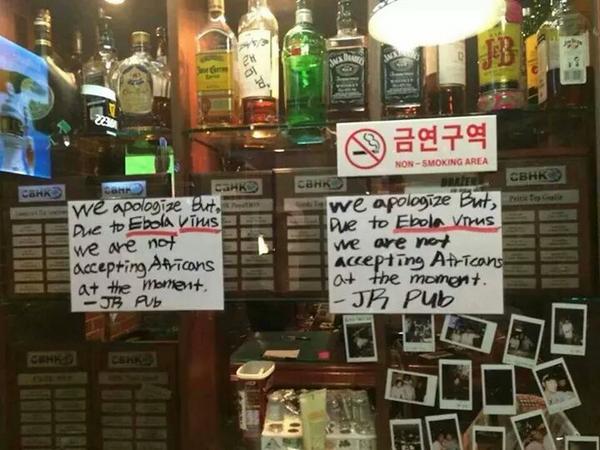
Africans unwelcome as Ebola threat

Ebola gives pub excuse to bar black people

With ethnic relations once again making headlines in America, racism elsewhere can sometimes make discrimination appear relatively minor by comparison. Consider what those of African origin face when living or traveling in Asia, for example.

Today’s illustration comes from Twitter, where one restaurant in South Korea is refusing to serve black people due to fears over Ebola!

Imagine the outrage were this sign to appear anywhere in the United States:ebolakorea

Given that many American soldiers stationed in Korea are African-American, it’s hard to believe this isn’t generating more attention.

Exploding demand for higher education worldwide

International student enrollment is on the rise at U.S. colleges.

In total, 764,495 international students were enrolled at colleges and universities across the United States during the 2011-2012 school year, up 5.7 percent from the previous year, according to a November 2012 report from the Institute of International Education.

The U.S. News Best Colleges rankings can help prospective American and international students refine their list of target schools in the United States, but some of the world’s best universities can be found outside the U.S. as well.

China, Australia, the United Kingdom, Germany and France all attract more than 100,000 international students each year, according to IIE data.

Latin America, the Middle East and other parts of Asia have also seen an uptick in international student enrollment over the past decade, according to a study by the Organisation for Economic Co-operation and Development.

One explanation for the trend toward international education: an “exploding demand for higher education worldwide,” the OECD notes.

Studying in a foreign country – whether for a semester, a year or for an entire degree – also helps prepare students to enter a high-tech and highly global economy, says Allan Goodman, president of IIE.

Executives at multinational corporations might work in nine or 10 different countries throughout their career. Those who stay closer to home will likely still work with people from other cultures on a regular basis, says Goodman, who co-authored “A Student Guide to Study Abroad.”

“If you’re the top student, but you’ve never sat next to a Chinese or Brazilian, or had an argument with an Indian or a discussion with a Frenchman, you’re not going to be prepared to be a worker in the global marketplace,” he says.

Sorting out where to study and why can be a multipronged equation.

For some, language is a primary factor. Students either want to learn in their native language or become fluent in another. Others want to gain business expertise abroad in order to get a leg up in an increasingly competitive workforce.

Many international students also choose where to study based on where they hope to start their careers, says Daniel Obst, IIE’s deputy vice president of international partnerships in higher education.

“There’s a great opportunity in another country to do academic work, but also then connect it to your first job,” he says.

Obst has personal experience as an international student. Born and raised in Germany, Obst earned his bachelor’s degree in the United States and his master’s in England. His academic interests motivated him to study outside of Germany, he says.

“I wanted to do international relations, and back then they didn’t have that as a degree program in Germany. They had political science,” he says.

Whatever the motive to study overseas, each major region has something to offer students bent on studying overseas.

Europe

International students accounted for 18.6 percent of total higher ed enrollment in the U.K. in 2010-2011, according to IIE.

Students can venture outside of the U.K. and still get a great education in Europe.

Schools such as the Swiss Federal Institute of Technology, Ecole Normale Superieure de Paris, the University of Copenhagen in Denmark and Ruprecht-Karls-Universitat Heidelberg in Germany also have strong global reputations.

Asia

Students from China, India and South Korea account for 52 percent of the 4.1 million international students worldwide, according to the OECD. But the region has also emerged as a top destination for foreign students.

Communist Chinese elite bank offshore

offshoreMore than a dozen family members of China’s top political and military leaders are making use of offshore companies based in the British Virgin Islands, leaked financial documents reveal.

The brother-in-law of China’s current president, Xi Jinping, as well as the son and son-in-law of former premier Wen Jiabao are among the political relations making use of the offshore havens, financial records show.

The documents also disclose the central role of major Western banks and accountancy firms, including PricewaterhouseCoopers, Credit Suisse and UBS in the offshore world, acting as middlemen in the establishing of companies.

The Hong Kong office of Credit Suisse, for example, established the BVI company Trend Gold Consultants for Wen Yunsong, the son of Wen Jiabao, during his father’s premiership — while PwC and UBS performed similar services for hundreds of other wealthy Chinese individuals.

The disclosure of China’s use of secretive financial structures is the latest revelation from “Offshore Secrets”, a two-year reporting effort led by the International Consortium of Investigative Journalists (ICIJ), which obtained more than 200 gigabytes of leaked financial data from two companies in the British Virgin Islands, and shared the information with the Guardian and other international news outlets.

In all, the ICIJ data reveals more than 21,000 clients from mainland China and Hong Kong have made use of offshore havens in the Caribbean, adding to mounting scrutiny of the wealth and power amassed by family members of the country’s inner circle.

As neither Chinese officials nor their families are required to issue public financial disclosures, citizens in the country and abroad have been left largely in the dark about the elite’s use of offshore structures which can facilitate the avoidance of tax, or moving of money overseas. Between $1tn and $4tn in untraced assets have left China since 2000, according to estimates.

Income inequality is a mounting issue in China, a consequence of the country’s rapid growth. A Beijing university study suggests that income at the richest 5th percentile are 34 times higher than those of the bottom 5th percentile.

China’s rapid economic growth is leading to a degree of internal tension within the nation, as the proceeds of the country’s newfound prosperity are not evenly divided: the country’s 100 richest men are collectively worth over $300bn, while an estimated 300m people in the country still live on less than $2 a day. The Chinese government has made efforts to crack down citizens’ movements aimed at promoting transparency or accountability among the country’s elite.

Source: The Guardian


Mugabe’s ban on Western poll observers

A younger Mugabe on the election poster

President Robert Mugabe on Thursday reiterated the Zimbabwe government’s position to bar Western observers from general elections set for Wednesday, insisting that only officials from friendly nations would be allowed to monitor the polls.

The veteran Zimbabwean leader said the United States, United Kingdom and other Western countries would never be invited to observe elections in Zimbabwe until they remove economic sanctions against top Harare officials.

“Our position is very clear. We will never allow the Americans and the British to come and observe our elections as long as their sanctions continue to burden our people,” he told supporters during a campaign rally in Chinhoyi farming town, about 100km northwest of Harare.

Zimbabwe has since 2002 refused to allow Western observers to witness the country’s general elections, accusing them of bias in favour of the opposition.

The Zimbabwe government however, said it has no problems welcoming election observers from the United Nations, Asia, the Southern African Development Community, the African Union and the BRICS group of countries comprising Brazil, Russia, India, China and South Africa.

Mugabe also said Thursday that the US and UK had no moral ground to lecture Zimbabwe on democracy when their own histories are tainted with cases of human rights abuses.

The US said earlier this week that it was concerned about the conditions prevailing in Zimbabwe ahead of general elections set for July 31.

A State Department spokesperson said Washington was wary about lack of transparency in electoral preparations and continued partisan behaviour by security organs, particularly the army and police. – APA