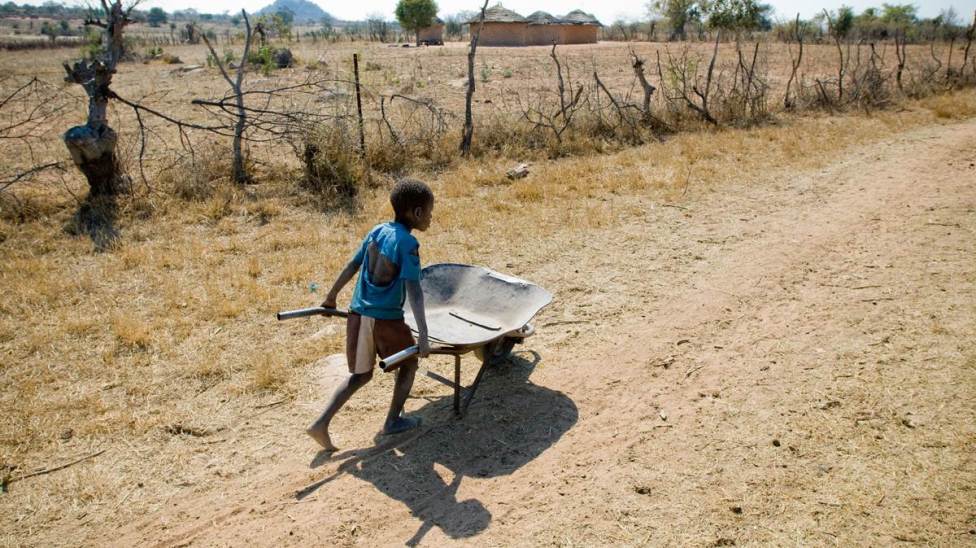
Famine: Zimbabwe’s chickens are coming home to roost

Zimbabwe, which has been ruled by the radical Afro-Marxist party ZANU PF for the last 39 years and long a darling of the global left, is finally hitting an economic brick wall with a possible famine in the offing, at least according to the United Nations World Food Programme.

The economic mismanagement of the country has been complemented by what is being called “the worst drought in almost four decades, cyclone-induced floods and an economic collapse have left Zimbabwe on the verge of its worst-ever famine”.

The southern African nation will probably run out of maize — its staple food — by January and about three out of five Zimbabweans won’t have enough to eat, according to the United Nations World Food Programme.

The government has already declared a state of disaster because of the drought, which has decimated harvests. One of the strongest-ever cyclones in the southern hemisphere also destroyed crops in March and a deepening economic crisis has limited the government’s ability to address the looming shortfalls.

Since a parity peg to the U.S. dollar was dropped in February, the local currency has slumped to 13.85 to the dollar, making it the world’s worst performer. That’s slashed spending power in a country where most goods are imported. Zimbabwe is already struggling to find sufficient foreign exchange to fund imports of fuel and wheat.

While Zimbabwe has experienced intermittent food shortages for the last two decades, the problem has mostly been limited to rural areas. This time, 3 million of the 8.5 million people at risk of food insecurity are in cities, said Eddie Rowe, the WFP’s country director in Zimbabwe.

“You will have a lot more people hungry in Zimbabwe than ever before,” he said. In the past, “in urban areas the alarm bells were not ringing.”

“The drought has just exacerbated the situation,” said Jee-A van der Linde, an economist at NKC African Economics in Paarl, South Africa. It will “deteriorate to a point where they need foreign aid.”

The country’s maize crop is expected to plummet 54% this year and Agriculture Secretary Ringson Chitsiko warned in March it only had seven months of grain stockpiles, including corn. Parts of north-western Zimbabwe had their lowest rainfall since 1981, according to the Southern African Development Community.

Zimbabwe has made attempts to replenish its maize stocks, but an international tender for at least 750,000 tons of corn failed because the government and bidders couldn’t agree on financial terms, two people familiar with the situation said.

The country has now agreed to buy 150,000 tons of maize from South Africa, the people said. However, analysts estimate Zimbabwe could need as much as 1 million tons of maize imports.

Sibusiso Moyo, the country’s foreign minister and head of its grain importation committee, didn’t respond to messages sent to his office seeking comment.

Zimbabwe’s crisis has been compounded by smaller harvests in neighboring countries, such as Zambia, which often have surpluses

The white maize preferred by Zimbabweans also limits the pool of potential suppliers, as the yellow variety is more common in other parts of the world. In southern Africa, white maize is mainly reserved for human consumption and yellow is fed to animals.

Yuan inclusion in SDR basket inevitable

An integrated Eurasian block will dominate the world. The Chinese are acting upon that insight.

The IMF is due to re-examine the composition of its currency basket for Special Drawing Rights, a foreign-exchange reserve asset for fund members, later this year says Zhao Yongsheng.

“Our assessment now is that the substantial real effective appreciation [of the yuan] over the past year has brought the exchange rate to a level that is no longer undervalued,” the IMF said last week after it concluded its 2015 Article IV Consultation Mission to China.

Does this mean that the yuan is about to be included in the SDR currency basket? We can consider a “signal” sent by IMF Managing Director Christine Lagarde during a speech at Fudan University in Shanghai in March: “It’s not a question of if, it’s a question of when.”

Her speech, and the IMF’s announcement, indicate that the yuan is quite likely to be included in the SDR basket when it is reviewed this year.

But merely joining the SDR basket is not the only important step for the yuan, even if it is already a significant development in the currency’s internationalization.

Actually, the inclusion of the yuan in the SDR basket is not just a question of “if” or “when,” but a question of “how much.”

Let’s look first at the composition of the SDR basket, which now includes the four strongest currencies in the world: the dollar, euro, yen and British pound.

When the SDR was launched in 1981, the shares for the five currencies in the basket were 42 percent, 19 percent, 13 percent, 13 percent and 13 percent for the dollar, Deutsche mark, French franc, yen and pound, respectively. The basket is adjusted every five years.

Looking at this original composition, we can divide the basket’s basic structure into two blocks: the “Deutsche mark-French franc block” (or the “euro block” after the adoption of the European single currency in 2001) and the “dollar-pound-yen block.”

This division is based on differences in culture, historical links and even military relationships.

It is true that Germany and France are not the same, as one is a Germanic culture and the other is a French or half-Latin culture.

Nevertheless, these countries had no choice but to work together to establish and expand the European Union. Especially since the birth of the euro, monetary and financial relations between Germany and France have become closer. They are both countries of Europe’s continental culture.

For their part, the UK and US share an “Anglo-Saxon” culture, and their relationship is that of siblings. With regard to Japan, it has close links to the US due to its post-WWII occupation and rebuilding by the US. That’s why we put these three countries and their currencies together.

Originally, the combined share of the mark and franc was 32 percent.

Even if we assume this European continental culture block increased to 37.4 percent for 2011-15, it would still lag far behind the dollar-pound-yen block, which stands at 62.6 percent for the same period.

How can we maintain balance in the SDR basket?

Balance is essential for any game with multiple players, and that is also true of currency baskets.

In the case of the above division, obviously the gap of 25.2 percentage points between two blocks is too huge to be good for stability.

If we assume a share of 10 percent for the yuan in the SDR basket, the euro plus the yuan will make up 47.4 percent of the basket, against a new share for the dollar-pound-yen block of 52.6 percent. Now, the gap is not so large.

Why do we put the euro and yuan together? This implies the necessity for Europe to find another force to implicitly provide balance against the “American hegemony.”

The increasing closeness of Europe and China will be gradually reinforced with the adoption of China’s “One Belt, One Road” initiative and the operation of the China-initiated Asian Infrastructure Investment Bank.

This solution can also be a moderate and acceptable reform for the current players in the SDR basket, whatever their position, because even with the new composition, the dollar-pound-yen block will retain a dominant position with 5.2 percentage points more than the euro-yuan block.

Finally, in China’s pursuit of inclusion, France will play a major role – and not only because the IMF’s president is usually a French national.

It is also because France needs China, probably much more than do other countries, to recover from the lingering effects of the financial crisis and keep its economy growing.

Source:Global Times

The author is a Paris-based economist and vice-president of the Paris-based China-France Association of Lawyers and Economists. bizopinion@globaltimes.com.cn

Repo left unchanged but rand sinks

The rand was a touch softer against the dollar on Thursday, coming off the session’s highs after the central bank left rates unchanged despite a hawkish policy statement that had fuelled last minute expectations for a hike.

Governor Lesetja Kganyago said the bank’s monetary policy committee voted 4:2 in favour of keeping the benchmark repo at 5.75% but warned the deteriorating inflation outlook meant the stance could not be “maintained indefinitely”.

The rand touched a session high of 11.7350/dollar after Kganyago warned that inflation expectations remained uncomfortably close to the upper end of the 3-6% target range over the longer term.

It had retreated to 11.8400 by 1531 GMT, little changed from Wednesday’s closing level of 11.8355.

“The sell-off in the rand post the MPC meeting … tells us that the market wants the Reserve Bank to start hiking interest rates,” said Jana van Deventer, a market analyst at ETM.

“There’s no doubt that the statement was hawkish, and that could provide support for the rand at the margins in coming months if they actually start hiking interest rates but it might be too little too late.”

Government bonds were weaker after the rate call, with the yield on the benchmark government bond maturing in 2026 ending the session at 7.985%, up 2.5 basis points from the previous day.

Strong dollar a threat to Eskom and South Africa

In the world of economics, one policymaker towers above all others. The head of America’s central bank, Janet Yellen, presides over a $17 trillion economy. The empire of her nearest competitor, Mario Draghi, amounts to a relatively puny $10 trillion. On top of this, the dollar’s global role means Ms Yellen has a huge impact abroad, influencing more than $9 trillion in borrowing in dollars by non-financial companies outside America—more than enough to buy all the firms listed on the stock exchanges of Shanghai and Tokyo. As the dollar strengthens both in response to healthier growth in America and in the expectation that the Federal Reserve is getting ready to raise rates, this burden is becoming harder to bear.

Dollar borrowing is everywhere, but the biggest growth has been in emerging markets. Between 2009 and 2014 the dollar-denominated debts of the developing world, in the form of both bank loans and bonds, more than doubled, from around $2 trillion to some $4.5 trillion, according to the Bank for International Settlements (BIS). Places like Brazil, South Africa and Turkey, whose exports fall far short of imports, finance their current-account gaps by building up debts to foreigners.

Even countries without trade gaps have been borrowing heavily. With interest rates on American assets so meagre—a five-year Treasury bond pays just 1.5%—those with dollars to invest have sought out more rewarding opportunities. Firms based in emerging markets seemed to fit the bill. Some are big names: state-owned energy giants like Russia’s Gazprom and Brazil’s Petrobras have been issuing dollar bonds via subsidiaries based in Luxembourg and the Cayman Islands. Others are smaller. Recent months have seen Lodha group, an Indian property developer, Eskom, a South African power generator, and Yasar, a Turkish firm that makes TV dinners, sell dollar-denominated bonds. By borrowing dollars at several percentage points below the prevailing interest rate in their domestic currency, CEOs have pepped up profits in the short term.

But finance rarely offers a free lunch. The worry is that tumbling energy prices mean firms like Gazprom and Petrobras now have much lower dollar income than expected when they took on debts. Others, such as Lodha, Eskom and Yasar, have few dollar earnings. Taking on debt just before a shift in exchange rates can be painful. In 2010 a Turkish firm borrowing $10m via a ten-year bond with a 5% coupon could expect to pay 22.5m lira ($15m) over the life of the bond. But the lira is down 43% against the dollar since then; the payments are now over 39m lira.

Where foreign debts and earnings line up there is little reason to worry. Asian firms’ foreign-currency debts tripled from $700 billion to $2.1 trillion between 2008 and 2014, going from 7.9% of regional GDP to 12.3%, according to economists at Morgan Stanley, a bank. To see whether the surge was bearable, the economists looked at the accounts of 762 firms across Asia. The findings were reassuring: on average 22% of their debt is dollar-denominated, but so are 21% of earnings. Although Asian firms are a big part of the emerging-markets’ borrowing binge, on the whole they seem well placed to cope with a rising dollar.

Yet there are still two reasons to worry. First, the outlook for China is a puzzle. The country holds $1.2 trillion in Treasury bills, many of which are sitting in its sovereign-wealth fund. When the dollar rises, the fund gets richer. But even in a dollar-rich country, there can be pockets of pain. China’s firms have built up a nasty currency mismatch. Almost 25% of corporate debt is dollar-denominated, but only 8.5% of corporate earnings are. Worse, this debt is concentrated, according to Morgan Stanley, with 5% of firms holding 50% of it.

Chinese property developers are the most obviously vulnerable. Companies like Evergrande, China Vanke and Wanda build and sell offices and houses, so most of their earnings are in yuan. Banned from borrowing directly from banks, they have been active issuers of dollar bonds. They have also borrowed from trust companies, according to Fitch, a rating agency. The trusts are themselves highly leveraged and have borrowed dollars via subsidiaries in Hong Kong. This arrangement will amplify the economic pain if property prices in China continue to decline, as they have been doing for several months.

The second problem is that whole economies, rather than just the corporate sector, look short of dollars. In Brazil and Russia, for instance, bail-outs of firms lacking greenbacks are blurring the lines between the state, banks and big companies. The general scramble for dollars has contributed to the plunge of the real and the rouble. Others could follow this path. Turkey’s dollar borrowing has grown rapidly since 2009: in addition to the debts Turkish firms have taken on, the state’s external debt has grown to almost 50% of GDP, far above the average for middle-income countries (23%). South Africa looks worrying too: its current-account deficit is the widest of any big emerging market, and the government’s external debt is 40% of GDP.

A wave of defaults would be unlikely to cause problems as widespread as the subprime crisis of 2008. Most bonds are owned by deep-pocketed institutional investors such as pension funds and insurers. The banks that have made loans face far tougher regulation than they did eight years ago and are generally far better capitalised. An emerging-market rout would not cause another Lehman moment. But it would mean big job losses at stricken firms. As investors reprice risk it would probably also lead to a sudden tightening of credit. In countries like South Africa or Turkey, where growth is evaporating fast, that could still be very painful. – The Economist

Russia may ban circulation of US dollar

Russia may ban the circulation of the United States dollar.

The State Duma has already been submitted a relevant bill banning and terminating the circulation of USD in Russia, APA’s Moscow correspondent reports.

If the bill is approved, Russian citizens will have to close their dollar accounts in Russian banks within a year and exchange their dollars in cash to Russian ruble or other countries’ currencies.

Otherwise their accounts will be frozen and cash dollars levied by police, customs, tax, border, and migration services confiscated.

After the law enters into force, it will be impossible to obtain cash dollar in Russia. The ban or termination of the US dollar will not apply to the exchange operations carried out by Russian Central Bank, the Russian government, ministries of foreign affairs and defense, the Foreign Intelligence Service and the Federal Security Service.

Source: APA

Petrodollars quit world markets for first time in 18 years

Energy-exporting countries are set to pull their “petrodollars” out of world markets this year for the first time in almost two decades, according to a study by BNP Paribas.

Driven by this year’s drop in oil prices, the shift is likely to cause global market liquidity to fall, the study showed.

Brent crude futures have fallen 23 percent this year, with 2014 promising to be only the second year since 2002 that crude prices will end the year lower than they began it.

This decline follows years of windfalls for oil exporters such as Russia, Angola, Saudi Arabia and Nigeria. Much of that money found its way into financial markets, helping to boost asset prices and keep the cost of borrowing down, through so-called petrodollar recycling.

This year, however, the oil producers will effectively import capital amounting to $7.6 billion. By comparison, they exported $60 billion in 2013 and $248 billion in 2012, according to BNP Paribas calculations.

Petrodollar recycling peaked at $511 billion in 2006, BNP said.

“At its peak, about $500 billion a year was being recycled back into financial markets. This will be the first year in a long time that energy exporters will be sucking capital out,” said David Spegel, global head of emerging market sovereign and corporate Research at BNP.

In other words, oil exporters are now pulling liquidity out of financial markets rather than putting money in. That could result in higher borrowing costs for governments, companies, and ultimately, consumers as money becomes scarcer.

Spegel acknowledged that the net withdrawal was small. But he added: “What is interesting is they are draining rather than providing capital that is moving global liquidity. If oil prices fall further in coming years, energy producers will need more capital even if just to repay bonds.”

The reversal is largely down to Russia and the rest of the ex-Soviet Union, which BNP estimates have withdrawn $57 billion from world markets.

Russian companies have been shut out of global markets since Western countries imposed sanctions because of the conflict in Ukraine. Those companies are increasingly forced to rely on their own cash reserves or central bank funding to meet external debt repayments.

Will China enter the heart of global finance?

The issue of whether the Chinese should be part of the International Monetary Fund’s Special Drawing Right, the composite reserve currency used in official financing, is highly technocratic, but the political questions at stake go to the core of world money and power – and will be discussed, in the background, at the annual meetings of the IMF and World Bank in Washington this week.

China is bidding to enter the heart of global finance by establishing its currency, the renminbi, as part of an ubiquitous monetary unit used in official transactions around the world.

The decision on a new SDR structure, to be made in the next 15 months, will influence how China and its currency can play a bigger part in driving world trade, investment and capital flows. The renminbi could eventually challenge the dollar and its pivotal position in world money — which is why the U.S. government and Federal Reserve are examining this with intense interest.

China is unlikely to mount an open campaign to enter the SDR, grouping the main reserve currencies, the dollar, the euro (linking countries in European monetary union led by Germany and France), the Japanese yen and British pound, and is valued at around $1.5.

Beijing would prefer the question of recalculating the composition of the SDR, which comes up for review in 2015, to follow market developments, reflecting a big increase in demand for renminbi financing from private banks, central banks, traders, corporations and asset managers.

Many hurdles remain. These include the renminbi’s lack of formal convertibility for transactions that shift capital inside and outside the country, where Beijing is reluctant to abolish all controls. In addition, China still has to release more statistics to the Fund about its monetary reserves and other matters. However, Chinese measures over the past three years to liberalize and internationalize its currency, and a big increase in financial market interest in China, are pointing toward a broadening of the SDR’s composition from January 2016.

An additional factor is China’s own action to galvanize emerging market economies toward reforming word monetary arrangements. This includes the five-nation Brics group’s decision to set up the New Development Bank in Shanghai, potentially challenging the IMF and the World Bank.

China believes it is close to earning the status of a reserve money, the first time that an emerging market currency would attain this position. Chinese entry into the “magic circle” has been advanced by the British government’s September decision to issue renminbi-denominated bonds, the first big government to take such a step, and allow the proceeds to be held as reserves by the Bank of England.

The main conditions for the renminbi to pass the SDR test are that it should be widely used in trade and be “freely usable” in international payments and asset management. Although a long way behind the dollar, the renminbi has made impressive strides recently and is challenging the euro in several key fields.

Next year’s planned review will touch, too, on the opportunity for the SDR to play a greater role on financial markets, for example in denominating bond issues. The SDR has lost ground as a financial vehicle in the past two decades, reflecting the surging importance of international private sector capital markets. But with the addition of the renminbi, it may be about to make a comeback.

Source: USA Today

Panama staring at empty grocery shelves

Less than four weeks after starting his new job, Panama’s President Juan Carlos Varela already has a serious challenge to deal with: empty grocery shelves.

Over the last five years, in fact, food prices have risen more than 24%.

Inflation isn’t a particularly unusual phenomenon in Central America, or in developing countries in general.

But what sets Panama apart is that the country is dollarized.

In its entire 111-year history as a sovereign nation, in fact, Panama has never issued its own currency.

This means that the country is subject to US monetary policy; when the Fed prints money, negative effects are quickly exported to Panama.

Of the jobs that the Fed claims they have created by printing $3.7 trillion over the last few years, zero of those have ended up in Panama.

Not to mention, the Panamanian government doesn’t have an endless supply of foreigners lining up to buy its debt.

Source: Sovereign Man

Central banks’ investment in yuan puts currency near reserve status

Investment by dozens of central banks comes despite currency not being fully convertible

At least 40 central banks have invested in the yuan and several others are preparing to do so, putting the mainland currency on the path to reserve status even before full convertibility, Standard Chartered said.

Twenty-three countries have publicly declared their holdings in yuan, in either the onshore or offshore markets, yet the real number of participating central banks could be far more than that, said Jukka Pihlman, Standard Chartered’s Singapore-based global head of central banks and sovereign wealth funds.

Pihlman, who formerly worked at the International Monetary Fund advising central banks on asset-management issues, said at least 17 central banks had invested in yuan assets without declaring they had done so.

The US dollar is still the world’s most widely held reserve currency, accounting for nearly 61 per cent of global allocated reserves at the end of last year, according to IMF data. The ratio has been on a declining trend since 2001, when 71 per cent of the world’s reserves were denominated in US dollars.

The IMF does not disclose the percentage of reserves held in yuan, but the emerging market countries’ share of reserves in “other currencies” has increased by almost 400 per cent since 2003, while that of developed nations grew 200 per cent, according to IMF data.

Pihlman said “a great number of central banks are in the process of adding [yuan] to their portfolios”.

“The [yuan] has effectively already become a de facto reserve currency because so many central banks have already invested in it,” he said. “The [yuan] may become a de facto reserve currency before it is fully convertible.”

The central banks more likely to add yuan holdings in the future were the ones with “strong trade linkages to China” and those which had relatively large levels of reserves which could consider diversifying more for return-related reasons, he said.

“The [yuan’s] convertibility may be already there for central banks in a way that has got them comfortable to start investing in the currency,” Pihlman said.

The rising popularity of the yuan among central bankers is probably mainly due to Beijing’s extremely favourable treatment of them as it has sought to encourage investment in the yuan.

For example, central banks enjoy preferential treatment in the qualified foreign institutional investor category, both on the size of the quota and the length of the lock-up period. The quotas to the interbank bond markets given to central banks are not publicly known, but some of those announced by investing central banks are up to 10 times larger than others in the programme and, most importantly, free of any capital controls.

“Central banks and sovereign funds have special treatment,” Pihlman said. “They have the ability to invest in a way that any other investor does not. When it comes to convertibility, there is nothing kind of formally out there, but the feed back from central banks is that it is fully convertible.”

Among the 23 central banks known to have yuan holdings, 11 are from Asian markets with close trade links with mainland China: Australia, Hong Kong, Indonesia, Japan, South Korea, Macau, Malaysia, Nepal, Pakistan, Singapore and Thailand, according to public records from either central banks’ own statements or central bankers’ interviews with the press.

The rest are five from Europe – Austria, Belarus, Norway, France and Lithuania – and seven from South America or Africa – Bolivia, Chile, Ghana, Kenya, Nigeria, South Africa and Tanzania.

Source: South China Morning Post


Total CEO sees no reason to pay for oil in dollar

Christophe de Margerie, Total’s chief executive said on Saturday the euro should have a bigger role in international trade.

The oil major’s CEO was responding to questions about calls by French policymakers to find ways at EU level to bolster the use of the euro in international business following a record U.S. fine for BNP.

“There is no reason to pay for oil in dollars,” he said. He said the fact that oil prices are quoted in dollars per barrel did not mean that payments actually had to be made in that currency.

French Finance Minister Michel Sapin said on Thursday that euro zone finance ministers would discuss ways of boosting use of the euro in international trade in their next monthly meeting on Monday.

“It would be a way to protect businesses when, outside of U.S. territory, they carry out transactions that are perfectly legal in the country they belong to,” he said.

Source: Reuters

Gold rises sharply on Fed interest-rate outlook

Gold futures jumped the most in 14 weeks as the Federal Reserve said U.S. interest rates will remain low, driving the dollar lower and boosting demand for the precious metal as an alternative investment.

According to Bloomberg, the greenback fell to a four-week low against a basket of 10 major currencies. Yesterday, Fed Chair Janet Yellen said rates will probably remain low for a considerable time after debt purchases by the central bank end. In 2013, gold ended a 12-year rally on expectations that the Feb would taper monetary stimulus following gains in the labor market.

“Some people are buying gold since Yellen made it clear that the low-interest rate regime is here to stay,” Tommy Capalbo, a broker at Newedge Group in New York, said in a telephone interview. “The dollar’s weakness is also supportive.”

Gold futures for August delivery rose 1.7 percent to $1,294.60 an ounce at 10:05 a.m. on the Comex in New York, A close at that price would mark the biggest gain for a most-active contract since March 12. Earlier, the metal reached $1,295.90, the highest since May 23.

The euro will remain the world’s favourite tradeable currency

With the rise of Bitcoin and general hostility towards so-called fiat currencies, notwithstanding the euroskeptic animosity towards the euro, many people are speculating about the ultimate demise of the euro. However, as French politician Marine Le Pen recently intimated to Der Spiegel, the euro is something of a German creation.

In essence, the euro represents a reincarnated Deutschemark, with bits of Dutch guilders and Belgian francs thrown in. Ever since French Finance Minister Pierre Bérégovoy decided to start fighting inflation in the German style during the 1980s, France also acquired a hard currency hitched to the Deutschemark, leading to the equation Germany + Benelux + France = one European currency. The French almost succeeded in smuggling a very old Gallic monetary unit, the écu, in as the ECU (European Currency Unit) but somehow the ploy did not succeed and today we know it as the euro, officially known to fx traders as the EUR. The public at large have got used to the symbol €.

And let’s not forget about Austria which also joined the monetary Anschluss with aplomb, ditching the Austrian schilling on 1 January 2002 when the euro started to circulate officially in the so-called eurozone.

Even if all the countries in Southern Europe had to go back to trading in their national currencies, the biggest part of the European Union, economically speaking, would still be using a unitary currency. The combined GDP of Germany, Austria, France and the Benelux countries is $7,75 trillion, whereas the total eurozone GDP equals $12,7 trillion. So we see that the original European currency club whose currencies first started to converge in the 1980s constitutes 61 percent of the eurozone’s GDP. If Italy is thrown in, it goes up to almost 77%. Italy has a large economy worth just over $2 trillion of annual GDP. During the dying days of the lira, Italy too started to seriously converge toward hard-currency status, similar to its transalpine neighbours. Parts of Northern Italy are really no different to Germany, with medium-sized businesses being heavily oriented towards exports of specialised machinery and consumer goods, including gold jewellery.

Talk in the British financial press of the “Club Med” countries who are out of sync with Germany and neighbours to the north-west is therefore of no real consequence, as any currency trader knows. Betting against the euro has been, for the most part, like going short the old Deutschemark or Swissie against the dollar, a long-term losing trade if ever there was one.

There are only two really liquid currencies in the world today: the dollar (USD) and the euro (EUR). Traders at the major currency banks like Citi, Deutsche, HSBC, JP MorganChase, UBS and others usually make a market in the EUR-USD pair in “half a yard”, i.e. half a billion euros that may be traded in a split second.

The recent hostility of the USA towards French and Swiss banks like BNP Paribas or Crédit Suisse has probably not been lost on Europeans in general. If ever the world had to go back to a dollar-only system, America could dictate terms (and gargantuan fines!) to everyone else.

So, love it or hate it, the euro is here to stay. If there had been another strong currency in the world, perhaps its future would have been less certain, but given long-term dollar weakness, it is the US currency that may unravel some day in the not too distant future. America has simply accumulated too many huge deficits, including budget and trade deficits, for the dollar not to depreciate over the long haul.

Probably the most stable currency in the world is the Swiss franc (CHF). However, despite Switzerland’s economic prowess and major role in banking, a country of 7 million people will never provide us with a global, tradeable currency.

The size of the global foreign exchange or FX market is $5,3 trillion per day. That is according to the Bank for International Settlements and the global results from the 2013 Triennial Central Bank Survey of Foreign Exchange and OTC Derivatives Markets Activity.

The EUR/USD (about 33% of all trade by volume) is the most actively traded currency pair by far, followed by the GBP/USD (13%) and USD/JPY (12%). Together these pairs alone account for 58% of all forex trade by volume. In their other possible combinations, EUR/GBP (4%), EUR/JPY 2%, GBP/JPY (1%), they account for about 65% of all forex trade.

Taken individually and looking at all the estimated trading volume of all the pairs these typically trade in, the USD is involved in over 71% of all forex trade, the EUR in about 41%, the GBP in about 18%, and the JPY about 16%.

We see then that the euro, while not having the privileged position of the dollar as a reserve currency, is nonetheless the only currency that may rival the dollar in the global currency market. If ever US military adventures in the world could turn a sizeable number of nations against it, the dollar could start to suffer as the preferred medium for oil and other commodity transactions. The only other currency that could remotely replace it as the world’s leading currency would be the euro.

Long-term dollar weakness driven US deficits represent the prime reasons why investors and foreign central banks may eventually lose their appetite for the greenback.

The death of money

 James Rickards
James Rickards

The collapse of the monetary system awaits the world in the near future, says financial expert James Rickards. Russia and China’s desire to rid the US dollar of its global reserve currency status is an early sign of the “increasingly inevitable” crisis.

“China has three trillion dollars, but they are buying gold as fast as they can. China worries that the US is going to devalue the dollar through inflation so they want to have a hedge if the dollar goes down, so the gold will go up,” Rickards told RT.

As one of the key events in support of his forecast, Rickards points to the words uttered by Russian President Vladimir Putin at the 18th International Economic Forum in St. Petersburg that took place earlier this month.

“Putin said he envisions a Eurasian economic zone involving Eastern Europe, Central Asia, and Russia. The Russian ruble is nowhere near ready to be a global reserve currency, but it could be a regional reserve currency,” he said, as quoted by ETF Daily News.

Rickards’ book about the demise of the dollar was released in April under quite an apocalyptic name – ‘The Death of Money.’ However, the author is surprised that the events are unfolding much faster than he predicted.

“If anything, the tempo of events is faster than expected. Therefore, some of these catastrophic outcomes may come sooner than I wrote about.”

Last Wednesday, China and Russia signed a historic US$400 billion gas deal which will provide the world’s fastest growing economy with the natural gas it needs to keep pace for the next 30 years. Experts say this could be the catalyst that dethrones the greenback as the world’s reserve currency.

The best-selling author writes that the “linchpin” of the collapse is the approaching failure of the dollar since it is at the foundation of the system. Powerful countries such as Russia, China, Iran, and India do not rely on the US in their national security and would benefit from the US economy being weaker, thus desiring to break free from the dollar standard.

He elaborates that the dual collapse “looks increasingly inevitable.”

“The mistakes have already been made. The instability is already in the system. We’re just waiting for that catalyst that I call the snowflake that starts the avalanche,” he said, as quoted by ETF.

There are three big international factors that are pressuring the dollar right now – Russia, China, and Saudi Arabia.

“Since the 1970s, Saudi Arabia [has been] the leader in what’s called the petrodollar. It basically means that Saudi Arabia and, by extension, OPEC, price oil in dollars, so the world market is in dollars.

“Russia is a major natural resource exporter; they price their exports in dollars as well. But Russia now is engaged in a financial war with the US around the issues in Crimea and Ukraine.”

The threats to the dollar are “ubiquitous,” the author states in his book. The only way the US can pay off its $17 trillion debt is with inflation, which would drive other countries away from the dollar while the accumulation of gold by Russia and China presages the shift to a new reserve asset.

“The next time we will have a liquidity crisis in the world it’s going to be bigger than the ability of central banks to deal with it. The IMF will basically have to bail out the world by printing the SDRs (an international reserve asset created by the IMF in 1969 to supplement its member countries’ official reserves). By that time, you will see the SDR emerge as the new global world currency,” Rickards told RT.

The Fed is the Great Deceiver

pcrBy Paul Craig Roberts and Dave Kranzler.

Is the Fed “tapering”? Did the Fed really cut its bond purchases during the three month period November 2013 through January 2014? Apparently not if foreign holders of Treasuries are unloading them.

From November 2013 through January 2014 Belgium with a GDP of $480 billion purchased $141.2 billion of US Treasury bonds. Somehow Belgium came up with enough money to allocate during a 3-month period 29 percent of its annual GDP to the purchase of US Treasury bonds.

Certainly Belgium did not have a budget surplus of $141.2 billion. Was Belgium running a trade surplus during a 3-month period equal to 29 percent of Belgium GDP?

No, Belgium’s trade and current accounts are in deficit.

Did Belgium’s central bank print $141.2 billion worth of euros in order to make the purchase?

No, Belgium is a member of the euro system, and its central bank cannot increase the money supply.
So where did the $141.2 billion come from?

There is only one source. The money came from the US Federal Reserve, and the purchase was laundered through Belgium in order to hide the fact that actual Federal Reserve bond purchases during November 2013 through January 2014 were $112 billion per month.

In other words, during those 3 months there was a sharp rise in bond purchases by the Fed. The Fed’s actual bond purchases for those three months are $27 billion per month above the original $85 billion monthly purchase and $47 billion above the official $65 billion monthly purchase at that time. (In March 2014, official QE was tapered to $55 billion per month and to $45 billion for May.)

Why did the Federal Reserve have to purchase so many bonds above the announced amounts and why did the Fed have to launder and hide the purchase?

Some country or countries, unknown at this time, for reasons we do not know dumped $104 billion in Treasuries in one week.

Another curious aspect of the sale and purchase laundered through Belgium is that the sale was not executed and cleared via the Fed’s own National Book-Entry System (NBES), which was designed to facilitate the sale and ownership transfer of securities for Fed custodial customers. Instead, The foreign owner(s) of the Treasuries removed them from the Federal Reserve’s custodial holdings and sold them through the Euroclear securities clearing system, which is based in Brussels, Belgium.

We do not know why or who. We know that there was a withdrawal, a sale, a drop in the Federal Reserve’s “Securities held in Custody for Foreign Official and International Accounts,” an inexplicable rise in Belgium’s holdings, and then the bonds reappear in the Federal Reserve’s custodial accounts.

What are the reasons for this deception by the Federal Reserve?

The Fed realized that its policy of Quantitative Easing initiated in order to support the balance sheets of “banks too big to fail” and to lower the Treasury’s borrowing cost was putting pressure on the US dollar’s value. Tapering was a way of reassuring holders of dollars and dollar-denominated financial instruments that the Fed was going to reduce and eventually end the printing of new dollars with which to support financial markets.The image of foreign governments bailing out of Treasuries could unsettle the markets that the Fed was attempting to sooth by tapering.

A hundred billion dollar sale of US Treasuries is a big sale. If the seller was a big holder of Treasuries, the sale could signal the bond market that a big holder might be selling Treasuries in large chunks. The Fed would want to keep the fact and identity of such a seller secret in order to avoid a stampede out of Treasuries. Such a stampede would raise interest rates, collapse US financial markets, and raise the cost of financing the US debt. To avoid the rise in interest rates, the Fed would have to accept the risk to the dollar of purchasing all the bonds. This would be a no-win situation for the Fed, because a large increase in QE would unsettle the market for US dollars.

Washington’s power ultimately rests on the dollar as world reserve currency. This privilege, attained at Bretton Woods following World War 2, allows the US to pay its bills by issuing debt. The world currency role also gives the US the power to cut countries out of the international payments system and to impose sanctions.

As impelled as the Fed is to protect the large banks that sit on the board of directors of the NY Fed, the Fed has to protect the dollar. That the Fed believed that it could not buy the bonds outright but needed to disguise its purchase by laundering it through Belgium suggests that the Fed is concerned that the world is losing confidence in the dollar.

If the world loses confidence in the dollar, the cost of living in the US would rise sharply as the dollar drops in value. Economic hardship and poverty would worsen. Political instability would rise.

If the dollar lost substantial value, the dollar would lose its reserve currency status. Washington would not be able to issue new debt or new dollars in order to pay its bills.

Its wars and hundreds of overseas military bases could not be financed.

The withdrawal from unsustainable empire would begin. The rest of the world would see this as the silver lining in the collapse of the international monetary system brought on by the hubris and arrogance of Washington.

Paul Craig Roberts was Assistant Secretary of the Treasury for Economic Policy and associate editor of the Wall Street Journal. He was columnist for Business Week, Scripps Howard News Service, and Creators Syndicate. He has had many university appointments. His internet columns have attracted a worldwide following. His latest book, The Failure of Laissez Faire Capitalism and Economic Dissolution of the West is now available.