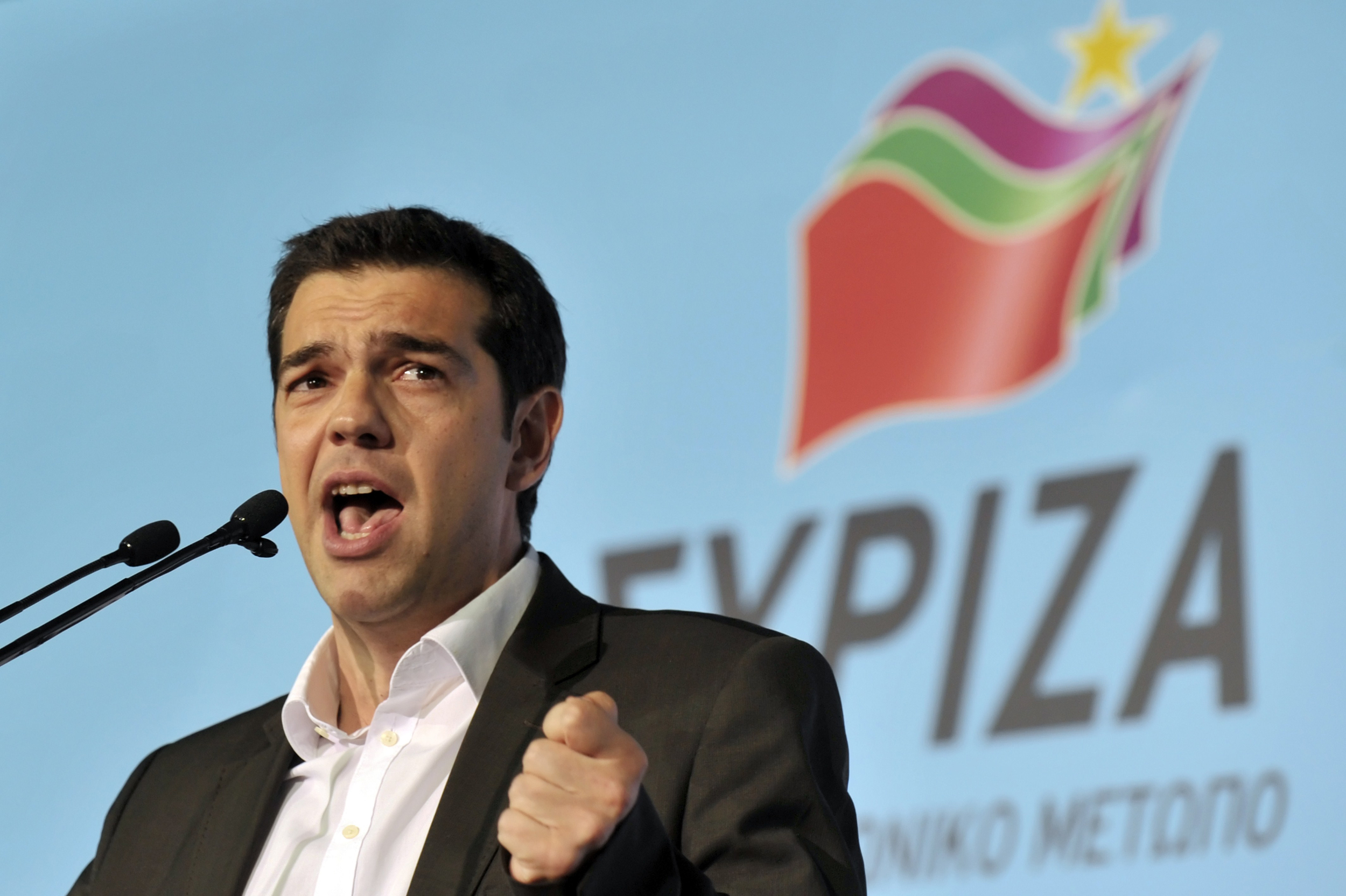
Grexit? Eurogroup says ‘Greece has closed the door’ with its referendum idea

AFP reports that Eurogroup head Jeroen Dijsselbloem on Saturday said Greece’s decision to hold a referendum over the future of its bailout programme was a “sad” decision that shut the door to further talks.

“The Greek government has apparently rejected our last proposals… that is a sad decision for Greece because it has closed the door for further talks where the door was still open in my mind,” the Dutch finance minister said as he arrived for talks with his eurozone counterparts.

Le Pen and Wilders announce new EU parliamentary group

Marine Le Pen, the leader of France’s National Front, announced the creation of Europe of Nations and Freedoms, a new far-right European Parliament group that will qualify for up to €17.5 million of EU money over the next four years.

Le Pen failed to form a group after the European elections last year, despite a surge in support for far-right parties. Her party topped the French vote, returning 24 MEPs.

At least 25 MEPs from seven different countries are needed to form a political group.The new group will include Geert Wilders’ Dutch Party for Freedom, the Freedom Party of Austria, Italy’s Lega Nord, and Belgium’s Vlaams Belang.

Le Pen did not reveal which MEPs from which countries have joined that core but that news is expected later today. At least two MEPs from two different countries not already linked to the alliance are needed to form the faction.

Parliament sources told EurActiv that at least one of the MEPs are thought to be from Poland’s Congress of the New Right. EurActiv understands that Hungary’s Jobbik party will not be joining because they are too extreme. Some press reports claimed a UK Independence Party member could be joining.

Le Pen announced last night that she would hold a press conference to unveil the faction. Wilders also hinted at an important announcement, according to Dutch media reports.

J’annoncerai demain à Bruxelles la constitution de notre groupe “Europe des Nations et des Libertés”. MLP

— Marine Le Pen (@MLP_officiel) June 15, 2015

She said on Twitter, “Tomorrow in Brussels, I will announce the creation of our group, Europe of Nations and Freedom.”

According to research by think tank Open Europe, based on 38 MEPs, the new group could apply for:

an annual grant of €2,974,718.39 to set up and run the new group;
a grant for a linked pan-European political party;
a grant for a linked political foundation or think tank;
amounting to €4,442,759.83 every year;
or about €17.5 million over the remaining four years of Parliament’s term.

Source: euractive.com

Yuan inclusion in SDR basket inevitable

An integrated Eurasian block will dominate the world. The Chinese are acting upon that insight.

The IMF is due to re-examine the composition of its currency basket for Special Drawing Rights, a foreign-exchange reserve asset for fund members, later this year says Zhao Yongsheng.

“Our assessment now is that the substantial real effective appreciation [of the yuan] over the past year has brought the exchange rate to a level that is no longer undervalued,” the IMF said last week after it concluded its 2015 Article IV Consultation Mission to China.

Does this mean that the yuan is about to be included in the SDR currency basket? We can consider a “signal” sent by IMF Managing Director Christine Lagarde during a speech at Fudan University in Shanghai in March: “It’s not a question of if, it’s a question of when.”

Her speech, and the IMF’s announcement, indicate that the yuan is quite likely to be included in the SDR basket when it is reviewed this year.

But merely joining the SDR basket is not the only important step for the yuan, even if it is already a significant development in the currency’s internationalization.

Actually, the inclusion of the yuan in the SDR basket is not just a question of “if” or “when,” but a question of “how much.”

Let’s look first at the composition of the SDR basket, which now includes the four strongest currencies in the world: the dollar, euro, yen and British pound.

When the SDR was launched in 1981, the shares for the five currencies in the basket were 42 percent, 19 percent, 13 percent, 13 percent and 13 percent for the dollar, Deutsche mark, French franc, yen and pound, respectively. The basket is adjusted every five years.

Looking at this original composition, we can divide the basket’s basic structure into two blocks: the “Deutsche mark-French franc block” (or the “euro block” after the adoption of the European single currency in 2001) and the “dollar-pound-yen block.”

This division is based on differences in culture, historical links and even military relationships.

It is true that Germany and France are not the same, as one is a Germanic culture and the other is a French or half-Latin culture.

Nevertheless, these countries had no choice but to work together to establish and expand the European Union. Especially since the birth of the euro, monetary and financial relations between Germany and France have become closer. They are both countries of Europe’s continental culture.

For their part, the UK and US share an “Anglo-Saxon” culture, and their relationship is that of siblings. With regard to Japan, it has close links to the US due to its post-WWII occupation and rebuilding by the US. That’s why we put these three countries and their currencies together.

Originally, the combined share of the mark and franc was 32 percent.

Even if we assume this European continental culture block increased to 37.4 percent for 2011-15, it would still lag far behind the dollar-pound-yen block, which stands at 62.6 percent for the same period.

How can we maintain balance in the SDR basket?

Balance is essential for any game with multiple players, and that is also true of currency baskets.

In the case of the above division, obviously the gap of 25.2 percentage points between two blocks is too huge to be good for stability.

If we assume a share of 10 percent for the yuan in the SDR basket, the euro plus the yuan will make up 47.4 percent of the basket, against a new share for the dollar-pound-yen block of 52.6 percent. Now, the gap is not so large.

Why do we put the euro and yuan together? This implies the necessity for Europe to find another force to implicitly provide balance against the “American hegemony.”

The increasing closeness of Europe and China will be gradually reinforced with the adoption of China’s “One Belt, One Road” initiative and the operation of the China-initiated Asian Infrastructure Investment Bank.

This solution can also be a moderate and acceptable reform for the current players in the SDR basket, whatever their position, because even with the new composition, the dollar-pound-yen block will retain a dominant position with 5.2 percentage points more than the euro-yuan block.

Finally, in China’s pursuit of inclusion, France will play a major role – and not only because the IMF’s president is usually a French national.

It is also because France needs China, probably much more than do other countries, to recover from the lingering effects of the financial crisis and keep its economy growing.

Source:Global Times

The author is a Paris-based economist and vice-president of the Paris-based China-France Association of Lawyers and Economists. bizopinion@globaltimes.com.cn

Lord Rothschild warns dark clouds are gathering in Europe, Russia, ME

Lord Rothschild characterized the geopolitical situation in the world as the most dangerous since the end of WWII, warning investors about a forthcoming crisis

Lord Rothschild has warned about the dark cloud on the horizon for the global economy, characterizing the geopolitical situation as the most dangerous since the end of World War II.

“We are confronted by a geopolitical situation perhaps as dangerous as any we have faced since World War II: chaos and extremism in the Middle East, Russian aggression and expansion, and a weakened Europe threatened by horrendous unemployment, in no small measure caused by a failure to tackle structural reforms in many of the countries which form part of the European Union,” wrote Jacob Rothschild, a British investment banker and a member of the prominent Rothschild family, in an annual Strategic Report of RIT Capital Partners plc (RIT).

RIT is an investment trust that has been investing “in a widely diversified, international portfolio” delivering high returns to shareholders since 1988.

According to the company’s website, RIT has more than doubled its net asset value per share and share price over the past ten years.

Although Rothschild’s RIT can currently boast the highest level of its share price, not everything is rosy in the garden for the global economy, emphasized Lord Rothschild: “The world economy grew at a disappointing and uneven rate in 2014 after six years of monetary stimulus and extraordinarily low interest rates.”

Furthermore, the value of paper money has reduced substantially, as countries were trying to generate growth by lowering the value of their currencies, particularly the Euro and the Yen, which have lost over 12 percent against the US Dollar during the last year. The undesirable consequences of such monetary experiments are hard to predict, noted Lord Rothschild.

It seems that Rothschild’s concerns are shared by the EU member states as well: at the end of 2014 several European countries demonstrated a revived interest in gold as a monetary policy instrument and focused on repatriating their bullion gold reserves from abroad, citing issues of economic stagnation and an unprecedented level of money printing in the world.

However, Jacob Rothschild underscored that the majority of companies are reporting profits exceeding forecasts together with steady earnings growth.

The banker believes that “the combination of a more competitive Euro and an aggressive program of quantitative easing and the yields available on equities, may well lead to even higher valuations.”

Source: Sputnik News

Switzerland stuns markets by giving up on currency peg

Bowing to the inevitable, Switzerland has ditched an increasingly expensive policy to limit the export-sapping rise of the Swiss franc — a decision that propelled the currency a whopping 30 percent higher against the euro within minutes.

Thursday’s decision by the Swiss National Bank, or SNB, to end its efforts to keep the euro from trading below 1.20 francs came amid mounting speculation that the European Central Bank will next week back a big stimulus program that will put more euros in circulation, which would further dilute their value.

That expectation has seen the euro face intense selling pressure in currency markets, particularly against the dollar. The euro has fallen to nine-year lows against the dollar and below its launch rate in 1999.

As the outlook for the euro has darkened, the cost for the Swiss central bank of defending the peg by buying euros or selling francs has risen. Though the timing of the Swiss decision proved a surprise, most foreign exchange experts thought the peg would have to be abandoned, just as previous such efforts had.

“Switzerland suddenly got a whole lot more expensive,” said Michael Hewson, senior market analyst at CMC Markets.

Many analysts thought the decision was inevitable in light of next week’s expected announcement by the ECB to break new ground in its efforts to inject life into the ailing 19-country eurozone economy. Its stimulus package is expected to be worth as much as 1 trillion euros ($1.17 trillion).

The peg, which was introduced in Sept. 2011, was an attempt to halt the rise of the franc — a traditional haven currency for investors — against the euro at a time when the eurozone debt crisis was at its height. The strong franc was then particularly problematic for Swiss exporters, who were forced to drastically cut prices to remain competitive.

Unsurprisingly, Thursday’s move prompted a painful 11 percent drop in Switzerland’s stock market as investors took fright at the worsening outlook for Switzerland’s traditional exporters, such as those selling chocolate or ski holidays.

Source: AP

De-dollarization: Europe and China start direct trading

China will started direct trading between the yuan and the euro today as the world’s second-largest economy seeks to spur global use of its currency.

The move will lower transaction costs and so make yuan and euros more attractive to conduct bilateral trade and investment, the People’s Bank of China said today in a statement on its website. HSBC Holdings Plc said separately it has received regulatory approval to be one of the first market makers when trading begins in China’s domestic market.

The euro will become the sixth major currency to be exchangeable directly for yuan in Shanghai, joining the U.S., Australian and New Zealand dollars, the British pound and the Japanese yen. The yuan ranked seventh for global payments in August and more than one-third of the world’s financial institutions have used it for transfers to China and Hong Kong, the Society for Worldwide International Financial Telecommunications said last week.

“It’s a fresh step forward in China’s yuan internationalization,” said Liu Dongliang, an analyst with China Merchants Bank Co. in Shenzhen. “However, the real impact on foreign exchange rates and companies may be limited as onshore trading volumes between yuan and non-dollars are still too small to gain real pricing power.”

Transactions exchanging yuan for dollars totaled 12.2 trillion yuan in the first half of 2014, dwarfing the 110.4 billion yuan worth of trades for euros and the 251.7 billion yuan for yen, the PBOC said in a monetary policy report last month.

Trading Ties

China’s trade with European Union nations grew 12 percent from a year earlier to $404 billion in the first eight months of 2014, according to data from the Asian nation’s customs department. That compares with just $354 billion with the U.S. during the period.

French and German companies lead among countries outside of greater China in the use of the yuan, according to a July report by HSBC that was based on a survey of 1,304 businesses in 11 major economies that have ties with mainland China. Some 26 percent of French corporates and 23 percent of German companies were using the currency to settle trade, the highest proportions apart from mainland China, Hong Kong and Taiwan.

Last One

China appointed yuan clearing banks this year in Frankfurt, Paris and Luxembourg, and Germany’s financial capital as well as Paris were awarded quotas under the Renminbi Qualified Foreign Institutional Investor program to invest the currency raised offshore in China’s domestic capital markets.

“Given the appointments of renminbi clearing banks in Frankfurt and Paris, today’s announcement is largely expected,” Australia & New Zealand Banking Group Ltd.’s economists led by Liu Li-gang wrote in a research note today. The agreement marks a “significant milestone” in yuan internationalization as the euro is the only G3 currency that has not had direct conversion with the yuan, Liu said.

The European Central Bank is able to draw on a maximum 350 billion yuan ($57 billion) swap line from the People’s Bank of China under the terms of an agreement signed in October 2013. The PBOC can access 45 billion euros ($57 billion) under the terms of the currency swap.

Source: Bloomberg

Total CEO sees no reason to pay for oil in dollar

Christophe de Margerie, Total’s chief executive said on Saturday the euro should have a bigger role in international trade.

The oil major’s CEO was responding to questions about calls by French policymakers to find ways at EU level to bolster the use of the euro in international business following a record U.S. fine for BNP.

“There is no reason to pay for oil in dollars,” he said. He said the fact that oil prices are quoted in dollars per barrel did not mean that payments actually had to be made in that currency.

French Finance Minister Michel Sapin said on Thursday that euro zone finance ministers would discuss ways of boosting use of the euro in international trade in their next monthly meeting on Monday.

“It would be a way to protect businesses when, outside of U.S. territory, they carry out transactions that are perfectly legal in the country they belong to,” he said.

Source: Reuters

The euro will remain the world’s favourite tradeable currency

With the rise of Bitcoin and general hostility towards so-called fiat currencies, notwithstanding the euroskeptic animosity towards the euro, many people are speculating about the ultimate demise of the euro. However, as French politician Marine Le Pen recently intimated to Der Spiegel, the euro is something of a German creation.

In essence, the euro represents a reincarnated Deutschemark, with bits of Dutch guilders and Belgian francs thrown in. Ever since French Finance Minister Pierre Bérégovoy decided to start fighting inflation in the German style during the 1980s, France also acquired a hard currency hitched to the Deutschemark, leading to the equation Germany + Benelux + France = one European currency. The French almost succeeded in smuggling a very old Gallic monetary unit, the écu, in as the ECU (European Currency Unit) but somehow the ploy did not succeed and today we know it as the euro, officially known to fx traders as the EUR. The public at large have got used to the symbol €.

And let’s not forget about Austria which also joined the monetary Anschluss with aplomb, ditching the Austrian schilling on 1 January 2002 when the euro started to circulate officially in the so-called eurozone.

Even if all the countries in Southern Europe had to go back to trading in their national currencies, the biggest part of the European Union, economically speaking, would still be using a unitary currency. The combined GDP of Germany, Austria, France and the Benelux countries is $7,75 trillion, whereas the total eurozone GDP equals $12,7 trillion. So we see that the original European currency club whose currencies first started to converge in the 1980s constitutes 61 percent of the eurozone’s GDP. If Italy is thrown in, it goes up to almost 77%. Italy has a large economy worth just over $2 trillion of annual GDP. During the dying days of the lira, Italy too started to seriously converge toward hard-currency status, similar to its transalpine neighbours. Parts of Northern Italy are really no different to Germany, with medium-sized businesses being heavily oriented towards exports of specialised machinery and consumer goods, including gold jewellery.

Talk in the British financial press of the “Club Med” countries who are out of sync with Germany and neighbours to the north-west is therefore of no real consequence, as any currency trader knows. Betting against the euro has been, for the most part, like going short the old Deutschemark or Swissie against the dollar, a long-term losing trade if ever there was one.

There are only two really liquid currencies in the world today: the dollar (USD) and the euro (EUR). Traders at the major currency banks like Citi, Deutsche, HSBC, JP MorganChase, UBS and others usually make a market in the EUR-USD pair in “half a yard”, i.e. half a billion euros that may be traded in a split second.

The recent hostility of the USA towards French and Swiss banks like BNP Paribas or Crédit Suisse has probably not been lost on Europeans in general. If ever the world had to go back to a dollar-only system, America could dictate terms (and gargantuan fines!) to everyone else.

So, love it or hate it, the euro is here to stay. If there had been another strong currency in the world, perhaps its future would have been less certain, but given long-term dollar weakness, it is the US currency that may unravel some day in the not too distant future. America has simply accumulated too many huge deficits, including budget and trade deficits, for the dollar not to depreciate over the long haul.

Probably the most stable currency in the world is the Swiss franc (CHF). However, despite Switzerland’s economic prowess and major role in banking, a country of 7 million people will never provide us with a global, tradeable currency.

The size of the global foreign exchange or FX market is $5,3 trillion per day. That is according to the Bank for International Settlements and the global results from the 2013 Triennial Central Bank Survey of Foreign Exchange and OTC Derivatives Markets Activity.

The EUR/USD (about 33% of all trade by volume) is the most actively traded currency pair by far, followed by the GBP/USD (13%) and USD/JPY (12%). Together these pairs alone account for 58% of all forex trade by volume. In their other possible combinations, EUR/GBP (4%), EUR/JPY 2%, GBP/JPY (1%), they account for about 65% of all forex trade.

Taken individually and looking at all the estimated trading volume of all the pairs these typically trade in, the USD is involved in over 71% of all forex trade, the EUR in about 41%, the GBP in about 18%, and the JPY about 16%.

We see then that the euro, while not having the privileged position of the dollar as a reserve currency, is nonetheless the only currency that may rival the dollar in the global currency market. If ever US military adventures in the world could turn a sizeable number of nations against it, the dollar could start to suffer as the preferred medium for oil and other commodity transactions. The only other currency that could remotely replace it as the world’s leading currency would be the euro.

Long-term dollar weakness driven US deficits represent the prime reasons why investors and foreign central banks may eventually lose their appetite for the greenback.

Dollar soars on news of diminishing US stimulus

dollarThe dollar soared Thursday as global markets reeled from the US Federal Reserve’s signal it may start to taper its massive stimulus this year.

News of a cash crunch in China also sent jitters through the market, driving investors into the safe-have dollar.

The euro fell to $1.3223 around 2200 GMT from $1.3297 late Wednesday.

The dollar jumped against the Japanese currency, to 97.27 yen from 96.39 yen, while the euro rose to 128.62 yen from 128.24.

“The price action in the US dollar today confirms that yesterday’s Federal Reserve meeting marked a major turning point for the greenback,” said Kathy Lien of BK Asset Management.

Stock markets across the globe and commodity prices swooned after Federal Reserve Chairman Ben Bernanke said Wednesday that the central bank could begin to wind down its $85 billion-a-month stimulus program as early as this year if the US economy continues to improve.

Analysts said the markets focused on the timetable for the tapering instead of the Fed’s statement that any move is conditional on the economic outlook.

The world’s reserve currency also benefited from renewed concerns about slowing growth in China, the world’s second largest economy, after weak manufacturing data.

Lien noted that interbank overnight lending rates in China had spiked to a record high in a rise that began two weeks ago, but the central bank has refrained from injecting money into the system.

The situation was made worse by weakening economic data, she said.

“Now China finds itself in a liquidity crunch begging for the central bank to step in,” Lien said.

“The central bank however refuses to do because they want to punish speculators and are in the midst of reforming the economy but the longer they hold off, the more disruption it will have on China’s economy and the global financial markets.”

The dollar rose to 0.9275 Swiss franc from 0.9277 late Wednesday.

The pound, however, was stronger against the greenback, fetching $1.5501, up from $1.5483. – AFP

Rise of a New Currency Order

For years now, the collapse of the dollar has been in the cards. Recent developments show mounting pressure on the dollar’s reserve currency status. With a major international deflation going on, the threat of inflation through money printing is unreal. However, should the dollar’s  reserve currency status end, the repatriation of trillions of petro- and eurodollars could lead to a strongly inflationary scenario.

The roles of a reserve currency are to finance international trade and to function as a store of value for Governments. Until the second world war it used to be the British pound, but with the demise of the British Empire, the pound lost its international relevance and was overtaken by the dollar. This was formalized in the 1944 Bretton Woods system. All other currencies were fiat currencies, but pegged to the dollar, which in turn was pegged to Gold at 40 dollars an ounce and redeemable for international trading partners.

The Eurodollar
With the dollar as the reserve currency, the US had to export dollars. In the early years after the war especially for Europe, the famous Eurodollars. This sounds great: print money and buy whatever you like. But with the Gold window it was also risky: overprinting could mean excess dollars would be exchanged back to Gold, depleting US Gold reserves.

This was also a weakness that those annoyed with American Hegemony could exploit. In 1967 the leftist press mogul Jean-Jacques Servan-Schreiber penned a famous screed called ‘le défi Américain’ (the American challenge’), arguing Europe was being colonized economically by superior American competition.

France, at the time, was run by de Gaulle, who never was impressed with Anglo-American supremacy. He made a point of exchanging every dollar he could lay his hands on as a means to undermine it.

In the late sixties the situation got badly out of hand because of the Great Society and the Vietnam war, very costly projects that were deficit financed, leading to serious inflationary pressures. Inflation that the US tried to export, leading to an excess of dollars abroad. Especially the resurging Deutschmark’s appreciation became untenable. The Europeans started pressuring the US to fix its deficits, provoking the US Treasury Secretary John Connally famous cry ‘the dollar is our currency and your problem’.

But the situation had become unsustainable and Nixon was forced to close the Gold window to stop the depletion of US gold. This was the end of the Bretton Woods system and from then on the major currencies were floated freely in the international currency markets.

The Petrodollar
But it did not end the dollar reserve currency status, as the Empire had been found another basis for it: they reached an agreement with the House of Saud, to accept only dollars for its oil. The Sauds agreed to invest their dollar wealth on Wall Street, making the deal even more powerful for the Empire. Saudi Arabia controlled OPEC and the dollar was saved: international oil trading is financed with dollar only. Since then we have been on an informal Black Gold standard, known as the petrodollar.

This situation was better than before, because overprinting of the dollar for international trade or to finance all sorts Empire projects could no longer be punished by depleting Gold reserves and would result only in rising prices.

In the last decade the problem of over printing was solved by artificially raising oil prices through the Peak Oil hoax, and ending Iraqi oil production. It must be understood that the Empire is not looking for more oil production. There is so much oil in the world that should it be drilled for freely, it would end the Money Power’s energy monopoly. The Iraq invasion and the quest for control of the Middle-East is to keep a lid on oil production. Saddam’s suicidal decision to accept euro for his oil only hastened his demise.

Even today Iraqi oil production is not even half of what it was before 1991. With the Western Oil companies now in charge, it will most likely never fully recover. By raising the price for oil, the oil market has mopped up  excess dollar supplies, which are now needed for the oil trade. As a result, the dollar has remained relatively stable in its value. Of course, it fits well with the agenda of decapitating the middle classes and under this agreement higher oil prices also means ever more oil profits invested in Wall Street.

Of course, the great boon of this for the Empire is that it can pay with worthless paper for real goods. It can eternally finance a major trade deficit.

Trade deficits are incorrectly understood as problematic.
From a nation’s point of view, the goal of trade is not to export, but to import. We export to give back for what we need from others. If you run the reserve currency, you don’t need to export as much as you import, because you can partially finance your imports with money printing. For all other nations this is impossible and trade deficits are lethal in the long run, as it leads to net capital outflow.

But the US Empire is in trouble. Its infrastructure is crumbling, its manufacturing base gone, it’s badly over extended. It needs ever more virulent threats to coerce the nations into dollar submission and just like Connally failed in 1971, the US is failing today. The Money Power is done with the Empire and the dollar and it is moving to the next phase. The dollar will have to step back and we are seeing a realignment.

The new currency order
China is moving towards a Gold backed yuan that will be very powerful in the international arena. Recently Australia, which is already completely dependent on China, with 30% of its exports going there, is preparing direct convertibility between the yuan and the Australian dollar, meaning they will no longer use US dollar to finance bilateral trade. This means less US dollars are needed in its reserve currency role.

In 2001 Goldman Sachs executive Jim O’Neill invented the BRIC’s. South Africa was later added, representing Africa and emphasizing its globalist agenda. Russia and China, as two powerful neighbors, obviously have long standing and important bilateral relations. But equally obviously, have little in common with Brazil, India and South Africa. India and China are actually sworn enemies. However, in 2009 they organized a first summit. Just a week ago we all of the sudden hear the BRICS are planning to open up a competitor to the IMF.  They’re still working out the details and it’s not a done deal yet, but the move looks very serious.

And there is of course the euro, which, make no mistake, is in great shape. True, Eurocrat legitimacy is suffering because of the euro crisis, even in Germany the currency is losing support. But the euro crisis is purely for internal consumption, to sucker the nations into surrendering budget responsibility to Brussels. This is the final frontier for a full blown EU federalist Super State. While the euro is deeply hated, this is not really a problem for the Money Power: it isn’t in this business to make friends and it does not mind a big fight. It only fears real alternatives and these are nowhere to be seen. There is nobody proposing anything real, people are just letting off steam. Once they get their fiscal union, the crisis will quickly end. People have a short memory.

The euro was designed to be eventually backed by Gold and the ECB has enough of the stuff to be ready for the coming transition.

Conclusion
We are seeing the advent of the new currency order. There will be a number of more or less equal blocks: a dollar zone, a Yuan/BRICS zone and the euro, with the Yen and the Pound as lesser entities. These will later be able to converge to even more ‘cooperation’, in the Money Power’s relentless march towards World Currency.

These units will be at least partially Gold backed, implying long term deflationary pressures. Central Banks are buying Gold in major quantities, creating the interesting question why Gold prices have not risen in the last 18 months.

The problem for the United States will be to manage the transition. Trillions of dollars that will no longer be needed will have to be repatriated and this will lead to very strong inflationary pressures at home. It is unclear how the Fed is going to deal with that. It probably can’t. Furthermore, the US is probably in the worst of positions to deal with a new Gold standard. They claim to have 8,000 tonnes of Gold in Fort Knox, but nobody really believes that.

The hyperinflation scare that the Austrians have been promoting because of ‘money printing’ is ridiculous: we are in a stagflationary depression and prices are rising because of speculation, not because of excess money. But when the dollar loses its current status, long term price rises will become the norm.

The Greatest Depression has only just started.

Anthony Migchels

‘The American Dream is a Myth’

The finance industry must take the blame for the growing divide between the rich and poor in the United States, says Nobel Prize-winning economics professor Joseph Stiglitz. In an interview with SPIEGEL, he accuses the industry of preying on the poor and buying government policies that help them get richer

American economist and 2001 Nobel Prize winner Joseph Stiglitz works as a professor at Columbia University. Stiglitz discusses how wealth disparity is dividing America and how Europe can best overcome the euro crisis.

SPIEGEL: What is the scale this inequality?

Stiglitz: In the last decades, income and wealth disparity have grown dramatically in this country. Let me give you an example: In 2011, the six heirs to the Walmart empire commanded wealth of almost $70 billion, which is equivalent to the wealth of the entire bottom 30 percent of US society.

SPIEGEL: What has become of the American dream?

Stiglitz: This belief is still powerful, but the American dream has become a myth. The life chances of a young US citizen are more dependent on the income and education of his parents than in any other advanced industrial country for which there is data. The belief in the American dream is reinforced by anecdotes, by dramatic examples of individuals who have made it from the bottom to the top — but what matters most are an individual’s life chances. The belief in the American dream is not supported by the data.

There has been no improvement in well-being for the typical American family for 20 years. On the other side, the top one percent of the population gets 40 percent more in one week than the bottom fifth receive in a full year. In short, we have become a divided society. America has created a marvelous economic machine, but most of the benefits have gone to the top.

SPIEGEL: With five more weeks to go in the presidential campaign, inequality hasn’t played a serious role yet, though.

Stiglitz: It has been a topic, but typically only underneath the surface. One cannot expect a scientific debate on the Gini coefficient, the statistical measure of inequality.

SPIEGEL: But who exactly represents the one percent?

Stiglitz: It is the group of people who get 20 to 25 percent of the income. Their share has doubled in the last 30 years. And they own about 35 percent of the wealth or more. They have the best houses, the best education and the best lifestyles.

SPIEGEL: Don’t the rich also give something in return? In Germany, the upper one percent contributes almost a quarter to the tax revenue, and the top ten percent more than half of the taxes. Isn’t that an appropriate share?

Stiglitz: I don’t know about the German numbers. What I can say is that the top one percent in the United States has an average tax rate of less than 30 percent of their reported income, and the large proportion who take much of their income as capital gains pay far less. And we know that they are not reporting all of their income.

SPIEGEL: We thought that as a rule Americans don’t begrudge the rich their wealth, though.

Stiglitz: There is nothing wrong if someone who has invented the transistor or made some other technical breakthrough that is beneficial for all receives a large income. He deserves the money. But many of those in the financial sector got rich by economic manipulation, by deceptive and anti-competitive practices, by predatory lending. They took advantage of the poor and uninformed, as they made enormous amounts of money by preying upon these groups with predatory lending. They sold them costly mortgages and were hiding details of the fees in fine print.

SPIEGEL: Why didn’t the government stop this behavior?

Stiglitz: The reason is obvious: The financial elite support the political campaigns with huge contributions. They buy the rules that allow them to make the money. Much of the inequality that exists today is a result of government policies.

SPIEGEL: Can you give us an example?

Stiglitz: In 2008, President George W. Bush claimed that we did not have enough money for health insurance for poor American children, costing a few billion dollars a year. But all of a sudden we had $150 billion to bail out AIG, the insurance company. That shows that something is wrong with our political system. It is more akin to “one dollar, one vote” than to “one person, one vote.”

SPIEGEL: Ninety-nine percent against 1 percent: That actually sounds like the perfect setting for a revolution. Why are things still so calm in the US?

Stiglitz: The United States doesn’t have much of a revolutionary spirit. My real concern is that people get alienated from politics. In the last election we had a voter turnout among young people of around 20 percent. These are the people whose future is most at stake, and 80 percent of them think it’s not worth to vote because it is a rigged system and in the end the banks are going to run the country anyway.

SPIEGEL: With a debt burden of $16 trillion there is not much room for maneuvering.

Stiglitz: The United States can borrow at close to a zero percent interest rate, we would be stupid not to invest more money and create jobs. And we could also make efforts to ensure that the super-wealthy pay their fair share. We could raise more money in a variety of ways. Look at the mining companies: The government grants them the right to extract resources for far less than it should, but auctions could make sure that they pay appropriately.

SPIEGEL: So your answer to the inequality problem is to transfer money from the top to the bottom?

Stiglitz: First, transferring money from the top to the bottom is only one suggestion. Even more important is helping the economy grow in ways that benefit those at the bottom and top, and ending the “rent seeking” that moves so much money from ordinary citizens to those at the top.

SPIEGEL: Is redistribution also the strategy when it comes to Europe and the euro crisis — moving money from the north to the south?

Stiglitz: The main problem in Europe right now are the austerity packages, they depress demand and weaken economic growth. The reversal of this policy is absolutely essential to develop growth and more equality. Spain, for example, gets weaker and weaker, money flows out of the country, and it is a vicious downward spiral.

SPIEGEL: Isn’t the real problem the lack of competitiveness? Spain and the other countries in crisis have lived beyond their means, that’s why they are in trouble.

Stiglitz: No, Europe’s crisis is not caused by excessive long-term debts and deficits. It is caused by cutbacks in government expenditures. The recession caused the deficits, not the other way around. Before the crisis Spain and Ireland ran budget surpluses. They cannot be accused of fiscal profligacy. More fiscal discipline will only worsen the downturn. No economy ever recovered from a downturn through austerity.

SPIEGEL: You assume that a government knows best where to create jobs. Don’t you overestimate that ability?

Stiglitz: We need roads, bridges and airports. That’s obvious. The returns from public investments in technology on average have been very high — think about the Internet, the Human Genome Project and the telegraph.

SPIEGEL: There are also many examples of public money that was wasted. The US space program cost a fortune, and the results were questionable.

Stiglitz: But even those expenditures are still less than the money wasted by America’s private financial sector, and the billions spent to bail out companies from the financial sector. One corporation alone, AIG, got more than $150 billion — more than was spent on welfare for needy families from 1990 to 2006.

SPIEGEL: The government also became owner of these companies and even managed to sell parts of them with a profit, though. Aren’t you afraid that this strategy of ever bigger stimulus packages might lead to inflation?

Stiglitz: Not necessarily. The central bank has the ability to take out liquidity from the system.

SPIEGEL: But it is much harder getting the liquidity out than getting it in.

Stiglitz: A well-managed central bank has lots of tools. It can raise interest rates or reserve requirements for private banks. So I think there is actually relatively little danger. The weakness in the European economy poses much more of a risk than any risk of moderate inflation. Better some job where the pay has declined in real terms by a few percent than no job at all.

SPIEGEL: What do you think Europe’s future prospects are?

Stiglitz: Europe is facing a critical point. The alternatives are “more Europe” or “no Europe.” The halfway configuration is unstable.

SPIEGEL: Which option would be better for Germany?

Stiglitz: Both strategies will cost Germany money, but the “more Europe” option will cost less. Europe needs a common banking system and a common financial framework. If Europe borrows as a whole it could have even better access to credit than the United States. So “more Europe” is not only better for Spain or Italy, but also for Germany.